
Protected: Leroy and Alibates (The Notes)
Enter your password to view comments.
Filed under Colony Road, Recollections 1966-1990, Taos
Leroy and Alibates
Taos, 1970s…
Leroy, a northern Tiwa, came over and sat beside me on a bench on the Taos city plaza before they removed the jail that plunged beneath the ground on the northwest side. It seemed a dungeon, of sorts, the jail. Could be a Taos County law enforcement kiva? Hey! he said. Hey, back. I read a newspaper. We talked that day. We talked the second day. Jack, can you loan me ten? Yes, I said. It may have been the first day he wanted the ten.
Leroy and I talked the third day, on the plaza before they covered the jail underneath. He said he used to make jewelry, but it bored him and he quit and drank too much. So, he said, I came back here, to the pueblo. More conversation. I was from Amarillo, loved to come up to the mountains, the high-desert country, I confessed.
I liked Leroy. So, I gave him a gift.
Out of my backpack on the third day, I brought out a paleolithic axe I had discovered in an exposed sandbank in the middle of the Canadian River near the Alibates flint quarry in Texas. I had waded across the Canadian River when it was low in the winter to find the 1849 rock cairns of Major Randolph B. Marcy when his survey team mapped a southern transcontinental railroad route. I found Marcy’s cairn. My legs cramped from the freezing, cold water when I waded across the Canadian River and when I came back. The muscle cramps were worth it: I found a rare tool, a paleolithic axe, perfectly formed, grayish-blue. And, I’ve never found such a prize since.
I handed the axe to Leroy. He took it in his hands and then quickly raised it to his cheek and rubbed the Alibates flint axe against his face.
Why the rub against his cheek? He smiled. Ahh! he said.
It’s yours, I said.
All I can remember now is that he said, Ohh.
Then, Leroy: Let me take you to the pueblo and up the mountain, Jack.
We went together up the Taos Mountain that day with his cousins in a blue Volkswagen with sunroof. Towards Blue Lake, towards the sky, towards birch trees all around.
Filed under Adventure, Colony Road, Recollections 1966-1990, Taos
A Finer Justice
Intemperate bulldozers stand by,Idling, low rumbling rhythm,As a finer justice falls into place.One lonely soul, lost in fitful sleep,Hears soft, distant whinnySlowly moving closer, ever closerWhite velvet face of the beautiful Bald-Face LieRises up through fog of despair,Breathing, breathing,Warm, moist nostrilsBreathing loose the mask of reason,Reminding, reminding,Life is better-lived with blood-free handsAnd a quiet mind.
(Bald-Face Lie, a seven-month-old filly of 72 Ranch near Weatherford, Texas, was shot by an unknown person on January 24, 2010, near the fence line on Fox Road.
Teresa Evangeline has a blog. Its link is Teresa Evangeline. She lives and writes in Minnesota, USA.)
Filed under Horses
Post Haste Update on Bald-Face Lie
There is no news to report on the killing of the cutting-horse filly, Bald-Face Lie. I have searched local newspapers and have listed three links on the original post from the Fort Worth Star-Telegram.
January 25, 2010, Horse Found Slain in Pasture
February 1, 2010, Community Posts Reward for Killer of Bald-Face Lie
Fine Sentences January 31-February 6, 2010
The best sentences from my friends on the blogroll for the week of January 31-February 6, 2010.
Before I could go back down to help him cross he’d run the other way across five times as much water, and up the far bank to reach the bridge from the other side. He flew up to us smiling. –Coyote Crossing, Chris Clarke.
Nestled in the foreground is the Rio Grande and in the background are the snow-covered majestic Sandia Mountains. Sandia means watermelon in Spanish. –Evangeline Art Photography.
Musicians, the good ones anyway, understand the rules of music so well that they are able to venture beyond the rules of their form and create something even more true and beautiful and reflective of the true condition of human life. –HappiForever and the Hungry Ghosts.
I love the cemetery in Cimarron, New Mexico, with the hazy purple mountains in the distance. I love the cemetery at Logan for its windmill in the corner and its lack of perpetual care. There are yuccas and cedar trees and a view to the Revelto Creek and the graves of my Aunt Ruby and Uncle T.H. –I Love New Mexico Blog.
The crowd screamed, pushed forward. I knew to lie prostrate on the hot roof. Machine gun fire continued. –The Block, Kittie Howard.
I’ve spent most of my cooking career running small boutique hotels, private homes and luxurious bed and breakfasts. The best part of working small is playing with unexpected treats like gourmet fruit for garnish. Every morning is chance for a new work of art. –New Mexico Photography, Sebastian.
In honesty, my favorite part of living in the land of boats, ships and all is seeing them in stillness. Of this I never tire. Sails folded, long water shadows cast. There is peace in still water and its mirrored reflections. –Sea Mists and Sunsets, Chris Schutz.
There are men in orange suits and neon signs warning, “Stay Away!” or “Keep Out!” all over the place. But still, there is no sound. Just the wind quietly whistling, and that low vibrational drum beat of science. –Stark Raving Zen in the Very Large Array, New Mexico.
I stepped outdoors to take this photo and the instant the air hit my skin, it brought back memories of a nine year old girl growing up in East L.A. and having the special treat of ice skating in the Paramount ice rink. –Taos Sunflower, photo of fog moving up to Arroyo Seco, New Mexico.
I had set up a small piece of the yard, down beneath the far end of the clothesline and there I lived in my head and in my heart for more than one summer. –Teresa Evangeline.
As I sighted through my viewfinder I knew the long hike and difficult climb had been worth it. I’d found a perfect spot to spend a few wonderful hours doing what I love the most. –Jeff Lynch, Texas Photography, upon seeing Gorman Falls near Bend, Texas.
On the edge of the darkened wood, the silence falls through the stilted trees…no whippoorwill remains. –Bonnie Joy Bardos, Bohemian Artist, from blogroll of The 27th Heart.
And, to be in the present eliminates our ongoing thoughts about our tragic, unhappy pasts. –Turquoise Moon, from the blogroll of The 27th Heart.
Outside the week of January 31-February 6, 2010, these are two bloggers that fall under Cordilleran blogging.
Christmas Eve our home is always open to our sons’ friends. They come after Taos Pueblo ceremonies, family dinners, drinks with friends. There’s green chile stew, cornbread, cookies. Sausage Cheese Balls. We have a bonfire outside in the pit and listen to the stories of their still young lives. The moon rises above Pueblo Peak. We relive the past and laugh and tell tales. Toast to their futures. –Coffee On the Mesa.
Often I gazed across to this remote ridge and wished to bridge the stream. –Observations from a Missouri River Bluff.
Filed under Cedar, Fine Sentences Series, Juniper
Post Haste Bald-Face Lie

Bald-Face Lie 2009-2010
A seven-month-old filly named Bald-Face Lie was found dead last Sunday, shot between the eyes at close-range. A horse trainer and ranch hand to the 72 Ranch near Weatherford, Texas, found Bald-Face Lie near the fence where as a friendly horse she would loaf with several other fillies. The high sheriff of Parker County, Larry Fowler, said We are going to find out who did this. We are just numb, grieved the owner, Kris Larsen. I was with the mare when this baby was born and I weaned her and halter-broke her. The reward for the killer is now close to $10,000 and he should have the good sense to turn himself in before he is found out. Bulldozers gouge the earth intemperately and sometimes to a higher purpose.
I know the 72 Ranch where Bald-Face Lie resided. Several miles north of the 72 Ranch, Duncan Steele-Park trains horses, including our horse, Fanny. Cattle drives from south Texas in the nineteenth century passed through Parker County on the trail to Dodge City, Abilene, even to greener pastures in the high mountains of New Mexico, Colorado, Wyoming.
72 Ranch mourns. The trainer slips halters on fillies and colts today and he will tomorrow and the next. The horror of Bald-Face Lie’s death settles respectfully beneath the pain of a world that is out of balance for human and horse alike. We will shrug and go on to the next watering hole that used to be called an oasis.
Newspaper article link: Community Offers Reward, February 1, 2010.
Newspaper article link: Prized Filly Valued at $20,000.00, January 26, 2010.
Newspaper article link: Cutting Horse Found Slain in Parker County Pasture, January 25, 2010.
Filed under Horses
Post Haste Verbena with Tool
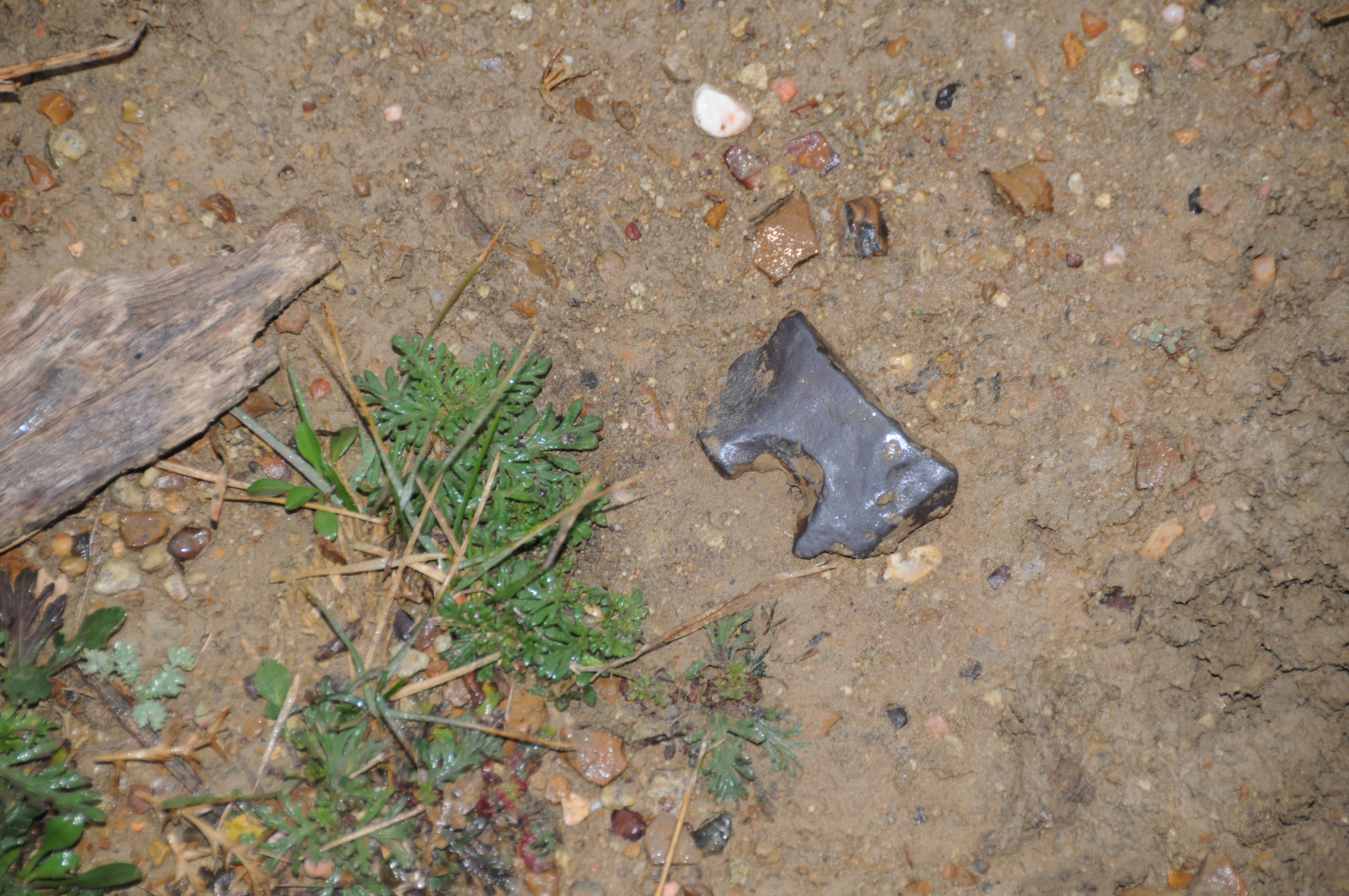
Prehistoric Tool In Situ Poprock Hill Pasture February 3, 2010
Temperature was 37 degrees at 6:30 a.m….Light rain was forecast and has started raining at 8:00 a.m….Rain exposes prehistoric tools, rocks, horseshoes, wood debris and boulders in the pastures….When I first moved here, I looked for quartzite flakes and tools of prehistoric people that harvested acorns, edible plants and deer. Finding no quartzite, I changed my pattern of survey and looked for iron ore and meteorite tools that had been abraded, not extensively flaked. I found things. Poprock Hill pasture has yielded tools in abundance and will be designated an archeological site by the state of Texas. This morning, after the first feed of the horses, I took a photograph of a tool in situ. Light rain washed clay off the tool, exposing craft and art of people that hunted and gathered before the arrival of the European. Not far away from the tool, a red ant hill with little stones about the portal to the underworld rose slightly from verbena plants that will bloom in the spring.
Filed under Flying Hat Ranch
Protected: Beginning: The Bridge Spoke (With Notes)
Enter your password to view comments.
Filed under Bend Texas, Colony Road, Recollections 1942-1966
Beginning: The Bridge Spoke
Bend, Texas, in the early fifties….
Two miles away from Sand Cemetery, the Colorado River was host mainly to catfish, some fifty pounds in weight, yellow and blue. A few ducks from time to time browsed along the banks where the current slowed. I saw catfish, gar, perch, turtle, ducks and heron. Blue heron rose off the river, awkwardly flapping to gain lift. You cross your fingers every time they start up as heron may never make the air. But they do. They gain ten or fifteen feet, level off and then in slow wing beats glide above the river following its contours like a liquid highway. They would turn at the bend of the river, nearly out of sight as I stood on the suspension bridge connecting San Saba and Lampasas counties above the Colorado River, watching the blue heron turn a gray color in the distance.
The suspension bridge sagged three feet as cattle trucks crossed, the weight of the trucks pushing a ripple of bridge planks in front of them, like an ocean wave. I ran to the end of the bridge and slid down the embankment to see trucks pass, the wave rising and falling. The bridge held strong for passengers, livestock and man, until it was torn down and replaced by a wider, concrete bridge that held no awe, little respect, and absolutely no history. The old suspension bridge groaned and creaked when cattle trucks shifted gears to speed over the planks. When trucks first crossed onto the suspension there was thunderclap. The new bridge did not speak; it said nothing when built; it says nothing now.
Filed under Bend Texas, Colony Road, Recollections 1942-1966


















 Sage to Meadow ~ Jack Matthews