
Protected: Beginning: Upkeep Donation
Enter your password to view comments.
Filed under Bend Texas, Colony Road, Recollections 1942-1966
Beginning: Bend Ford
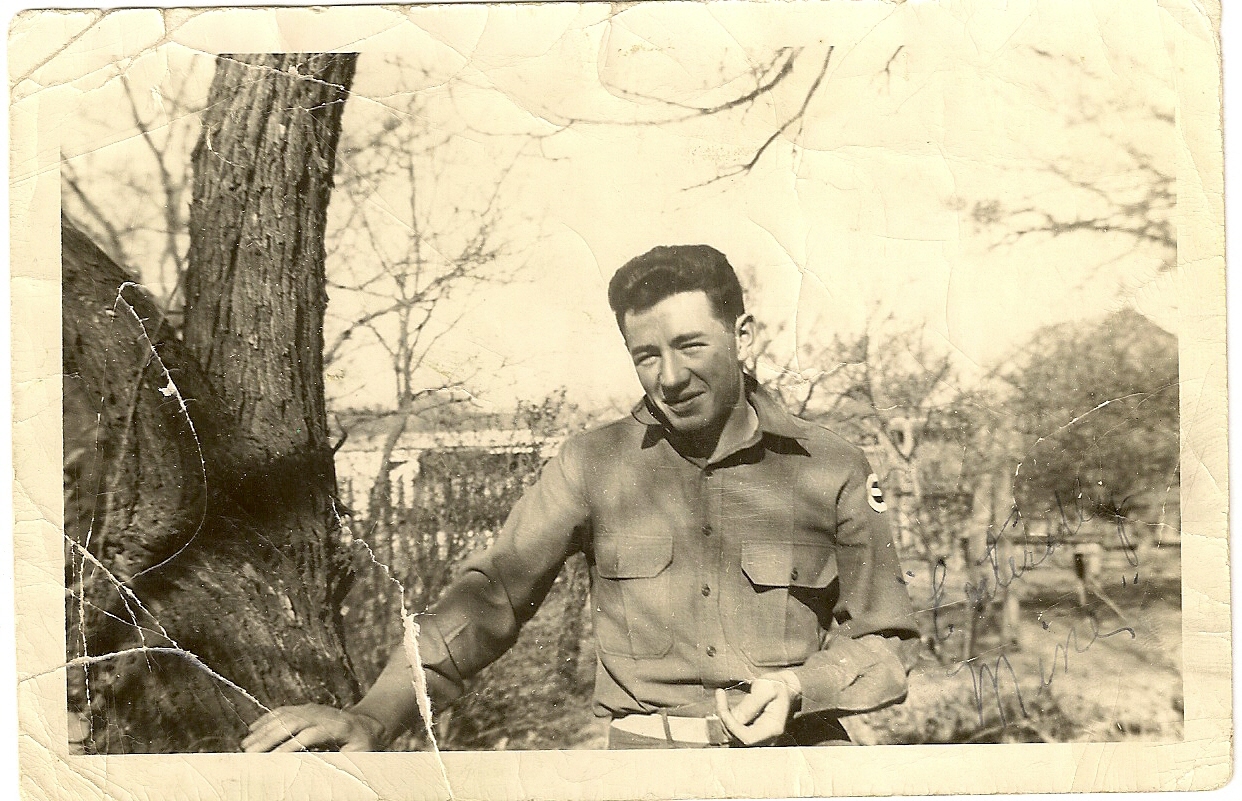
Jack F. Matthews, Sr., Winter 1941-42, Texas
As posted in “Beginning: Red Ants,” there is first a setting out, a beginning of all things. Nations and tribes record their origins and seed their narratives with great events and heroes. Beginnings do not stop with national revolution or constitutions, but are present in the family, the circle of kin. Not stopping there, the setting out goes even farther down into each sentient, solitary being. Corporeal narratives, we each are.
The beginning is that earliest moment of consciousness, not self-consciousness because that comes later under the mesquite tree in Texas when the wind blows (at least for me, it was). It may be a song, a face, an automobile, truly anything under the sky that sticks first in the mind, imprinting a memory. At that moment the setting out begins and does not end till death. It may never be written, never told; but it is embedded in the flesh.
Mother’s setting out, she tells me, was when she and her father, Jake, were crossing the Bend Ford on the Colorado River near her Uncle Nathan’s home on horseback, riding double, when the horse slipped and fell on her. The river bottom, only one or two feet below the surface at the ford, is solid granite like the face of Round Rock near Fredericksburg, Texas, and mother, Jake, and horse entangled, thrashing in water. Her leg broke and they sent for Dr. Doss who set the leg as her father fashioned a small crutch for his two-year old to walk. The river became a constant theme in her life: the flood, the boundary, the swimming. Gywn crossed the river at Bend Ford many times after the fall, but the accident was her setting out, with horse and water above her and a father to save her.
My cousin and I were sitting on the ground outside the one-room trailer house on Austin Avenue in Brownwood, Texas, looking down at a clock. The year was either 1943 or 1944. The bedside clock was a throwaway timepiece, the face removed, the case gone, but the wheels and spring intact. In our play, the clock had been wound tight, the wing nuts stuck in the ground. The alarm went off and the clock spun around and around. My cousin and I gazed as only children can, intently focused on the exposed wheels and clock turning in the dirt. Wheels clicked within wheels turning. I looked away from the spinning clock and saw green bamboo stalks beside the trailer. I looked down, my cousin stared at the spinning clock until it stopped, turned again, then finally stopped. She looked at me. We giggled. My beginning was an old clock stuck in dirt, spinning round.
Two-and-a-half miles away from the spinning clock and trailer house, Camp Bowie trained soldiers for the war. My father, Jack Matthews, had left the camp, left us, and was jumping out of planes for extra money, urging Gywn to keep flying the Irish green. He was parachuting with Easy Company, 506th Parachute Infantry Regiment, destined for Europe and every major combat operation from Normandy to Berchestgarten. The Band of Brothers, Easy Company. Since Gywn and Jack had divorced shortly after the war, I knew few details about him. I found a cache of letters in her things following her death and I did not open them until the summer of 2009. When I found out he was a foot soldier in Easy Company, I ordered books overnight from Amazon.com and read his story, his name in print.
In Gywn’s cache of correspondence, I read the letters and documents dated until 1946. There was a story beyond the narrative my mother had told me and its plot lines were different from what I had been told as a boy. I stopped reading and put the letters back in the Bigso Boxes of Sweden I bought from Container Store to preserve them. I have put them aside for now because there’s a story to be told. An old, old story, along the banks of the Colorado River in Texas, before the spinning clock, before my beginning, but in the flesh of my family.
Filed under Bend Texas, Colony Road, Recollections 1942-1966
Beginning: Red Ants
There is first a setting out, a beginning of all things. Among the Huron in America, a woman fell from from the sky, hurling toward water. Two loons that were flying over the water saw her and placed themselves beneath her to cushion her fall, holding her above the water, and calling for other animals to help hold her up. The cry of the loon can be heard a long distance. Animals came, including the turtle, and helped her, building earth from the bottom of the sea. Here in the Southwest, among the Navaho, human beings emerged from the earth as red ants and red ants are the ancestors of those that walk the earth today on solid ground.
I remember my Uncle Floyd on his ranch in Cherokee, Texas, taking poison to the large red ant hills in the corrals and alleyways of the cattle pens. Some ants died, but most of them survived the attack and continued to bring small stones to their portal. The red ants never stung him, nor me. Uncle Floyd eventually gave up the task and let them be. The Navaho and other tribes collect the stones at the ant pile and place them in gourds to make rattles. Uncle Floyd, Aunt Lennie, and I would attend the Methodist Church in Cherokee, Texas, and hear the minister read Genesis on how God created the earth and gave dominion of its creatures to man in the beginning.
I never assisted in putting the poison on the ant hills. The red ants always looked so harmless and when I held one in my hand, there was no stinging, just a waving of the antenna and a deliberate attempt to find a way off of my boyish hand. Today here on Flying Hat, I let the red ants live and bring their little stones to their entry holes. I wonder how they place themselves down in the ground and what chambers they retire to. Their pathways are so well-traveled on the surface that they may be two inches wide, devoid of vegetation, and a hundred-yards in length. In Pecan Tree pasture, the ants have a lot of food from the side-oats gramma Cody Scott and I planted five-years ago. In the area cleared around the ant hills, I can see the tracks of deer. The word, deer, is traced back to an Indo-European hypothetical word meaning, to breathe.
On our place here in Texas, the ants emerge from the earth and a deer signifying breath stands above them on solid ground brought up by turtles in ancient times to save the woman that fell from the sky in the beginning.
Notes
For method, N. Scott Momaday, The Way to Rainy Mountain. For Huron, Elsa A. Nystrom, Primary Source Reader for World History, volume I: to 1500. For Navaho, divers sources including Washington Matthews, his Smithsonian series on Navaho singing chants. See also Frank Waters, Masked Gods.
Filed under Colony Road, Recollections 1942-1966
Protected: Margaret Mead and Committees of Correspondence Applied to Iran
Enter your password to view comments.
Filed under Uncategorized
Kindred
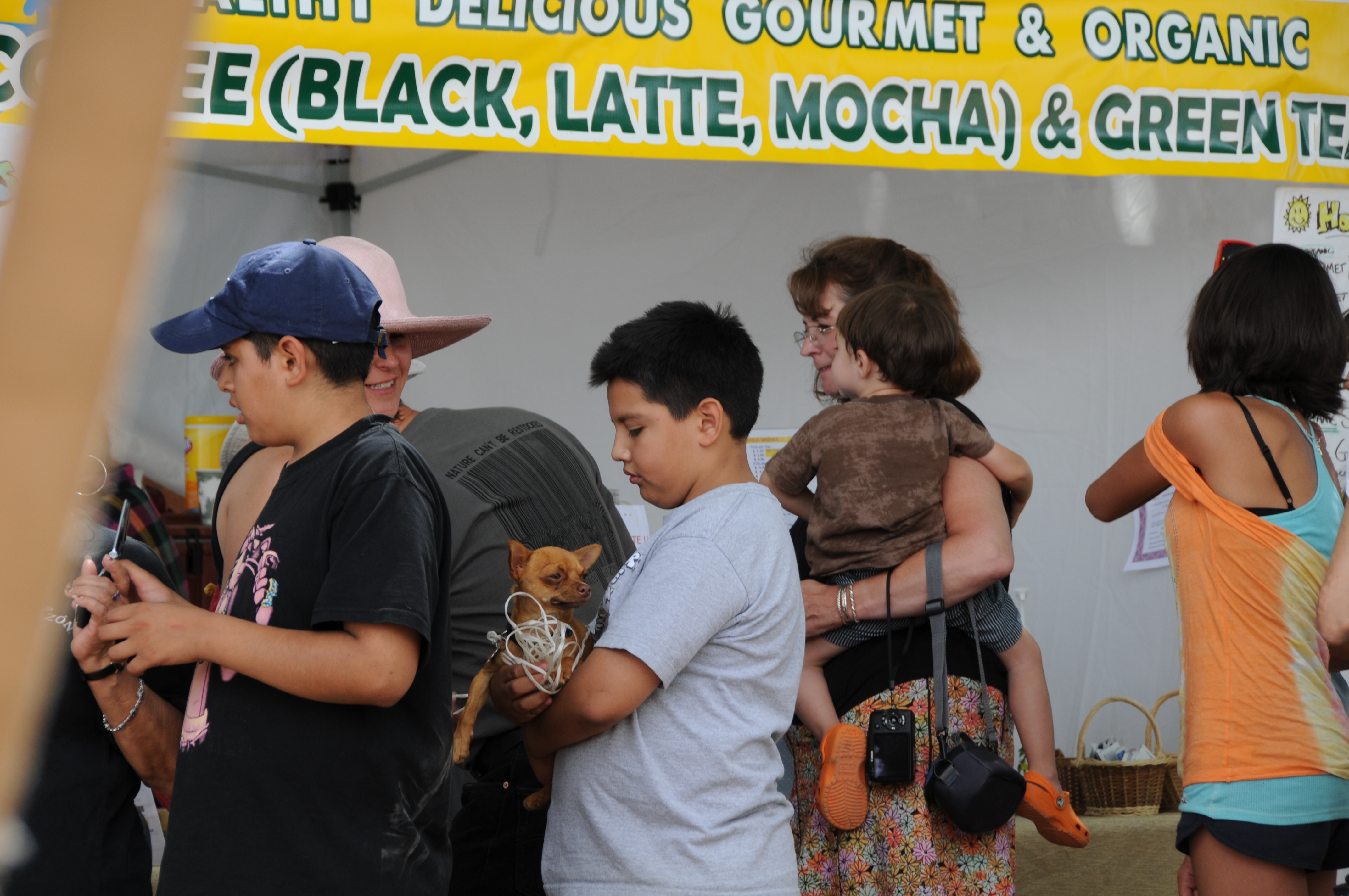
My Kindred at Las Golondrinas July 2009
I write to put down thoughts, images.
I put it down to not lose it, but to save a fragment.
The fragment demands narration, almost imperious.
And, then there is you to hear it yes hear it.
A holy trinity of me, you and the imperious fragment.
My kindred.
Filed under Santa Fe
Greenery in a Texas Winter

Stable Greenery in a Texas Winter
Yesterday, January 17, 2010, the temperature was 70 degrees in central-west Texas. A light breeze came from the south persisting into the early evening. Down in the uncovered stables winter grass emerged about two inches high during the day. Although winter wheat and rye give green to fields in a Texas winter, the winter grass in the stable seemed different, like a surprise gift from a friend. Lilly the alpha mare saw the grass and grazed after eating her senior grain with supplements to ease her arthritis. Forget April for the moment. January is the cruelest month.
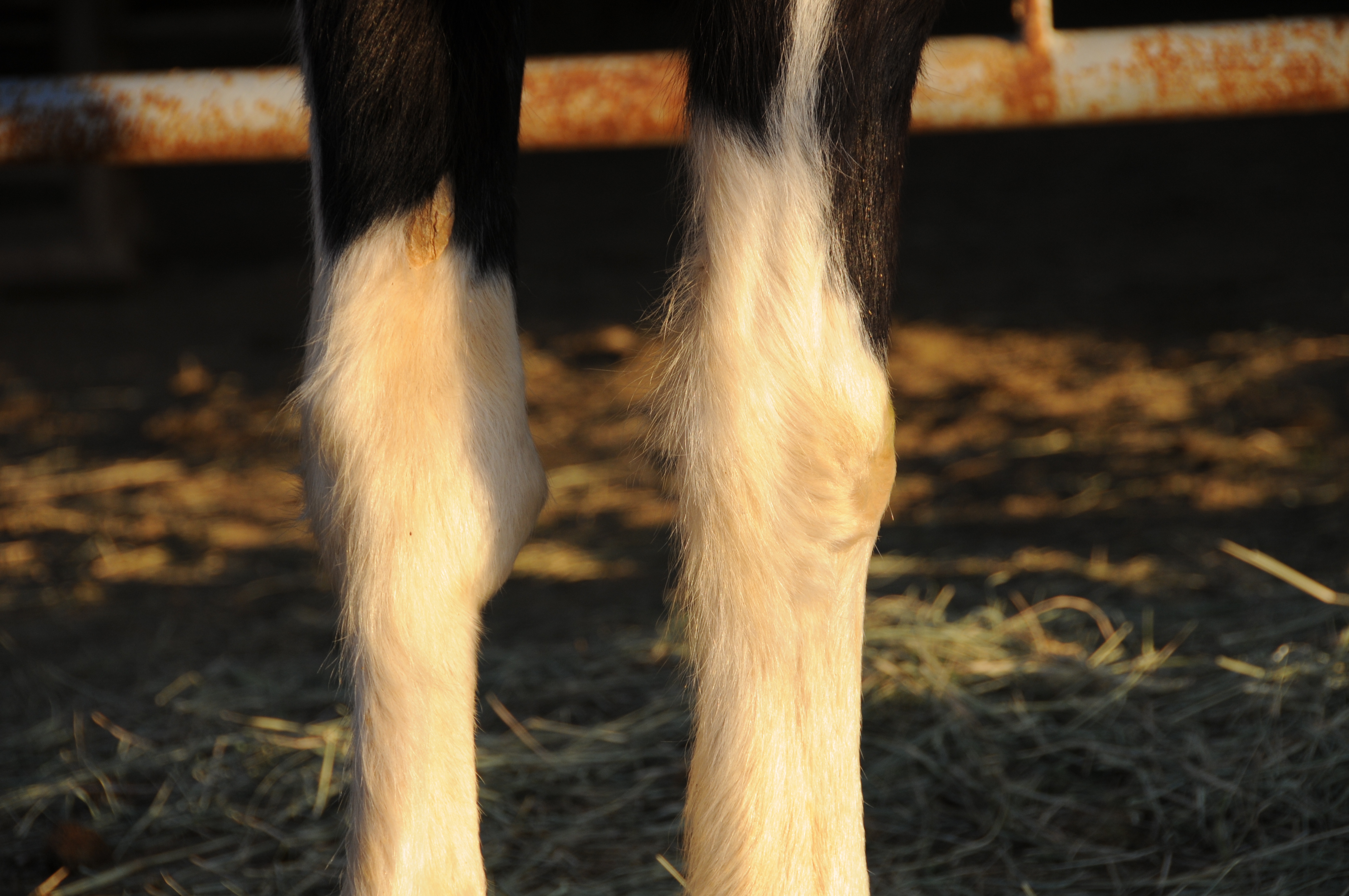
Old Lilly's Knees and Forearms Backside
This is the backside of Lilly’s knees and forearms and you can see her osteoarthritis. She is twenty-five-years old. Her date of birth is January 20, 1985. Her full name is Ima Lil Moore and she is the companion and foal sitter to Shiney. Despite her age, when it snows Lilly prances.

Shiney the Horse in Morning Sunshine
Shiney is a six-months-old colt. He is a male, all-boy and quite different from a filly. Lilly, his sitter and companion, will turn her backside to him and threaten a kick if he acts rambunctious towards her. Oddly enough, pairing the oldest horse in the remuda with the youngest, Lilly and Shiney, has kept her young and made him old.
Filed under Horses
Ice in Trough
My first winters in Texas in the 1940s were in Brownwood, central Texas, but other winters fell upon me in Austin, Amarillo, and Mingus. Snowshoes and skies are not required in Texas, but gloves, long underwear, waterproof boots, field coat, and hood or toboggan cap are accouterments imperative to outdoor work or play. Chaps of wool aren’t optional, they don’t even exist this far south in the West. Wooly chaps would snag on brush and mesquite down here, spilling rider into the cactus and spooking the horse to bolt. If you insist upon wearing a hat, it must be felt and if it cold and windy, stampede strings are required to hold the hat in place although I have seen few strings in my lifetime. Usually, a hoodie is worn and a neckerchief is tied twice around the throat for warmth. The hoodie is hardly ever pulled up about the head. Too urban.
Most often these days the tending of cattle during a Texas winter is performed in a pickup, stopping to throw hay or chop ice from a trough. Mechanized feed bins on the back of flatbed pickups allow cattle cake or cubes to be dispersed without leaving the warmth of the cab.
This winter in the 2010s I must feed two horses in the stable area, then load hay and grain in the pickup and drive to the Well House corral to feed the other three horses. Before daylight in the morning, I shuttle the grain and hay into two feed bins without separating the horses. The horses sort themselves out, the alpha mare Sweet Hija makes the other two horses move aside as she chooses. I get out of the pickup with a flashlight and have the headlights beamed into the arena so that I can climb over the corral fence and chop ice. For the last five mornings I have taken the hatchet to the ice in the trough and chopped through two to five inches of ice. The water splashes up on my coat and glasses and freezes immediately. I become partially caked in ice and as I climb back over the corral fence, my gloves stick to the piping and I have to pull my hands away from the railing. I think of the movie Christmas Story and the boy whose tongue stuck to the flagpole. Nothing that serious here. Only gloves, not tongue.
I finish the chore of feeding horses before 6:00 a.m. on Tuesdays and Thursdays and drive around the Poprock Hill pasture, through the pasture gate and up the hill and out on the county road. Other days of the week I can feed later at daybreak, not in the dead of night. On Tuesdays and Thursdays I have a lecture at 8:00 a.m. in Abilene and I must be at the bottom of Ranger Hill by 6:15 a.m. to keep with my schedule on Interstate 20.
I drive to Abilene, my gloves are drying out on the dashboard, I’ve unwrapped the bandanna from my throat, taken my toboggan cap off and have my coat hung behind me. The Ford F-150 cab is warm. I think my lecture to the first class will be….
Filed under Horses
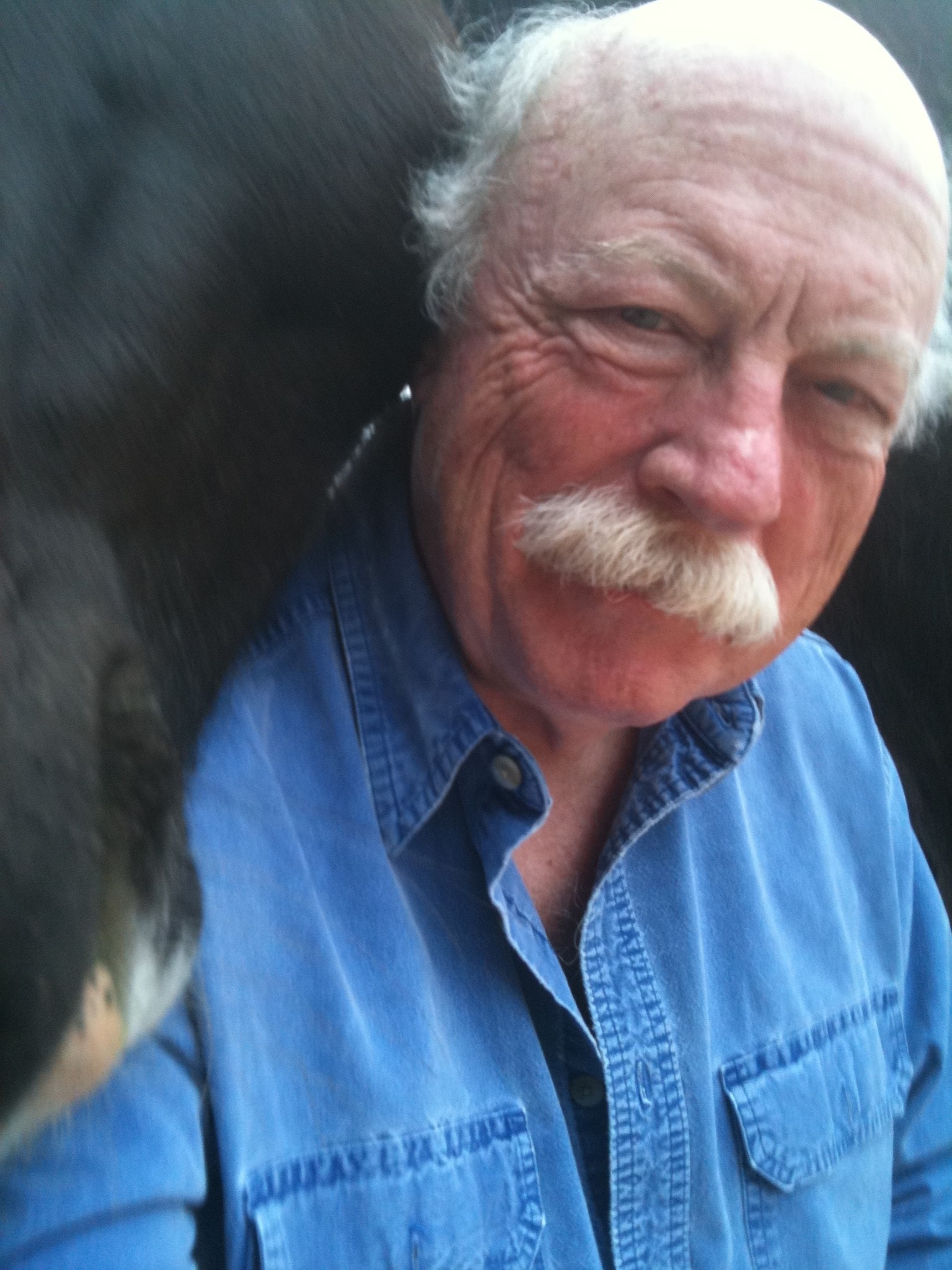


















 Sage to Meadow ~ Jack Matthews