Field Log 3/25/2010

North Erath County, Texas, 32.43 lat., -98.36 long. Elev. 1,086 ft.  Turkey Creek Quad.

Rain yesterday, 0.90 inches.  Cannot work field, too wet to plow (literally, folks).

Bow hunter died this morning.  My colleague at college, David Kanady, passed away.  Forty-ish.

He taught British literature at a juco place — oh, the bowels of  pedagogy.  David would walk the hall to  invigorate himself to teach.  He saw teaching as an opportunity, not a preparation.  But, a bow hunter died this morning.  That’s what I want to write about, that’s his legacy.  A bow hunter: giving the animal a chance.   He missed his shot.  He ate what he killed.  Traveled to Wyoming, followed the herd, and took his shot.  I know it was part vain, but  he shot with honor, giving life a chance.  He was appointed on a contract to teach at a juco place, $24,000.00 a year.  Hey, but you get benefits!   He gave the antelope a chance, then he dressed it, and brought the meat to the table of his parents, an only child he was.  He missed shots.  Bow and arrow.   David hunted parttime, respected nature always.  RIP, David.

Lilly settle in to her stall.  Hija adjusts to corral again.  Oh, she is a peppy girl — see her pedigree.

Called Duncan Steele-Park.  Will pick up Fanny tomorrow.
The Origin of Urantia by Dipti Bhakti

11 Comments

Filed under Duncan Steele-Park, Field Log, Shiners Fannin Peppy (Fanny)

Logo of Grrl Scientist

I have discovered in the last few days, two striking logos, artful and intriguing.  I posted The Conelo Project logo yesterday.  Here is another artful logo from Grrl Scientist, Living the Scientific Life, and her other blog, Maniraptora: Tastes Like Chicken Blog.

GrrlScientist Image on About Page (artist unknown)

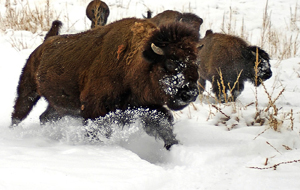
Grrl Scientist’s logo picture of herself is a parrot, inserted on her blog site.  I am always intrigued as to self-portrait selections, logo appointments and gravatars.  My gravatar is Evangeline Chavez’s photograph of buffalo stampeding through the snow at Sandia Pueblo.  If I parse out the personal-emotive rationale for using award-winning Chavez’s photograph (with permission), it is this:

Motion, winter, symbol of the West (bison), vigor, nature, white and brown, buffalo hair, undomesticated, untamed, consequence of over cropping, revitalization, reestablishment of wilderness virtues, ghost and present animation, return of the repressed.

Buffalo and Snow, Sandia, Evangeline Chavez

2 Comments

Filed under Life in Balance

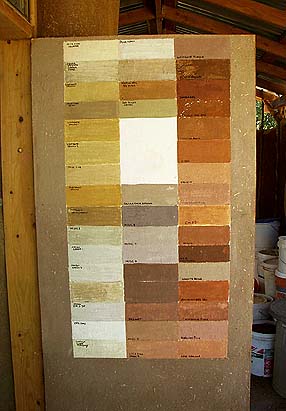
Canelo, Arizona, Natural Color Palette

Color Palette of Bill and Athena Steen, Canelo, Arizona (courtesy Caralee Woods)

This is a color palette on the door of a storage shed of clay samples owned by Bill and Athena Steen, Canelo, Arizona.   The Steens are teachers of building straw bale homes.  In addition, they work with clay and lime native to the Southwest in their building projects.  Their goal is to connect culture, people and nature.

“The Canelo Project is a small non-profit organization founded in 1989. We are dedicated to the exploration and development of living systems, including growing food and building that creates friendship, beauty and simplicity.

We are known primarily for our work in Strawbale and other Natural Building techniques.” — Bill and Athena Steen, Canelo Project.

Conelo Project Logo

This is the beautiful logo of the Canelo Project, illustrative, I think, of their mission and purpose.

For more information, please click on the website, The Conelo Project, and Bill Steen’s blog,  The Canelo Chronicles.

Thanks to Caralee Woods for this information.

Leave a comment

Filed under Natural Colors

The Natural Colors of Caralee Woods

Caralee Woods and Jimmy Henley live near Kanab, Utah.  They are building a straw bale compound on their place and have committed themselves to a minimum footprint on the land.  With solar panel, water well and environmentally-green construction, Caralee and Jimmy portray the best application of technology, science and ethics to minimize humanity’s impact on the planet.  They are truly off the grid — literally.  You can see their efforts over the past few years by clicking on their website Building a Straw Bale House. When I posted the piece from Bioephemera Blog this morning concerning the ca. 1686, natural colors, Caralee commented with the email below and provided a photograph of how she and Jimmy artfully and craftily shaped balls of colors from the Utah countryside as a result of finding natural clays for their plastering.  I think what she and Jimmy have created is not only an application for their home, but pieces of art that I wish to possess and place as a centerpiece upon my table.

“This is so interesting to me. One of the first things we did here is start looking for natural clay. We had plenty of the terra-cotta colored stuff here on the land for the earthen plaster, but what about the clay paint and finishing plaster for the interior? We drove around for a long time with a bucket and small shovel in the trunk so we could stop and take samples of the wonderful variety of Mother Earth’s colors when we saw something we liked. I would go home, sieve the clay, mix it with some water, and make clay balls that I then polished (I won’t bother you with this process here) to see what we had. The picture below is just a small sampling of the results; I’ve added many since.  There are no more beautiful, soothing colors anywhere in the world than what is produced naturally.”  –Caralee Woods to Jack Matthews, March 24, 2010.

Art of Caralee Woods, Natural Clay Balls, Utah

6 Comments

Filed under Life in Balance, Natural Colors

Brush Fire High Salt Cove Creek

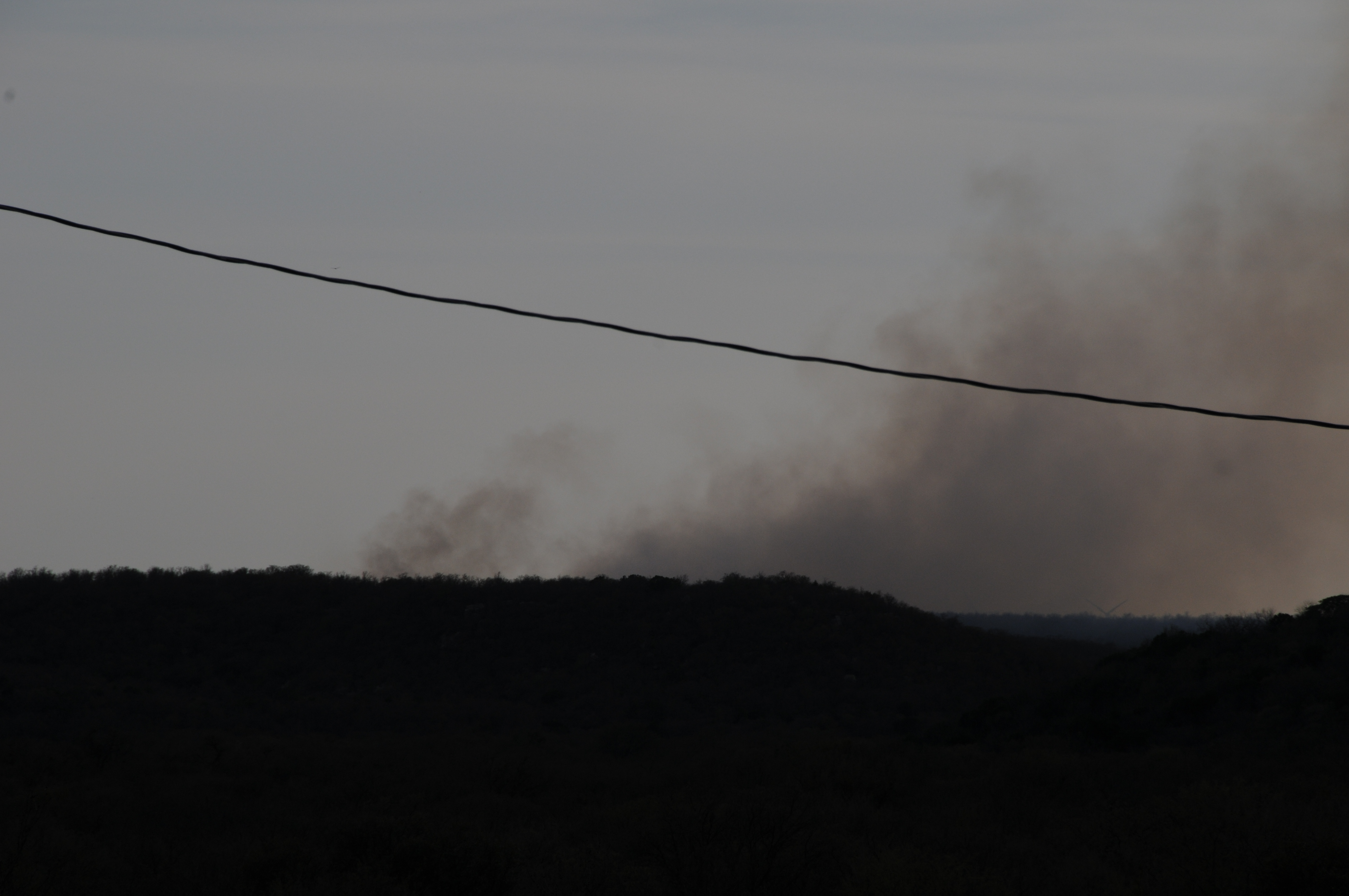
Two days ago, March 22, 2010, a brush fire raged out of control about four miles southwest of our place.  My estimation of the location from our place on Poprock Hill was near High Salt Cove Creek, 32.43 deg. N., 98.39 deg. W., Stephenville Quad map.

High Salt Cove Creek Fire, March 22, 2010 (click to enlarge)

Volunteer fire departments from Huckabay, Gordon and other small communities converged on the fire and extinguished the blaze late yesterday evening.  Despite recent snow and rain, last spring and summer’s growth of grass was dead and ignited.

The smoke colored the air a kind of amber about our home — not at all pleasant.

Cross Plains, Texas, Fire ca. 2007

Several years ago a huge fire broke out near Cross Plains, Texas, approximately seventy (70) miles southwest of Flying Hat.  Brenda and I were attending a funeral near Cisco, Texas, and the wind and smoke completely covered the western sky.  Several people were killed and the destruction obliterated sections of the community.  A firefighter at Cross Plains reported that the wind changed directions while the town burned and swept into neighborhoods that had been bypassed with the first sweep of fire.

It was also the same year that the huge prairie fire in the Texas Panhandle destroyed livestock and several hundred square miles of grassland.  Therefore, like any other community in the country, we are quite conscious of fire safety.

There are some good tips for making your country surroundings safe from the Texas Forest Service website below.

Texas Forest Service.

6 Comments

Filed under Flying Hat Ranch

A Naturalist’s Color Palette, ca. 1686


From Richard Waller, "A Catalogue of Simple and Mixt Colours with a Specimen of Each Colour Prefixt Its Properties" Philosophical Transactions of the Royal Society of London, vol. 6, 1686/1687 (London, 1688)

Click to enlarge the color palette

“Noting the lack of a standard for colors in natural philosophy, and inspired by a similar table published in Stockholm, Richard Waller indicated that his “Table of Physiological Colors Both Mixt and Simple” would permit unambiguous descriptions of the colors of natural bodies. To describe a plant, for example, one could compare it to the chart and use the names found there to identify the colors of the bark, wood, leaves, etc. Similar applications of the information collected in the chart might also extend to the arts and trades, he suggested.”  –Jessica Palmer, Bioephemera Blog.

Click the link below to bring up Jessica Palmer, Bioephemera Blog.

A naturalist’s color palette, circa 1686 : bioephemera.

Read more about Waller’s color system in The Creation of Color in Eighteenth-Century Europe by Sarah Lowengard.

6 Comments

Filed under Plants and Shrubs

Texas Buffalo Shooting

I affirm.  Life is out of balance: this news article and oral interview (on the primary NPR site link) brings out the worst on both sides of the fence here in Texas.  Ranch managers and owners, near Benjamin, Texas, clash over the buffalo of QB Ranch (diversified operation, but also a hunting ranch) straying consistently upon the Niblo Ranch, a traditional operation.  After pushing through the fence, fifty-one buffalo of QB ranch were shot on the Niblo Ranch.

Buffalo, by law in Texas, are classified as indigenous animals and have not the same protections as cattle or sheep.  The Niblo ranch foreman who shot the buffalo has been charged with criminal mischief.

Texas Buffalo Shooting Triggers Culture Clash : NPR.

“Two hundred years ago, great herds of plains bison — massive majestic animals — roamed the endless prairie of West Texas. What happened to those herds stains the national conscience. The bleaching white bones of the 51 animals rotting in the Texas sun near the QB Ranch are a throwback, a reminder of the carnage a man with a rifle can do.”  — Wade Goodwyn of NPR.

I affirm.  The placement of buffalo on a ranch for trophy-hunting purposes may be legal, but it is base and immoral.  It is base because it reflects a lack of refinement of virtue, the virtue of preserving life for its own sake, be it buffalo or the sage grouse.  It is immoral, for the act of killing buffalo is killing another life without just cause.  It never was just to kill buffalo except for the family and tribe to survive in the time before the railroads came.  At that moment in time, the buffalo kill sustained life and the animal itself was worshiped for what it gave to keep tribes and families intact — so different from now.  Much has been written about the near-extermination of the buffalo in the nineteenth-century and it is not my purpose to go over the historiography of America’s western expansion.  I am an historian and I know the canon.  And, the process of settling the New World was based on erasing the wild, stomping out the natural, and assimilating all things New World to the Old.

The big ranches at Benjamin are costly monuments to the Old World’s erasure of the New.  The Dallas oilman that stocks his ranch with buffalo for bloodsport reflects European kings that killed stags throughout the day and the next day and the next.  NPR states there is a culture clash.  That is correct, but they stopped short of indicting the largest cultural clash of modern times:  the artifices of man versus the naturalism of the world, death versus life, the city against the garden.  The rotting buffalo near the QB ranch do not stink, it is industrialized culture that settles over their spirits that stinks to hell.

[Please also refer to The Fat-Takers by Lame Deer.]

11 Comments

Filed under Life Out of Balance

Lewis and Clark Plant Identification

Lewis and Clark’s Montana Plants When Lewis and Clark were in Montana they collected an unknown number of vascular plant specimens.  Of all the specimens collected, 31 still exist and are housed in the Lewis and Clark Herbarium in Philadelphia. This page includes articles about these 31 special Montana plants generally, species specifically, and a list of sources for further study.  Click the link below for photographs and citations.

Lewis and Clark

2 Comments

Filed under Plants and Shrubs

Field Log 3/21/2010

North Erath County, Texas, 32.43 lat., -98.36 long. Elev. 1,086 ft.  Turkey Creek Quad.

Prepared one acre of pasture for seeding native grasses, 3/19/2010.

Received shipment of native grass and wildflower seed, 3/17/2010

Scattered deer corn in The Grove.  Note:  find article on supplements to corn, move low steel feeding trays to The Grove.

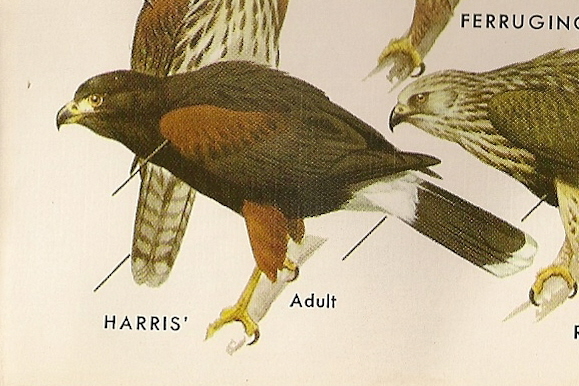
Definite typing of hawk.

Harris' Hawk (Parabuleo unicinctus) Peterson's Field Guide

Harris' Hawk (Parabuleo unicinctus) Peterson's Field Guide

Field surprise (always).  As I sat listening to the wind in The Grove, the hawk flew within fifty (50) yards of me, displaying flashy white rump and white band on the tail. White banding very conspicuous. Black and chestnut colors on thighs and shoulders. He flew extremely fast back and forth three times in front of me, then angled over to the pond. Fast. Peterson writes that the Harris’ Hawk resides in c.-w. Texas south into Mexico. Habitat is river woodlands, mesquite, brush. Nesting of sticks in yucca, mesquite, low tree. I have been looking higher for a nest. Must look lower. One hawk.

Take photo of Harris’ Hawk in field.

Cleaned out stalls, hay bins.

Addendum, 3/22/2010, here is my 1969, Peterson, A Field Guide to Western Birds, and the plate with identification factors.  It’s well-used and a treasure of mine.

Plate 15, Peterson, A Field Guide to Western Birds, 2nd ed., 1969 (click to enlarge)

2 Comments

Filed under Field Log

Escape the Notion that Land is only Cropping Opportunity: Like Udall R.I.P.

Roger G. Kennedy, who was director of the National Park Service in the 1990s, said Mr. Udall “escaped the notion that all public land was essentially a cropping opportunity — the idea that if you cannot raise timber on it or take a deer off it, it wasn’t valuable.” On the other hand, Mr. Kennedy said, Mr. Udall understood that public lands like parks enhanced the economic value of privately held land nearby.

Stewart L. Udall, 90, Conservationist in Kennedy and Johnson Cabinets, Dies – Obituary (Obit) – NYTimes.com.

2 Comments

Filed under Life in Balance, Life Out of Balance