More Sunday in The Grove with Bridal Path

Salt Creek Above the Road

Sunday Saunter

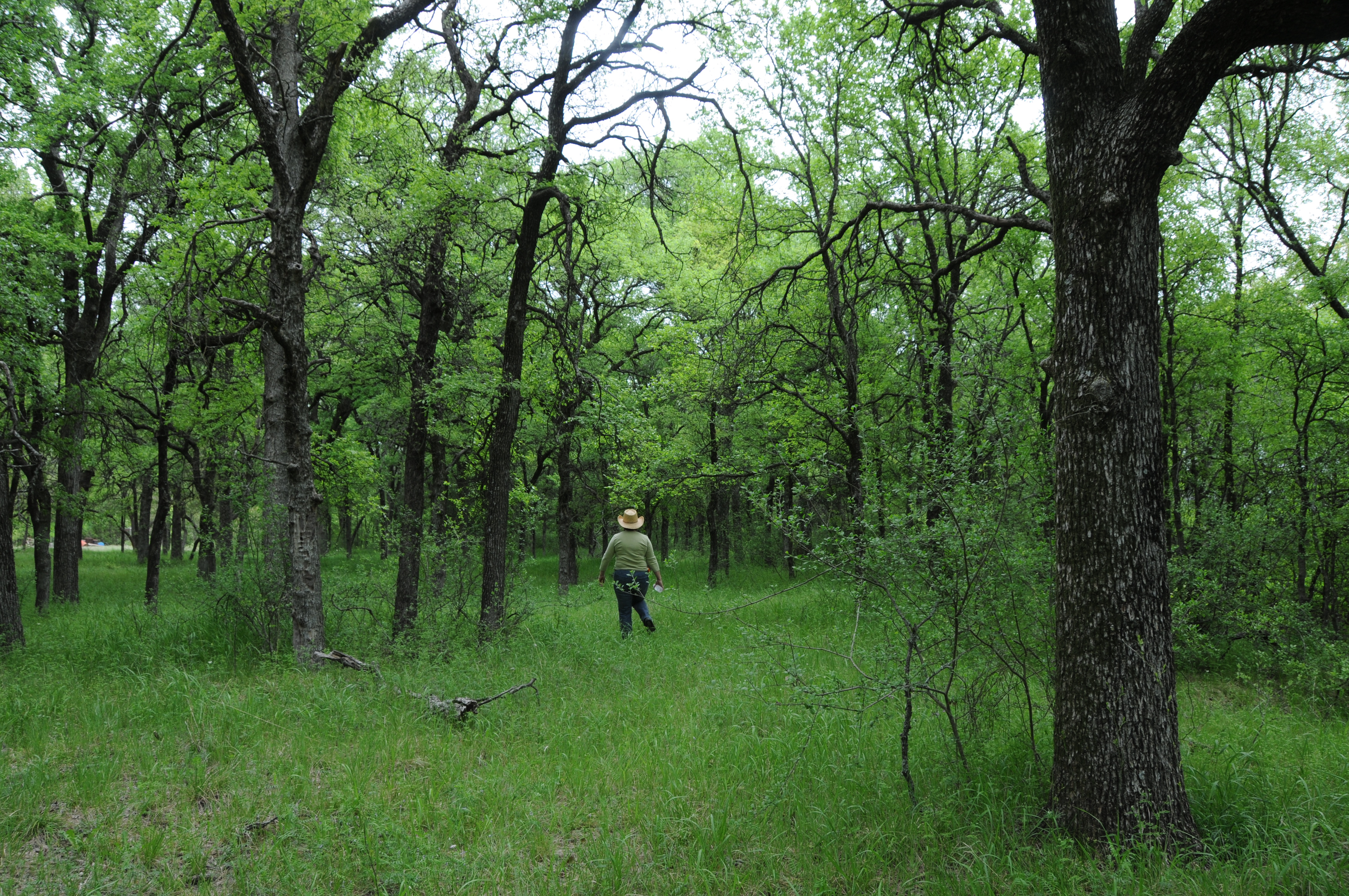
I have shredded the high grass in The Grove over the past few years.  This year I intend to limit the shredding to a bridle path for us to ride horses and hike.

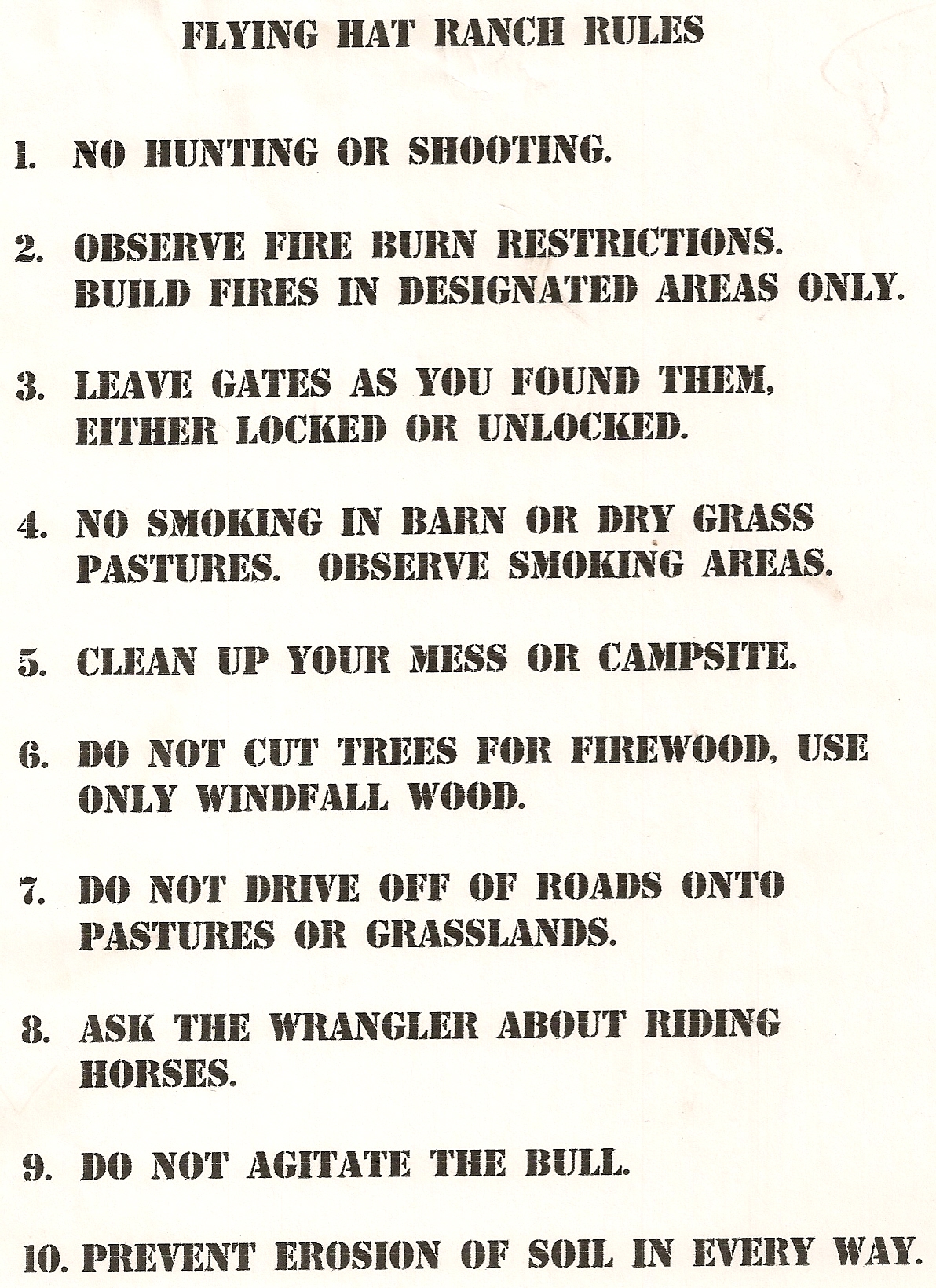
Drafted in 2003, the following is a list of rules for the ranch.  In most cases, rules are not necessary for visitors, including family.  From time to time, however, we have social gatherings of city slickers and tenderfoots that get agitated and liberated by the wide-open spaces in the West.  Not wanting to spoil fun or merriment, but also wanting to preserve the habitat and wildlife on our place, these rules are posted on the refrigerator door of the main kitchen where guests will surely notice since soda pop and beer are stored therein.  (Click to enlarge.)

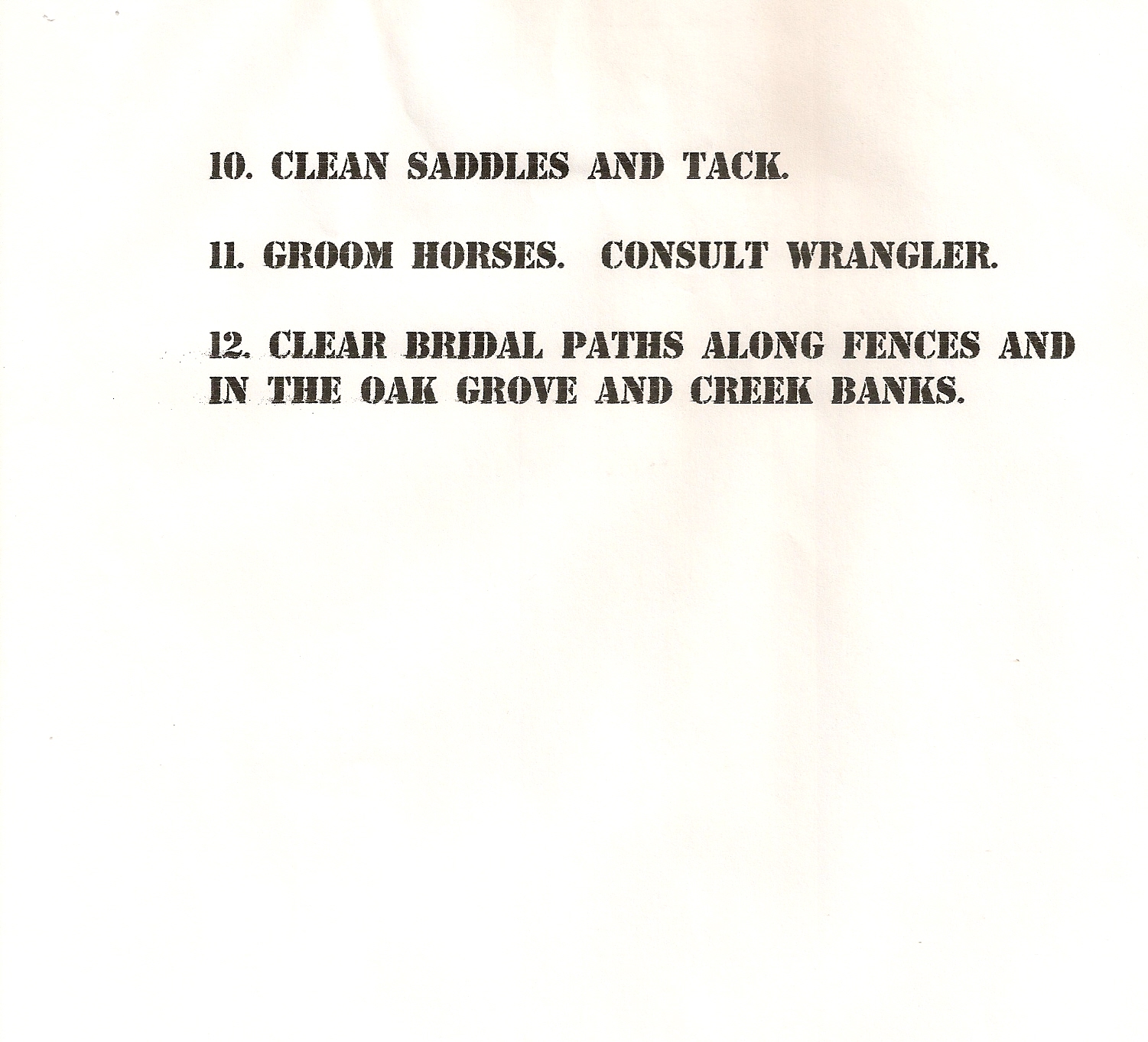
The following list consists of daily or regular general chores to keep the place in shape.   I apologize for the misspelling in Ranch Work Standing Order No. 12, although one could conceive of a wedding down in The Grove.  Rules and chores are printed on heavy-weight paper (25 percent cotton bond), left over from the old days when heavy paper was needed for manuscript submission, so I cannot go into the printing and correct the misspelling.  Folks, it’s an imperfect world.  (Click to enlarge.)

8 Comments

Filed under Flying Hat Ranch

Sunday in The Grove

Lower Salt Creek

Oak Red Above Creek

No. 1 Flower The Grove

Brenda in The Grove

Today, Brenda and I drove to The Grove to have a small picnic lunch.  She had suggested a picnic earlier in the morning.  After a few chores, I came back by the house and Brenda met me at the back door with a picnic cloth sack.  She got in the passenger seat after I moved the field bag and camera out of the way.  We slowly drove to The Grove, about 0.4 miles on the pasture road, admiring the wildflowers along the way.  (Tomorrow, I use a disc to bring topsoil over the seeds I spread yesterday.)

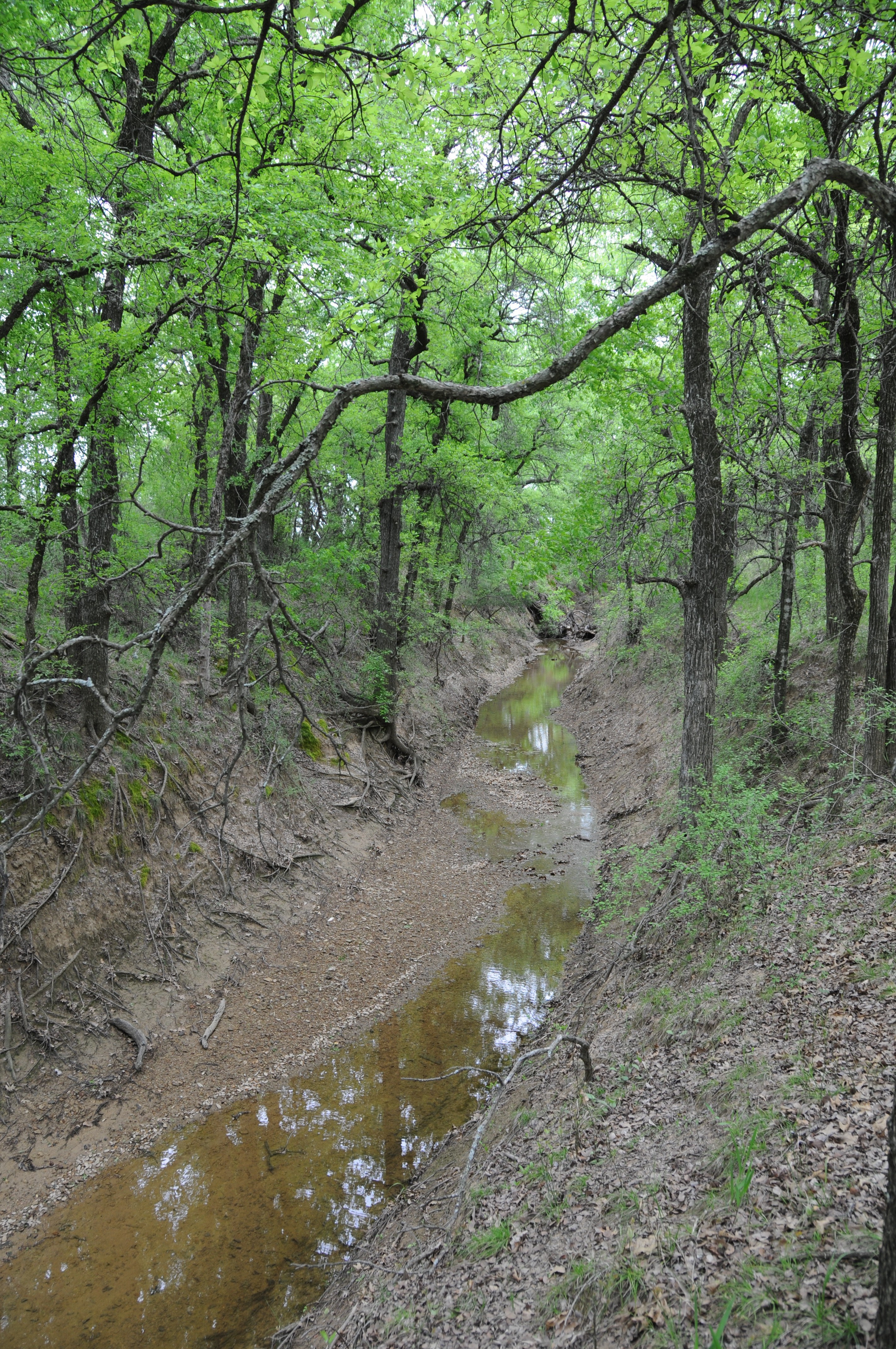
We had a light lunch of ham sandwiches, potato chips and Dr. Pepper.  We finished the lunch off with small chocolate eggs wrapped in colored foil.  As we sat on the tailgate of the pickup, we chatted about the flowers under our feet, the pre-blossom forms that presage the flower.  We looked south into the Salt Creek ravine, not able to see the water in the creek, but feeling the effect of the cool water and the canopy of trees above us.

We then walked to the creek and I showed her the red oak tree (verify) that was different from other oaks along the bank.  We walked along the creek bank — it’s rather deep, the creek ravine, about fifteen feet to the bed.  We noticed a few old deer trails and holes under trees that animals had dug.  I took photographs of wild flower specimens she discovered.   She suggested that I hollow out a large oak tree that had fallen in order to put in some plants back at the house.  We chatted about taking the surplus brick we had stored at the construction area and use it to floor the ground for the outdoor grill.  I teased her that I was going to have to get out my notepad to take down all the projects she intends for me to accomplish.

We walked all the way to the east water gap and turned around, slowly walking back to the truck.  Brenda said that this summer, Olivia, our grandchild, could put on long pants and hike with us along the creek and about the grove.  We arrived back at the truck and drank some cold water, refreshing ourselves.

Brenda wanted to ride on the tailgate on the return trip.  I promised I would go slow.  I circled by the corrals and Shiney the colt was very interested in the person riding on the tailgate — a new visual for the little guy.  After pausing to chat with the horses — fine horses, courageous horses — I drove back to the house, Brenda and I talking even though she was still riding the tailgate and I was driving.   The wind was blowing, but not hard.  Clouds and moisture from the Gulf of Mexico passed overhead.  No rain fell although a forty percent chance had been forecast.

Sunday in The Grove.

19 Comments

Filed under Life in Balance

Field Log 4/3/2010

North Erath County, Texas, 32.43 lat., -98.36 long. Elev. 1,086 ft.  Turkey Creek Quad.

Day looks less windy and can broadcast grass seeds.  Disc and broadcast today (Saturday).  Take Sunday off.

Finished turning and applying disc implement to Pecan Tree Pasture and the house fields.  Turned about four acres in the far pasture, two acres at the house fields.  Harris’ Hawk flies overhead as I prep soil.  The Bryant field west of the pecan orchard is being plowed so lessee can plant seed for hay.  The lessee drives a John Deere enclosed cab.  I like my Case that is not enclosed, but has a Farmall sun shield, because I can feel the wind and smell the turned soil.  And, I really don’t want a CD player and radio on the tractor.  Also, when idling the engine, I can hear the Harris’ Hawk — can’t do that with enclosed cab.  Note: with the Bryant field stripped of grass and brush, there is less cover for wildlife.

As I apply the disc to the pasture, I can see the shadows of the Turkey Vulture (Cathartes aura) and Harris’ Hawk on the ground as they glide above the tractor.  Several vultures roost in the dead tree on the Bryant place, along Barton Creek.

Wind over past two weeks has dried out topsoil despite rain.

I say to Brenda at lunch that I saw a wren-type, ground-feeding bird in the native grasses that I have let grow in the Pecan Tree Pasture.  The bird spied the tractor coming and darted around and entered the tall bluestem grass (verify) as I passed by along the fence row.  I have shredded the pasture twice since I moved here, but I’ll not be shredding any more.  The fifty-three (53) acres will be as sustainable as I can make it.  Seeing the wren in the field of native grass that Cody Scott had planted in 2004, signals to me that the field is a good habitat for wildlife.  Last year as I worked in the field, I scared up two deer that had taken a rest in the high grass.  Since the Halls cleared their brush and have put Adirondack chairs in their grove, small bridges over their gullies and a workshop next to the Pecan Tree Pasture, I’ll not be seeing as many deer as I once did.  I’ll not be putting any chairs about the place.  I’ll sit on a log or lean up against a tree — nature’s furniture.

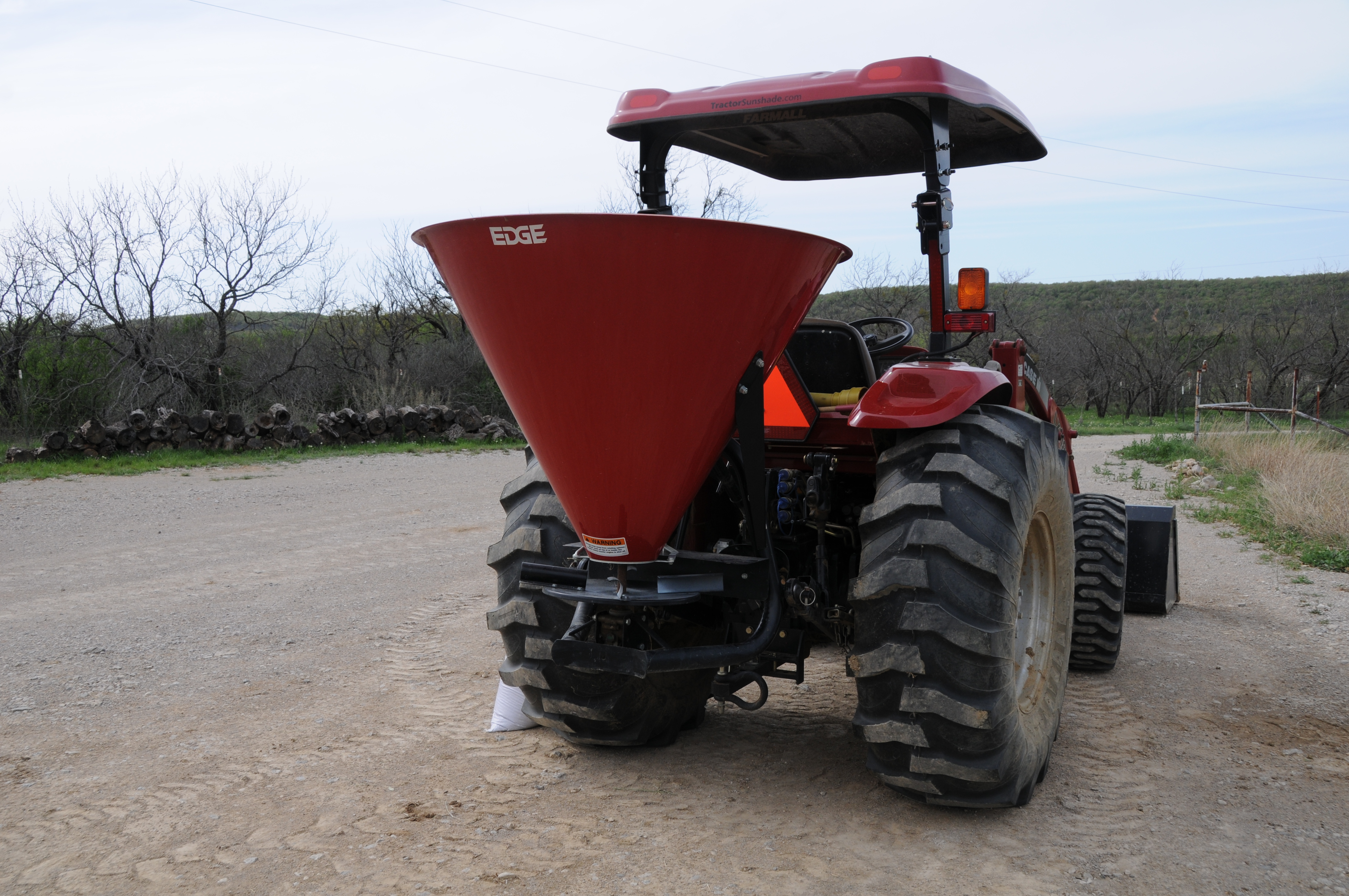
Brought up the tractor with the Edge broadcast seeder and spreader.  Backed tractor and spreader up to rocks on driveway so that water runoff would go onto lawn not puddle in driveway.  Attaching PTO difficult.  Used WD-40.

Case DX-55 with Edge Broadcast Seeder and Spreader, April 3, 2010 (click to enlarge)

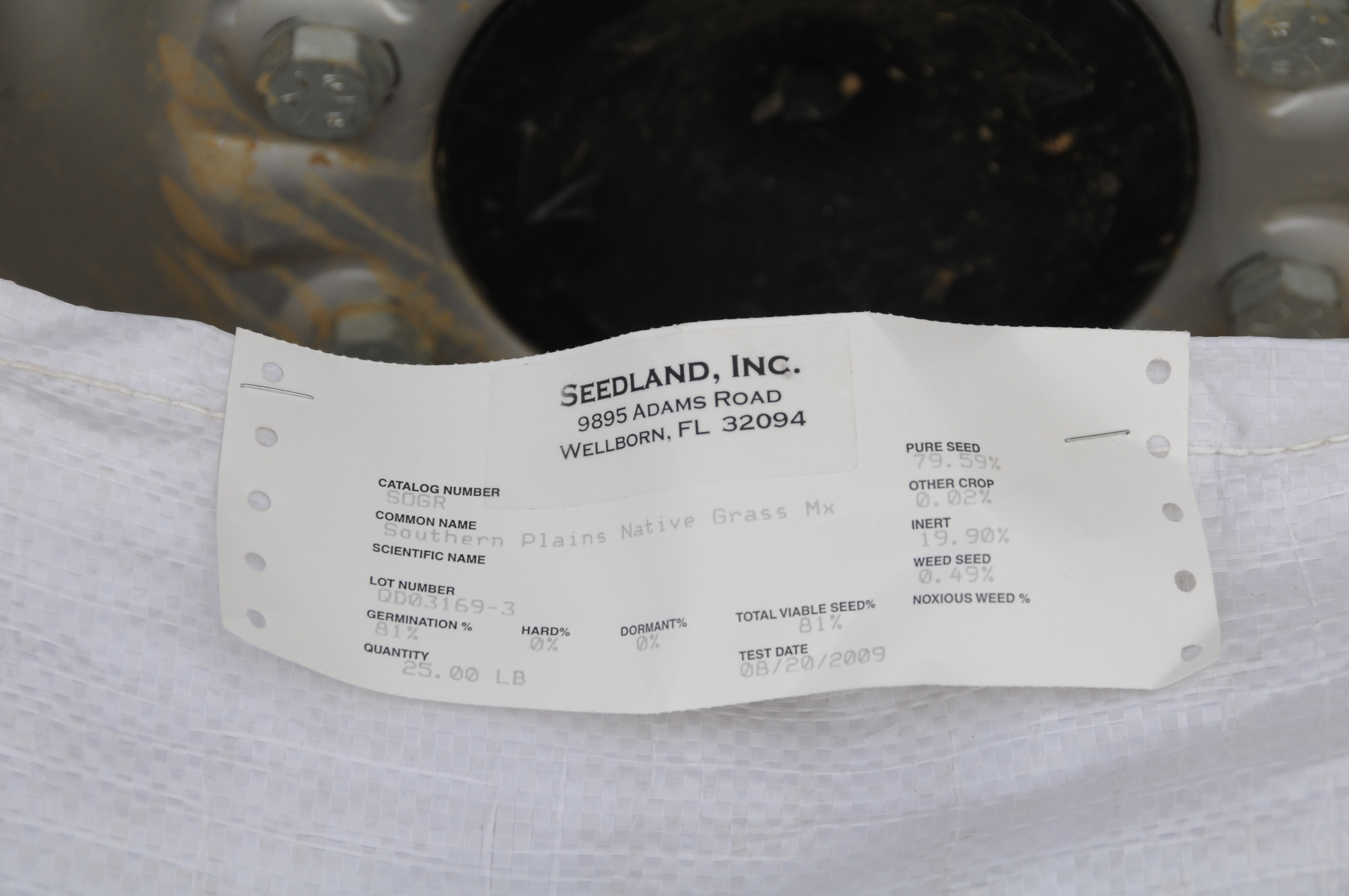
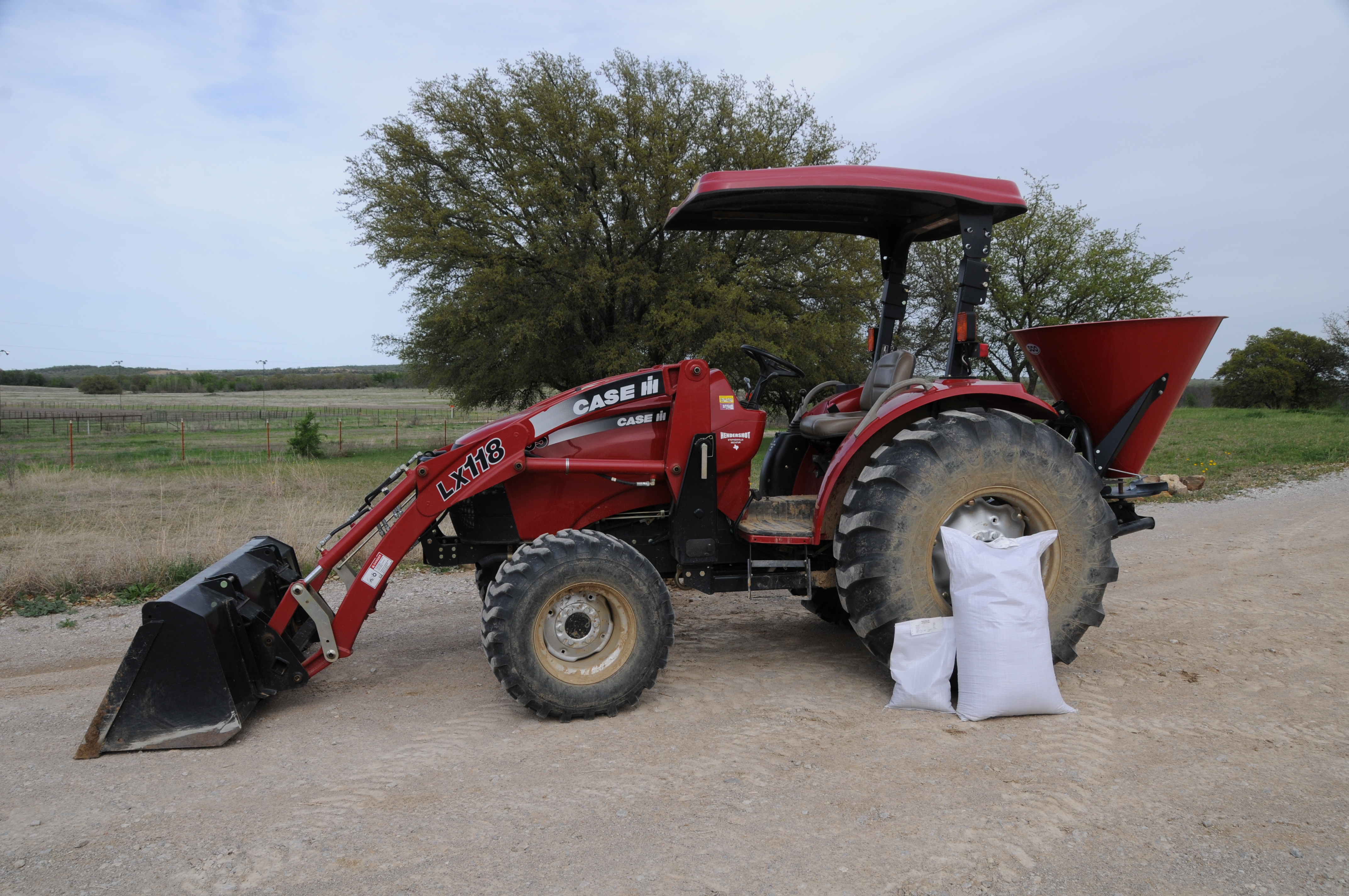
Made calculations as to orifice size to allow seeds to fall through and be broadcast.  Start out with a No. 2 opening.  In the thumbnail below you can see a large white bag and a smaller bag.  The larger bag is the native grass (25 lbs.) and the smaller is the wildflower seed (2 lbs.).

Southern Plains Native Grass Mixture #2901, April 3, 2010

Native Grass Seed Bag and Small Wildflower Bag, April 3, 2010

Texas and Oklahoma Native Wildflower Mixture, April 3, 2010

Wildflower Varieties Planted

Premium TEX / OKA Regional Wildflower Mixture

Common Name *Type Scientific Name Flower Color
Baby’s Breath, Annual A Gypsophila elegans White
Black-Eyed Susan A/B/P Rudbeckia hirta Yellow
Bluebonnet, Texas A Lupinus texensis Blue
Coreopsis, Lance-Leaved P Coreopsis lanceolata Yellow
Cosmos, Sulphur A Cosmos sulphureus Yellow/Orange
Candytuft, Annual A Iberis umbellata White/Pink/Violet
Coneflower, Purple P Echinacea purpurea Purple
Cornflower, Dwarf A Centaurea cyanus Mix
Coneflower, Prairie B/P Ratibida columnifera Yellow/Red
Coneflower, Clasping A Rudbeckia amplexicaulis Yellow
Golden Wave Tickseed A Coreopsis basalis Yellow
Evening Primrose, Dwarf P Oenothera missouriensis Yellow
Evening Primrose, Showy P Oenothera speciosa Pink
Gaillardia, Annual A Gaillardia pulchella Yellow-Red
Mint, Lemon A Monarda citriodora Lavender/White
Phlox, Annual A Phlox drummondii Red
Poppy, Corn A Papaver rhoeas White/Pink/Red
Prairie Clover, Purple P Petalostemon purpureum Purple
Sage, Scarlet A/P Salvia coccinea Red
Wildflowermix.com

Native Grasses Planted

The native grasses planted are: Blue Grama, Sideoats Grama, Buffalo Grass, Plains Bristlegrass, Little Bluestem, Prairie Junegrass and Sand Dropseed.

The wind came up to 10-15 m.p.h.  in the afternoon.  Delayed spreading until after supper at 6:15 p.m.

Following supper, spread seed in Pecan Tree Pasture and house pastures until 9:15 p.m.  Used headlights on tractor to finish spreading.  Orifice enlarged to Nos. 5 and 8.  Spread some seeds on arena-south pasture.  Must disc twice this area on Monday.

Salt Creek runs through the grove with about two-three inches of flow.  Tadpoles emerge.  I hear the trickle of flow as the water falls down on the rocks alongside the road to the far pasture.  Cannot use the road because of the water flow and must go around the Halls place on SH 108.  I put the Case tractor into high gear, fourth position and watch for traffic on the highway.  I have lights flashing.  In four trips to the far pasture today, only one vehicle passed me: a motorcycle with two people, man and woman, traveling to Stephenville, most likely to have barbecue at Hard Eight.

The quote I always have in mind:  Begin with the sun and all else shall follow.  — D.H. Lawrence.

4 Comments

Filed under Field Log, Plants and Shrubs

The Horses of Flying Hat

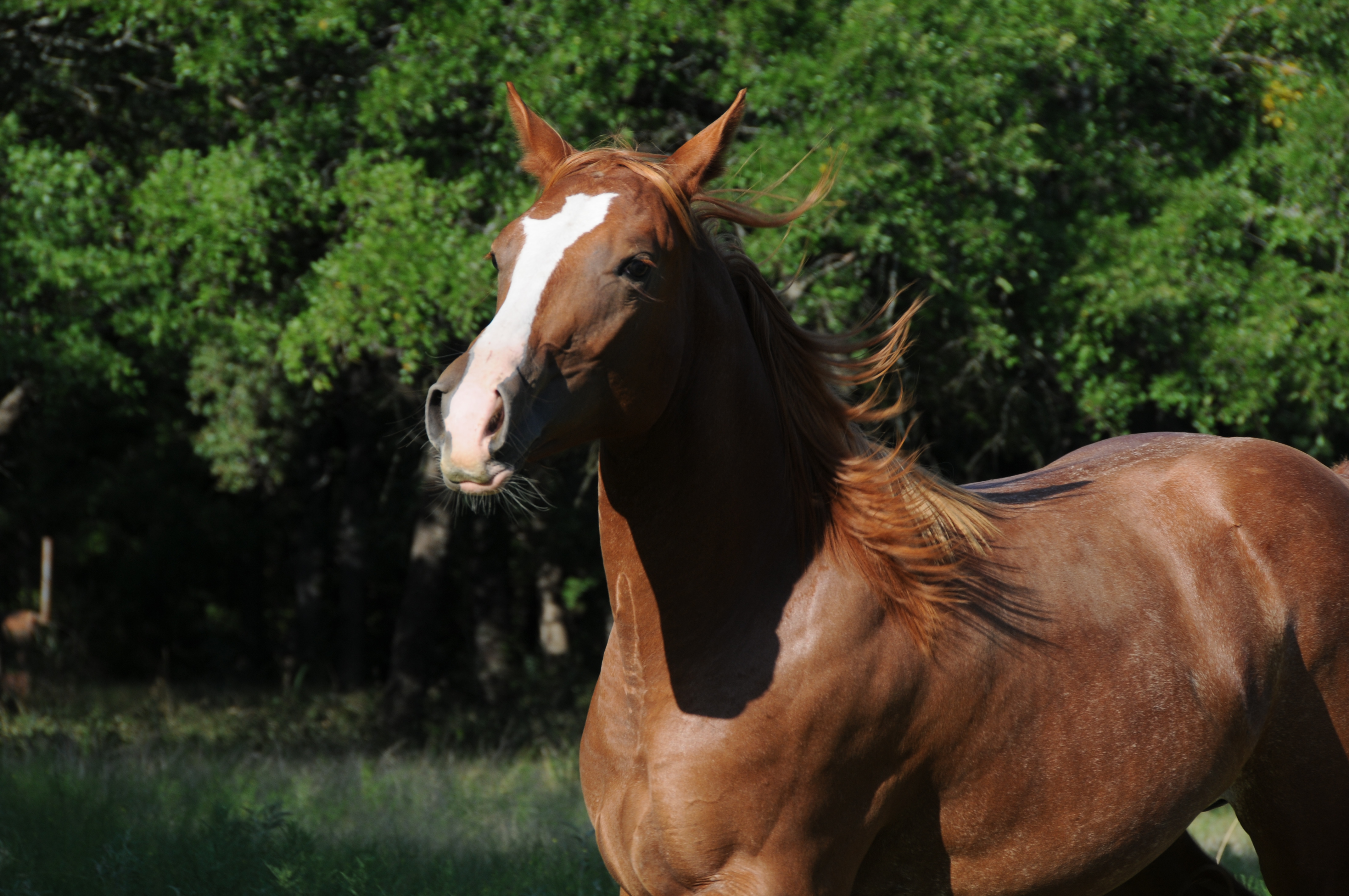
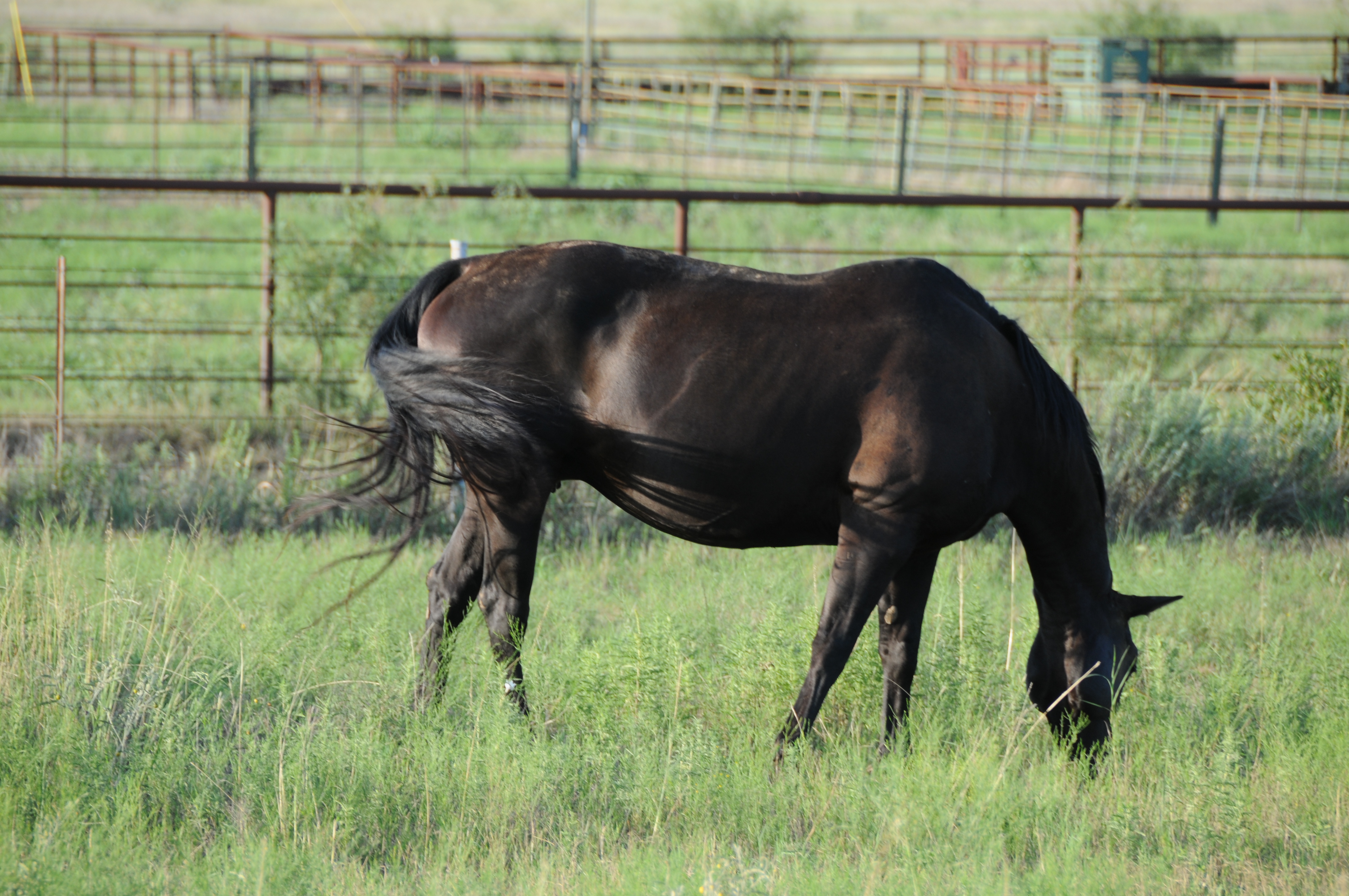
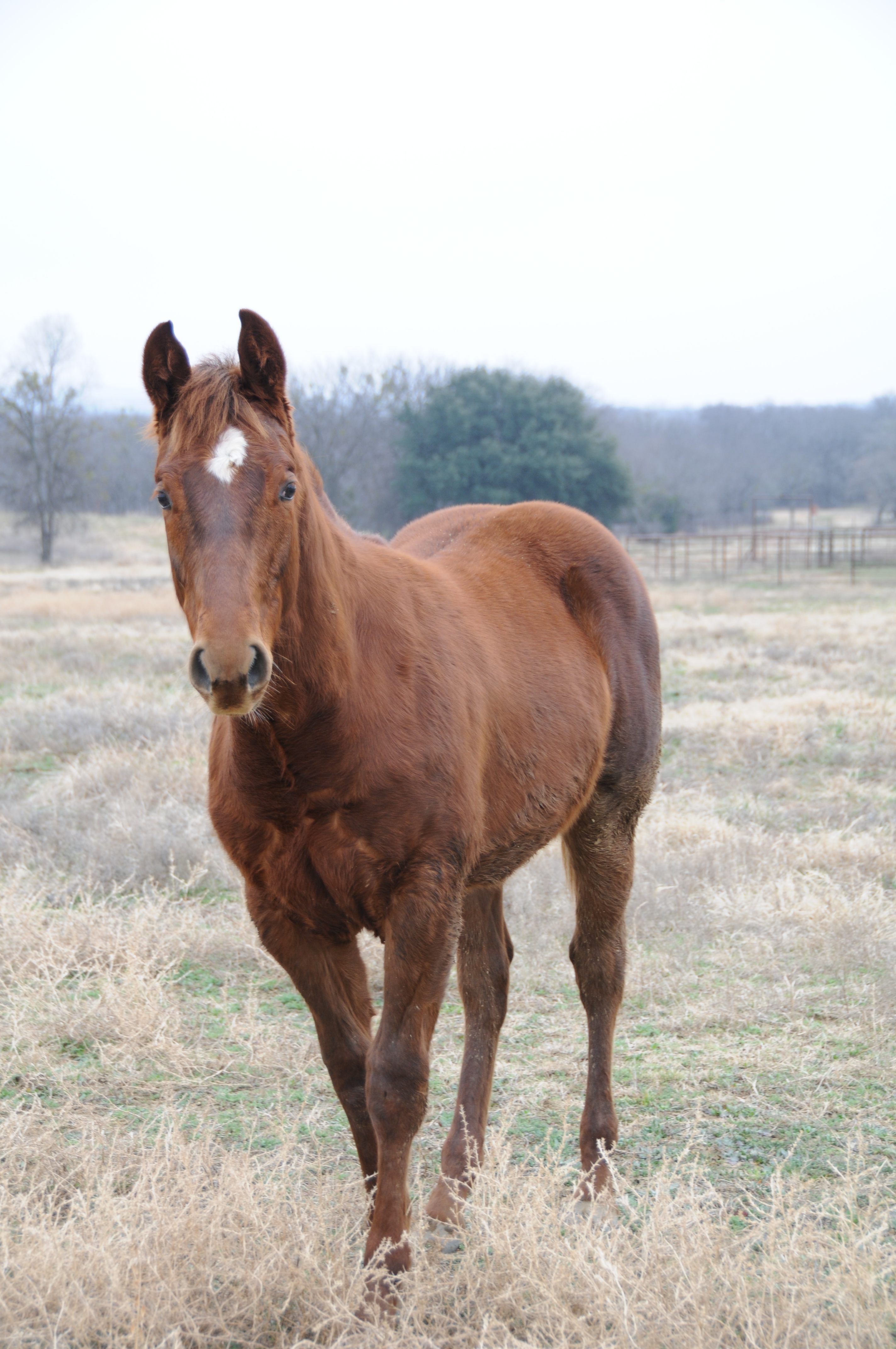
I thought I would put in one post a photograph of each of the horses I work with on a daily basis here at our place, Flying Hat.  All of these photographs can be enlarged by clicking on the photograph. By enlarging the photograph, if you have a moment, will reveal a lot of detail, as these photographs are usually 2.0 plus in megabytes.  I like to take photographs using the most detailed mode (within reason, of course) I can.  You can always lessen the detail in a photograph, but never add detail to it.
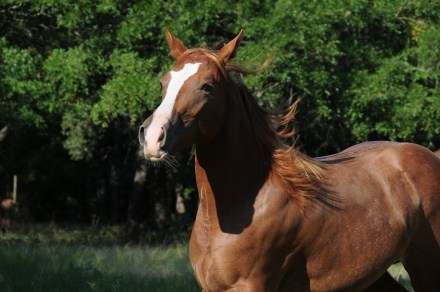
Shiners Fannin Peppy

This is Shiners Fannin Peppy or “Fanny.”  Fanny has been in training — elementary school — for a hundred days with Duncan Steele-Park at the GCH Land & Cattle Company of Weatherford, Texas.  Fanny is a daughter of Sweet Hija below.  Fanny is quite vocal.  She will begin to nicker once she knows that I am going to feed.  It is a vocalization that is more of a chortle, kind of a gargle, deep-down in her throat.  Fanny will continue to nicker-chortle every fifteen seconds or so until I put feed in her bin.  Translation to English:  “Oh, boy, I can’t wait, can’t wait for my grain.  Oh, boy, oh boy.”
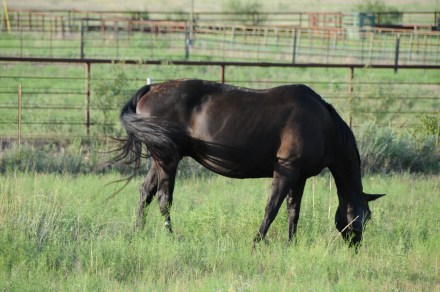
Sweet Hija

This is Sweet Hija or “Hija,” as we like to call her.  I purchased her in 2003, from King Ranch.  She starred in a King Ranch video for marketing before the auction at Kingsville.  She cut cattle with J. R. Ramirez, her trainer, in front of two-hundred prospective buyers.  I bought her at the King Ranch Legacy Auction in 2003, in front of  2,000 spectators — really stressful, but fun.  When I walked to the stables to view Hija after purchase, two stalls down from her was her grandfather, Peppy San Badger.  He was looking over the crowd and his granddaughter.  Peppy San Badger was nearing the end of his days, but he was still eager to see people and his progeny — be around the excitement.  I am sorry to say that I did not appreciate his background and heritage that day as I was just beginning to understand the quarter horse culture.  Peppy San Badger, Hija’s grandsire, was one of the greatest quarter horses ever to have lived: he rewrote performance records and records in the show pen.  He died in 2005, less than two years after he saw Hija load up into our horse trailer and come to Hannibal.  I have a photograph that shows Peppy in the background, Hija in the fore.  I’ll try and retrieve it for you some day.

When I saddle and ride Hija, I have to give her a run around the round pen before I mount (it’s been a while, however, since I’ve ridden) because she has that spirit of Peppy San Badger.  He would give a little buck when you first mounted him, but not a mean buck, just an energetic buck that he was happy to be alive — so also, his granddaughter.

Ima Lil Moore

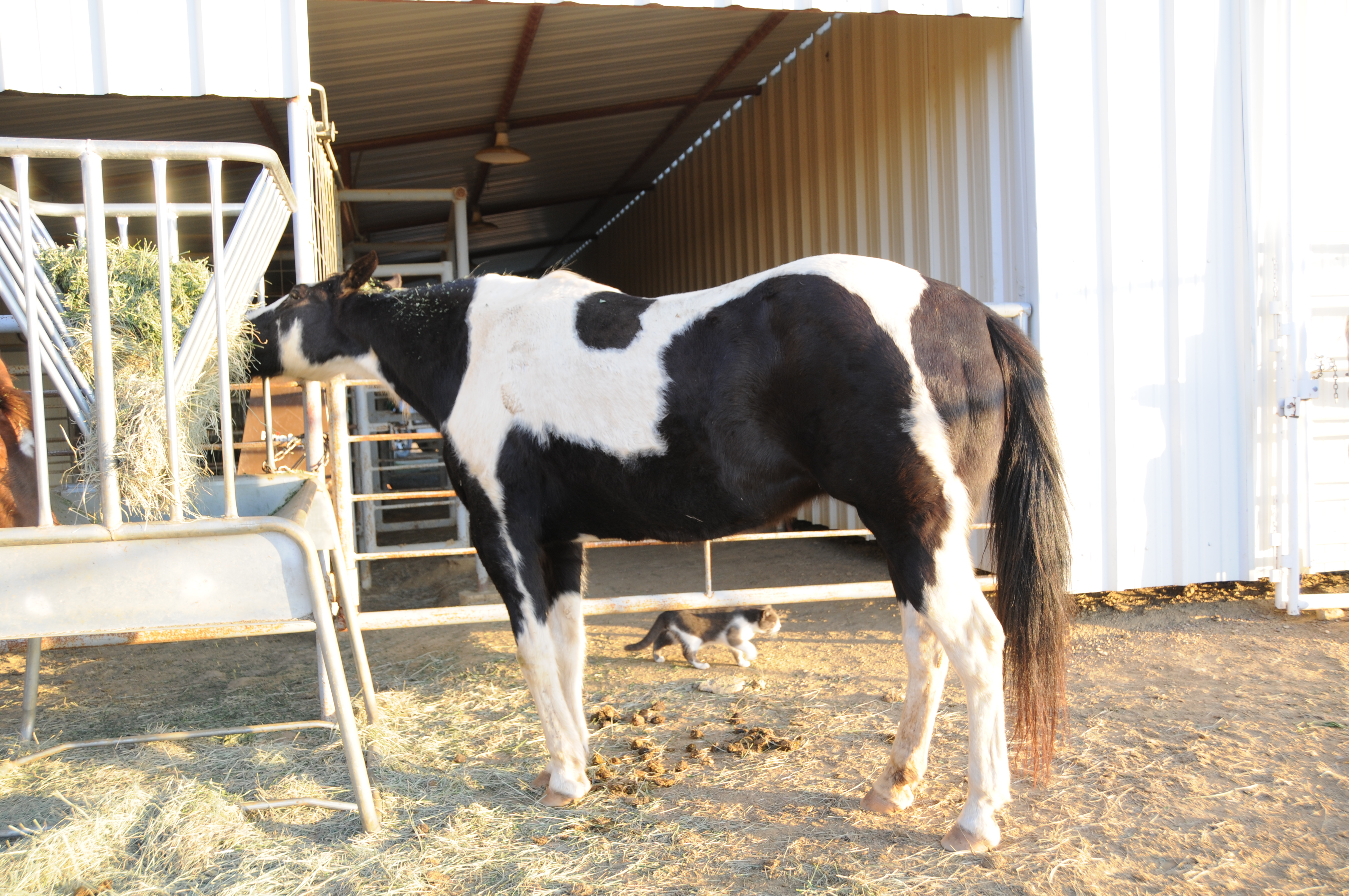
This is Lilly, the oldest mare in the remuda.  I inherited Lilly and her son, Star, upon the settlement of my parents’ estate in 2003.  Lilly is the alpha mare of the remuda.  She is challenged by Fanny for placement at the food trough.  Lilly likes to take her good time these days to come to the stall.  I favor her and let her use the alleyway to get into her stall (see the alleyway above) rather than have her walk a longer distance.  You can also see in the photograph above, the barn cat, Paint or Little Paint.  Odd, but he has the same markings of Lilly.
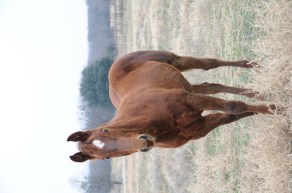
Shiners Fannin Pepto

Here is “Shiney.”  He is all-boy, a colt and a peppy one at that.  He is the son of Sweet Hija.  This is the guy I am having so much fun with these days.  He is an intact male and I have him for sale, but Brenda and I have talked about keeping him — me more than her — but it would require the construction of a stallion run.  Shiney is such a fine boy.  I really like working with him.

Stars Bars Moore

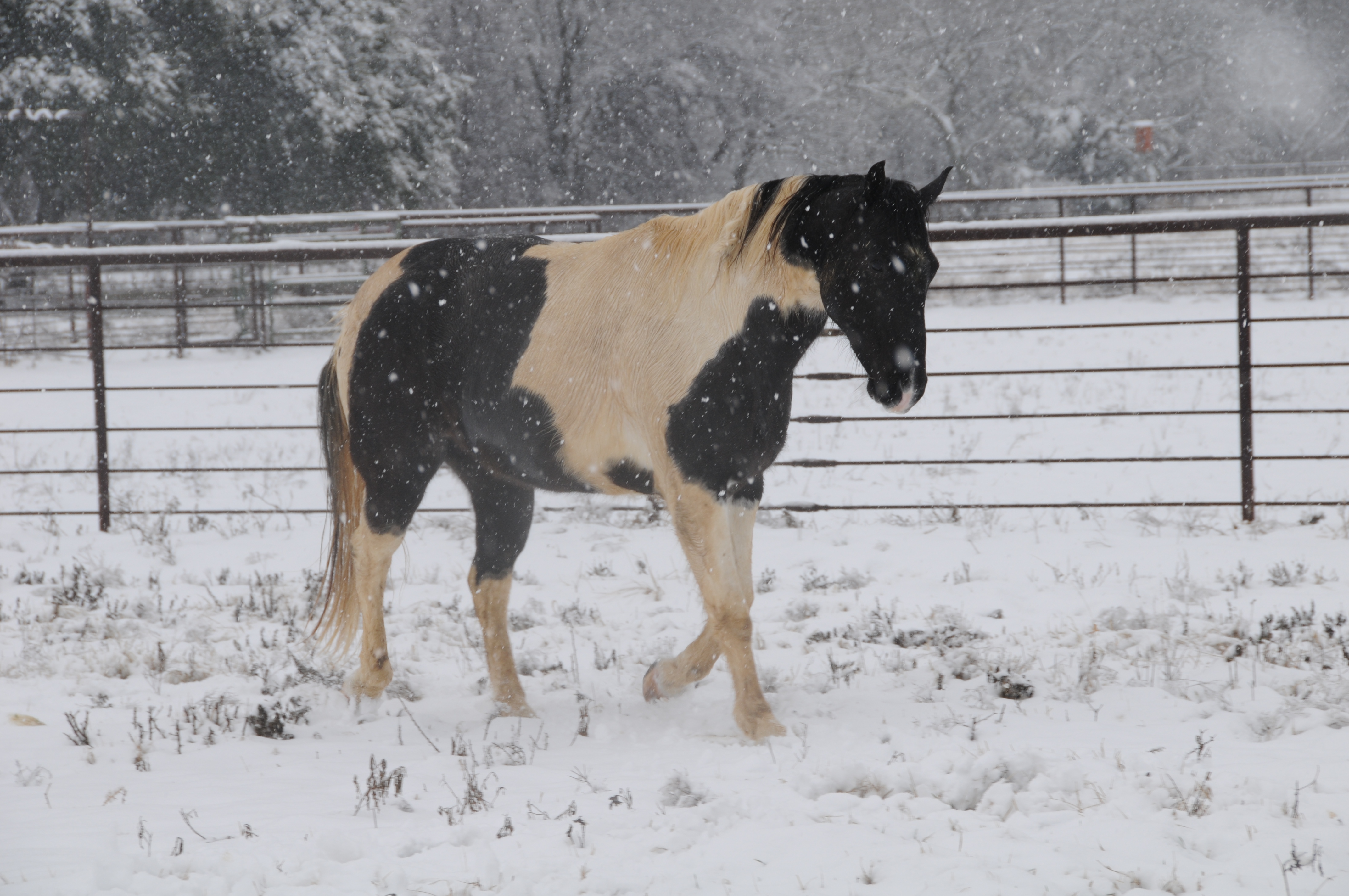
Star is a gelding and the baby-sitter for Shiney.  Star and Shiney inhabit the large outdoor arena and are given to playing many games of “Gotcha,” a variation of tag.  Star is a large horse.  I often refer to him with affection: The Beer Wagon Horse.  Star is the son of Lilly.  Star is known far and wide as the levitating horse of Flying Hat — check a previous post this winter on the blog.

A friend of mine at the college, Roland Stroebel, says to me almost daily, “I’m homesick, Jack.”  By that he means that he wants to go back to his farm south of Cisco, Texas, and work with the land and his cattle.  He misses his farm — homesick.  When Roland’s work is done at the college, he leaves and I can see him working with his fine Angus cattle into the evening darkness.

When I am away from all of the horses and land upon which they trod, I am homesick for their companionship, their warm breath and smell.  It is said:  “There is something about the outside of a horse that is good for the inside of a person.”  I believe that with all my heart.

19 Comments

Filed under Duncan Steele-Park, Flying Hat Ranch, Horses, Lilly, Shiners Fannin Peppy (Fanny), Shiney (Shiners Fannin Pepto), Star, Sweet Hija

Greening of Flying Hat and The Grand Inquisitor

Spring Afternoon, Poprock Hill Looking South, March 31, 2010 (click to enlarge)

Flying Hat Ranchito bursts with grass and flowers this late afternoon in March.  With snowfall this winter, greater amounts of nutrients lobbed onto tiny snowflakes already formed around dust particles, so that natural fertilizer fell from the sky — snow and sleet, not Monsanto.  The grass appears greener, more vibrant.  Certainly, an abundance of flowers bloom that we’ve not seen since homesteading in 2003.

The springing to life, lately dormant, continues in The Grove, and I want to go down there and take photographs — mine are more documentary than artful, but so? — for you and my record. There are willow trees and wild Mustang grapes in The Grove.  A large oak tree that we have dubbed The Council Tree will surely have shade so that we can spread a red-checkered tablecloth on the tailgate of the pickup and have a sandwich and wine or beer.  Definitely, spring in Texas.

Desdemona Windfarm in Distance, March 31, 2010 (click to enlarge)

Desdemona Windfarm in Distance, March 31, 2010 (click to enlarge)

In this second photograph, you see the greening of the trees to the southwest.  If you enlarge the photograph, you can see the Desdemona windfarm of British Petroleum beyond the ridgeline in the distance.  Those windmills are approximately twenty (20) miles or more from us.  I have yet to look upon the windmills and be calmed.  Not that technology should be calming, but the monumental size of these windmills evokes a slight fear, a fever, as it were.   I am glad, however, that the wind is collected and that diminishes our dependence on finite resources.  In a sense, there is a greening in our region along with the greening Flying Hat.

Then comes “The Grand Inquisitor,” chapter five of Book Five: Pro and Contra, The Brothers Karamazov, Fyodor Dostoevsky.  Shortly before turning out the light to go to sleep two nights ago, I mentioned to Brenda that I was going to read one more chapter of The Brothers Karamazov.  The book is not light reading, I knew that.  But, I wasn’t prepared for “The Grand Inquisitor,” for god’s sake, and I’m not trying to be punny.  The sheer length of paragraphs in that chapter overwhelmed me, not to mention the nuances of religion so stretched out that I thought, You can’t wring anymore out of “bread” than what you have already done, Fyodor!  But he did.   My bed lamp did not go out as quickly as I had hoped.  I finished the chapter and have reread it.  Why, you may ask, am I reading The Brothers Karamazov?  First, I want to read the 100 best pieces of literature ever written.  That’s why.  (There are several lists of the “best and greatest.”  I’ll post the lists eventually.)  The Brothers Karamazov is considered one of the greatest compositions.  The second reason is that I am curious about what makes great literature, the writing of a person that brings you into their inner world of comprehension.

There is a lot of idiocy and mindless rant on television, the internet and in the newspapers.  So, in order to bring a sensibility of order and art to my world out here in west Texas, along with my horses and land, I read good things and I think about those things — even the Grand Inquisitor — as I work with horses, unload hay and plant native grass seed in the soil.  I intend to wear out, not rust out, in this great land of ours, the idiocies of the day notwithstanding.  We all need to continue to green in some way, even if it means reading “The Grand Inquisitor” before turning out the lamp.  Do choose another chapter, however.

8 Comments

Filed under Recollections 1990-

Field Log 3/28/2010

North Erath County, Texas, 32.43 lat., -98.36 long. Elev. 1,086 ft.  Turkey Creek Quad.

The wind continues to blow today, approx. 15-25 m.p.h.   Yesterday, the wind was so strong it blew the mistletoe off the trees.  That’s gotta be high wind.

Yesterday, looked at Cooper’s in Stephenville for hackamore.  No good choices.  Too much metal.  Duncan Steele-Park used soft rope, no metal for the hackamore.

Fanny adjusting back to the ranch, but the colt down in the arena is having a hissy-fit to get close to her.  Shiney the colt is all-boy.  He’s eleven-months old, doesn’t know what his body is all about right now, but he will.  We mature males and females went through this period, I think — puberty.

Today, let Fanny, Hija and Lilly into pasture.  Shiney runs around the arena trying to attract Fanny’s attention.  Shiney is a full-brother to Fanny (same sire, same dam).  He calms down, then I put the mares into the Broke Tree Corral and stall area.  They seem relieved to get away from the peppy little guy that just wants to play.

Evening feed, two-hours ago, they all settled in.  Calm, for awhile.

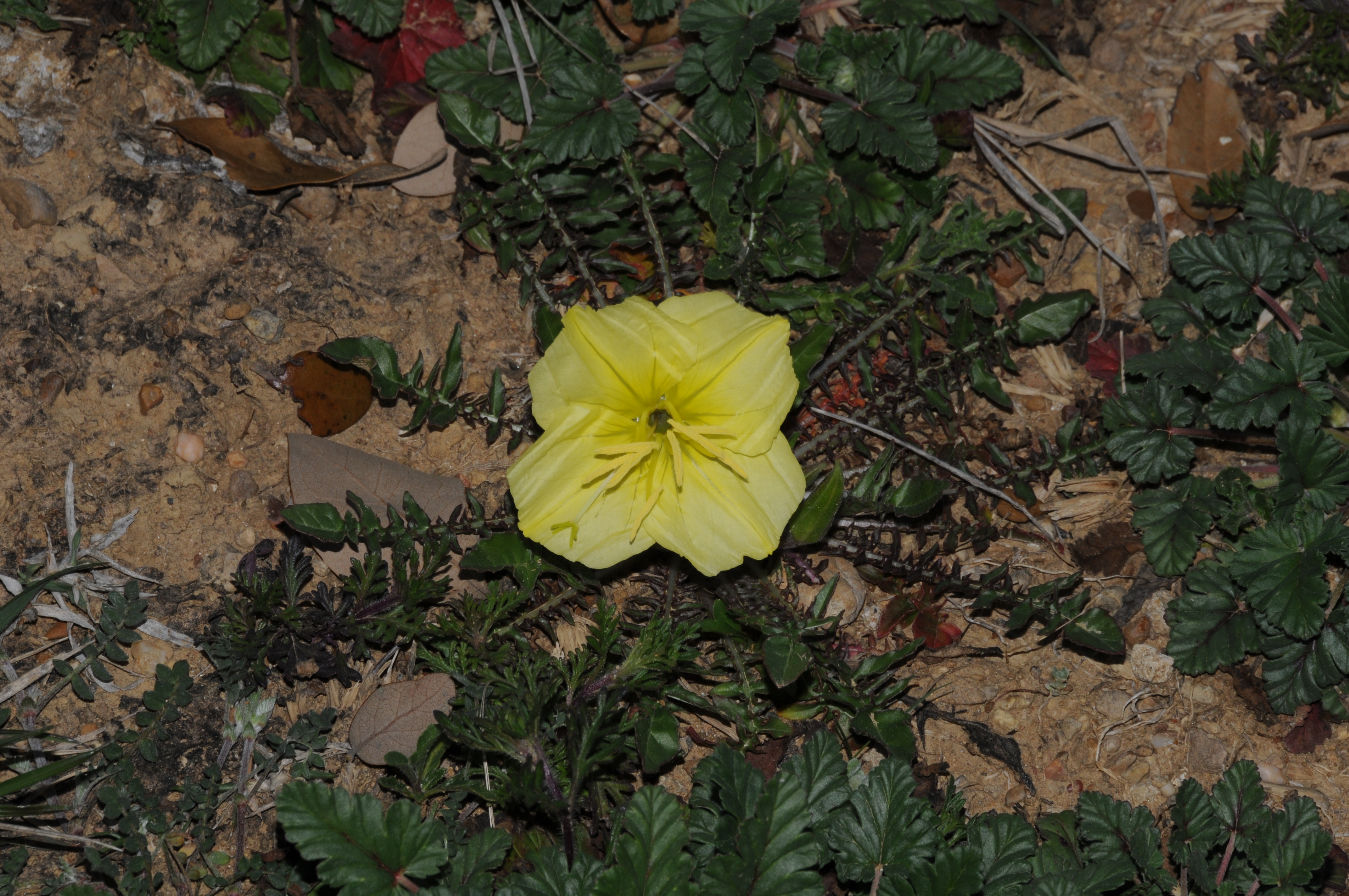
Buttercup (Oenothera triloba Nutt), Poprock Ranch House, March 2010 (click to enlarge)

I searched for genus and species typing for the wildflower above.  Found it in Irwin and Wills, Roadside Flowers of Texas, that I have cited before.  These blossoms open in the morning and in the later afternoon shade.  The plant falls under the Evening-Primrose Family (Onagraceae).  Brenda first called it an evening-shade plant and she was correct.

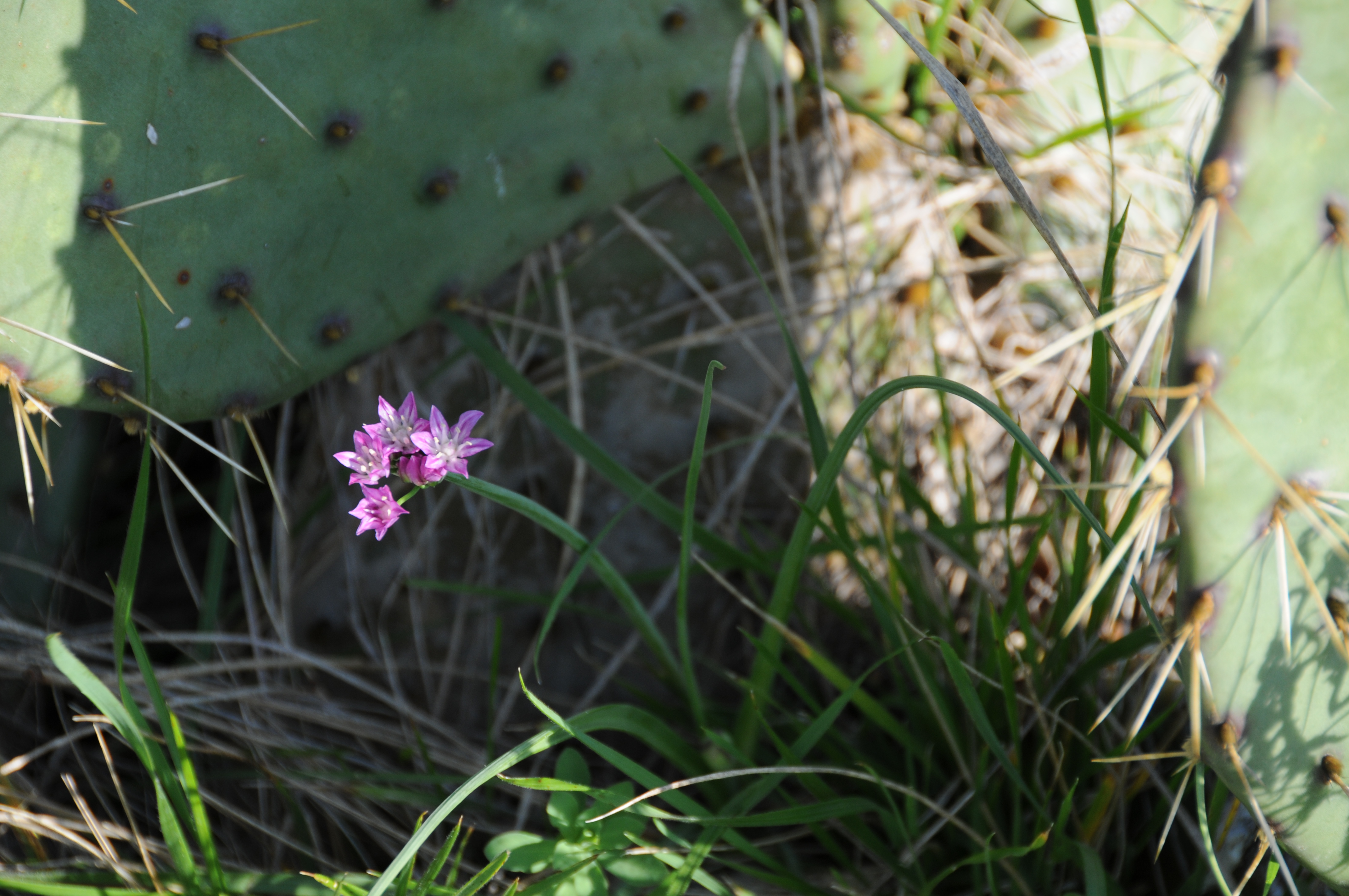
This next blossom is from the same vicinity of the Buttercup.  This is the Wild Onion (Allium mobilense) that I found this morning.  I go out for the third time to the Poprock Ranch House grounds, to the southwest, prior to the barn, and I find this Wild Onion.  It is next to the fence line and the morning sun is rising fast.  Don’t want to lose the shadow for this framing.

Prickly Pear Cactus and Wild Onion (Allium mobilense), March 2010 (click to enlarge)

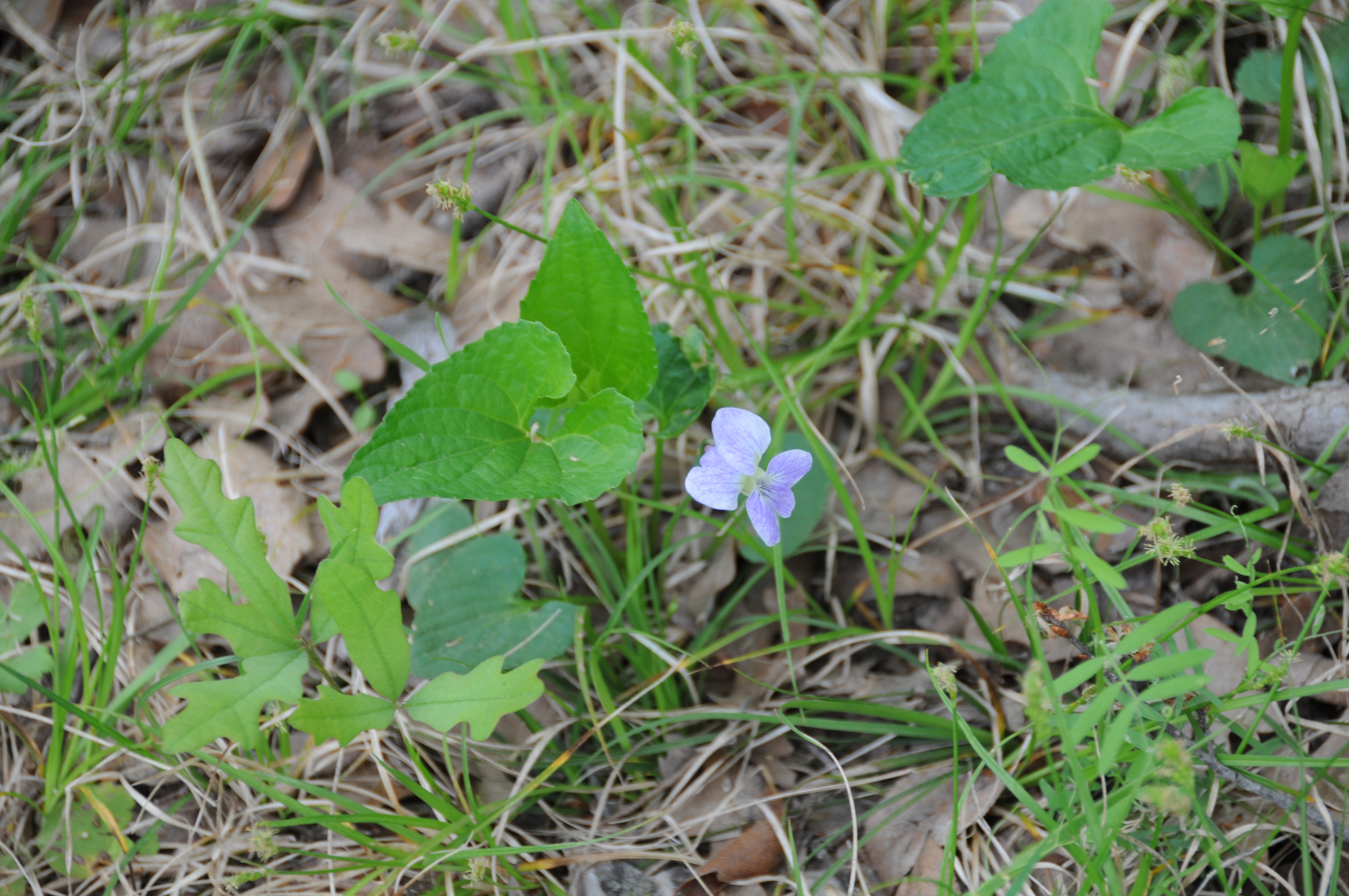
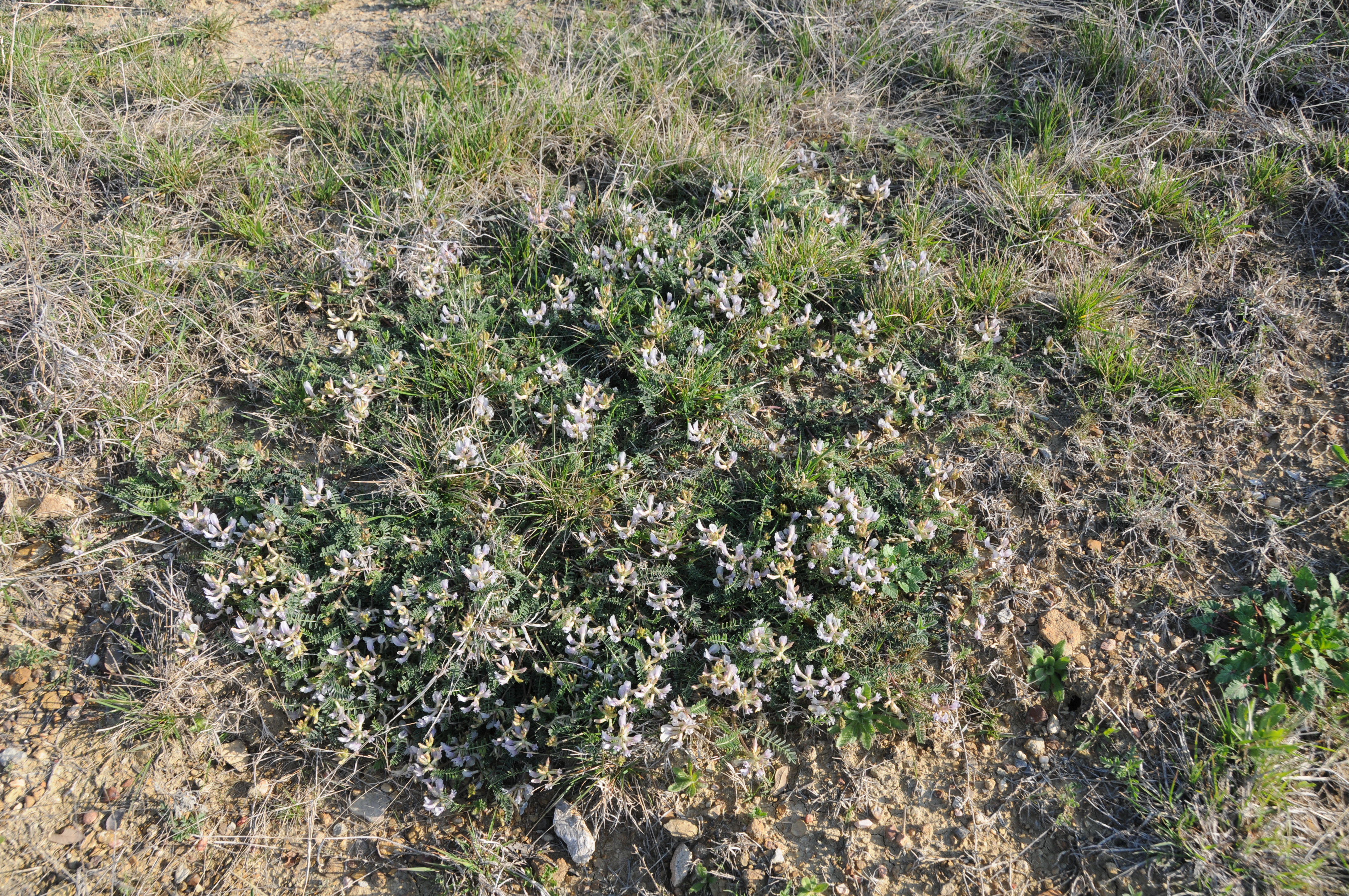
Then, upon scanning the ground, I find these other wildflowers.  I will identify them later, but I thought to end the weekend, I’ll go ahead and post them.

Unknown No. 1, Poprock Hill Ranch House Grounds, March 2010 (click to enlarge)

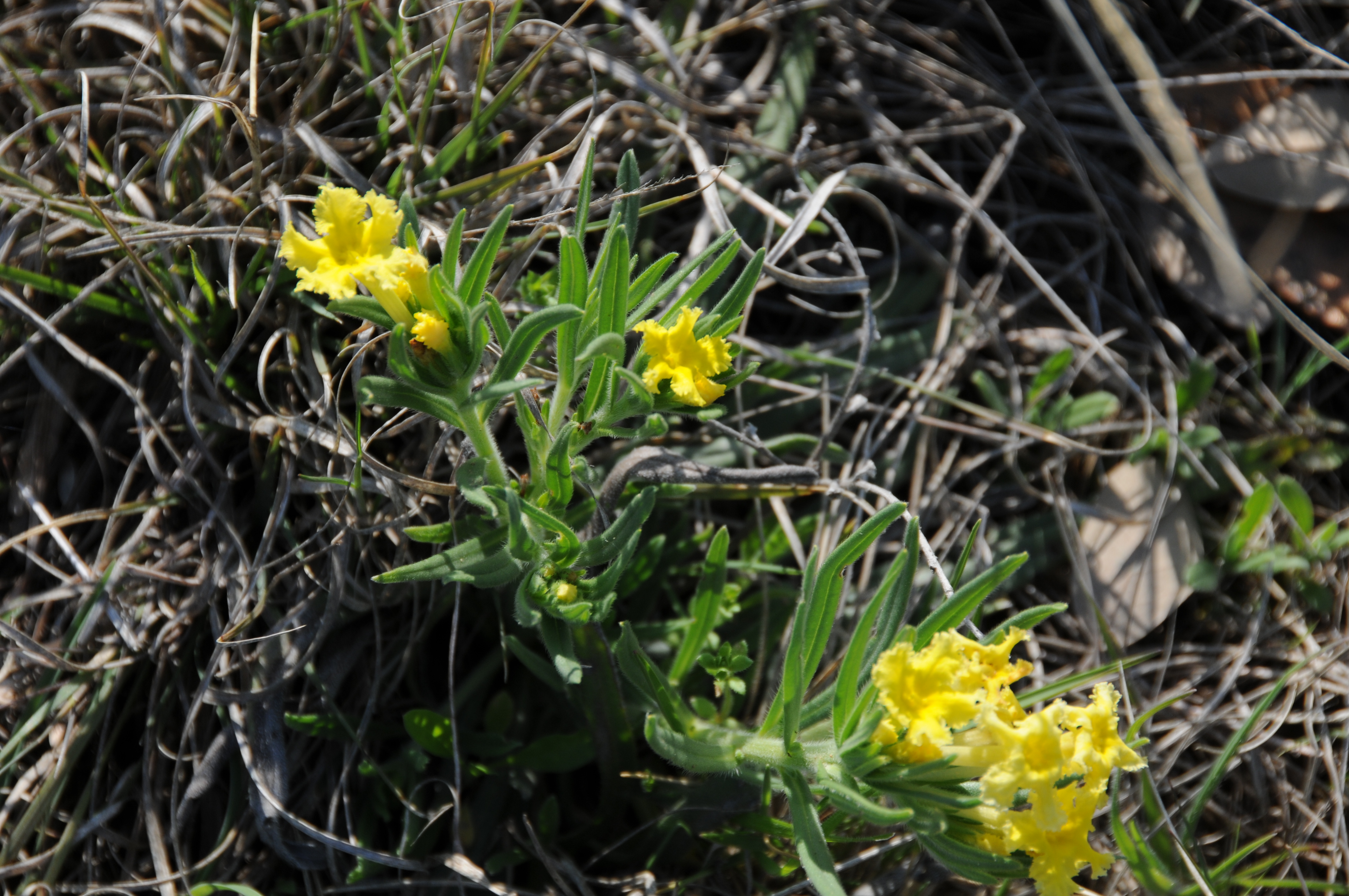
Unknown No. 2, Poprock Hill Ranch House Grounds, March 2010 (click to enlarge)

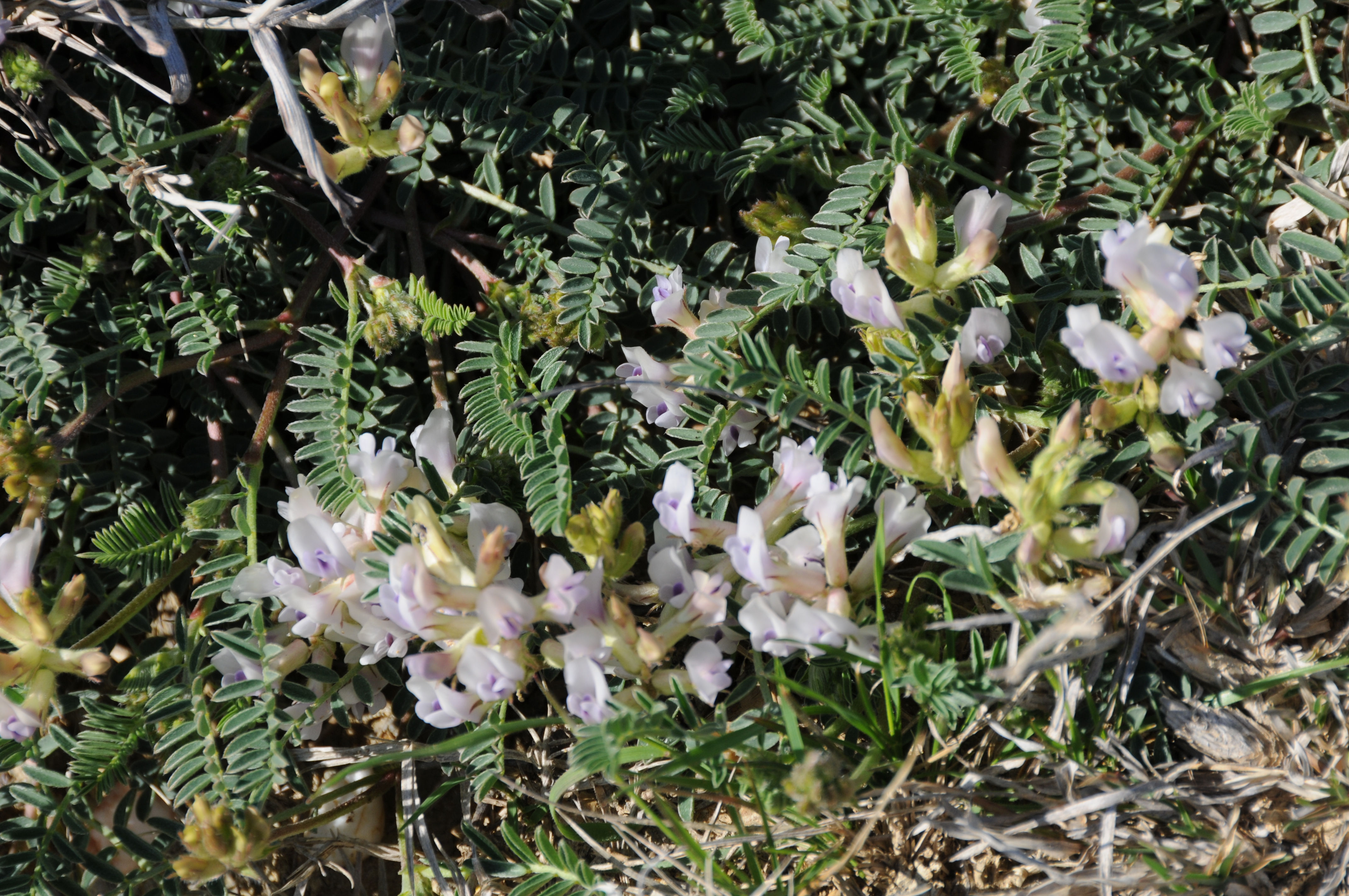
Unknown No. 2, Close-up, Poprock Hill Ranch House Grounds, March 2010 (click to enlarge)

This is a close-up view of the previous wildflower, having a distinctive scent.

Wind has died down.

Neighbors across on the country road that live in the trailer house have moved.  I liked the family.  Young woman with child.  She wrote letters and lifted up the red flag on the rural mailbox so that Jeannie Chisolm, our mail carrier and caretaker, could take the letters to friends far and wide.  Sometimes both our red flags for Jeannie would be up and I felt close to the family across the country road.

13 Comments

Filed under Field Log, Plants and Shrubs

Taos Sunflower: When The Simple Life Isn’t

A really great post on being on and off and on the electrical grid in Taos, New Mexico.  Personal comments on solar panels, batteries, washing, refrigeration and a husband who happens to be an electrical engineer.

Martie (Taos Sunflower) evokes the contradictions we all live with in trying to be frugal, green and sustainable.

Taos Sunflower: When the simple life isn’t.

4 Comments

Filed under Taos

Fanny Returns

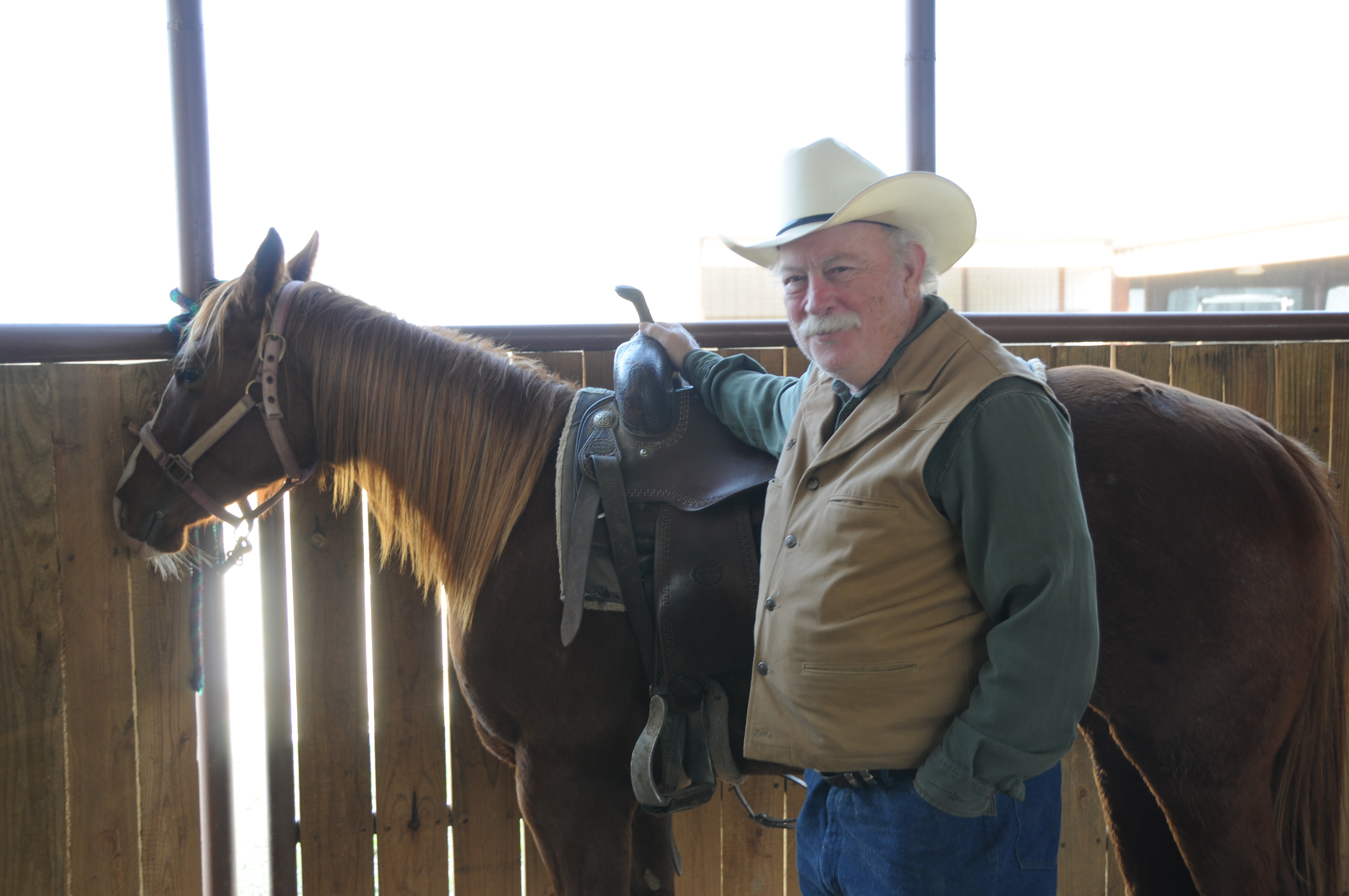
Shiners Fannin Peppy and Jack Matthews, GCH Land & Cattle Co., March 2010 (click to enlarge)

Shiners Fannin Peppy, “Fanny,” came back to Flying Hat yesterday.  At the hands of Duncan Steele-Park, her teacher, she has had three months of the best training I could afford.  Fanny will be a excellent pleasure horse, a fair cutter and all-around riding horse.  Duncan assessed Fanny:  She’s a good horse, but in this high-dollar business of cutting horses, she could not compete at the super-athlete level that is required to succeed.  I’m not a swimmer, either, he said, and I and you, Jack, have to play to her talents, to her disposition and behavior.  It’s unfair to force her into being the athlete she is not.

I could not have asked for a better teacher for my horse.  Let her be herself, play to her strengths.  Fanny came back home and was welcomed by the remuda: they kicked and ran and whinnied, communicating excitement.  I’ll have more photographs about Fanny, but for now, you’ll have to settle for the photograph above: myself, my companion.

16 Comments

Filed under Duncan Steele-Park, Horses, Shiners Fannin Peppy (Fanny)

It’s Recess! Coggin Ward 1955

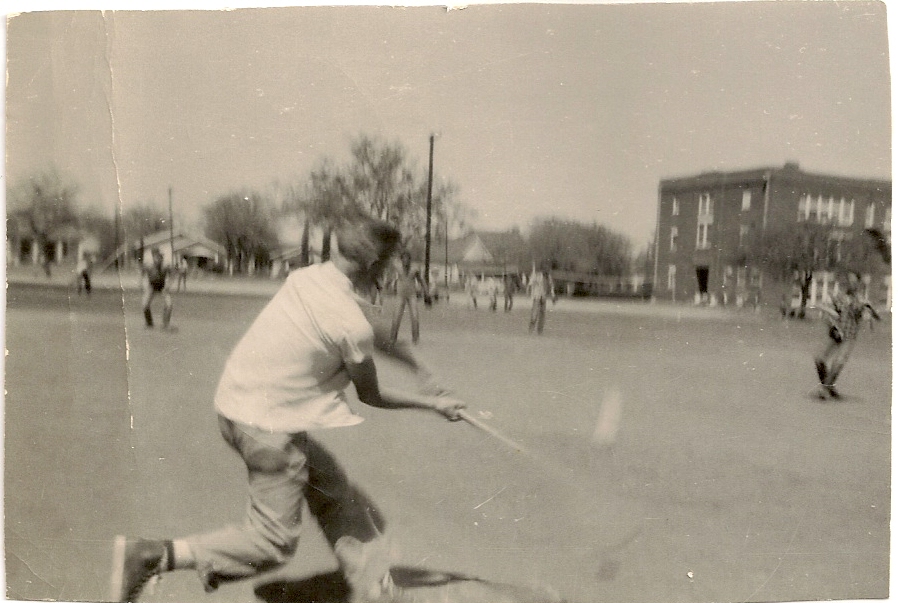
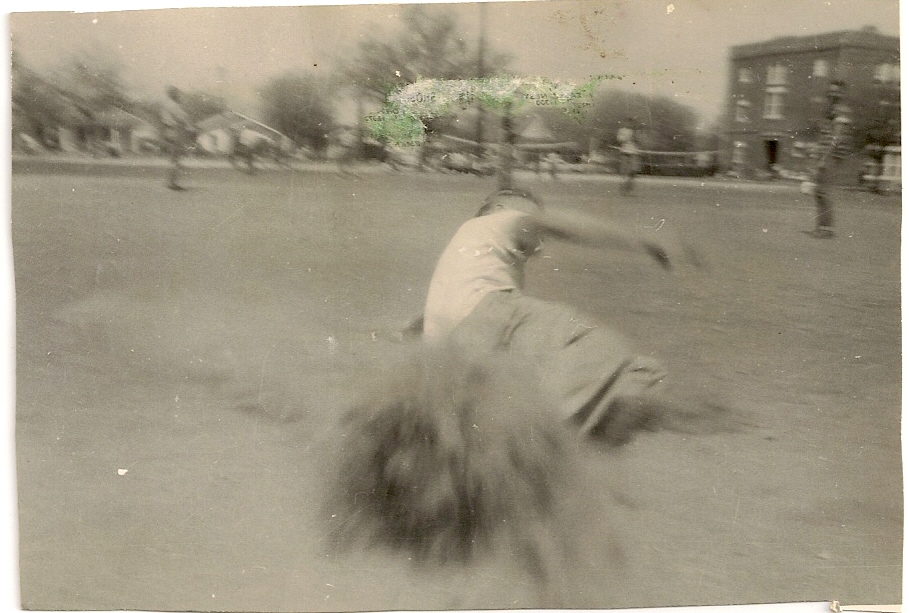
Dale Smith Hitting Home Run, Coggin Ward, Brownwood, Texas, 1955 (click to enlarge)

In the 1950s, when I went to elementary school at Coggin Ward in Brownwood, Texas, we had two recesses, one in the morning and one in the afternoon.  The op-ed article from the New York Times today (see link below) decries the lack of playtime in childhood and the problems encountered at recess — bullying, arguing, intimidation — so much so, that recess coaches have been appointed for troubled schools and playgrounds.  “For children in past eras, participating in the culture of childhood was a socializing process. They learned to settle their own quarrels, to make and break their own rules, and to respect the rights of others. They learned that friends could be mean as well as kind, and that life was not always fair”, so writes David Elkind.

I loved recess at Coggin!  Not so much to escape academics because I loved most of my classes, but I engaged recess like a high form of testing my strength against my weaknesses — running, jumping, kicking soccer balls, escaping from tag, hitting the baseball, even playing mumblepeg on school grounds (pocketknife game, we all carried them).

I used a 620 Kodak camera to take these pictures of us playing baseball in ca. March 1955, at Coggin Ward school.   (Mother used the Kodak to capture pictures of Camp Bowie and my father in the 1940s.)  Dale Smith was a good friend of mine and quite talented in athletics.

These photographs show no recess coaches.  I think there were a couple of teachers observing from the building, but they were never interventionists in our play and gaming unless a major squabble broke out (I don’t remember any).  We chose sides to play baseball.  There was some organization every now and then — calesthentics were occasionally forced upon us.  In the choosing of sides, athletic ability carried the most importance, then popularity.  Even the poorest-talented boy would be chosen to play for there was no sulking allowed we ordered.  I learned that life was not always fair and good, but most of the time the shame and failure could be overcome by coming up to bat again, having another chance for a hit to drive in Henley from second base.   There was always another chance at the plate, and, even then, there was tomorrow’s recess to score a point to win the game.

Television, computer games and other devices have robbed children and adolescents of time outside in the sun and wind and rain.  Look at the trees in the photographs.  It’s late winter, early spring and the leaves are not even out on the trees.  I can tell you that we would play at recess as long as the dust did not obscure second base from homeplate.  We learned to play and adapt to each other.  Oh, these were “social skill sets” that we carried into life beyond Coggin, beyond Brownwood High School.  It may be strange for us of the 1940s and 1950s to visualize a recess coach on the playground, but if that is needed to get boys and girls, young men and women, out of boxes called classrooms and houses, then so be it.  I think I’ll apply to be a recess coach in my retirement.  I’d rather be on the playground than behind a lectern on any sunny day of the year.

Choose sides, boys!  I want Dale, Joe and Jimmy on my side.  Carol will lead the cheers.  It won’t turn out that way, but that’s life, a lesson I learned at recess.

Dale Smith Sliding Into Homeplate, Coggin Ward, Brownwood, Texas, 1955 (click to enlarge)

Baseball Card Photo, Dale Smith, Coggin Ward, Brownwood, Texas, 1955 (click to enlarge)

Op-Ed Contributor – At Schools, Playtime Is Over – NYTimes.com.  This is the link to the New York Times article explaining the socialization problems of modern youth.

18 Comments

Filed under Recollections 1942-1966

Gunnison Sage-grouse: Newly Designated Species

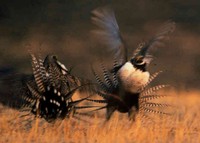
Gunnison Sage-grouse (Centrocercus minimus), Western State College of Colorado Website

Click on the link below for breed characteristics, description of habitat and directions to the Waunita Lek Watchable Wildlife Site near Gunnison, Colorado.  The viewing is only April 2-May 10.

Gunnison Sage-grouse — Western State College of Colorado — for breed characteristics and habitat.

Waunita Lek Viewing site for Gunnison Sage-grouse courting rituals — you must arrive before sundown and have a Colorado Wildlife Habitat Stamp.

I never knew what a lek was until I read up on the grouse.  A lek is a breeding area, a place that males display their feathers, wing beats and air sac thumping — quite similar to teenage rituals at a high school dance.

5 Comments

Filed under Birds