The Hardin Way

Jimmie Hardin Quarter Horses in Aubrey, Texas

Shiners Fannin Pepto, my one-year-old colt, is being ground trained and fit for the Summer Sale at Triangle Sales, Shawnee, Oklahoma, on June 5, 2010.

I took him as far as I could in ground training, but it was time to send him to Jimmie Hardin Quarter Horses in Aubrey, Texas, for training and conditioning for sale.

Jimmie Hardin in Show

I went up to Aubrey, Texas, yesterday, to see Jimmie and Shiney.

I hardly recognized him since he has a month’s growth since I last saw him.  But, that’s not all.  He has been groomed and taught manners.  He stands on his four feet in a show pose and is learning to trot with Peppy, his trainer, and Jimmie.

Jimmie Hardin has been Aubrey, Texas, for several decades, building upon the horse business of her father.  The little town of Aubrey has grown up around her.  Jimmie’s corrals border the Aubrey High School and a Sonic drive-in is just down the street.  She says that nowadays land is selling by the square foot.

Jimmie told me to go up to Shawnee on the third of June, settle Shiney into his stall and have him presented for passers-by when they come and look on Friday, the day before the Saturday sale.  She is going to purchase a leather halter and stud chain for Shiney to look his best.  There will be a bit of silver on the halter to sparkle.  I want him to look his best and that means leather halter.

Equine Body History

Horsewoman Hardin said that Shiney has taken a real liking to Peppy, the handler with whom you see in the photograph.  Peppy grooms and trots Shiney.  They have a bond together.  The treatment that Jimmie and Peppy give to my colt will engender confidence in him to trust humans and know that their touch will be kind and never hurtful.  With older horses, like my Star (levitating horse in winter), you can discern the history of treatment to them.  Ears, feet and flanks of the equine body embed the treatment of years past and one can see kind firmness, but also mistreatment and mistakes.  Experienced horsemen and horsewomen can pick up the history.  Monty Roberts, a famous horse trainer, can discern the equine-body history rapidly in the round pen and corral.
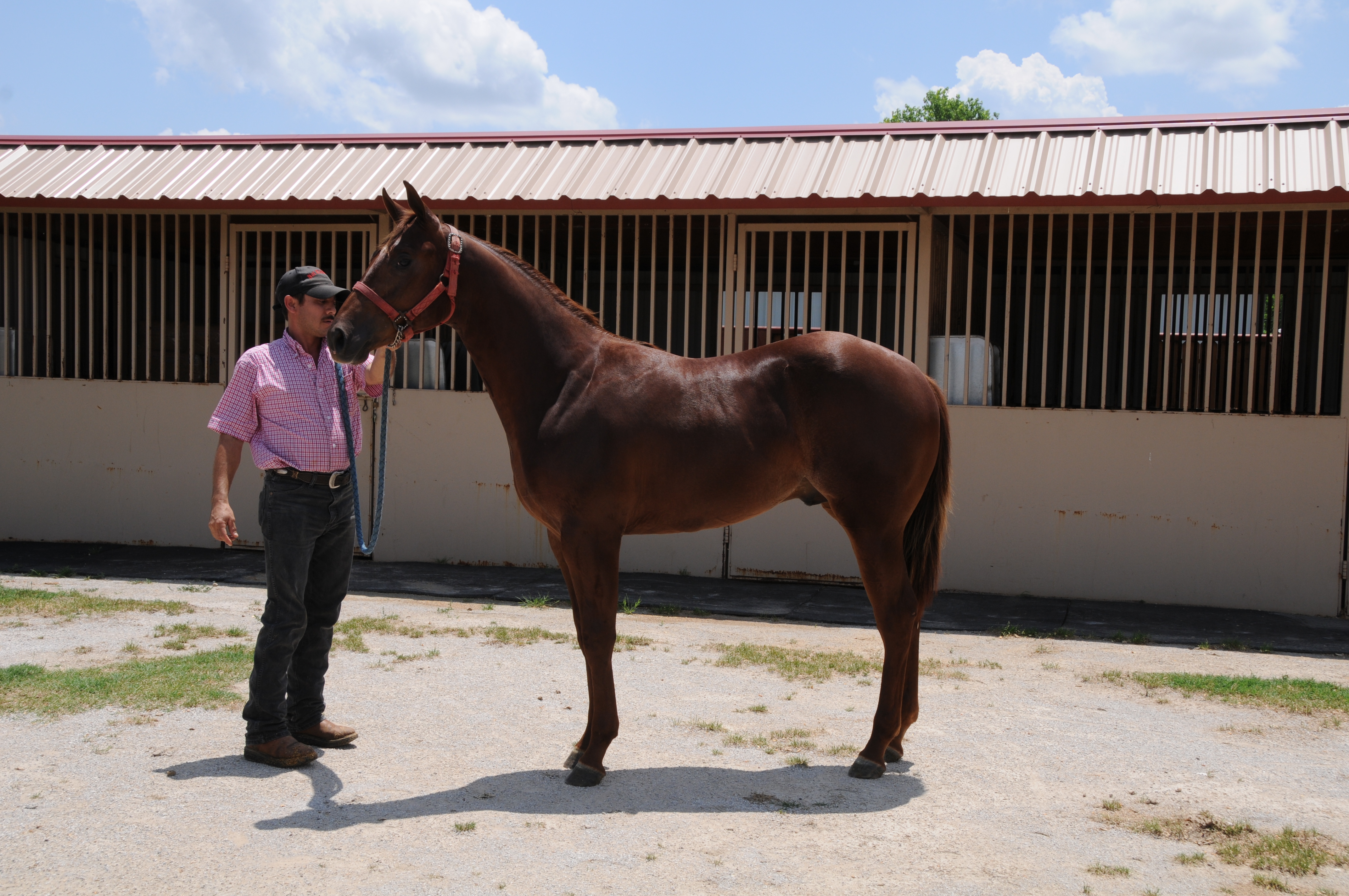
The Handler Peppy with Shiners Fannin Pepto

Peppy the Handler Alerting Shiney to Pick those Ears Up

The Hardin Way

It is important for humans and horses alike to respect the other.  It will insure a long and happy life for both.  The Hardin Way develops the horse and provides the human with a well-mannered companion.

Jimmie Hardin with Shiners Fannin Pepto
7 Comments

Filed under Horses, Shiney (Shiners Fannin Pepto)

Gorman Falls: Texas Rainforest

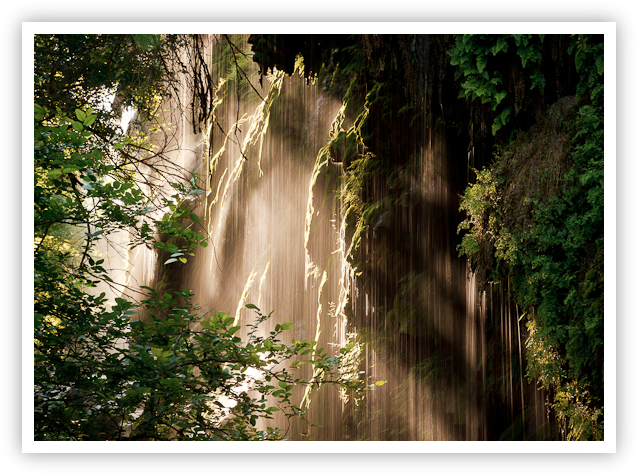
Gorman Falls near Bend, Texas (Jeff Lynch, Photographer)

Jeff Lynch is producing some of the most stunning photos of Texas landscapes.  This photograph of Gorman Falls, near Bend, Texas, is spectacular.  Please click on the link below for technical information about the photo and his biography.

I have camped many times at Gorman Falls.  I qualified for the First Class rank in the Boy Scouts by hiking from Bend, Texas, to Gorman Falls in the 1950s.  My grandmother hiked with me and pointed out wagon trails and campsites that she had traveled upon and cooked for cowboys, including her husband, J.W. Parks.  When we reached Gorman Falls, she picked watercress from about the stream to relish our lunch.  She lived in Bend, Texas, and worked as a telephone operator at the one-person switchboard.  The switchboard was in the living room where we played dominoes and listened to KWKH Shreveport, Louisiana, for country music and the Louisiana Hayride.

Gorman Falls existed as a respite from the summer heat, a cool habitat for sunburned people that managed cattle on horseback.

Texas Rainforest | Serious Amateur Photography is Jeff Lynch’s blog and website.

On May 10, 2010, the San Saba Commissioner’s Court met and received a report on the Colorado Bend State Park and Gorman Falls. The San Saba News & Star report is found at this link.  Other items included a discussion about the county scales at Hamrick’s Automotive.

10 Comments

Filed under Bend Texas

Going Green at Malabar Farm

Louis Bromfield of Pleasant Valley Malabar Farm, Ohio (Malabar Farm Website Photo)

Malabar Farm, Ohio, has sustainable outlook about their resources. Needs some emulation in the Trans-Mississippi West.

Malabar Farm is the farm name that Louis Bromfield gave his land.  Bromfield wrote, Pleasant Valley, 1943.

I do not like Wikipedia, but for fast information that needs backing-up or verification, it seems to be a first source.  Therefore, on sustainability, greenness or the LEED, this is what they have:  Leadership in Energy and Environment. I didn’t know what LEED was.

Our ranch is operated on the low-impact ranching principles.  In planning remodeling, we are considering LEED certification for the ranch house.  Our beef cattle operations in the future will include, after careful consideration, the Niman Beef production program.

Salt Creek, Flying Hat Ranch, Hannibal, Texas

2 Comments

Filed under Life in Balance

Survived by her Family and the Tamarin

Devra G. Kleiman (1942-2010) at National Zoo with Golden Lion Tamarins at National Zoo (NY Times Photo)

People Not Avatars

Examples, models and real-people, not avatars, present themselves as historic figures upon whose narratives we should integrate into our lives.  Dr. Devra G. Kleiman, who died this week, transformed zoo culture and assisted sentient beings in replenishing their species.  As Livy remarked:  “She is a model to emulate.”

Kleiman’s Procedures Relevant to American West

My blog, Sage to Meadow, focuses on the American West, mainly Trans-Mississippi West, and I worry everyday about the destruction and attenuation of not only sentient creatures, but also the sagebrush and native grassland.  Dr. Kleiman represents the scientific and emotionally best in us, Homo sapiens sapiens.  Her procedures–careful study, legal applications, conservation–can be applied anywhere in the biological environs of this planet, be it the Central Plains or the National Zoo.  Her work must be carried on by us and young men and women coming of age.  Writ small, it might be the feed you distribute occasionally to the mountain quail in Taos or establishing wildlife corridor for deer in Texas.  The caretaking of dogs and cats as Caralee Woods and Jimmy Henley in Kanab, Utah, reflect Kleiman’s outlook upon the wider biological kingdoms.  Writ large, it would be the slowing down or elimination of paved parking lots and strip malls: the culture of overconsumption.

Devra G. Keiman (1942-2010) Biologist Whose Work Transformed Zoos

Dr. Devra Kleiman worked successfully for decades to re-flourish the populations of the Gold Lion Tamarin and Giant Panda.  Her research and field crews impelled the culture of exhibition zoo-dom to restructure their entertainment and captivity culture “to concerted, scientifically informed conservation.”

Dr. Kleiman, in her work with the tamarin, persuaded zoos to give up title to the tamarin in return for the designation of  “a long-term loan from Brazil,” allowing zoo tamarins to be shuffled about the world for diverse breeding.  Her work became the paradigm for 100 breeding programs for endangered species, including the California condor and the black-footed ferret.

In 1972, when China presented the United States with two pandas, Ling-Ling and Hsing-Hsing, Dr. Kleiman and her research team begain to study the panda, holistically (social, sexual, gastronomic) in a 24-hour observation log.  Not until 2005, thirty-three years later, did the pandas produce offspring and only by artificial insemination.   The first offspring, a male by the name of Tai Shan, was later sent to China.

Please note the by whom she is survived in the quote,

Dr. Kleiman’s first marriage, to John Eisenberg, ended in divorce. Besides her husband, Mr. Yeomans, whom she married in 1988, she is survived by her mother, Molly Kleiman; a brother, Charles; three stepdaughters, Elise Edie, Joanna Domes and Lucy Yeomans; and four grandchildren.

She is also survived by the heirs of her scientific labors. When Dr. Kleiman began her work with golden lion tamarins, there were fewer than 200 alive anywhere; today, according to the National Zoo, about 1,500 live in the Brazilian wild.

Tai Shan, now almost 5, has lived since February at the Bifengxia Panda Base in China’s Sichuan Province.

I like that paragraph, “survived by the heirs of scientific labors.”  Give us legions of men and women like Dr. Kleiman.

Devra G. Kleiman, 67, Biologist Whose Work Transformed Zoos – Biography – NYTimes.com.

3 Comments

Filed under Life in Balance

Field Log 5/15/2010 (Wildlife Migration and High Field Fence)

North Erath County, Texas, Lat 32.43 N, Long -98.36 W, elev. 1,086 ft.  Turkey Creek Quad.

Talked by phone with Jimmie Hardin in Aubrey, Texas.  Shiney the colt is progressing along very well.  “He’s a boy and doing just fine,” she said.

Sweet Hija was inseminated on Thursday.  Will pick her up today.

Rain yesterday: 0.9 inches.

This morning at 5:10 a.m. I heard owl and turkey.  Scissor-tailed flycatchers call out vigorously just before daybreak.

Weather pattern unusual.  Finfrock at NBC-DFW says the dynamic is a cold front semi-stalled over Texas with jet stream winds blowing one way, surface winds the other.  Pattern has been with us for three days–since Wednesday.

Question the high fencing built by ranches.  What does this do to migratory patterns?  Celebrity Ranch has high fencing.  Factor this in for disturbance of wildlife migration.

High Field Fence by LE Fence Company, Waco, Texas

High field fence as pictured above can prevent migratory wildlife from crossing dangerous roads.  Use it to alter, without completely destroying, trails.  But, how?  Consult the corridor crew over in New Mexico.

In the nineteenth century, Glidden sold fence in San Antonio, Texas, with the advertisement for barbed wire: “Lighter than air, stronger than whiskey and cheaper than dirt!”  Cattle could be micro-managed within the barbed-wire pastures.

Do we have any significant corridors for wildlife migration in Texas that are specially designated?

4 Comments

Filed under Field Log

First Anniversary Prairie Sagebrush Awards, June 27, 2010

First Anniversary of Sage to Meadow Blog, June 27, 2010

On June 27, 2009, I began blogging.  My first blog was The 27th Heart.  Over a period of time, I changed the name of my blog to Sage to Meadow.  In order to celebrate and pay attention to a year of learning and relating to other bloggers, I am going to give a Prairie Sagebrush Award to each of my blogging friends for their best post.   Read the details below.

Prairie Sagebrush Award

The First Anniversary Prairie Sagebrush Awards, June 27, 2010, will be given to the finest post written by my blog friends, during the year, 2009-2010.  One post will be chosen from each blog and I will edit and publish them as a collection on June 27, 2010, on Sage to Meadow.   For each reader comment, Sage to Meadow Blog and Flying Hat Ranch will donate one dollar to a Wildlife Corridor in west Texas and New Mexico–see details below.  I will not designate a first, second or third place, but rather select the one finest post from each blogger.  How can I?  Each blogger has great posts and I’ll post the one I like the best–personal taste.

Why Choose the Prairie Sagebrush as Logo?

The Prairie Sagebrush is a native plant that is an important winter feed for Elk, Pronghorn and deer throughout the American West.  It is an edible herb and aromatic.  So many aspects of nature are associated with the American West and Southwest, but among the more prominent are sagebrush, antelope, deer, elk, buffalo, pines and the Rockies.  The sagebrush is imperiled–see my page on Sagebrush.

The Sensual Sagebrush

The Prairie Sagebrush and other varieties of sage provide one of the most sensual and pleasurable plants known to man: perfume, cooking and wildlife habitat.   The burning of sage in Native American ceremonies implores sanctification and purification as well as perfumed smoke about the room.  I used to burn sage in my fireplace and briefly close the flue to smoke-up the room.  I use sage in cooking, both chopped or whole leaves. Lewis and Clark reported that antelope would rub their foreheads on sagebrush for its perfumed scent.

I look forward to re-reading posts of 2009-2010, and putting together a collection for the Prairie Sagebrush Awards, June 27, 2010.  I’ve already started collecting and the blog posts are most outstanding!

Photographs of Prairie Sagebrush

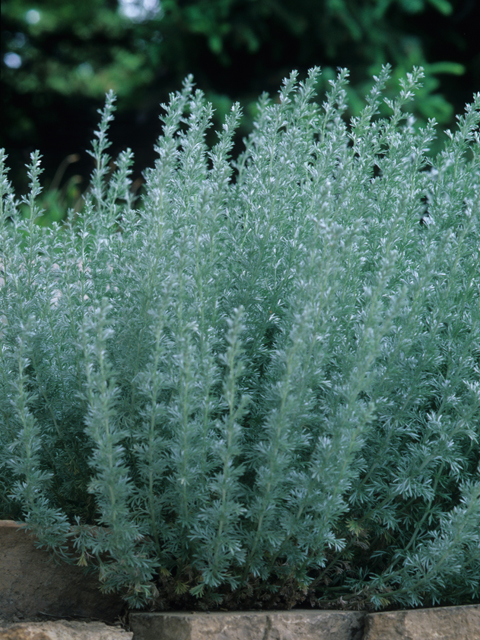
Prairie Sagebrush No. 1 (Artemisia frigida) by Sally and Andy Wasowski

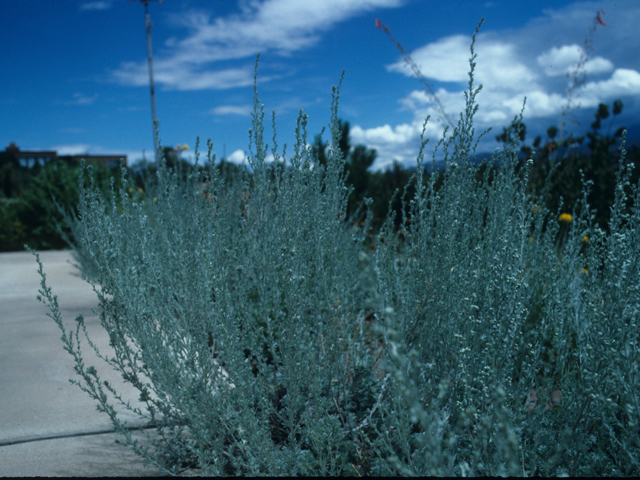
Prairie Sagebrush No. 2 by Sally and Andy Wasowski

Prairie Sagebrush No. 3 by Texas Agriculture Experiment Station

Wildlife Corridors

For every reader comment, Sage to Meadow Blog and Flying Hat Ranch will donate one dollar to Wildlife Corridor organizations in west Texas and New Mexico. (Limit is $500.00 and only one comment per reader counts.)  We need Wildlife Corridors so that migrations of beautiful animals may be seen by our grandchildren.

Leave a comment

Filed under Prairie Sagebrush Awards 2010

Backlog Unclogged: A List of Worthy Links About Nature

Here are some links to articles about various topics that I have in my backlog.  Some of these I want to write a post about, but since I think they are of value, I wanted to get the links out to you before I wrote.

40 bloggers who really count – Times Online.  The London Times selects forty bloggers worthy of note.  Divided into categories, i.e., green, nature, feminism, politics, etc.

Costa Rica Learn Jaguars Need a Smooth Commute – NYTimes.com.  Costa Rica habitat preservationists are working to provide migrating corridors for the jaguars.

Worldchanging: Bright Green: Koyaanisqatsi Revisited A reflection on the film and its lasting affect.

I have come across the Borror Laboratory of Bioacoustics, Ohio State University.

Here are the sounds of a Sandhill Crane and two chicks about the nest in Michigan.

Sandhill Crane on nest.

Enjoy the sound.  I will be getting authorization to use the sound database more fully in my blog.

From The Atlas of Global Conservation – The Washington Post.  This is a tremendous map resource for reference.

The Daily Scrapbook.  All things related to scrapbooking.  Illustrates old scrapbooks from early twentieth-century forward.  Lots of photos.

Getting Used to It – Cooks Illustrated.  Christopher Kimball writes an essay with each publication.  This is one of his best.

Is There an Ecological Unconscious? – NYTimes.com.

New Finding Puts Origins of Dogs in Middle East – NYTimes.com.

Divide and Diminish – Opinionator Blog – NYTimes.com.

2010 Report: Climate Change — Grasslands.

Climate Change Threatens Migratory Birds, Report Says – NYTimes.com.

The Sleeping Giant.  A Montana blogger.

Bioregional Animism.

MSU News Service – Management of cheatgrass on Conservation Reserve Program lands.

Condor Lays Egg in National Park – NYTimes.com.

A Deal to Save the Everglades Could Rescue U.S. Sugar Instead – NYTimes.com.

3 Comments

Filed under Life in Balance

Old Glory Dancing

San Angelo, Texas, Concho Valley Farmers Market (San Angelo Standard-Times, May 8, 2010)

“From truck tailgates, more than a half-dozen vendors will display an array of freshly picked vegetables, fruits, plants and flowers at the traditional farmers market at El Paseo de Santa Angela on South Oakes Street, across from Fort Concho National Historic Landmark in downtown San Angelo….The initial inventory will consist of greens, radishes, carrots, beets, pecans, honey, houseplants, asparagus, spinach, potatoes, onions and garlic. Homegrown tomatoes should be harvested around the first of June, squash should be ready in the coming weeks, and watermelons will be available for sale in time for the Fourth of July.   ‘All our farmers pick their gardens the day before, wash and ready the produce for next-day sale,’ she said. ‘It’s fresh, fresh, fresh because we pick it and we sell it.’   The market association’s bylaws prohibit outside vendors when locally grown vegetables are available. Most of the vendors are from Wall, Mereta, Fairview, Grape Creek, Knickerbocker and Christoval.”

By the count of the U.S. Department of Agriculture, there about 4,500 farmers markets in the U.S.   Eat fresher food, support your local farmers market.  Dallas, Texas, has a huge farmers market.  Fort Worth used to have a farmers market on Belknap Street, but I not so sure it is still there.

And, once you have prepared fresh vegetables with your grass-fed beef or buffalo, go to a dance.  The Old Glory civic hall is not open, but if it was, you might find your way to that fair place and say in the morning, “A good time was had by all!”

Old Glory, Texas, Senior Dance (Abilene Reporter-News, April 2, 2010)

“Seniors dance: A Senior Citizens Dance will be held from 7 to 10 p.m. Thursday at the Old Glory Community Center. Live music will be performed. Snacks will be served.”

Old Glory was settled in 1904, by German families, originally dubbed Brandenburg or Old Brandenburg, but with the outbreak of World War I, the name was changed to a more patriotic line: Old Glory.  The schoolhouse came to be the civic center when the population of Old Glory dropped to 125 in the 1990s (Handbook of Texas, “Old Glory, Texas”).

Dancing in the old schoolhouse, small community in west Texas, music live, not canned.  The blood flows with dancing and one can be young again.

Old Glory High School Civic Center (Photograph by Jack Williams)

Those that danced that weekend in Old Glory till soil and manage cattle, working in rural settings, close to nature and its infinite cycles of seasons.  This very same month (April), the Sage-grouse in Colorado stomps ground, and in Old Glory, men wheel their pardners, round and round in an old high school that they learned about Europe’s wars, their wars in the Twentieth Century that brought about the name change under which they danced that early spring evening.

Old Glory dancing.  Cupid drumming.

2 Comments

Filed under Life in Balance

Over the Hill

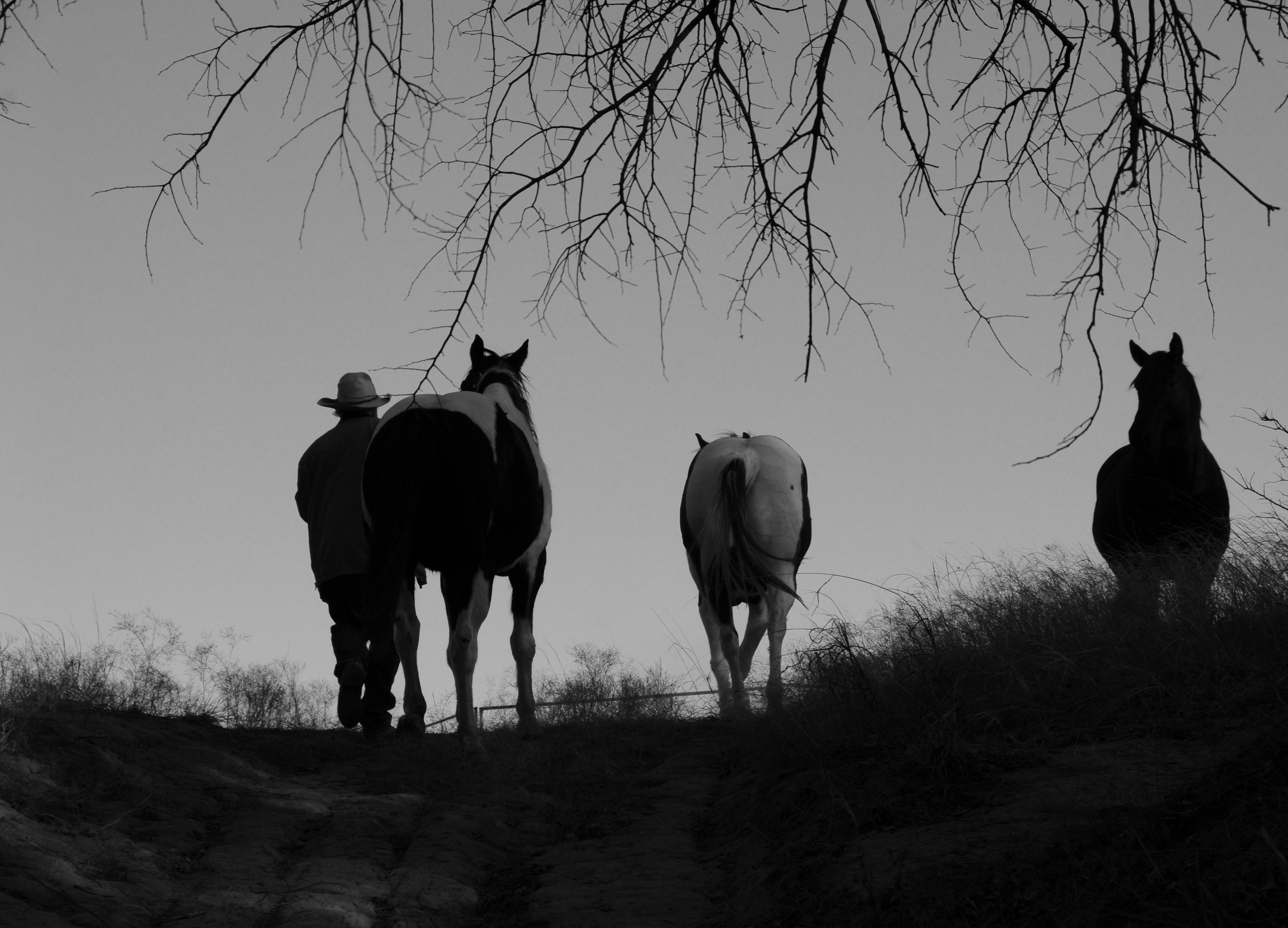
Over the Hill, February 2009

I am leading Star, Lilly and Sweet Hija over to the Pecan Tree Pasture.  They don’t really need my assistance to go over to the field, but on that day, the horses had not been there in several months and I wanted to walk with them.  The photograph was snapped in February 2009.  Hija was pregnant with Shiney and Fanny was behind Brenda who took the shot.  She stands in the creek bed and is looking up the road to the pasture.

The gate to the Pecan Tree Pasture was closed and I had to open it for them.

Their habit pattern is to go over to the far field and browse on grass most of the day, then near sundown that will come running at a gallop to get their grain in the stables.  Since this photograph was taken, I have kept Lilly close to the stable because of her age.  With Lilly back at the stables, they will not linger in the Pecan Tree Pasture all day long, but come back early to be with Lilly.

Brenda entitled this photograph, “Over the Hill.”

12 Comments

Filed under Horses

Field Log 5/10/2010 (Kiowa Good Luck, The Mariposa) [Corrected]

North Erath County, Texas, 32.43 lat., -98.36 long. Elev. 1,086 ft.  Turkey Creek Quad.

All photographs below may be enlarged with a click of the mouse for maximum detail.

Yesterday, I hiked into the grove.  Cool temperatures in the 60s F.  Light rain.  Saw several blooms of plants I have yet to identify.

This morning, drove to Pecan Tree Pasture to photograph blossoming plants for identification and cut mesquite.  Wind is high at 25 m.p.h. plus, sustained.  Red Flag warnings are posted on the MSN Weather link for counties west of us (Upper Concho River area) until 8:00 p.m.

Green-flowered Milkweed (Asclepias asperula), May 2010

Plant Identification

This is the Green-flowered Milkweed (Asclepias asperula).  I saw only two clumps in the pasture.  Several butterflies and bees are on the flower.  The Monarch caterpillar feasts on blossoms.  It is toxic to animals and probably humans.  The pollen may also cause a rash or itch.  The Butterfly-weed (not this type pictured) is also known as the Pleurisy-root, known for medicinal value.

I was not aware of its toxicity.

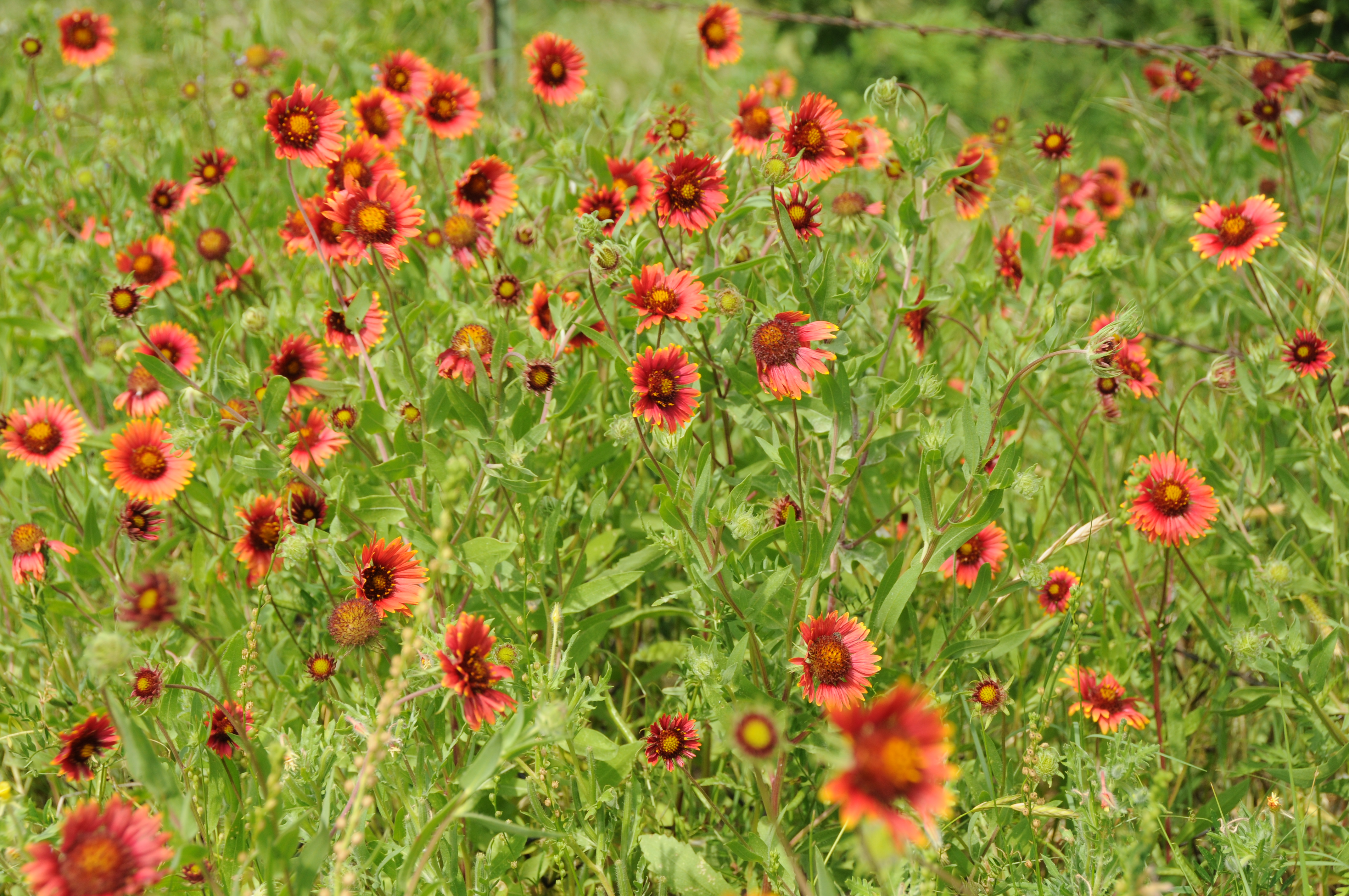
Indian Blanket (Gaillardia pulchella), May 2010

This is a stand of Indian Blanket (Gaillardia pulchella) next to the fence in the far pasture, the biggest stand of this species on the ranch.  Alongside State Highway 108, however, extensive Indian Blankets occur.  C. and L. Loughmiller, Texas Wildflowers, report that they have seen a forty-acre pasture completed covered in this one species.  Many years ago, I saw pastures in San Saba and Lampasas Counties covered in Indian Blanket.

Another name for Indian Blanket is Fire-Wheel.

It has medicinal qualities and the Kiowa considered its emergence good luck.  [See Lady Bird Johnson Wildflower Center notation, Indian Blanket.]

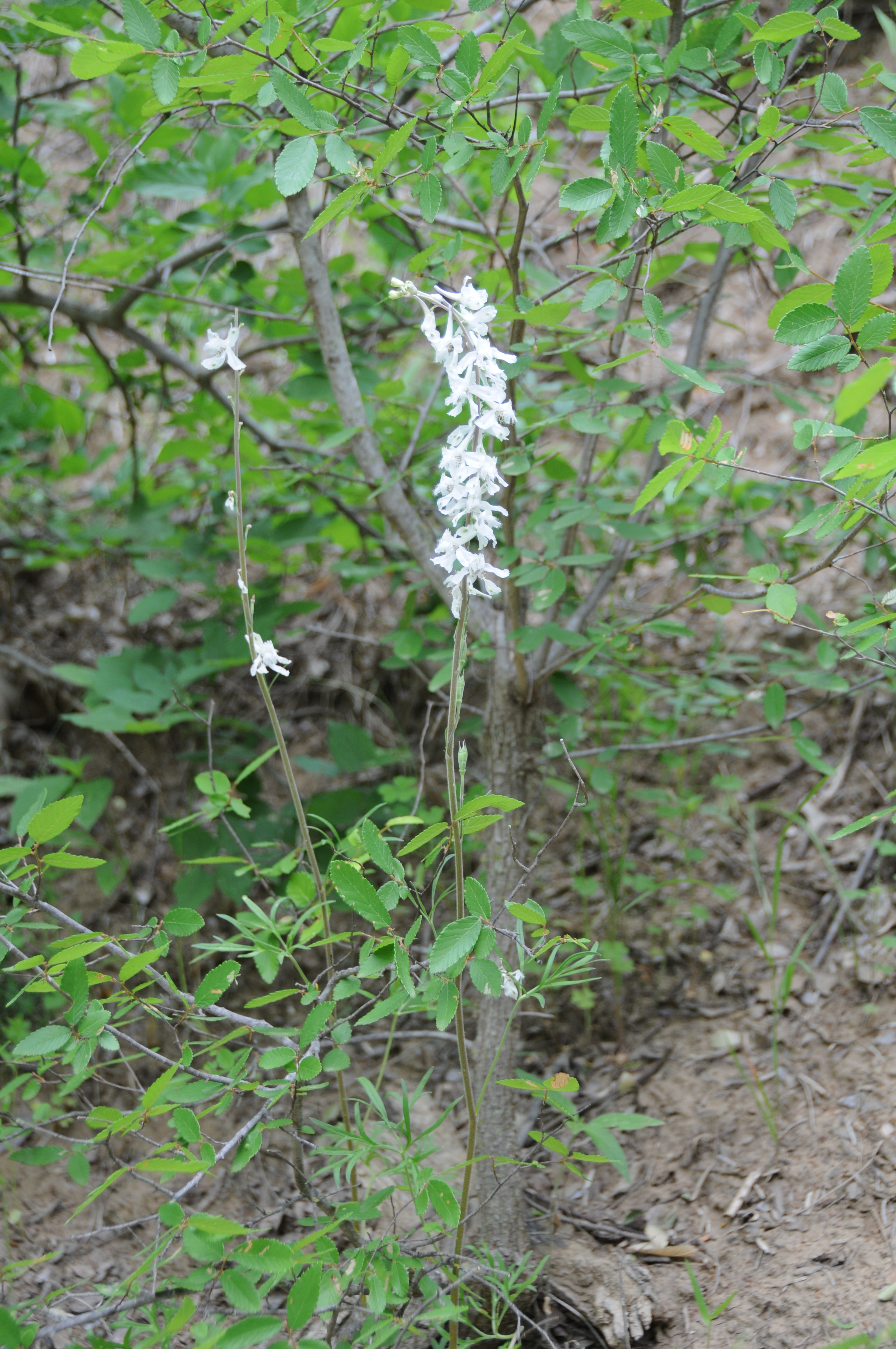
Prairie Larkspur (Delphinium virescens) Nutt., May 2010

This is the Prairie Larkspur (Delphinium virescens).  I found this along the banks of Salt Creek.  Again, this is a poisonous plant to animals and humans, although its seeds have medicinal properties.

In typing these plants and blossoms, I am finding more poisonous species than I imagined.  The horses leave the Larkspur and Milkweed alone, but I will be cautious during the fall when green grass is gone, as they might sample the plants.

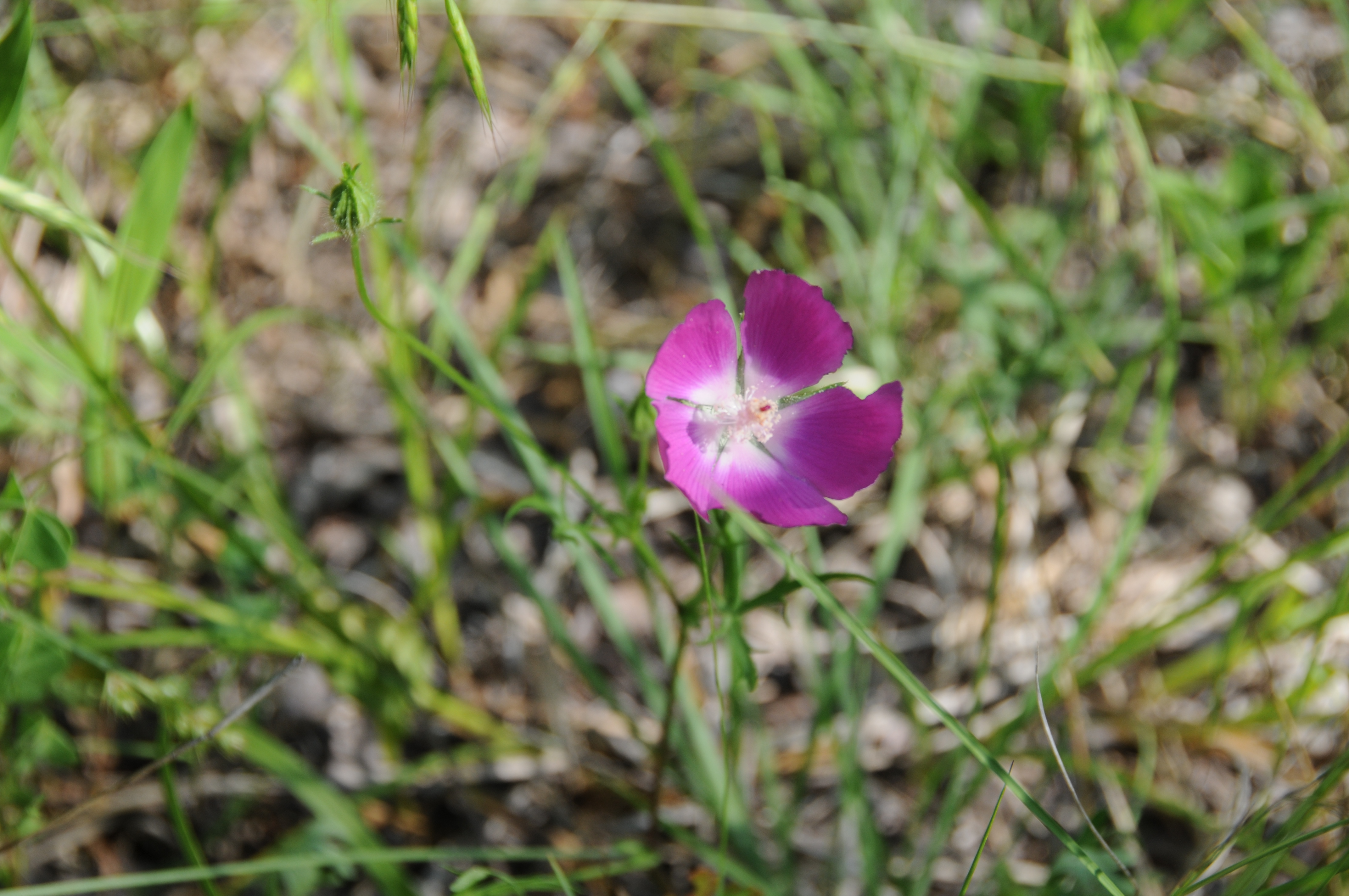
Wine Cup (Callirhoe digitata), May 2010, Photo 1

I am excited about this plant and blossom.  It is a delicate flower and there are only two stands of it on Flying Hat.  It is called Mariposa Lily or Sego Lily (Calochortus nuttallii).  One stand is along side the Pecan Tree Pasture road and the other is on the north side of The Grove.  I’m anxious to put out this photograph to show you, and I think I have it typed correctly, but later this evening when the wind calms down, I will go and verify.

The Mariposa Lily is considered among the most beautiful wildflowers in southwestern United States (Loughmiller, Texas Wildflowers). This Mariposa Lily on Flying Hat is probably the more common Mariposa, but a Desert Mariposa is quite rare in Texas.  Nonetheless, this flower is most delicate and I am excited we have two bunches of Mariposas.

Although I would be disappointed, if anyone can type this otherwise, please enter your rationale in the comment section.

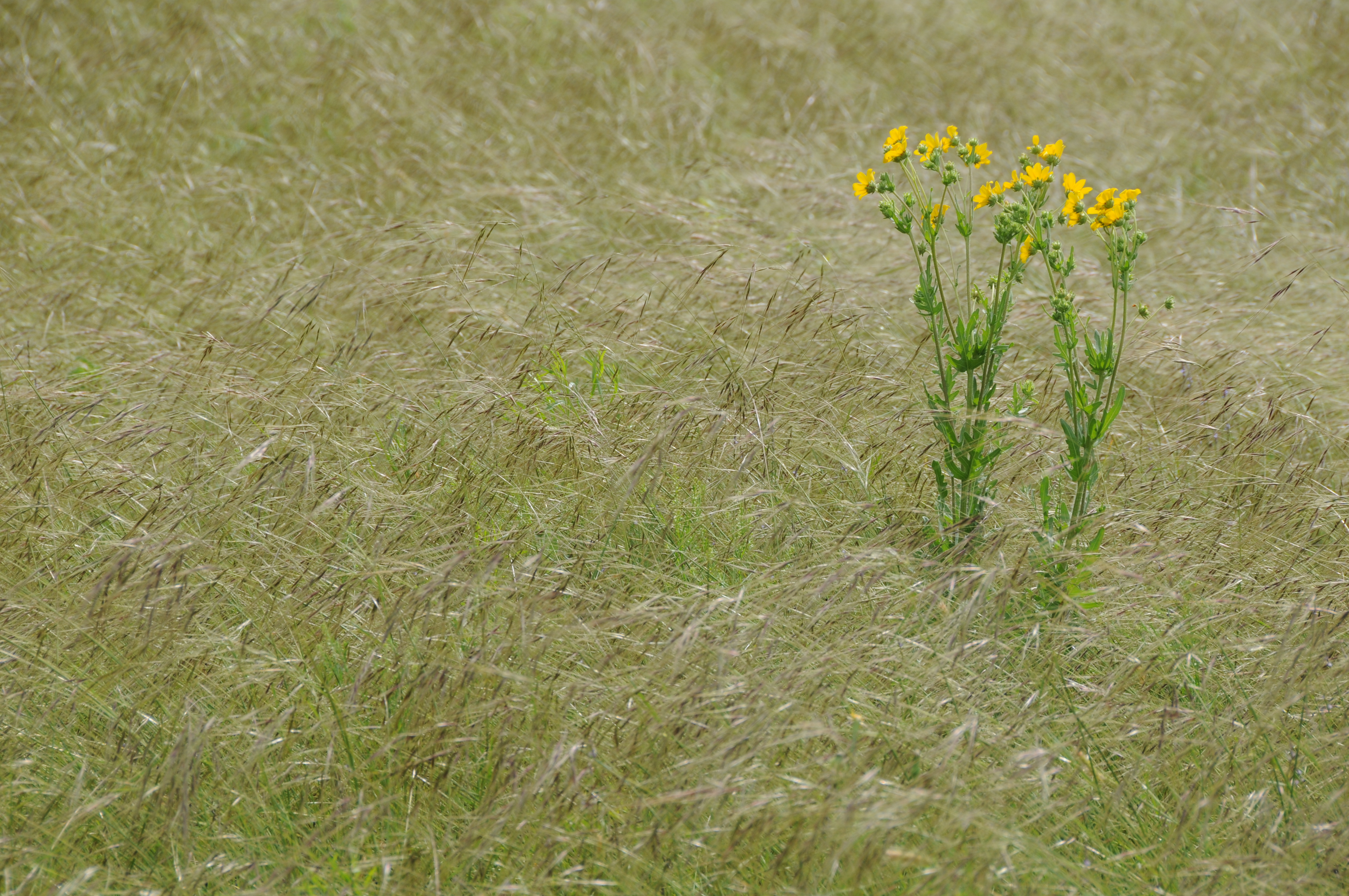
Texas Groundsel (Ragwort), May 2010

We have beaucoup amount of Texas Groundsel (Ragwort, Senecio ampullaceus) along our pasture roads.  The yellow blossoms are striking and until I changed the range strategy, I would shred these plants rather early in the spring.  This year, however, I have let them thrive.

Horses

Sweet Hija is still at Equine Sports Medicine & Surgery, waiting for the right time to be inseminated.

Shiney is still in Aubrey, learning manners from Jimmie Hardin.

Cut fifteen (15) mesquite bushes from pasture and fence row.

Note: Please check back later today for a verification of the Mariposa.

Correction to Identification

Correction to post, 5/10/2010, 5:38 p.m.  The winds died down some and I went back to The Grove to verify the plant and blossom.  It is not a Mariposa Lily.  It is a Wine Cup (Callirhoe digitata). When I investigated the Wine Cup in the field, I did not separate its petals to count them, but rather relied on the photograph exclusively when I got back to the house.  Brenda looked at it and had a question about the stamens and pistil form, but did concur with my first conclusion.

When I went back down to the grove a few minutes ago, I separated the petals to determine if there were three or five or however many.  Three petals would be the Mariposa.

Wine Cup (Poppy Mallow), May 2010, Photo 2

As you can clearly see in the Photo 2 of Wine Cup (Poppy Mallow), there are five petals.  I also carefully delineated the stem structure and it seems to be C. involucrata (Nutt.) [Wills and Irwin, Roadside Flowers of Texas, p. 153-154].

This plant also goes by Finger poppy-mallow, Poppy mallow, Standing winecup, Wine cup or Winecup.

15 Comments

Filed under Field Log, Plants and Shrubs