Field as teacher

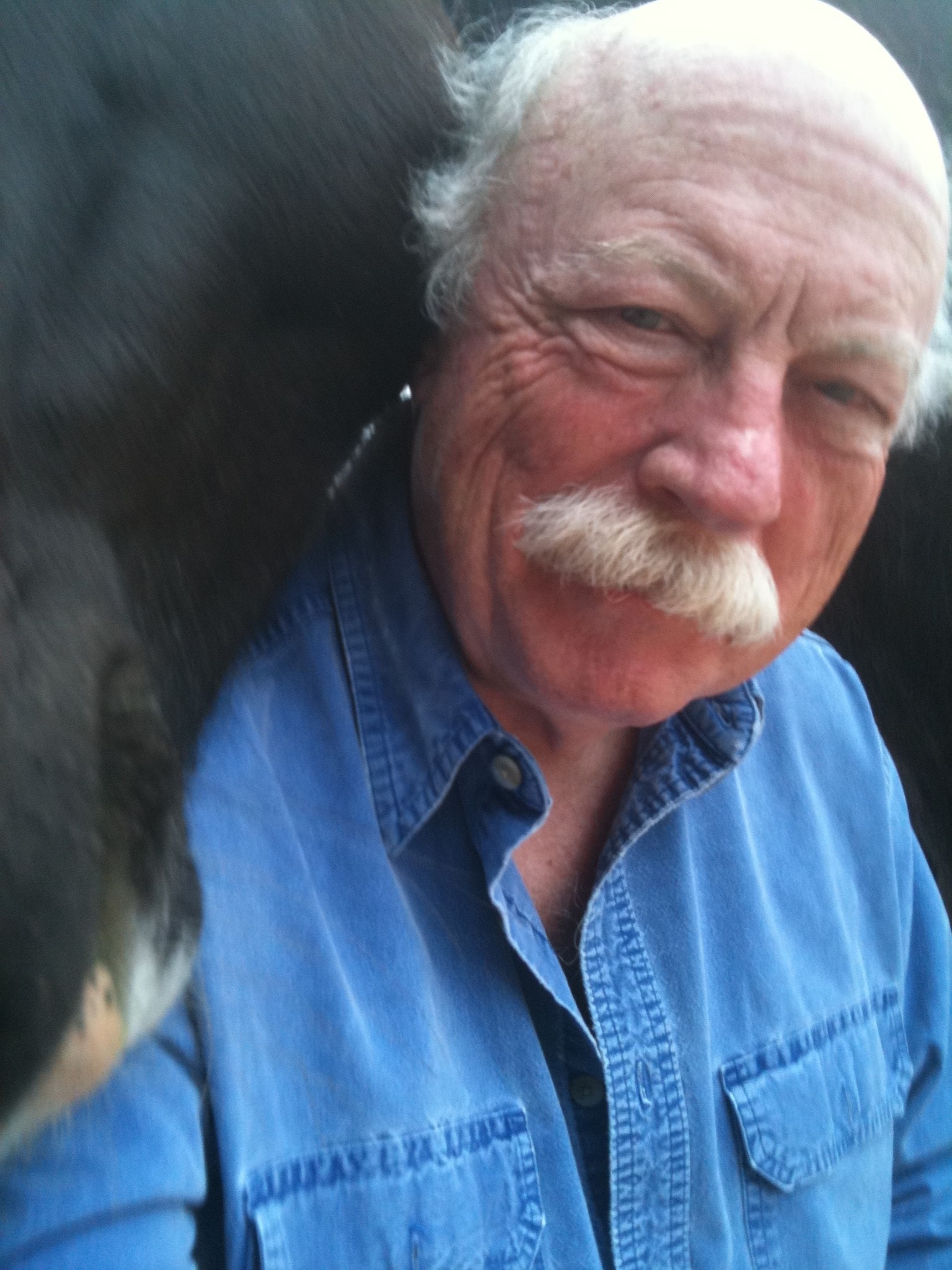
John Cheever in Massachusetts at the age of seventeen…

The spring of five months ago was the most beautiful spring I have ever lived in. The year before I had not known all about the trees and the heavy peach blossoms and the tea-colored brooks that shook down over the brown rocks. Five months ago it was spring and I was in school.

In school the white limbs beyond the study hall shook out a greenness, and the tennis courts became white and scalding. The air was empty and hard, and the vacant wind dragged shadows over the road. I knew all this only from the classrooms.

I knew about the trees from the window frames, I knew the rain only from the sounds on the roof. I was tired of seeing spring with walls and awnings to intercept the sweet sun and the hard fruit. I wanted to go outdoors and see the spring, I wanted to feel and taste the air and be among the shadows. That is perhaps why I left school.

In the spring I was glad to leave school. Everything outside was elegant and savage and fleshy. Everything inside was slow and cool and vacant. It seemed a shame to stay inside.

~ John Cheever, “Expelled,”  The New Republic, October 1, 1930.

* * *

I think it important, even redemptive, that I spend time in nature, away from the classroom or ranch house, walking in pasture and grove.  Yes, I know, it is all nature, even within four walls — the air, the sunlight, the particles of dust and skin floating within the house.  Without walls, however, weather intrudes, scents come sharply and trees present their foliage.  Wildlife intersects the trail.

When I lectured at T. C. U. one semester, I taught from a second-story lecture hall with an array of seven or eight windows looking out upon elms and green grass about the campus.  It was a western civilization class of thirty students.  Often I went to the windows while lecturing, propped my elbow on the ledge and instructed undergraduates while frequently glancing into the seasons outside the panes.  I liked that classroom and sometimes dream of it.

* * *

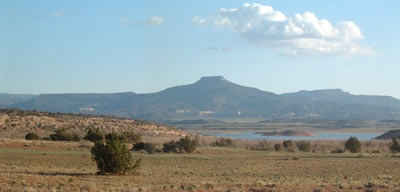
Field work in anthropology never tired me.  Surface surveys for isolated occurrences of stone tools or hearths carried me from arroyo to mesa in New Mexico.  Boots dusty, sweatband wet and Levis soiled at the end of the morning offered solid evidence of my toil.  I thought of people, long ago, that walked the same good ground, gazing at Cerro Pedernal.  My students that I led into the field, without fail, always returned to the classroom the next day invigorated, talkative and inspired.  The field instructed, not me.

______________________________

Notes:


John Cheever, “Expelled,” The New Republic, October 1, 1930, reprinted in The New Republic, January 5, 2011.

13 Comments

Filed under Life in Balance, Nature Quote of the Day, Quote of the Day

Swarming berry feast for Tufted Titmouse

Tufted Titmouse (Cornell University)

I wrote my dissertation in Fort Worth, Texas, from a second-floor office, looking out upon an enclosed patio. Adjacent to the large window that framed my view were White Fringetrees that bore dark blue berries.  I composed intently and turned frequently to the window, yearning to be in high country, viewing pinon, spruce and ponderosa, not the Fringetree in a hot Texas summer.

One afternoon as I churned out sentences I saw birds fly onto and into the White Fringetrees.  Not just a few, but hundreds of birds landed on tree branches, weighing them down, almost to a point of snapping the branches from the tree trunk.  I turned away from writing and gazed upon Tufted Titmice engorging fringetree berries (1).  The animated flock, chirping and calling loudly, ate for fifteen or twenty seconds and then abruptly flew away, out of sight, in a orchestrated arc of motion.

I was stunned at clasping claws, fluttering wings, pecking mouths and swarming birds within ten feet of my desk.  No sooner than I began to think about their behavior the titmice returned, engorging and hanging upside down, flying crazily away, drunk upon the nectar, happily filled.

They stripped the tree of berries after two more returns to the table and I never saw them again that summer.  I waited for a few to return in the remaining days, but they never flew back.

I revere that image.  I thought then, as I do now, that the berry feast of swarming titmice lifted my mood and helped propel me to finish my dissertation, for at my desk I saw nature churning, grasping, eating and flying.  High country, after all, in Texas.

______________________________

Notes:

1.  Please read my reply to Bill’s comment in this post about my confidence in typing a Tufted Titmouse.  I have a measure of doubt about the typing.  I wrote to Bill:

I’m not one-hundred percent confident it was a tufted titmouse. At the time, I had never seen any bird like it: tufted, grayish, small, energetic. Fort Worth is 65 miles from where I live now, 120 miles from where I was born and reared. I would say I am seventy-five percent confident about the typing. I’m not by any means a birder and I was hesitant in presenting this post. I remember at the time that I got my Peterson out a few days after the event. My first definition was some sort of junco, passing through like you say, but a junco was too large. With a little bit more definition, photographs and migrating patterns into Texas (no farther than Texas, I read), I hesitantly put it as a tufted titmouse. No one was with me at the time of the sighting to corroborate….If you read my reply to your comment, how do you go about your typing of birds up there? Today, I use the Peterson and Cornell University website. My Peterson is falling apart from use in the field and carrying around for, say, forty years?…Thanks, Bill, for commenting.  [Bill writes a nature blog and lives in New England.  His blog is Wildramblings.]

The White Fringetree (Chionanthus virginicus), http://en.wikipedia.org/wiki/Chionanthus_virginicus.  See also Rutgers Landscape and Nursery Services, New Jersey.

Tufted Titmouse, Identification, All About Birds – Cornell Lab of Ornithology (Baeolophus bicolor).

9 Comments

Filed under Birds, Recollections 1990-

Pronghorn sunbursts

N. Scott Momaday

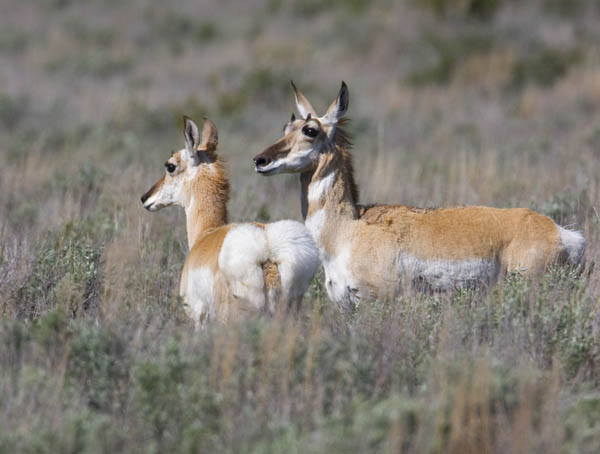
One morning on the high plains of Wyoming I saw several pronghorns in the distance.  They were moving very slowly at an angle away from me, and they were almost invisible in the tall brown and yellow grass.  They ambled along in their own wilderness dimension of time, as if no notion of flight could ever come upon them.  But I remembered once having seen a frightened buck on the run, how the white rosette of its rump seemed to hang for the smallest fraction of time at the top of each frantic bound — like a succession of sunbursts against the purple hills.

— N. Scott Momaday, The Way to Rainy Mountain, p. 19.

* * *

In the early seventies, between Clayton and Springer, New Mexico, Charles Fairweather and I drove fast to the Sangre de Cristos for our yearly getaway with several other friends who had already made camp.  We came up out of the roadbed onto a small hill and to the right, off the highway about 200 feet, were several pronghorn.  Charles quickly stopped the car and pulled out his deer rifle.  Charles, I said, let the pronghorn be.  Besides, it would be poaching if you shot him.  He was a good man, but impulsive at times.  He re-sheathed his weapon without a word and drove on to camp.

* * *

Between Snyder and Post, Texas, large ranches abound.  On one ranch, the Covered S, I saw pronghorn graze five years ago.  In the last four years, with the placement of wind mills for power and an extensive clearing of brush, I see no pronghorn.  They grazed in pastures on either side of highway.  This holiday, as we traveled to Lubbock, I looked intently onto the eastern pasture of the Covered S, hoping to see white rump in brown and yellow grass.  I saw none on either day we passed the Covered S.  I counted plenty of oil wells, but no antelope.

* * *

In the Journals of Lewis and Clark, they reported that antelope would rub themselves against sagebrush in order to perfume themselves.

* * *

Pronghorn at Red Rock, Idaho (J. Purdue photographer)


11 Comments

Filed under Adventure, Life in Balance, Life Out of Balance, Sagebrush

Stranded on a winter night in the Jemez Mountains

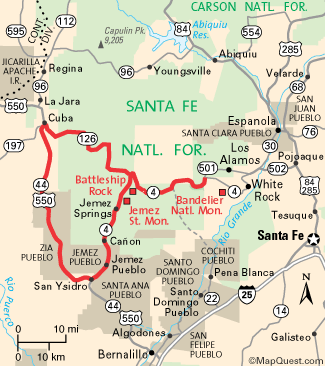
Road map of the Bandelier-Jemez area, New Mexico

One snowy and cold winter night in the 1980s, I was stranded on a forest road adjacent to New Mexico State Highway 4, between Los Alamos and Jemez Pueblo.  I drove a 1976 Chevrolet short-bed pickup with a two bunk camper.  The pickup was desert tan and the camper green with off-white stripes.  Not a flashy pickup, but neither was it an Eddie R. V. (National Lampoon Christmas Vacation).

I defined myself as a broad-gauge field researcher, taking notes on terrain, Native American culture and the interaction of Anglo, Spanish and Indian sub-cultures.  I kept a good set of notes and used them in class and at the desk when I wrote.  (Those notes are in filing cabinets in the barn today.  It’s 20 deg. F. this morning and I’m not fetching notes.  I’ll retrieve them later this year.)

On this particular trip to New Mexico in the 1980s, I had spent one night in Taos in the maid’s quarters at the Sagebrush and I was headed south to the Jemez Pueblo to spend the night at their campground and then on to Socorro and warmer climes the next day.  (A camper could pull into the campground at night and pay the next morning.)  It was around New Year or Christmas and snow had fallen in the higher elevations.   New Mexico State Highway 4, from Bandelier to the Jemez Pueblo, had an elevation of 8,000 feet and the snow had been partially snowplowed from the roadway, but neither forest roads nor pull outs had been cleared of snow and ice.

It was late in the evening, about 9:30 p.m., when I began to ascend the Jemez range.  As I left Los Alamos, I believed if I drove carefully I could safely go over the mountains and down to the pueblo.  My pickup was a two-wheeled drive with off-road tires and I had driven in snow and mud for many years in New Mexico and Texas.  When I reached the top of the Jemez range, I pulled into a picnic area that had not been cleared.  At first, I did not see a slight slope downhill, but when I noticed it, I immediately stopped and put my pickup in reverse to pull back out on the highway, about 150 feet from my position.  I backed up fifty feet and the traction gave way, tires spinning.  I was stranded and it was 10:30 p.m.

Snow was falling and no cars had come by on the road.  I wasn’t about to wander onto the road at night to flag down assistance.  Who would stop in the middle of the night for some guy up on the mountain and a pickup hidden among the conifers, nowhere to be seen?  Nobody would stop.  I decided to wait until daylight to flag for assistance.  I got out of the pickup, turned away from the road and walked down into the forest.

What a moment, I thought.  I may be stranded until morning, but the quiet of late evening and starry sky made me appreciate my predicament.  Only in this isolation, no trucks or cars passing, did I hear and see the forest and sky.  The stars were much brighter than on the Texas plains and they seemed to flash and glitter.  Wind blew through the trees sharply and the older pines creaked and groaned.  As the wind coursed, its sound was basso, baritone, not sharp tenor, but deep tones, earthy.

Even now, twenty-years-plus later, I slip into a reverie, reflective of that moment:  I have on my Eddie Bauer green parka, waterproof hiking boots with bright-red gaiters to the knees, snow pants, toboggan cap and ski gloves.  I walk farther down into the forest and stand transfixed in the snow for five minutes or so.  I realize I am experiencing one of the keenest moments of time, space and nature in my life.  And, it all comes about because of my carelessness.  The wind passing through the trees sounds lonely, yet comforting.  The stars faraway, yet close.  Alone without human company, I feel a family.

Well, enough of an Emersonian Drop’s Pond moment, I thought.  I have to get to sleep.  I walked back to the pickup and climbed into the camper.  I had several bedrolls.  My warmest bedroll was a blue mummy-type, goose down, that I would sleep in.  I spread the other bedrolls and a couple of old family quilts on the floor of the camper, stripped to my long underwear, got into the bedroll and pulled on my toboggan cap, tightened the mummy bag and promptly began to contemplate my fate.

I had no fear of freezing to death.  I was embarrassed for getting stranded.  Really embarrassed.  I could die of embarrassment.  Here I was on top of the Jemez in a two-wheel drive pickup.  I really didn’t want to hear from anybody that I should’ve had a four-wheel drive or chains.  Yeah, I should’ve, but I don’t.  But in order to get out of this jam, I would have to listen to the criticism.  Small price to pay, I thought, to have someone pull me out.  I drifted off to sleep, awakening a couple of times before morning light to the sound of high wind through the trees.  I slept warmly and awoke refreshed.

When it was fully sunup, I stood beside the highway.  I had heard one or two trucks during the night, but none since sunrise.  The weather news on the radio was good — no squalls or fronts approaching.  After twenty minutes, a man in a jeep came by with a winch on the front bumper.  I waved him down politely.  He stopped and I asked for just a pull out to the edge of the highway.  “Well, sure,” he said.

I waited for the inevitable why don’t you have four-wheel?  Chains?

Those words did not come.  He drove the jeep down close to my Chevy, hooked the winch on the pickup and pulled me back up to level ground where I had traction, taking all of three minutes.  Unhooking the winch, I reached for my billfold to give him a couple of dollars and thanked him appropriately.  He refused to take any money, saying, “It’s no trouble, glad I could help you.  Take care.”  And, with that, he drove on down the mountain without throwing criticism in my direction.  I was as grateful for his understanding as I was the pull out.

I pitched my Chevy into second gear and came down the Jemez, heading south to warmer climes, remembering the sound of wind through the trees and shining stars on the mountain as well as the kindness of a stranger with few words.

______________________________

Notes:

I wrote notes on this adventure the next day.  The notes are in the filing cabinet in the barn.  Still.

In writing this post, between paragraph one and two, I wrote a couple of hundred words about eating and lodging in New Mexico in association with this adventure, but deleted it.  I saved it for another day.

I looked for a photograph of snow on the Jemez, but could not find any to insert.

I do carry chains in bad weather these days.  But, they are cumbersome to take on and off, depending on the terrain.  Solutions include having a four-wheel-drive truck, have two spare tires with chains already placed so that you change tires out or stay by the fire.  Tour another day.

12 Comments

Filed under Adventure

The eve of a new year on the ranch

Pigeons flying towards a new year above the Santa Fe plaza.

 We make resolutions and there’s nothing wrong in doing so.  We plan to do better, give more and finish the big chores we have had on our list for months, maybe even curtail or give up our vices.  Well, maybe not completely give them up, but back off bad habits.

I work with students, horses and the land.  I work in order to live, not live in order to work.  That’s a big, big difference.  Working with students this last year has been more rewarding than ever before in my professional career.  I attribute that to my nearing retirement and wanting to give what I think is of value to the student before I put the chalk in the tray and walk away.  Time is fleeting and I don’t have time to cover all the points, just the most significant.  So, for this next year, I resolve to cut the excess from the lectures and discussions and get right to the core: finding your voice, writing down your voice and tending to your own garden (Voltaire, Gilgamesh, Trilling).

For my life with horses, it’s a sadder year coming.  We are selling Sweet Hija who is pregnant with a female and Shiners Fannin Peppy, the first foal out of Sweet Hija.  Brenda and I will be left with our two paints, Star and Lilly, both having their share of health problems these days.  In January, we are going to Oklahoma City for the Mixed Winter Sale at Heritage Place.  Market forces beyond my control have cut through our ranch operations with a vengeance and the cost of horse breeding and market conditions force my hand.  What Brenda and I are trying to do, in taking Hija and Fanny to the sale in Oklahoma, is to put these fine horses in the best sale around so that they will have good homes or ranches to live out their days.  So, for this next year, I resolve to focus on Star and Lilly, build some good, strong pens in the Pecan Tree Pasture for their safety.  I resolve not to think too much about our loss of Hija and Fanny and the little one — difficult to push that resolution through next year, I guarantee.

And, finally with the land, I resolve to set up brush piles for the little critters, deer and birds about the place, not shredding every single bush like some of my neighbors.  Further, I want to learn the name of every tree species on Flying Hat Ranch, or at least make a major dent in nomenclature.  I will also continue to plant native grasses about the pastures.

The eve of 2011 is here.  I toast to love, health and fortune to be found among horses and land, family and students — yours as well as mine.

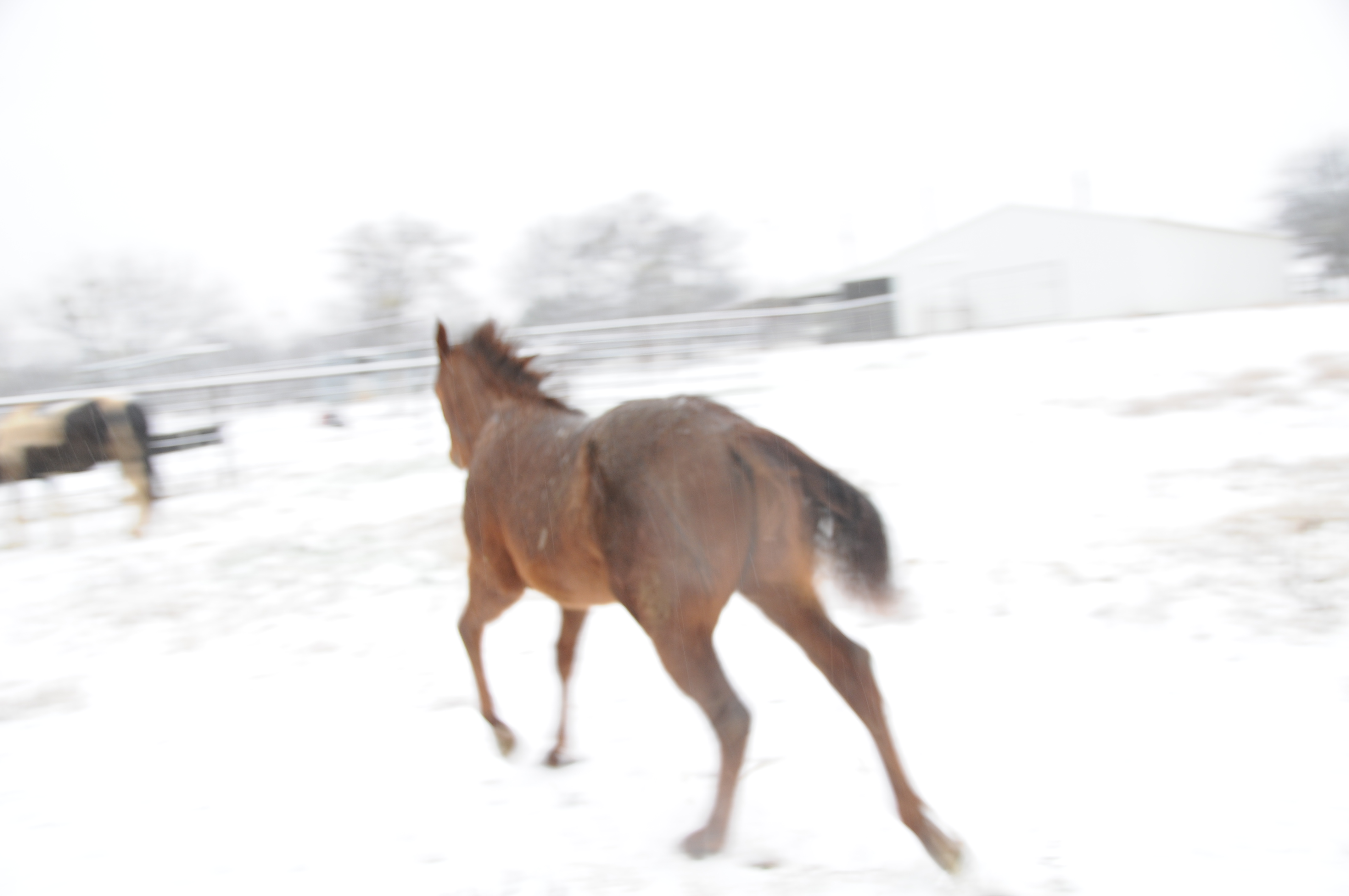
Sweet Hija at full gallop in winter snow (2010).
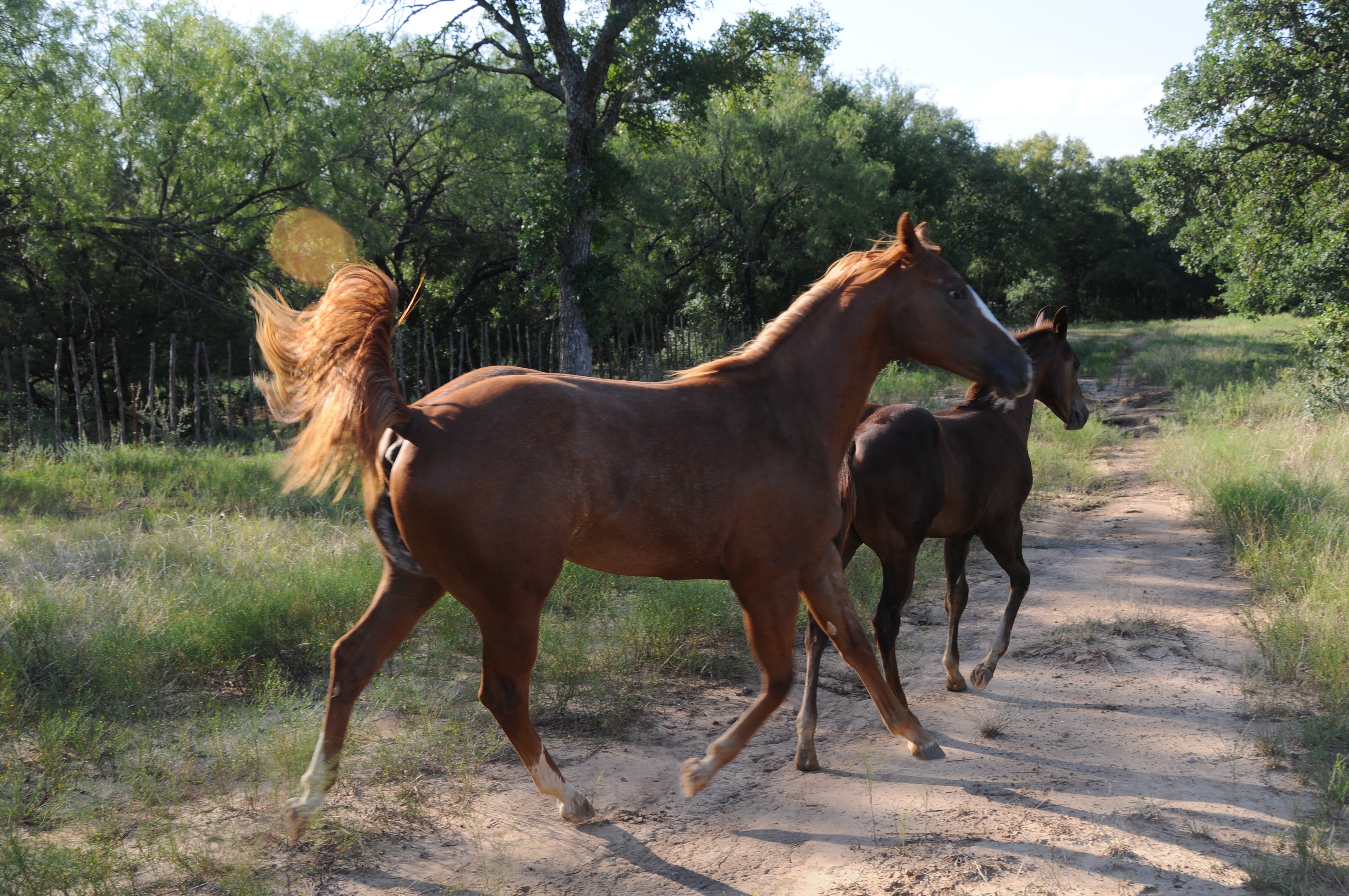
Fanny strutting in the grove with Shiney (summer 2009).

15 Comments

Filed under Flying Hat Ranch, Lilly, Shiners Fannin Peppy (Fanny), Sweet Hija

“From the Stone Wall” by Wildramblings

Far away from the Southwest, this nature writer describes a day in the New England woods, not so far different from our treks and hunts among the mesquite, cholla and oak.  Wildramblings is a blog worthy of putting on your roll.  Click the link below and relish fine writing.

From the Stone Wall | Wildramblings.

7 Comments

Filed under Adventure, Life in Balance

Willful Lilly

Willful Lilly walks to Well House Corral (December 27, 2010).

In the ongoing story of Lilly (Ima Lil Moore), she is a willful horse.  The above photograph shows her this morning, after browsing a few minutes in the front pasture, walking intently to the fence panels of the Well House Corral.

Lilly had spent the night in the stables underneath a 150 watt light bulb.  When I went down this morning to feed her, she was up and moving and whinnying for her breakfast, even pinning her ears back slightly when I entered her stall.  After she finished her grain, I put out two blocks of green alfalfa for her to munch on.

And, this is point of the story, she turned away from the hay rack and deliberately walked out of the corral and into the pasture with a determination of a yearling.  She’s twenty-five years old, for goodness sakes!  Then, after a bit of browsing, I shot the above photograph of Lilly.

She’s going to die — we’re all headed that way, for sure — within who-knows-how-long?  Tomorrow, next week, next month, next year?  Jim Scroggins is coming out to the ranch with his back hoe in the morning to dig a grave pit for Lilly.  Don’t be sad.  I’ll set up panels around it so that no one will wander into it.  It’s a preparation, sort of like making a will or planning a funeral with your favorite mortician.  (My political mentor when I was young was Groner Pitts of Brownwood, Texas, a funeral director.)  If Lilly makes it through the winter and I and the vet think she will, I’ll fill up the pit with water and maybe ducks will swim in it.  It is there, however, just in case.

But, for now, Lilly is a willful mare, stubborn in her habits, sleeping longer than usual and limping a little with arthritis.  Kinda like your grandfather or grandmother.  She has her life today and she willfully directs herself to green winter grass, lying down in the sun and drinking from the stock pond with ducks swimming about her.  It’s a good day to live.

9 Comments

Filed under Horses, Life in Balance, Lilly

Luminaria Christmas


Farolitos

Lights wrapped around tree with mobile art piece.


Rios Woodyard luminaria.

Christmas in Santa Fe includes the traditional farolito stroll after dark along Canyon Road, the artistic thoroughfare that delights the eye.  The luminaria is the wood fire.  Farolitos are candles within paper sacks that light up the edges of sidewalks and walls along Canyon Road.  For up-to-date information, consult the Santa Fe New Mexican newspaper’s Christmas Day edition.

New Mexican Christmas celebrations rival Italy and Germany.  Alessio Franceschetti, a very good friend of mine, sent me a montage of Christmas scenes in Italy.  Do look at it:  Natale in Italia 2010.  This montage is moving and beautiful.  Thank you, Alessio.


4 Comments

Filed under Christmas

Holiday wishes from Sage to Meadow and field notes

Shiney galloping to the corral during winter. No fear of the sun disappearing here.

A holiday greeting…

The sun in the northern hemisphere is at its lowest points this time of the year.  I do not think ancient and prehistoric people feared the sun would continue to sink towards the south and disappear forever — at least in southern latitudes of the northern hemisphere.  There was and is sufficient overlap of folk knowledge and tribal elder history to instruct the young and anxious that nature’s cycle continues her circle of cold to warm to hot, hot to warm to cold.

Christmas Eve and Day are here.  I wish each of you a Merry Christmas and Happy New Year!

* * *

Update on Lilly and Star…

Lilly, our oldest mare, is holding her own at 25 years of age.  She moves between the Well House Corral and the pasture, indicating a good level of energy and health.  Her feed consists of all the alfalfa she wants, Equine Senior Purina grain and 1 – 2 grams of bute (painkiller for horses) a day.  To husband animals rewards the steward: nickers and whinnies of recognition and impatience, warmth of animal in cold weather, riding for fun (both rider and horse can enjoy if accomplished properly) and work, and the sheer companionship and friendship of the horse.  One of my pleasures of having horses is hiking in the woods and having Star follow me like a hiking friend.  Star will go up and down creek bank, push aside brush to continue the hike and rest with me beside a fallen log.  If I wish to walk alone, I have to close the gate to the woods.  Most of the time, I want him with me.

Star is confined to the first corral.  He is overweight and feed intake must be limited.  He has all the coastal bermuda hay he can eat and some painkiller for his front legs.  His confinement lasts one week.  I have had to separate him from Lilly since she has alfalfa, he must have coastal.  Star is not pleased, but he adjusts.

* * *

A field post about bird songs on winter mornings…

December 16, 2010, 7:05 a.m.

Within the last two weeks I have noted birds about the barn and stables sing profusely only in the morning during the winter and are relatively quiet for the rest of the day.  I have not spent the day about the barn and stables to confirm unequivocally this observation (I’ll probably regret having brought this up in the first place), but it seems a sound observation.  During the day when I do chores and in the evening when I feed the horses and spend a hour or so in the barn area, I hear no birds or few birds.  In the morning, birds chatter and tweet, but do not break into long melodious fugues.

Our small ranch is located in North Erath County, Texas, Lat 32.43 N, Long -98.36 W, elev. 1,086 ft. Turkey Creek Quad.  Mesquite trees, live oak trees, elm and underbrush comprise the habitat for birds.

Among singing birds I see in the morning are redbird (just tweets), titmouse, chickadee, wrentit, wren, red-headed woodpecker, white-crowned sparrow, house sparrow, dove and a couple of other species I have yet to identify.  They browse in trees, on the ground and in the underbrush.  If I remain motionless in the corral after disturbing them, they resume their chattering and calls in a few minutes.  When the sun reaches a point in the sky at approximately 10:00 a.m. or so, songs and calls diminish.  I see birds for the remainder of the day, though not quite as frequent as the first two or three hours in the morning.  I hear during the day the quacks of ducks on stock ponds and crows on the fly.

7:35 a.m.

I have returned from the barn and stable area and this post is taking a curious turn.

A cold front moved in last night and the temperature is 40 deg. F.  The sun is not shining and clouds completely obscure the sky.  On point, birds are quiet, not even a peep, casting a different observation and bringing to light variables I had not considered: temperature, sunshine, clouds.

With the temperature in the 40s and no sunshine, I hear no birds.

17 Comments

Filed under Christmas, Flying Hat Ranch, Horses

Christmas Eve Music in Old California

This post was published Christmas 2009.  I have added some photographs to the original for this 2010 Christmas.  I find “Christmas Eve music in Old California” poignant with the cultural interaction.


Christmas in California before the Americans came [1840s] was a season when all the grown people had as much fun as the children do now.  And the children had so much fun that they never got over it and ever after loved play and presents more than work and hard bargaining….

One Christmas Eve, I remember best, there was a full moon.  Over all the ground there was a glittering frost, just enough to whiten everything, yet not enough to even nip the orange trees which at this season of the year hang full of fruit and blossom both….

We had much music–guitars of the Mexican and Spanish type, made with twelve strings of wire, and mandolins.  After supper there was dancing in the patio, coffee and cigaritos on the veranda, and singing everywhere.  Someone said it was a beautiful night for a horseback ride over the valley to the Mission Santa Clara.  The horses in the corral were soon saddled.  There were twenty-five or thirty of us young men and women.  Our horses were the best of the big herds that were attached to every rancho….The saddles, bridles and spurs were heavily covered with silver bullion ornaments, as in those times we put silver on our horses instead of on our dining tables; for Spaniards…live on horseback, and they eat but to live, instead of living to eat.

Riding out of the patio gate it was like a scene from the time of the Moors in Spain.  As our horses snorted in the cold air they spun the rollers in their bits, making music that only the Spanish horse knows [1].

______________________________

Notes:

[1]  José Ramon Pico, “Before the Gringo Came,” San Francisco Call, December 1899.  From Sam Travers, Christmas in the Old West:  A Historical Scrapbook, pp. 171-174.

Mission Santa Clara Asís established in 1777, was located a few miles south of San Francisco.  This mission and adjacent Indian pueblo eventually grew into Santa Clara and San Jose.  The mission is now located on the campus of  Santa Clara University.

Frank Principe, silversmith from Lindell Beach, British Columbia, writes that many of the old California-type bits, such as the Santa Barbara, were designed with Islamic religious symbols.  The symbols included seven buttons, half moons, and starts.  This is traceable to Moorish occupation of Spain until the 1490s, the Cortez expedition to Mexico, and other adventures.  He writes, “For the last one hundred years or so most North American bit makers have been using these designs without realizing their historical significance.”

Sweet Hija (Spanish for “daughter”), my black mare, has King Ranch breeding.  Even today, King Ranch provides ranch horses for Mexican ranches.  Of all my horses, Sweet Hija is the fastest and most energetic.  After saddling Hija, I must run her about the round pen to work off her energy before she is ridden.  She is the most alert and sensitive to her surroundings, spotting deer a half a mile away.  I have to use binoculars to see what she sees.

Spanish Mustang Research Facility.

11 Comments

Filed under Christmas, Horses