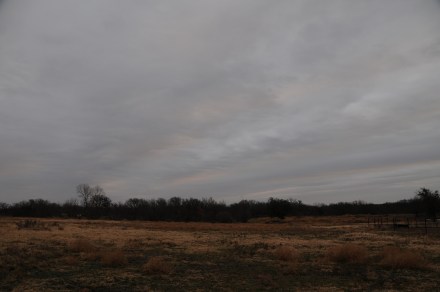
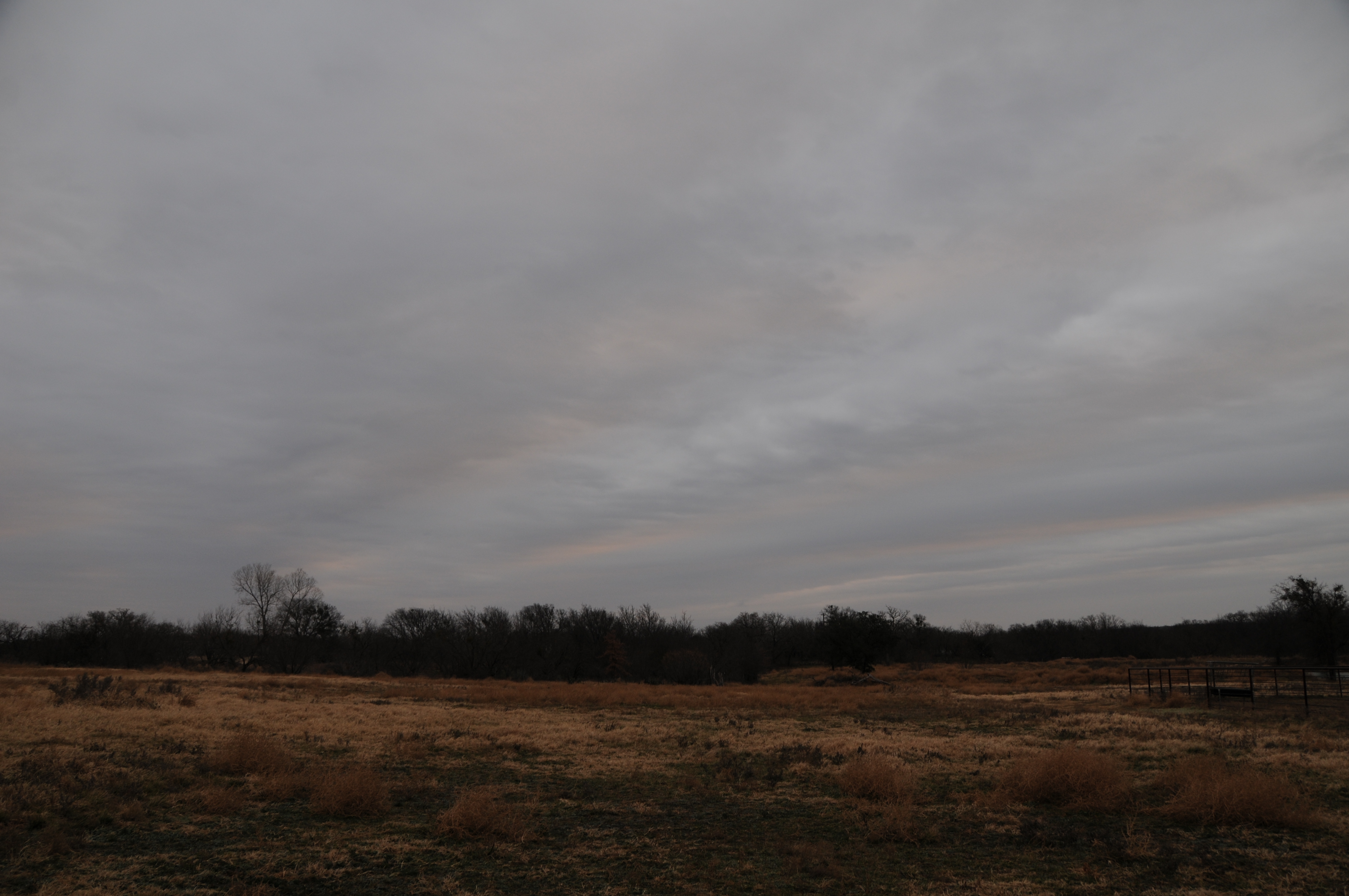
South Poprock Hill Pasture, Flying Hat Ranch, January 7, 2010
By the calendar it is January 7, 2010, and I am in the pickup, near the barn. Looking east from the Well House corral in south Poprock Hill pasture, the early morning sky configures a cold day for livestock and young men and women on horseback who manage them. Currently, we have no cattle herd to tend, but five horses need our daily attention. I rose early before daylight and planned the first feed of the day for Lilly the oldest mare and alpha, Star the gelding-son of Lilly, Sweet Hija the King Ranch legacy mare, and Shiney the colt of Sweet Hija.
Presently, I do not tend the fifth horse. The fifth horse is off-site, at Duncan Steele-Park’s place near Weatherford, Texas, going to school in the round pen of equine education. This horse, Fanny, is with ten others in her cohort, learning and gaining confidence to join-up and toil with cowboys and cowgirls that must use horses that are strong and even-tempered.
Duncan has a philosophy about horse training. Before we even unloaded Fanny from the stock trailer, he stated his way of working with young horses. Duncan grew up in Australia and his methods presage directness, no frills, no nonsense. He spoke clearly, precisely, in clipped tones of the Down Under, and with the authority of a thousand rides upon young horses needing guidance to confirm man as a friend, not predator.
The most important lesson you must teach a young horse, who is having his first few rides, is to go forward which is why I don’t spend much time in a round pen because there is no where for a horse to go in an arena. I find myself a fence line or a lane and kick the latch of the arena open and let my young horse just run. You see if you leave a young horse’s feet free you keep his mind free. And if things are getting a little radical, just one-rein stop him and then let him go and before you know it he begins to relax. People and clinicians now days take too much of the impulsion out of young horses because they spend too much time doing groundwork [in the roundpen].
I think I’ll play with Fanny this afternoon and see what she does [1].
My grandfather, J.W. “Jake” Parks trained or as they used to say, “broke” horses. My mother told me that her father would use a forceful technique to train horses and that the “screams” of the horses upset her as a child and caused her to resent the method Jake used, even Jake. My grandfather did not have a coarse or abusive nature; he loved jokes and took my mother and his sisters fishing along the Colorado River. He was, unfortunately, taught to use the aggressive method by his teachers and peers; that was what he saw in the 1910s and 1920s in central Texas. I think if my grandfather had seen another method to train without force, he would have used it. Those methods were not present in his background, although the method of respectful, non-forceful training has been around in recorded history since Xenophon, the Greek cavalry officer, 5th century B.C.E. General Stephen W. Kearny who marched American troops through New Mexico to California in the Mexican-American War, 1846-1848, reportedly used non-abusive techniques in handling horses. My grandfather probably never knew Xenophon’s way or Kearney’s. He was, like us all, a man of his times and it ended badly.
In the 1930s, while working on the Sorrel Ranch in Sonora, Texas, my grandfather was critically injured riding a horse named Hell’s Canyon as they popped brush for cattle. Riding fast, he struck a low-hanging tree branch and was knocked unconscious. Unfound for three days, he almost died before ranch hands rescued him. He never regained his health following the accident. I do not believe Hell’s Canyon delivered a mystical counterforce to Jake, re-aligning balance to horse screams and my mother’s pain, but rather the accident came as both horse and rider delighted in the chase of cattle for round-up.
The story of my grandfather and Hell’s Canyon was heaped on me when I was a child and I was told I favored my grandfather in body, but I never saw him. In the family narrative, horses and and my grandfather were always joined, wedded, symbiotic, tragic. I was never expected to follow my grandfather’s path. That was just as well because I grew up in a small town, my country experiences were inconstant and we had no land, no cattle, no horses.
Time passed, I inherited horses, my grandfather’s inheritance was passed down to me and I bought more horses, good horses, fine-bloodied, and beautiful. I bought land and I began to work with horses without force, without pain, and with respect. And, when it is time, I take them by the halter and give them to a teacher who will help them grow in ways that take them to high places, wind-swept and sunlit that call out their strength and delight to help tend livestock with humans in the West.
Duncan Steele-Park has a fenced lane, about fifty-feet wide, that angles from his round pens into the Texas brush and trees and pasture. Though I have not seen it, I know where the lane ends. I can tell you where it begins. For the horse, the lane begins with respect and it must end in a land of fun with Duncan Steele-Park. Jake would be pleased; he would be changed.
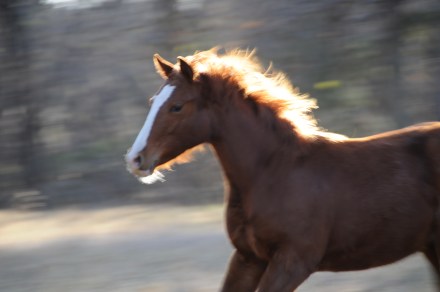
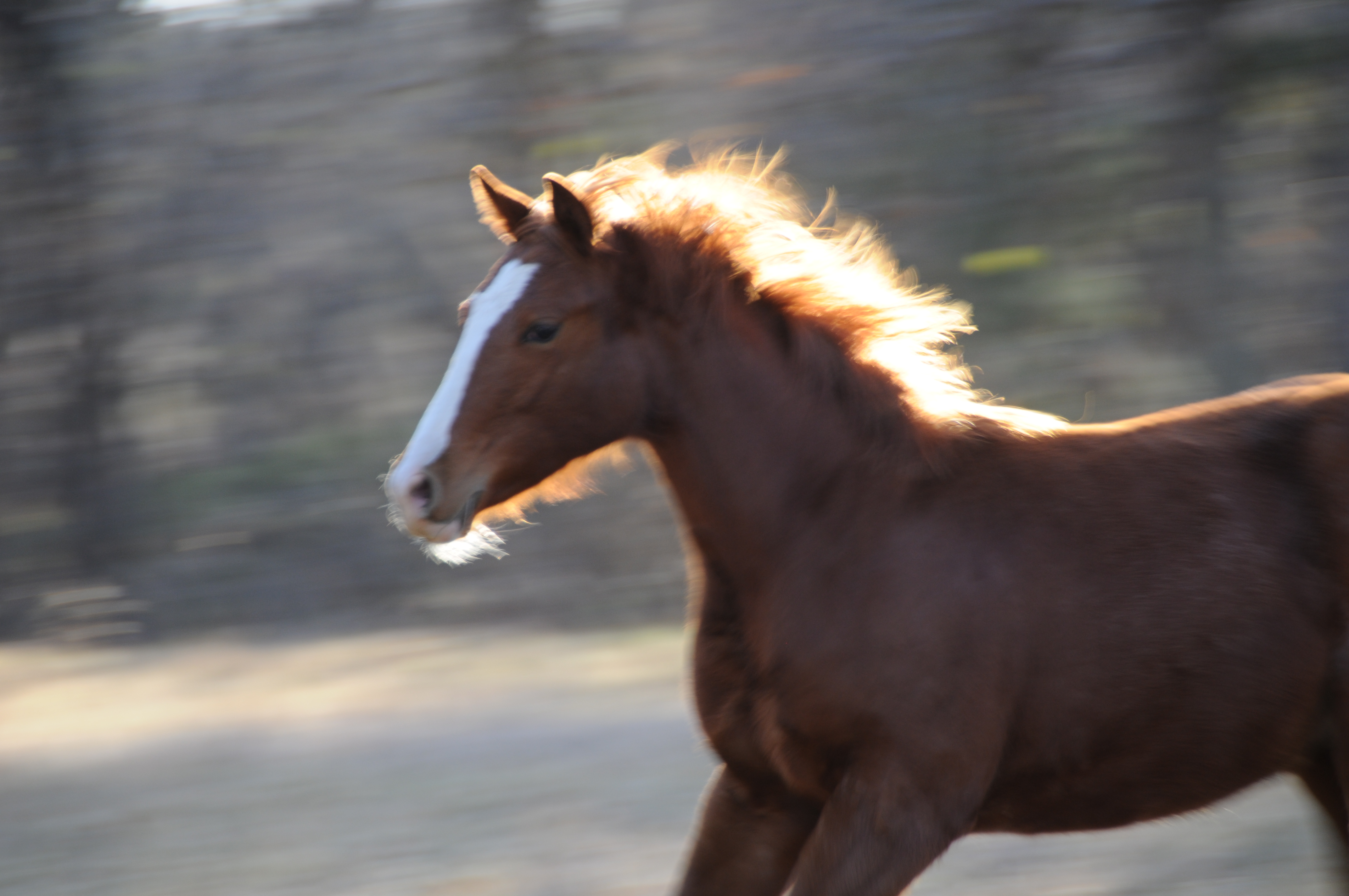
Fanny in the Grove, Winter 2009
Notes
[1] Conversation of Duncan Steele-Park to Jack Matthews, Weatherford, Texas, December 22, 2009; email of Duncan Steele-Park to Jack Matthews, Weatherford, Texas, January 8, 2009.
An an object lesson in writing and fact-checking, I sent Duncan an email on January 7, 2009, for him to fact-check my recollection of our conversation on December 22, 2009. My recollection was:
I let them gain a confidence before I ask anything of them. Some trainers just put them in the round pen and round and round they go, boring them and not letting them be. What I do is let them go down the lane, down the lane, learning for themselves and gaining confidence before I ask anything of them in the round pen. Then as they go down the lane, after awhile I ask something of them in the round pen.
As you can read, Duncan’s correction of my recollection carries specificity about training that my later recollection did not. His words have greater clarity about his philosophy and present his training style in definitely his own words. I can hear in his writing, the down-under Australian accent.
Duncan Steele-Park’s email address is duncansteelepark@yahoo.com.



















 Sage to Meadow ~ Jack Matthews