Tag Archives: United States

Poaching or just curious? Deer on Flying Hat Ranchito

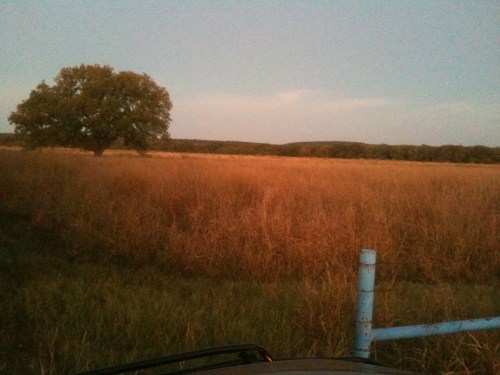
Southeast gate of Pecan Tree Pasture, deer season opening day, November 5, 2011, 7:35 a.m.

(The following datum comes from Field Notebook No. 1, October 29, 2011 –.  These are the original notes I took this morning on the first day of the regular deer season in north Erath County, Texas, November 5, 2011.)

7:50 a.m. In the far field at Pecan Tree Pasture.  One rifle shot to the south, a loud report.  41 deg. F.  One photo taken at southeast far gate.  No deer yet sighted.  Traffic light on State Highway 108.  Owl call, hooting, in the grove.  [I am parked between the grove and pecan tree, having entered from the far southeast gate to contain deer? within the field.]

No deer stands sighted on Old Bryant place, the Dooley place, that I can see.  This is different from past three years.  Two years ago, I sighted nine deer stands from my place.

Crows cawing — very few.

7:59 a.m., flock of crows flying east to west.

8:00 a.m.  Solitary deer sighted between me and water trough on my pasture road.  I am at the grove-pasture gate.

8:01 a.m.  Rifle report to the far south.

Deer may have come out of the grove gate by the water trough.  Deer leisurely walking up the pasture road.

(Bring binoculars next time.)

(Clear brush around fence in places so the F-250 is not scratched.)

A gray, short-bed pickup cruises by my open southeast gate, turns off road by gate, pauses, then goes north on SH 108.  No identification of the gray pickup.  Not a neighbor.

8:10 a.m.  Chickadees or wrens fussing in the mesquite brush, grove.  Will the solitary deer I saw cross SH 108?

8:14 a.m.  Rifle report to the east at some distance, estimated three miles distant.

8:21 a.m.  Rifle report to my southwest, very loud, very loud either on Dooley or Woods place.  I can almost smell the gunpowder.  [I carefully listen for bullet coming through air, but hear no sound.]

Far away to the south, another rifle shot.

A white-flatbed pickup passes on SH 108, slows down by field, turns around and comes back by deer at water trough, slows down, goes up road, turns around and then heads south on SH 108.  He probably saw the deer on my place.  Not a neighbor.

Big bluestem grass abounds in this field.

8:50 a.m.  Leave field.

______________________________

Notes, corrections, additions:

This year the rifle sounds are greatly reduced in number for the opening day of the general season.  The pickups that turn around and gaze into the far field where I have deer may be curious or may be looking for an opportunity to poach.  I can’t monitor and don’t want to monitor my field constantly.  I am glad that the deer stands have been significantly reduced in number from several years ago.  I have Tony Navarro to thank for that.  Game Warden Tony Navarro’s great-grandfather signed the Texas Declaration of Independence.  I rode with him in his outfitted pickup a couple of years ago when we scanned Flying Hat Ranchito for game. 

Game Warden Tony Navarro's card

2 Comments

Filed under Deer, Field Log

Not mine, not yours, but ours: Penasco Upper Llano acequias

The house on 17 irrigated acres from the Acequia de San Juan Nepomoseno del Llano. Water rights since 1789 (photograph by Taos Properties).

Forty-four years ago, in 1967, I traveled to New Mexico from Amarillo, Texas.  It was my third and most memorable trip for I dreamed for days about colors and pottery and adobe and silver.  I would lie down, fall asleep and pass into a dream world of silver and blue skies — northern New Mexico.  It was not all pleasant because I became ill from eating different Native American and Mexican foods, but that never deterred me from returning again and again and again.

Aside from digestive and dreaming events, I vividly remember a man plowing his field with horses near Mora, the unpaved streets about the Taos plaza and the narrow strips of farm land that bordered rivers and irrigation ditches.  The narrow strips of irrigated land not only reflected a precise lay of the land by survey crews, but also reflected a community, a meshing of farmers.  What was there about those fertile strips that drew me in?    In later anthropological field trips, I took my students by the Pecos River irrigated plots along State Highway 3 that ran from Interstate 40 to Interstate 25 between Santa Rosa and the Pecos Pueblo.  (Click to see Google map of the Pecos River plots.)

The system of irrigation is called acequia, referring both to the irrigation ditch and the association of members organized around it.

I have never owned land in New Mexico, but if I did I would buy a parcel of land that had water rights to an acequia, a system that stretches back in time to Native American communities before the arrival of the Spanish who adopted the local customs of water rights (riparian rights).  Having land that possesses an acequia, one automatically gains entry into a community that cleans, rebuilds and nourishes the ditches and, further, is granted rights to meet in a democratic association to discuss apportioning water and policies affecting owners that border the irrigation ditch.

Several weeks ago, I came across a piece of property near Penasco that if I could sell my ranchito, I would buy and move my horses and equipment post haste to Penasco Upper Llano.  See the following Google map:  This is the map-image of the Penasco Upper Llano property and other strips of community property.

This particular piece of property with the adobe house pictured above is located in the high country between Taos and Santa Fe and can produce 700 bales of hay a year.  The water rights go back to 1789, the year that the United States inaugurated its first president, George Washington.  The surveyor’s plat looks like this:
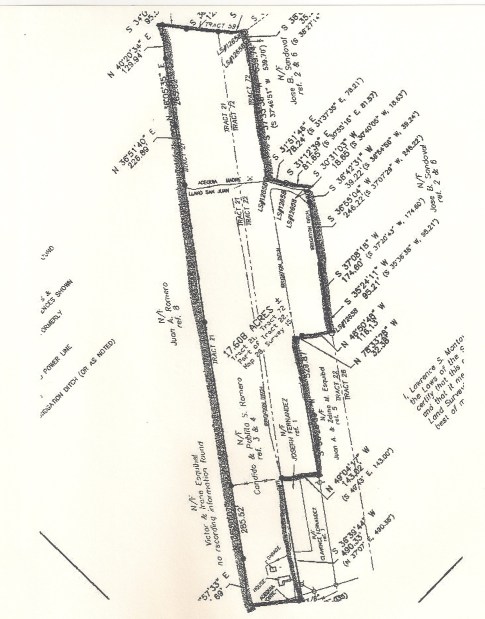

Stanley Crawford in his work, Mayordomo: Chronicle of an Acequia in Northern New Mexico (1988), writes of the acequia culture that I admire:

There are few other civic institutions left in this country in which members have as much control over an important aspect of their lives; relatively autonomous, in theory democratic, the thousand acequias form a cultural web of almost microscopic strands and filaments that have held a culture and landscape in place for hundreds of years….

Ditch-cleanings are all very much the same, and in this they often feel more like ritual than work.  The crew varies from year to year: a couple of old men don’t turn up each year, a couple of boys barely able to handle a shovel, fifteen- and sixteen-year-olds, take their places; the weather is better or worse than some vague notion of what is usual, mayordomos come and go and some are responsible and fair, others vindictive, punitive, almost military, others are lazy and heedless of the needs of the ditch; and the crew can be a good-natured, hard-working creature, or sullen and complaining and evasive, qualities perhaps dictated by the amount of pride or fear circulating through the hearts of both those in charge and those doing the actual digging….

Buddy Manzanares who, on one of my last perfunctory inspection tours half an hour from the end of the spring digging, calls on me to admire a meticulously dug out and cleaned up tarea [a grave-size chunk of the ditch], with the banks cleaned of grass and squared neatly where they end in the bottom of the smoothly shoveled-out channel….This man knows how to make this small thing, this chore, into more than we commonly imagine, and what can be more important to know in this life, than just that.

Mayordomo, pp. 176, 224, 228-29.

The deep thing about acequia that pulls on me is the ready-made community that circulates around water rights that nourish subsistence crops and the growth of hay.  The isolation of many Texas ranches and the people that tend them and steward their animals is not good; in fact, it diminishes the rancher to a coarse individuality that thins the possibilities of  human endeavors, insinuates a obsessive pecuniary attitude about the land and narrows civic — read unselfish — behavior to the mere casting of a vote once or twice a year.

There are western ranching communities that transcend these deficiencies, I grant you, but the tendency has been to sell out or buy more land, thus expelling more people from the agrarian way of life.  I have experienced this and have witnessed the deleterious affect upon my family.

I shall not be accused of romanticizing the acequia culture — oh, go ahead and accuse! — because it is a human community and there will be conflict and law suits, but there is an association, a group of men and women meeting about water and how to nourish their livestock, beans, alfalfa, corn, tomatoes, okra, flowers, lawns, chilis, vineyards, peaches, plums, apricots, coastal bermuda, roses, trees, and every other conceivable plant that flourishes from the soil that is watered.  Having an acequia culture forces the lesson about sharing in real, material ways that no desk-bound, box-bound person will ever learn.  The basic premise is:  water is limited, we all need it, how will we share it?  And, how are we going to keep it coming down the ditch?  The answer: let’s talk about it, let’s vote on it, let’s implement our decision.

Like so many other things in life, the ditch is more than a ditch.  The acequia and the water is not mine, not yours, but ours.
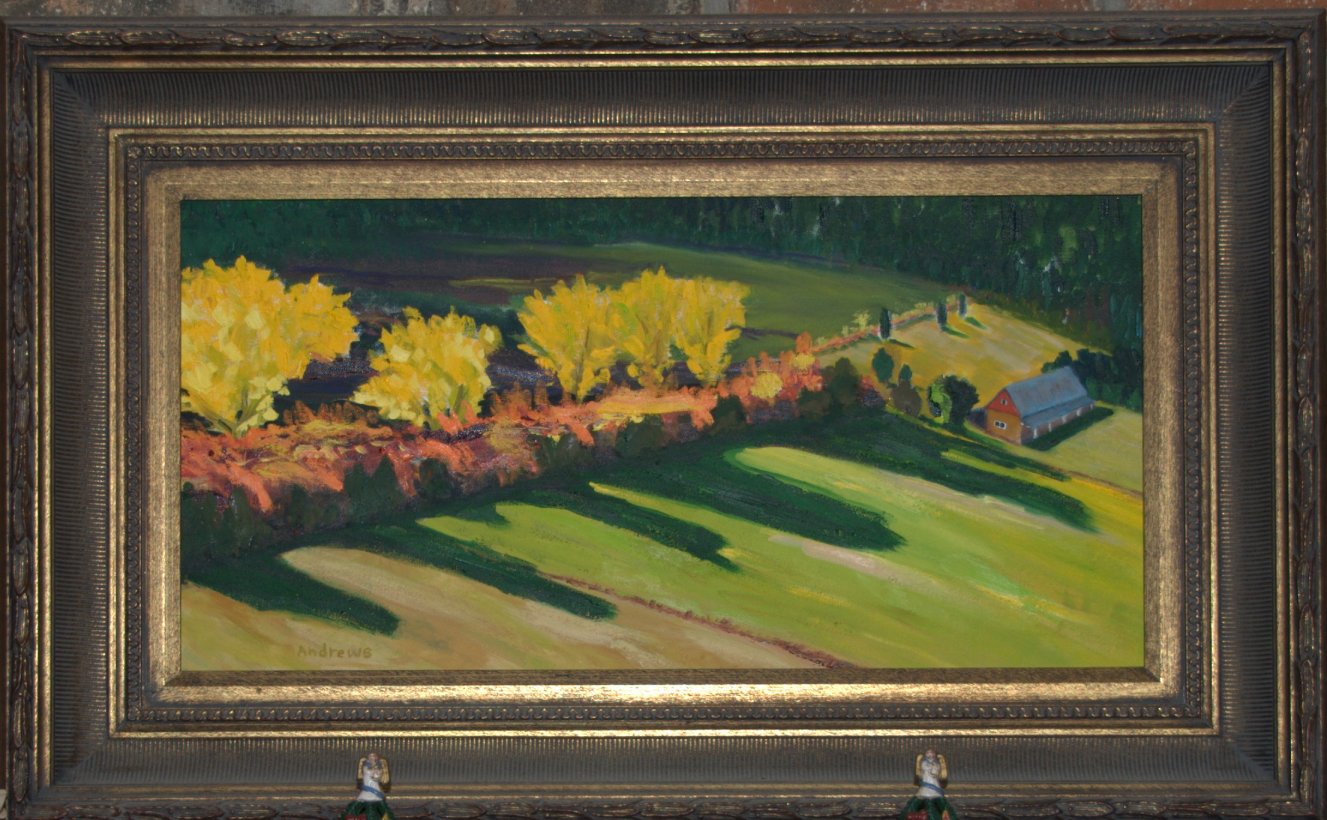
Acequia near Vadito, New Mexico, (Vadito II, oil by Eric Andrews, Taos, personal collection of J. Matthews).

______________________________

Notes, corrections and additions:

The language keyboard for Spanish and diacritical markings frustrates me.  Hence, the Spanish diacritical markings for “Penasco” are missing, although about every 20 times, I can get the tilde above the “n” in Penasco.  If anyone has any suggestions within the WordPress format to easily apply diacritical markings to writing, please comment or drop me an email at matthewsranch@msn.com.  I am intent upon using proper markings, but I am not going to spend ten minutes every time I need a tilde to paste it on.  Can Windows Vista do anything right?  Of course they can, but you have to update your browser every five minutes.  And, then restart.

13 Comments

Filed under Life in Balance, Santa Fe, Taos

Sage blooms in Abilene

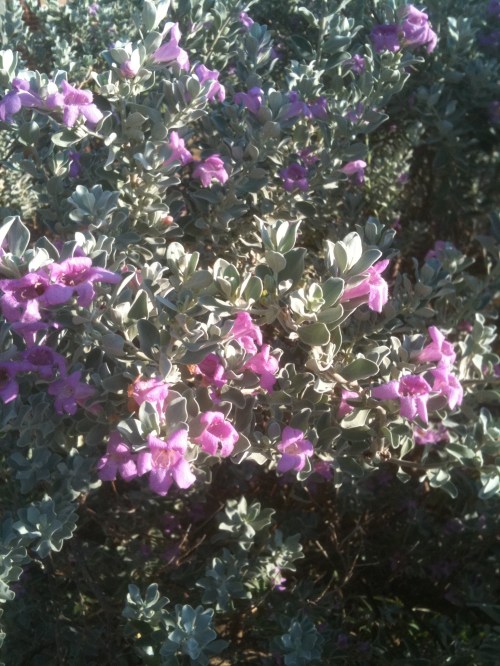
Sage blooming in Abilene, Texas, September 20, 2011.

This late summer, thundershowers fall infrequently around Abilene, Texas.  Yet, some showers do fall about this west Texas city that lies close to the Brazos River and Buffalo Gap, a niche in the hills that allowed buffalo to migrate from north to central Texas in the nineteenth century, following the shortgrass and bluestem in their casual browsing.

Two days ago as I worked late at my office at Cisco College, I walked by three large sagebrush by the back entry door.  A monarch butterfly floated by, floating and fluttering as if they are playing, and landed on one of the blossoms.  But before I could draw my iPhone from my coat pocket, it flew away and out of my range to snap a picture.  Alas, I was too slow on the draw.  I followed it to a green clump of slender grasses and lost it, despite my intent search.  The monarch had buried itself from my eyes, thinking me a raptor?

Yesterday, following the blooming sagebrush and my failure to photograph the butterfly, it rained about the city, to the north and west particularly.  A rainbow emerged with the sun setting to the east.  And, this morning, the temperatures were the coolest since May, a 61 degrees before sunup.

I think, if sagebrush blooms, can rain be far behind?  And playing monarchs about the purple sage?  Not far behind either.

Three sagebrush with blossoms at the back door of Cisco College, September 22, 2011. The monarch flew and hid in the bushes to the upper right of the photograph.


10 Comments

Filed under Monarch Butterfly, Plants and Shrubs, Sagebrush

Balance — monarchs, milkweed and horses

Leading edge monarch in Spring 2011, north Erath County, Texas.

Earlier this week on the first full day of Spring 2011, I received a communication from Journey North that the monarchs “were pouring out of Mexico” and that the leading edges were entering Oklahoma, about a 100 miles from our place in north Erath County, Texas.  A day before the e-mail, I had seen a monarch in our front field feasting on nectar of wild verbena, but I did not have my camera to take a picture.

The next day, March 23, 2011, I spotted this leading edge monarch in our live oak tree out in front of our house.  Twenty-three live oak trees live on the knoll of our home, a hill really, that is known as Poprock Hill in local folklore.  These trees have been the roosting place for monarchs, I am sure, for several generations.  We have seen monarchs every year since we have moved here and last year I snapped pictures for the blog of a large roost of monarchs in the Fall as they flew to Mexico.

I have known of butterflies all of my life, but only in the last fifteen years have I begun to look deeply into the ecology of where I live in north Erath County, Texas.  This blog I write, Sage to Meadow, has become a platform for me to the rest of the world, a medium of communicating my love of nature, its greens and browns, births and deaths that encompass us all.  Butterflies such as the monarch abound where I live and I did not know milkweed was a prime source of its nutrition.

Milkweed, like many other things, is an example of nature’s complexity and diversity, for although it is a prime source of food for butterflies, its over-indulgence by horses and cattle is toxic and may result in death if untreated.  When I learned of that last year, I quickly researched  the milkweed and its correlation with horses and found that adequate grass and grain prevents the livestock from consuming large quantities of milkweed.

So, the lesson here is balance for farmers and ranchers.  Keep good stands of grass in the field, do not overgraze, and horses and man and butterflies can co-exist.  It’s not the final lesson of life, but it’s one of the best lessons to acquire — for the monarchs can continue to find food to and from Mexico, horses will graze elsewhere and be pacified, and we will be able to look upon all their beauty and grace as we observe from close and far away the interconnectedness of us all.


Green-flowered Milkweed (Asclepias asperula), May 2010, north Erath County, Texas.


18 Comments

Filed under Horses, Life in Balance, Monarch Butterfly

Listening to the Fredericksburg Cypress

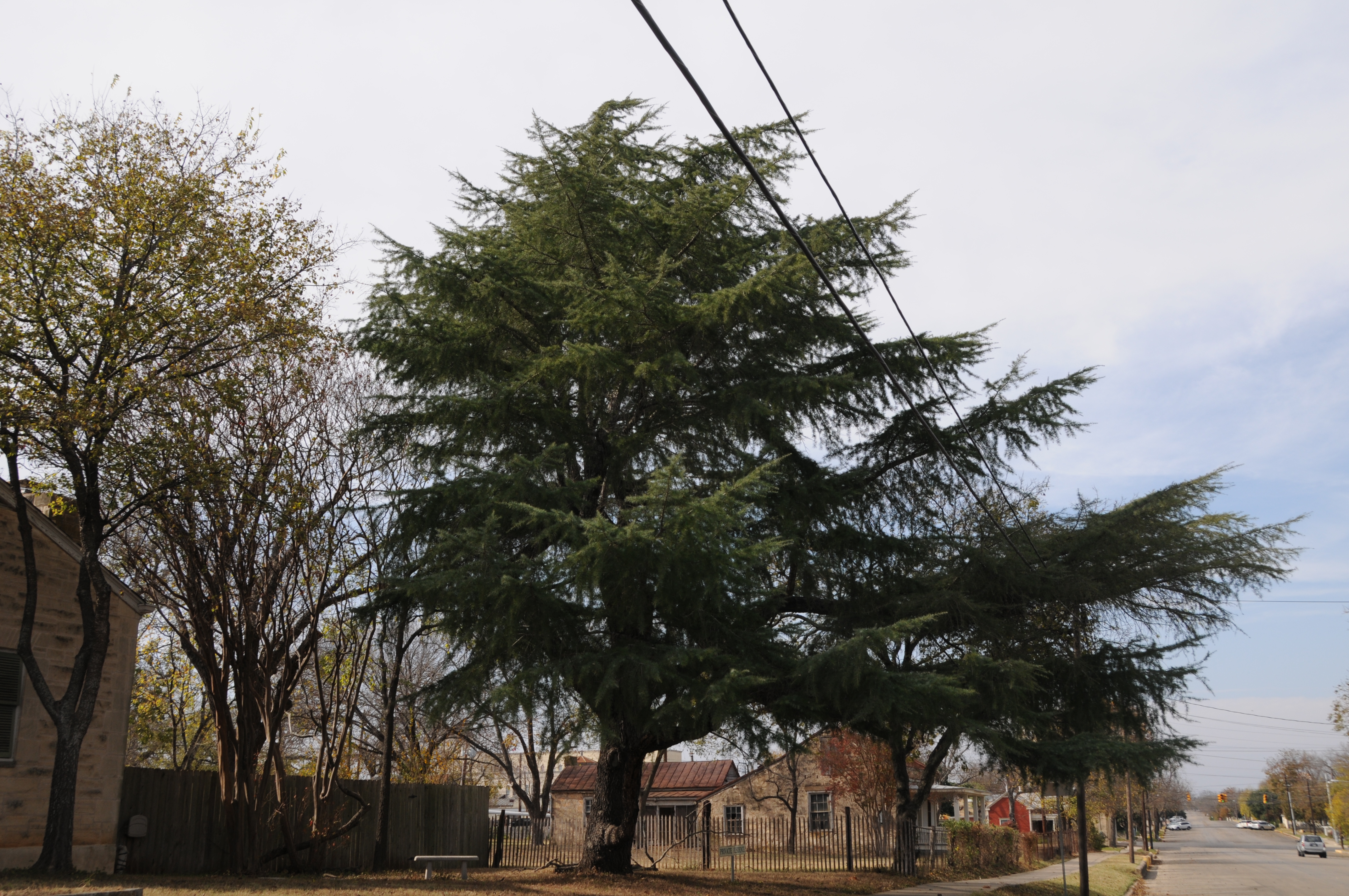
Mexican Cypress tree on Thanksgiving Day (2010)

Earlier today, I wrote the post below about identifying the tree pictured in this post.  I have since identified it as a Mexican Cypress tree.  Brenda and I drove back to the tree before we had our Thanksgiving dinner at August E’s in Fredericksburg, and as soon as we rounded the corner, she said, “That’s a cypress.”  I snapped more photographs and have factored attributes so that I am reasonably confident that this is a Mexican Cypress.  Other exotic nomenclature includes Montezuma Bald Cypress, Sabino, Ahuehuete and Cipres.

* * *

On one plane, I identify the tree because it is scientific to do so, giving a living thing a name that can be recognized across the community of naturalists so as to place it, give it provenance.  It is curiosity that prompts me to go back to this living, breathing organism and know its name, history and classic place in the scientific literature.  I might, in researching, find that this Mexican Cypress has healing qualities from its sap, its perfume.  It may even be a thing I would lace about my neck so that its scent alleviates anguish, propelling kinship with an organism that does not march across Texas, but sits still, in the yard of an old German land grant, most patient, most alive and most still.

On another plane, different and perhaps redemptive, is the search for connection in nature, in a world that seems so repelled by these things — trees, wild animals, un-managed waters — that all things wild are seen as a cropping, a harvesting opportunity.  I find that the cypress tree tells me something 1000 fathoms deep in the sea.  It says, I am the shade for your cattle, for your family reunions and my timber will eventually be your table, even your fire to warm you.  But, I will do those things only if you choose me to do so.  I will remain complacent and here until that day you choose to use me or ignore me in your work.

The cypress tree is named Mexican Cypress and is forty-feet tall, but it tells us something beyond the graph paper of science.  Are we listening?

The following photographs were snapped on Thanksgiving Day, my second effort at identification, giving rise to the above post.

______________________________

The post that follows below was written earlier today.

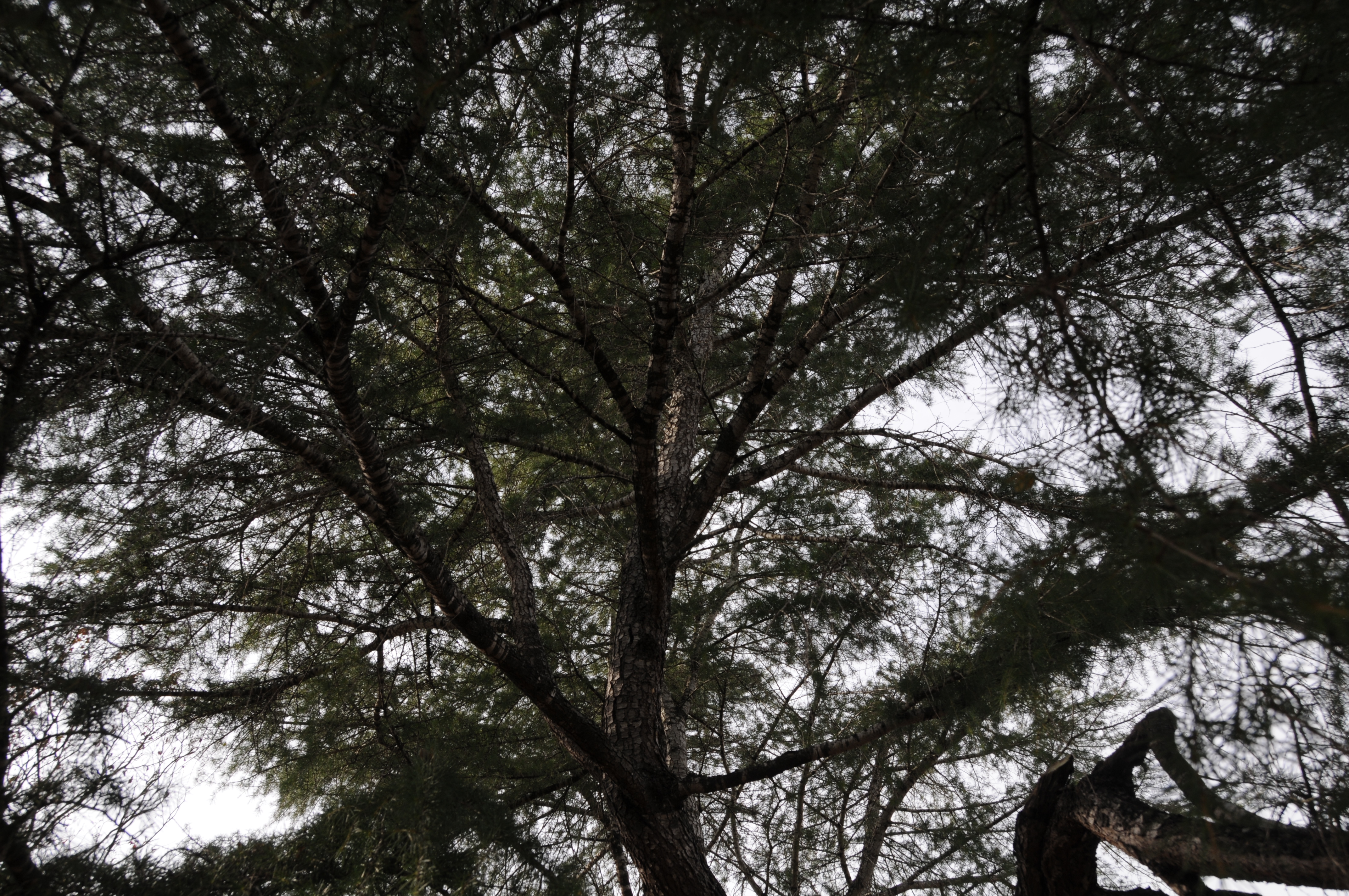
Before identification, one of two photographs that started the identification process (photographed the day before Thanksgiving, 2010).

In 1846, German immigrants settled Fredericksburg, Texas.  They brought seed and domesticated animals, planting corn most quickly.  I am in the town — population about 4,000 — and have been walking through older sections of town and I came upon this tree, pictured above.  It’s a most unusual tree, but I live 180 miles north of here in another life zone, so I am unaccustomed to the botany here.  I will continue this post later today or early in the morning with more photographs, but for now I am stumped on the identification of the tree.  I only have two photographs and the above shot is the best and it’s not all that good artistically or for the field record.  It’s all I have at the moment.  I did not get stimulated to type this until I couldn’t find botanical attributes quickly.

At this moment, I have one possibility:

Montezuma Bald Cypress, Mexican Cypress, Sabino, Ahuehuete, Cipres
Taxodium mucronatum Description: Montezuma Bald Cypress is found from the Rio Grande River south to Guatemala, although it is uncommon to rare in Texas. The main difference between Montezuma Bald Cypress and Baldcypress is that Montezuma Baldcypress is evergreen and the male flowers are borne in long racemes, whereas common Baldcypress is deciduous and the male flowers are in short clusters. Since the extreme southern part of the state is the northernmost of its range, it has difficulty surviving winters farther north than San Antonio.

Fredericksburg is within the life zone for this tree.  What has me thrown off is the trunk of the tree that appears oak.  It may be a graft?

More later today.

______________________________

Notes:

Information from Native Trees of Texas, Texas A&M University, see link on my pages.

Related Articles

6 Comments

Filed under Field Log

Tropical Storm Hermine Blows Hats Off

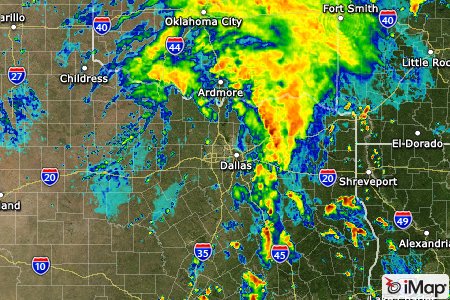
Tropical Storm Hermine, September 8, 2010, 3:05 p.m. CDT. Hermine has passed over our ranch and is headed northeast out of Texas. If you look west of Dallas about 100 miles, that is the location of Flying Hat Ranch.

Tropical Storm Hermine came through Flying Hat Ranch yesterday, dumping four inches of precious rainfall.  The clouds were low to the ground.  The mussel shells we place in the road going to the barn floated down the road with eroded soil, giving the appearance of beach front property instead the semi-arid West.

Hermine blew my hat off and knocked out our high-speed internet connection.  I came into Fort Worth today in order to work on my online classes.  As we left the ranch, the eye of Hermine passed over Interstate 20 and the sun shined and blue sky appeared.  But within a matter of minutes the eye of the storm passed and we were in gentle rain again.

When I fed the horses this morning, Star and Fanny ran around the corral in excitement, kicking and prancing, enjoying the cooler temperatures and wet weather.  I had to empty their feed bins of water.  Lilly, who is by herself in the Broke Tree Corral, loves the cooler weather, too.  The corrals are side-by-side so that they all can be together, young and old alike.

10 Comments

Filed under Adventure, Flying Hat Ranch

Our Taos Blue Door

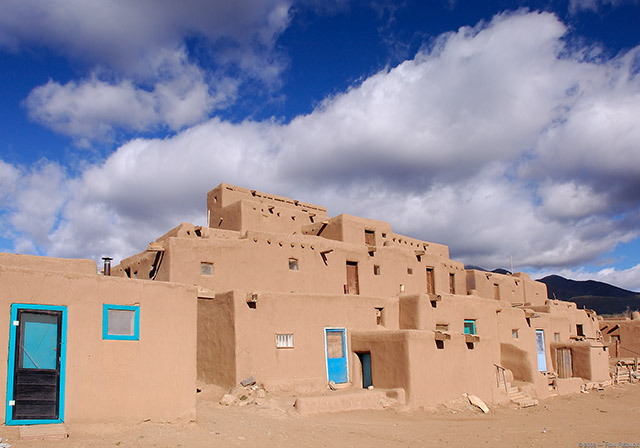
On my first visit to Taos Pueblo in 1967, blue doors and window frames reflected color brilliantly against adobe walls.  Still do.  Never outlandish in my opinion, the blue gave an even more mysterious quality to the north and south pueblo complexes.  I read that the Taos blue or Taos green, as it might also be designated, prevented evil and witchcraft from entering the dwelling.  The color surrounded the window or door frame with a protective halo.  It was also a beautiful color by itself, the security notwithstanding.

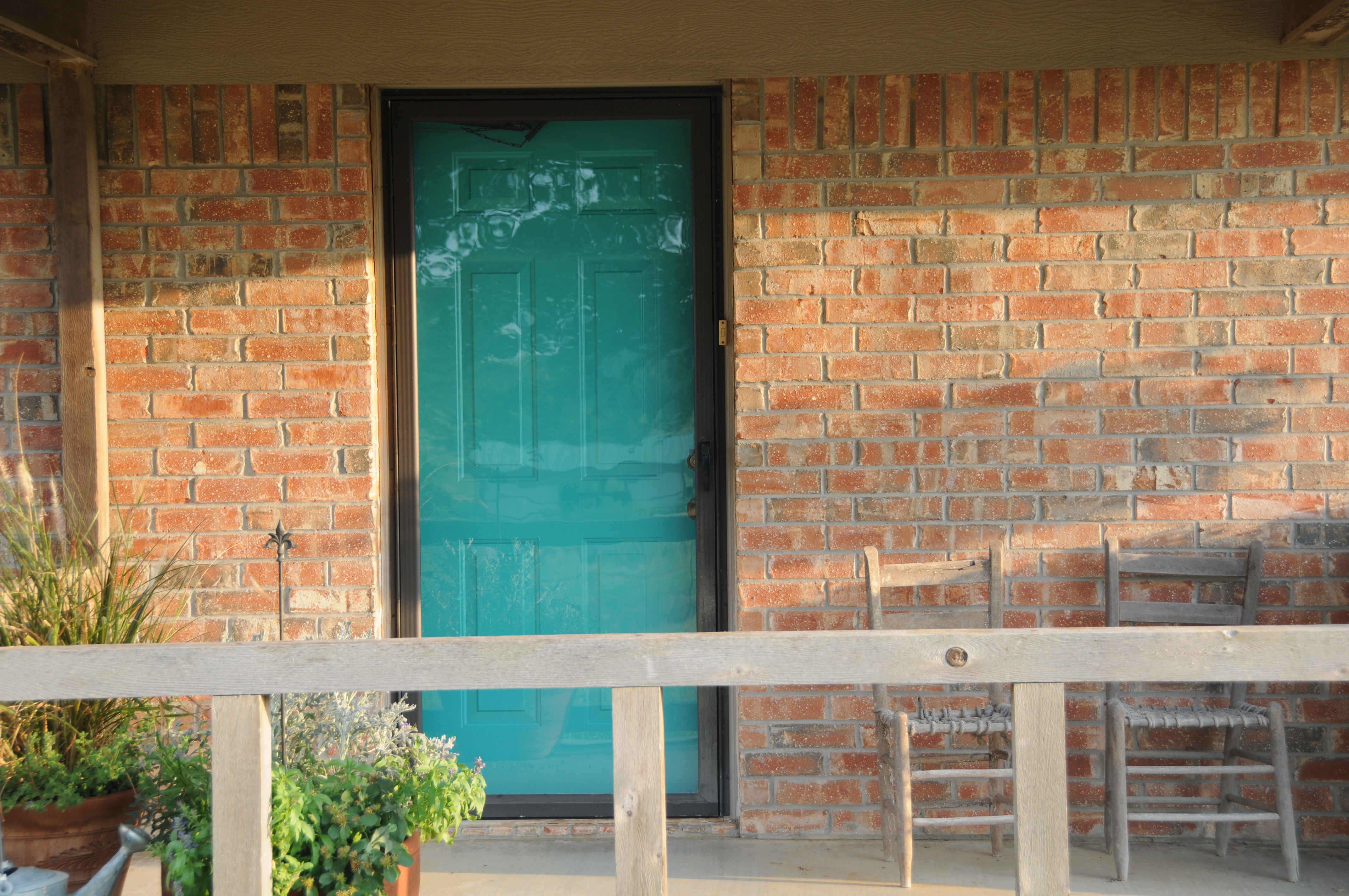
Blue Front Door, Flying Hat Ranch

When we decided to paint our gray doors, we looked up photographs in our books of the Taos blue and green, settling on the color you see in these photographs.  Brenda painted all three of our doors.  We got the paint from Sherwin Williams in Weatherford, Texas.  She took in a swatch that she had compared with photos in Christine Mather and Sharon Woods, Santa Fe Style, p. 25, lower right-hand photograph.  Sherwin Williams designated the color, Turquish, No. 6939.  She bought a gallon, using a third of the gallon to paint the doors twice.  I am trying to get her to paint the tack room door of the barn.  Course, there are no evil spirits down there.  Not with the horses chasing away bad dreams.

Close up of Taos Blue front door of Flying Hat Ranch house

______________________________

Notes:

Christine Mather and Sharon Woods, Santa Fe Style, New York: Rizzoli, 1986.

21 Comments

Filed under Flying Hat Ranch, Santa Fe, Taos, Taos Blue Doors

Nuzzles and Campus

Horses on Bianditz mountain, in Navarre, Spain...

Horses on Bianditz mountain, in Navarre, Spain. Behind them Aiako mountains can be seen.

My summer has ended.  Although the season does not astronomically change until September 21st, my summer is over.  I will feed the horses in an hour or so, then drive the interstate highway to campus, officially beginning the Fall semester.

Our summer has been dark and bright, jagged and smooth.  Broomweed has been shredded, horses husbanded and a vacation to the high country taken.  Brenda painted our doors Taos blue and green, symbolizing a color that repels the ills of the cosmos.  But they also look beautiful.

Here is one of my favorite pictures that I will carry with me as I return to campus.

Shiners Fannin Peppy "Fanny" Nuzzling Jack

18 Comments

Filed under Flying Hat Ranch, Horses, Shiners Fannin Peppy (Fanny)

Rewilding the Self

Rediscovering nature and its sentient beings is “rewilding.”  In the mid-1990s, Michael Soule of the University of California, Santa Cruz, proposed the idea that to restore ecosystems one should start from the topside down — reintroduce bears, wolves and otters to a deteriorating system.  Soule’s work was in conservation biology, but is now applied to psychology.

To many people in the field of mental health, a rewilding of the psyche is essential to the “heart’s ease.”  The following article from The New York Times expands on several themes surging in ecology and psychology.  I highly recommend you read this.

Is There an Ecological Unconscious? – NYTimes.com.

Artwork by Kate MacDowell (Photograph by Dan Kvitka for The New York Times)

8 Comments

Filed under Life in Balance