Tag Archives: Texas

Typing duck in flight part 2: the takeoff

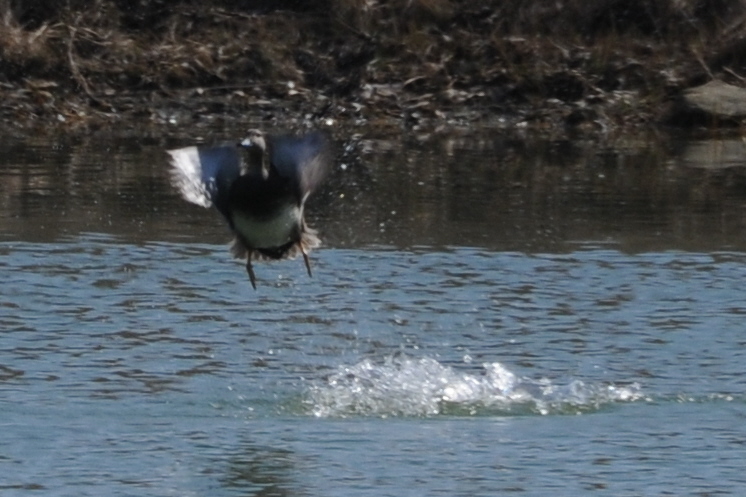
The unidentified duck in the photograph below takes off.  Upon a clue from Bill Lattrell who loves wild places (see his Wild Ramblings blog), the duck may be a Redhead (Aythya americana).  Field marks from Peterson’s include the male that is gray with a black chest and round red-brown head; the bill blue with black tip.  Both sexes have gray wing-stripes.  I have one additional photograph of the duck as it took off from the pond.


Tentatively a Redhead duck in takeoff from pond (February 2011).

The other aspect that may be a factor in identifying the duck as Redhead is that they patter along the surface while getting underway.  From the photograph above, you can see the traces of a patter?  It all happened so fast when the duck took flight that I could only snap two pictures.  (There is a camera feature to take rapid sequential shots that I should turned on.)  The other photograph is in a previous post yesterday.  It is the same duck.

In any case, if any of you have an opinion about the duck above, please comment or write me at matthewsranch@msn.com.  Duck feedback anyone?

7 Comments

Filed under Canvasback, Redhead Duck

No more rodeo


Texas Cowboy Reunion rodeo opening scene.

Received news today after doctor’s examination that I had an acute (severe) irritation of the cartilage in my left knee caused by arthritis.  No surgery is planned, nor  M.R.I.  The warning signs of the knee giving way, freezing up or ballooning the size of a grapefruit will necessitate further action, but for now, no more running or rodeo.

Not that I ever got caught up in rodeo.  The last one I participated in was back in 1958 when Brian Bettis and I scrambled for calves at the Comanche County Rodeo.  We came in second, bruised and somewhat bloody by the calf.  Calf won, we lost.  Since then, I’ve always worked cattle using a squeeze chute.  The simplest squeeze chute is to block both ends of the chute with heavy timber.  The cattle I handled were not abused and came to be accustomed to the chute to the point they stood calm while I doctored or vaccinated.  I will continue to work cattle with the chute since it doesn’t require heavy labor, just patience.

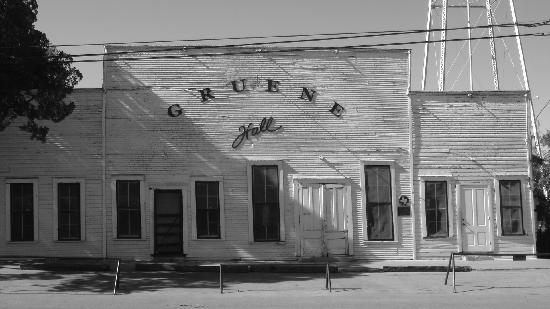
In any case, Sawbones said that I could not run or sprint again and that I would have to wait awhile to go back to the dance hall.  I love to dance.  I hear fiddle music and I am carried away.  But I have to wait awhile.

Gruene dance hall, oldest in Texas.

Further, the Doc said I needed to get some riding shoes or boots with soft soles.  After leaving his office, we went to Cavenders and I bought some Ariats with soft soles.  I wore them out of the dry goods store and they feel really good.

The cane?  Well, yes, I bought a cheapie at Walgreens and will use it for infrequent occasions.  My first use of it was to poke Brenda in the backside.  She did not appreciate that.

It is a bench mark to be told that “the running days are over.”  I ran occasionally in the pastures for exercise, but it was never a habit pattern.  Still, it’s a solemn note on the music score today.  Yet, I hear music and it’s a band with fiddle and guitar.  Come on, Brenda, let’s waltz across the floor!  You’re not a widow yet.

10 Comments

Filed under Dancing

Rough Creek drums

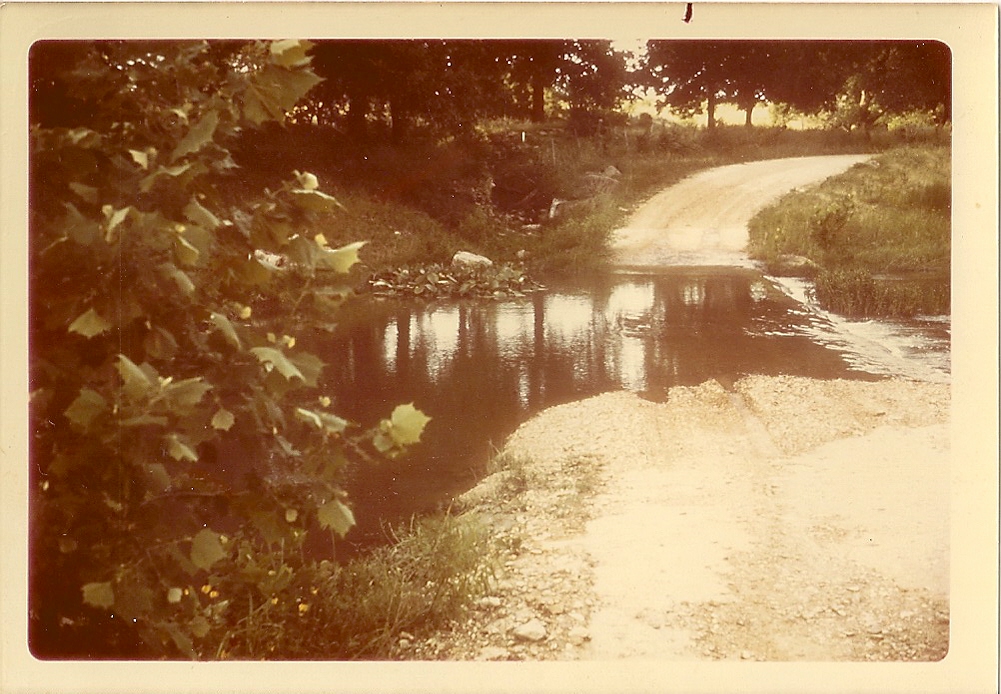
Rough Creek on the Parks Place, San Saba County, Texas, looking northeast, ca. 1970 (J. Matthews)

Relying upon memories of childhood can be misleading, even downright wrong in place and time.  As adults when we reflect upon last year’s vacation we may err in detail and conversations we thought we had.  Even so, memories preserve detail that can re-emerge with an almost preternatural force with a bit of reflection and musing, even to the point of re-evoking scents and cachets of the past that transcend the moment.

My mother and grandmother never hosted parties, but they hosted and partook of family celebrations — Thanksgiving, Christmas, Easter, birthdays.  And there were funerals, lots of them.  Funerals brought the Parks, McRorey, Morris, Ward, Millican and Ragsdale families together for burying kinfolk and re-establishing contact with distant relatives at Bend Sand, High Valley, Colony and Cherokee cemeteries in central Texas.  When I attended these functions, I had two sets of clothes, one for dressing-up and the other for outdoors.  Following the meal or funeral, I changed quickly into jeans and hiking shoes and explored and played with my cousins.  Having dinner at the Parks Place signified the best of all possible worlds because Rough Creek ran through it.

Rough Creek flowed through my great-grandfather’s place and formed the backdrop, foreground, side-scene and main-event for me.  Even today, still, Rough Creek continues to course through my mind and heart and its memory pacifies my days.  My great-grandfather’s ranch was called the Parks Place.  Not the Parks Ranch, the Parks Place.  Rough Creek cut the Parks Place in two parts, emptying into the Colorado River that bordered the east boundary.  For untold generations, Comanche Indians encamped at the confluence of Rough Creek and the Colorado, only to be driven away in the 1840s with the settlement of the area.  In the field north of the creek, after a hard rain, flint tools lay exposed.  A large midden revealed debris of hundreds of years.

I found stone tools, but my primary focus concerned the creek.  A county road ran through the Parks Place and at the creek, a large concrete slab had been poured, forming a stone-firm foundation for the road and continual pool of fresh water for perch, catfish and minnows.  Blue-colored dragon flies lit on green lily-pads and joined together in reproduction that I never fully figured out as to male and female flies.  Sycamore, cottonwood and pecan trees shaded most of the creek’s bank.  The water temperature was cold and it took a few minutes to become accustomed when as a boy my mother allowed me to swim and wallow with slippery moss on rounded stones.

I hiked up and down both banks of the creek.  When the terrible drought of the 1950s occurred, Rough Creek continued to run.  Neighbors in pickups with forty-five gallon water drums, came to the creek, parked on the slab and filled drums with water.  Their children swam and played in the water while the adults bailed water into the drums with buckets.  The elders were sun-tanned and strong, their hats crusted with dark sweatbands that bespoke toil and care for their cattle and family.  My great-grandfather never closed the road and I never saw the gates closed.  Cattle guards — steel-framed panels set in the ground — allowed trucks and pickups to pass over them unhindered, but kept the cattle in check and within the bounds of the Parks Place.

My great-grandfather gave me a branding iron, an iron with a capital “P” for the Parks Place, when I was a boy.  I have it hanging in the alleyway of my barn and see it everyday when I feed Star, my paint gelding.  I’ve not used it because our brand is a Running M.  I do not think of cattle when I see the the branding iron.  I think of Rough Creek on the Parks Place and I wonder how high the water is at the crossing.  Is it high enough that perch and catfish swim back and forth across the slab?  If another drought comes, will the present owners be patient with the neighbors who come to fill their drums?

In the early 1970s, I took the photograph of Rough Creek that sets the banner and feature photo of this post.  The Parks Place had been sold and passed into other hands.  The road remained open and I stopped at the creek’s edge and took this photograph.  I framed it with the sycamore on the left and the road and concrete slab in the foreground.  Behind the trees, on the upper left-side of the photograph is the grist mill, but you cannot see it clearly.

The photograph verified that my memory remained good and that cool, fresh water flowed over a concrete slab with lily-pads and bull rushes abounding.  After taking the photo, I drove slowly out of the Parks Place and up the road, past the mill and over the cattle guard I had seen when I was young and had most of my life in front of me.

______________________________

Notes:

The intersection of Rough Creek and the road is precisely 31.136°N 98.5468°W, elevation at center: 1,119 feet (341 meters), San Saba Quad map.

I have a true narrative I have written involving a court case between my relatives and the first owner of the Parks Place (not the present owners) after it was sold.  The first post-Parks owner attempted to close the road.  My cousins de-welded the gates, threw them in the pasture and smeared his brand on the portal with cow manure.  The owner sued my cousins in civil court — most upset he was about the cow manure.  My mother and cousins testified that the road running through the Parks Place had always been open for ranchers and their families living in the back country, and that closing the gate impeded the commercial and social intercourse, long-standing in history, of the community.  The owner lost the case, sold out and moved on.  The present owners of the former Parks Place indulge me and my kin when we stop and look at Rough Creek as we go into the back country.  My great-aunt Helen Tom, daughter of my great-grandfather, talks with the present owners about her growing up on the ranch and they allow my aunt to visit and see the place at any time she so desires.

16 Comments

Filed under Bend Texas, Colony Road, Recollections 1942-1966, Recollections 1966-1990, San Saba Texas

Saving a drowning Roadrunner

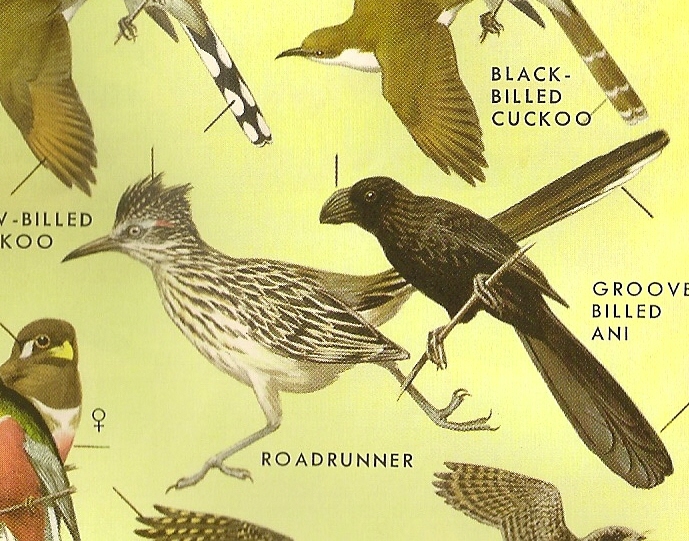
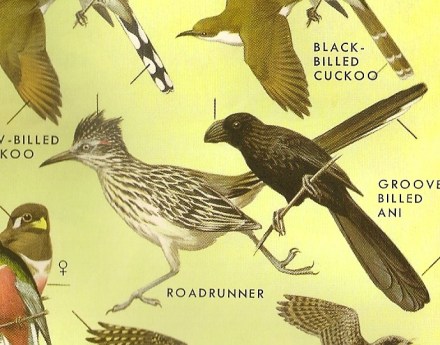
Roadrunner (Geococcyx californianus), Petersen Field Guide

In the summer of 2009, I rescued a roadrunner (Geococcyx californianus) from drowning in the circular water trough in the Well House Corral.

Roadrunners occupied a minor niche in my bird and animal kingdom as I grew up in central Texas.  My Aunt Lennie McRorey who lived on a ranch with her husband in San Saba County, Texas, kept a minor collection of roadrunner figurines and commissioned a small oil painting of a roadrunner that my daughter displays on her end table in Lubbock.  Driving down highways and especially back roads, roadrunners flew or ran across the road in front of the car.  I never saw any remains of roadrunners beside the road, attesting, I think, to their agility and speed.  They were big and seemed amusing the way they ran and picked at insects along the highways.  In a way, the roadrunner to me seemed unique among birds, more of an ostrich-like being than a flight creature — a miniature ostrich, for sure.

When we moved to our ranch in 2003, I saw roadrunners occasionally along our county road, but in 2008 and 2009, I noticed a pair of roadrunners that nested or habitually occupied the Well House Corral next to the Dooley Pond and mesquite brush to the west of our fence line.  As are most of my discoveries here on the place, my initial observation was accidental.  I was resting in the shade of the barn alleyway one hot summer day in 2008, when I saw a roadrunner dart from well house to the arena and under the trees in the corral.  Initially, I saw only one, but after a few more sightings during the summer, I saw two of them.  They often flew up in the lower branches of the live oaks and sat in the afternoon.  At the most, I spent thirty minutes watching their antics in the lower branches, wallowing and playing in the arena, and then I followed their hunt towards the east and our stock pond.  The summer of 2008 came to a close and I did not see them until the next summer.

Water trough in Well House Corral that ensnared roadrunner.

I had set a circular water trough in the Well House Corral for cattle and horses.  The trough was large, about six feet in diameter and held enough water for two or three days for cattle.  One afternoon in the summer of 2009, I walked down to the trough to check its level and noticed that the water was greenish and appeared disturbed.  Live oak leaves fell in the trough, and algae grew about the leaves and errant grass stems.

As I looked at the level of water I saw a long, log-like thing in the water.  It was listless, dead.  I looked closer and realized it was some kind of animal?   I thought at first a very large squirrel or possum?  Then, the parts all came together and I realized it was a roadrunner, one of the roadrunners I had been observing for two summers.  I thought, How could you have gotten drowned as crafty and smart as you are?  Oh, no, you poor thing.  I beat myself up for a moment, thinking I should have kept the water level higher so that if he had wanted a drink, he could have perched on the edge.

Well, I had to get him out of the water or it would become contaminated.  As I reached over to pick him up, his eye blinked!

Good god almighty, he’s alive!

I gotta get him out of there.  As I reached over to pick him up with my bare hands, I stopped.  The roadrunner could turn and peck me mightily, drawing blood.  Several years ago I had grabbed a mockingbird that had become caught in some netting I used to protect ripening grapes in our vineyard and the mockingbird had turned and pecked my finger in two places, drawing blood before I could let it go.  Pecked by a mockingbird is one injury, but a roadrunner peck may be a wound to the bone.

Seeing that the roadrunner was exhausted and I had to do something fast, I ran back up to the barn and grabbed my sombrero that was large and a couple of warm, fresh towels I used to groom horses.  I hurried back down to the water trough and dipped the sombrero under the roadrunner and lifted him out.  He was still blinking, but not moving at all.  He was huge.  I never knew how big these things were.  He was at least two feet long!  Think a small ostrich.

I put the roadrunner and sombrero on the ground and gently gathered him up in the towels.  With one towel I held him and the other I dried him off thoroughly.  With each stroke of the towel, going from head to tail, he would stretch his neck and extend his body as if running.  As he would stretch, his neck area would reveal sparse feathers and tender skin.  I saw no lesions or breaks or fractures.  I continued for five minutes or so drying him off.

Now what to do?  He was not standing or trying to fly off.  I decided to keep him on the towel and take him to the arena where it was sunny and warm and away from our barn cats.  I placed him down alongside the arena panels, near an area that I had seen him and his mate play.  He remained still, but was beginning to stir a bit.

I walked back up to the alleyway where I could monitor him and watched.  After about thirty minutes, I saw him stand up and begin to fluff his feathers and preen.  This went on for fifteen minutes.  I had to move on to other chores and left him alone.  An hour or so later, I went back to the arena and checked on his condition.  He was gone, most likely over the fence line to the Dooleys and his mate.

I’ve often wondered, fantasy-like, Borges-like, that somewhere in Mexico after he had recovered, this roadrunner told a story to his friends about a sombrero, the marvelous power of a hat that came down out of the sky and carried him out of water to dry land and life again amongst the cactus and creosote of the desert.  Just a fantasy.
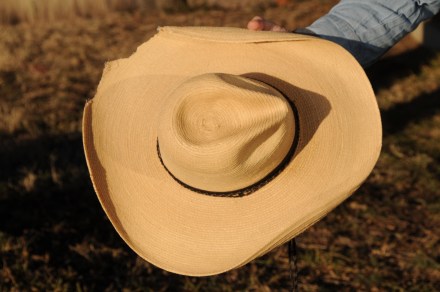
The sombrero that was used to rescue the roadrunner.

______________________________

Notes:

This last summer, 2010, I have not seen any roadrunners in the Well House Corral.  Our neighbors to the east have cleared a lot of brush from their property and deer and other critters have moved southward, into the grove and far pasture, so the habitat for the roadrunner has changed.  I continue to look for them.  I know that observing the roadrunner in the wild is most infrequent and I am motivated to observe more when I can.

In the photograph of the hat, you will notice two bite marks out of the rim.  Star, my paint gelding, reached through the stall and took two chunks of straw out of it while I wasn’t looking.  The hat is made by SunBody hats www.sunbody.com and is constructed from palm leaves in Guatemala by Jose Medrano.
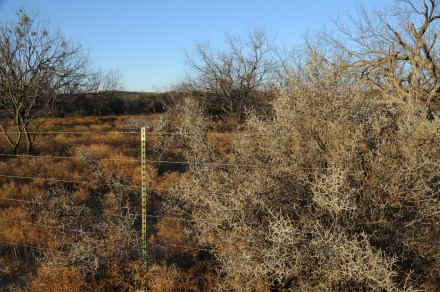
Towards the Dooley Pond where the roadrunners have their nest.
The live oak trees where the roadrunners sat.

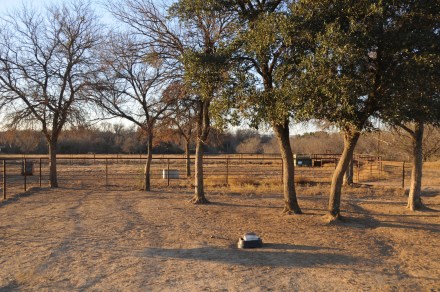
The arena where the roadrunners played.

The spot where I put the roadrunner to dry off.

Senor Jack wearing the hat that saved the roadrunner.

17 Comments

Filed under Flying Hat Ranch, Life in Balance, San Saba Texas

Tropical Storm Hermine Blows Hats Off

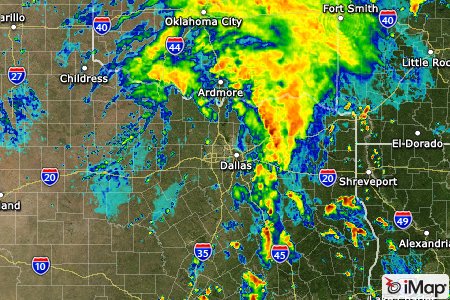
Tropical Storm Hermine, September 8, 2010, 3:05 p.m. CDT. Hermine has passed over our ranch and is headed northeast out of Texas. If you look west of Dallas about 100 miles, that is the location of Flying Hat Ranch.

Tropical Storm Hermine came through Flying Hat Ranch yesterday, dumping four inches of precious rainfall.  The clouds were low to the ground.  The mussel shells we place in the road going to the barn floated down the road with eroded soil, giving the appearance of beach front property instead the semi-arid West.

Hermine blew my hat off and knocked out our high-speed internet connection.  I came into Fort Worth today in order to work on my online classes.  As we left the ranch, the eye of Hermine passed over Interstate 20 and the sun shined and blue sky appeared.  But within a matter of minutes the eye of the storm passed and we were in gentle rain again.

When I fed the horses this morning, Star and Fanny ran around the corral in excitement, kicking and prancing, enjoying the cooler temperatures and wet weather.  I had to empty their feed bins of water.  Lilly, who is by herself in the Broke Tree Corral, loves the cooler weather, too.  The corrals are side-by-side so that they all can be together, young and old alike.

10 Comments

Filed under Adventure, Flying Hat Ranch

Jubilee of My July

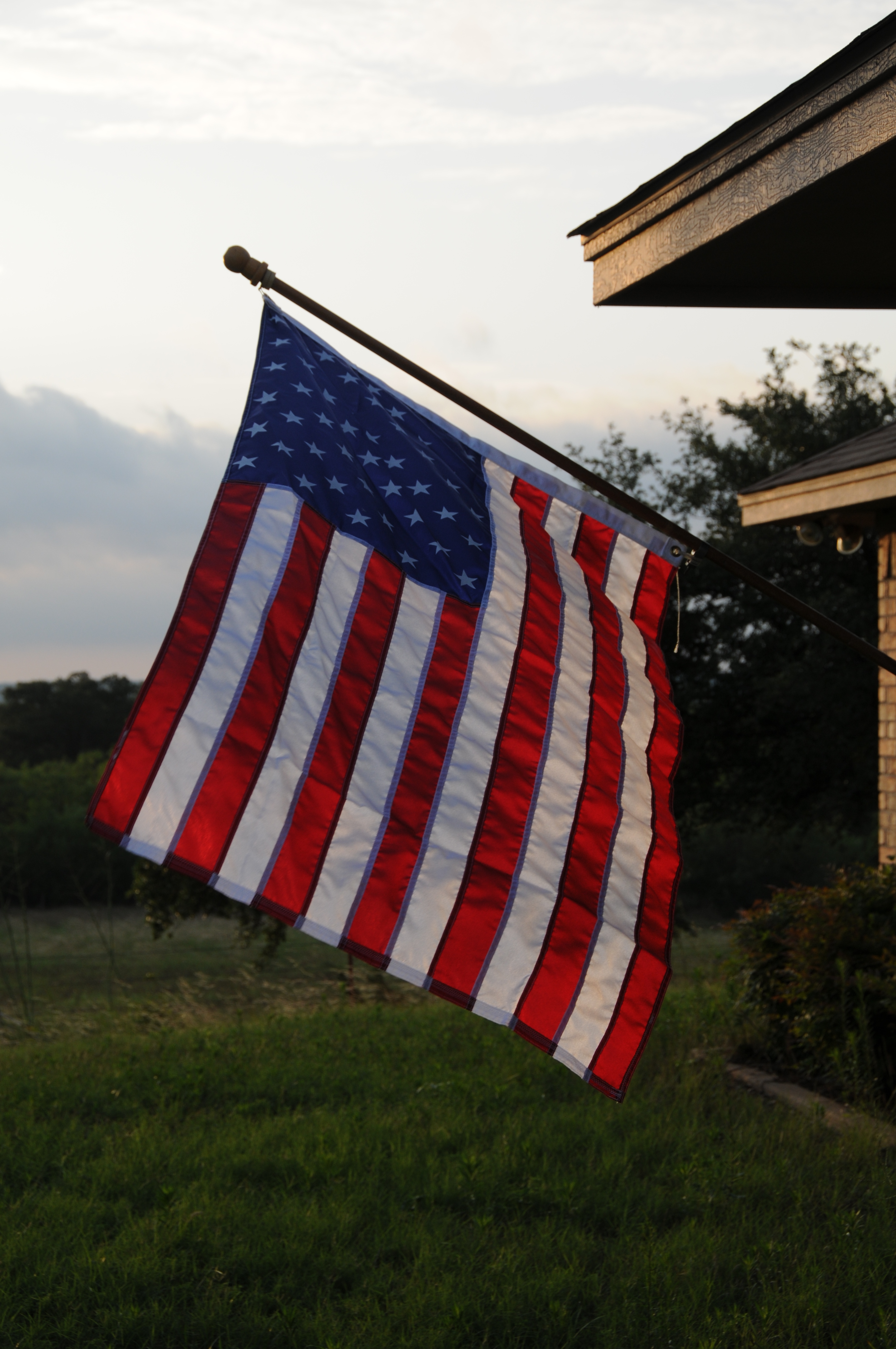
Flag and Early Morning (Photo by J. Matthews, 2010)

My wife prevailed upon me yesterday to put up an American flag.  [Read the notes at the end of this post about Norman Rockwell and his American Ideal paintings.]  I installed a pole caddy on the front porch, dusted off the flag pole, unfolded Old Glory, used twine to tie the lower end of the flag to the mast and hung it.  Like so many other small projects on the ranch, flag pole installation had been put off for years.  At our previous home in Mingus, we had hung a flag for several weeks after 9/11, but since moving to the ranch, we had left the flag carefully folded in the cedar chest that we use as a coffee table in the grand room.

As I was growing up in Texas, the Fourth of July was nearly always hotter than the hub of hell.  Many jokes came from the heat in Texas:  If I had a choice between hell and Texas, I’d live in hell.  And so on.  But enough about Hades.  For several years, my parents and I would go to Brady, Texas, about fifty miles from our home in Brownwood and attend the Brady Jubilee.  That was its name: jubilee.  I always associated stifling heat, horse racing and yellow watermelon (salted, of course) with jubilee.  It never made much sense to me to travel in a hot, non-air-conditioned pickup or old Ford sedan whose rough felt seats were smelly and lounge under trees and watch horse racing from a distance.  Come the first of July, the dreaded Brady Jubilee jaunt lay in front of me like a sauna with no water.  There must of been something character building about the event, but I never could figure it out.

This Fourth of July, the weather is cloudy in west-central Texas from the effects of a gulf hurricane and the temperature is a tolerable middle 80 deg. F.  We’ve had about two inches of rain this past week and the grass has greened slightly — not a typical Fourth.  Where were these days back in my boyhood?

Given this age of internet technology, the town of Brady, Texas, has a website. As a link within the website, there is the Brady Jubilee. I’m somewhat disappointed, however, as I read over the list of activities.  There are none for July 4th and no horse racing.   All of the Brady Jubilee activities take place July 1-3: Heart of Texas Ford Parade with a “Hats Off To Our Heroes” accent, washer and horseshoe pitching tournaments, fireworks the nights of July 1-3, and a dance Saturday night featuring Brian Burk, Kristen Kelly and the Modern Day Drifters.

Brady Jubilee, Richards Park (Photo by Cross Bar Land Co.)

Suddenly, I realize that July 4th this year is on a Sunday!  That’s why the Brady Jubilee has nothing planned for the Fourth.  It’s a church day and normal activities cease and there’s no exception to that rule.

The horse racing, however, is probably a thing of the past — they were short races for quarter horses and not many were booked because of the July heat.

On this day, with no Brady Jubilee scheduled, our plans are to attend a fireworks display at either Possum Kingdom Lake or go into Fort Worth for dinner and watch the display over the Trinity River.  Either way there will be no horse racing or jubilee today.

I have to go now and feed the horses and, just by chance, they may race around the arena.  To my list of morning chores I will hang the flag.  On this Fourth of July, I will think of the Brady Jubilee with its heat, melon and horses and quietly yearn for another day there.  Yes, I know, the heat.

______________________________

Notes:

The New York Times today ran an article on Norman Rockwell.   A quote about him: “These are qualities one wants to retain as a society, and it is a credit to Rockwell’s subtle, story-weaving imagination that he captured the values we celebrate on Independence Day without ever having done a painting of American flags waving from porches or July skies bursting with fireworks.”

That’s correct, never made a painting with American flags waving from porches.  He painted America in the people he painted.

10 Comments

Filed under Cedar, Juniper, Recollections 1942-1966

Hallway and Alleyway: Country Style

In the country, hallways and alleyways are often crammed with tools, coats, hats, hay and feed, not to even mention dogs and cats.  The hallway and alleyway to home, barn and stable give additional shelter and protection during a rain or busy day.  Mudrooms are quite common on farms and ranches as well as wide porches, some extending all around the house.  Porches may be a place to relax, but the porch chairs and swing share space with barrels, boxes and rope.  It’s not all neat and tidy on the ranch.

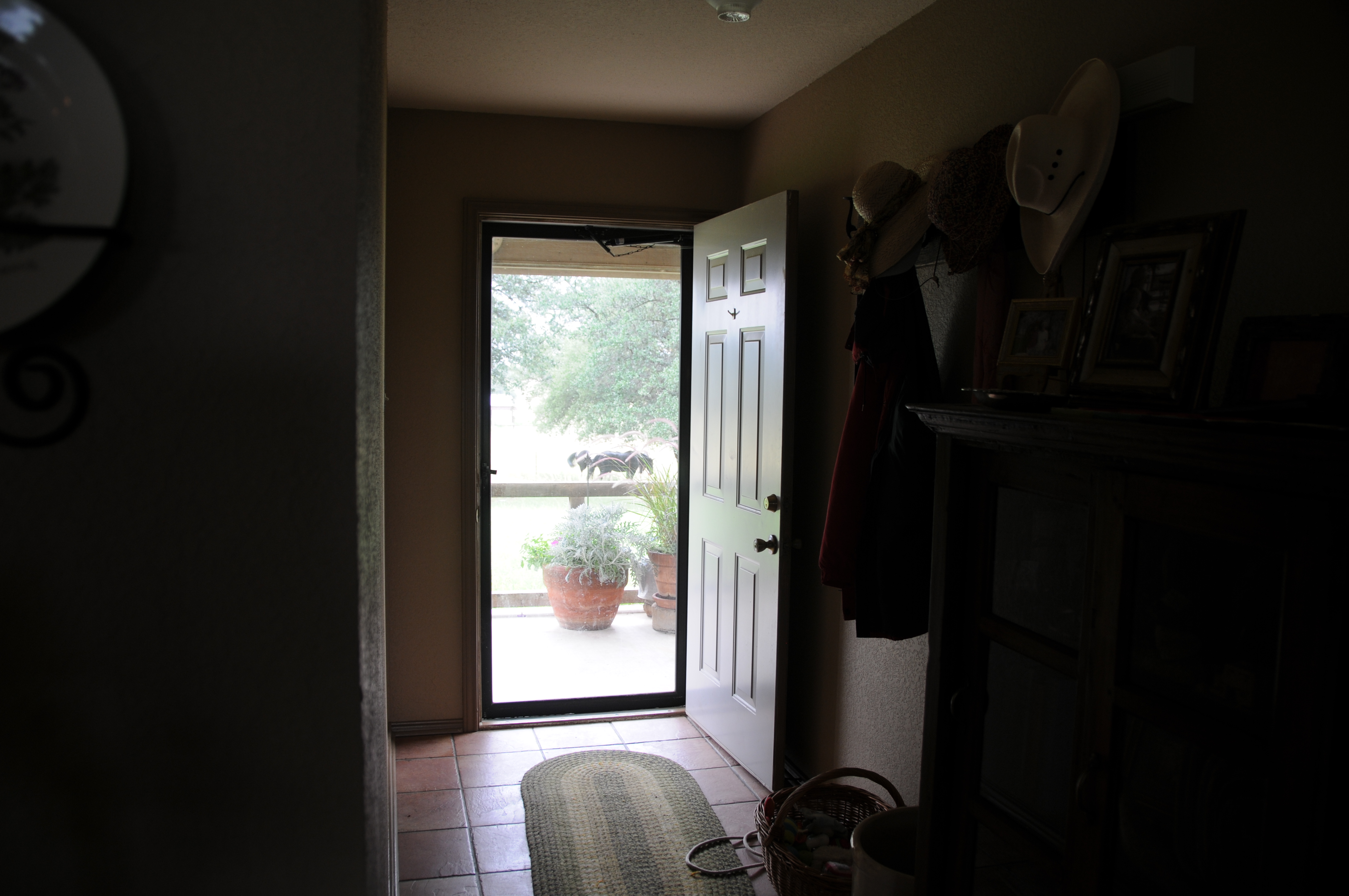
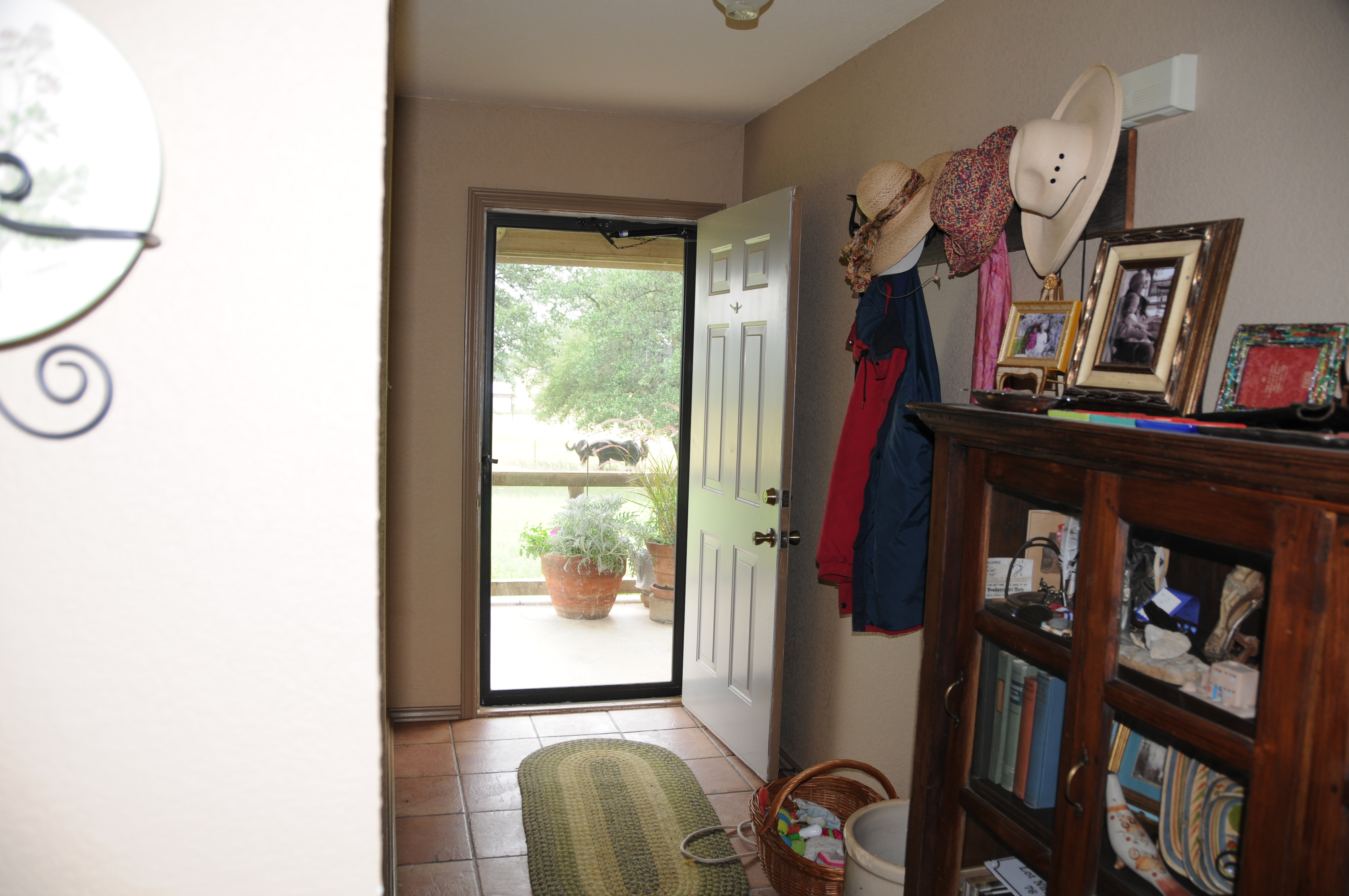
Ranch House Hallway (Photo by J. Matthews, 2010)

Here is the hallway in our home that extends out onto a small, front porch that has a couple of rope-crossed chairs and flower pots.  The barn cats often come up to the front porch to lounge because it faces north and has ample shade.  The front porch is merely an entryway for the house, but the back porch extends the length of the house.

The hallway has a hat and coat rack on the right side of the photograph.  I have counted as many as ten hats and caps on the rack, and during the winter, coats and rain gear hang appropriately for convenient use.

Hallway by Flash (Photo by J. Matthews, 2010)

The second photograph of the hallway, illuminated by the modern invention of flash, illustrates the glass hutch with books, photographs, Native American pottery, prehistoric-lithic tools, horse bits and spurs.   Hallway as museum.

In the old days before air conditioning, porches would be screened-in and iron bedsteads would be moved out onto the porch so that you could sleep in the mild night air.  I was not interested in sleeping on a bed on a porch, but preferred to sleep under a sheet within the house, tolerating the heat until morning.  I might move a pallet into the hallway beside the screen door.  Hallway as bedroom.

The barn alleyway this morning shows hay bales from Arizona.  These bales weigh 100 lbs. and are three-stringed — barely manageable.  The first set of bales on the wooden plat is alfalfa; the second set is coastal bermuda.  These bales provide about a week-and-a-half of hay to four horses.  I have been cleaning out the barn and opted to put the hay in the alleyway for a time to allow the barn to dry out and give me some room to move tools and implements around.

Barn Alleyway with Hay (Photo by J. Matthews, 2010)

Hallway and barn alleyway — country-style — have multiple uses and are always comfortable spaces for storage and resting.  Let the cool, fresh air flow down the barn alleyway and things are good whether you are from the city or country.

6 Comments

Filed under Flying Hat Ranch

Field Log 6/18/2010 (Fawn)

North Erath County, Texas, Lat 32.43 N, Long -98.36 W, elev. 1,086 ft. Turkey Creek Quad.

Salt Creek Field Hike

Yesterday, Wendy, my daughter, and Olivia, my granddaughter, and I hiked through the grove on a short field trip.  I gave Olivia her first lesson in using the field compass: the arrow points north, where is north?  Show me.  She had been given a military field compass, basic structure.

Field discoveries and observations: mussel shell, dead wild turkey with feathers scattered, several Swallowtail butterflies and skeletal remains of small animals.  Rocks of various colors collected for Olivia’s “rock bag.”  Identification of poison ivy and sumac — to be avoided, of course.

The horses, Hija, Star and Fanny followed us closely until we got deep in the grove and then they galloped through the grove’s tall grasses.  They were curious of the little one, Olivia.  I gave instructions to walk deliberately and straight while the horses lingered with us, so as to let them clearly know where we were.  (Lilly was in the Broke Tree corral with her hay.)

Down in the grove we identified recently-imprinted deer tracks, but saw no deer.  I pointed out the sharper edge of the deer track indicated the direction the deer was walking.

Taking the F-150 to the Far Field

After the hike into Salt Creek bed and grove, the temperature climbed to the upper 80s F. and we came back to the barn and drove the F-150 to the far field, beyond the creek where I have nurtured native grasses for several years, including a recent spring planting of native grass and flower seeds.  The grasses were high and from a recent rain of 2.00 inches quite plush with green and erectness.  It was much too hot to amble across the grove into the pasture and return by foot.

Last week I had shredded a six-foot path in the grove and in the Pecan Tree Pasture for safety’s sake and mobility.  The Dooleys had told me that several copperheads and rattlesnakes had been found on their place.  The copperheads, Kelly Dooley said, had been attracted by the recent addition of a small pond with koi fish about their house.  They may deconstruct the small pond.  I have only seen grayish coachwhips on our place.

As we turned the F-150 onto the southern, shredded pathway, running east-west on the far southern side of the Pecan Tree Pasture, we looked down the path and at the far end and there was a fawn, about two-tenths of a mile away.  The fawn browsed leisurely along the path while, I presume, its mother lay in the tall native grasses.  It was quite small with large ears.

It was my first sighting of deer for several months.  We corroborated, as best we could, that it was deer and we turned the F-150 on the path I had shredded under the pecan tree.  Wendy wants to have a picnic lunch  under the pecan tree on Saturday.  I was still raving about the deer as we turned onto the highway to come back to the house.

______________________________

Notes:

Since settling here in 2003, the deer count has diminished drastically from a weekly count of 15 to zero.  Deer used to migrate from the Blue and Hall places to the east of us through our house pastures and into the grove and southern Pecan Tree Pasture.  The Halls cleared brush from their small acreage and eliminated cover for deer.

The distance for the sighting of the deer was two-tenths of a mile.  Wendy sighted the deer.  We had no binoculars so I could not bring the image closer.  My only reservations on a fully-positive identification were that I did not see the mother deer and there seemed to be a white stripe on the muzzle of the fawn, but that could have been an illusion from the angle of the sun (we were looking eastward).

I intend to let the grasses grow high near the edge of the highway to give a privacy hedge to shredded pathways.  As of now, the deer along the pathway can be observed from the highway.  Given the present disposition of blood sportsmen in our state, a sighting of one deer will result in leasing several deer blinds on contiguous land.  I have observed hunters placing apples on fence posts to attract deer onto land they have leased — not the ethic of most hunters I know.

I have some photos pertinent to field activity, but they were not taken yesterday on the field trip.

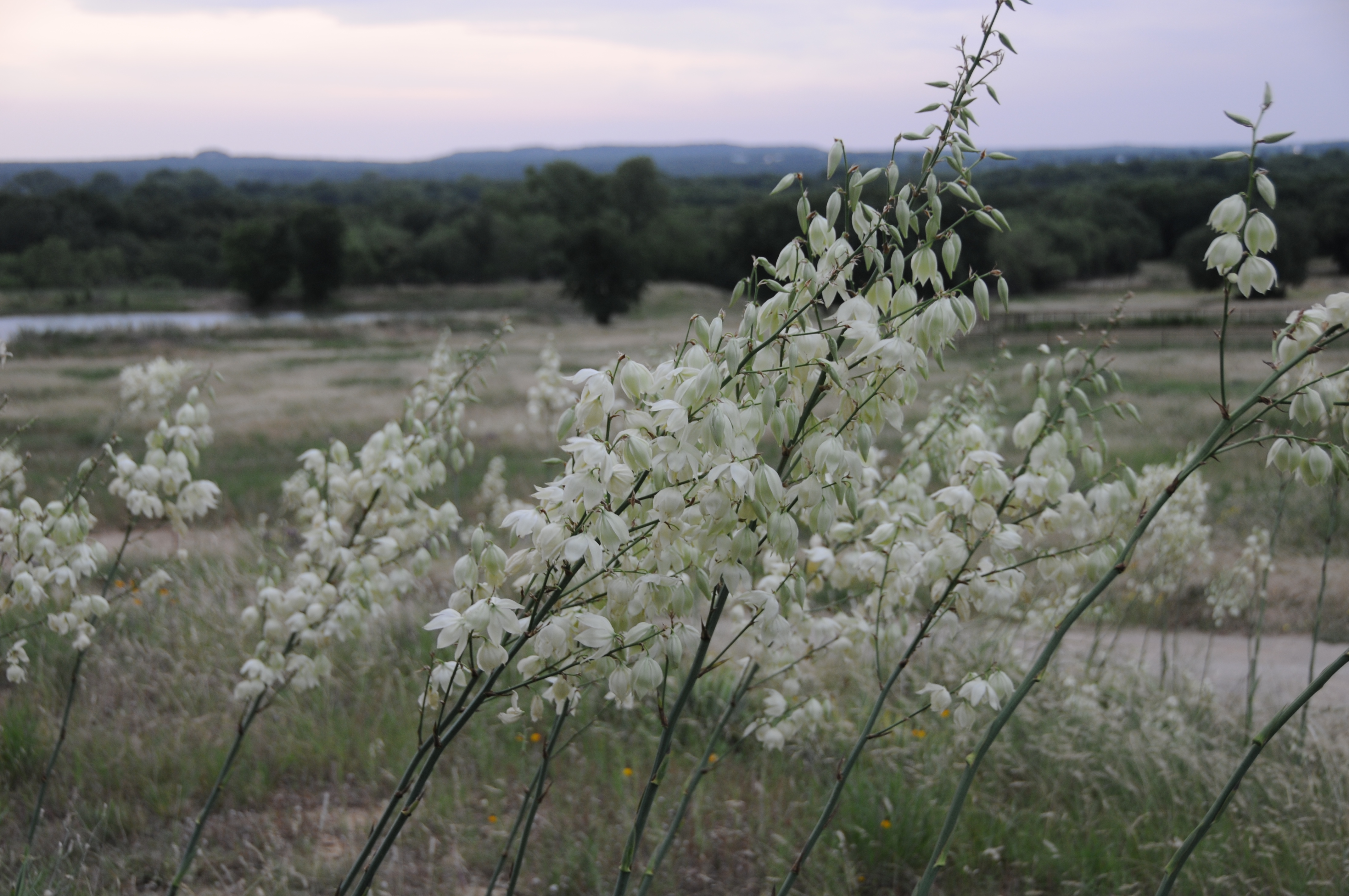
Yucca Blossoms in June (Photo by B. Matthews, 2010)

Olivia Needham with Star, Hija and Fanny (Photo by B. Matthews, June 2010)

Texas Groundsel (Photo by B. Matthews, May 2010)

8 Comments

Filed under Field Log

Running With Shiney

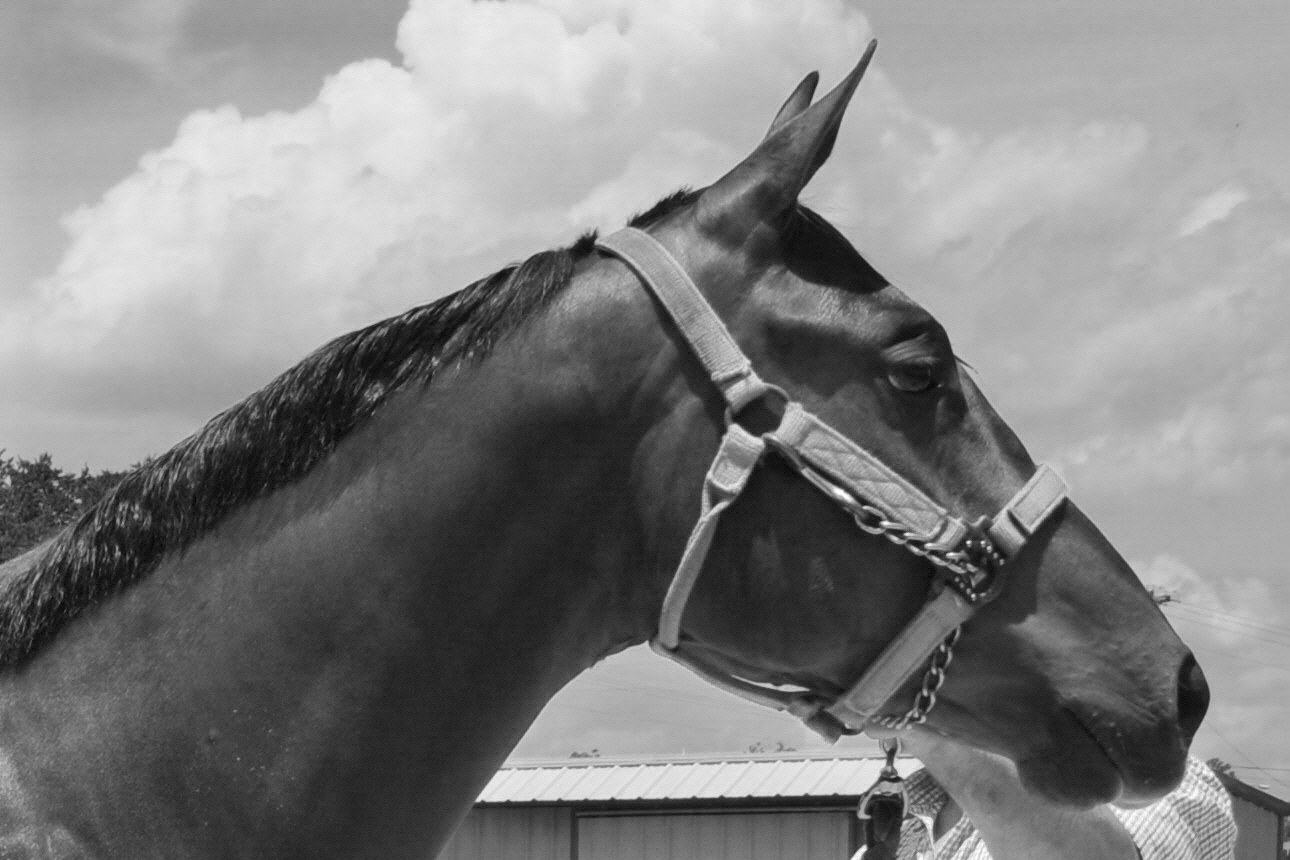
Shiners Fannin Pepto (2010)

Bittersweet is the moment when you perceive that the boy has become a man, the girl a woman, for then you see passageways that are closed forever.  Those days of softness and pliability are gone.  Ahead, there appears toil and disciplined hours that hopefully will insure security and comfort in all seasons, so that  life can go on with moments, perhaps hours, of rest and sociability with family and friends.  As a caretaker for the young, be they human or not, the letting-go as they walk away or as you drive away from the curb extracts a pain within that circulates around the thoughts: Have I done well enough by them?  Do they have what it takes to survive?  What could I have done different?

I trained Shiney (Shiners Fannin Pepto) in ground manners as much as I could while working and traveling at a full-time job.  My life with horses began only eight-years ago when my parents died and I inherited two paint horses.  I began to change when I worked horses.  I gradually became more patient with my life in west Texas that had turned out quite different than I thought it would.  I added another horse.  I bought a fine-blooded mare (Sweet Hija) from King Ranch and from her issued two foals, Fanny and Shiney.  The time came about three months ago to send Shiney to a professional horse trainer to fit for sale.  When I sent Shiney to Jimmie Hardin’s in Aubrey, Texas, I had carried the colt as far as I could.  Since I had only worked with mares or geldings since 2002, he was more than I could handle — or so I thought.

Jimmie Hardin and her crew, especially Peppy, her right-hand trainer, worked with Shiney to fit him for sale: standing, tying, leading, and running with the handler.  Good manners.  Midway in his training, I went up to see Shiney’s progress.  I saw his development in many areas, but one behavior held my attention:  when Shiney ran with Peppy in the corral, he held his head high and the two of them trotted in unison, turning this way and that way, Shiney showing his form and muscle and even excitement to run with a person.  As I first saw them running, I wanted to run with my horse, my colt, that young thing I had blown my breath into his nostrils on his first day, a year ago, May 15, 2009.

Four days ago, Brenda and I picked up Shiney from the trainer.  His mane was braided, coat sleek, and hair trimmed.  All fit for sale in Shawnee, Oklahoma.

We unloaded Shiney after a four-hour trip and I walked him around the sale grounds.  Then, I began to walk briskly, faster, and then broke into a trot.  I held the stud chain close under his chin, neither tight nor loose, and Shiney picked up his pace and we both ran together.  I turned and he turned with me.  I stopped, he stopped.  We ran again.  There, it happened, a powerful creature, joining with a person.

As I walked back to Brenda, she was smiling so broadly: He is so beautiful.  He holds his head so erect.  He is gorgeous.  You two looked so good together.

On sale day, I ran with Shiney three times.  I didn’t have to.  Once for buyers from Laredo and once for Steve Phipps of Springfield, Missouri, who purchased him.  We did not even lead him through the sale ring.  The price was right and Phipps was the one for Shiney.

The third time I ran with Shiney it was for me and him, alongside the barn and trailers, outside in the morning sun of Oklahoma.  I never grew tired or weary with our runs.  I was holding on to him for as long as I could and then I had to let him go.

I’ll never forget as long as I live that I once ran with a colt that was becoming a stallion.  Bittersweet, to see him grow.

9 Comments

Filed under Horses, Shiney (Shiners Fannin Pepto)

Prairie Sandbur and Bull Nettle

Two New Discoveries of Flowering Plants

In my regular field work here on Flying Hat, two new discoveries were made this morning of Texas flowering plants.  One discovery  was the Texas Skeleton Weed (Lygodesmia texana), also known as Purple Dandelion, Flowering Straw.  The other discovery, this one rather exciting, was the Prairie Sandbur (Krameria lanceolata), also known by the name of Crameria, Ratany or Trailing Ratany.  Before we go to the Prairie Sandbur (accurate spelling), let’s look at the Texas Skeleton Weed, shall we?  (I’m beginning to sound like Mr. Rogers here.)

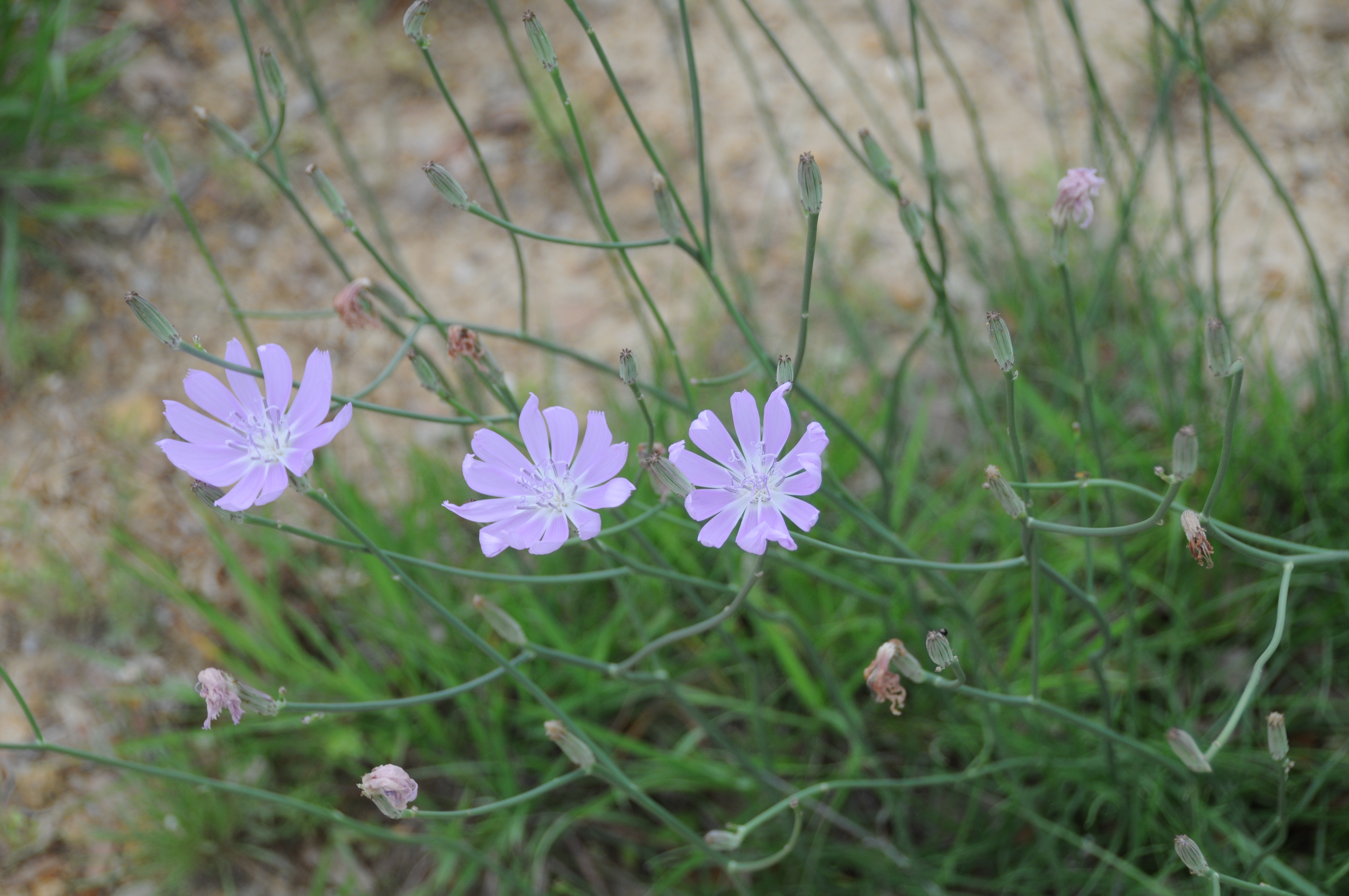
Texas Skeleton Weed

Texas Skeleton Weed, May 2010

This beautiful lavender flower is the Texas Skeleton Weed (Lygodesmia texana), also referred to as the Purple Dandelion, Flowering Straw.  These flowers appeared rather suddenly in the last two or three days.  The term skeleton is applied because of the  leafless stems and the odd angles of the stems, analogous to skeletal assemblies.  According to Loughmiller, Texas Wildflowers, “When the stems are broken, they exude sap which coagulates into a gum.”  The medicinal qualities of this plant are presently unknown to me.  I am currently searching my bookselves for my medicinal plant book for North America.  I do have Richard Evans Schultes, Hallucinogenic Plants, New York: Golden Press, 1976, but this Texas Skeleton Weed is not in it.  I don’t like the term, “weed.”  This plant is far to beautiful to be designated, “weed.”  Perhaps the Bull Nettle is a weed, but I even have my doubts about the construct of the botanical term, “weed” applied to it.  Weed carries a cultural signification of unwanted, not desirable or bad.  I know we use the term, “weed,” a great deal and I understand the context, but I think it should be dropped from the lexicon.

Prairie Sandbur

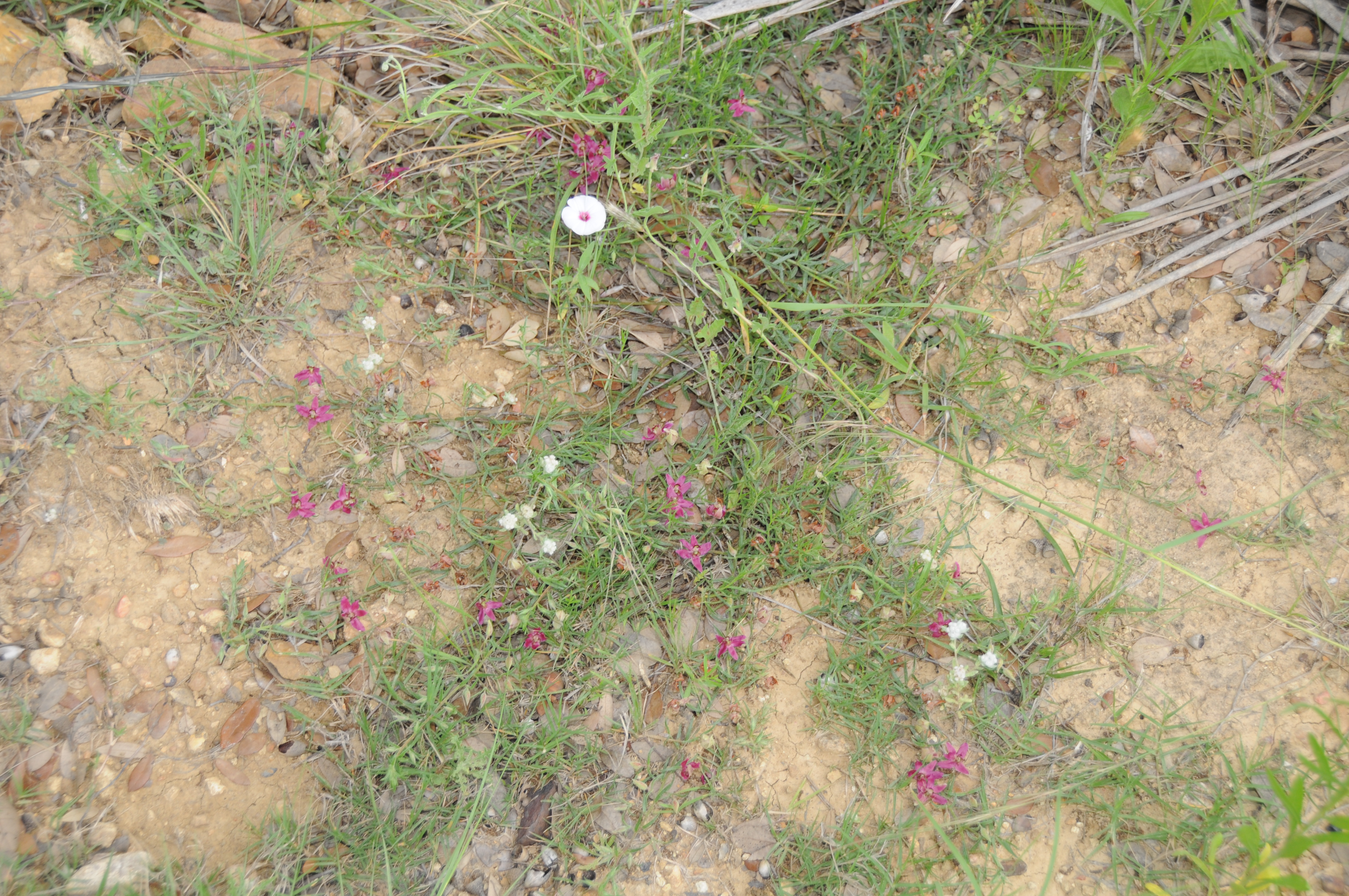
Prairie Sandbur Cluster, May 2010

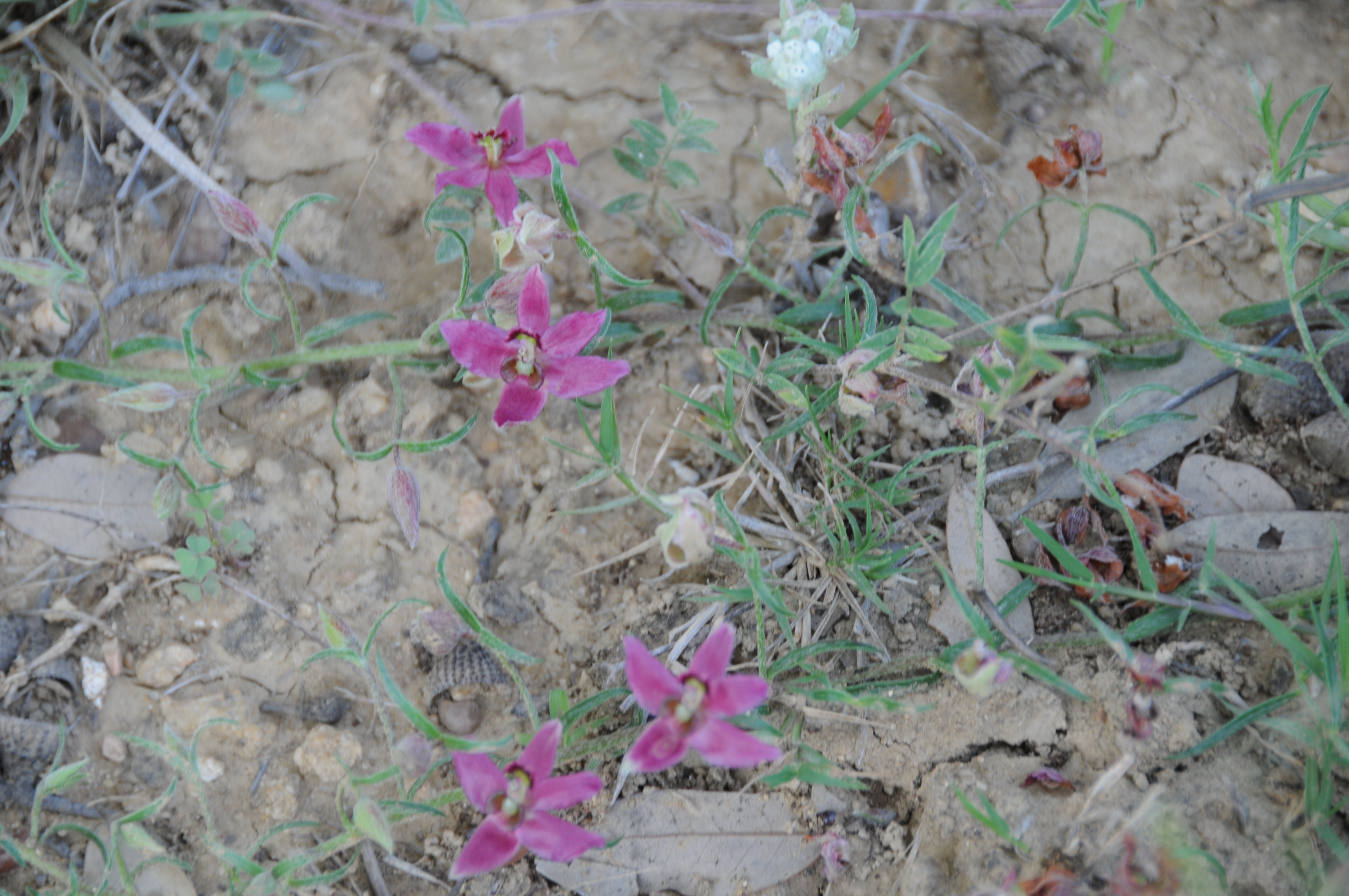
Prairie Sandbur Close-up, May 2010

The Prairie Sandbur is the reddish flower in the photographs above.  It is also known as the Trailing Krameria, Ratany, Crameria and Trailing Ratany.  This is not the sandbur of the grass family.  The leaves and flowers grow from prostrate branches.  According to Loughmiller, this plant and flower is neither conspicuous nor abundant.  They state that the Prairie Sandbur does occur in many parts of the Trans-Pecos River area of Texas.  Our ranch is in the West Cross Timbers region of Texas.  We are Trans-Brazos by about 50 miles westward.  This Prairie Sandbur was found on the east side of Poprock Hill in a well-drained slope area.  This plant may be the rarest find on our place.  I have looked carefully about Poprock Hill and this is the only cluster!

Texas Bull Nettle, Stinging Nettle, Tread-Softly, Spurge Nettle or STAY AWAY FROM THIS THING!

I went out to the Pecan Tree Pasture this morning and hoed or cut out by the hoe some 100 or so Bull Nettles (Cnidoscolus texanus).  I still have about one more acre to hoe.

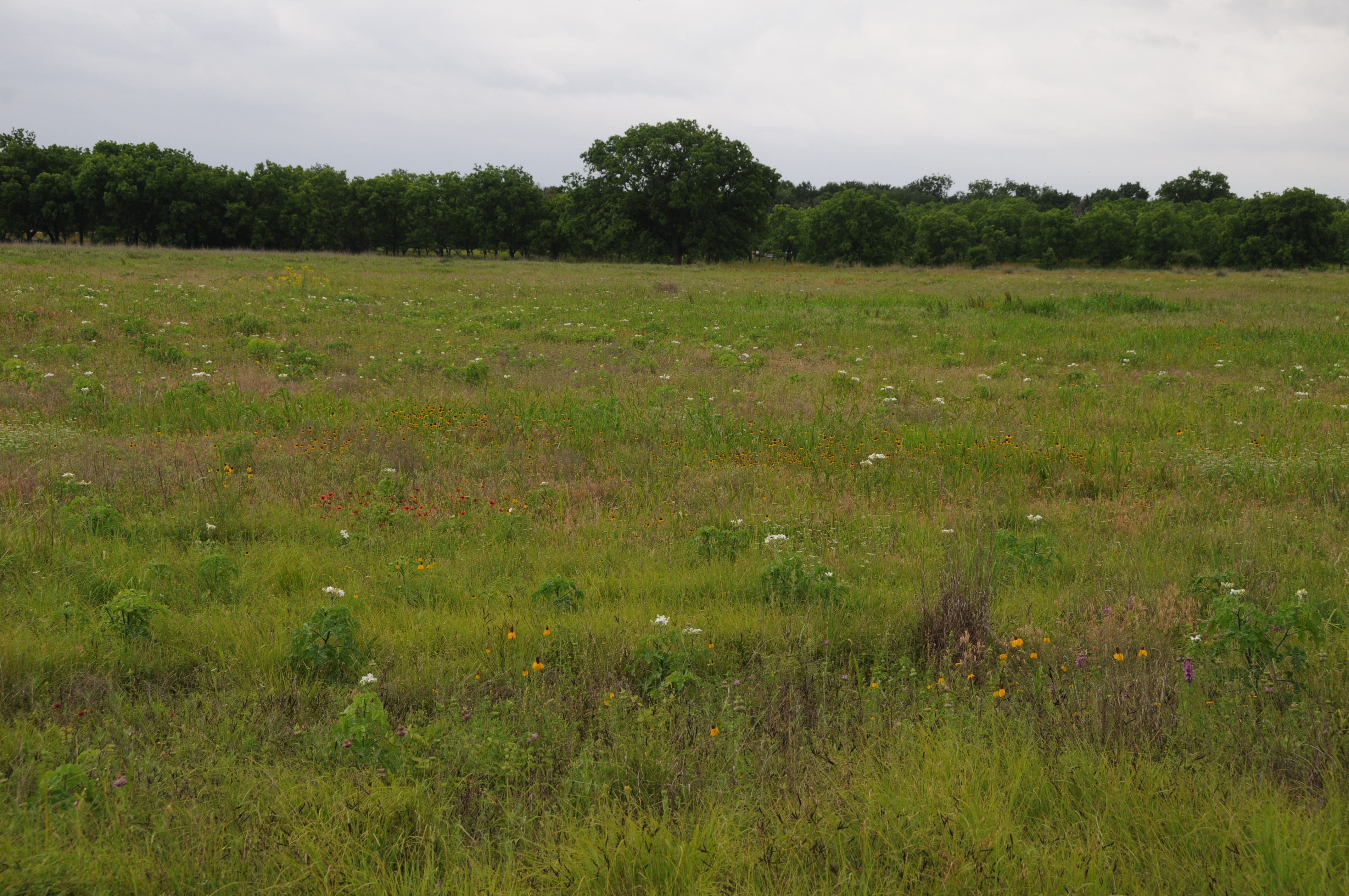
Bull Nettle (White Blossoms) in Pecan Tree Pasture, May 2010

Here you see the white blossoms of the Bull Nettle in the field.  Actually, hoeing the plant is rather easy since the vascular main stems are soft at this stage of growth, plus with all the rain we have had, the soil is soft.  This photograph is looking southward, towards the Old Bryant Place, and you can see that the pecan tree, for whom this pasture is named has dark-green foliage.

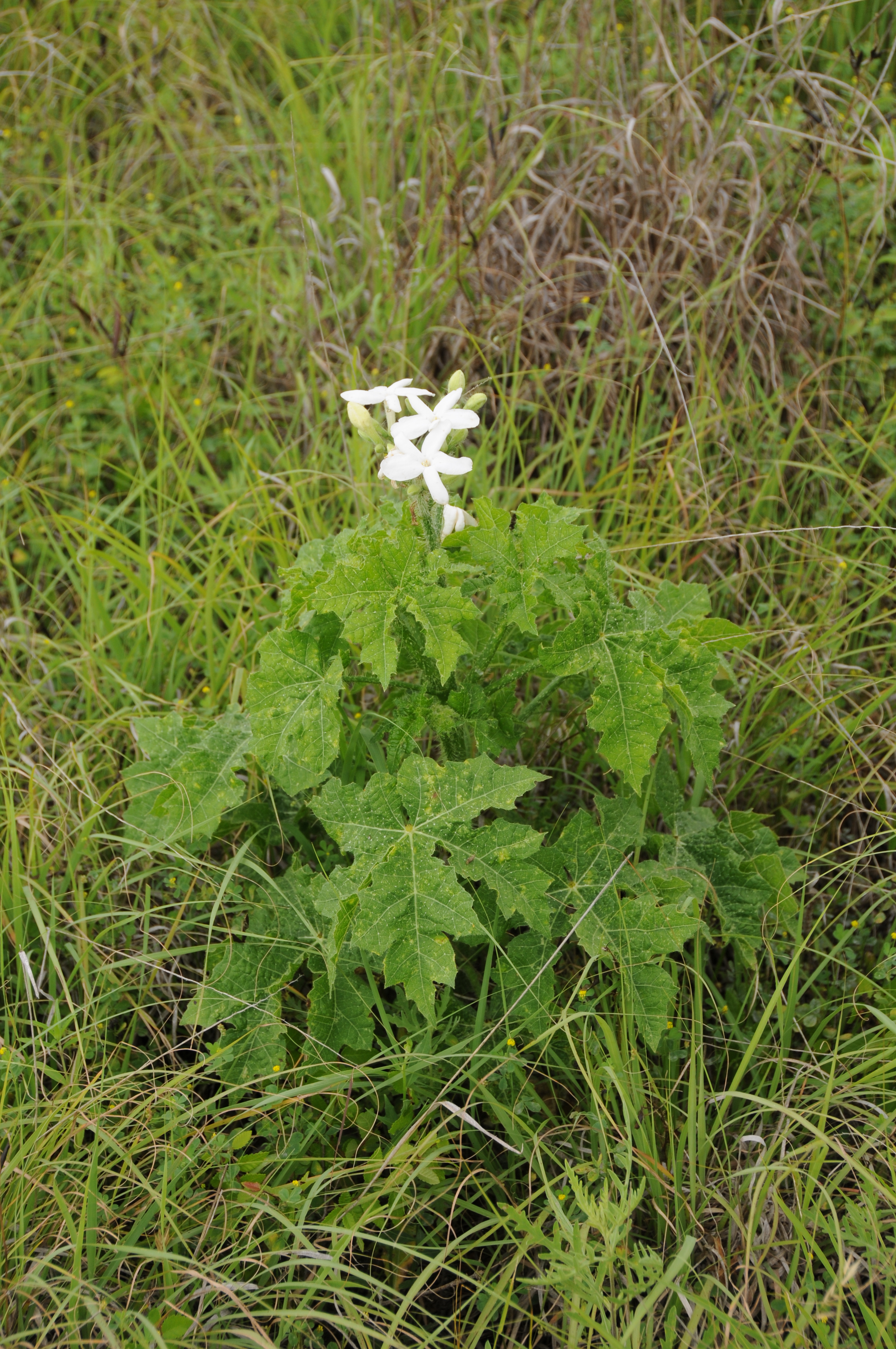
Single Bull Nettle Plant in Pecan Tree Pasture, May 2010

The Bull Nettle is a plant to be avoided.  The plant has leaves that are prickly as well as the stem and if you brush up against it, the nettles will sting.  Loughmiller says the effect of the nettles will last 30-45 minutes.  The stems, if broken, will exude a sap that some people discover, too late, is an allergen.

Today, I brushed up against a Bull Nettle once and I was wearing denim jeans (Wranglers), but the nettle penetrated the denim and I felt a sharp sting.  It was a light brushing, just once, but still burned.  I have a quick recovery to Bull Nettle in my system and the stinging lasted for about one minute.   My initial contact with Bull Nettle occurred when I was three or four-years old and I was with my mother and grandmother at the Sand Cemetery in Bend, Texas.  They were on a cemetery clean-up for our ancestors’ graves when I grabbed a Bull Nettle (trying to help) in my right hand.  It had a lovely blossom.  I really, really experienced pain, especially in the palm of my hand, and for several years, the palm would erupt in a rash.  I think that early exposure to Bull Nettle gave me a bit of tolerance, but not immunity.

The Bull Nettle has a personal and family history that goes back sixty-four years, to a time when we cleaned up the cemetery for the Morris, Baxter and Brazil families at Bend, Texas.  With the 400 or so Bull Nettles I have scooped out of my pasture, every Bull Nettle or so, I think of my family and how I came to be doing precisely this hoeing, on this cloudy day in Texas.

______________________________

Notes:

A fine source for identifying Texas wildflowers is Campbell and Lynn Loughmiller, “Texas Wildflowers: A Field Guide,” Austin: University of Texas Press, 1989.

I supplement my typing operations with cross-checking from other sources, particularly the online services listed under my page, “Native Shrub Identification Guide.”  The sources found online at the Ladybird Johnson Wildlife Center are quite valuable.

13 Comments

Filed under Plants and Shrubs, Recollections 1942-1966