Tag Archives: Texas

Pyrocumulus over Possum Kingdom Lake

Pyrocumulus over Possum Kingdom Lake (MSNBC photo, August 2011)

As I drove back to the ranchito yesterday afternoon from Abilene, moving with light traffic on Interstate 20 near Eastland, Texas, I looked northeast and saw towering pyrocumulus clouds. Approximately forty to fifty miles away from where I drove on the highway, I pinpointed the fires at Palo Pinto, Texas, or Possum Kingdom Lake. My ranchito lay far away from the inferno, so my anxiety lessened and I began to think more intently about the precise location. The smoke rose high in the sky, becoming pyrocumulus, rolling and billowing upwards.  It had started at about 1:30 p.m.

When I arrived at the house, I turned on the television and Dallas-Fort Worth stations reported the fires near Possum Kingdom Lake, the southeastern side of the huge lake that dams the Brazos River, the largest river in Texas. In April, fires had erupted about the lake, destroying homes and thousands of acres of trees and grass with attendant wildlife. Once again, Possum Kingdom habitat ignites, the residents flee not having time to salvage photos or documents.

I ruminate that our region suffers a drought, cow tanks dry, underbrush decadent and my primary source of water, the Barton Creek Cooperative, restricts water use with heavy penalties for violators.  In the Possum Kingdom fire zone, summer camps for teenagers and children abound, primary homes and secondary homes stand close to trees that are pruned carefully, the underbrush removed as a fire hazard.  Yet, so, when the spark falls on the dead, crackly grass and brush, natural forces beyond man’s control take precedence and airships with their whap-whap-whap of whirling blades pour water onto flames that send smoke and ashes high into the sky, creating pyrocumulus in the blue skies of Texas.  I think of a line from Full Metal Jacket:  Who is in command here?

The origin of the fire is unknown and as of this morning, August 31, the fire is not contained.

For a morning news report, August 31, 2011, see “Wildfires burning homes in Texas, Oklahoma,” from MSNBC.

______________________________

Notes, corrections and additions:

The quote from the movie, “Who’s in command here?” originally read Apocalypse Now.  The proper citation is from the movie, Full Metal Jacket.

The photograph from MSNBC shows smoke and ash close to the ground and none of the “clouds” are pyrocumulus.  I saw the pyrocumulus while on the interstate highway and I failed to use my iPhone to photograph the phenomenon. 
23 Comments

Filed under Life Out of Balance, Weather, Wildfire

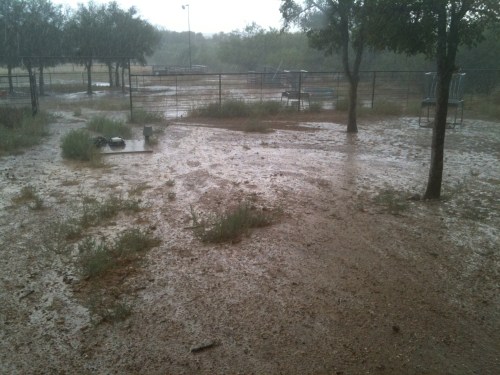
Rain in Broke Tree Corral

Rain in Broke Tree Corral, north Erath County, Texas, August 12, 2011.

Yesterday afternoon, after months of drought, rain came down sporadically in drops, then sheets of rain.

The first raindrops bounced on the aluminum roof of the barn and stables. Lightning flashed, thunder clapped, and Star the paint gelding and I flinched.  He bolted for about three gallops, then returned quickly to the shelter of the stable.  Within thirty minutes, five-tenths of an inch had fallen and a lightning strike on the oil piping fence about fifty-yards away knocked out electrical power.

I fed Star his grain and Horseshoer’s Secret — a potion for rebuilding hoof walls — and he munched haply through the noise of the thunderstorm, occasionally bringing his head out of the feed bin to see if I still sat in the alleyway waiting out the rain.  I talked to him, Good boy, fine fellow.

Broke Tree Corral is the first of two successive corrals about the barn and arena.  So named for an American Elm tree that broke in two, the tree has continued to thrive with bark and one-half of its internal veins intact for at least eight years now.  The grass in the corrals has become brittle and sparse.  The rain quickly formed small channels that flowed into the second corral, the Well House Corral, where bare ground could not stop the erosion-flow into the near fields of buffalo grass and mesquite sprouts.

Rain flows down the road towards the barn, north Erath County, Texas, August 12, 2011

Rain has fallen, the temperature has dropped and the Jack Rabbit has come out of his burrow to chomp on fresh sprouts and new, tender, blades of grass in the small dell between me and the Dooley place.  The drought has not been broken decisively, but this rainfall is a far away sound of better days and nights headed to Texas, a hunter’s footfall tracking a devil of fiery brutalities to slay and scatter to cool winds and shady juniper groves for those that live with the land.

____________________________

Notes, corrections and additions:

Try as I might, misspelled words sometimes slip through.  I do not rely on “check spelling” frequently, but will look again at a word if it is underlined in red.  In this post this morning, I misspelled, “lightning,” twice!  I spelled it “lightening” and missed the correction.  In writing posts, I do not have a proofreader.  It is an imperfect world filled with imperfect compositions.

27 Comments

Filed under Rain, Star, Weather

Clouds with Mourning Dove

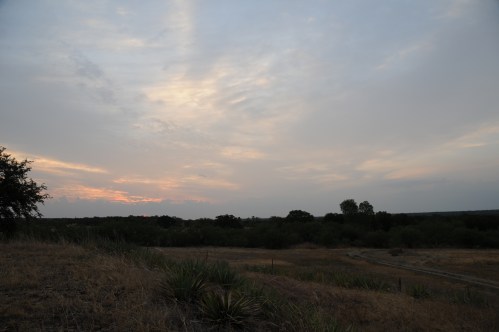
Pre-dawn clouds in Texas, north Erath County, August 2011.

Yesterday in mid-afternoon, August 10, 2011, a weak squall line walked through my ranchito in central-west Texas.  Blue-gray rain clouds edged and staggered to a halt south of my place.  A few drops of rain fell.  The power of the squall line churned up dust clouds, obscuring the Nowack barn across the county road in a microburst downdraft.  East of me, seventy-five miles away, Fort Worth had rain falling on Sundance Square, the heart of downtown commerce and entertainment that coarsely promotes the city as, “Where the West Begins.”  I disagree, but that argument will have to wait for another day.

The squall line with thunderclouds failed to bring rain on my land yesterday, but one weather change in the future will bring drops and sheets of rain.  I looked at the weather charts yesterday afternoon and saw thundershowers, sixty-miles north, let loose rain, then dissipate into nothingness but a void of mirages, quavering silver lakes far away.  No mirage here, the juniper trees in the ranchito grove threw off a luscious scent with the rise in humidity, dispelling summer for a time and bringing a promise of better days.

This morning, clouds remain to my east and as the sun rises, I see remnants of yesterday’s storm over Sundance Square.   I count three, perhaps five, sun rays through the cirrus and cumulus debris.  In all of this — the dust clouds, wind, scarce drops of rain and the sun’s rays — I look at yesterday’s date, August 10th, and know that Fall is forty days away, and that the sun rises later and sets earlier each day upon the earth’s northern hemisphere, Sundance Square and my hacienda. 

As if I needed any more natural substantiation that the season is turning — I do — Mourning Doves (Zenaidura macroura) sustained their ooah, cooo, cooo, coo this morning for over an hour, sitting on power lines and in the mesquite brush of the Dooley place to my west.  The Mourning Dove with hot mornings and brutal afternoons of heat on the ranchito does not coo earnestly, but quiets in sorrow for the lack of rain.

The Mourning Dove is in the lower-left photograph, a White-fronted Dove is pictured in lower-right (Audubon Society Field Guide, 1977).

______________________________

Notes, corrections and additions:

The call of the Mourning Dove comes from Roger Tory Peterson’s A Field Guide to Western Birds (1969), my constant reference and field guide that is tattered and torn.  But I would not have it any other way.

Photographs of the dove are from The Audubon Society Field Guide to North American Birds (1977).  This reference guide from Audubon was in the small library of my parents who grew up in the country of central Texas and were always cognizant of wildlife, thunderstorms, cattle and horses.  I inherited the library and treasure each volume of field manuals that they thumbed through.

Several species of dove reside and pass through the ranchito. 

10 Comments

Filed under Birds, Rain, Weather

Cool, clear water

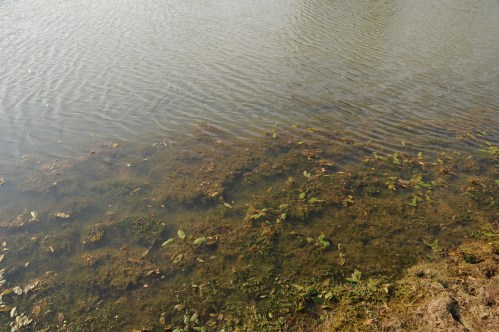
Western edge of pond, Flying Hat Ranchito, north Erath County, Texas, July 2011.

Proust had his tea cake that extended memories to prosy heights that we all have started to climb, but failed to reach — my ascent stopped at Swann’s Way, but I’m not going to stay long on the ledge for I have hammered the next piton to assail the final page of Mt. Swann.  “Cool Water,” a country and western classic by the Sons of the Pioneers, a tea cake of sorts, takes me back to old Camp Bowie, near Brownwood, Texas, as I complained the lack of water on a hot summer day, touring with my parents in a old, non-air conditioned Ford sedan.  Why they weren’t thirsty, I’ll never know, but I campaigned persistently for halting somewhere, anywhere, for water.

I must have been persuasive for my step-father stopped the car along the highway and I crossed over a fence and ran to a pond of fresh, cool water in a green pasture.  I drank, cupping the water in my hands, not muddling the water as I scooped.  Even today, I still see that pond when I drive in the region, although it has been dug out and deepened countless times.  Both my step-father and mother laughed in sympathy and I was dubbed, “Chief Water Bucket,” a name I did not like nor wanted.

The drought in the Southwest descends brutally upon the landscape, in the news and by the mails; the only shade at times is under lovely junipers.  I look out upon brittle, brown grasses; the trees in the grove are turning golden.  The newspapers boldface the headlines that cattle are being sold through the night at local auctions as cattlemen line up two-miles long with moaning cows in their trailers.  In the mail, Barton Water Cooperative states that I can only water the yard twice a week and if the water usage exceeds tolerable levels, I will be assessed a fine, a surcharge.  I fill one water trough for my horse, Star, allowing an overflow into a pan on the ground for wildlife.  I dare a surcharge for that.

This summer I have thought often about “Cool Water,” and sung and hummed the melody and lyrics.  Each time I reflect on the music, I am back with my parents alongside the road, running for the cool, clear water in that pasture.  “Cool Water,” is my tea cake, my madeleine.

Here are the lyrics to “Cool Water,” followed by a current photograph of the ranchito’s only pond.

All day I face the barren waste without the taste of water,
Cool water.
Old Dan and I with throats burned dry and souls that cry for water,
Cool water.

The night are cool and I’m a fool each stars a pool of water,
Cool water.
But with the dawn I’ll wake and yawn and carry on to water,
Cool water.

(Chorus)
Keep a movin’ Dan, don’t you listen to him Dan, he’s a devil not a man
and he spreads the burnin’ sand with water.
Dan can’t you see that big green tree where the waters runnin’ free
and it’s waiting there for me and you.
Water, cool water.

The shadows sway and seem to say tonight we pray for water,
Cool water.
And way up there He’ll hear our prayer and show us where there’s water,
Cool Water.

Dan’s feet are sore he’s yearning for just one thing more than water,
Cool water.
Like me, I guess, he’d like to rest where there’s no quest for water,
Cool water.

(“Cool Water,” Sons of the Pioneer, RCA Country Legends.)

Flying Hat Ranchito pond, north Erath County, July 2011.

19 Comments

Filed under Juniper, Recollections 1942-1966, Weather

If she isn’t the prettiest thing you’ve ever seen, I’ll give her to you!

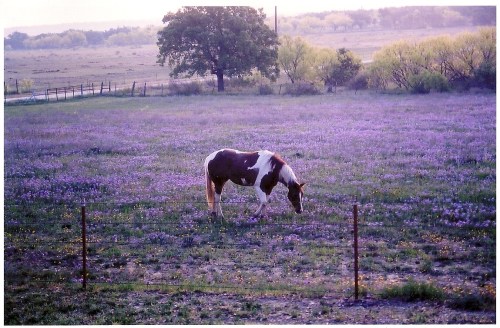
Wild Flower Gal with verbena (north Erath County, Texas, late winter, 2007).

Four winters ago, my neighbor, Jerry Wood who lives two miles south of me on County Road 114 stopped at my mailbox as I retrieved letters one morning.  We chatted for a few minutes as he kept his diesel truck running and as we closed our conversation he said, “I have a horse, Jack, [words unintelligible over the engine noise] I’ll give her to you!”

“I’ll give her to you?”  I had three horses at this time, two tobiano black paints and one quarter horse, Sweet Hija, and another horse added to the remuda would not be a problem to train and feed.  But, a gift horse?  I thought as Jerry drove off that he must be terminally ill or something drastic was going on like divorce or bankruptcy.  I immediately decided that if the horse was sound, I would take her off Jerry’s hands and ease his problem — whatever it was.

Within the week, I drove down to Jerry’s with my trailer hitched up, pulled into his corrals and saw Wild Flower Gal, a sorrel tobiano paint that was drop-dead gorgeous.  “Why would he even want to get rid of this beautiful creature?” I quietly thought.  In any case, he took her through her paces, showed that she was healthy and halter-trained and I liked her behavior so she would fit in after getting to know my other three horses.

After seeing her training, paces and overall friendliness, I asked Jerry, “Are you sure you want to give this beautiful horse to me, Jerry?”  I thought he was making a big mistake to give Wild Flower Away and I did not want to exploit Jerry’s problem — whatever the heck it was — in his hour of crisis.

“What?” he said.

“You did say, didn’t you, Jerry, that you were giving this horse to me?”  This was quickly going in a perplexing direction I did not like.

“Oh, no!” he quickly replied.  “I said, ‘If she isn’t the prettiest thing you’ve ever seen, I’ll give her to you.'”

“Oh, you did?”  This was definitely in embarrassing territory.  “How much do you want for her?”

“One-thousand dollars,” he replied.

I became a tad dizzy in my thinking at that point, but my mind quickly cleared the confusion:  Jerry’s diesel engine had blocked out his words, “If she isn’t the prettiest thing you’ve ever seen…”  And I had slammed his statement into, “I have a horse to give you, Jack.”

What to do?  Buy the horse and lighten my bank account?  Probably the best exit strategy.  If I did not buy Wild Flower Gal, I would probably be the center of an oft-told tale at the Hannibal Country Store concerning my over-eagerness to gainsay another yegua for free.  I did not want that circulating around the cracker barrel.

So, I bought Wild Flower Gal, loaded her up and brought her to my stables.  Jerry signed over the pedigree, pocketing a thousand.

Wild Flower Gal was pretty, but not the prettiest gal I had ever seen.  But, pretty enough to buy and train and sever any anecdote about my confusion.  Several months later I snapped the photograph of her in late winter browsing through the wild verbena.  It was fitting, this photograph, because she was in a pasture of wild flowers that reflected her namesake.  I sold her a year later for a thousand dollars to a family near Abilene, Texas, that showed her at halter and loved her well.

A lot of lessons emerge from this story.  Verify and clarify conversations of commercial intercourse.  Cut your engines when conversing.  Above all, there’s no such thing as a free horse.

16 Comments

Filed under Horses, Sweet Hija, Wild Flowers of Texas

Spring to Summer in central Texas

Mustang grape vines on southern fence of Pecan Tree Pasture (May 2011).

Emergent flora signifies the arrival and maturation of Spring into Summer in central Texas.  Mustang grape vines climb trees and follow fence lines without fail.  I collect buckets of ripened grapes in late June or early July.  Daily observations of ripening grapes must take place or birds pluck the deep ruby-red berries and in over-consuming they fly dizzily, drunkenly away, first to the harvest, leaving my mouth and bucket empty.

Mesquite and mustang grapevines often intertwine and when harvesting, the mesquite thorns force the cost of harvesting painfully upward.

Mustang grapes with mesquite (June 2011).

*  *  *

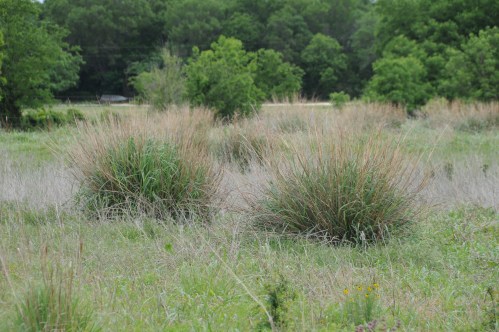
Two stands of Big Bluestem grass (May 2011)

When rain falls, grass flourishes.  The top of the stems reach six-feet or more high.  Big.  Native.  Bluestem.

* * *

The final exhibit of Spring in this post is prickly-pear cactus with its brilliant yellow cactus flower.  I note that many varieties of insects clamor and dive into the flower, bees especially.  Cactus is destroyed as nuisance flora as a regular chore on small ranches and farms.  Yet, its fruit is edible, the flower yields pollen for honey and in drought, propane torches burn thorns and cattle consume the paddles.  The roar of burning pear signals drought upon the land.

* * *

For the moment, propane torches rest against barn walls.  Yesterday, west of my ranchito about a hundred miles, and northwest of Abilene, Erin Rea reports prairie fires near her farm.  The drought has descended brutally on her area and in a line stretching to the southeastern corner of Colorado,  the land reminds old-timers of the dust bowl days.  @Tuckertown tweets, “Wildfire in Southern Colorado fouls the air along Colorado’s Front Range. Very tender dry in the SE corner of Colorado. Very bad.”

The Spring to Summer in central and west Texas is endurable as we live with the land whether mustang grapes emerge or prairie fires burn.

5 Comments

Filed under Field Log, Weather

Sound of wind and bird in live oaks near Mingus, Texas

Wind sounds, April 19, 2011, on Flying Hat Ranchito beneath evergreen live oaks.  Turn up your volume to hear bird calls and wind through live oaks.  A bit of a respite from the last few days.  The wind increases in volume.  Shadows of leaves on the ground.

14 Comments

Filed under Flying Hat Ranch, Sounds

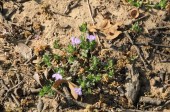
Wild flowers of a dry Texas Spring day

[Please note that when this post was first published yesterday, April 10, 2010, the Silverleaf nightshade was misidentified as a Dayflower.  The corrections have been made in the caption of the flower and plant and the notes contain a warning about the use of the Silverleaf nightshade.]

At 9:59 a.m. I drove down to the barn and parked the F-150.  Taking my camera and walking carefully, within the next hour I traced a familiar path from the barn thorough the corrals, into the arena pasture and into the grove.  I walked along the edge of Salt Creek and photographed these wild flowers of our dry Texas Spring.  Salt Creek is an intermittent-running creek, but there are pools of water and tracks abound.   The trees are green and lush about the creek and grass, despite the drought, remains verdant.

I picked a blossom of wild verbena in the main pasture and gently pressed it.  The fragrance flew about my face and I inhaled deeply.  Only a partial blossom I pressed, but it nonetheless imparted its scent that remained for minutes, not seconds, as I walked back up to the barn.  Beside the kitchen sink, we have liquid verbena soap, reminding me of the wild as I wash my hands, arms and face.

* * *

My uncle Floyd McRorey used to come in from the field and wash his hands in the kitchen sink with hard Lava soap as Aunt Lennie prepared a meal.  I never saw Aunt Lennie wash the dinner dishes.  She helped dry, but never washed the dinner dishes.  Uncle Floyd always washed the dinner dishes.

* * *

All of the following photographs may be enlarged with a click of your mouse.


Notes:

The scientific nomenclature for each plant may be incorrect as there are a broad range of varieties.  I refer to as many as four books and two databases to identify the plant, but I may be in error, so please verify my identification.

The Silverleaf nightshade is all toxic.  Medicinal: Used for rattlesnake bite – root chewed by medicine man, who then sucks on the wound to remove venom, then more root is chewed and applied to swollen area. (Steiner) Southwestern Native Americans used the crushed berries to curdle milk in making cheese, and the berries have also been used in various preparations for treating sore throat and toothache (Lady Bird Wildflower Center Plant Database).

Please see the link for Silverleaf nightshade:

Lady Bird Johnson Native Plant Database Silverleaf nightshade.

10 Comments

Filed under Wild Flowers of Texas

Spring with Effie and Gywn


Effie Vernon Morris Parks (1900-1966)

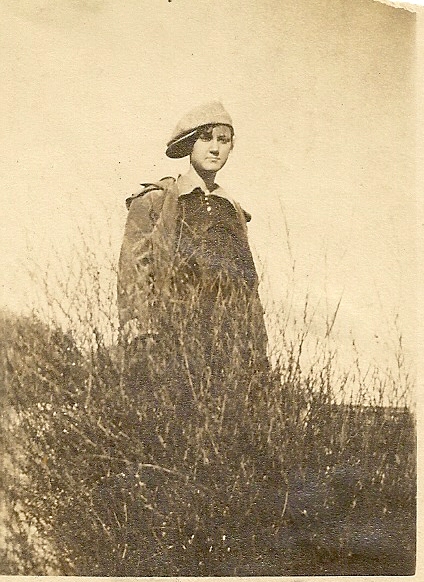
I have written about my grandmother, Effie Parks, many times on the blog.  Here is a photograph of her in 1919, near Bend, Texas.  She cooked for chuck wagons on several ranches along with her husband, Jake, who managed cattle on horseback.  During the Great Depression, she sewed for the Works Progress Administration.  In her last years, she worked as a telephone operator in Lometa and Bend, Texas.  She taught me the rudiments of dominoes, playing guitar and hitting a baseball.  She and her husband were married by a parson in an onion field near the Colorado River in central Texas.  In her will, she divided her property among her two children and me.

Gywn Matthews Hollingshead (1920-2003)

This is my mother, Gywn.  This photograph was taken about 1938 when she was living with her mother, Effie, at Bend, Texas.  She married my father, Jack, in 1942, shortly before he volunteered to become a parachutist with the 506th P.I.R.  He was a member of Easy Company, made famous by Stephen Ambrose and Tom Hanks.  Gywn worked for over thirty years for the Southwestern States Telephone Company and General Telephone.  She helped pay for my college education and gave Brenda and me the money for a down payment for a $35,000 house in Mingus, Texas in 2000.  She would come to Mingus and visit us, sitting in the kitchen and looking out on the vineyard I had planted.  She always had a quote of some sort to throw out for the occasion.  One I remember is: Ask me no questions and I’ll tell you no lies.  She was Irish mainly, and proud of it.

I have posted these photographs and short commentary of Effie and Gywn because it is April and Spring is upon us and I never can go through this month without thinking of how Effie and Gywn and I traveled the backroads to Bend, Texas, and San Saba to visit relatives at Easter.  The flowers of April and May emitted the most beautiful perfumes imaginable in nature.  They talked quietly about plants and cattle and loved ones that we saw and loved ones that had departed.  I sat in the back seat of the car and listened to their talk and inhaled the scent of bluebonnets and paintbrushes all around.

Today, Brenda and I can travel the same road to Bend, Texas, and flowers spring up again.  We can go down that road and crisscross the same roads I traveled as a boy with Effie and Gywn.

31 Comments

Filed under Bend Texas, Life in Balance

Rabies and Star

Star Bars Moore

In the city, look out for the bus.  In the country, what doesn’t sting or bite you will stick you — wasps, mosquitoes, mesquite thorns or worse.  Still, I had rather be out in the country and take my chances.

Rabies in horses is rare, but on the Bryant place, across the fence to the south of us, two horses were put down because one of them had a full-blown case of rabies.  Its companion horse had not displayed rabies symptoms, but Erath County authorities ordered it killed as it had no rabies vaccination documentation.  One was euthanized Thursday, March 24, and the other unfortunate horse this Thursday, March 31.  The first horse exhibited rabies symptoms and the vet took tissue samples that confirmed the disease.  The Bryants are having to take rabies shots since they were in close contact with the horse.

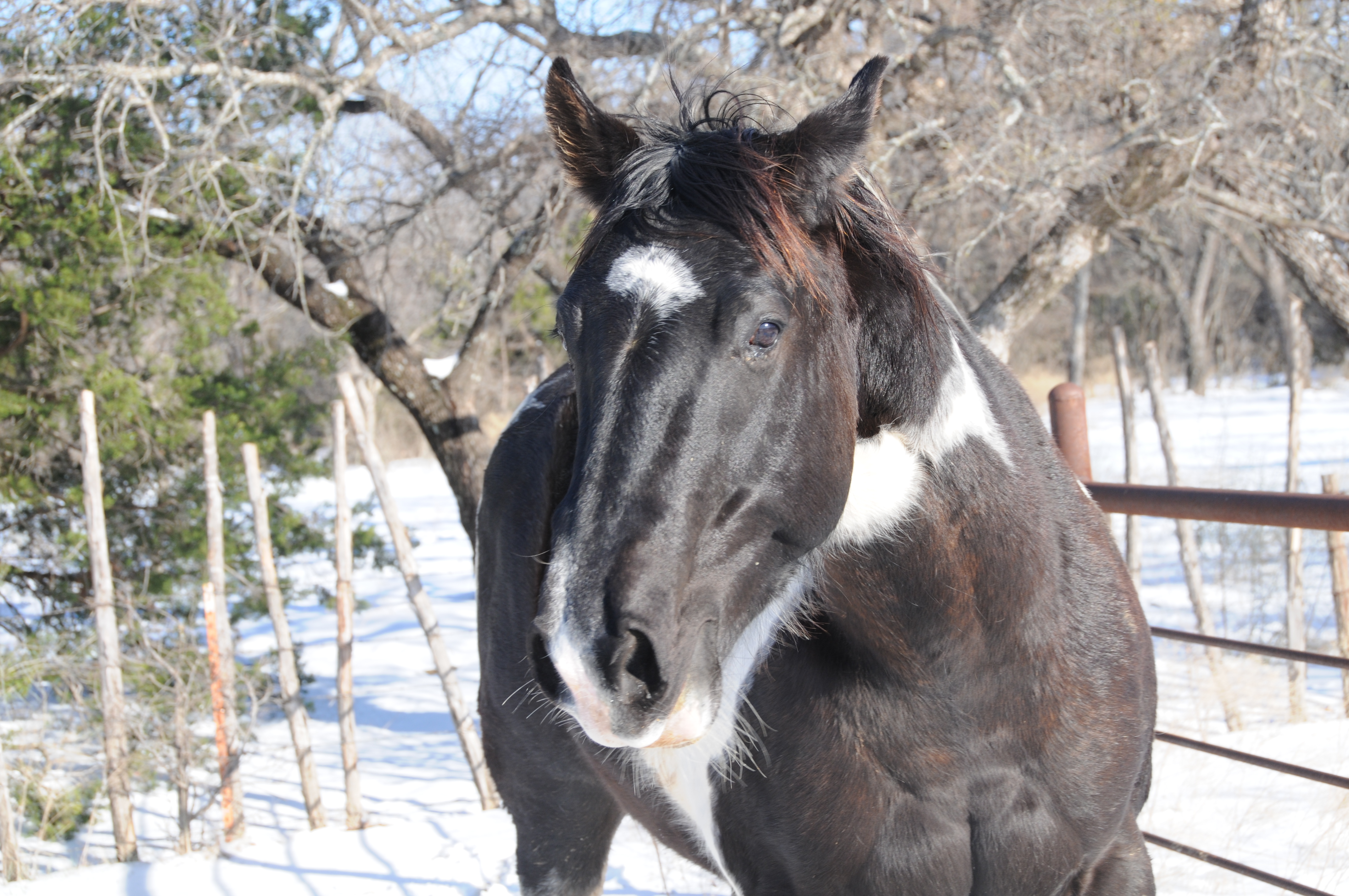
My paint gelding, Star, had been staying in the front pastures away from the Bryant place until last Sunday, March 27.  For two days, Star had infrequent contact with the second horse over the fence that had been killed.  Since rabies can be transmitted via mucous interchange, it is a very serious situation for Star.

Star had been inoculated against rabies in 2009, and last week before the contact with the Bryant horse he had been given his rabies shot for 2011.  Our veterinarian, Dr. Skeet Gibson of Equine Sports Medicine and Surgery, Weatherford, says the 2011 inoculation has not gone into full effect, and the 2009 inoculation begins to diminish in effectiveness after a year-and-a-half.  But since Star had no contact with the rabid horse — only the companion horse that had been killed — the chances were slim that any transmission had taken place.

Nonetheless, the vet said to isolate Star for two weeks and minimize my contact with his muzzle and mucous discharges, look for symptoms (not eating, behavior changes, etc.) and contact my personal physician for advice.

I called our personal physician immediately and neither I nor Brenda will be required to take rabies shots unless Star is rabid.  Star will probably be okay, but isolation and observation is imperative.

And just how did I find out about this whole issue of rabies next door?  My neighbors to the east that have horses called me Thursday, March 31, to inform me of the euthanizing, and they have no land contiguous with the Bryants!  They called to alert me as a fellow horseman.  Neither the Bryants nor the Erath County authorities had contacted me.  Had I been informed last week, I would not have allowed Star to go to the far pasture — Pecan Tree Pasture.  As it is now, we are having to take measures to determine disease contact that may, in the end, be fatal to Star, although I repeat it is doubtful.

Within an hour after the Halls called me and I had visited with the Bryants to find out the facts, I went across the county road to inform a fellow horseman of the situation.  In the country, we must work together.  I choose to do so.

25 Comments

Filed under Flying Hat Ranch, Horses, Star