Tag Archives: Texas

Merry Christmas!

Electric lantern in central Texas with characteristic star, December 24, 2011.

I wish you a Merry Christmas and Happy New Year!  In the words of Abraham Lincoln, A fellow is about as happy as he makes up his mind to be.  So, in the spirit of a great president who faced reality head-on, let us make up our minds a few times during the day to be merry and happy.  I would be a lot happier if I didn’t have to hear Alvin and the Chipmunks sing Christmas songs, but it is hard to avoid if one goes into the city malls.  Yet, to stay out of the malls means I might not run into my favorite seasonal character, Clark Griswold.  Play ball! 

Merry Christmas!

(I will publishing a post later today about my favorite fauna flora coincident with Christmas and other events in my life: the juniper.) 

5 Comments

Filed under Christmas

Walking with Great Blue Herons

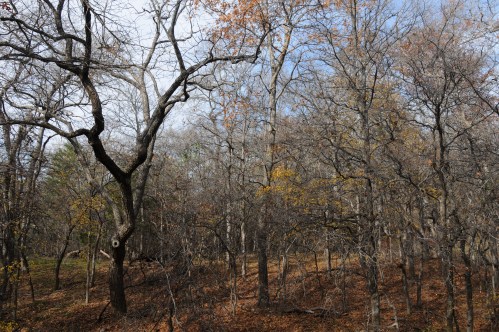
The grove peninsula. This is one of several peninsulas formed by the meandering Salt Creek (December 2011).

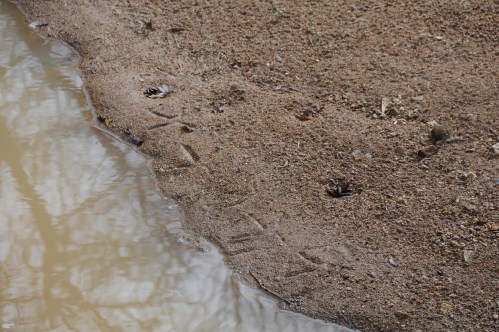
Blue Heron tracks along a still pool of water in Salt Creek (December 2011).

I walked in the grove this morning.  Several peninsulas emerge in the grove, cut by the swift and long-flowing water of Salt Creek.  Upon purchasing Flying Hat Ranchito eight-years ago, I found a red metal chair on the peninsula I photographed, a solitary chair for the previous owner to muse, observe or rest.  I took the chair off the peninsula.

Wet and cold the air, I saw track of the Great Blue Heron that frequents the creek that meanders among the elm, oak and juniper.  I see one or two of them each day flying to the cow tanks about the ranchito.  The heron track I identified with my Peterson’s field guide to animal tracks, a new third edition I purchased when Border’s went out of business in Fort Worth.

I was not alone as I walked in the grove.  The Great Blue Heron — past and present — walked with me in the grove today.

Related articles


7 Comments

Filed under Birds, Great Blue Heron, Juniper, Life in Balance

Hardshell and gobble, gobble! Pecans and turkeys in my family

In central Texas, for as long as I can remember, pecans and turkeys have been a mainstay harvest source for my family clan:  Morris, Parks, McRorey, Millican, Gray, Hollingshead.

Millican Pecan Co., San Saba, Texas

The Millican family business, stretching back to the nineteenth century, provided pecans for Queen Victoria and Alfred Lord Tennyson. The queen and Lord Tennyson were an integral part of the customer base for many years. My grandfather and grandmother took long bamboo poles and thrashed pecans along the Colorado and San Saba Rivers. On one occasion my grandfather lost his high school ring while thrashing and never found it. Someone will unearth it one day and see the graduation date at about 1917-1918, and think it unfortunate, yet quaint, the ring was lost.

Before mechanical pecan shellers, my step-father and uncles about Thanksgiving and Christmas had stained fingers, like charred wood, from cracking and peeling pecans.  In older years, a package of shelled pecans was always included with Christmas gifts and the nuts were minced upon for days thereafter.  As I put a pecan in my mouth, I reflected upon the labor tended, my step-father cracking pecans in front of the radio or television in the evenings.  I knew hard shell from soft shell pecans and sought the soft shell to crack — didn’t we all?

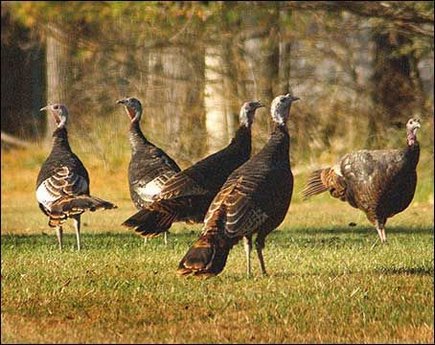
The McRorey family — Floyd, Lennie, John R. and Joycelyn — raised turkeys for the Thanksgiving table on a grand scale with thousands fed and sped to market before the holidays.  The turkey business was good for the McRoreys and when I stayed with them I drove the tractor as grain was unloaded in the feed bins.  I was not the best of drivers, but I meant well.  I learned much from my Uncle Floyd.

My mother hunted wild turkey.  On one occasion in Brown County (Brownwood, Texas, the county seat), she bagged the first turkey of the season.  With a .22 caliber rifle she took her kill that season.  She arose before daylight in the morning and placed herself behind a hunter’s blind on my uncle’s ranch near Brookesmith, along the creek, and waited patiently for the flock.  Ofttimes, she merely watched the wildlife, counting the flock or observing deer in the pasture.  For many years after she won the first-turkey-taken prize, as I accompanied her on errands around town, she was asked: Are you going to get the first turkey this year, Gywn?  What rifle do shoot turkey with?  Where do you hunt?

I am one and two generations removed from a family clan that thrashed pecans, raised turkeys and lived off the produce of the soil, harvesting and consuming nature’s fecundity.  I have only lightly touched those activities, but I am aware, deeply so, that when I eat pecan pie today I see the bamboo poles of thrashing in the rafters of the barn, and when I see the breast meat of turkey upon my plate I hear the gobble-gobble of Uncle Floyd’s turkeys along the Cherokee Creek in San Saba County.  I am truly thankful for for the produce of the soil and the hands that have tended the harvest and taught me lessons about nature and all that dwells therein.

18 Comments

Filed under Pecan, Turkey

Poaching or just curious? Deer on Flying Hat Ranchito

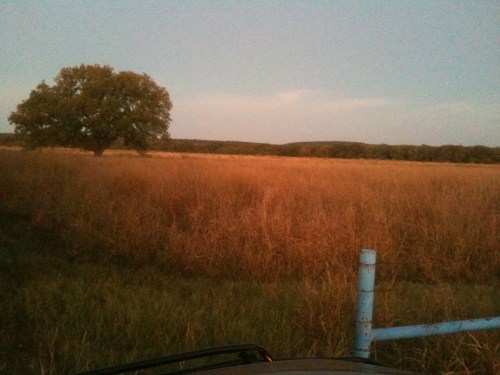
Southeast gate of Pecan Tree Pasture, deer season opening day, November 5, 2011, 7:35 a.m.

(The following datum comes from Field Notebook No. 1, October 29, 2011 –.  These are the original notes I took this morning on the first day of the regular deer season in north Erath County, Texas, November 5, 2011.)

7:50 a.m. In the far field at Pecan Tree Pasture.  One rifle shot to the south, a loud report.  41 deg. F.  One photo taken at southeast far gate.  No deer yet sighted.  Traffic light on State Highway 108.  Owl call, hooting, in the grove.  [I am parked between the grove and pecan tree, having entered from the far southeast gate to contain deer? within the field.]

No deer stands sighted on Old Bryant place, the Dooley place, that I can see.  This is different from past three years.  Two years ago, I sighted nine deer stands from my place.

Crows cawing — very few.

7:59 a.m., flock of crows flying east to west.

8:00 a.m.  Solitary deer sighted between me and water trough on my pasture road.  I am at the grove-pasture gate.

8:01 a.m.  Rifle report to the far south.

Deer may have come out of the grove gate by the water trough.  Deer leisurely walking up the pasture road.

(Bring binoculars next time.)

(Clear brush around fence in places so the F-250 is not scratched.)

A gray, short-bed pickup cruises by my open southeast gate, turns off road by gate, pauses, then goes north on SH 108.  No identification of the gray pickup.  Not a neighbor.

8:10 a.m.  Chickadees or wrens fussing in the mesquite brush, grove.  Will the solitary deer I saw cross SH 108?

8:14 a.m.  Rifle report to the east at some distance, estimated three miles distant.

8:21 a.m.  Rifle report to my southwest, very loud, very loud either on Dooley or Woods place.  I can almost smell the gunpowder.  [I carefully listen for bullet coming through air, but hear no sound.]

Far away to the south, another rifle shot.

A white-flatbed pickup passes on SH 108, slows down by field, turns around and comes back by deer at water trough, slows down, goes up road, turns around and then heads south on SH 108.  He probably saw the deer on my place.  Not a neighbor.

Big bluestem grass abounds in this field.

8:50 a.m.  Leave field.

______________________________

Notes, corrections, additions:

This year the rifle sounds are greatly reduced in number for the opening day of the general season.  The pickups that turn around and gaze into the far field where I have deer may be curious or may be looking for an opportunity to poach.  I can’t monitor and don’t want to monitor my field constantly.  I am glad that the deer stands have been significantly reduced in number from several years ago.  I have Tony Navarro to thank for that.  Game Warden Tony Navarro’s great-grandfather signed the Texas Declaration of Independence.  I rode with him in his outfitted pickup a couple of years ago when we scanned Flying Hat Ranchito for game. 

Game Warden Tony Navarro's card

2 Comments

Filed under Deer, Field Log

Frosty tumbleweeds in a Texas corral

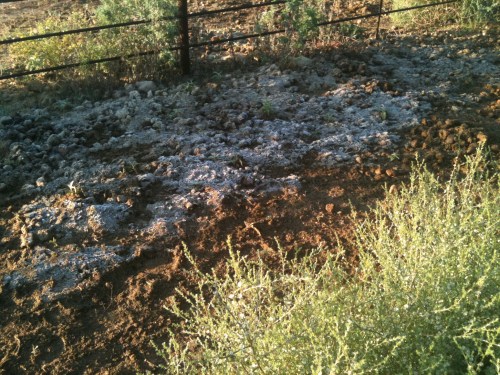
Frost in Broke Tree Corral (October 29, 2011).

For the first time since last April, frost rests upon the Broke Tree Corral!  The temperature at the ranch house read 35 deg. F., but when I walked down to the corral, I saw frost.  Then I photographed frost on the horse apples and soil (I could have photographed frost on the trailer, but this was a neat pic with green tumbleweed).

This weather event is worthy of a separate post — should have made it on Saturday — because, well, it’s cold for a change, and we have been sweltering, perspiring, cussing, finding shade, digging caves and seeking the earth’s innards for cool places like Sonora Caverns or Carlsbad Caverns.  Many of us in the Southwest have even constructed wine cellars for cool comfort even though many Texas vaqueros  prefer Shiner or Casa Blanca beer and won’t use the cellars for anything but a cool getaway.  River bottoms at night also offer pleasant temperatures.  Bear Creek and Palo Pinto Creek near my ranchito are cool at night.

I like the tumbleweed and frost.  Yesterday I had to shred tumbleweeds in the Broke Tree because when they dry up the tumbleweeds will detach from the soil, roll around and scare the horses at night — yes, tumbling tumbleweeds.  I am not going to ever use tumbleweeds for Christmas trees.  Too fragile, smell funny.  The way this economy is going, however, I may cut the tumbleweeds and go to the Metroplex and purvey to florists!  I am getting a mite desperate.

Tumbleweed courtesy of TumbleweedsRus.com

10 Comments

Filed under Plants and Shrubs

Not mine, not yours, but ours: Penasco Upper Llano acequias

The house on 17 irrigated acres from the Acequia de San Juan Nepomoseno del Llano. Water rights since 1789 (photograph by Taos Properties).

Forty-four years ago, in 1967, I traveled to New Mexico from Amarillo, Texas.  It was my third and most memorable trip for I dreamed for days about colors and pottery and adobe and silver.  I would lie down, fall asleep and pass into a dream world of silver and blue skies — northern New Mexico.  It was not all pleasant because I became ill from eating different Native American and Mexican foods, but that never deterred me from returning again and again and again.

Aside from digestive and dreaming events, I vividly remember a man plowing his field with horses near Mora, the unpaved streets about the Taos plaza and the narrow strips of farm land that bordered rivers and irrigation ditches.  The narrow strips of irrigated land not only reflected a precise lay of the land by survey crews, but also reflected a community, a meshing of farmers.  What was there about those fertile strips that drew me in?    In later anthropological field trips, I took my students by the Pecos River irrigated plots along State Highway 3 that ran from Interstate 40 to Interstate 25 between Santa Rosa and the Pecos Pueblo.  (Click to see Google map of the Pecos River plots.)

The system of irrigation is called acequia, referring both to the irrigation ditch and the association of members organized around it.

I have never owned land in New Mexico, but if I did I would buy a parcel of land that had water rights to an acequia, a system that stretches back in time to Native American communities before the arrival of the Spanish who adopted the local customs of water rights (riparian rights).  Having land that possesses an acequia, one automatically gains entry into a community that cleans, rebuilds and nourishes the ditches and, further, is granted rights to meet in a democratic association to discuss apportioning water and policies affecting owners that border the irrigation ditch.

Several weeks ago, I came across a piece of property near Penasco that if I could sell my ranchito, I would buy and move my horses and equipment post haste to Penasco Upper Llano.  See the following Google map:  This is the map-image of the Penasco Upper Llano property and other strips of community property.

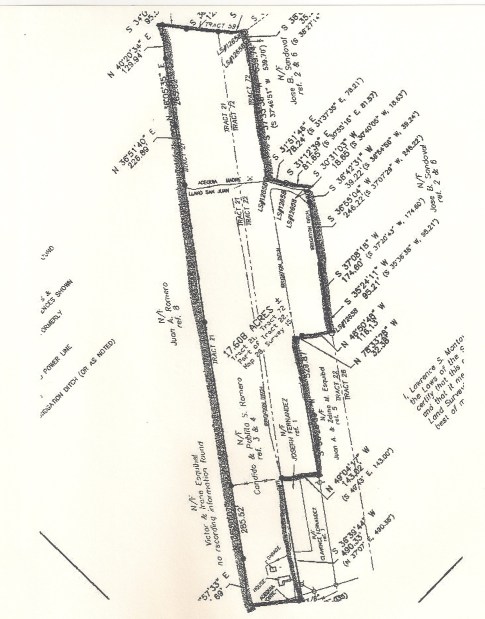
This particular piece of property with the adobe house pictured above is located in the high country between Taos and Santa Fe and can produce 700 bales of hay a year.  The water rights go back to 1789, the year that the United States inaugurated its first president, George Washington.  The surveyor’s plat looks like this:


Stanley Crawford in his work, Mayordomo: Chronicle of an Acequia in Northern New Mexico (1988), writes of the acequia culture that I admire:

There are few other civic institutions left in this country in which members have as much control over an important aspect of their lives; relatively autonomous, in theory democratic, the thousand acequias form a cultural web of almost microscopic strands and filaments that have held a culture and landscape in place for hundreds of years….

Ditch-cleanings are all very much the same, and in this they often feel more like ritual than work.  The crew varies from year to year: a couple of old men don’t turn up each year, a couple of boys barely able to handle a shovel, fifteen- and sixteen-year-olds, take their places; the weather is better or worse than some vague notion of what is usual, mayordomos come and go and some are responsible and fair, others vindictive, punitive, almost military, others are lazy and heedless of the needs of the ditch; and the crew can be a good-natured, hard-working creature, or sullen and complaining and evasive, qualities perhaps dictated by the amount of pride or fear circulating through the hearts of both those in charge and those doing the actual digging….

Buddy Manzanares who, on one of my last perfunctory inspection tours half an hour from the end of the spring digging, calls on me to admire a meticulously dug out and cleaned up tarea [a grave-size chunk of the ditch], with the banks cleaned of grass and squared neatly where they end in the bottom of the smoothly shoveled-out channel….This man knows how to make this small thing, this chore, into more than we commonly imagine, and what can be more important to know in this life, than just that.

Mayordomo, pp. 176, 224, 228-29.

The deep thing about acequia that pulls on me is the ready-made community that circulates around water rights that nourish subsistence crops and the growth of hay.  The isolation of many Texas ranches and the people that tend them and steward their animals is not good; in fact, it diminishes the rancher to a coarse individuality that thins the possibilities of  human endeavors, insinuates a obsessive pecuniary attitude about the land and narrows civic — read unselfish — behavior to the mere casting of a vote once or twice a year.

There are western ranching communities that transcend these deficiencies, I grant you, but the tendency has been to sell out or buy more land, thus expelling more people from the agrarian way of life.  I have experienced this and have witnessed the deleterious affect upon my family.

I shall not be accused of romanticizing the acequia culture — oh, go ahead and accuse! — because it is a human community and there will be conflict and law suits, but there is an association, a group of men and women meeting about water and how to nourish their livestock, beans, alfalfa, corn, tomatoes, okra, flowers, lawns, chilis, vineyards, peaches, plums, apricots, coastal bermuda, roses, trees, and every other conceivable plant that flourishes from the soil that is watered.  Having an acequia culture forces the lesson about sharing in real, material ways that no desk-bound, box-bound person will ever learn.  The basic premise is:  water is limited, we all need it, how will we share it?  And, how are we going to keep it coming down the ditch?  The answer: let’s talk about it, let’s vote on it, let’s implement our decision.

Like so many other things in life, the ditch is more than a ditch.  The acequia and the water is not mine, not yours, but ours.

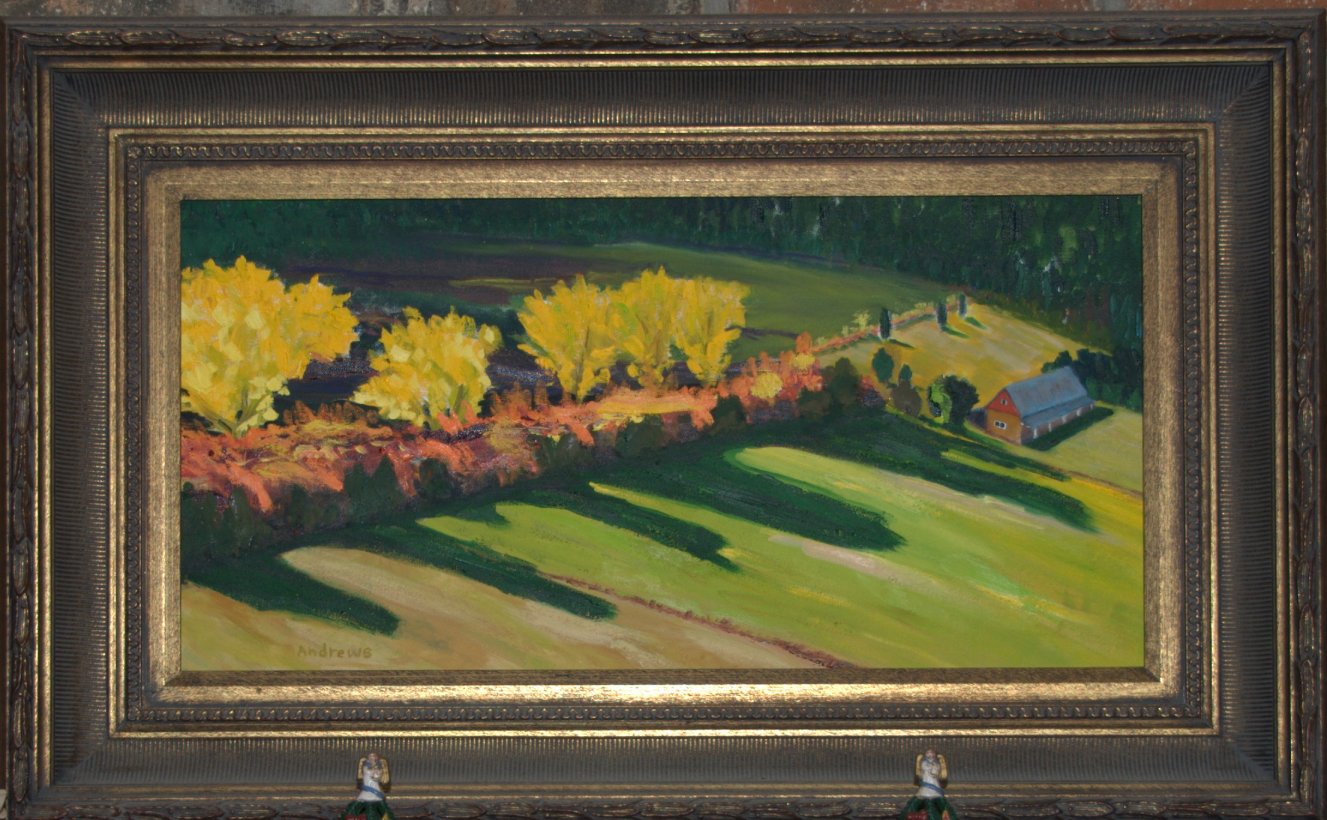
Acequia near Vadito, New Mexico, (Vadito II, oil by Eric Andrews, Taos, personal collection of J. Matthews).

______________________________

Notes, corrections and additions:

The language keyboard for Spanish and diacritical markings frustrates me.  Hence, the Spanish diacritical markings for “Penasco” are missing, although about every 20 times, I can get the tilde above the “n” in Penasco.  If anyone has any suggestions within the WordPress format to easily apply diacritical markings to writing, please comment or drop me an email at matthewsranch@msn.com.  I am intent upon using proper markings, but I am not going to spend ten minutes every time I need a tilde to paste it on.  Can Windows Vista do anything right?  Of course they can, but you have to update your browser every five minutes.  And, then restart.

13 Comments

Filed under Life in Balance, Santa Fe, Taos

October in Texas: dusting and sunflowers

Sunflowers with dust storm near Abilene, Texas (October 17, 2011).

A light “dusting” of dust, not snow, descended with high winds upon Texas yesterday. A cold front came in the afternoon that sent temperatures this morning down into the lower 50s F. I love changes in weather. Of course, not with abrupt turns that bring destruction and fire, but changes like yesterday: brisk winds, racing clouds, lightening, rain in the distance that you can smell (my dog, Yeller, lifts his head high to catch the scents far away), dark clouds with long trailing edges that signal rain prospects and all of it bringing anticipation to the heart that tomorrow will be different, a new day with fresh starts all over the world.

How can one capture that cachet of weather change and anticipation for riding your favorite horse into the future? ( I am down to one horse, my Star paint gelding, so he is the favorite, the last of the remuda — but I will build a remuda back with brown mares that foal in the Spring.)  Well, you can’t capture it, but you can take a photograph that elicits Texas weather change, and the above photograph of Texas plains, dust and sunflowers, brings yesterday’s moment to pause.

You must ENLARGE the photo above to get the full effect of yesterday’s “dusting” around Abilene, Texas.  The evocations the photograph brings reminds me of migrating pioneers in the nineteenth century that saw the Trans-Mississippi West plains and stopped, not wanting to venture farther onto land that had little water, few trees and a population that spoke strange languages.

O, Pioneers!  Be not afraid!  There are springs and rivers, trees are in the ravines and highlands!  The Indians will trade and parley and teach their tongues, if you will tread lightly upon the terrain!

Yes, I know that pioneers did not tread lightly.  There were, however, places of concord — Bent’s Fort, the Pawnee, the Tewa, among other spaces and culture.

Despite this riff-tangent about the American pioneer, I come back to the weather change of yesterday that brought cold winds, turning the sunflowers to face the southern climes.  Bees and butterflies still feasted on its pollen, riding the petals like cowboys on broncs; the contrast of red earth, dusty skies and yellow flowers showed a tough plant on inhospitable soil, holding on tight and bearing its colors to the world.  I love these types of weather changes.

5 Comments

Filed under Weather, Wild Flowers of Texas

The quail, the deer and setting the lesson

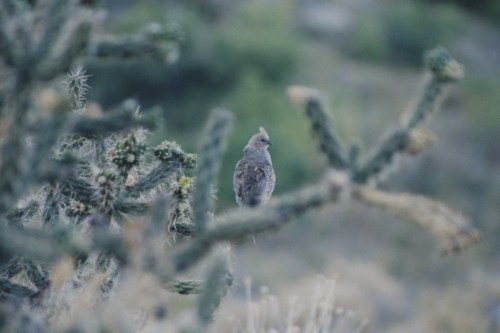
Scaled quail on cholla bush (photograph by Marcus G. Martin, Photo Gallery).

Quail are sociable, staying together from birth to death as a covey, and when one lone quail, separated from the group, calls out plaintively, the covey circles back and joins the solitary being, bedding down all together in the evening so that they appear to be one animal, not fifteen or twenty, when observed closely.  (I have reared quail and know their habits.)  The quail also make for a fine gumbo, or with a brown sauce on top of white rice, a delicious entree.  They are beautiful and interesting to watch, but they are also food.

Deer, buck or doe, appear majestic in the field as they scan for predators and graceful when they arc over fallen timber or fence.   Fawns scamper and play about their mothers like children at the playground.  The backstrap or tenderloin of the deer is one of the finest cuts of meat on earth.  The liver of venison when soaked in milk overnight becomes delicate to the taste when fried and offers potency to the sick.  Deer are beautiful and interesting to watch, but they are also food.

Two years ago, in 2009, I chose the name of my blog, “Sage to Meadow,” based upon a post by Coffeeonthemesa, a blog published out of Taos, New Mexico. Coffeeonthemesa uses a phrase in her post that describes a covey of scaled quail moving from “sage across the meadow” near her home.  I like that.  It describes plant and terrain, sage and meadow: expansive geographic images and symbols of the American West.

Here is the post of Coffeeonthemesa — the italics are mine — that gave my blog its name and a setting of a lesson about food.

The covey of scaled quail (Callipepla squamata) that pass through our yard on their mesa rounds is smaller this year. It seems there are only a dozen or so, but they are quite plump. They move north to south from the sage across the meadow, stop to graze under the sunflower seed feeder, move through the little shed (have they ever found anything to eat in there?) and out again, in a little row. They search around the wood pile and cross the barren summer garden, before heading down the road towards the mesa edge. Last week I found the feathers and scant remains of one on the north side of the house where our woodstove ash pit lies.

They’re short-tailed, chunky birds with a cotton top crest, and the lookout quail sits atop a sagebrush or low fence post and barks out warnings to the others. Generally they run when something nears, zigzagging through the underbrush. Although the covey can explosively flush when startled.

I cannot help, when watching them under the feeder, but imagine how their plump little breasts would make a fine gumbo.

Coffeeonthemesa blog, Taos, New Mexico, November 13, 2009.

The eloquence of Coffeeonthemesa’s prose brings the eternal cycle into her final sentence:  “I cannot help, when watching them under the feeder, but imagine how their plump little breasts would make a fine gumbo.”

I have never been a consistent hunter in the food chain.  I shop the food chain.  I go to the supermarket for food, but I know it is not the supermarket that gives me food.

I have hunted in the food chain.  In the 1970s, I went deer hunting with two friends, shot my deer and dressed it in the field.  Oh, I had known the one-life-for-another axiom for a long time, but the buck I shot set the lesson inside me, inside my body so that all the literature and thinking I had ever done about one-life-for-another seemed faraway, alien even, to the beautiful, majestic animal I knelt before.

Beneath me, still breathing, eyes open, the grey coat shimmering, lay the deer, my first deer, its antlers hard and white.  No longer would he browse the field, sniff the wind, eat acorns beneath live oaks.  His animation was near end.  As I put my pistol to his heart, I promised myself that I would prepare all of him for me and my wife and my friends to eat.  I would honor this being, this deer, this day under the sun near Van Horn, Texas.

As I dressed the deer, I retched and threw up.

Must all lessons be assimilated like this?  Or, expelled like this?  Can’t very well drop the class can I?  Can we?  How do I get out of this university (universe)?

The regret and sadness I had that day recedes when I ponder the lesson the deer set in me.   In my anthropology classes, the lesson is taught every semester, every class, to every student.  I don’t grade them on it except for the economics of reciprocity in a society.  I set them on a path to learn the lesson — they will have to go into the field to have the lesson truly set, but here are the words:

We all take life to sustain ourselves.  To obscure that fact is profane.  To recognize that we take a life to sustain ourselves is sacred.  The sharing of food with another, next to laying down our life, is the greatest gift we can give others.  Who feeds you?  And, what do you do for them in return?

Jack Matthews, author of Sage to Meadow, Introductory Lecture in Physical and Cultural Anthropology.

____________________________

Notes, corrections and additions:

The New Mexico State University Scaled Quail Management Operation.

Marcus G. Martin Bird Photo Gallery.   The quail on cholla bush is from Martin’s gallery — permission pending.  Click his link for other photographs and website.

This post started out only as a post describing how my blog got its name.  From quail gumbo, however, the post grew into what it is now.

Along with the more somber lesson herein written, there are other lessons  from an anthropological perspective that relate to to food:  (1) by giving food, parties, spreading your resources, you enlarge your social network and friends; (2) gifts make slaves; (3) by giving of gifts, including food, you create obligations.  I think that we could go deeper into the psychology of harvesting animals, but for the moment, this is it.  One aspect that bears mentioning is that if you take life with respect, you probably won’t harvest unnecessarily, and you will get beaucoup angry with those that do.  You may even go to war with agencies that take the fat of the land and hold it in reserve, extracting a price for its distribution.  Read most any history on the opening of the American West, the partial closing of the American West. 

5 Comments

Filed under Deer, Life in Balance

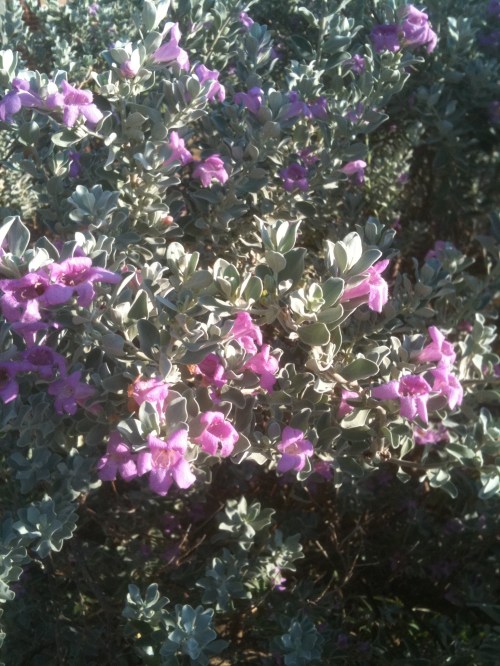
Sage blooms in Abilene

Sage blooming in Abilene, Texas, September 20, 2011.

This late summer, thundershowers fall infrequently around Abilene, Texas.  Yet, some showers do fall about this west Texas city that lies close to the Brazos River and Buffalo Gap, a niche in the hills that allowed buffalo to migrate from north to central Texas in the nineteenth century, following the shortgrass and bluestem in their casual browsing.

Two days ago as I worked late at my office at Cisco College, I walked by three large sagebrush by the back entry door.  A monarch butterfly floated by, floating and fluttering as if they are playing, and landed on one of the blossoms.  But before I could draw my iPhone from my coat pocket, it flew away and out of my range to snap a picture.  Alas, I was too slow on the draw.  I followed it to a green clump of slender grasses and lost it, despite my intent search.  The monarch had buried itself from my eyes, thinking me a raptor?

Yesterday, following the blooming sagebrush and my failure to photograph the butterfly, it rained about the city, to the north and west particularly.  A rainbow emerged with the sun setting to the east.  And, this morning, the temperatures were the coolest since May, a 61 degrees before sunup.

I think, if sagebrush blooms, can rain be far behind?  And playing monarchs about the purple sage?  Not far behind either.

Three sagebrush with blossoms at the back door of Cisco College, September 22, 2011. The monarch flew and hid in the bushes to the upper right of the photograph.


10 Comments

Filed under Monarch Butterfly, Plants and Shrubs, Sagebrush

Well springs Frio loam

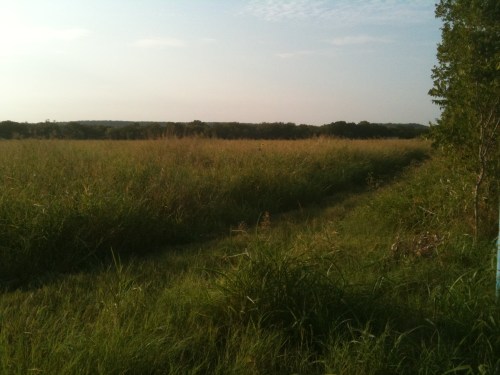
Southeast corner of Pecan Tree Pasture, Johnsongrass and big bluestem (September 4, 2011).

Drought has come to the Southwest, particularly Texas. Wildfires erupt and I view every cloud in the sky as either friend or foe, rain-cumulus or pyrocumulus. Man lives in oscillating cycles: birth, maturity, degeneration and death; spring, summer, winter and fall; day and night. Nature’s theater, the grandest show — in fact the only show on the road — brings hot, dry days to us, an uneasy audience that sits without a program in hand.

Raising my hands and putting on a broad-brimmed hat to shield myself from the sun, I think, Is there is no way out of this parched country of west Texas, this incessant drought?  As a matter of habit, I drove to the far field two days ago, then again yesterday, and what I saw brought me out of the funk and into the reality of primary, nascent things that fosters renewal, not despair.  What I saw was the green field of my far pasture, Pecan Tree Pasture, a 35 acre field of buffalo grass, side-oats gramma, little bluestem, big bluestem and Johnsongrass that stood higher than my head!  The rain of about 2.5 inches two weeks ago provided enough moisture for a re-eruption of growth.

Trying to understand the dissonance of yellow-brown drought in Texas and this field of green grass, I gazed deeper and deeper into the field, trying to resolve these issues of color.  Then, it penetrated:  I was not looking deep enough, for beneath the grass lay soil, the wellspring for grass, the fountain of energy that we all thrive upon.  Well springs the soil.

Land, then, is not merely soil; it is a fountain of energy flowing through a circuit of soils, plants, and animals.  Food chains are living channels which conduct energy upward; death and decay return it to the soil.

Aldo Leopold, A Sand County Almanac, p. 216, New York: Oxford Press, 1949.

In primary school, we all saw the pyramid chart of soil, plants, animals, man, sun and the flowing of energy back and forth.  The tooth and claw of the pyramid remained omnipresent, but never voiced.  We knew one thing lived by absorbing another living thing, whether cougar on deer, fox on rabbit or kids on hamburgers, but our teachers for reasons of refinement side-stepped the tooth, the claw.  The revealing of one thing eating another lay with fathers and uncles in the field on cloudy, windy and cold days.  Perhaps that is how it should be.

To know my soil, early this morning I unfolded the Soil Survey Map of Erath County, Texas, in order to type the soil of the far field I saw yesterday.  The map is ninety-one years old (1920); it is still accurate, still a good map.  My land, temporary occupant that I am, encompasses three soil types.  First, I have rough stony land (R) upon which sits the house, barn, stables and arena.  Second, the tree grove of American elm, willow, live oak, red oak, juniper and pecan rests upon Frio silty clay loam, Colluvial phase (F).  Through the tree grove runs Salt Creek, an intermittent flowing stream.

In the far field, where big bluestem is stretching upwards of seven-feet in height, a pasture that has not been grazed by Angus cattle in four years, is Frio loam (Fm), deposits of earth that have rushed down from High Salt Cove and between two creeks, Barton Creek and Salt Creek.  From Frio loam springs the grass in the far field.  The doe and fawn I disturbed yesterday lie between the high stands of big bluestem, and I lapse back to Oklahoma’s plains and the waving blue-red waves of autumnal bluestem that rustle with wind, the stems making sounds as they brush against one another.  The pasture holds the moisture of the last rain and though I am not a person of edgy competition, I would put my far field of green grass up against any non-fertilized field in Erath County for height, vigor, nutrients and wildlife.

After tending the far field for eight years and seeing the soil’s fountain of energy this late summer, How is it that man fouls such richness, such gifts?  The answer is complex, but knowable.  The resolution to stop the pollution begins with a respect for knowledge, deep knowledge that is revealed early and, unfortunately, forgotten early on with so many other things in our youth, a bulletin board that displayed the food chain in first grade.  The ethic of conservation and sustainability rests upon simple principles that need the status of a Commandment, an article of the Constitution, a catechism of the church.  Better yet, we should recover that which was lost when we began to make pottery, metal and textiles thousands of years ago, or left on that bulletin board at Coggin Elementary School in Brownwood, Texas.

Land is a fountain of energy.  In my far field, Frio loam is a wellspring.

* * *
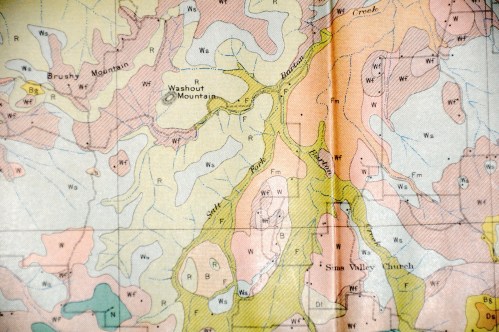
Click to enlarge. Soil survey map, Salt Creek and Barton Creek merger, from Soil Survey of Erath County, Texas (Washington: Government Printing Office, 1922). The far field is located at about center-left along Salt Fork and is associated with the symbol, Fm, for Frio loam.

______________________________

Notes, corrections and additions:

Aldo Leopold, A Sand County Almanac And Sketches Here and There, New York: Oxford Press, 1949.  I am quoting from the paperback, special commemorative edition that has an introduction by Robert Finch.

Soil Survey of Erath County, Texas, Washington: Government Printing Office, 1922.  The map was drawn in 1920, hence, it is ninety-one years old.  I found it in the workshop of the house I once owned in Mingus, Texas.  The house was know as the Old Bertino Place, named for the Italian family that had come to the area to work in the coal mines of Thurber in the nineteenth century.

I have been reading a considerable amount of literature this summer:  Aldo Leopold, Thoreau, Tolkien, Patrick Leigh Fermor, Edward Hoagland, Black Elk, Frank Waters, Wordsworth, Catulus.  I have something to write.  Whether it sells or not is a by-product.  I have to write, I really do.

18 Comments

Filed under Life in Balance, Rain, Sounds, Weather