Tag Archives: Texas

Rain comes, chores follow

For the last two days, rain has fallen, perhaps as much as three inches.  My rain gauge cracked and I estimate the amount cautiously.  Replacing the rain gauge is a task ahead of me.  Weather forecasters — I listen to the Dallas-Fort Worth NBC television station — say the rain will stop by tomorrow.  My water tank appears up by several inches, although it is too muddy to trudge down to verify.

The plow follows the rain.  That’s an old adage.  Here’s another one: Chores follow the rain.  Right at the top of the list of my chores is to perform foundation dirt work on the alleyway and barn area.  Water runs off the barn roof and into the alleyway and horse stall.  In addition, I have to transport my Case DX-55 tractor to the repair shop to fix the linkage to the PTO (power train operation) so that I can do another chore.  I have to shred some sprouting mesquites in the fields with the tractor and shredder.  Until the rain subsides and sun dries the soil a bit, I am at ease in the ranch house.

Here is a photograph of rain puddles in front of the barn.

Here is the rain runoff in front of barn. Notice Star on the right side of the tack room.

The runoff from the barn roof floods the alleyway. This is a chore to follow the rain.  Notice the green trees and grass in the background.

The alleyway and stalls will need more foundation after the area dries.

This next week is Spring Break.  I’ll be marking a few tasks off my list.  My list of chores is not long, so maybe I will put one chore on a page rather than list the whole congregation of tasks on one page.  That way I can see one task at a time, or one task on one page at a time.  Pace myself, as my step-father used to say.  He did not say much, but that was an ‘adage’ I remember he said.

The list:

1. Construct dirt foundation for alleyway and stalls.

2. Change tire on flatbed trailer so I can haul tractor to repair shop.

3. Take tractor to repair shop and return.

4. Shred mesquite sprouts.

5. Replace rain gauge.

11 Comments

Filed under Rain, Weather

Flowers of Flying Hat (6-8): Sow thistle is not a weed.

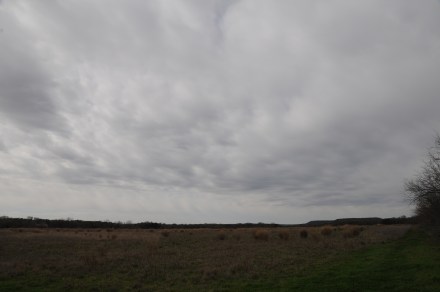
Far field clouds, March 2012.

6. False Garlic, Crow Poison (Nothoscordum bivalve), March 2012.

This False Garlic flowers early and there are several colonies clustered together throughout the ranchito.  This False Garlic is closed and due to the rains and cold yesterday and today, I do not have an open flower to illustrate — but, I shall.  This is found in the lane to County Road 114, and other colonies are about the gate between the arena and the grove pasture.

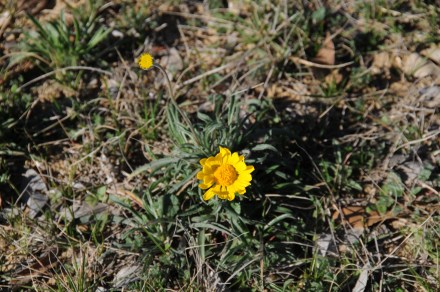
7. Sow Thistle (Sonchus asper), March 2012.

Sow Thistle appears to be a weed, but it is not.  Authorities claim the milk of this plant relieves eye ailments.  I wonder if I could apply this to my left eye?  I think not.  I’ll rely upon Dr. Callanan, but then again…. This appeared one afternoon and then its flowers have closed.  This Sow Thistle inhabits the disturbed soil underneath the live oak tree to the southeast of the house.  I have read much about the categorization of ‘weed’ versus ‘plant.’  The term ‘weed’ seems culture-specific, a term of dislike, marginal.  Goats, sheep and cattle eat this with relish.  To them, it seems, this is a plant, not an obnoxious weed.  One person’s plant is another person’s weed?

8. Unknown.

These little-bitty guys erupt on the top terrace and emerge as small, almost unnoticeable flowers. As of today, I have failed to find their name, and I also need a closeup to gain greater resolution of their attributes. Today it is raining and the blossoms are closed.

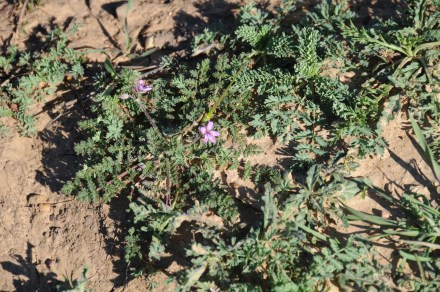
More Violet ruellia, violet wild petunia (Ruellia nudiflora).

This is a another photograph of violet wild petunia, previously identified.  It has erupted in large numbers along Interstate 20 from Mingus to Abilene.

13 Comments

Filed under Flowers of Flying Hat

The 2011 Prairie Sagebrush Awards for blogging

The Prairie Sagebrush Award 2011 is given for fine writing, photography and art in the blogosphere.  From my blogroll, I select a post, photograph or art piece from 2010-2011, early 2012.   For each comment that is entered on this ‘The 2011 Prairie Sagebrush Awards for blogging’ post, I will donate a buck ($1.00) to a wildlife corridor in Texas or New Mexico.  I set a limit of $100.00 — not that I am going to have more than fifty comments, but who knows?

I have excerpted portions of these fine writings and art into my post in respect for their blogs and copyright.  Please click on the links to obtain the full text of these really fine bloggers.

Please feel free to copy the Prairie Sagebrush Award 2011 design-image and put it on your blog to link back to this post or to one of the blogs below.  (No, I’m not trying to pump up my numbers, just trying to illustrate the high quality of work performed on blogosphere.)

[Wild Bill, Wild Ramblings blog, ‘Conifer Encounter.’…On the way back I asked him, and this was one of the few times I had spoken, how he knew so much about the woods. He answered that he was a biology professor at Springfield College, but had grown up in the pine barrens in New Jersey. He surmised that most of his knowledge he had learned as a boy wandering those Mid-Atlantic swamps, coupled with reading a lot of books about nature. And then he laughed out loud, almost in a boisterous way. “And once I met an old man in the woods,” he declared, and he laughed again, this time even more loudly….

[Grethe, Thyra blog, ‘Goodbye to King Winter.…The next week-end was foggy and raw and the sun seemed so far, far away. It was nice to see that the people at the restaurant of  Skovmøllen (the old Water Mill-restaurant) saw to that the little birds were fed with Danish bread and fat-bowls. There was also morning bread with cinnamon and the birds seemed to like it!  Notice the little blue tit. It is so ruffled. I hope it will cope….

[Photograph: Montucky, Montana Outdoors blog, ‘A visit to an old painting.]

Montucky, 'A visit to an old painting,' January 24, 2011.

[Cirrelda, Color of Sand blog, ‘Ides of January — yard observations.’…I stood for a while looking at my pobrecito pinon tree tilting away from the drooping elm limbs above it. Then those elm limbs were golden – the light was coming at them directly from that western mesa edge (miles away) and the whole damn wild elm tree was shining in its massive shagginess. (I so curse that tree at times since its roots tangle into every vegetable bed.) Smoke on my hands and clothes, I stand and gaze at the afternoon in my yard….

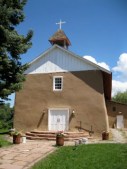
[Martie, Taos Sunflower blog, ‘Photos from my hood.’ …This morning I was down in Arroyo Seco (the nearest village to my home, where my yarn shop used to be) and had a few moments alone with my camera.  I thought I’d go look for beautiful flowers, but alas, in this drought, they were not to be found.  Then I looked up at the beautiful clouds in the sky over the old church behind our building, and thought it has probably been years since I’ve shared photos of it with you.  It was a ready reminder of why so many people come here to study art and paint the local scenery.  I’m sorry there aren’t any flowers for you, but hope you enjoy the rest…

[Shoreacres, The Task at Hand blog, ‘Promises Made, Promises Kept.’…My extraordinary good fortune was to be born into a family more than willing to make and keep promises.  My father took promises especially seriously. The eldest of six children, he was one of those increasingly rare creatures – a man of his word. Whether it was a work colleague, a neighbor, a family member or his tiny daughter coming to him with a request, if he said he would do it, he did….

[Wrensong, Writings from Wild Soul blog, ‘Waiting for the Sun.’  See also the female cardinal photograph associated with this winning post.]  Everything so still/ in this windless dawn/ Ice hangs from every twig/ air cold as stone/ Sun arrives like hope/ and hunger. ~wrensong

[Marie, The Rambling Wren blog, ‘The Red Fox.’…The fox stood stock still in the middle of the lane. We watched each other silently for 10 or 15 seconds, then the fox turned to go. But she paused, then sat down and looked back at me. She seemed unsure how to proceed, and kept looking up the secondary driveway we use for moving trailers and the RV. There’s a large woodpile there, an old barn the previous owners had dismantled elsewhere and brought here, planning to reconstruct. But the project was never finished, and we now have habitat for all sorts of critters–rabbits and woodchucks, chipmunks, feral cats, and now, perhaps, red fox. Had she moved her kits there, I wondered?…

[Kittie Howard, Kittie’s Stories, ‘Shopping at Best Buy.’…Best Buy, that big box store, re-entered my life.  I didn’t want to buy a new computer just yet.  The plan was to limp along with what I had until the Thanksgiving/Christmas holidays. Last Saturday night, the motherboard died….

[Rebecca, Rebecca in the Woods, ‘On Not Hearing a Boreal Owl.’…Then yesterday GrrlScientist had to go and write a blog post about about Wilson’s Snipe and mention that the “winnowing” sound created by its tail feathers during its courtship display sounds very similar to the call of a Boreal Owl. And that courting males “fly in circles.” And that they do this “long into the evening.” And sometimes even at night, I suppose? Sigh. No one likes deleting a species from their life list…. [Bold added.]

[Photograph and recipe: Karen Rivera, New Mexico Photography, ‘Green Pumpkin and Green Chili Pueblo Stew.’]
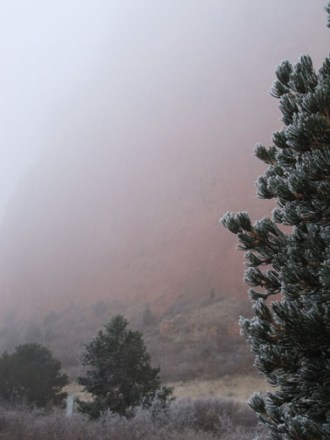
Karen Rivera, 'Road between Cimarron and Taos, New Mexico,' March 8, 2011.

[Debra, Find an Outlet blog, ‘Death’s Mementos.’…Every day I am moved by roadside memorials to people who weren’t ready to die. People who were in the wrong place at the wrong time. They’re a constant reminder of how fragile we are—bits of bone wrapped in a flimsy shroud of a ridiculously unsuitable hide. We’re anything but fierce when up against poison, bullet, disease, or 3,000 pounds of steel, glass and chrome….

[Wildstorm, Backroads Photo blog, ‘North Texas Desert.’…There is no such thing–the North Texas desert. Yet it seems like it when you glance across the dry roasted pastures where nothing grows. What is green? The cedar trees. Even the oak trees have burned up leaves….

[Bunnyterry, I Love New Mexico blog, ‘Gardening in New Mexico.’…As I stand here with the garden hose in my hand, I’m reminded of a paper I wrote on personal landscapes for that particular history class.  The instructor’s goal throughout the class was to get us to tie our own personal histories to history in the broader sense, which, if I were teaching history today, would be my goal as well…

[Teresa, Teresa Evangeline blog, ‘At Home in My One Room Schoolhouse.’ …I almost forgot to tell you: when I crossed over into New Mexico from Utah on Sunday, in less than a quarter of a mile there were two crows and a coyote. The crows were standing over their dinner in the ditch, whoever the poor critter had been, and the coyote was trotting away from them, down in a hollow, across a snow-covered field….

[Annie, Anniepickens’s blog, ‘Spring Garlic.’…Sunday I got to the Farmers’ Market later than usual, it was already packed with people but choices were still good. The first thing I wanted to do was find the egg guy and trade in my used cartons. It seems like the only time I remember that I’m going to take them back is when I am at the market buying more eggs. Very happy with myself for finally remembering….

[Photograph: Jeff Lynch, Serious Amateur Photography, ‘Those Spanish Skirts.’]
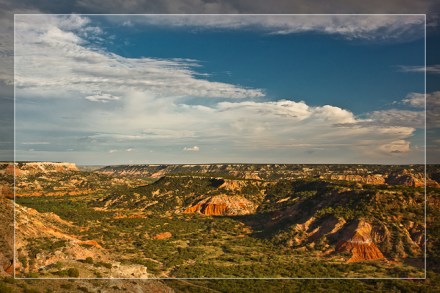
Jeff Lynch, Palo Duro Canyon, 'Spanish Skirts,' January 2011.

[Photograph: Evangeline Chavez, Evangeline Art Photography blog, ‘Dia de Los Muertos.’]

Evangeline Chavez, 'Dia de Los Muertos,' posted November 6, 2011.

[Poster image and environmental work: Chris Clarke, Coyote Crossing blog, ‘Desert Biodiversity.’]
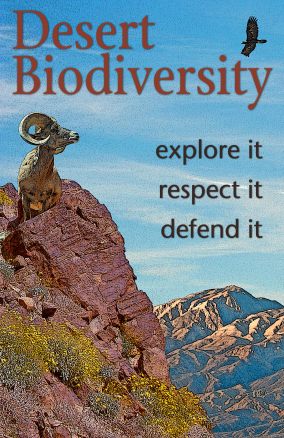
Desert Biodiversity poster, Chris Clarke, December 2011.

[Bonnie Bardos, Bohemian Artist: Painting and Thought blog, ‘New Sculpture.’]
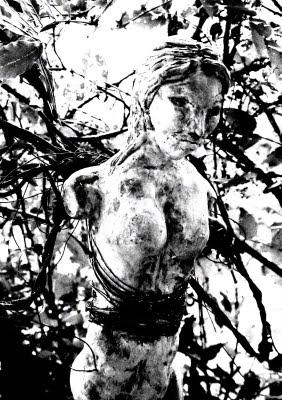
Bonnie Bardos, 'New Sculpture,' May 2011.

[Photograph: Steven Schwartzman, Portraits of Wildflowers blog, ‘Welcome to the Texas Hill Country.’]
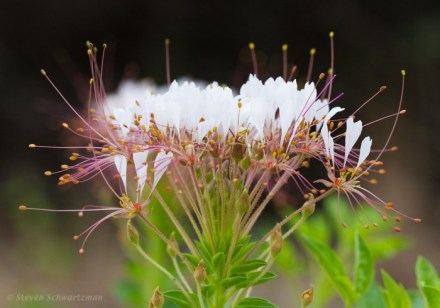
Steven Schwartzman, 'Clammyweed flowering,' June 2011.

52 Comments

Filed under Prairie Sagebrush Awards 2011

Flowers of Flying Hat (1-4): Late Winter blossoms

Human beings set goals, or at least I think they should.  On the other hand, doing what comes naturally has its attraction too.  I have set several objectives regarding nature observations on my 53 acres.  Here on the place — called variously, the ranchito, Flying Hat Ranch — I have sought to identify every tree on the place and have started a good list of American elm, cottonwood, mesquite, juniper, oak, and so on.  Identifying every tree continues to be a goal.  Tree identification was (still is) my first goal in field work on Flying Hat.  Other goals I have set up include:

observing another fox and taking its photograph,

identifying every bird I see,

identifying every bird I hear,

for one year, photographing every wild flower I observe on Flying Hat.

Achieving these goals, and the process of doing so, is personally satisfying and gives me narratives for this blog.  I have decided to start another goal-oriented project and demonstrate it on my blog.  I have begun taking pictures of the wild flowers on Flying Hat and my goal is to continue photographing and identifying flowers (all colorful blossoms) through a turn of seasons for one year – March 2012 – February 2013.  So, let’s see how far I can go with this project.  Here are my first photographs.  The No. 3 flower is disputable as a “Texas Star.”

(If I have made an error in typing, please comment or e-mail me your reasons for seeing the flower and plant differently.  I want to be right in my typing, but more than that I want the typing to be correct.  Note: All photographs are taken on the 53 acres of my ranchito; none are photographed off the place or off the ranchito grid.  For a precise location of Flying Hat, see location information in this blog footer.)

1. Verbena (Verbena bipinnatifida?). February 26, 2012, west slope of terrace, Fenster's field. See Wills and Irwin, p. 189.

2. Parralena (Dyssodia pentachaeta), of the Aster family. February 26, 2012, on back terrace and in Fenster's field east of the house. See Ajilvsgi, p. 148.

3. Bluebell bellflower (Campanula rotudifolia), February 26, 2012. See http://www.wildflower.org/gallery/result.php?id_image=3102; see notes below.

4. Violet ruellia, violet wild petunia (Ruellia nudiflora). February 26, 2012, Fenster's field, far field. See http://www.wildflower.org/plants/result.php?id_plant=RUNU; Ajilvsgi, p. 377.

______________________________

Notes, corrections and additions:

No. 3 flower and plant is probably as described in caption.  Thanks to Montucky of Montana Outdoors blog and Grethe of Thyra blog.  The issue seems to be resolved it you stand up the flower and look at the total plant.  The flower would droop like a bell and the leaves and stem favor the image in the citation in the caption: http://www.wildflower.org/gallery/result.php?id_image=3102.

Mary Wills and Howard Irwin, Roadside Flowers of Texas.

G. Ajilvsgi, Wildflowers of Texas.

Campbell and Lynn Loughmiller, Texas Wildflowers.

Steven Foster and Christopher Hobbs, Western Medicinal Plants and Herbs (A Peterson Field Guide).

23 Comments

Filed under Flowers of Flying Hat, Wild Flowers of Texas

Meadow lark with morning sun

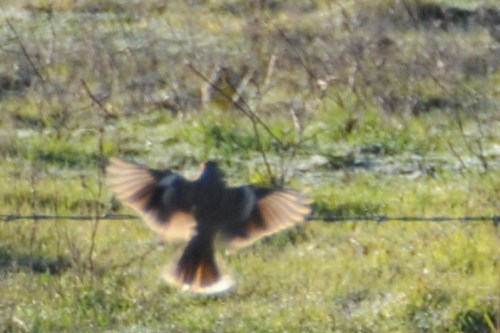
Early morning landing.

Early this morning as I walked down the road to feed Star, I saw these meadow larks (Sturnella neglecta) sunning on the barbed wire fence between the house and arena pasture.  I walked quickly back up to the house, grabbed my camera and took a few shots.  The larks are skittish and I did not get close, but I edited the ‘Early morning landing’ above as the sunlight pierced the feathers, creating an illumination that I saw only when I enlarged the picture.  Fascinating.

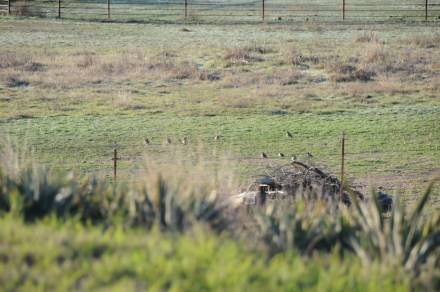
The photograph below captures the small flock on the fence.  When I came back to the house after feeding Star I looked out the front window and saw that the flock (or another group) had come around to the front of the house and was feasting on insects and seeds on the front lawn.  You can click on the ‘Larks on barbed wire’ below and obtain a larger image.  I did not get a picture of the flock at the front of the house.

Larks on barbed wire.

I have noted that birds are singing more here at the ranchito since the weather has warmed and rains have come.  I saw my first Western Bluebird (Sialia mexicana) a few days ago perched on a T-post beside the road to the barn.  I have a goal to photograph the bluebird this year.  I have seen as many as eleven bluebirds bathing in the runoff water from the horse trough.

______________________________

Notes, corrections and additions:

To disclose my identification of the ‘meadow larks’ above, I have to add that my confidence in typing the above birds as meadow lark is fairly high, but with a bit of doubt about western or eastern.  When I got the Peterson’s guide open and starting reading about the meadow lark, there are at least two varieties, western and eastern, and I will have to look closer for the signature attributes.  The white edges on the tail (seen in the first photograph) are specific signatures for the western variety, so I go with that identification.  Besides, this is west Texas. 

I will look again in the morning at the flock, pending their reappearance.

37 Comments

Filed under Birds

Overflowing pond

I’m not for sure the drought here in my area — central-west Texas — has been broken, but the recent rain filled my neighbor’s pond and it has overflowed gently the last few days into my pond or cow tank.  I walked yesterday to my pond and noticed the overflow, catching me by surprise as I jumped the slight current, avoiding getting my boots wet.  It was quite cold, by our standards, and I returned to the house after a bracing hike.

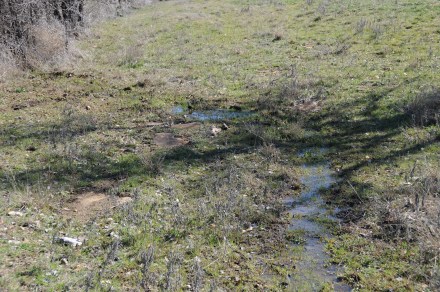
The overflow from Blue's pond, February 11, 2012.

Star follows me on the hike yesterday. He is browsing on grass sprouts, lately erupting from the rains.

I like the contrast of the leafless trees and Star with the previous photograph that shows emergent winter grasses and water.

The temperature yesterday when I hiked was 28 deg. F., not cold enough to freeze the runoff, but cold enough to wear a warm coat and toboggan cap.

Today the temperature remains about the same and we are forecast sleet and rain from 6:00 p.m. until tomorrow morning.

18 Comments

Filed under Star, Weather

Rain fills pond

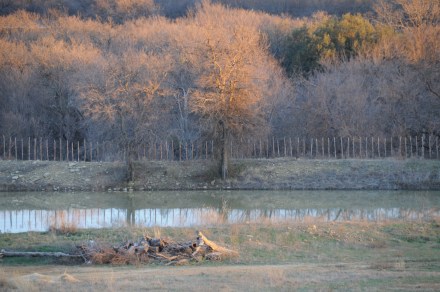
Three days ago rain came to the area and I received about 4.5 inches of moisture.  The pond, seen above, rose three feet from run-off water.  Many areas of Texas, not just central West Texas, received sufficient rain to fill lakes and ponds.  The run-off was severe and water flooded roads.  Burn bans have been lifted.  I have read news reports that the drought has been lifted.  My pond has not been this full in over two years.

34 Comments

Filed under Weather

Wind and flag football

URGENT – WEATHER MESSAGE NATIONAL WEATHER SERVICE FORT WORTH TX 206 PM CST SUN JAN 22 2012 …A WIND ADVISORY IS IN EFFECT FOR MOST OF NORTH TEXAS THROUGH 7 PM… .A POTENT UPPER LEVEL SYSTEM MOVING NORTH OF THE REGION IS SPREADING VERY STRONG AND GUSTY WINDS FROM WEST TO EAST ACROSS THE REGION. WEST TO SOUTHWEST WINDS WILL BE SUSTAINED FROM 20 TO 35 MPH WITH GUSTS OF 40 TO 50 MPH. THE STRONGEST WINDS WILL OCCUR IN THE AREA GENERALLY ALONG AND WEST OF INTERSTATE 35/35E.

I read the weather forecast last night, fearing an outbreak of fire with such oxygen rushing through dry brush and grass.  From the back porch, I see eight miles to the Cross Timbers hills and ridge lines toward Stephenville and Hannibal.  Neither smoke nor fire can be seen, only dust and the affect of wind.

I seek to take photographs that will reflect the aridity, the drought conditions as well as today’s fierce wind.  As I have written before in another post, if you wait for the wind to die down or cease in Texas to work, you will never get anything done.  True.  A good pair of sunglasses and sunscreen provide protection as well as a sense of humor to work and play here in central West Texas.  To play hard and lose one’s self, one forgets the wind.

In the 1970s, at holidays with family in the Panhandle, near Canyon, Texas, we played football after dinner (served at noon), and we played with windy conditions.  Across a large front yard providing turf for, say, forty yards of a playing field, we had to compensate for the strong prevailing winds out of the southwest or northwest — low, short passes.  The teams were co-ed and young wives and female cousins ran and fought for every yard along side their husbands and relatives — one female cousin became a colonel in the Marines.  Touch football rules prevailed, sometimes flag football with a bandanna hanging out of our blue jeans.  The wind begone, we played anyway.  Of course, we forgot about the cold and wind as we played together at Thanksgiving, Christmas and once in the summer.

Here at the ranchito, the wind blows today, but there are no contests in the front yard, only birds tucked fast in the branches of the live oaks or nestled in pasture grass.  Here are some photos I took about an hour ago.

This view is towards the southwest, showing the dust in the distance and the leafless trees.

***

Wind whipping grass blades on terrace.

***

View towards Lilly's rock cairn and the Blue farm beyond the mesquite tree line.

***

Looking towards the west.

***

From the back terrace, I shot a thirty-second video of the landscape to the southeast.  Not much excitement in the footage, but it’s the middle of Winter.

16 Comments

Filed under Flying Hat Ranch, Recollections 1966-1990

Fur, crane and juniper berries: field log

The Scientist does not study nature because it is useful to do so.  He studies it because it takes pleasure in it; and he takes pleasure in it because it is beautiful.  — Jules Henri Poincare

* * *

[These are primary field notes taken today.  Time entered in UTC or Zulu time, i.e. 1759.  Post-field note commentary bracketed and italicized.]

12/27/2011

Flying Hat Ranch, North Erath County, Texas, Lat 32.43 N, Long -98.36 W, elev. 1,086 ft. Turkey Creek Quadrangle map.

1759.  51 deg. F.  [Cold enough to start into the field with line jacket, but by the time I got to grove, I shed the jacket, putting it on the fence post.]

1805.  Three or more ducks on pond.  No identification.  Woodpile near pond has been reduced by rain and natural deterioration.  Tree limbs and logs have settled in earth.  [Erath County has taken the burn ban off.  I’ll not burn the pile because it houses several critters.  The ducks are three and they make little noise.  They paddle to the far side of the pond as I stride by.]

1817.  Barbed wire between grove and arena pasture broken, 5 T-posts from the gate, towards the west.  Apparent deer tracks on the ground, no sign of struggle, crawling under, deer popped the strand.  Fur on ground.  Photos taken.  [I have seen juvenile deer scoot under the fence; hence, I think they broke it.  I looked carefully for signs of an entanglement in the wire, but found none and also went over to the creek embankment to make sure no deer had fallen.  I’ll repair the fence later this winter.  I wonder if it is deer “fur” or “hair?”  According to Scientific American, mammalogist, Nancy Simmons, there is no difference between fur and hair.]

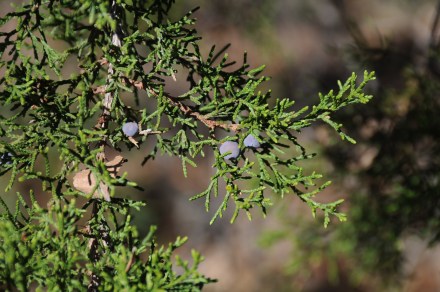
1828.  Juniper berries on tree to the east of brick pile.  Tree is 20 feet high, 20 feet across  at lower crown.  Five juniper trees in immediate vicinity.  One large juniper 30 feet to east-southeast of the little grove.  This juniper is 30 feet tall, trunk is 2-3 feet in diameter.  [I had never stopped to count the number of junipers in the small grove, nor estimated the height of the tallest tree.  My recent post on junipers has prompted my focus.  I thought about picking the berries and consuming them, reenacting my Zuni experience.]

1843.  Red oak leaf falls.  I think it a floating butterfly.  Then I see the red oak.  No butterfly.  [What tricks our mind plays.  I thought for a moment that a Monarch might have roosted and emerged in the sun.  The leaf floated like a butterfly, not a swaying back-and-forth manner like a leaf.]

1849.  Two burrows near east water gap, one looks inhabited.  [Skunk, armadillo?  Other?]

1853.  Remnants of deer-stand ladder.  [I have dismantled all deer stands in the trees that I can find.  This ladder will be dismantled soon.  I hate it when nails are driven into trees.]

1855.  Bull bellows on Dooley Place.  [The Red Angus bull bellows.  ‘Twould be interesting to take field notes at a certain point for just sound, not images, just sound.]

1858.  Harris hawk ascends into tree at about 10 foot level, watches me approach, then flies low out of tree towards north.  [I have typed the Harris before.  There are two of them that soar and predate in the grove and surrounds.  They’ve been here on Flying Hat for two years.]

1908.  Scare 4-7 turkey vultures from dead mesquite tree at southwest part of grove.  [I hope Ethan Connell has checked the turkey vulture on his Life List in his Peterson’s.]

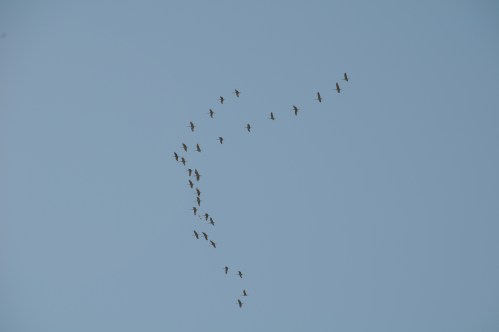
1917.  Flock of Sandhill Cranes overhead, flying north to south, catching wind currents.  [When I first heard the Sandhills,  I looked too high, gave up and then found them at a lower altitude.]

1930. Turn around at northwest corner of far field and return to house. Star whinnies at me.

1938.  White-crowned sparrows fly low in brush about arena at southeast end.

1942.  Scare up the resident jack rabbit while searching for stone tool in situ.  [I cannot find the stone tool.  I do have it located, however, on the GPS and I can locate it later.  I had placed a yellow surveyor’s flag at its place, but the elements have blown it down — or possibly, Star.]

1946.  At pasture-house gate.  [Log entries conclude.]

5 Comments

Filed under Cedar, Deer, Ducks, Field Log, Sandhill Crane

Juniper: an evergreen for all my seasons

Juniper in Flying Hat Ranchito grove, often referred to as cedar (J. Matthews, 2011).

(As a disclosure, I use “cedar” and “juniper” interchangeably.  See notes below from Encyclopedia Britannica and Wikipedia.)

I grew up with cedar all around me, but cedar posts for building fence predominated.  T-posts (the steel ones) may be making fence construction faster these days, but I hold to the cedar post as a primary building material.  Allergies from cedar congest the lungs of Texans, particularly central residents who weather the Mountain Cedar every year.  A website dedicates itself to, “Cedar: The Allergy Plague of Trees.

All of that being said, the cedar or juniper holds personal value for me beyond the descriptions, quotes and links I attach in this post.

Of all the flora about me as I grew up and the plants about me now, the juniper radiates scent and memories, even beyond the majestic pecan in my far pasture.  I burned juniper in a Folger’s coffee can to sweeten the air at campsites and even in my apartment from time to time, placing the coffee can at the edge of the hearth.  I have taken cedar bark and twisted it into fine pieces and lit a single match to start a campfire, and I have carried cedar tinder in my backpack to start fire along the trail.  I cut cedar staves and posts one Christmas vacation to earn extra money and to say, I once worked as a cedar chopper.

Green juniper groves along the Colorado River near Bend, Texas, contrasted with bleached white-gray rock outcroppings, and I found old campsites of roundups in pastures about the river, the blackened rock, not the red, holding the remains of cedar fires.  My grandmother once pointed out a cow camp firepit near the Colorado that she had cooked for the crew and her husband-cowboy Jake, before his accident on the horse Hell’s Canyon.

I have camped near cedar breaks many times, but the one time I remember was on the Zuni Reservation, out in the middle of the reservation, by myself with junipers and coyotes through the night.  I built a small fire of cedar and munched on a juniper berry for its bitter effect.  I had sped to the reservation from Grants, New Mexico, and hastily set up camp, sleeping in my bedroll beside the fire the night through.  I was seeking a medicine man, but he never found my camp.

More often than not at Christmas time, my family cut a juniper tree from the ranch to place in the living room.  The tree may have been as short as three feet, at other times, five-feet tall.  I loved the aroma of the juniper as it filled the house for Christmas.  Tinsel drooped from the branches with those bubbly lights all aglow.

Near Abilene, on the road to Coleman, there is a park on the east side of the highway at Buffalo Gap, a broad cut in the hills that buffalo and migrants used to go into southwest Texas from the High Plains and Caprock.  The park has a large grove of junipers that have trunks three to five feet in diameter.  I have rested there many times and note the broad-deep shade the junipers provide in the Summer and windbreak during Winter.  From the Juniper Park — as I have taken to call it — one can see into Buffalo Gap and off in the distance the plains to the north.  This Juniper Park has been a lookout, a redoubt of some sort, for a long, long time.  I think I stopped there one time when I was traveling to Brownwood to take care of my aging mother, or it may have been another time, and I rolled the windows down to smell the juniper and place my hand on the fertile greenery I had known all my life, or that other day anew in late Spring.  I thought then, as I do now, that I will remember this day for as long as I live, for although my mother lay dying and I was teaching in a foreign land, the evergreen of juniper and its effect transcended my sorrow and sense of alienation from this world.  I have found home and peace and love beneath junipers for all my seasons.  To me, its fruit is never bitter.

______________________________

Notes, corrections and additions:

Some juniper trees are misleadingly given the common name “cedar,” including Juniperus virginiana, the “red cedar” that is used widely in cedar drawers. True cedars are those tree species in the genus Cedrus, family Pinaceae.

In Morocco, the tar (gitran) of the arar tree (Juniperus phoenicea) is applied in dotted patterns on bisque drinking cups. Gitran makes the water more fragrant and is said to be good for the teeth.

American Indians have used juniper to treat diabetes; such treatments by the Navajo, for example, are under clinical study.[3] Clinical studies have shown that treatment with juniper may retard the development of streptozotocin diabetes in mice.[4] Native Americans also used juniper berries as a female contraceptive.[5] The 17th Century herbalistphysicianNicholas Culpeper recommended the ripened berries for conditions such as asthma and sciatica, as well as to speed childbirth.[6]

“Juniper,” Wikipedia, accessed December 25, 2011.

* * *

juniper, any of about 60 to 70 species of aromatic evergreen trees or shrubs constituting the genus Juniperus of the cypress family (Cupressaceae), distributed throughout the Northern Hemisphere. The juvenile leaves of a juniperare needlelike. Mature leaves are awl-shaped, spreading, and arranged in pairs or in whorls of three. Some species have small, scalelike leaves, often bearing an oil gland, which are pressed closely to the rounded or four-angled branchlets. Male and female reproductive structures usually are borne on separate plants. The reddish brown or bluish cones are fleshy and berrylike and often have a grayish, waxy covering. They mature in 1 to 3 seasons and contain 1 to 12 seeds, usually 3.

Common juniper (J. communis), a sprawling shrub, is widely distributed on rocky soils throughout the Northern Hemisphere. Many ornamental cultivars have been developed. The berrylike megastrobilus of this species is used to flavour foods and alcoholic beverages, particularly gin, which is named after Juniperus through the French genièvre. Juniper “berries” have a fragrant, spicy aroma and a slightly bittersweet flavour. Used with venison, they remove the gamey taste. They are also used to season sauces and stuffings, in pickling meats, and to flavour liqueurs and bitters.

An important ornamental and timber tree of eastern North America is the eastern red cedar (J. virginiana), whose fragrant wood is made into cabinets, fence posts, and pencils. This species is an invader of glades, pastures, prairies, and other open grassy areas in parts of its range; thus, it is considered a troublesome weed by some botanists and land managers. The savin (J. sabina) of central Europe, Chinese juniper (J. chinensis) of eastern Asia, and creeping juniper (J. horizontalis) of eastern North America are other popular ornamental species with many horticultural varieties. The wood of incense, or Spanish, juniper (J. thurifera), of Spain and Portugal, and of Phoenician juniper (J. phoenicea) of the Mediterranean region sometimes is burned as incense.

Oil of juniper, distilled from the wood and leaves of several species, is used in perfumes and in medicines such as diuretics. Galls produced by junipers as a reaction to fungal infection are known as cedar apples. This fungus, cedar apple rust, completes its life cycle on members of the apple subfamily of the flowering plant family Rosaceae, which contains numerous species of trees and shrubs commercially valuable as fruit and ornamental plants. The growth of junipers around apple orchards and plantings of related genera is thus discouraged to avoid disfigurement or loss of these important cultivated plants.

Encyclopædia Britannica Online, s. v. “juniper,” accessed December 25, 2011, http://www.britannica.com/EBchecked/topic/308301/juniper.

12 Comments

Filed under Cedar, Juniper, Life in Balance