Tag Archives: Texas

Cloud portal to the coast

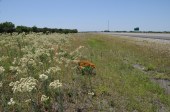
Thundershowers on either side of Interstate 20 west of Cisco, Texas, May 2012

Last Friday, May 11, 2012, I drove to Abilene for commencement at Cisco College where I instruct.  West of Cisco, on Interstate 20, I saw this cloud portal — at least that is what I call it.  I sped between the two thundershowers.  A few drops fell on my car.  The first couple of weeks in May is a time of showers and cool temperatures in west Texas.  That is not always true, for this time last year, I was busy writing about wildfires in my area.

I have a friend at Cisco College that teaches English and he traveled to the Oregon coast last year, staying near Seal Rock and Newport, soaking in cool temperatures and consuming seafood and local white wines.  He talks about moving to Oregon, selling his ranch and settling in the cooler climes.  I think about the higher altitudes of northern New Mexico around Truchas and Taos that have sharp winters and cool nights during the summer.

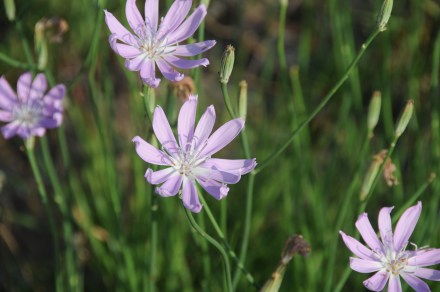
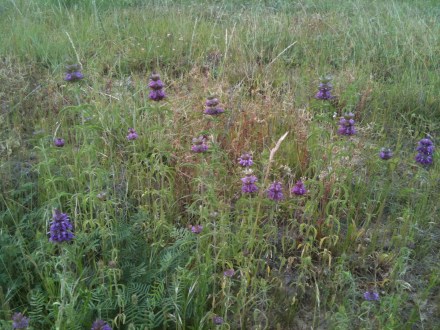
We both will probably stay put: he in Santa Anna, me in Mingus, for there are mild winters and days in May where thundershowers bring out the Cut-leaf Daisy, Fire Whorls, Queen Anne’s Lace, Purple Dandelions in brilliant colors while horses and cattle graze in lush Spring fields of gramma and bluestem.  I should like, however, to go to the Newport and Depoe Bay area of Oregon where my friend says, ‘There is a resident pod of whales for ten months out of the year about the coast.  You can see them surface and dive, surface and dive.’

I want to see that scene some day.  The cloud portal in the photograph above opens to the west, towards the Pacific, towards the whale.  And away from home.

______________________________

Notes, corrections and additions:

Depoe Bay was added as an additional site my friend visited.  It is a central location for beautiful scenery and whales.  The boating outing in ‘One Flew Over the Cuckoo’s Nest’ was filmed in the area.

14 Comments

Filed under Adventure, Rain, Taos, Weather, Wildfire

Orange milkweed, not globemallow

Please note the change of identification from 7:00 a.m. to 3:11 p.m.  I thought you might like the changing process of classification.

Composed at ca. 7:00 a.m. this morning, before field trip

The hunt is on again for identifying a wildflower, but this time the plant in question falls outside the ranchito and does not fit into my project of cataloging wildflowers on my land.

Yesterday afternoon at about Mile Marker 352 on the south side of Interstate 20, I saw a bush-clump of brilliant orange-scarlet flowers.  I have never seen such brilliance.  Hurrying to the ranchito and my office, I combed page-by-page my wildflower identification books and at least five websites that classify flowers.  I may have found the answer, but I cannot with a lot of confidence conclude the flowers to be the Caliche globemallow or Scarlet globemallow and I have had to reverse my classifications before — I once identified the Wine Cup as a Desert Mariposa — so, I must go up the hills to my west tomorrow and find the flowers again.  Elaine Lee and her mother have recently seen ‘neon-orange flowers’ near Putnam, Texas, on Interstate 20.

In reflecting on the Scarlet globemallow (?), I may have seen a family’s roadside memorial marker with orange plastic flowers wrapped around a cross?

Composed at ca. 3:11 p.m. after field trip to photograph

I combined a trip to the First National Bank of Santo at Mingus, Texas, with a field excursion up on top of Ranger Hill (Mile Marker 352) to photograph this flower.  I thought I had it down as a Scarlet globemallow even though I flew by the plant at 70 m.p.h.  I made two trips by the flower before I turned into the grass along side Interstate 20.  There was no access road nearby so I turned on my emergency blinkers.  I discovered five clumps of the plant and its blossoms as trucks shot by. 

Of course, I am self-conscious at the side of an Interstate taking pictures of wildflowers:  What the hey am I doing here?  A few truckers blow their horn.

I admit I am so curious about this plant and flower that I spend $8.00 in diesel fuel going up the hill from where I live to get close to this flower and photograph.  That’s ‘What the hey am I doing there.’  Secondly, what the hey is that flower doing there?  Too many questions with not enough answers, so I drive back to the ranchito, eat a ham sandwich and upload the pics and begin to compare the blossoms with Scarlet globemallow.  Totally different blossoms, totally different plants.

This search, I think, is going to go on for a long, long time.  So, I pick up my first manual, and on page 16 of Campbell and Lynn Loughmiller’s Texas Wildflowers is the Orange milkweed also known as Butterflyweed, Butterfly milkweed, Orange milkweed or Pleurisy root.  That was fast.

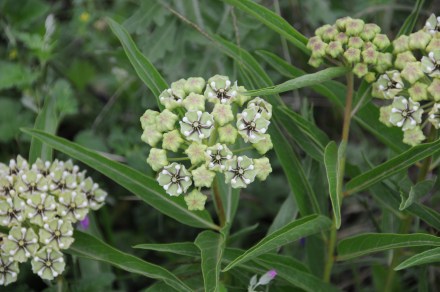
I have Green milkweed on the ranchito, but no Orange milkweed.  I am curious as to the medicinal properties of the Orange milkweed.  And, what is pleurisy?  I remember hearing it as a boy:  I’ve got some pleurisy this morning, Little Jack.  I think it must be some sort of joint pain?  In any case, I am confident as to the classification and it is a brilliant, showy blossom known as Orange milkweed.

Many county roads meander about my area.  I think my next trip will be up the road for 15 miles or so where my mail carrier habitually sees a bobcat cross the road.  There be things to discover and photograph up the road, up the hill and into nature’s wonders.  I do believe it so.


24 Comments

Filed under Wild Flowers of Texas

Wind, Yucca and Wine Cups: A Texas Spring

Two days ago I and the ranchito received 0.25 inch of rain, causing bees to work hard yesterday in the front yard, gathering pollen from an unidentified burst of small white flowers and residual Gyp Indian Blankets.  I have photographed the white flowers and will integrate them into the catalog of Flowers of Flying Hat.  Cool winds blew the yucca blossoms about and I took this video of wind blowing the yucca blossoms.

Rain fell this morning at the house and my commute to Abilene (87.2 miles) was tricky and slick in my large F-250 pickup.  A Federal Express truck with two tandem trailers went off the road west of Cisco on Interstate 20 and turned over.  From what I gathered, passing by in the rain, no fires erupted.  I hope the driver escaped with little or no injury.

Elaine Lee wrote about the Wine Cups in our vicinity.  She lives in Clyde, Texas, and drives to Cisco, Texas, every work day.  Elaine is a careful observer of flora and fauna along Interstate 20, including the ducks on Baird Hill Pond.  She has noticed, as I have, the large flock of wild turkeys that infrequently browse in the field south of Baird Hill.  Elaine writes of the Wine Cups,

I’m certain you are correct about wine cup not being present last year in your location.  This year, and never before, I saw wine cup growing along the highway edge in the Interstate 20 median.  They were growing just west of Putnam, TX and stretched for probably 200 or 300 hundred yards.  Of all Texas wildflowers, I have heard they are the most difficult to become established.  I don’t know if grassfire in the median caused the heat to break their seed covering or ground heat from the drought, but whatever it was, it created a very nice showing this Spring.  In years past I have seen them along the Interstate 20 frontage road not far from my sister’s house in Dallas, but never in this area.  However, I hope they are here to stay since they add another color dimension to the Spring landscape.

In researching the Wine Cup, I have found something quite interesting.  The Wine Cup has native distribution only to southwest Missouri and southeast Kansas, south to to Louisiana and central Texas.  It has spread to other states.  Flying Hat Ranchito is located on the western periphery of central Texas.  My mailing address comes out of Mingus, Texas, but the ranchito is ten-or-so miles southeast of Mingus, back in the hills, in Sims Valley, near Hannibal, Texas.  Hannibal now has one building that used to double as a general store with a Masonic Lodge on the second floor (don’t hold me too tight on these two historical functions of the building for I need to do more research).  The Wine Cups I photographed are six miles away from Hannibal, to the north.

My plans for the weekend include further observations of Wine Cups in the grove area.  At last count, eight Wine Cup blossoms erupted.  Of yucca, some one-hundred stalks abound on the terraces.  One hundred stalks times one-hundred blossoms per stalk equals 10,000 blossoms.  Of rain, 0.25 inch two-days ago, about 0.10 inch this morning.  Of bees and critters?  I will count them another day.

______________________________

Notes, corrections and additions:

From the Lady Bird Johnson Wildflower Center, I quote,

Callirhoe digitata Nutt.

Finger poppy-mallow, Poppy mallow, Standing winecup, Wine cup, Winecup

Malvaceae (Mallow Family)

USDA Symbol: CADI2

USDA Native Status: Native to U.S.

The wine cup is a perennial growing 8–20 inches tall, depending on moisture and soil, with gray-green stems. Leaves are alternate, basal leaves having stems about as long as the leaf; leaves are coarsely lobed or scalloped to deeply 5-lobed. There are few leaves on the upper part of the stem. Flowers have 5 petals, cup-shaped at first and opening out nearly flat as the flower matures. They are violet to red-violet, sometimes white, 1–2 inches across. The stamens and pistil form a conelike structure in the center of the flower.

11 Comments

Filed under Succulents, Wild Flowers of Texas

Wine Cup Clearing: Flowers of Flying Hat (25-31)

Wine Cup clearing

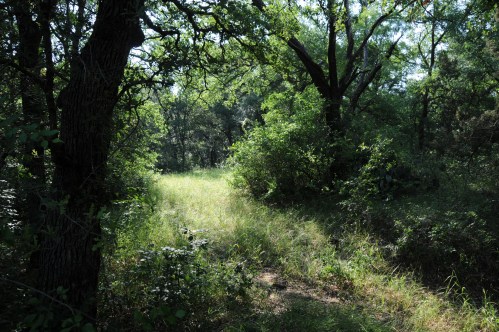
At 8:30 this morning, I walked and drove to the far field.  Smiling at wild mustang grapevines that yield monarch butterflies along the fence row, I hiked with camera in the grove along Salt Creek.  The creek runs water despite the lack of rain for over a month.  Squall lines last evening bypassed the ranchito, dumping hail and rain in Fort Worth, sixty-seven miles away to the east and in Cisco, forty-five miles to the west.  Wine Cup clearing, as I now call it, bears Wine Cups this Spring.  I saw none last year.  In the photograph above, the Wine Cups are on the right side of the clearing.  They have cool shade from the oak and elm and the creek runs nearby that brings the ambient temperature down a few degrees.

Names have been given, I am sure, to places on the ranchito before I came, but they have not been passed down.  (There has been only one owner previous to me besides the Venable family that settled larger sections of land in the surrounds.)  I give a name first by location:  near field, far field, arena pasture, barn pasture, etc., but then when an object or landform becomes prominent, like Pecan Tree or Wine Cup, I name the space, giving it animation and fixing the impression.  I have no crew to direct into the pastures, but when I refer to The Grove or Pecan Tree Pasture, friends and family know where that is, associating flora and fauna with location, and ambiguity disappears.

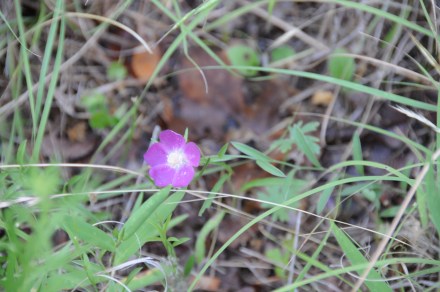
25. Wine Cup (Poppy Mallow)

Two-years ago, I discovered one or two Wine Cups in the grove, up from the creek, in a private place for this blossom.  Today, eight blossoms of Wine Cup or Poppy Mallow emerged from the same location.  Eight Wine Cups are not a bell weather of climate change, but rather, I suspect, a change due to fallowing, allowing the flowers to replenish.  Green grass and tall trees abound about the Wine Cup’s private place.  I find no Wine Cups at other locations on the ranchito although I continue to search.

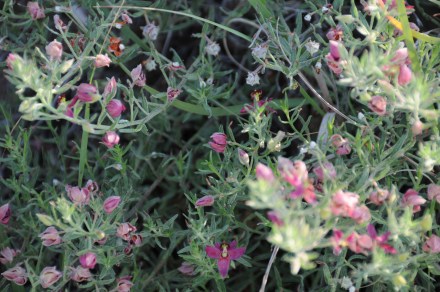
26. Trailing krameria,Crameria, Prairie sandbur, Trailing Ratany

I find Trailing krameria or Prairie sandbur in only two places on the ranchito, both on the knoll where the house sits.  This is a delicate plant and can be missed and mowed under if one is not careful.  It lies along the fence line between the house and front pasture and, secondly, has emerged on a terrace  to the southeast.  I find archeological evidence of hearth and tool making about the ranchito and I wonder if earlier inhabitants or migrants  saw this plant.  I presume so and know it must have some medicinal properties?

27. Skeleton Plant, Purple Dandelion, Flowering Straw, Milk Pink

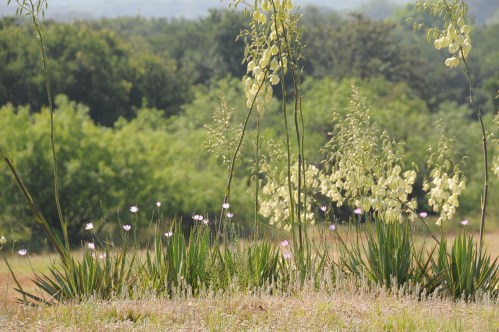
The stems of Skeleton Plant are rigid, attached at obtuse angles, like a skeletal frame.  The flower stalk and blossom are tall, some two feet.  These plants are more prolific this year than two years ago.  Here is a larger picture of the Purple Dandelion with yucca blossoms.  I cultivate neither.  Both emerge wild.

Purple Dandelions with yucca blossoms

28. Bull Nettle

In the far field I have Bull Nettle.  It has medicinal properties, but is quite painful to be brushed against.  As a boy, I got a painful lesson in ‘trying’ to pick its blossoms.  I have a collector in Wisconsin to whom I will send a few with warning labels this Spring.

29. Prickly Pear cactus

30. Coneflower

31. Common Yarrow

No. 31 is Common Yarrow.

The pastures are browning here and towards San Angelo and Mexico I am told by ranchers more desert appears.  Grass fires have been erupting this last week between here and Abilene.  Yet, the diversity of nature here on these 53 acres of my ranchito shows both browning pastures and a creek that runs water with moss growing on its banks.  Brown and green, primary colors of nature, intermingle and birds continue to sing despite the fear I have that a climate shift has come and the green will dwindle until next year’s Spring rains.  I may be right; I may be wrong.  As the ancients said, We shall see what we shall see.

16 Comments

Filed under Flowers of Flying Hat, Wild Flowers of Texas

Olivetti and Flowers of Flying Hat (20-24)

Keyboard

When possible, I use a large keyboard, not the small letter touchpad of iPhone. Who can possibly compose substantially on an iPhone?  My hands are large, like a teamster’s.  Here is my keyboard (QWERTY) I have pressed and pressed posts since 2005. I ratchet out fifty-words a minute when inspired or copying.  Nonetheless, I still have a typewriter although it is in the barn.  It is an Olivetti portable I purchased in Amarillo, Texas, back in the 1970s.  I look at Office Depot and Staples most times I shop and I still see typewriter ribbons stocked. How long will Office Depot stock typewriter ribbons? Probably not much longer.  I like the clack, clack of the keys hitting paper, although it has been twelve years since I used the Olivetti.  Although I eschew Wikipedia, the typewriter ribbons link above is quite informative.

* * *

20. Yucca blossoms

Here I have more photographs of flowers that blossom on Flying Hat Ranchito, an ongoing project of mine for 2012-2013.  The yucca stalks that blossom flowers have been erect for two weeks, but only today have I seen blossoms.  Although we have had rains that nourished the first eruptions of grasses and plants, for almost three weeks now we have been bereft of moisture.  The pastures are already browning and it isn’t even May.  Most likely, the failure of the yucca stalks to bear flowers emanates from our dry spell — we shan’t call it a drought, just yet.

21. Horse mint

Horse mint is neither as prolific nor robust as it was two years ago.  Again, we lack additional rains to bring the horse mint to full fruition.  But some hearty plants, nonetheless, have sprouted.

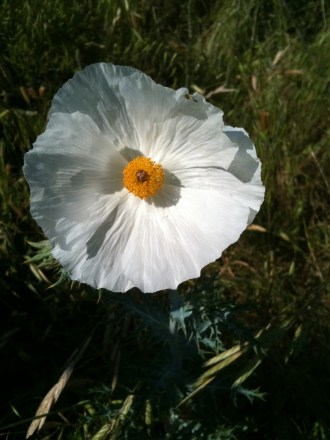
22. Texas pricklypoppy, Papaveraceae (Poppy Family)

To my west, on the Dooley place, a whole field of Texas pricklypoppy has erupted.  I have a few poppies on Flying Hat Ranchito, and No. 22 is an example.

23. Unidentified

Yellow flowers predominate this time of year on my ranchito, especially the Cut-Leaf Daisy.  But No. 23, a yellow flower, I have not identified.  I first had it down as a Black-Eyed Susan, but now I am not so sure.

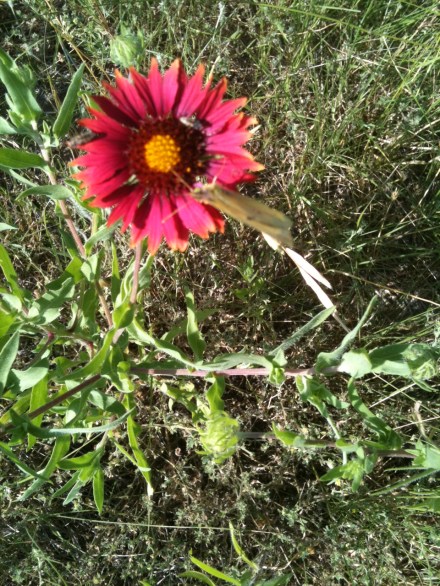
24. Indian Blanket

Indian Blankets are rather sparse this Spring, not fully developed as two years ago.  Nonetheless, here is No. 24, a photograph I took this morning over in the far field.  I have brilliant photos of the Indian Blanket from year’s past, but this No. 24 is from my project of photographing wild flowers for 2012-2013.

* * *

This morning as I drove along the southern boundary of the far field where the large pecan tree lives, I came across a roost of Monarch butterflies among the Mustang grapevines and mesquite.  I estimate twenty to thirty Monarchs abounded, played and flew about the fence line, large butterflies they were.  ‘Tis not a promise, but I may go over in the morning and photograph the area.  And, I shall come back to the house and type out my spiel on a QWERTY keyboard, not an iPhone.  Furthermore, my Olivetti portable needs to be resettled in my office and not remain in the barn, do you not agree?

20 Comments

Filed under Flowers of Flying Hat, Wild Flowers of Texas

Ranchito blossoms: Flowers of Flying Hat (14-19)

In my continuing task of photographing all different species of blossoms for one year on Flying Hat Ranchito (less than 2560 acres in western America), I have six new pictures to post, only two have I identified.  I thought it better to start posting the ranchito blossoms even though identification is lacking because I don’t want to archive these beautiful plants and I think posting the unidentified will stimulate me to do further research, or possibly you-as-reader have a quick classification in mind.

This time last year, my posts focused on the wildfires and drought.  Today, pastures are green — there is some browning already — and county fire bans in my area are lifted.

14. Milkweed

15. Nightshade

16. Texas vervain (Verbena halei)

17. Unknown

18. Unknown

19. Annual Phlox, periwinkle

16 Comments

Filed under Flowers of Flying Hat, Wild Flowers of Texas, Wildfire

Shame and Kisses: More Flowers of Flying Hat (12-13)

Catclaw or Shame Vine

12. Catclaw, Shame Vine

This blossom and plant attests a rapid response to the human touch. It is variously known as: Shame Vine, Sensitive-Briar, Catclaw, Shame-Boy  (Mimosa microphylla). It has appeared every Spring since I have lived here, but I never photographed it before today. When I looked up the name of the plant, I also read that the tiny opposite leaflets close upward quickly when touched or walked upon. One authority says that the mechanism of withdrawal is not known in all respects.  Fascinated, I went down after lunch and shot this video of the Catclaw or Shame Vine.  Sure enough, when touched, it drew its claws in or folded its leaflets in ‘shame.’  Look at this video for it’s fascinating.


The Wild Honeysuckle or Kisses

13. Wild Honeysuckle, Bee Blossom or Kisses (Gaura suffulta), April 2012.

I spent two hours in the fields and grove this morning, photographing blossoms, mustang grapevines, yucca and the family of Gyp of Indian Blanket. Suddenly, there erupts in the pastures the Wild Honeysuckle pictured above. One day it is not there, the next day the flower is spread over five acres of pasture.  I never knew Honeysuckle grew on the ranchito.

The area has had two good rains in the last month that accounts for the lushness of the fields.

Of course, in identifying the blossoms above I found no quick method to do so.  I kept going among three wildflower books and the pictures in the books are not always precisely reflective of my photographs.  I find the Lady Bird Johnson Wildlife Center possesses a number of photos and variations that I can deduce better than one picture in one book.  But it did not help me this time.  I nearly gave up and was about to publish the blossom anyway, when I went into the Roadside Flowers of Texas by Mary Metz Wills and Howard S. Irwin.  Wills painted the wildflowers and did not photograph!  Nonetheless, I found a sketch of Wills that coalesced the attributes of the Wild Honeysuckle for me to identify.    Wills and Irwin’s book was published in 1961 by the University of Texas Press.

* * *

What is this with the local naming of plants?  Shame Boy, Shame Vine, Kisses, Catclaw?  Before we had scientific names, the visual and behavioral characteristics set plants and blossoms apart for identification.  ‘Tis useful, quaint, enduring in memory.  Only this Spring have I finally seen the ‘stork’s bill’ in the Stork’s Bill plant.  It is not in the blossom, but is the shape of the seed pods in the plant’s emergent foliage.  I think both names are necessary, the scientific for classification and study, and the local idiomatic names that reflect culture.  I enjoy learning names of nature’s plants and creatures for it is like meeting strangers — long and lasting friendships may endure, strangers no more.

* * *

I know you may think I am tedious about the Gyp Indian Blanket, but here is another picture of the family.  I can see the family outside my kitchen window and often monarchs perch and feed upon the family.  I have photos of monarchs perched upon the blossoms and will post them in the future.

16 Comments

Filed under Flowers of Flying Hat, Wild Flowers of Texas

Yucca morning

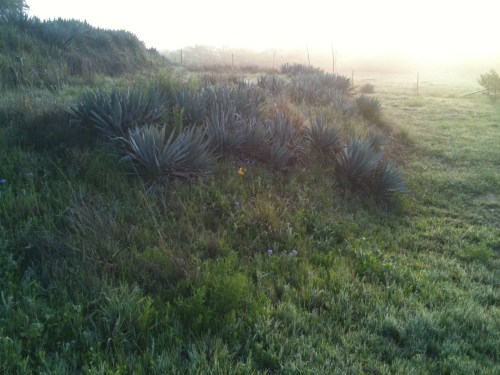
Pale-leaf Yucca on Terraces with Fog, Flying Hat Ranchito, March 30, 2012

In walking down to the stables to feed Star this morning, I paused and looked towards the east, the rising sun flared by fog, and I shot this photograph of yucca, fog, dew and a couple of blossoms of verbena (click the photograph to enlarge). Three terraces gird the ranch house and each level has families of yucca that hold the soil about the landscape and prosper in well-drained soil for their health.

The temperature briefly holds in the middle 60s as I look at this scene. I dwell on it as I write this post and think of the moisture upon green grasses and yucca.  So different from this time last year as fires broke out across Texas, consuming dried grasses, brittle brush and wildlife unable to flee.  Today is different, substantially so, with recent rains and low temperatures. The fire ban is off for Erath County. I see an abundance of wildflowers and I inhale the air suffused with humidity and perfumed with fresh grasses.

This ‘yucca morning’ will last in my senses for a long, long time, and I possessively want the moment to stand still as I look east towards the rising sun, flared by fog, that shall warm the day and send fresh grass shoots skyward.

14 Comments

Filed under Flying Hat Ranch, Life in Balance, Plants and Shrubs, Succulents

Why I wrote, ‘The fox, the hare and the chef.’

As benchmarks go, I have one coming up.  My blog will surpass 100,000 hits sometime today or early this evening.  That’s not like a seventieth birthday or turning twenty-one, and it will not be chiseled on some rock for passersby to see on the road to Samarkand.  It’s a blog thing, don’t you know?

Whether many or most people have read entire posts or have glanced and surfed on, I have no way of knowing.  What I do know is that one of my posts, ‘The fox, the hare and the chef,’ March 30, 2011, has continued to rack up over 1,000 hits a week for several months.  If I am to be known by one piece of writing in my life, this is the composition I desire that to be.

I want it remembered because with beauty comes violence, and, as human beings, we attend that performance in reverence — or at least we should.

‘The fox, the hare and the chef,’ was written in one, long sitting, but I had thought about the content and structure for a long time.  To be quick about it, I had wanted to write about Thomas Keller, the chef of the French Laundry in California, not because of his fine cuisine, but because of his full experience with preparing a rabbit dish, from slaughter to the pan.  He vowed not to waste that rabbit he had personally slaughtered.  This young man in learning the skills of his trade, to become one the world’s most heralded chefs, had insight of  a Socrates in the backyard of a restaurant.  He would not waste the life he had taken.

I nearly always seek humor in writing about nature and our relationship to our good earth.  That’s hard to find these days in the midst of waste, tar pit oil and needless consumerism, but it is there to alleviate the anguish of what we see and read about.  My post, ‘The fox, the hare and the chef,’ however, had no humor, no comedy and it just, frankly, turned out that way.

The humor in ‘The fox, the hare and the chef,’ is not evident, but it is there.  When I started to raise a beautiful herd of Angus cattle in 2007, I was going to be an impersonal cattleman — no affection or emotion for the heifers and steers, all business, no silliness or attachment.  Well, was I ever caught asleep.  In caretaking the Angus, I was shot twenty-seven times by cupid; for in each of the twenty-seven cows I raised, I found myself seeing personality, behavior patterns and sociability I never thought existed.  I walked among the creatures, just to be with them.  Go figure, I fell in love with a herd of cloven-hoofed beasts!  Impersonal?  Heavens no!  I took care of those cattle like they were my own offspring.  Funny, but also quite serious.

So, when I loaded the twenty-seven Angus in the stock trailer to take them to Carter Cattle Company for transport to Perryton, Texas, the cleanest feedlot in the state, a part of me went with them, and I knew that their rearing to that point had been the best around.  Whatever table they came to, I wanted people sustained with a healthy product and a sense that the great chain of being continue with a reverence for the gift of life on their plate — like Keller’s little bunnies.  Don’t waste the cattle I tended with love, and don’t waste your own life in boundless folly, for that does not honor the life in front of you — or on your plate.

With beauty comes violence, and, as human beings, we should attend that performance in reverence.  That is why I wrote, ‘The fox, the hare and the chef.’

______________________________

Notes, corrections and additions:

Thomas Keller, The Importance of Rabbits,‘ The French Laundry Cookbook, New York: Artisan, 1999.  See page 205 for the essay, recipe on page 207.

The fox is beautiful to behold, but it will take its cut in the barnyard and in the field — beauty and violence.

16 Comments

Filed under Life in Balance

Cedar of hope

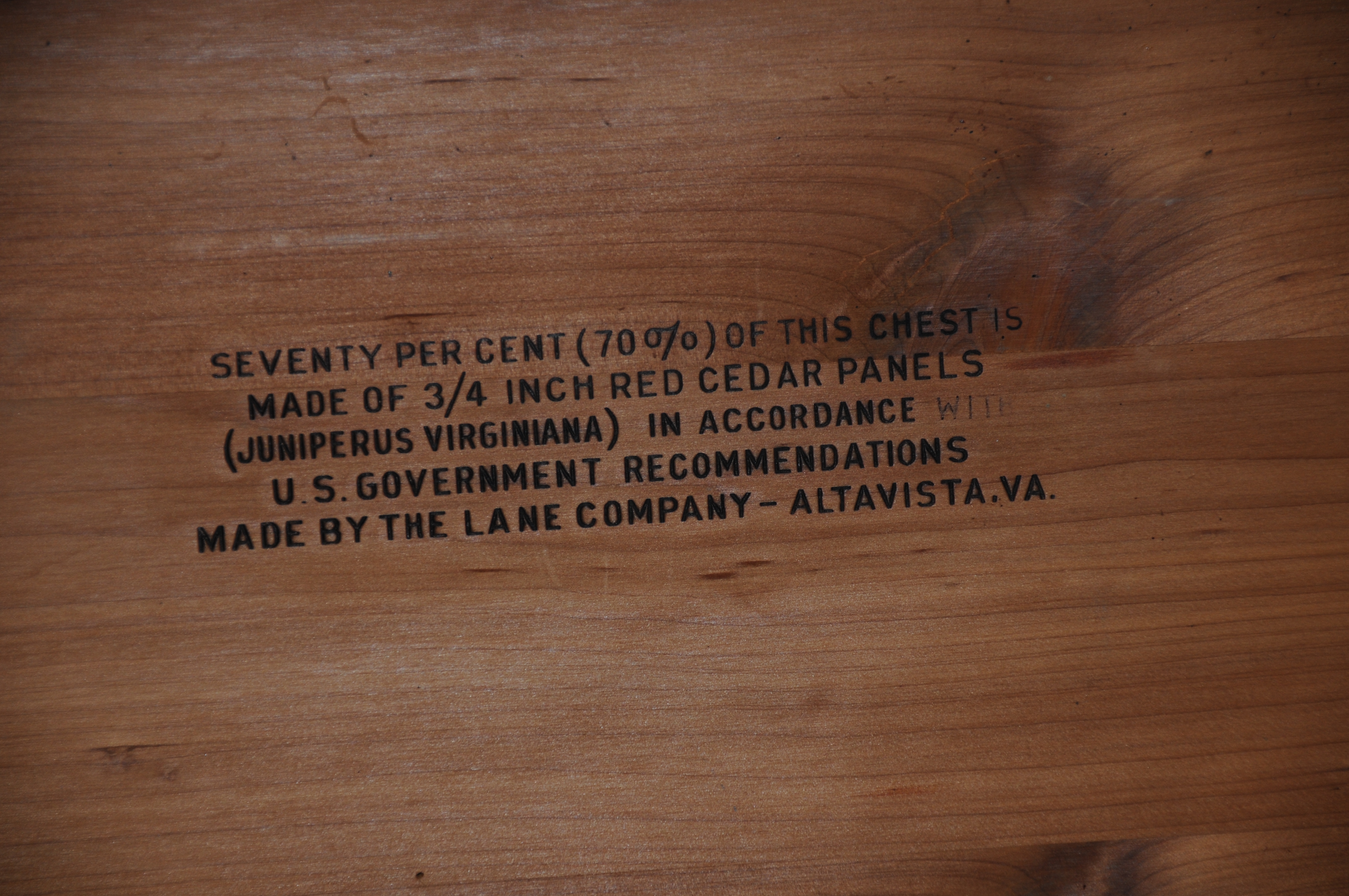
I have a cedar chest in the living room, placed between the sofa and the armoire.  I store Pendleton blankets in it now, but it was my mother’s cedar chest or hope chest as it was sometimes called. Opening it up the other day, I came across the trademark on the lid with the scientific name of the red cedar used to construct the chest: Juniperus virginiana.  I don’t recall ever having seen that before.

I find it quaint, old-style, to burn the imprimatur into the lid.  Frankly, I am not one given to hope, but rather working for a desired outcome seems to pay off better than wishing.  Cedar chests, however, were storage boxes of blankets, sheets, pillowcases and fine dresses for young women in the 1920s and 1930s in Texas, my mother being one of those hopeful for the ‘right man.’  The Lane Company that manufactured cedar chests went out of business in 2001, after having started constructing ammunition boxes for the U.S. military in The Great War.

As I open the cedar chest today, the red cedar smell permeates the blankets and handkerchiefs I store.  The scent of cedar brings back the vignette of my mother leaning down, opening the lid of her hope chest and caressing white sheets and pillowcases as I sat on the bed and read comic books as a boy.  Cedar is a tree.  Cedar was hope.

______________________________

Notes, corrections and additions:

As the contents of such a chest would primarily be linens, construction in moth-repellent cedar, or at least a cedar lining, was popular. The Lane Company of Altavista, VA (1912, closed 2001)[4] were a notable maker of cedar chests. After developing production-line techniques for making ammunition boxes during World War One, they turned these production techniques and a patent locking-mitre corner joint, into vast numbers of chests. This was aided by strong advertising, using a teenaged Shirley Temple as a model, in a campaign targeted at GIs and absentee sweethearts of World War II. They were particularly well-known for their practice (since 1930) of distributing miniature (12″ long) cedar chests to high-school girls as advertising gifts.[3] The Eastern Redcedar (Juniperus virginiana) is the “cedar” used in making moth-repelling cedar chests and drawers, as well as pencils.

‘Hope Chest,’ Wikipedia, accessed March 15, 2012.

15 Comments

Filed under Juniper, Recollections 1942-1966