
[Posted by Chris Clarke on August 10, 2010. Chris Clarke’s Blog is Coyote Crossing: Writing and Photography from the Mojave Desert. This post is reprinted with Chris Clarke’s permission. I find this composition about Ivanpah Valley to be revelatory from several angles: the pressure to gain new sources of energy erases natural habitats, the failure of citizens to stop the project because of organizational weakness, the retreat of Sierra Club from responsibility because of trade-offs and the force of building new power stations for an over-consumption society. Government should stop this project. Who speaks for the tortoise? The cholla? The Hopi have said that life is out of balance. They try to correct the balance with rituals and dancing. Life is out of balance when our power needs obliterate the habitat of living things. Chris Clarke speaks for the wild lands and its plants and creatures just as the Hopi drumbeat seeks to realign the balance.]
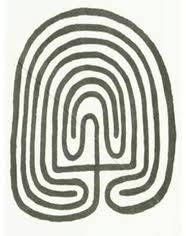
Hopi Labyrinth Pictograph

Ivanpah Valley Site of Proposed Solar Power Grid
Ancient desert slated for destruction. Laura Cunningham photo.
There is a story that has haunted me since I first heard it, and it comes to mind often these days. It was in the early 1960s, and the Sierra Club — playing politics in order to save one landscape deemed more important than others — had agreed not to oppose a gigantic dam on the Colorado river upstream from the Grand Canyon. Not long after that deal was struck, author Wallace Stegner suggested to the Sierra Club’s director, David Brower, that the Club had acted in haste. Stegner invited Brower to visit the place the Club had written off as unworthy of protection. Brower did. He was horrified at what he’d done. When I met Dave some three and a half decades later, he was still upset over his failure to protect Glen Canyon from the dam builders.
I’ve often wondered, especially after getting to know Dave a little, what that float trip must have been like for him: to see the cathedrals, the fern seeps dotted with crimson Epilobium, the tortuous slot side canyons and sublime riffles; to know it would all soon be destroyed; to be wracked with knowing that he might have been able to save the place had he more vigorously opposed the plans to destroy it. I’ve thought of that trip, taken back when I was a small child, and I’ve wondered how he must have felt during it.
Sometime in the next couple of weeks, I will be heading to the Ivanpah Valley to find out.
On or around the 15th of September, the developers of the proposed Ivanpah Solar Energy Generating System will be granted all the permits they need to proceed with building their nearly 4,000-acre project. As soon as the permits are in hand, the company’s “biologists” — in much the same sense in which the guy spraying your house for termites is an “entomologist” — will walk the site methodically, shovels in hand, looking for burrows. They will dig up every single desert tortoise they find for relocation. About half of those tortoises will be dead in a year, if similar past projects are any indication. Other animals will be evicted as well: kangaroo rats, burrowing owls, desert woodrats and rattlesnakes, kit foxes, desert horned lizards and badgers. The job will be done in a hurry: legally, no tortoises can be “relocated” after October 15.
And then the bulldozers will come. They will come to rip out the hundred-year-old creosote bushes and thousand-year-old Mojave yucca clumps. They will come to scrape the desert pavement that has been protecting the land from erosion since the Ice Age. They will come to evict the pencil cholla and elegant lupine and the honey mesquite, to blade away almost all of the old-growth creosote desert — though they say they will leave a bit of open soil between the mirrors, a sop to those who’ve asked if they might not leave a few square feet of vegetation here and there as a compromise. That compromise will actually make things worse. Unprotected by desert pavement, those bits and pieces will scour away in the first good wind, will provide harbor to invasive red brome and Sahara mustard, whose seeds will then blow into the adjacent Mojave National Preserve.
When they’re finished, the developers will have installed 173,000 mirrors, each one seven by ten feet, over nearly six square miles of murdered old-growth desert. Those mirrors will focus desert sun on boilers atop three 469-foot towers — taller than the great Pyramid of Cheops. The towers won’t last anywhere near as long as the Pyramid: they have a projected lifespan of twenty or thirty years. But in that time they, along with the mirrors that surround them, will produce a white and hellish glare that even the agencies supporting the project admit will pose a serious hazard to drivers and aviators. The project will almost certainly disable sight-hunting raptors. Night lights on the towers will attract disoriented birds, who will collide with the structures and die.

This stake in the heart of the desert, this new gaping wound that will erode the integrity of the desert for many miles around, this industrial project that even its backers admit will cause serious, unmitigable damage to the environment, this project of an “alternative energy” corporation funded by Chevron and BP and Morgan Stanley and Goldman Sachs — this is renewable energy.
There is still a chance to save the site, still a chance that a large green group will sue over violations of the National Environmental Policy Act, and stall the project for a month until it’s too late to relocate the tortoises, which would mean no construction on the site before December 31, which would mean no Federal stimulus funding for the project, which— given the fact that this uneconomical project could not happen without massive subsidies — might kill it. It would certainly buy us more time. But such a lawsuit becomes less likely with each passing hour. The large green groups have turned their back on the Ivanpah Valley. The Sierra Club — eager to play Glen-Canyon-style politics forty years after those politics were forever discredited — refuses to oppose the project. Every single Sierra Club member I know who is personally familiar with the Ivanpah Valley steadfastly opposes the solar plant, but the Club has expressly silenced its own activists. The Sierra Club, and the National Resources Defense Council, and The Wilderness Society, and a number of other prominent groups have decided to offer up the Ivanpah Valley as a token of their willingness to cooperate with the energy industry.
The mistake, of course, as has been amply demonstrated so many times, is that such dealing won’t buy the groups any influence. Ivanpah Valley is merely the first domino to fall. One “acceptable” project after another will follow, on lands the Respectable Greens deem uninteresting: at Ocotillo, in the Amargosa Valley, at Bullard Wash and Palo Verde, in the Granite Mountains. Hundreds of thousands of acres will fall to the bulldozers, a mistake to dwarf the damming of Glen Canyon, and the damage will multiply, will blow off the sites of each project as plumes of dust.
Not long hence — as the projects go wrong, catch fire, break down, prove unprofitable and are abandoned, and as society turns to actual, practicable solutions to climate change — a new generation of people who care about whatever fragments remain of the desert will ask hard questions. They will ask why we did not stop these projects.
They will ask Carl Zichella and Carl Pope and Michael Brune of the Sierra Club: “Where were you when the wild lands needed you?”
They will ask Johanna Wald of NRDC: “What on Earth did you think you would accomplish by trading these places away?”
They will ask Kieran Suckling of the Center for Biological Diversity: “What did you have to do instead that was more important?”
They will ask you, and they will ask me: “Why did you not throw yourselves on the gears and make this stop?”
I don’t have an answer for that last one.
I do remember a time when it seemed impossible the Berlin Wall would fall, when it would have been absurd to suggest Nelson Mandela might someday be president of South Africa, when it would have been unthinkable to suggest the United States would start to accept same-sex marriages. Change sometimes comes in an eyeblink; I have not yet given up hope. But our time is short.
Sometime soon, in the next couple of weeks, I will head out to the Ivanpah Valley for a night or two, to greet its tortoises and cactus wrens, to photograph its big red-spined barrel cacti, to hike among its cholla and creosote for what may be the last time. I will grieve that I did not do more to preserve the land there and I will be thankful for the opportunity to give it a voice, however ineffective a voice mine may have been. I will celebrate having met the place, a landscape far older and more precious than I can really grasp, at what may turn out to be the very end of its existence.
This never needed to happen.
[This post is a reprint of Chris Clarke’s composition on August 11, 2010. See Coyote Crossing by Chris Clarke.]
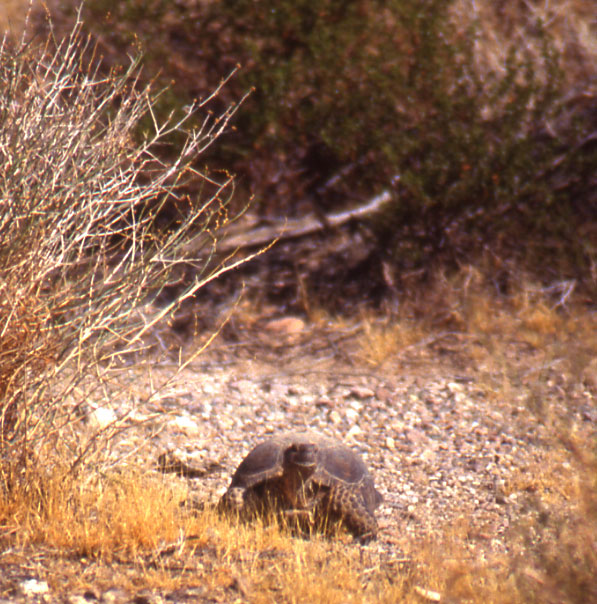
Desert Tortoise at Ivanpah Valley
______________________________
Notes:
Permission obtained from Chris Clarke to reproduce his post on my blog, August 11, 2010, by e-mail.
The photograph of the Hopi labyrinth, desert tortoise and simulated solar array are my additions to his post. The photograph of Ivanpah Valley is attributed to Chris Clarke’s post.


















 Sage to Meadow ~ Jack Matthews