Tag Archives: New Mexico

Not mine, not yours, but ours: Penasco Upper Llano acequias

The house on 17 irrigated acres from the Acequia de San Juan Nepomoseno del Llano. Water rights since 1789 (photograph by Taos Properties).

Forty-four years ago, in 1967, I traveled to New Mexico from Amarillo, Texas.  It was my third and most memorable trip for I dreamed for days about colors and pottery and adobe and silver.  I would lie down, fall asleep and pass into a dream world of silver and blue skies — northern New Mexico.  It was not all pleasant because I became ill from eating different Native American and Mexican foods, but that never deterred me from returning again and again and again.

Aside from digestive and dreaming events, I vividly remember a man plowing his field with horses near Mora, the unpaved streets about the Taos plaza and the narrow strips of farm land that bordered rivers and irrigation ditches.  The narrow strips of irrigated land not only reflected a precise lay of the land by survey crews, but also reflected a community, a meshing of farmers.  What was there about those fertile strips that drew me in?    In later anthropological field trips, I took my students by the Pecos River irrigated plots along State Highway 3 that ran from Interstate 40 to Interstate 25 between Santa Rosa and the Pecos Pueblo.  (Click to see Google map of the Pecos River plots.)

The system of irrigation is called acequia, referring both to the irrigation ditch and the association of members organized around it.

I have never owned land in New Mexico, but if I did I would buy a parcel of land that had water rights to an acequia, a system that stretches back in time to Native American communities before the arrival of the Spanish who adopted the local customs of water rights (riparian rights).  Having land that possesses an acequia, one automatically gains entry into a community that cleans, rebuilds and nourishes the ditches and, further, is granted rights to meet in a democratic association to discuss apportioning water and policies affecting owners that border the irrigation ditch.

Several weeks ago, I came across a piece of property near Penasco that if I could sell my ranchito, I would buy and move my horses and equipment post haste to Penasco Upper Llano.  See the following Google map:  This is the map-image of the Penasco Upper Llano property and other strips of community property.

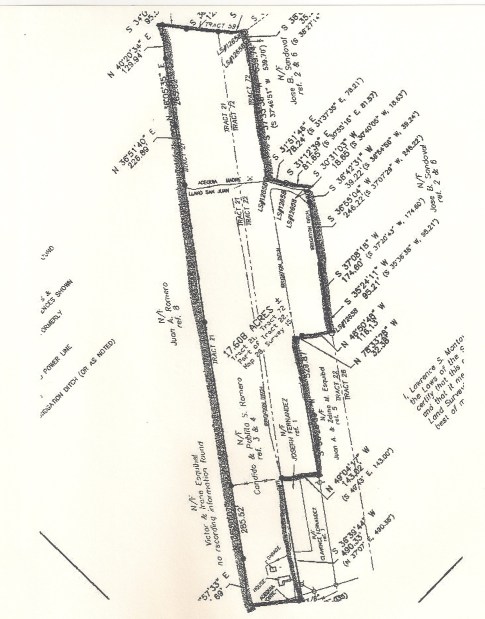
This particular piece of property with the adobe house pictured above is located in the high country between Taos and Santa Fe and can produce 700 bales of hay a year.  The water rights go back to 1789, the year that the United States inaugurated its first president, George Washington.  The surveyor’s plat looks like this:

Stanley Crawford in his work, Mayordomo: Chronicle of an Acequia in Northern New Mexico (1988), writes of the acequia culture that I admire:

There are few other civic institutions left in this country in which members have as much control over an important aspect of their lives; relatively autonomous, in theory democratic, the thousand acequias form a cultural web of almost microscopic strands and filaments that have held a culture and landscape in place for hundreds of years….

Ditch-cleanings are all very much the same, and in this they often feel more like ritual than work.  The crew varies from year to year: a couple of old men don’t turn up each year, a couple of boys barely able to handle a shovel, fifteen- and sixteen-year-olds, take their places; the weather is better or worse than some vague notion of what is usual, mayordomos come and go and some are responsible and fair, others vindictive, punitive, almost military, others are lazy and heedless of the needs of the ditch; and the crew can be a good-natured, hard-working creature, or sullen and complaining and evasive, qualities perhaps dictated by the amount of pride or fear circulating through the hearts of both those in charge and those doing the actual digging….

Buddy Manzanares who, on one of my last perfunctory inspection tours half an hour from the end of the spring digging, calls on me to admire a meticulously dug out and cleaned up tarea [a grave-size chunk of the ditch], with the banks cleaned of grass and squared neatly where they end in the bottom of the smoothly shoveled-out channel….This man knows how to make this small thing, this chore, into more than we commonly imagine, and what can be more important to know in this life, than just that.

Mayordomo, pp. 176, 224, 228-29.

The deep thing about acequia that pulls on me is the ready-made community that circulates around water rights that nourish subsistence crops and the growth of hay.  The isolation of many Texas ranches and the people that tend them and steward their animals is not good; in fact, it diminishes the rancher to a coarse individuality that thins the possibilities of  human endeavors, insinuates a obsessive pecuniary attitude about the land and narrows civic — read unselfish — behavior to the mere casting of a vote once or twice a year.

There are western ranching communities that transcend these deficiencies, I grant you, but the tendency has been to sell out or buy more land, thus expelling more people from the agrarian way of life.  I have experienced this and have witnessed the deleterious affect upon my family.

I shall not be accused of romanticizing the acequia culture — oh, go ahead and accuse! — because it is a human community and there will be conflict and law suits, but there is an association, a group of men and women meeting about water and how to nourish their livestock, beans, alfalfa, corn, tomatoes, okra, flowers, lawns, chilis, vineyards, peaches, plums, apricots, coastal bermuda, roses, trees, and every other conceivable plant that flourishes from the soil that is watered.  Having an acequia culture forces the lesson about sharing in real, material ways that no desk-bound, box-bound person will ever learn.  The basic premise is:  water is limited, we all need it, how will we share it?  And, how are we going to keep it coming down the ditch?  The answer: let’s talk about it, let’s vote on it, let’s implement our decision.

Like so many other things in life, the ditch is more than a ditch.  The acequia and the water is not mine, not yours, but ours.
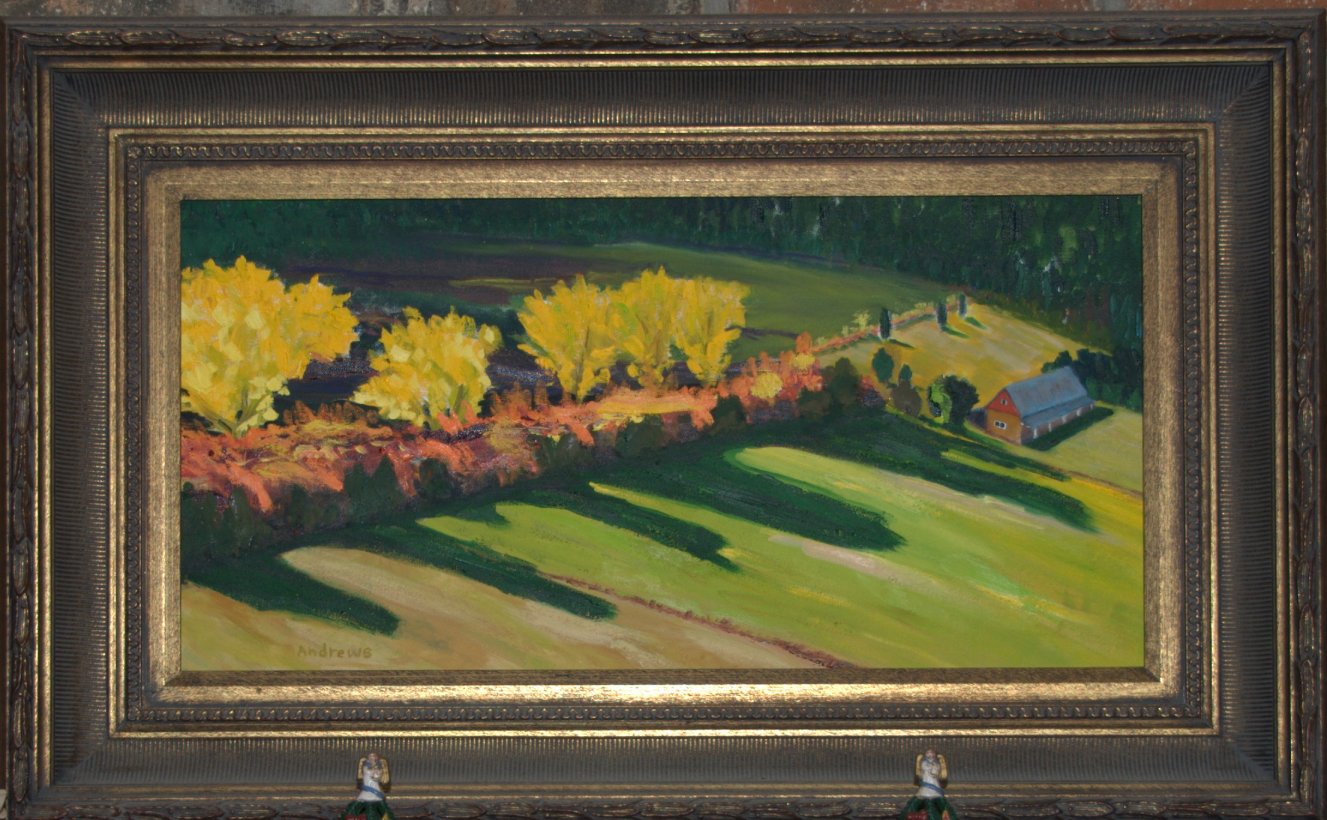
Acequia near Vadito, New Mexico, (Vadito II, oil by Eric Andrews, Taos, personal collection of J. Matthews).

______________________________

Notes, corrections and additions:

The language keyboard for Spanish and diacritical markings frustrates me.  Hence, the Spanish diacritical markings for “Penasco” are missing, although about every 20 times, I can get the tilde above the “n” in Penasco.  If anyone has any suggestions within the WordPress format to easily apply diacritical markings to writing, please comment or drop me an email at matthewsranch@msn.com.  I am intent upon using proper markings, but I am not going to spend ten minutes every time I need a tilde to paste it on.  Can Windows Vista do anything right?  Of course they can, but you have to update your browser every five minutes.  And, then restart.
13 Comments

Filed under Life in Balance, Santa Fe, Taos

Lilly’s* cairn

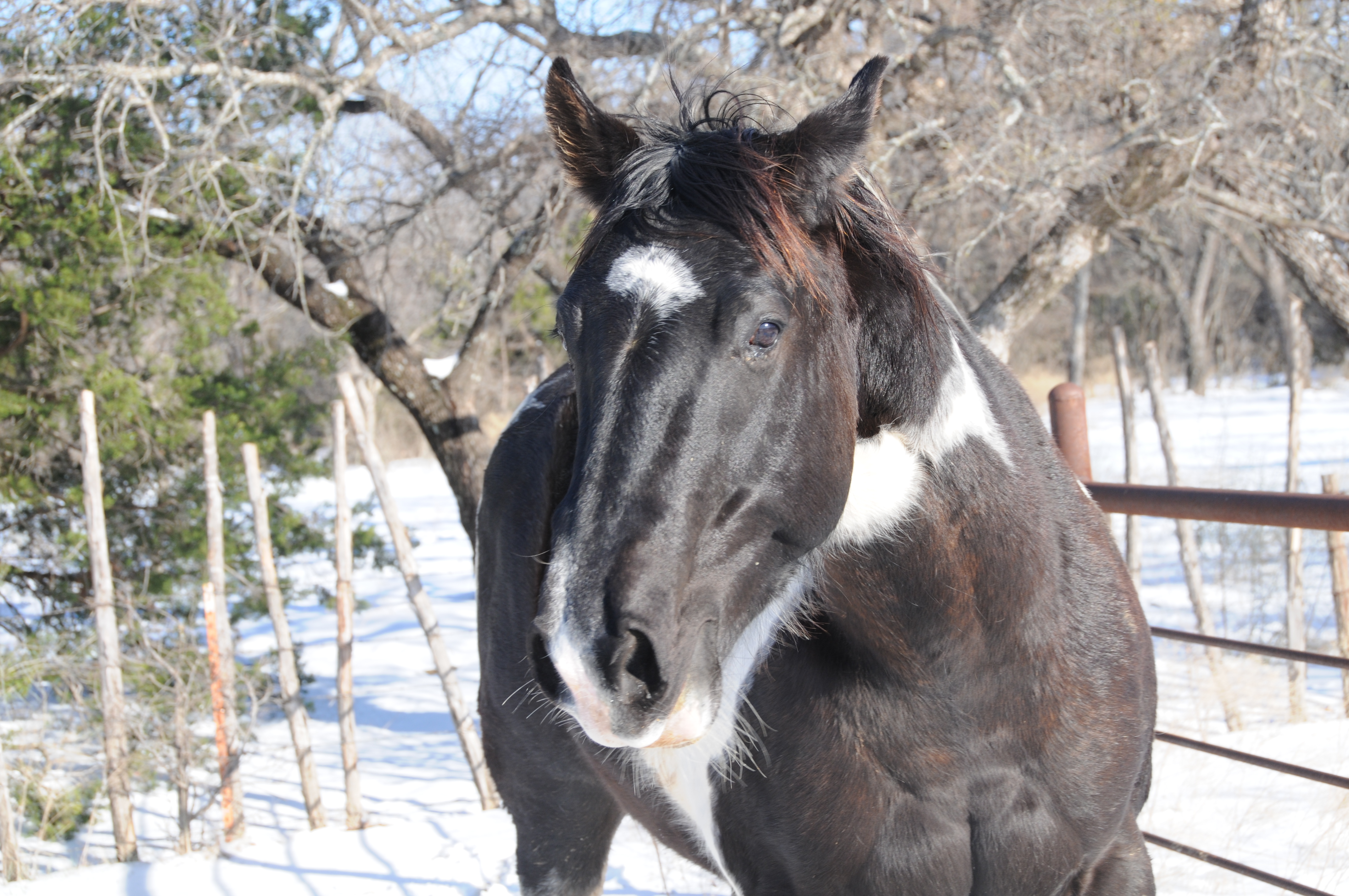
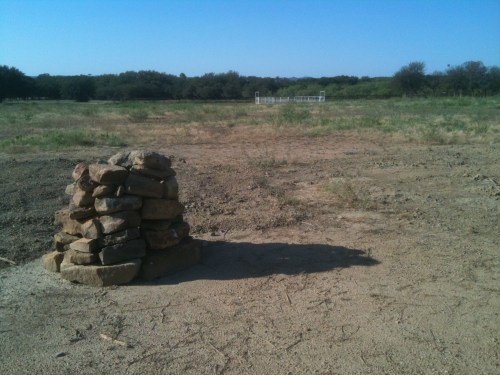
Rock cairn of Ima Lil Moore, September 25, 2011.

This summer I constructed a rock cairn to stack sandstone and petrified wood on the ranchito. A few feet up from the cairn in the photograph, I smoothed the soil with a hand rake. The smooth soil and the cairn mark the spot that Lilly*, known also by her registered name, Ima Lil Moore (APHA 111214), lies buried, six feet beneath the surface in a grave dug by the backhoe of a Stephenville, Texas, contractor. The cairn is about four feet in height and I pile smaller stones within the hollow of the cairn as I work through the day.

Cairns are built on top of mountains and within them sometimes a tin box is placed so that mountaineers may log themselves in and make a few comments about the climb to the top. I’ve done that with Mt. Taylor and Pedernal in New Mexico, climbs that I remember vividly and relive in my mind as I grow old. I shall not stop climbing. I don’t have a mountain to climb now as a goal, but the South Truchas peak in New Mexico is the only one of the Truchas peaks I have not assailed.  I will find the South Truchas cairn and write of my climb some day.

Lilly’s cairn contains no tin box, but as I look at it during the day I etch comments about her in a notebook that never fades or tears. She was my first and original teacher of horse behavior. I learned the difference between a kick of aggression and a kick of delight. Lilly never bit or kicked in aggression. She suffered to stand in her last days, allowing me to put a sling on the tractor and hoist her up by the neck, whereupon she shook herself and proceeded to the hay bin as if nothing had happened. To her last days, feeble as she was, the powerful King Ranch mare of mine who stood two hands above her always moved aside in respect for Lilly so that she could eat where she wanted. Lilly was alpha among the remuda.

I have thought of writing a post about putting Lilly down, and I will some day, but for now, I fill her cairn with rocks she galloped upon, throwing stones in her run to green pastures and fresh water.  I know those stones and pick them up for her cairn.  And in my dreams, Lilly walks beside me on a trail to the top of a unknown mountain, and she fills my night with peace.

Lilly (1985-2011)

______________________________

Notes, corrections and additions:

*The spelling of Lilly is “Lilly.”  It is a nickname that originated with my mother.  The flower, “lily,” is spelled with one “l,” but this horse has always had it spelled with two “l’s”.  Call it quaint Texas spelling.  The spelling of names on birth certificates is always interesting.  And, unfortunately, sometimes confusing.

8 Comments

Filed under Lilly

Rabies and Star

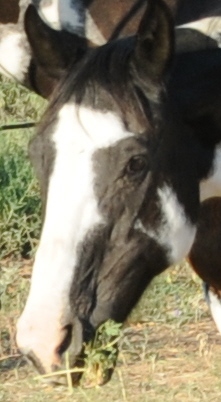
Star Bars Moore

In the city, look out for the bus.  In the country, what doesn’t sting or bite you will stick you — wasps, mosquitoes, mesquite thorns or worse.  Still, I had rather be out in the country and take my chances.

Rabies in horses is rare, but on the Bryant place, across the fence to the south of us, two horses were put down because one of them had a full-blown case of rabies.  Its companion horse had not displayed rabies symptoms, but Erath County authorities ordered it killed as it had no rabies vaccination documentation.  One was euthanized Thursday, March 24, and the other unfortunate horse this Thursday, March 31.  The first horse exhibited rabies symptoms and the vet took tissue samples that confirmed the disease.  The Bryants are having to take rabies shots since they were in close contact with the horse.

My paint gelding, Star, had been staying in the front pastures away from the Bryant place until last Sunday, March 27.  For two days, Star had infrequent contact with the second horse over the fence that had been killed.  Since rabies can be transmitted via mucous interchange, it is a very serious situation for Star.

Star had been inoculated against rabies in 2009, and last week before the contact with the Bryant horse he had been given his rabies shot for 2011.  Our veterinarian, Dr. Skeet Gibson of Equine Sports Medicine and Surgery, Weatherford, says the 2011 inoculation has not gone into full effect, and the 2009 inoculation begins to diminish in effectiveness after a year-and-a-half.  But since Star had no contact with the rabid horse — only the companion horse that had been killed — the chances were slim that any transmission had taken place.

Nonetheless, the vet said to isolate Star for two weeks and minimize my contact with his muzzle and mucous discharges, look for symptoms (not eating, behavior changes, etc.) and contact my personal physician for advice.

I called our personal physician immediately and neither I nor Brenda will be required to take rabies shots unless Star is rabid.  Star will probably be okay, but isolation and observation is imperative.

And just how did I find out about this whole issue of rabies next door?  My neighbors to the east that have horses called me Thursday, March 31, to inform me of the euthanizing, and they have no land contiguous with the Bryants!  They called to alert me as a fellow horseman.  Neither the Bryants nor the Erath County authorities had contacted me.  Had I been informed last week, I would not have allowed Star to go to the far pasture — Pecan Tree Pasture.  As it is now, we are having to take measures to determine disease contact that may, in the end, be fatal to Star, although I repeat it is doubtful.

Within an hour after the Halls called me and I had visited with the Bryants to find out the facts, I went across the county road to inform a fellow horseman of the situation.  In the country, we must work together.  I choose to do so.

25 Comments

Filed under Flying Hat Ranch, Horses, Star

Typing duck in flight part 2: the takeoff

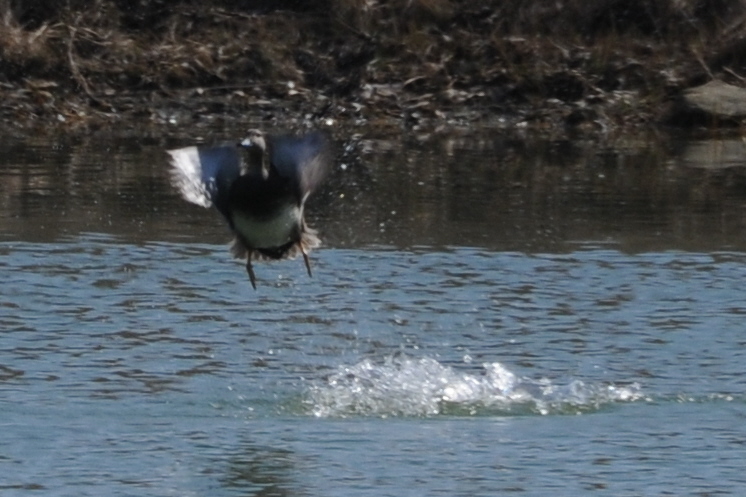
The unidentified duck in the photograph below takes off.  Upon a clue from Bill Lattrell who loves wild places (see his Wild Ramblings blog), the duck may be a Redhead (Aythya americana).  Field marks from Peterson’s include the male that is gray with a black chest and round red-brown head; the bill blue with black tip.  Both sexes have gray wing-stripes.  I have one additional photograph of the duck as it took off from the pond.


Tentatively a Redhead duck in takeoff from pond (February 2011).

The other aspect that may be a factor in identifying the duck as Redhead is that they patter along the surface while getting underway.  From the photograph above, you can see the traces of a patter?  It all happened so fast when the duck took flight that I could only snap two pictures.  (There is a camera feature to take rapid sequential shots that I should turned on.)  The other photograph is in a previous post yesterday.  It is the same duck.

In any case, if any of you have an opinion about the duck above, please comment or write me at matthewsranch@msn.com.  Duck feedback anyone?

7 Comments

Filed under Canvasback, Redhead Duck

Field as teacher

John Cheever in Massachusetts at the age of seventeen…

The spring of five months ago was the most beautiful spring I have ever lived in. The year before I had not known all about the trees and the heavy peach blossoms and the tea-colored brooks that shook down over the brown rocks. Five months ago it was spring and I was in school.

In school the white limbs beyond the study hall shook out a greenness, and the tennis courts became white and scalding. The air was empty and hard, and the vacant wind dragged shadows over the road. I knew all this only from the classrooms.

I knew about the trees from the window frames, I knew the rain only from the sounds on the roof. I was tired of seeing spring with walls and awnings to intercept the sweet sun and the hard fruit. I wanted to go outdoors and see the spring, I wanted to feel and taste the air and be among the shadows. That is perhaps why I left school.

In the spring I was glad to leave school. Everything outside was elegant and savage and fleshy. Everything inside was slow and cool and vacant. It seemed a shame to stay inside.

~ John Cheever, “Expelled,”  The New Republic, October 1, 1930.

* * *

I think it important, even redemptive, that I spend time in nature, away from the classroom or ranch house, walking in pasture and grove.  Yes, I know, it is all nature, even within four walls — the air, the sunlight, the particles of dust and skin floating within the house.  Without walls, however, weather intrudes, scents come sharply and trees present their foliage.  Wildlife intersects the trail.

When I lectured at T. C. U. one semester, I taught from a second-story lecture hall with an array of seven or eight windows looking out upon elms and green grass about the campus.  It was a western civilization class of thirty students.  Often I went to the windows while lecturing, propped my elbow on the ledge and instructed undergraduates while frequently glancing into the seasons outside the panes.  I liked that classroom and sometimes dream of it.

* * *

Field work in anthropology never tired me.  Surface surveys for isolated occurrences of stone tools or hearths carried me from arroyo to mesa in New Mexico.  Boots dusty, sweatband wet and Levis soiled at the end of the morning offered solid evidence of my toil.  I thought of people, long ago, that walked the same good ground, gazing at Cerro Pedernal.  My students that I led into the field, without fail, always returned to the classroom the next day invigorated, talkative and inspired.  The field instructed, not me.

______________________________

Notes:


John Cheever, “Expelled,” The New Republic, October 1, 1930, reprinted in The New Republic, January 5, 2011.

13 Comments

Filed under Life in Balance, Nature Quote of the Day, Quote of the Day

Pronghorn sunbursts

N. Scott Momaday

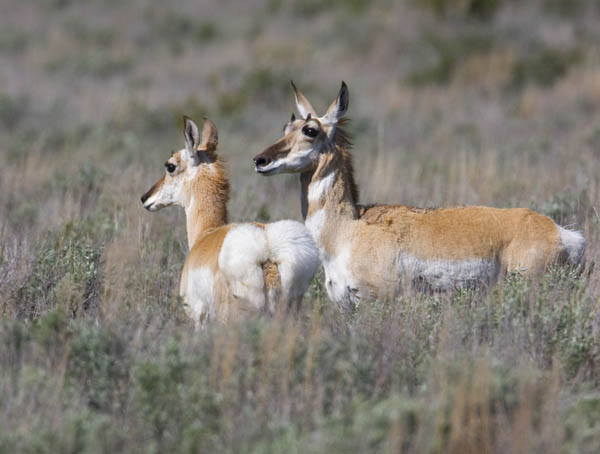
One morning on the high plains of Wyoming I saw several pronghorns in the distance.  They were moving very slowly at an angle away from me, and they were almost invisible in the tall brown and yellow grass.  They ambled along in their own wilderness dimension of time, as if no notion of flight could ever come upon them.  But I remembered once having seen a frightened buck on the run, how the white rosette of its rump seemed to hang for the smallest fraction of time at the top of each frantic bound — like a succession of sunbursts against the purple hills.

— N. Scott Momaday, The Way to Rainy Mountain, p. 19.

* * *

In the early seventies, between Clayton and Springer, New Mexico, Charles Fairweather and I drove fast to the Sangre de Cristos for our yearly getaway with several other friends who had already made camp.  We came up out of the roadbed onto a small hill and to the right, off the highway about 200 feet, were several pronghorn.  Charles quickly stopped the car and pulled out his deer rifle.  Charles, I said, let the pronghorn be.  Besides, it would be poaching if you shot him.  He was a good man, but impulsive at times.  He re-sheathed his weapon without a word and drove on to camp.

* * *

Between Snyder and Post, Texas, large ranches abound.  On one ranch, the Covered S, I saw pronghorn graze five years ago.  In the last four years, with the placement of wind mills for power and an extensive clearing of brush, I see no pronghorn.  They grazed in pastures on either side of highway.  This holiday, as we traveled to Lubbock, I looked intently onto the eastern pasture of the Covered S, hoping to see white rump in brown and yellow grass.  I saw none on either day we passed the Covered S.  I counted plenty of oil wells, but no antelope.

* * *

In the Journals of Lewis and Clark, they reported that antelope would rub themselves against sagebrush in order to perfume themselves.

* * *

Pronghorn at Red Rock, Idaho (J. Purdue photographer)


11 Comments

Filed under Adventure, Life in Balance, Life Out of Balance, Sagebrush

Stranded on a winter night in the Jemez Mountains

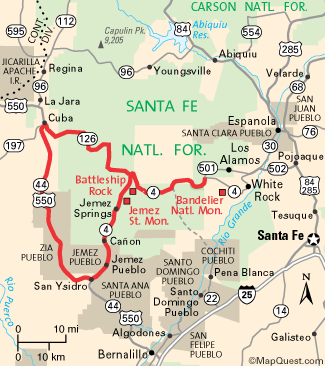
Road map of the Bandelier-Jemez area, New Mexico

One snowy and cold winter night in the 1980s, I was stranded on a forest road adjacent to New Mexico State Highway 4, between Los Alamos and Jemez Pueblo.  I drove a 1976 Chevrolet short-bed pickup with a two bunk camper.  The pickup was desert tan and the camper green with off-white stripes.  Not a flashy pickup, but neither was it an Eddie R. V. (National Lampoon Christmas Vacation).

I defined myself as a broad-gauge field researcher, taking notes on terrain, Native American culture and the interaction of Anglo, Spanish and Indian sub-cultures.  I kept a good set of notes and used them in class and at the desk when I wrote.  (Those notes are in filing cabinets in the barn today.  It’s 20 deg. F. this morning and I’m not fetching notes.  I’ll retrieve them later this year.)

On this particular trip to New Mexico in the 1980s, I had spent one night in Taos in the maid’s quarters at the Sagebrush and I was headed south to the Jemez Pueblo to spend the night at their campground and then on to Socorro and warmer climes the next day.  (A camper could pull into the campground at night and pay the next morning.)  It was around New Year or Christmas and snow had fallen in the higher elevations.   New Mexico State Highway 4, from Bandelier to the Jemez Pueblo, had an elevation of 8,000 feet and the snow had been partially snowplowed from the roadway, but neither forest roads nor pull outs had been cleared of snow and ice.

It was late in the evening, about 9:30 p.m., when I began to ascend the Jemez range.  As I left Los Alamos, I believed if I drove carefully I could safely go over the mountains and down to the pueblo.  My pickup was a two-wheeled drive with off-road tires and I had driven in snow and mud for many years in New Mexico and Texas.  When I reached the top of the Jemez range, I pulled into a picnic area that had not been cleared.  At first, I did not see a slight slope downhill, but when I noticed it, I immediately stopped and put my pickup in reverse to pull back out on the highway, about 150 feet from my position.  I backed up fifty feet and the traction gave way, tires spinning.  I was stranded and it was 10:30 p.m.

Snow was falling and no cars had come by on the road.  I wasn’t about to wander onto the road at night to flag down assistance.  Who would stop in the middle of the night for some guy up on the mountain and a pickup hidden among the conifers, nowhere to be seen?  Nobody would stop.  I decided to wait until daylight to flag for assistance.  I got out of the pickup, turned away from the road and walked down into the forest.

What a moment, I thought.  I may be stranded until morning, but the quiet of late evening and starry sky made me appreciate my predicament.  Only in this isolation, no trucks or cars passing, did I hear and see the forest and sky.  The stars were much brighter than on the Texas plains and they seemed to flash and glitter.  Wind blew through the trees sharply and the older pines creaked and groaned.  As the wind coursed, its sound was basso, baritone, not sharp tenor, but deep tones, earthy.

Even now, twenty-years-plus later, I slip into a reverie, reflective of that moment:  I have on my Eddie Bauer green parka, waterproof hiking boots with bright-red gaiters to the knees, snow pants, toboggan cap and ski gloves.  I walk farther down into the forest and stand transfixed in the snow for five minutes or so.  I realize I am experiencing one of the keenest moments of time, space and nature in my life.  And, it all comes about because of my carelessness.  The wind passing through the trees sounds lonely, yet comforting.  The stars faraway, yet close.  Alone without human company, I feel a family.

Well, enough of an Emersonian Drop’s Pond moment, I thought.  I have to get to sleep.  I walked back to the pickup and climbed into the camper.  I had several bedrolls.  My warmest bedroll was a blue mummy-type, goose down, that I would sleep in.  I spread the other bedrolls and a couple of old family quilts on the floor of the camper, stripped to my long underwear, got into the bedroll and pulled on my toboggan cap, tightened the mummy bag and promptly began to contemplate my fate.

I had no fear of freezing to death.  I was embarrassed for getting stranded.  Really embarrassed.  I could die of embarrassment.  Here I was on top of the Jemez in a two-wheel drive pickup.  I really didn’t want to hear from anybody that I should’ve had a four-wheel drive or chains.  Yeah, I should’ve, but I don’t.  But in order to get out of this jam, I would have to listen to the criticism.  Small price to pay, I thought, to have someone pull me out.  I drifted off to sleep, awakening a couple of times before morning light to the sound of high wind through the trees.  I slept warmly and awoke refreshed.

When it was fully sunup, I stood beside the highway.  I had heard one or two trucks during the night, but none since sunrise.  The weather news on the radio was good — no squalls or fronts approaching.  After twenty minutes, a man in a jeep came by with a winch on the front bumper.  I waved him down politely.  He stopped and I asked for just a pull out to the edge of the highway.  “Well, sure,” he said.

I waited for the inevitable why don’t you have four-wheel?  Chains?

Those words did not come.  He drove the jeep down close to my Chevy, hooked the winch on the pickup and pulled me back up to level ground where I had traction, taking all of three minutes.  Unhooking the winch, I reached for my billfold to give him a couple of dollars and thanked him appropriately.  He refused to take any money, saying, “It’s no trouble, glad I could help you.  Take care.”  And, with that, he drove on down the mountain without throwing criticism in my direction.  I was as grateful for his understanding as I was the pull out.

I pitched my Chevy into second gear and came down the Jemez, heading south to warmer climes, remembering the sound of wind through the trees and shining stars on the mountain as well as the kindness of a stranger with few words.

______________________________

Notes:

I wrote notes on this adventure the next day.  The notes are in the filing cabinet in the barn.  Still.

In writing this post, between paragraph one and two, I wrote a couple of hundred words about eating and lodging in New Mexico in association with this adventure, but deleted it.  I saved it for another day.

I looked for a photograph of snow on the Jemez, but could not find any to insert.

I do carry chains in bad weather these days.  But, they are cumbersome to take on and off, depending on the terrain.  Solutions include having a four-wheel-drive truck, have two spare tires with chains already placed so that you change tires out or stay by the fire.  Tour another day.

12 Comments

Filed under Adventure

Holiday wishes from Sage to Meadow and field notes

Shiney galloping to the corral during winter. No fear of the sun disappearing here.

A holiday greeting…

The sun in the northern hemisphere is at its lowest points this time of the year.  I do not think ancient and prehistoric people feared the sun would continue to sink towards the south and disappear forever — at least in southern latitudes of the northern hemisphere.  There was and is sufficient overlap of folk knowledge and tribal elder history to instruct the young and anxious that nature’s cycle continues her circle of cold to warm to hot, hot to warm to cold.

Christmas Eve and Day are here.  I wish each of you a Merry Christmas and Happy New Year!

* * *

Update on Lilly and Star…

Lilly, our oldest mare, is holding her own at 25 years of age.  She moves between the Well House Corral and the pasture, indicating a good level of energy and health.  Her feed consists of all the alfalfa she wants, Equine Senior Purina grain and 1 – 2 grams of bute (painkiller for horses) a day.  To husband animals rewards the steward: nickers and whinnies of recognition and impatience, warmth of animal in cold weather, riding for fun (both rider and horse can enjoy if accomplished properly) and work, and the sheer companionship and friendship of the horse.  One of my pleasures of having horses is hiking in the woods and having Star follow me like a hiking friend.  Star will go up and down creek bank, push aside brush to continue the hike and rest with me beside a fallen log.  If I wish to walk alone, I have to close the gate to the woods.  Most of the time, I want him with me.

Star is confined to the first corral.  He is overweight and feed intake must be limited.  He has all the coastal bermuda hay he can eat and some painkiller for his front legs.  His confinement lasts one week.  I have had to separate him from Lilly since she has alfalfa, he must have coastal.  Star is not pleased, but he adjusts.

* * *

A field post about bird songs on winter mornings…

December 16, 2010, 7:05 a.m.

Within the last two weeks I have noted birds about the barn and stables sing profusely only in the morning during the winter and are relatively quiet for the rest of the day.  I have not spent the day about the barn and stables to confirm unequivocally this observation (I’ll probably regret having brought this up in the first place), but it seems a sound observation.  During the day when I do chores and in the evening when I feed the horses and spend a hour or so in the barn area, I hear no birds or few birds.  In the morning, birds chatter and tweet, but do not break into long melodious fugues.

Our small ranch is located in North Erath County, Texas, Lat 32.43 N, Long -98.36 W, elev. 1,086 ft. Turkey Creek Quad.  Mesquite trees, live oak trees, elm and underbrush comprise the habitat for birds.

Among singing birds I see in the morning are redbird (just tweets), titmouse, chickadee, wrentit, wren, red-headed woodpecker, white-crowned sparrow, house sparrow, dove and a couple of other species I have yet to identify.  They browse in trees, on the ground and in the underbrush.  If I remain motionless in the corral after disturbing them, they resume their chattering and calls in a few minutes.  When the sun reaches a point in the sky at approximately 10:00 a.m. or so, songs and calls diminish.  I see birds for the remainder of the day, though not quite as frequent as the first two or three hours in the morning.  I hear during the day the quacks of ducks on stock ponds and crows on the fly.

7:35 a.m.

I have returned from the barn and stable area and this post is taking a curious turn.

A cold front moved in last night and the temperature is 40 deg. F.  The sun is not shining and clouds completely obscure the sky.  On point, birds are quiet, not even a peep, casting a different observation and bringing to light variables I had not considered: temperature, sunshine, clouds.

With the temperature in the 40s and no sunshine, I hear no birds.

17 Comments

Filed under Christmas, Flying Hat Ranch, Horses

Santa Fe Farmers’ Market

Over the Labor Day holiday, we took a mini-vacation to Santa Fe, stopping on the way to visit my daughter in Lubbock, Texas.

Roasting Peppers

From the first hour we were in Santa Fe, my wife, Brenda, said that we must go to the Farmers’ Market in the Santa Fe rail yard.  I was glad we went because the Santa Fe plaza was  filled with white-tented craft booths and in the evenings we could not enjoy strolling in the plaza.  There was a pleasant display of crafts, but no opportunity to stroll on the plaza.  Another evening, another trip for that.  So it was off to Farmers’ Market early Saturday morning.

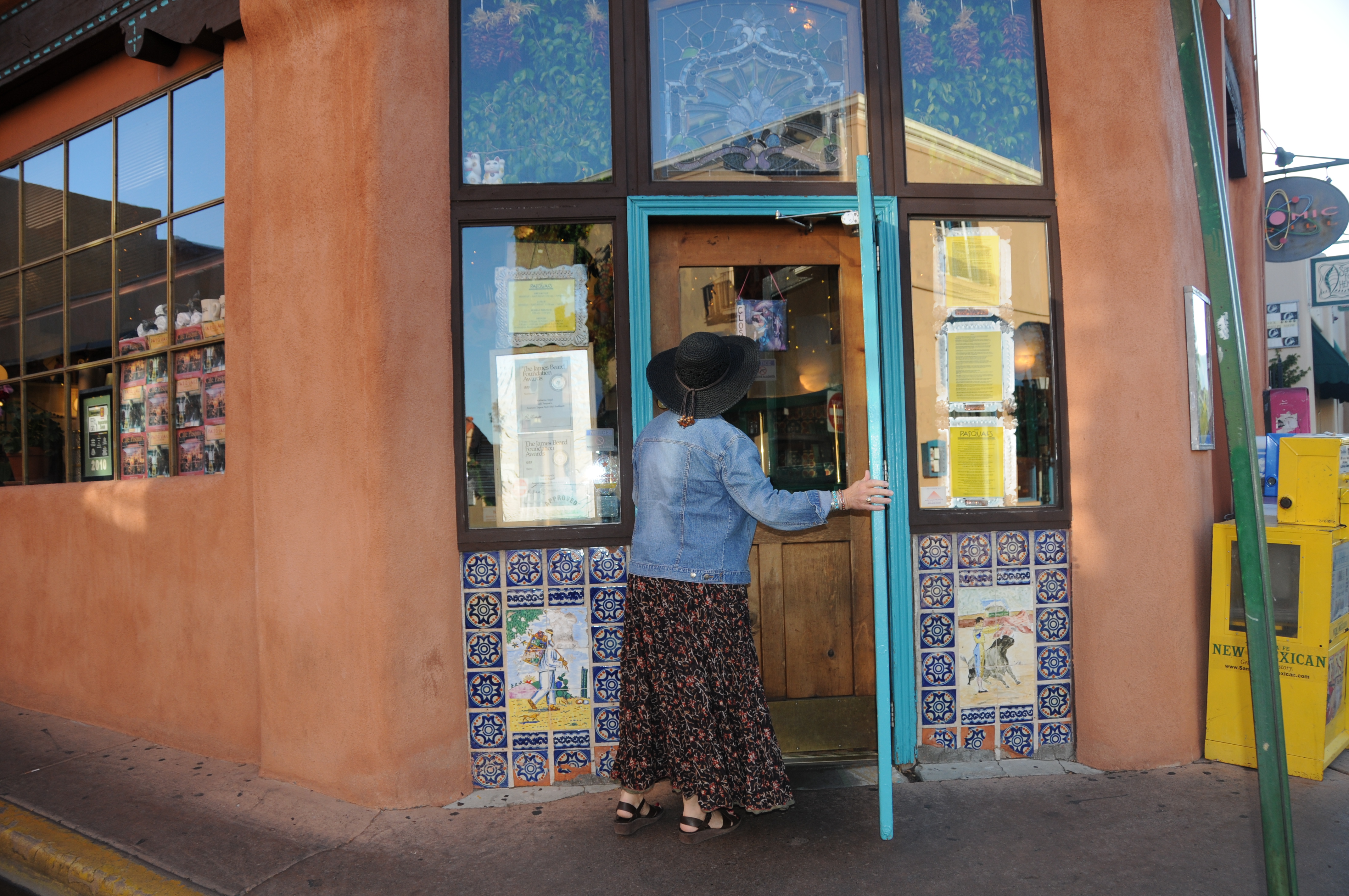
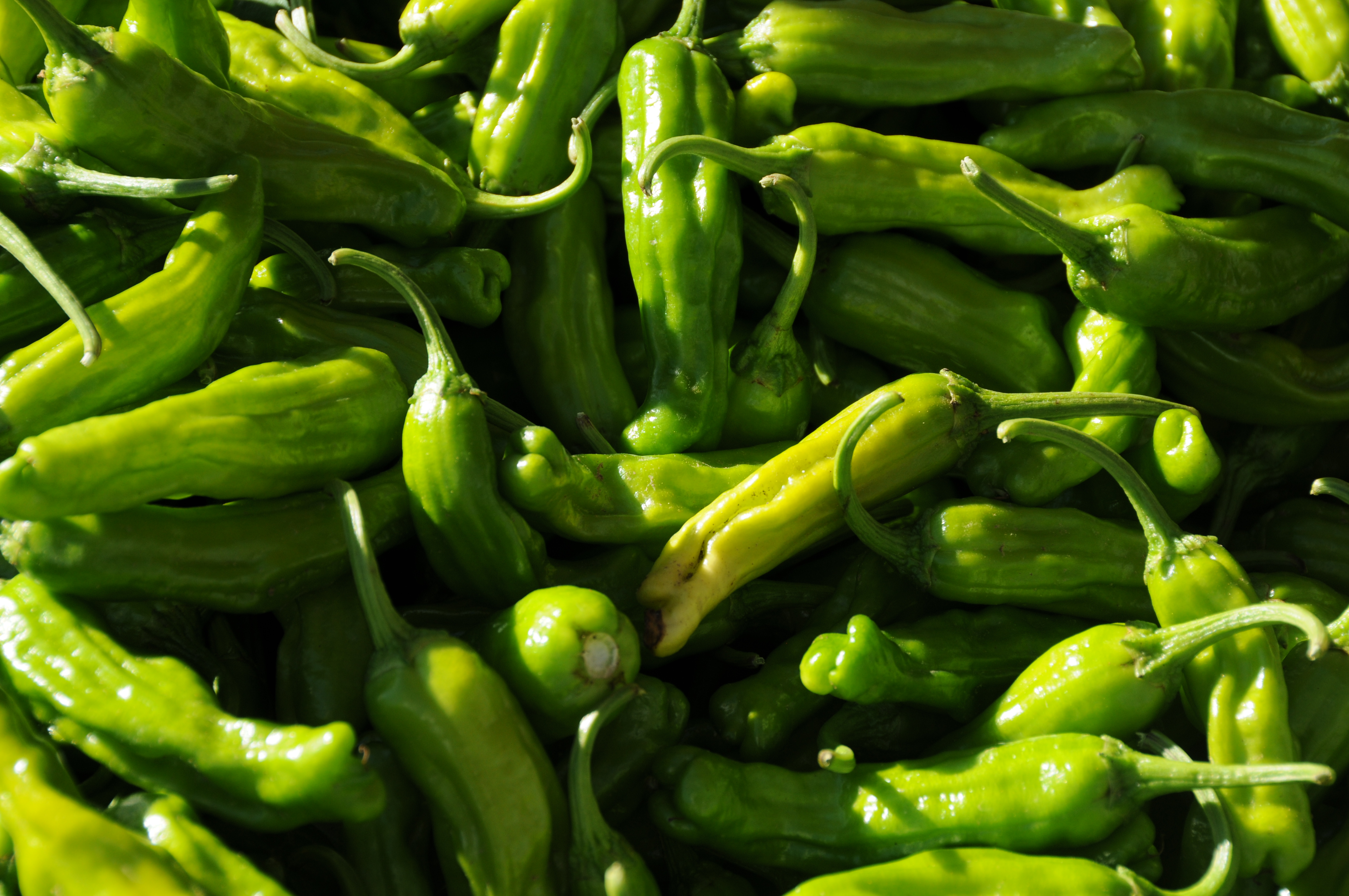
The Farmers’ Market meets all expectations for food and merriment and good all-around fun for a Saturday morning!  I took photographs.  Brenda purchased garlic oil, leeks, dried apple chips, basket, a garlic chain and sage-lavender soap.  We put the leeks in our cooler in the room under ice so that we could have leek soup when we returned to our ranch.  Chili peppers?  Well, we had them at every meal in Santa Fe, from Cafe Pasqual’s to Lumanaria.  Oh, boy, how great it is, a movable feast in Santa Fe.

Here are few more photos of the market.  I’ve read some of my blogger friends lately that have hankered for chili and New Mexico.  So, for you, here are some photos to whet you appetite before you book for travel.

Shallots at Santa Fe Farmers' Market

Santa Fe Farmers' Market Stroll

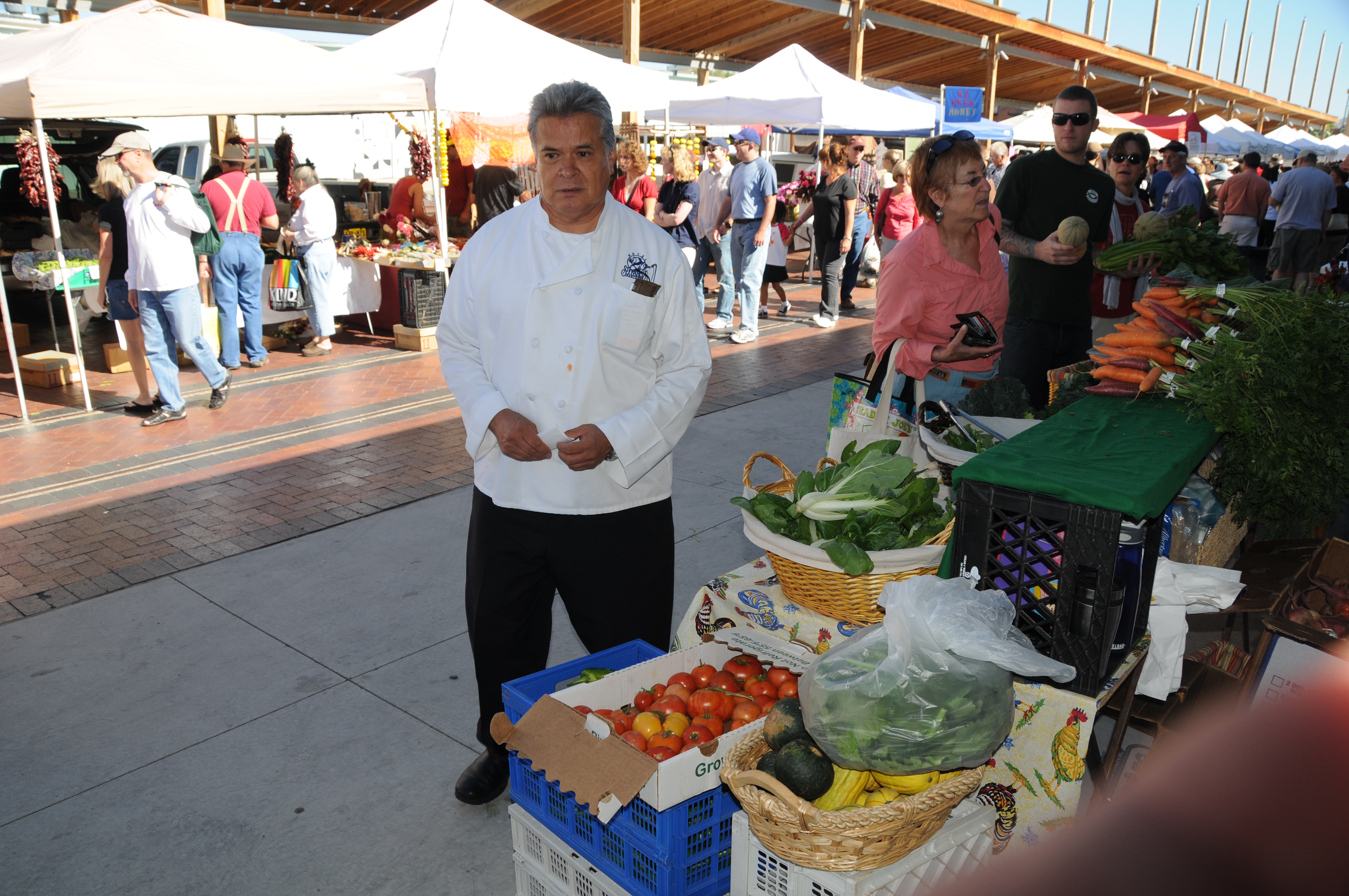
The Chef at St. Francis Hotel looking for fresh ingredients.

Roasting Peppers

Brenda at Cafe Pasqual's before we went to Farmers' Market. Pasqual's did not open up until 8:00 a.m. We were there early, thinking it opened at 7:30 a.m. We went in and had a fine table because we were early.

This is our table at Cafe Pasqual's. We had arrived early and were one of the first to be seated. We like the sparkling water and often take the bottle home to put fresh plants in so as to conserve the bottle and the energy spent to make it. Geraniums. Yes, geraniums. I have always had them around me. Mother grew them for as long as I can remember.

Chili Peppers, Farmers' Market, Labor Day Weekend, 2010

20 Comments

Filed under Santa Fe

Our Taos Blue Door

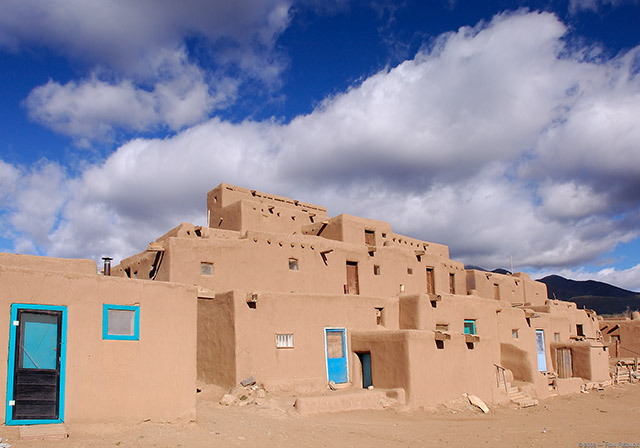
On my first visit to Taos Pueblo in 1967, blue doors and window frames reflected color brilliantly against adobe walls.  Still do.  Never outlandish in my opinion, the blue gave an even more mysterious quality to the north and south pueblo complexes.  I read that the Taos blue or Taos green, as it might also be designated, prevented evil and witchcraft from entering the dwelling.  The color surrounded the window or door frame with a protective halo.  It was also a beautiful color by itself, the security notwithstanding.

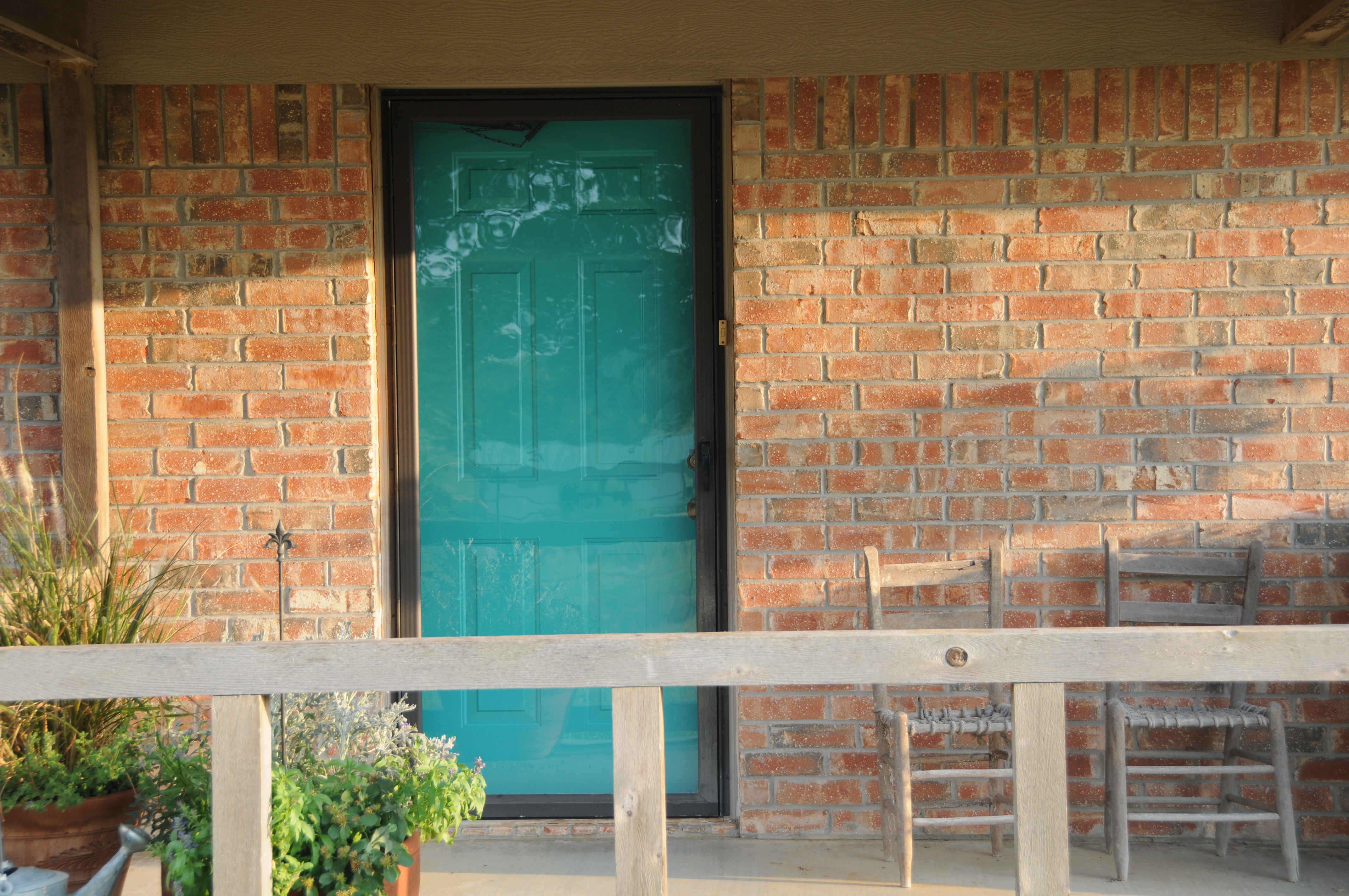
Blue Front Door, Flying Hat Ranch

When we decided to paint our gray doors, we looked up photographs in our books of the Taos blue and green, settling on the color you see in these photographs.  Brenda painted all three of our doors.  We got the paint from Sherwin Williams in Weatherford, Texas.  She took in a swatch that she had compared with photos in Christine Mather and Sharon Woods, Santa Fe Style, p. 25, lower right-hand photograph.  Sherwin Williams designated the color, Turquish, No. 6939.  She bought a gallon, using a third of the gallon to paint the doors twice.  I am trying to get her to paint the tack room door of the barn.  Course, there are no evil spirits down there.  Not with the horses chasing away bad dreams.

Close up of Taos Blue front door of Flying Hat Ranch house

______________________________

Notes:

Christine Mather and Sharon Woods, Santa Fe Style, New York: Rizzoli, 1986.

21 Comments

Filed under Flying Hat Ranch, Santa Fe, Taos, Taos Blue Doors