Tag Archives: Nature

Cloud portal to the coast

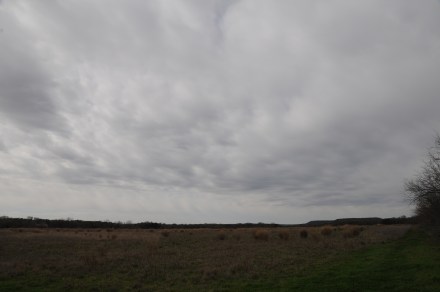
Thundershowers on either side of Interstate 20 west of Cisco, Texas, May 2012

Last Friday, May 11, 2012, I drove to Abilene for commencement at Cisco College where I instruct.  West of Cisco, on Interstate 20, I saw this cloud portal — at least that is what I call it.  I sped between the two thundershowers.  A few drops fell on my car.  The first couple of weeks in May is a time of showers and cool temperatures in west Texas.  That is not always true, for this time last year, I was busy writing about wildfires in my area.

I have a friend at Cisco College that teaches English and he traveled to the Oregon coast last year, staying near Seal Rock and Newport, soaking in cool temperatures and consuming seafood and local white wines.  He talks about moving to Oregon, selling his ranch and settling in the cooler climes.  I think about the higher altitudes of northern New Mexico around Truchas and Taos that have sharp winters and cool nights during the summer.

We both will probably stay put: he in Santa Anna, me in Mingus, for there are mild winters and days in May where thundershowers bring out the Cut-leaf Daisy, Fire Whorls, Queen Anne’s Lace, Purple Dandelions in brilliant colors while horses and cattle graze in lush Spring fields of gramma and bluestem.  I should like, however, to go to the Newport and Depoe Bay area of Oregon where my friend says, ‘There is a resident pod of whales for ten months out of the year about the coast.  You can see them surface and dive, surface and dive.’

I want to see that scene some day.  The cloud portal in the photograph above opens to the west, towards the Pacific, towards the whale.  And away from home.

______________________________

Notes, corrections and additions:

Depoe Bay was added as an additional site my friend visited.  It is a central location for beautiful scenery and whales.  The boating outing in ‘One Flew Over the Cuckoo’s Nest’ was filmed in the area.

14 Comments

Filed under Adventure, Rain, Taos, Weather, Wildfire

Yucca morning

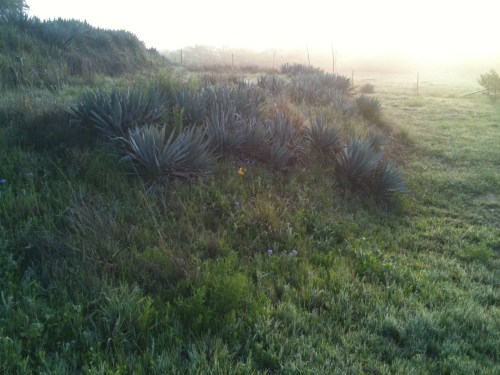
Pale-leaf Yucca on Terraces with Fog, Flying Hat Ranchito, March 30, 2012

In walking down to the stables to feed Star this morning, I paused and looked towards the east, the rising sun flared by fog, and I shot this photograph of yucca, fog, dew and a couple of blossoms of verbena (click the photograph to enlarge). Three terraces gird the ranch house and each level has families of yucca that hold the soil about the landscape and prosper in well-drained soil for their health.

The temperature briefly holds in the middle 60s as I look at this scene. I dwell on it as I write this post and think of the moisture upon green grasses and yucca.  So different from this time last year as fires broke out across Texas, consuming dried grasses, brittle brush and wildlife unable to flee.  Today is different, substantially so, with recent rains and low temperatures. The fire ban is off for Erath County. I see an abundance of wildflowers and I inhale the air suffused with humidity and perfumed with fresh grasses.

This ‘yucca morning’ will last in my senses for a long, long time, and I possessively want the moment to stand still as I look east towards the rising sun, flared by fog, that shall warm the day and send fresh grass shoots skyward.

14 Comments

Filed under Flying Hat Ranch, Life in Balance, Plants and Shrubs, Succulents

Broke Tree Corral antics and Flowers of Flying Hat (9): Blueish Ground plum

At the beginning of this Spring Break I set out to accomplish several chores:  Construct dirt foundation for alleyway and stalls, change tire on flatbed trailer so I can haul tractor to repair shop, take tractor to repair shop and return, shred mesquite sprouts and replace rain gauge.  The list changed.  No surprise there.

Putting more of a fine gravel foundation is delayed because stalls and the alleyway are still wet.  I have changed the tire on the flatbed trailer and will load the tractor later today.  Before I can hitch up the shredder, the linkage to the power train operation must be repaired.  So, the list has changed and I have conducted manure management tasks before I take the tractor to Stephenville — muckraking with tractor.

As I worked on cleaning the corrals, I let my gelding, Star, out for a browsing and to visit his friends over the fence, like neighbors chatting across the hedge in suburbia. When I went to halter him and bring him back after two hours of browsing, he bucked and snorted on halter like a rodeo horse. He wanted to remain out and become satiated with grass to a point of sleepiness. I can’t let him do that since he is laminitis prone, a condition that requires close monitoring of green grass consumption. Star entered Broke Tree Corral and continued to act horsey with bucking and running. What a day he was having!  Here is Star munching on grass about an hour before the rodeo began.

My morning had a few Kodak moments — no more Kodachrome, I know.  Digital rules.  The Bluebell bell flowers opened up with the few minutes of sun this morning and I brought the camera down to the pasture before I started cleaning the corrals.  Bluebell flowers erupt all over the two front pastures.  Where I had one patch of bell flowers a couple of days ago, now the flowering occurs in multiple patches.

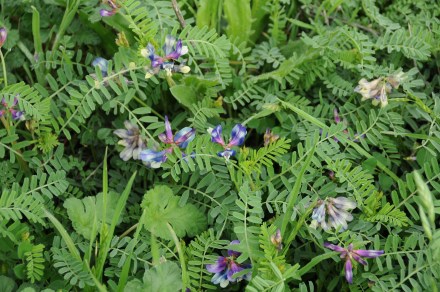
The final photo in my continuing year-long goal of photographing the different species of flowering plants on the ranchito is another Ground plum or milkvetch, but with a different color, a more blueish hue to the blossom. I’ll go ahead and give it a different number because of the definitive difference in color.

9. Ground plum, milkvetch (blueish-violet blossom), Astragalus crassicarpus?

I will take some photographs of the namesakes of the corrals. I have had to give them names because Corral No. 1, Corral No. 2 get lost in the process of giving directions to cowboys and haulers.  I end up saying, Put the horse in the corral with the broken tree in it!  I have no signage for the place, just naming with visible, easily identifiable attributes (broken tree, well house, pecan tree). Nothing like trying to identify a sparrow these days, a process we are all still involved in as the attributes continue to be noted.

10 Comments

Filed under Flowers of Flying Hat

Flowers of Flying Hat (6-8): Sow thistle is not a weed.

Far field clouds, March 2012.

6. False Garlic, Crow Poison (Nothoscordum bivalve), March 2012.

This False Garlic flowers early and there are several colonies clustered together throughout the ranchito.  This False Garlic is closed and due to the rains and cold yesterday and today, I do not have an open flower to illustrate — but, I shall.  This is found in the lane to County Road 114, and other colonies are about the gate between the arena and the grove pasture.

7. Sow Thistle (Sonchus asper), March 2012.

Sow Thistle appears to be a weed, but it is not.  Authorities claim the milk of this plant relieves eye ailments.  I wonder if I could apply this to my left eye?  I think not.  I’ll rely upon Dr. Callanan, but then again…. This appeared one afternoon and then its flowers have closed.  This Sow Thistle inhabits the disturbed soil underneath the live oak tree to the southeast of the house.  I have read much about the categorization of ‘weed’ versus ‘plant.’  The term ‘weed’ seems culture-specific, a term of dislike, marginal.  Goats, sheep and cattle eat this with relish.  To them, it seems, this is a plant, not an obnoxious weed.  One person’s plant is another person’s weed?

8. Unknown.

These little-bitty guys erupt on the top terrace and emerge as small, almost unnoticeable flowers. As of today, I have failed to find their name, and I also need a closeup to gain greater resolution of their attributes. Today it is raining and the blossoms are closed.

More Violet ruellia, violet wild petunia (Ruellia nudiflora).

This is a another photograph of violet wild petunia, previously identified.  It has erupted in large numbers along Interstate 20 from Mingus to Abilene.

13 Comments

Filed under Flowers of Flying Hat

Flowers of Flying Hat (5): Ground plum, not yummy

Yesterday evening as I came back a different path from the barn after feeding Star, I discovered this flowering plant, the Ground plum, milkvetch.  I spent over an hour perusing field books until I identified Ground plum.  I nailed the identification when I corroborated a field book description with the Lady Bird Johnson Wildflower Center website.  Depending upon the species of Astragalus, some members are poisonous, but this species is not.  Even so, Ground plum is not a yummy plant although its fragrance is lovely — somewhat spicy I believe.

5. Ground plum, milkvetch (Astragalus crassicarpus?). March 3, 2012, southeast second-level terrace. See: http://www.wildflower.org/gallery/result.php?id_image=9002; Wills and Irwin, p. 138, especially.

I discovered a new link for plants: University of Michigan-Dearborn Native American Ethnobotany.  You must check this out for medicinal uses of plants.

This medicinal use of plants starts me thinking.  I may set aside an area in the barn to harvest some of these plants.  I already have a request for bull nettle to be sent up to Wisconsin for an indoor greenhouse.  Don’t let the bull nettle go outside!

14 Comments

Filed under Flowers of Flying Hat, Wild Flowers of Texas

The 2011 Prairie Sagebrush Awards for blogging

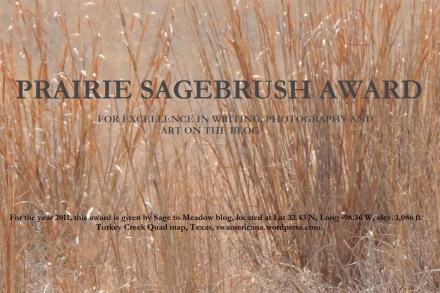
The Prairie Sagebrush Award 2011 is given for fine writing, photography and art in the blogosphere.  From my blogroll, I select a post, photograph or art piece from 2010-2011, early 2012.   For each comment that is entered on this ‘The 2011 Prairie Sagebrush Awards for blogging’ post, I will donate a buck ($1.00) to a wildlife corridor in Texas or New Mexico.  I set a limit of $100.00 — not that I am going to have more than fifty comments, but who knows?

I have excerpted portions of these fine writings and art into my post in respect for their blogs and copyright.  Please click on the links to obtain the full text of these really fine bloggers.

Please feel free to copy the Prairie Sagebrush Award 2011 design-image and put it on your blog to link back to this post or to one of the blogs below.  (No, I’m not trying to pump up my numbers, just trying to illustrate the high quality of work performed on blogosphere.)

[Wild Bill, Wild Ramblings blog, ‘Conifer Encounter.’…On the way back I asked him, and this was one of the few times I had spoken, how he knew so much about the woods. He answered that he was a biology professor at Springfield College, but had grown up in the pine barrens in New Jersey. He surmised that most of his knowledge he had learned as a boy wandering those Mid-Atlantic swamps, coupled with reading a lot of books about nature. And then he laughed out loud, almost in a boisterous way. “And once I met an old man in the woods,” he declared, and he laughed again, this time even more loudly….

[Grethe, Thyra blog, ‘Goodbye to King Winter.…The next week-end was foggy and raw and the sun seemed so far, far away. It was nice to see that the people at the restaurant of  Skovmøllen (the old Water Mill-restaurant) saw to that the little birds were fed with Danish bread and fat-bowls. There was also morning bread with cinnamon and the birds seemed to like it!  Notice the little blue tit. It is so ruffled. I hope it will cope….

[Photograph: Montucky, Montana Outdoors blog, ‘A visit to an old painting.]

Montucky, 'A visit to an old painting,' January 24, 2011.

[Cirrelda, Color of Sand blog, ‘Ides of January — yard observations.’…I stood for a while looking at my pobrecito pinon tree tilting away from the drooping elm limbs above it. Then those elm limbs were golden – the light was coming at them directly from that western mesa edge (miles away) and the whole damn wild elm tree was shining in its massive shagginess. (I so curse that tree at times since its roots tangle into every vegetable bed.) Smoke on my hands and clothes, I stand and gaze at the afternoon in my yard….

[Martie, Taos Sunflower blog, ‘Photos from my hood.’ …This morning I was down in Arroyo Seco (the nearest village to my home, where my yarn shop used to be) and had a few moments alone with my camera.  I thought I’d go look for beautiful flowers, but alas, in this drought, they were not to be found.  Then I looked up at the beautiful clouds in the sky over the old church behind our building, and thought it has probably been years since I’ve shared photos of it with you.  It was a ready reminder of why so many people come here to study art and paint the local scenery.  I’m sorry there aren’t any flowers for you, but hope you enjoy the rest…

[Shoreacres, The Task at Hand blog, ‘Promises Made, Promises Kept.’…My extraordinary good fortune was to be born into a family more than willing to make and keep promises.  My father took promises especially seriously. The eldest of six children, he was one of those increasingly rare creatures – a man of his word. Whether it was a work colleague, a neighbor, a family member or his tiny daughter coming to him with a request, if he said he would do it, he did….

[Wrensong, Writings from Wild Soul blog, ‘Waiting for the Sun.’  See also the female cardinal photograph associated with this winning post.]  Everything so still/ in this windless dawn/ Ice hangs from every twig/ air cold as stone/ Sun arrives like hope/ and hunger. ~wrensong

[Marie, The Rambling Wren blog, ‘The Red Fox.’…The fox stood stock still in the middle of the lane. We watched each other silently for 10 or 15 seconds, then the fox turned to go. But she paused, then sat down and looked back at me. She seemed unsure how to proceed, and kept looking up the secondary driveway we use for moving trailers and the RV. There’s a large woodpile there, an old barn the previous owners had dismantled elsewhere and brought here, planning to reconstruct. But the project was never finished, and we now have habitat for all sorts of critters–rabbits and woodchucks, chipmunks, feral cats, and now, perhaps, red fox. Had she moved her kits there, I wondered?…

[Kittie Howard, Kittie’s Stories, ‘Shopping at Best Buy.’…Best Buy, that big box store, re-entered my life.  I didn’t want to buy a new computer just yet.  The plan was to limp along with what I had until the Thanksgiving/Christmas holidays. Last Saturday night, the motherboard died….

[Rebecca, Rebecca in the Woods, ‘On Not Hearing a Boreal Owl.’…Then yesterday GrrlScientist had to go and write a blog post about about Wilson’s Snipe and mention that the “winnowing” sound created by its tail feathers during its courtship display sounds very similar to the call of a Boreal Owl. And that courting males “fly in circles.” And that they do this “long into the evening.” And sometimes even at night, I suppose? Sigh. No one likes deleting a species from their life list…. [Bold added.]

[Photograph and recipe: Karen Rivera, New Mexico Photography, ‘Green Pumpkin and Green Chili Pueblo Stew.’]
Karen Rivera, 'Road between Cimarron and Taos, New Mexico,' March 8, 2011.

[Debra, Find an Outlet blog, ‘Death’s Mementos.’…Every day I am moved by roadside memorials to people who weren’t ready to die. People who were in the wrong place at the wrong time. They’re a constant reminder of how fragile we are—bits of bone wrapped in a flimsy shroud of a ridiculously unsuitable hide. We’re anything but fierce when up against poison, bullet, disease, or 3,000 pounds of steel, glass and chrome….

[Wildstorm, Backroads Photo blog, ‘North Texas Desert.’…There is no such thing–the North Texas desert. Yet it seems like it when you glance across the dry roasted pastures where nothing grows. What is green? The cedar trees. Even the oak trees have burned up leaves….

[Bunnyterry, I Love New Mexico blog, ‘Gardening in New Mexico.’…As I stand here with the garden hose in my hand, I’m reminded of a paper I wrote on personal landscapes for that particular history class.  The instructor’s goal throughout the class was to get us to tie our own personal histories to history in the broader sense, which, if I were teaching history today, would be my goal as well…

[Teresa, Teresa Evangeline blog, ‘At Home in My One Room Schoolhouse.’ …I almost forgot to tell you: when I crossed over into New Mexico from Utah on Sunday, in less than a quarter of a mile there were two crows and a coyote. The crows were standing over their dinner in the ditch, whoever the poor critter had been, and the coyote was trotting away from them, down in a hollow, across a snow-covered field….

[Annie, Anniepickens’s blog, ‘Spring Garlic.’…Sunday I got to the Farmers’ Market later than usual, it was already packed with people but choices were still good. The first thing I wanted to do was find the egg guy and trade in my used cartons. It seems like the only time I remember that I’m going to take them back is when I am at the market buying more eggs. Very happy with myself for finally remembering….

[Photograph: Jeff Lynch, Serious Amateur Photography, ‘Those Spanish Skirts.’]
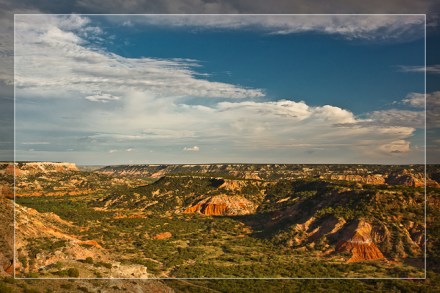
Jeff Lynch, Palo Duro Canyon, 'Spanish Skirts,' January 2011.

[Photograph: Evangeline Chavez, Evangeline Art Photography blog, ‘Dia de Los Muertos.’]
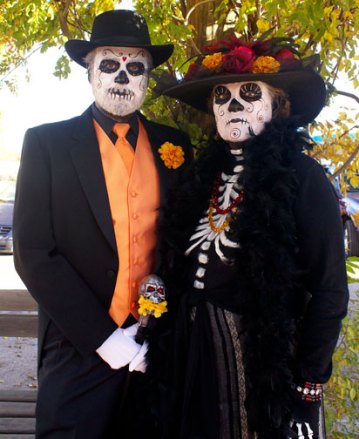
Evangeline Chavez, 'Dia de Los Muertos,' posted November 6, 2011.

[Poster image and environmental work: Chris Clarke, Coyote Crossing blog, ‘Desert Biodiversity.’]
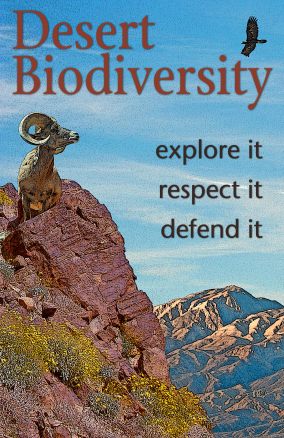
Desert Biodiversity poster, Chris Clarke, December 2011.

[Bonnie Bardos, Bohemian Artist: Painting and Thought blog, ‘New Sculpture.’]
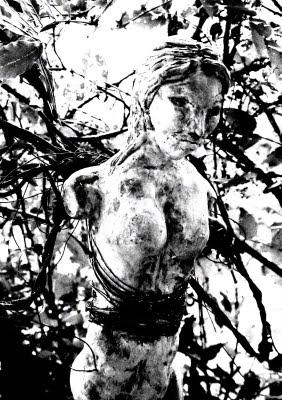
Bonnie Bardos, 'New Sculpture,' May 2011.

[Photograph: Steven Schwartzman, Portraits of Wildflowers blog, ‘Welcome to the Texas Hill Country.’]
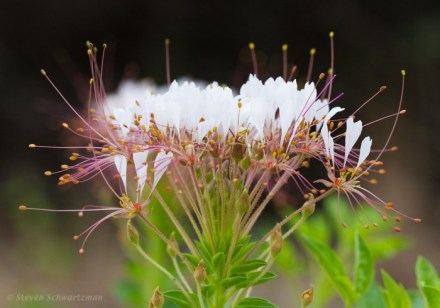
Steven Schwartzman, 'Clammyweed flowering,' June 2011.

52 Comments

Filed under Prairie Sagebrush Awards 2011

Central Texas Christmas Eve 2011

Circulating around Christmas Eve and coming into Christmas Day, I have taken some photographs that illustrate rural and town life in central Texas.  These photographs were taken near Mingus, Llano and Fredericksburg.  Mingus is the town that is designated on my mailing address, although Hannibal (no longer having a post office) and Gordon are closer to my ranchito.  (The Mingus post office is slated to be closed because of cost-cutting measures.)

My Uncle Floyd and Aunt Lennie had a ranch at Cherokee, near Fredericksburg.  I spent summers and holidays with Floyd and Lennie as a boy and teenager.  My Aunt Lennie prepared chicken-fried steak that was actually a recipe for wienerschnitzel (lightly breaded veal steaks) and serve beets that were purple and sweet and icebox cold.  My cousin, Allan, and I literally begged her to prepare chicken-fried steak.  Little did I know then that she obtained her country cuisine largely from the Fredericksberg German culture.

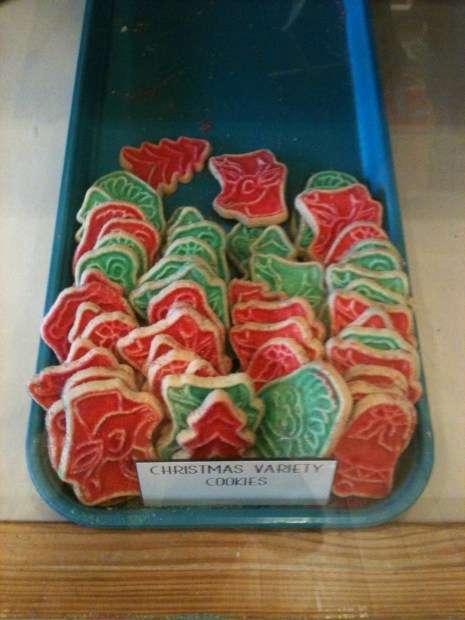
Christmas variety cookies at Fredericksburg Bakery, December 24, 2011.

The Fredericksburg Bakery has been producing cookies and breads since 1917.

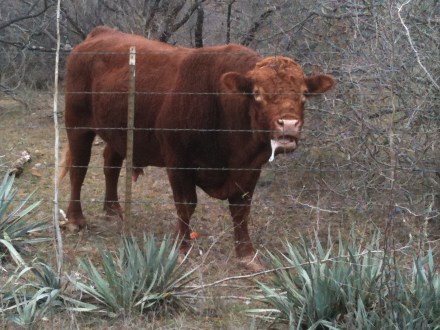
Here is Dooley's Red Angus bull, my neighbor to the west (December 22, 2011).

There is nothing wrong with the drooling Red Angus. He has been feasting on shortgrasses and hay, perhaps a few Christmas cookies.  He’s a very gentle fellow and will amble away when you approach him. The Red Angus breed is noted for its weight-gaining ability. I have considered purchasing some.

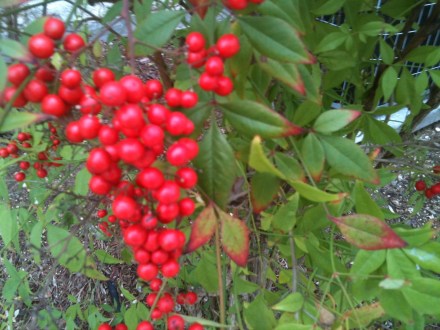
Red berries beside Highway 16 near Llano, Texas (December 23, 2011).

These berries look good enough to eat, but don’t! If you see berries or fruits that are red and you don’t know the variety, don’t eat the red!  These berries are not to be mixed into any Christmas recipe for cookies or breads.  Please refer to your favorite cookbook for ingredients in your cookies.

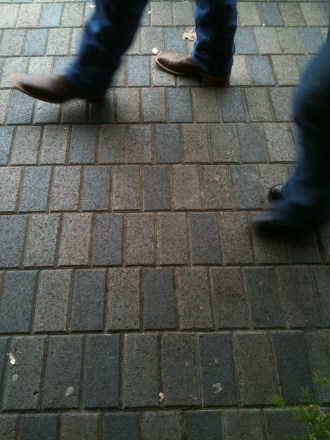
Texas boots on the last shopping day before Christmas (Fredericksburg, Texas, December 24, 2011).

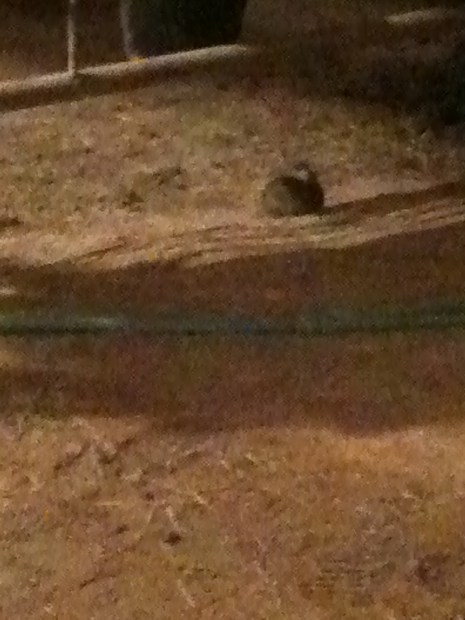
Cottontail rabbit eating spilled grain, December 22, 2011.

I like this pre-Christmas Eve image. I had fed Star before dark and left the light on in the barn and stalls. When I went back down to turn off the lights, I saw this cottontail beneath Star’s feed and hay bin, delicately picking up stray nuggets of Horseman’s Choice 12% feed. I watched the rabbit for five minutes and snapped several shots with my iPhone, the one I include here being the best in low light.  The rabbit probably favors a sweeter fare, like the Purina sweet feed for performance horses.

Heron and squirrel along Baron's Creek in Fredericksburg, Texas, December 24, 2011.

Baron’s Creek runs through Fredericksburg, Texas. I walked along the creek yesterday and today. This afternoon I spotted a heron in the water and framed the heron with the pecan tree on the left of the shot. When I looked at the results, I saw a squirrel in the tree. Do you see the squirrel?  The squirrel had been gathering pecans, the heron waiting for the stray frog or fish.

Tomorrow is Christmas Day.  I hope to have another post about rural and town life in central Texas as well as the flora and fauna.  Be sure to note my attention to juniper on Christmas Day.

8 Comments

Filed under Birds, Christmas, Fredericksburg Texas, Great Blue Heron

Walking with Great Blue Herons

The grove peninsula. This is one of several peninsulas formed by the meandering Salt Creek (December 2011).

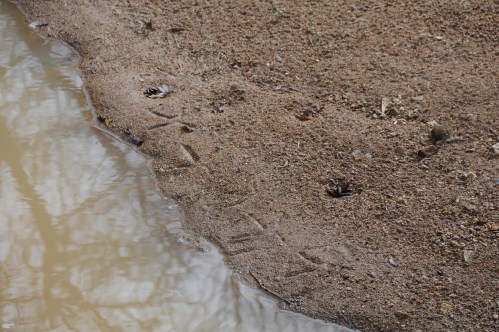
Blue Heron tracks along a still pool of water in Salt Creek (December 2011).

I walked in the grove this morning.  Several peninsulas emerge in the grove, cut by the swift and long-flowing water of Salt Creek.  Upon purchasing Flying Hat Ranchito eight-years ago, I found a red metal chair on the peninsula I photographed, a solitary chair for the previous owner to muse, observe or rest.  I took the chair off the peninsula.

Wet and cold the air, I saw track of the Great Blue Heron that frequents the creek that meanders among the elm, oak and juniper.  I see one or two of them each day flying to the cow tanks about the ranchito.  The heron track I identified with my Peterson’s field guide to animal tracks, a new third edition I purchased when Border’s went out of business in Fort Worth.

I was not alone as I walked in the grove.  The Great Blue Heron — past and present — walked with me in the grove today.

Related articles


7 Comments

Filed under Birds, Great Blue Heron, Juniper, Life in Balance

Saturday morning chores

Path in the Grove, Spring 2011.

It is Saturday morning and chores must be done.

I had rather walk the path in the Grove as photographed above, but duty calls.

To wit:  establish an insecticide ring about the ranch house that is minimal to reduce or eliminate the large wood ants scouting out the kitchen.

Go to Gordon Hardware Store six-miles away and purchase hardware for gates and trellis.

Collect trash along County Road 114.

Fetch Shiner Bock beer from barn refrigerator.  Pour half for me, half-a-bottle for Star, the paint gelding.  I don’t know about me, but Star deserves it having made it through isolation and the smoke from the fires.

16 Comments

Filed under Life in Balance

The fox, the hare and the chef

I think we should leave our boxes of house, classroom and boardroom and integrate with the natural world of fresh air, sun and terrain, if only for a vacation.  Venturing into the field, the park, even a backyard, nature comes upon you with sight, sound and scent that carries you away from asphalt and brick.

It’s not all pleasant, this leaving the box.  With the flower comes the wasp.  The fox is beautiful, but rabbits will die.

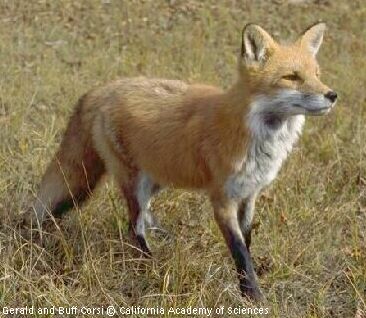
I have seen three wild foxes in my lifetime — that’s all, and I have looked.  In 1956, the first was along Pompey Creek in Mills County, Texas, on the lease of my step-father.  I was sitting on one side of the creek and along the other bank, a fox trotted along the stream, looked once at me and continued on.  I was impressed at its gait that was leisurely, self-assured.  The fox was plump, its coat deep-red and shiny.  I wanted to follow it and see where it went and if it had a mate and kits and where its burrow was.  I wanted to live with the fox and see it again and again and again in the forest and along Pompey Creek.  I never saw it again, although I looked for months and years thereafter for red fur coats in the central Texas brush.

The second time I saw a wild fox was in 2005 when Brenda and I were sitting out on the back porch.  We can look far into the pasture that is twenty-feet below, as we are on a hill above the grasses.  In the late spring evening, a fox came trotting along a pasture road, heading north into the brush of Blue’s farm to the east of us.  This fox’s coat was darker than the one at Pompey Creek, but the same focused gait carried him farther into the brush and away from the cleared field of buffalo grass.  Brenda and I spoke in whispers as it trotted away.  That same year, 2005, fifteen deer moved daily from Blue’s farm, across our pasture and into the grove.

Two years later in 2007, I was standing on the bank of Salt Creek in our oak tree grove when along the dry creek bed the third fox trotted, headed upstream towards the Dooley place on the west side of our ranch.  I was about fifteen feet above the creek bed and stood still as the fox passed by.  That was four years ago and I have seen none since.  A solitary deer occasionally drinks from the pond and I see track that may be fox.

* * *

The fox hunts and in the end, rabbits scream and chickens cluck and run.  The farmer brings the shotgun to the shoulder and fires once, twice, thrice.  The Dooleys to our west have chickens and they pen them for safety, but fox and coyote still take their cut.  The Dooleys count their losses.  I hear no gunfire.  The fox must eat.

It is a cycle of birth and death, the preyed upon and the predator.  You know the story, you’ve even been a part of it.  To describe the cycle is easy, but to understand it and live with it, to go on despite the tooth and claw is very difficult, for we like to deny the cycle happens or we put it away over there, behind the fence, beyond the hedge.  When I taught anthropology, my first lesson and repeated lesson through the semester was “Food — Where is it?  And, how do we get it? Who provides it for you?”  We buy food at the supermarket, but that’s not where it comes from, and it is not wrapped in cellophane when the middleman harvests the animal or plant.

Thomas Keller owns the most famous restaurant in America today, The French Laundry in California.  When he was young and honing his skills at the restaurant of Rene and Paulette Macary, near Catskill, New York,  he approached the purveyor of rabbit:

Thomas Keller

One day, I asked my purveyor to show me how to kill, skin, and eviscerate a rabbit.  I had never done this, and I figured if I was going to cook rabbit, I should know it from its live state through slaughtering, skinning, and butchering, and then the cooking.  The guy showed up with twelve live rabbits.  He hit one over the head with a club, knocked it out, slit its throat, pinned it to a board, skinned it — the whole bit.  Then he left.

I don’t know what else I expected, but there I was out in the grass behind the restaurant, just me and eleven cute little bunnies, all of which were on the menu that week and had to find their way into the braising pan.  I clutched the first rabbit.  I had a hard time killing it.  It screamed.  Rabbits scream and this one screamed loudly.  Then it broke its leg trying to get away.  It was terrible.

The next ten rabbits didn’t scream and I was quick with the kill, but that first screaming rabbit not only gave me a lesson in butchering, it also taught me about waste.  Because killing those rabbits had been such an awful experience, I would not squander them.  I would use all my powers as a chef to ensure that those rabbits were beautiful.  It’s very easy to go to a grocery store and buy meat, then accidentally overcook it and throw it away.  A cook sauteing a rabbit loin, working the line on a Saturday night, a million pans going, plates going out the door, who took that loin a little too far, doesn’t hesitate, just dumps it in the garbage and fires another.  Would that cook, I wonder, have his attention stray from that loin had he killed the rabbit himself?  No.  Should a cook squander anything, ever?

It was a simple lesson.

— Thomas Keller, The French Laundry Cookbook, New York: Artisan, 1999, p. 205, “The Importance of Rabbits.”

In too many of my hunts when young I squandered wildlife.  I still pay for that everyday.  I don’t hunt anymore, but I would if I had to.  My last hunt was deer and that was many years ago when I went with two of my closest friends to Van Horn, Texas.  I dressed my kill in the field and brought the deer back for my family.  I did not need to hunt for I garnered a paycheck every month and bought groceries at the supermarket.  I never hunted after Van Horn.  We ate what I shot.

In 2008, Brenda and I brought to market twenty-seven head of Angus stocker cattle after feeding them several months on our native grass pastures.  I made sure that when I transported them to the feed yard that they went to the cleanest and healthiest feed yard in Texas.  They did go to Perryton, Texas, a place of little stress and fine management with no HotShots (paddles to strike the calf) and plenty of room to move and breathe.

As I loaded the twenty-seven Angus into the stock trailer, I said under my breath and to no one in particular:  You go now!  You fatten yourselves!  I’ve done the best by you I could!  You better go to the table of someone that finds a cure for cancer for I will think of you the rest of my years!

I made no profit on the cattle, but I prepared them the best I could.  I did not squander resources in tending them as their steward.

And they were beautiful, like the fox, for some of them had a red hue about their coats as the sun went down.

______________________________

Notes:

One of my first blogs was called, “The 27th Heart,” named after Unit 27 Angus stocker calf that fell sick.  I tended him and took him to the vet.  He recovered.

I cook from Keller’s cookbook and always remember that story he wrote.  It is deep and connected with the American Indian.  Parallels can be drawn.

The italics in the quote of Keller’s are mine.


28 Comments

Filed under Life in Balance