Tag Archives: Naturalism

Spring Flowers in Texas

Stork's Bill (Erodium texanum) April 2010

Here is Stork’s Bill or Pine Needle (Erodium texanum) found here on Flying Hat.  It is an annual herb, member of the Geranium family, most of which are found in Europe and South Africa [C. and L. Loughmiller, Texas Wildflowers: A Field Guide, p. 104; H. Irwin and M. Wills, Roadside Flowers of Texas, pp. 140-41.]

Scarlet Paintbrush or Indian Paintbrush (Castilleja indivisa) April 2010

These Indian Paintbrushes are uncommon on Flying Hat.  I found most of these in the Pecan Tree Pasture and not many of them.  The Blue Place, the family to the east of us, has a field that is quite loaded with the paintbrushes.  I have a photograph of the Blue field and will post it in the future.
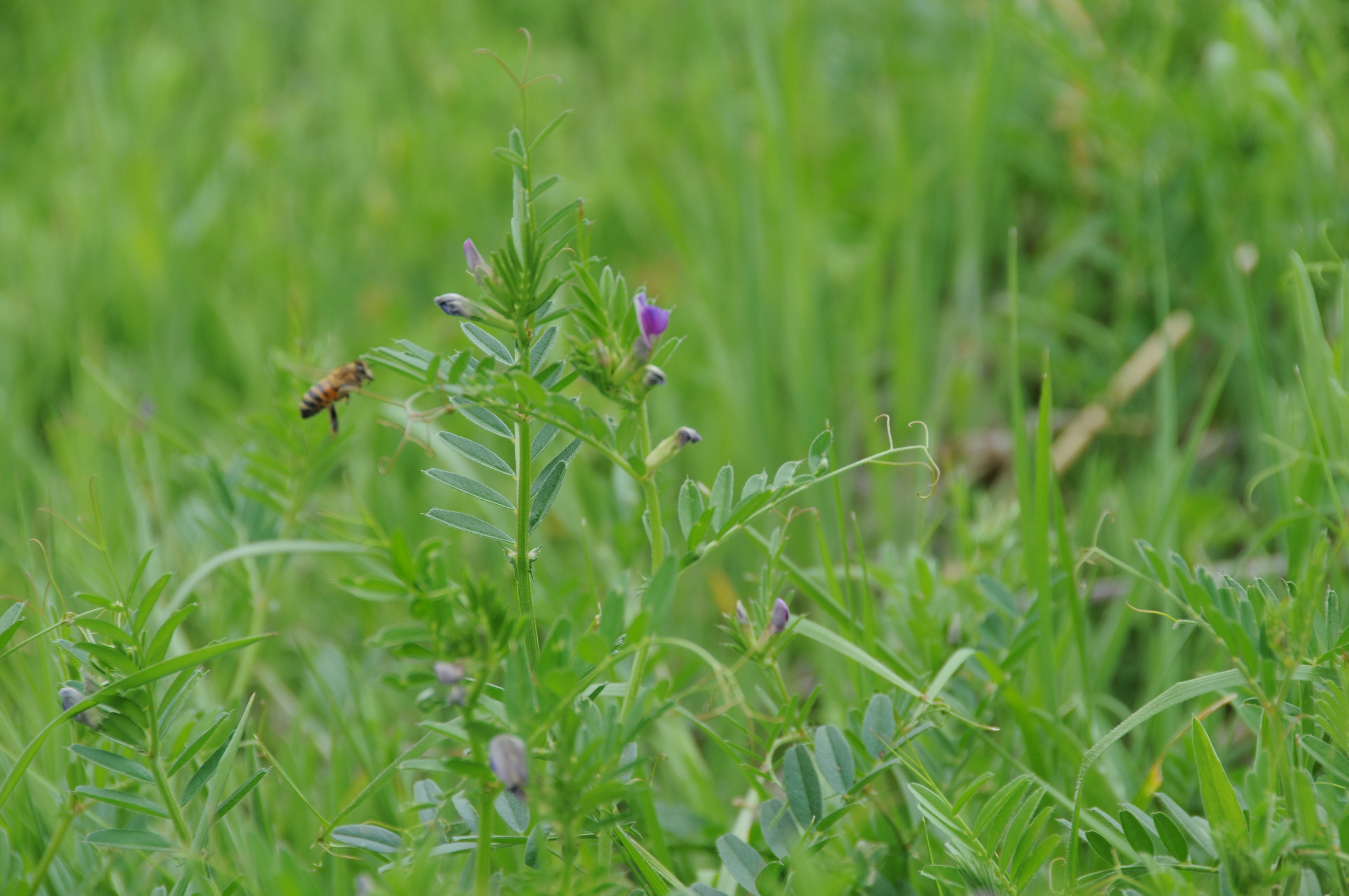
Purple Vetch (Vicia dasycarpa) with Bee April 2010

This vetch, Purple Vetch (Vicia dasycarpa), is not the poisonous variety. Notice the bee that is pollen-gathering.  The spring rains have been so abundant that the vetch is knee-high in my fields and the Blue Place, to the east of us, has vetch that is chest-high as it climbs on the field fence.  As I say, this is not the poisonous variety and the bees love to gather pollen from it.
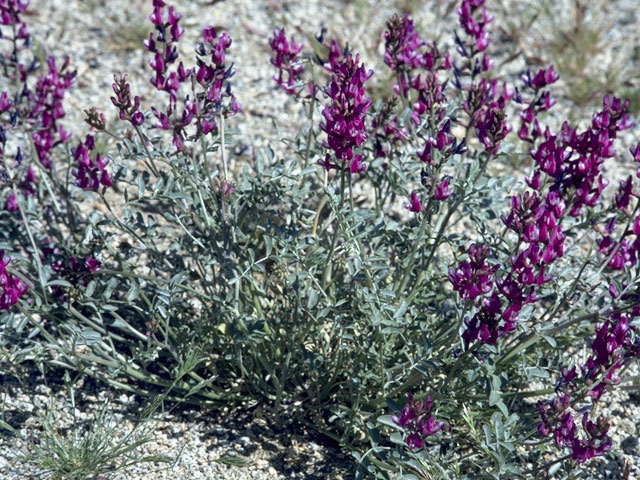
Wooly Milkvetch (Astragalus mollissimus), Wooly Locoweed (NPIN Image Gallery, Lady Bird Johnson Center)

This is a photograph of the poisonous variety of vetch that we do not have on the ranch.   From Irwin and Wills, Roadside Flowers of Texas, p. 138:  “Of the nearly 1000 species of Astragalus, over 200 occur in the United States, about 35 of them in Texas.  The members of the genus that are poisonous to livestock are called Locoweeds, while the harmless ones are known as Milk-vetches.  In the former category is the Woolly Loco of the Panhandle and Trans-Pecos area, a tufted, soft-hairy, deeply rooted perennial with dense racemes of purplish flowers in the late spring.  Quite innocuous looking to the eye, the Woolly Loco is among the ‘early risers’ in the spring, and so tempts cattle, even though its taste is so disagreeable that they normally avoid it.  Later, in periods of drought when grasses succumb, the persistent Woolly Loco remains, seemingly unaffected.  Nor are browsing animals the only ones concerned.  The nectar contains poisonous substances, sometimes causing decimation of bee populations.”

In talking with Roland Stroebel today, my colleague at the college who tends Angus cattle, our non-poisonous Purple Vetch is abundant on his place also, but does not cause a problem for his browsing livestock.  Roland’s ranch is south of Cisco, Texas, and his family goes back several generations.

2 Comments

Filed under Plants and Shrubs

Field Log 4/16/2010

North Erath County, Texas, 32.43 lat., -98.36 long. Elev. 1,086 ft.  Turkey Creek Quad.

Light mist this morning.  Probably 0.20 inch of rain since yesterday.

Lilly, Star and Fanny browse front pasture.  Lilly shows age with slower gait and right back leg limp.  Sweet Hija still at ESMS on Brazos.  Shiney is at Jimmie Hardin’s in Aubrey, Texas, for ground training and conditioning for Triangle Sale, Shawnee, Oklahoma, June 5, 2010.  Miss the little guy more than I thought I would.

Pasture grasses are erupting well.  Vetch in far field is waist-high in places.

This week, Mourning Doves (Zenaidura macroura) are cooing.  No calls before then, but noticed their presence.  This morning the doves were ground feeding in the front yard.  From Peterson: has a pointed tail, most widespread dove in the West.  As to the call, Peterson says it is a “hollow mournful ooah, cooo, cooo, coo. At a distance only the three coo‘s are audible.”  The color of the dove in our front yard was a reddish-gray with black spots.  The two dove would ground feed a moment, then hunker down in the grass and loaf.  I must have watched them for ten minutes and then had to come back to office and work on college Blackboard classes.  I will have to focus on their call to hear the 00ah.  I am practicing on imitating their call better.

We have a larger dove that is whitish that appears in late summer.  It is untyped.  The two dove will perch on the power pole by the barn and watch me feed the horses.

The following are some photographs I took this morning.

Vetch and Clouds Far Field, April 2010

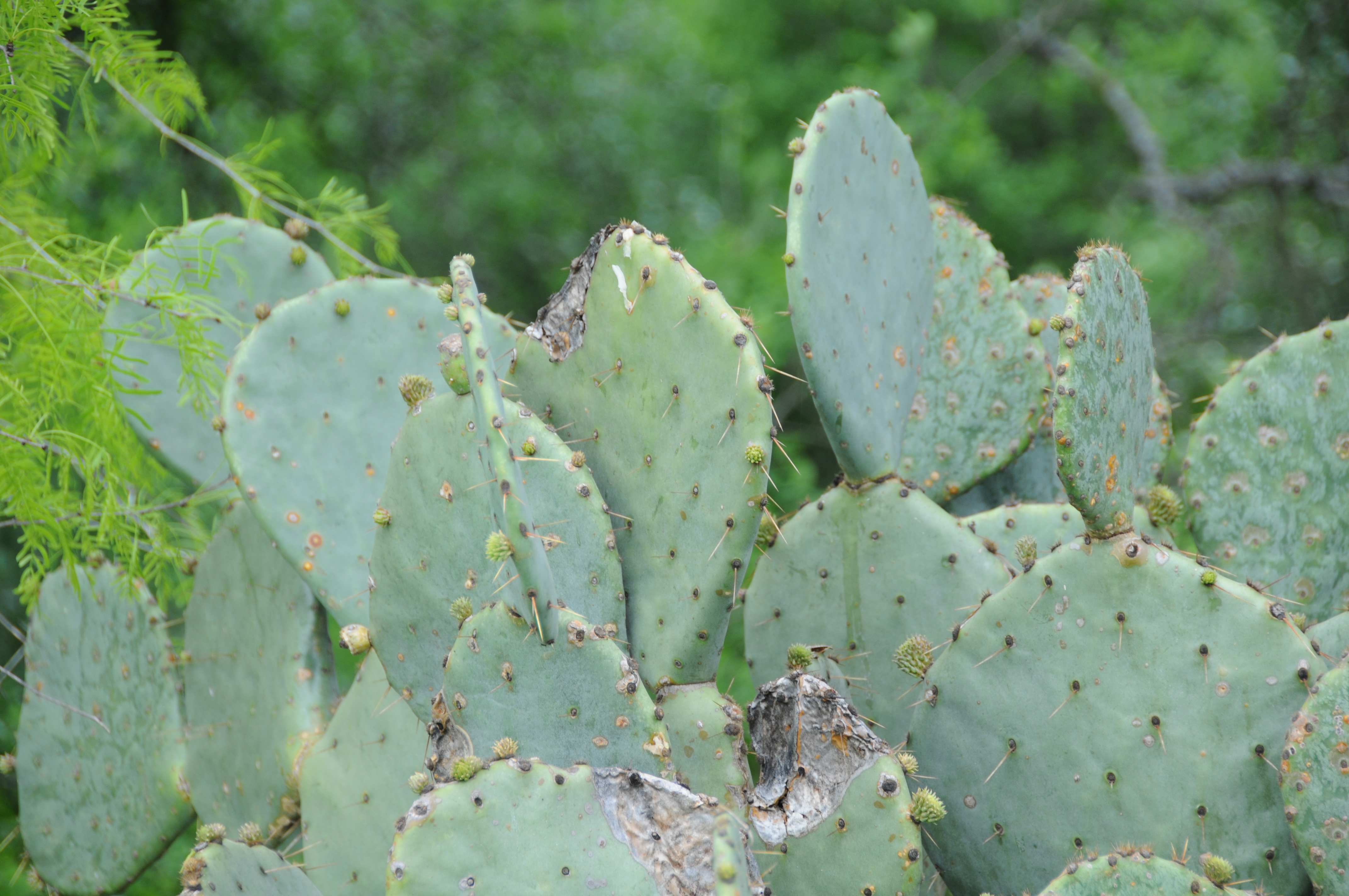
Prickly Pear Bush, April 2010

Cactus Fruit, April 2010

These photographs were taken last week.

Round Pen and Twin Mountains in Distance, April 2010

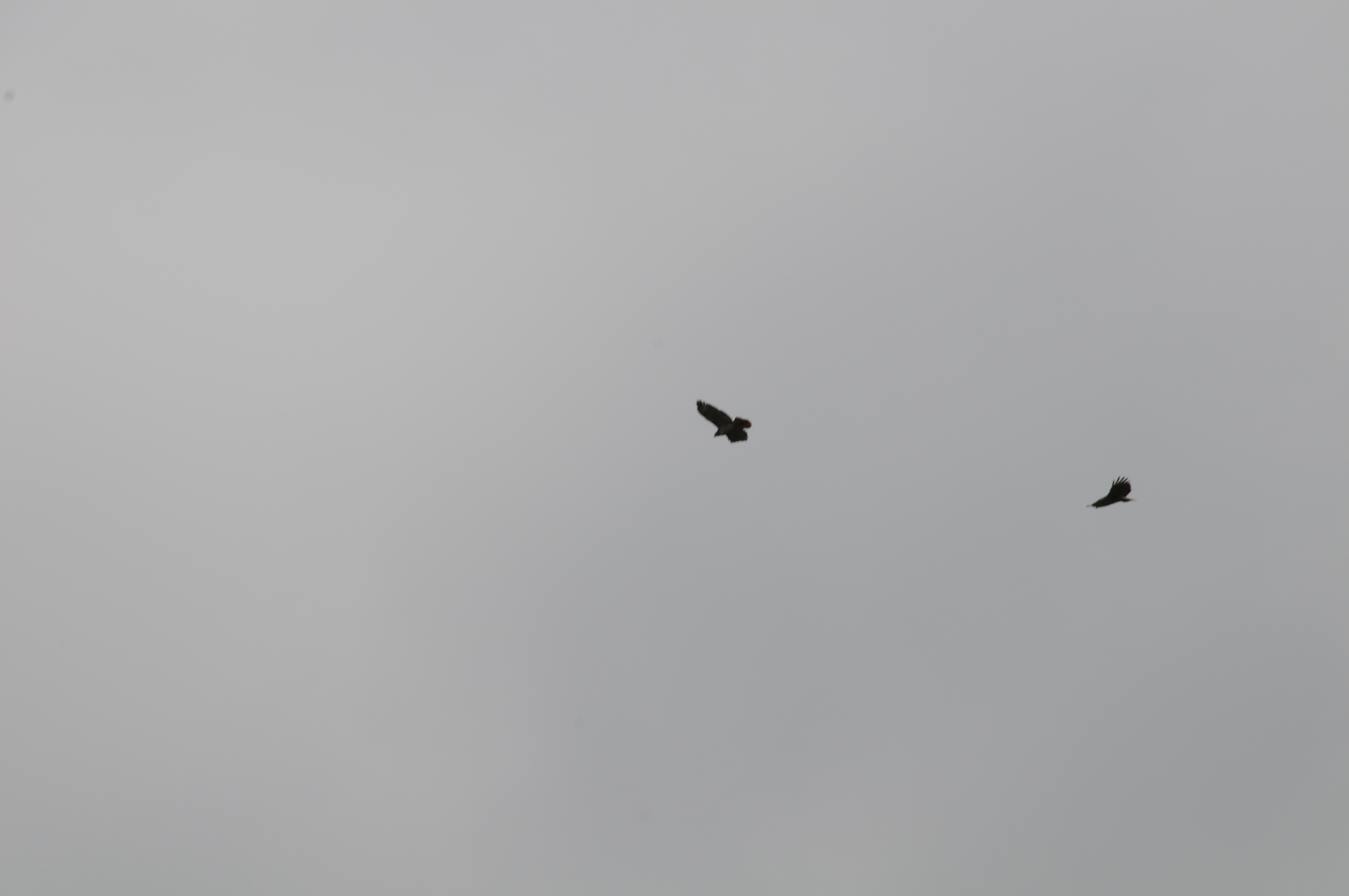
Harris' Hawks at Play, April 2010

Field grasses obscure pasture lanes.  Minimum shredding planned this year, indicative of lower carbon footprint.  In addition, taller grasses can harbor wildlife.  Hand cut mesquite brush this season, using clippers and large cutters.  Lessen vehicle use in pastures.

Lilly, Star and Fanny have browsed their way to the front pasture and are now standing close together, switching their tails to keep the flies away.  They have all this space to lounge around in and they prefer to stand together with their bodies almost touching.  Herd animals.  I worry about Lilly during the night and have corralled her so she can avoid predators.  One mountain lion sighting three months ago on SH 108 near Gibson place.

I must get the duct tape down in the barn and duct tape my Peterson’s Field Guide.  The binding is coming off.

10 Comments

Filed under Field Log

Canelo, Arizona, Natural Color Palette

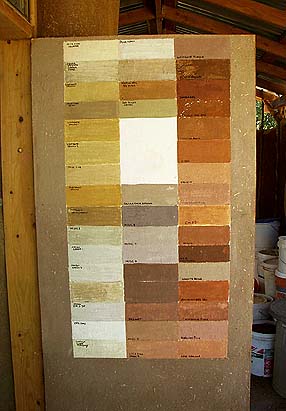
Color Palette of Bill and Athena Steen, Canelo, Arizona (courtesy Caralee Woods)

This is a color palette on the door of a storage shed of clay samples owned by Bill and Athena Steen, Canelo, Arizona.   The Steens are teachers of building straw bale homes.  In addition, they work with clay and lime native to the Southwest in their building projects.  Their goal is to connect culture, people and nature.

“The Canelo Project is a small non-profit organization founded in 1989. We are dedicated to the exploration and development of living systems, including growing food and building that creates friendship, beauty and simplicity.

We are known primarily for our work in Strawbale and other Natural Building techniques.” — Bill and Athena Steen, Canelo Project.

Conelo Project Logo

This is the beautiful logo of the Canelo Project, illustrative, I think, of their mission and purpose.

For more information, please click on the website, The Conelo Project, and Bill Steen’s blog,  The Canelo Chronicles.

Thanks to Caralee Woods for this information.

Leave a comment

Filed under Natural Colors

The Natural Colors of Caralee Woods

Caralee Woods and Jimmy Henley live near Kanab, Utah.  They are building a straw bale compound on their place and have committed themselves to a minimum footprint on the land.  With solar panel, water well and environmentally-green construction, Caralee and Jimmy portray the best application of technology, science and ethics to minimize humanity’s impact on the planet.  They are truly off the grid — literally.  You can see their efforts over the past few years by clicking on their website Building a Straw Bale House. When I posted the piece from Bioephemera Blog this morning concerning the ca. 1686, natural colors, Caralee commented with the email below and provided a photograph of how she and Jimmy artfully and craftily shaped balls of colors from the Utah countryside as a result of finding natural clays for their plastering.  I think what she and Jimmy have created is not only an application for their home, but pieces of art that I wish to possess and place as a centerpiece upon my table.

“This is so interesting to me. One of the first things we did here is start looking for natural clay. We had plenty of the terra-cotta colored stuff here on the land for the earthen plaster, but what about the clay paint and finishing plaster for the interior? We drove around for a long time with a bucket and small shovel in the trunk so we could stop and take samples of the wonderful variety of Mother Earth’s colors when we saw something we liked. I would go home, sieve the clay, mix it with some water, and make clay balls that I then polished (I won’t bother you with this process here) to see what we had. The picture below is just a small sampling of the results; I’ve added many since.  There are no more beautiful, soothing colors anywhere in the world than what is produced naturally.”  –Caralee Woods to Jack Matthews, March 24, 2010.

Art of Caralee Woods, Natural Clay Balls, Utah

6 Comments

Filed under Life in Balance, Natural Colors

A Naturalist’s Color Palette, ca. 1686


From Richard Waller, "A Catalogue of Simple and Mixt Colours with a Specimen of Each Colour Prefixt Its Properties" Philosophical Transactions of the Royal Society of London, vol. 6, 1686/1687 (London, 1688)

Click to enlarge the color palette

“Noting the lack of a standard for colors in natural philosophy, and inspired by a similar table published in Stockholm, Richard Waller indicated that his “Table of Physiological Colors Both Mixt and Simple” would permit unambiguous descriptions of the colors of natural bodies. To describe a plant, for example, one could compare it to the chart and use the names found there to identify the colors of the bark, wood, leaves, etc. Similar applications of the information collected in the chart might also extend to the arts and trades, he suggested.”  –Jessica Palmer, Bioephemera Blog.

Click the link below to bring up Jessica Palmer, Bioephemera Blog.

A naturalist’s color palette, circa 1686 : bioephemera.

Read more about Waller’s color system in The Creation of Color in Eighteenth-Century Europe by Sarah Lowengard.

6 Comments

Filed under Plants and Shrubs