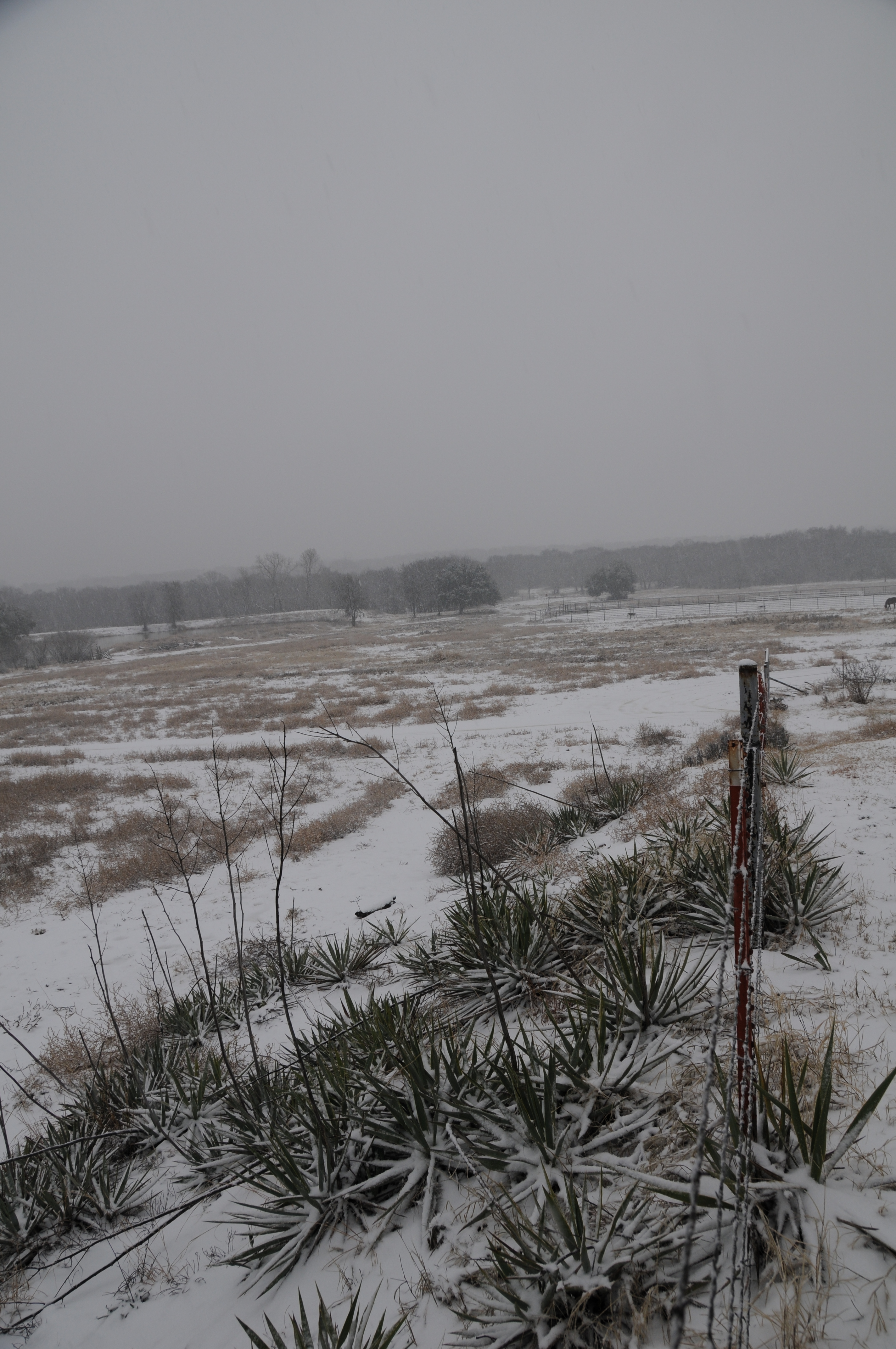
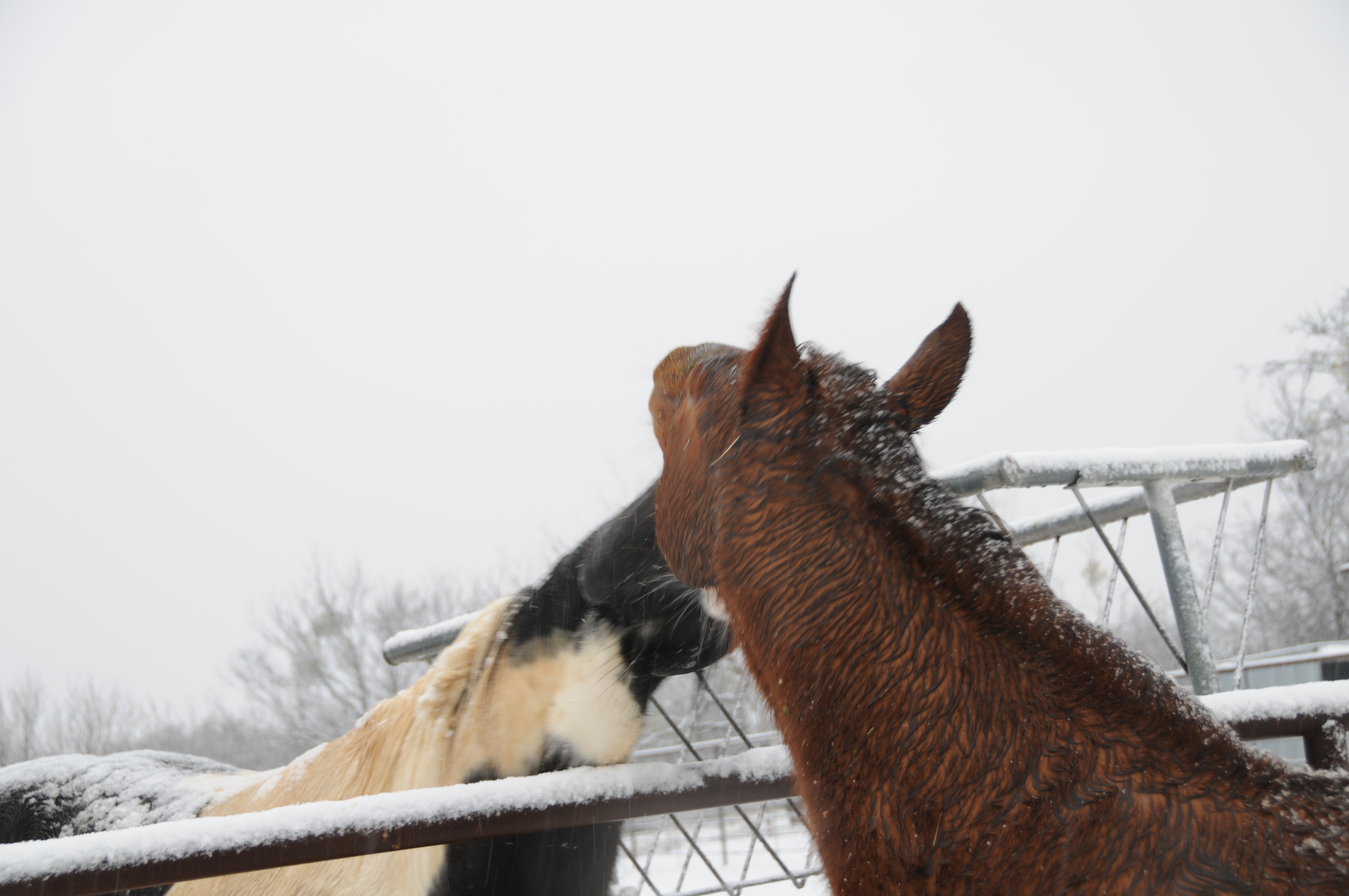
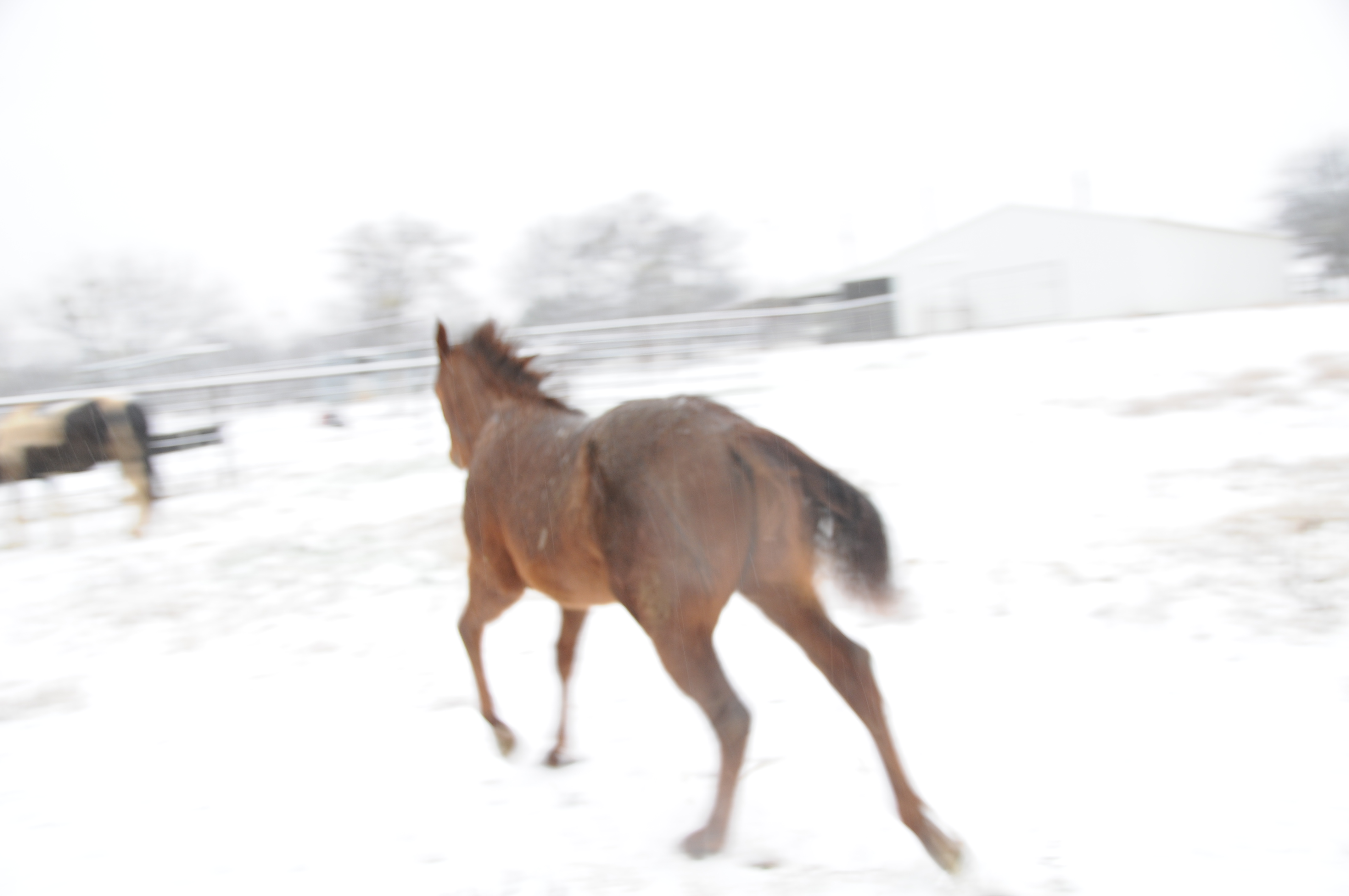
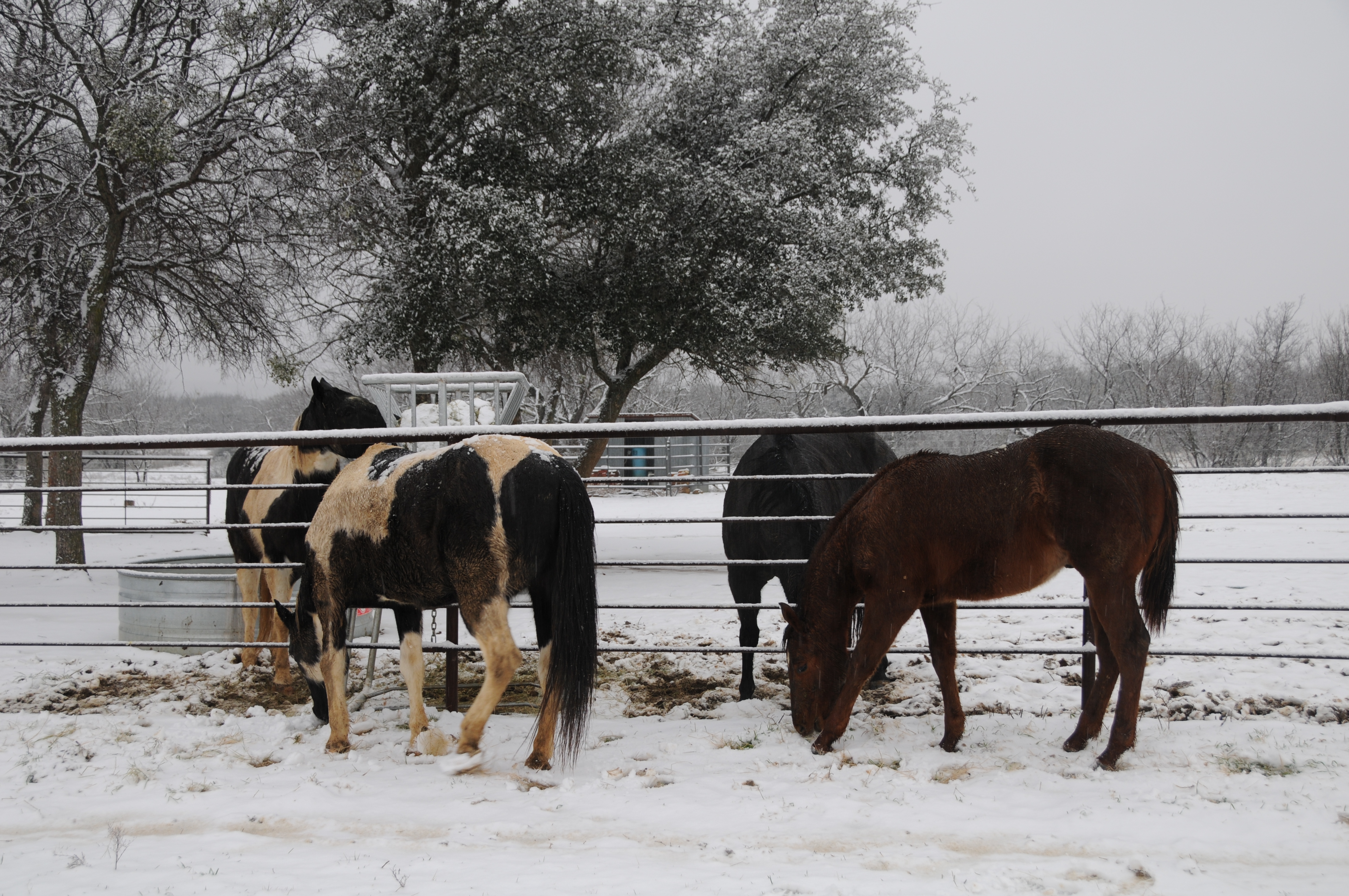
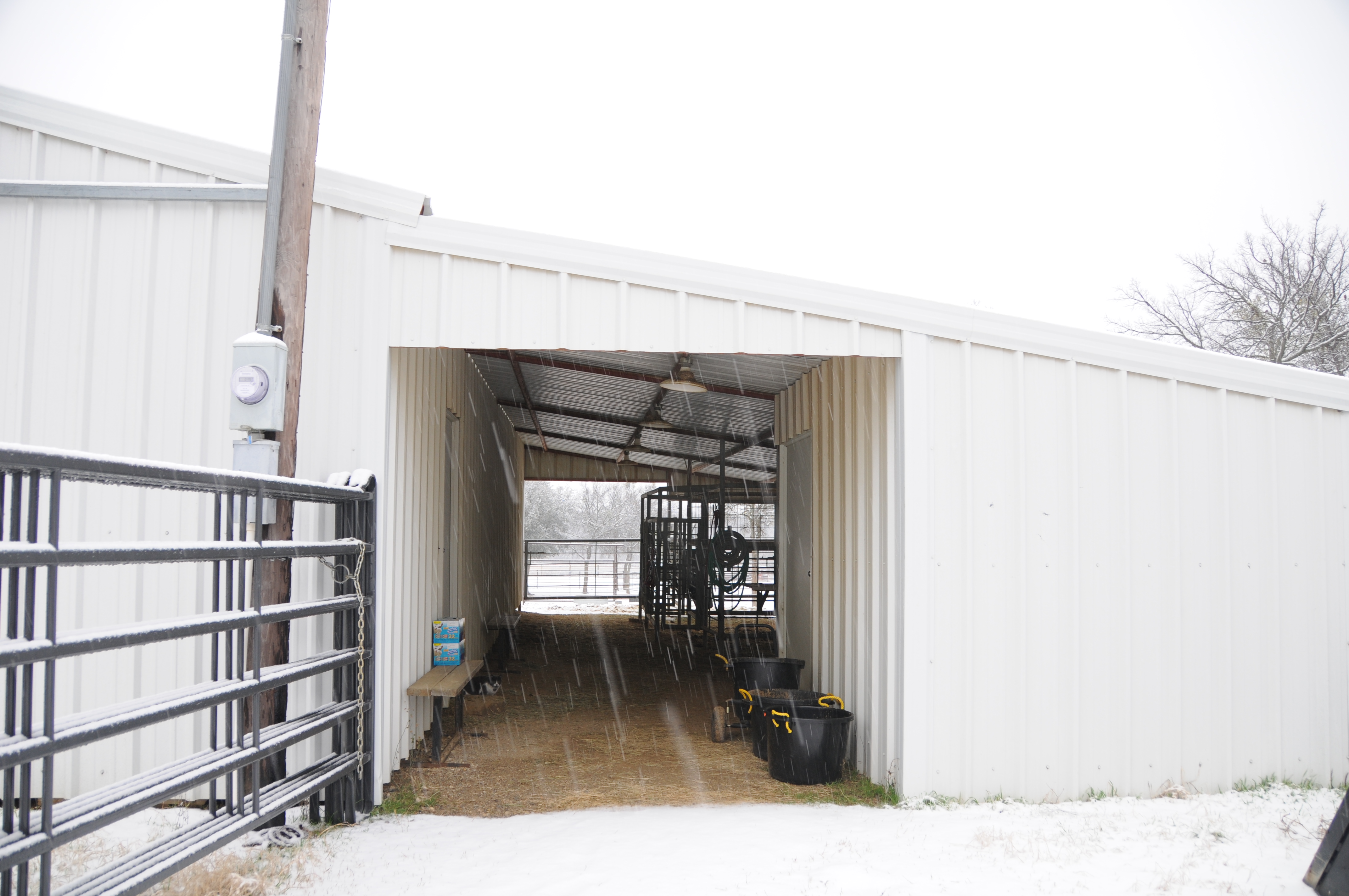
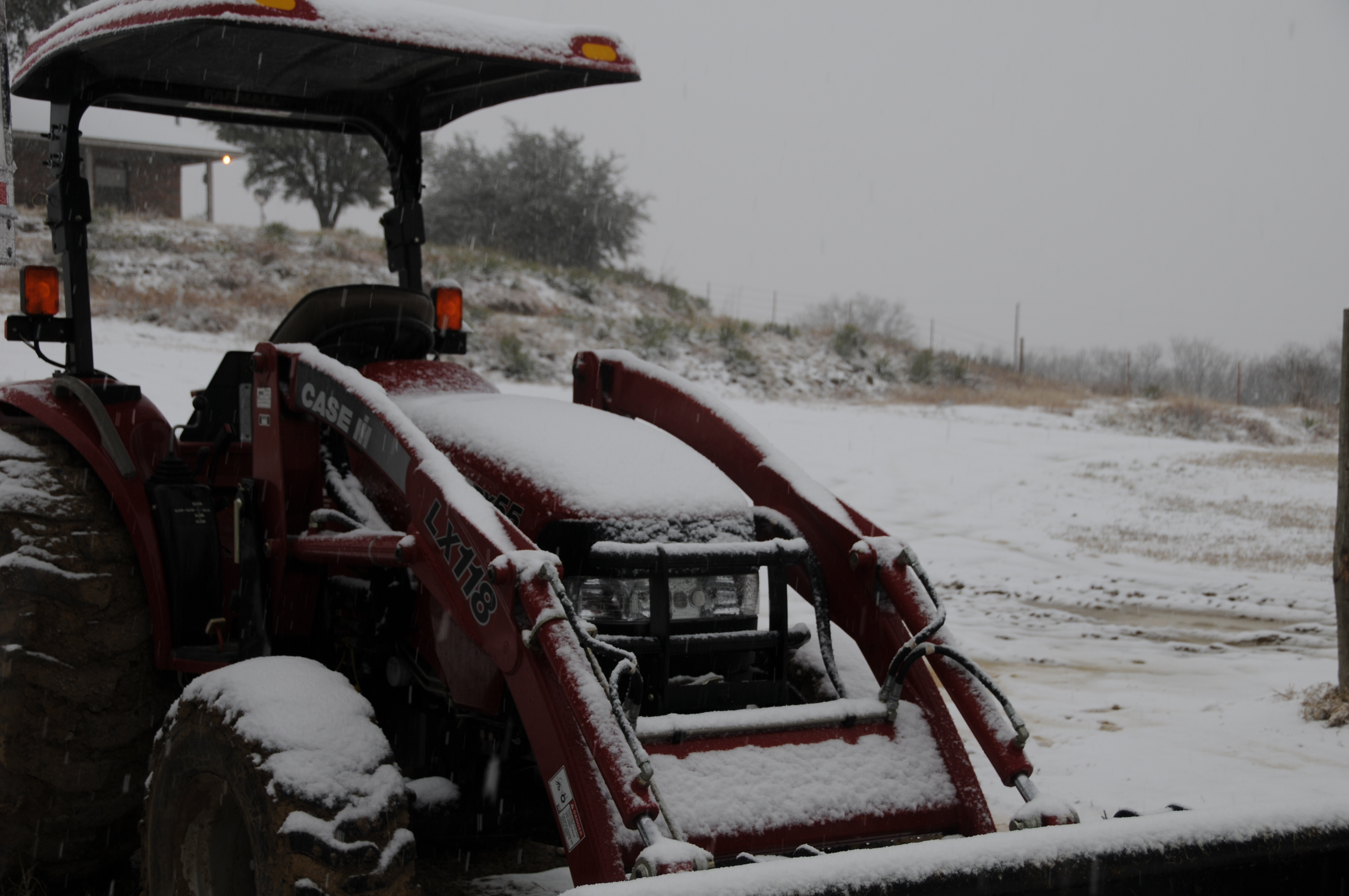
Schools in Abilene and Fort Worth, Texas, were canceled this morning. I went out to take some photographs of Flying Hat. If you click the photographs, you get a full-size picture with detail.
A seven-month-old filly named Bald-Face Lie was found dead last Sunday, shot between the eyes at close-range. A horse trainer and ranch hand to the 72 Ranch near Weatherford, Texas, found Bald-Face Lie near the fence where as a friendly horse she would loaf with several other fillies. The high sheriff of Parker County, Larry Fowler, said We are going to find out who did this. We are just numb, grieved the owner, Kris Larsen. I was with the mare when this baby was born and I weaned her and halter-broke her. The reward for the killer is now close to $10,000 and he should have the good sense to turn himself in before he is found out. Bulldozers gouge the earth intemperately and sometimes to a higher purpose.
I know the 72 Ranch where Bald-Face Lie resided. Several miles north of the 72 Ranch, Duncan Steele-Park trains horses, including our horse, Fanny. Cattle drives from south Texas in the nineteenth century passed through Parker County on the trail to Dodge City, Abilene, even to greener pastures in the high mountains of New Mexico, Colorado, Wyoming.
72 Ranch mourns. The trainer slips halters on fillies and colts today and he will tomorrow and the next. The horror of Bald-Face Lie’s death settles respectfully beneath the pain of a world that is out of balance for human and horse alike. We will shrug and go on to the next watering hole that used to be called an oasis.
Newspaper article link: Community Offers Reward, February 1, 2010.
Newspaper article link: Prized Filly Valued at $20,000.00, January 26, 2010.
Newspaper article link: Cutting Horse Found Slain in Parker County Pasture, January 25, 2010.
Filed under Horses
Tagged as 72 Ranch, Bald-Face Lie, Flying Hat Ranch, North Texas Humane Society, Parker County, Sheriff Larry Fowler, Weatherford Texas
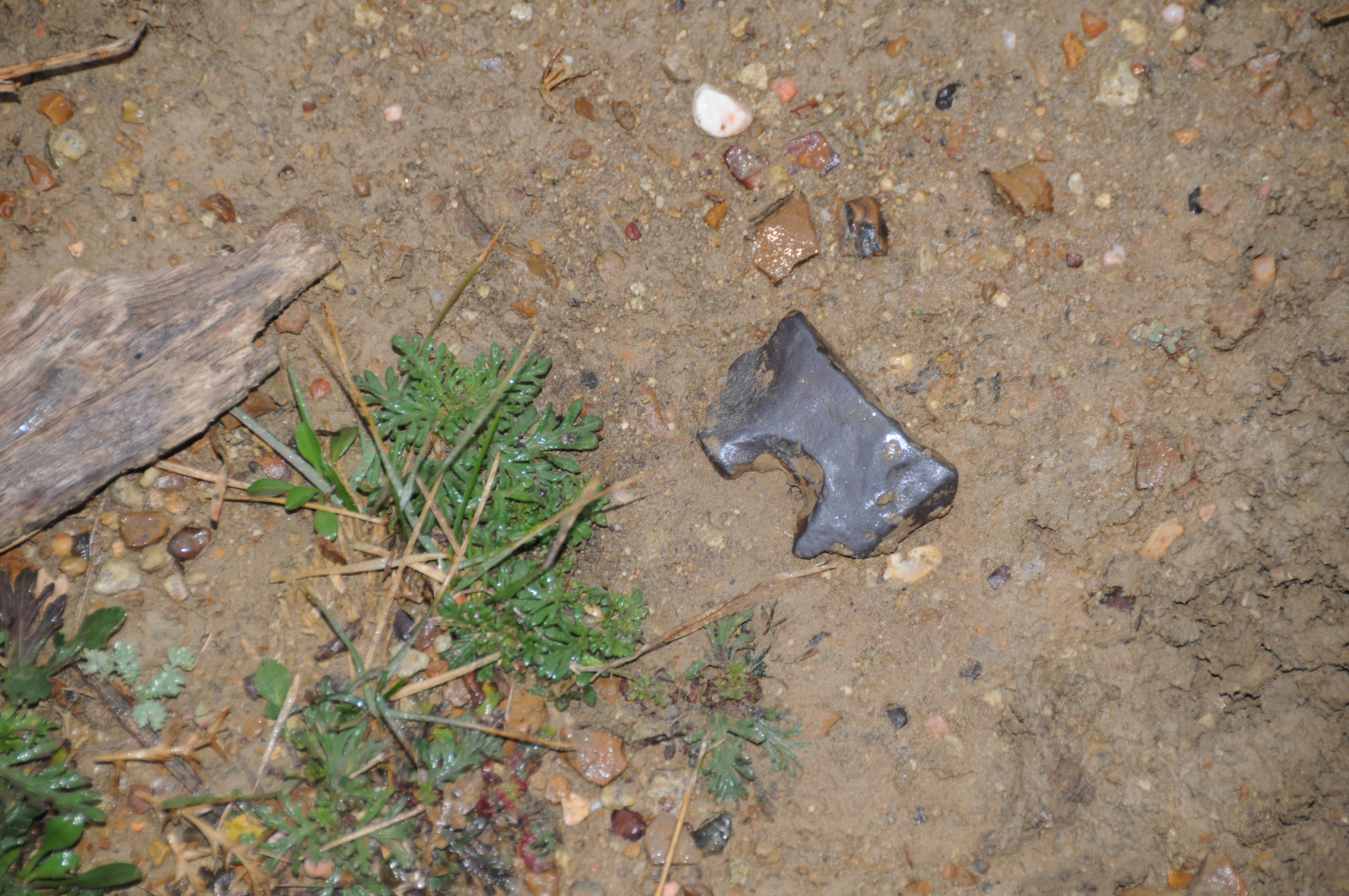
Temperature was 37 degrees at 6:30 a.m….Light rain was forecast and has started raining at 8:00 a.m….Rain exposes prehistoric tools, rocks, horseshoes, wood debris and boulders in the pastures….When I first moved here, I looked for quartzite flakes and tools of prehistoric people that harvested acorns, edible plants and deer. Finding no quartzite, I changed my pattern of survey and looked for iron ore and meteorite tools that had been abraded, not extensively flaked. I found things. Poprock Hill pasture has yielded tools in abundance and will be designated an archeological site by the state of Texas. This morning, after the first feed of the horses, I took a photograph of a tool in situ. Light rain washed clay off the tool, exposing craft and art of people that hunted and gathered before the arrival of the European. Not far away from the tool, a red ant hill with little stones about the portal to the underworld rose slightly from verbena plants that will bloom in the spring.
Filed under Flying Hat Ranch
Tagged as Flying Hat Ranch, Foggy Weather, Iron Ore Tools, Native Plants, Prehistoric Tools
Enter your password to view comments.
Filed under Uncategorized
Tagged as Abilene Texas, Flying Hat Ranch, Quarter Horses, Shiners Fannin Pepto, TCU Press
Yesterday, January 17, 2010, the temperature was 70 degrees in central-west Texas. A light breeze came from the south persisting into the early evening. Down in the uncovered stables winter grass emerged about two inches high during the day. Although winter wheat and rye give green to fields in a Texas winter, the winter grass in the stable seemed different, like a surprise gift from a friend. Lilly the alpha mare saw the grass and grazed after eating her senior grain with supplements to ease her arthritis. Forget April for the moment. January is the cruelest month.
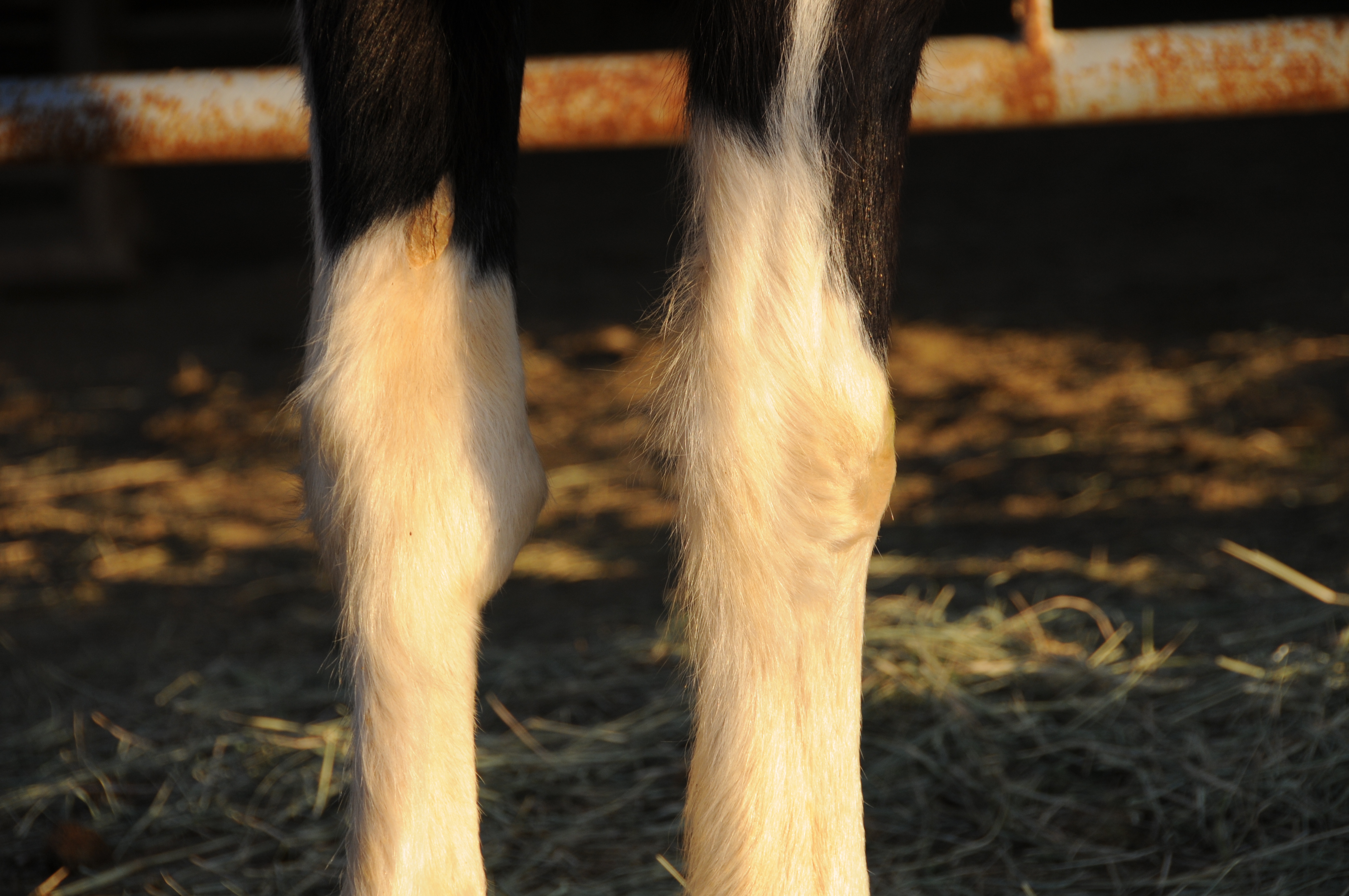
This is the backside of Lilly’s knees and forearms and you can see her osteoarthritis. She is twenty-five-years old. Her date of birth is January 20, 1985. Her full name is Ima Lil Moore and she is the companion and foal sitter to Shiney. Despite her age, when it snows Lilly prances.
Shiney is a six-months-old colt. He is a male, all-boy and quite different from a filly. Lilly, his sitter and companion, will turn her backside to him and threaten a kick if he acts rambunctious towards her. Oddly enough, pairing the oldest horse in the remuda with the youngest, Lilly and Shiney, has kept her young and made him old.
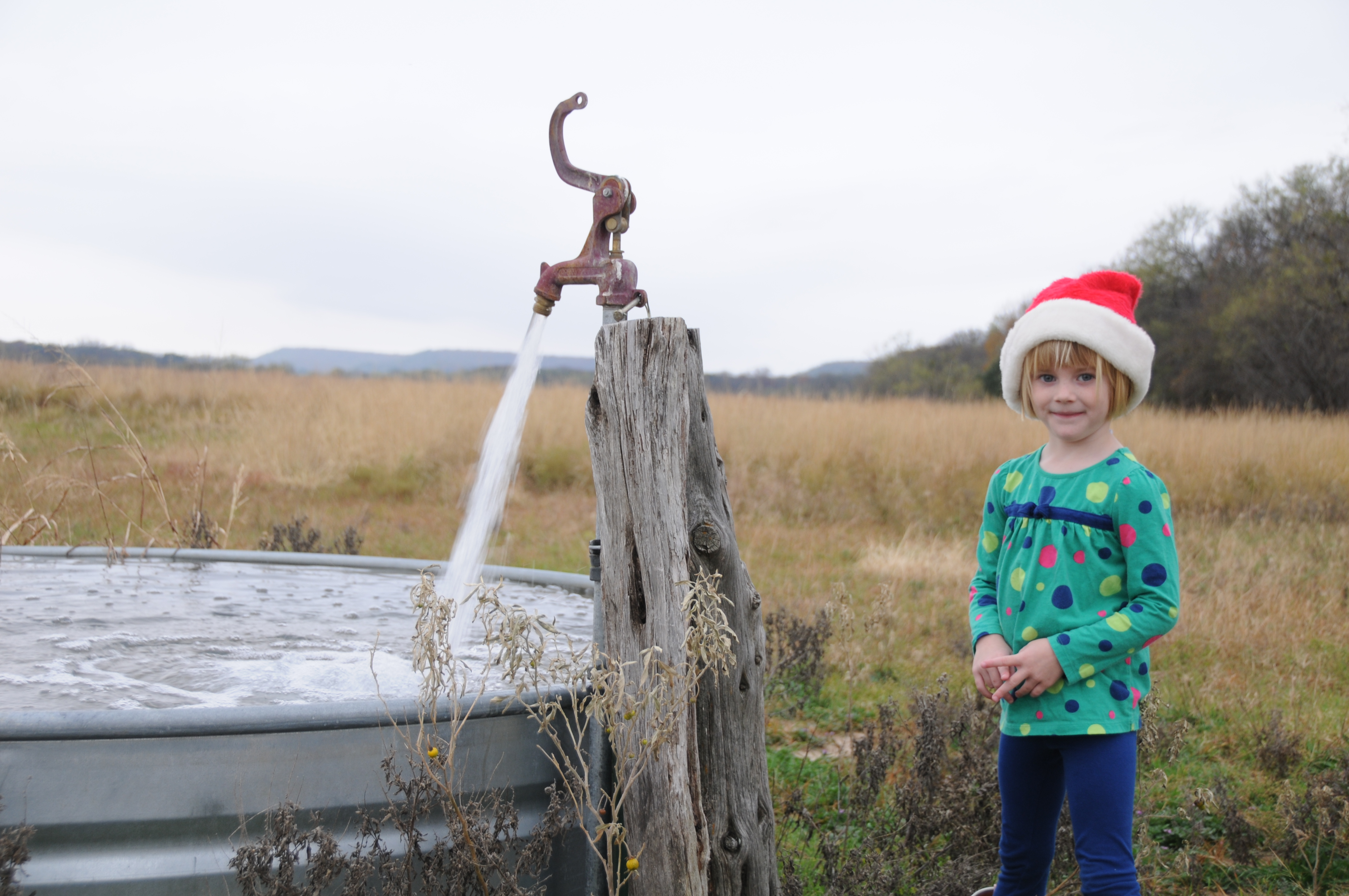
In preparation for Christmas and the New Year, stock tanks must be filled to the brim for horses, cattle, and deer. Olivia Gywn Needham poses while filling the Pecan Tree Pasture water trough. On this day in late November, she incessantly asked, “What are we going to do next, Grandpere?” I ran out of chores before she ran out of energy. Chores are play at this time in her life. Being with Olivia makes chores enjoyable, festive, and less burdensome. I have seen, as you have, fathers and mothers, grandfathers and grandmothers, bring the child into the tasks of the day that must be completed before the dark. Integrating the child with what we have to do gives them a sense of belonging and purpose to the day, and, I think, it gives us a sense of renewal that the world just might continue to endure with a piece of us after we depart.
This young woman is Jennifer Connell, my daughter-in-law, and she is engaging Star, Sweet Hija, and Fanny (looking over Hija’s withers). Jennifer is in her second year of law school at Texas Wesleyan University. Recently married to my step-son, she also works at Wesleyan to help defray expenses. As we were walking back to the ranch house, she said that she wants horses again in her life, as she had been around them growing up in north Texas. The New Year for Jennifer will be difficult, attending school, settling into her marriage, and working. But, beneath the stress and grind, she prevails into the year, performing in class and rewriting her notes for clarity. The New Year for her and Michael, her husband, will bring accomplishment of goals that will set their path for the future. Star, the paint, when Jennifer visits, will lower her blood pressure and give companionship that only a horse can do. “There’s something about the outside of a horse, that is good for the inside of a woman.” And, a man.
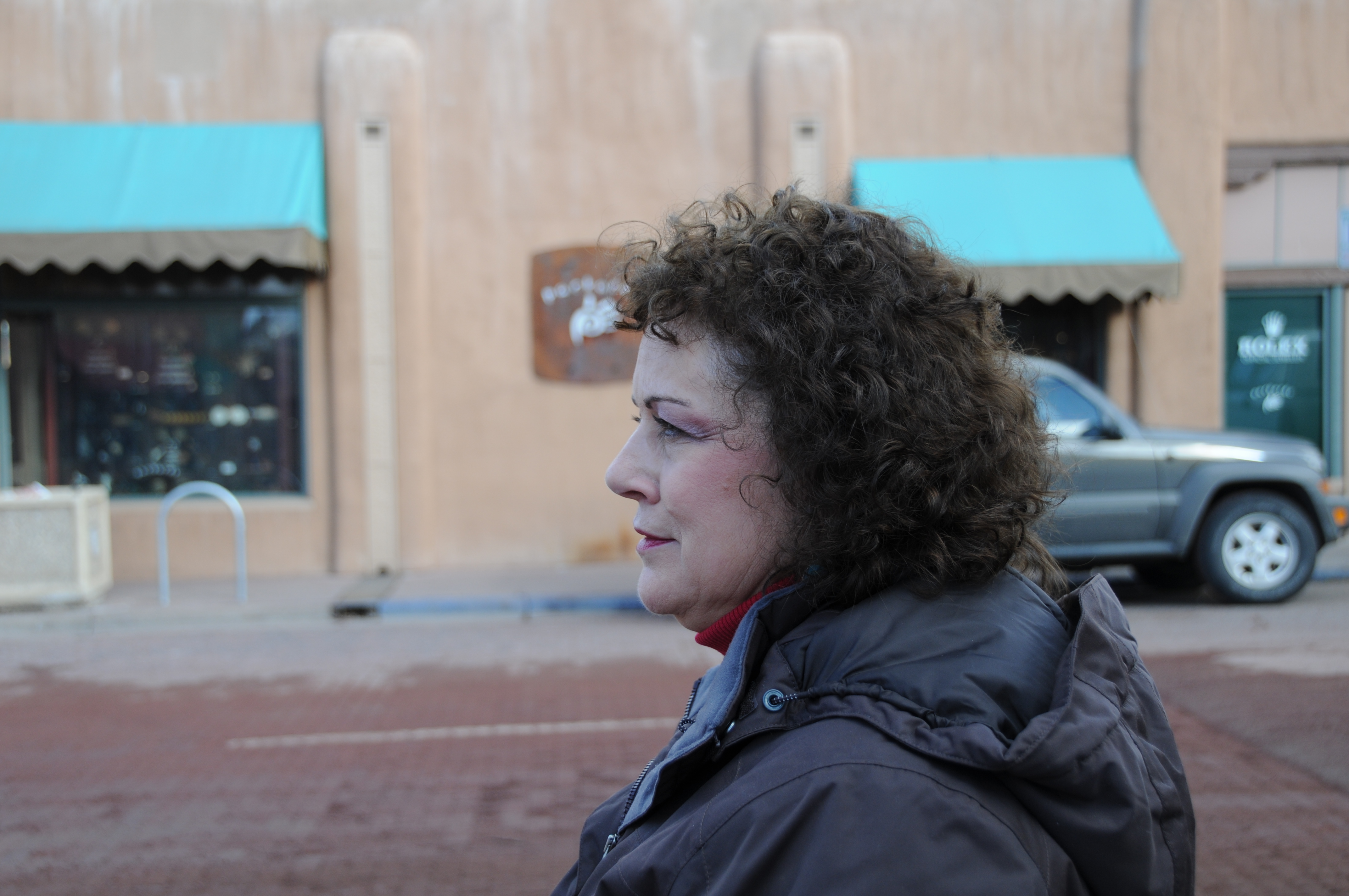
This is Brenda, my wife. While in Santa Fe she noticed that several shops had closed and that inventory stock was down at several businesses. Our stay in Santa Fe this year was a rest from teaching and tending our ranchito (anything less than 2,560 acres is not a ranch, see John Wesley Powell). The New Year for Brenda will be, like mine, sacred and profane, toil and rest, sky-high and ocean-low. Like Olivia and Jennifer, in the photos above, we will endure and with some deliberation, maybe we can occasionally play through our days and nights, finding a self-loss in the rhythm of nature’s beauty out here in the West.
To my friends, to my fellow bloggers, to my family, to my dogs and cats and horses, trees and grasses, and the wildlife of the American Southwest:
Happy New Year!
Filed under Horses
Tagged as Flying Hat Ranch, Inn at Loretto, La Fonda, New Mexico, Quarter Horses, Santa Fe, Shiners Fannin Peppy, Texas Wesleyan University
This morning at almost 7:30 o’clock, I heard a sharp, loud crack, towards the south pasture. I thought an oak tree in the grove had split its trunk.
It was not the splitting of a large oak tree, but the sharp, hard retort of a deer rifle. To the southeast is the Hall place, to the due south is the Bryant place, and west is the Dooley land. I could not determine the precise location of the wood-not-splitting crack.
Since moving here in 2003, I have seen the deer population go down significantly. The Halls to the southeast have cleared their ten acres and, thus, removed the brush for deer. The Dooleys have a deer stand within fifty yards of my Well House Corral. The Bryants have had as many as four or five deer stands to the south of the native-grass pasture. The harvest of deer has been devastating. I now see two deer occasionally, where six years ago, I saw a herd of twelve to fifteen regularly.
After the rifle report this morning, I put on my red jacket, fed the horses, and then walked over our fifty-three acres to see the killing fields around us. Deer tracks in our creek indicated two, maybe three deer, had passed. I walked the creek bed, then over to the pasture of gramma, Johnson, and blue-stem grasses. I saw no hunters, but a half a mile away a white pickup was tucked up against a grove on the Fulfer place. That was the place of the Wood Not Splitting.
The hunter’s white pickup was new, neither rusted nor bleached by the sun. The chrome shined. Was it necessary to kill deer for food this Sunday morning? To rouse me and my wife with your wood-not-splitting crack? I’m not so sure I would be the Gentle Stockman if you met me today.
I say again, I have no argument with those that need food to live, to harvest deer for their table, to take a kill with respect. But, for those that kill to gainsay an image of Western toughness or ruggedness, I think their behavior is violent upon the deer, their friends, and themselves. There is redemption for the blood sportsman. Go into the field without a weapon and sit. Sit quietly for a day and see the stag and doe dash through the brush, across the pasture, and out of sight. Sit so quietly that you see the deer graze, browse, and lick their young. Then, if you are not redeemed after seeing these things, you are lost.
The word “deer” is connected to the verb, “to breathe,” in the Indo-European hypothetical. Harvesting deer without respect cuts off breathing, the deer as well as your own.
Filed under Deer, Flying Hat Ranch
Tagged as Deer Season, Flying Hat Ranch, Frank Waters, Mingus Texas
This is a narrative of how my ranchito in Texas is called, “The Flying Hat,” and of special places on earth that evoke attachment and meaning in an ineffable way, be it Gorman Falls or Estes Park or Truchas Peaks.
Gorman Falls is located in San Saba County, along the Colorado River, downstream from Bend, Texas, and above Lake Buchanan. Since 1984, Gorman Falls has been managed, fortunately, by the Texas Parks and Wildlife Department. An artesian spring, ejecting about three-hundred gallons a minute, provide hand-cramping cold water for the falls.
When wading in the water, legs cramp from the cold. Water cress grows naturally along the stream.
The spring is about one-quarter of a mile up from the falls. The sound of the waterfall is loud, a low roar, back down by the cliffs, as you walk under a canopy of sycamores, cottonwoods, and pecan trees that give shade, plunging the ambient temperature ten degrees or more. The temperature change is so vivid, it is like opening the refrigerator in the house after working outside in the heat. It is no wonder that the Comanche, the working cowboys of the Gorman and Lemons Ranches, planned their day to be close to the falls when toil eased at mid-day or stopped in the evening, so that the cool air and artesian water might ease their muscles or give good medicine to the tribe.
I know of these things, maybe not the Comanche camp, by listening to my grandmother who tended the chuck wagon for her husband who managed cattle for the ranches. My grandmother, Effie, took me to the falls many times, always pointing out on the downhill slope to Gorman Falls, “That’s where we camped and set up the wagon, built a fire right there.” And, I would look and see bleached rocks and junipers, a clearing in the trees, and, yes, the remnants of a fire, her fire, many layers below. I thought of the cowboys who herded cattle, sitting down and eating beans, cornbread, and beef that my grandmother cooked. She was not that tough of a woman, of a person, to fix grub on the ranches, but she did. She followed my grandfather because she loved him and would cook for him and his pardners, as they tended cattle in the blazing hot, anvil-hard earth, Texas sun. Gorman Falls, with its cool, artesian water, was Beulah land, paradise, relief beyond belief, for them, for me.
I have camped many times under the sycamores at Gorman Falls, but the time I remember the most was in 1951, when my grandmother, Effie; my stepfather, J. W. Hollingshead; and my mother, Gywn, drove to the falls for a picnic. I was nine-years-old. My step-father, J.W., had an old gray, felt hat that was soiled and very, very ugly. My grandmother had teased him for months to get a new hat and throw his old hat away. As the four of us chatted under the shade of the trees and cool air along the stream, my grandmother proposed to my stepfather that if he would throw his old hat over the waterfall cliffs, she would throw her bonnet over the falls after his hat. But, J. W. throws first. It was an ugly hat.
Smiling so broadly, my stepfather walked to the edge of the falls and threw his hat over the cliff, the wind and mists of the water catching it, holding it, and then settling onto the trees below, never to be seen again. And, with that, my grandmother, grinning and chuckling softly, walked to the edge of the falls, unpinned the hat from her hair, and threw her hat, a yellow, broad-brimmed hat trimmed in wide black ribbons, into the air and it, too, settled with the mists of the falls onto the trees below. The hats flew, suspended, they flew.
We all laughed and I, to myself, admired my grandmother for creating an event that took us beyond our scarce resources as a family, the jobs under good, but insensitive bosses, to a place that transcended our daily duty, our toil. Yes, I laughed, too, but I was a witness, a boy looking at his gods, knowing something, but not understanding everything they did.
Time is fleeting. I grew. They worked. They played, they loved. They went away. My grandmother passed in May 1965, my stepfather in December 2002, and my mother in April 2003.
In November 2003, I purchased land near Mingus, Texas, from the inheritance of my family. I named the place, The Flying Hat. That would be the best name, a time when all four of us were laughing: my grandmother, stepfather, mother, and me, beside hand-cramping artesian water, under sycamore trees, as flying hats settle onto trees below. These days, my granddaughter and I deliberately throw our hats off the terrace of our ranch house to amuse ourselves, but we know, deep down, the flying hats over Gorman Falls, Texas, flew first.
______________________________
Notes:
Portions of this post first appeared on The Flying Hat Horses website, several months ago. The “About Us” page on the website is currently being revised. The Colorado Bend State Park has infrequent field trips to the falls. The Colorado Bend State Park, however, is open to campers and fishermen.
I visited Gorman Falls with my grandmother and relatives when it was under the supervision of the Lemons and Gorman Ranches (I’m not sure which ranch). Being privately owned, it lacked meticulous cleanups, having certain debris trails along the Colorado River bank and artesian stream. Despite that, the greenery around the stream was composed of ferns, some native. I would like to go back and type the plants, especially the water cress, since my grandmother fixed a salad one time beside the stream by harvesting the cress. I stated in the post that the temperature would fall ten degrees. I have not taken the ambient temperature under the the canopy of trees, and I will correct my post if I have more data.
The fifty-three acres I purchased was with the inheritance I received from Effie, J.W., and Gywn, so I thought it proper to pay some respect by the naming, Flying Hat. This fifty-three acres in Erath County is combined with thirty-five acres I share with my cousins in Mills County for a total of eighty-eight acres. Living with eighty-eight acres is a soothing and fiery experience. John Wesley Powell, in the nineteenth century, wrote that in the West a ranch should be comprised of at least 2,560 acres, so as to sustain a profitable operation. Today, a lot of us in the southwest, have much less than 2,560 acres (four sections, English township nomenclature), but we have jobs to supplement our income and a passion to live with the land. My grandfather, J.W., who helped manage the Gorman and Lemons Ranches, worked at times for the Santa Fe Railroad, to supplement his income and to save some for his own ranch.

Filed under Colony Road
Tagged as Colorado Bend State Park, Flying Hat Ranch, Gorman Falls Texas, Gywn Parks
[Originally published on October 12, 2009. This post has been updated to include commentary for the summer of 2010.]
The photograph above is our stock pond or cow tank that you read a lot about on my blog. It is about fifteen-feet deep, but you can see from the photograph that it is down by three feet or so. That’s not unusual. The horses will wallow at one end of the tank, about where the camera is.
When will the ducks come to the pond this year? Last year the first ducks arrived during October when there was a freeze line back up north of Mingus.
What will be the date of the first arrival this year? I would like to build a duck blind so I can take photographs.
Sometimes ducks come during the summer and warm weather. I think they must come from some of the large lakes around here like those on Celebrity Ranch and Possum Kingdom.
I would like to type the ducks and take photographs of them and post on the blog.
The health of wildlife is measured many ways. One of the best ways is by a field count. My field count is not graphed on paper, but daily observations occur.
I have seen no ducks for several months on the pond, not even the resident ducks that may stay year round at Celebrity or Possum Kingdom.
Just as important, I have not seen the Blue Herons alight on the south side of the pond for several weeks.
The health of the waterfowl on Flying Hat Ranch is unknown. They are gone for the summer or have relocated. I presume the Blue Heron will return. I shall post about them when they browse in the pond.
The health of wildlife? None are present for a field count.
Filed under Ducks, Flying Hat Ranch
Tagged as Blue Heron, duck, field count, Field Work, Flying Hat Ranch, heron, Stock Tank, Texas