Tag Archives: Flora and Fauna

Flowers of Flying Hat (6-8): Sow thistle is not a weed.

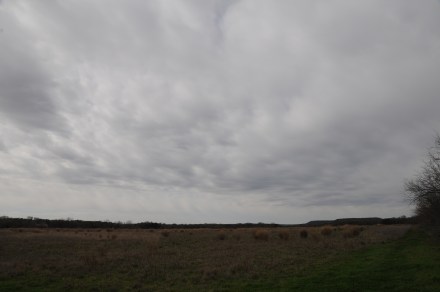
Far field clouds, March 2012.

6. False Garlic, Crow Poison (Nothoscordum bivalve), March 2012.

This False Garlic flowers early and there are several colonies clustered together throughout the ranchito.  This False Garlic is closed and due to the rains and cold yesterday and today, I do not have an open flower to illustrate — but, I shall.  This is found in the lane to County Road 114, and other colonies are about the gate between the arena and the grove pasture.

7. Sow Thistle (Sonchus asper), March 2012.

Sow Thistle appears to be a weed, but it is not.  Authorities claim the milk of this plant relieves eye ailments.  I wonder if I could apply this to my left eye?  I think not.  I’ll rely upon Dr. Callanan, but then again…. This appeared one afternoon and then its flowers have closed.  This Sow Thistle inhabits the disturbed soil underneath the live oak tree to the southeast of the house.  I have read much about the categorization of ‘weed’ versus ‘plant.’  The term ‘weed’ seems culture-specific, a term of dislike, marginal.  Goats, sheep and cattle eat this with relish.  To them, it seems, this is a plant, not an obnoxious weed.  One person’s plant is another person’s weed?

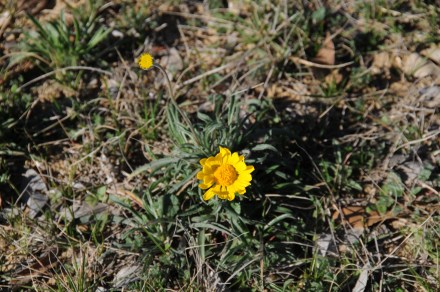
8. Unknown.

These little-bitty guys erupt on the top terrace and emerge as small, almost unnoticeable flowers. As of today, I have failed to find their name, and I also need a closeup to gain greater resolution of their attributes. Today it is raining and the blossoms are closed.

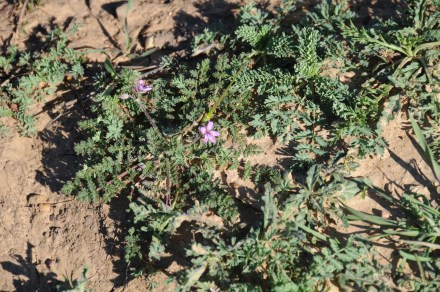
More Violet ruellia, violet wild petunia (Ruellia nudiflora).

This is a another photograph of violet wild petunia, previously identified.  It has erupted in large numbers along Interstate 20 from Mingus to Abilene.

13 Comments

Filed under Flowers of Flying Hat

Flowers of Flying Hat (1-4): Late Winter blossoms

Human beings set goals, or at least I think they should.  On the other hand, doing what comes naturally has its attraction too.  I have set several objectives regarding nature observations on my 53 acres.  Here on the place — called variously, the ranchito, Flying Hat Ranch — I have sought to identify every tree on the place and have started a good list of American elm, cottonwood, mesquite, juniper, oak, and so on.  Identifying every tree continues to be a goal.  Tree identification was (still is) my first goal in field work on Flying Hat.  Other goals I have set up include:

observing another fox and taking its photograph,

identifying every bird I see,

identifying every bird I hear,

for one year, photographing every wild flower I observe on Flying Hat.

Achieving these goals, and the process of doing so, is personally satisfying and gives me narratives for this blog.  I have decided to start another goal-oriented project and demonstrate it on my blog.  I have begun taking pictures of the wild flowers on Flying Hat and my goal is to continue photographing and identifying flowers (all colorful blossoms) through a turn of seasons for one year – March 2012 – February 2013.  So, let’s see how far I can go with this project.  Here are my first photographs.  The No. 3 flower is disputable as a “Texas Star.”

(If I have made an error in typing, please comment or e-mail me your reasons for seeing the flower and plant differently.  I want to be right in my typing, but more than that I want the typing to be correct.  Note: All photographs are taken on the 53 acres of my ranchito; none are photographed off the place or off the ranchito grid.  For a precise location of Flying Hat, see location information in this blog footer.)

1. Verbena (Verbena bipinnatifida?). February 26, 2012, west slope of terrace, Fenster's field. See Wills and Irwin, p. 189.

2. Parralena (Dyssodia pentachaeta), of the Aster family. February 26, 2012, on back terrace and in Fenster's field east of the house. See Ajilvsgi, p. 148.

3. Bluebell bellflower (Campanula rotudifolia), February 26, 2012. See http://www.wildflower.org/gallery/result.php?id_image=3102; see notes below.

4. Violet ruellia, violet wild petunia (Ruellia nudiflora). February 26, 2012, Fenster's field, far field. See http://www.wildflower.org/plants/result.php?id_plant=RUNU; Ajilvsgi, p. 377.

______________________________

Notes, corrections and additions:

No. 3 flower and plant is probably as described in caption.  Thanks to Montucky of Montana Outdoors blog and Grethe of Thyra blog.  The issue seems to be resolved it you stand up the flower and look at the total plant.  The flower would droop like a bell and the leaves and stem favor the image in the citation in the caption: http://www.wildflower.org/gallery/result.php?id_image=3102.

Mary Wills and Howard Irwin, Roadside Flowers of Texas.

G. Ajilvsgi, Wildflowers of Texas.

Campbell and Lynn Loughmiller, Texas Wildflowers.

Steven Foster and Christopher Hobbs, Western Medicinal Plants and Herbs (A Peterson Field Guide).

23 Comments

Filed under Flowers of Flying Hat, Wild Flowers of Texas

Meadow lark with morning sun

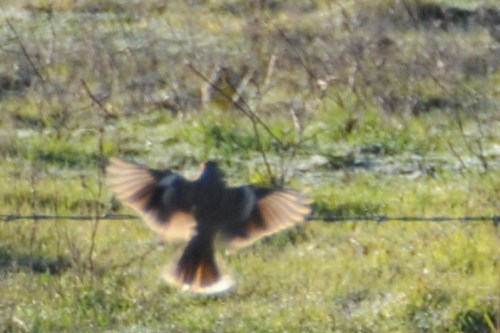
Early morning landing.

Early this morning as I walked down the road to feed Star, I saw these meadow larks (Sturnella neglecta) sunning on the barbed wire fence between the house and arena pasture.  I walked quickly back up to the house, grabbed my camera and took a few shots.  The larks are skittish and I did not get close, but I edited the ‘Early morning landing’ above as the sunlight pierced the feathers, creating an illumination that I saw only when I enlarged the picture.  Fascinating.

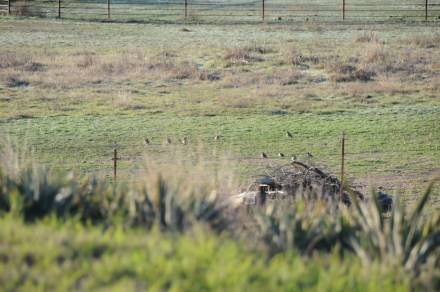
The photograph below captures the small flock on the fence.  When I came back to the house after feeding Star I looked out the front window and saw that the flock (or another group) had come around to the front of the house and was feasting on insects and seeds on the front lawn.  You can click on the ‘Larks on barbed wire’ below and obtain a larger image.  I did not get a picture of the flock at the front of the house.

Larks on barbed wire.

I have noted that birds are singing more here at the ranchito since the weather has warmed and rains have come.  I saw my first Western Bluebird (Sialia mexicana) a few days ago perched on a T-post beside the road to the barn.  I have a goal to photograph the bluebird this year.  I have seen as many as eleven bluebirds bathing in the runoff water from the horse trough.

______________________________

Notes, corrections and additions:

To disclose my identification of the ‘meadow larks’ above, I have to add that my confidence in typing the above birds as meadow lark is fairly high, but with a bit of doubt about western or eastern.  When I got the Peterson’s guide open and starting reading about the meadow lark, there are at least two varieties, western and eastern, and I will have to look closer for the signature attributes.  The white edges on the tail (seen in the first photograph) are specific signatures for the western variety, so I go with that identification.  Besides, this is west Texas. 

I will look again in the morning at the flock, pending their reappearance.

37 Comments

Filed under Birds

Walking with Great Blue Herons

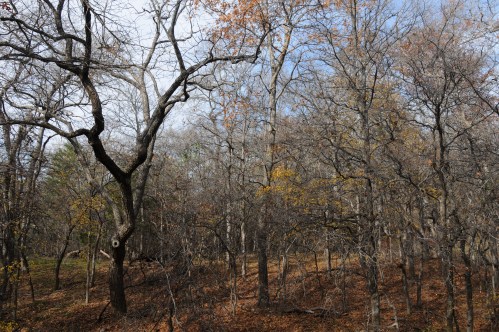
The grove peninsula. This is one of several peninsulas formed by the meandering Salt Creek (December 2011).

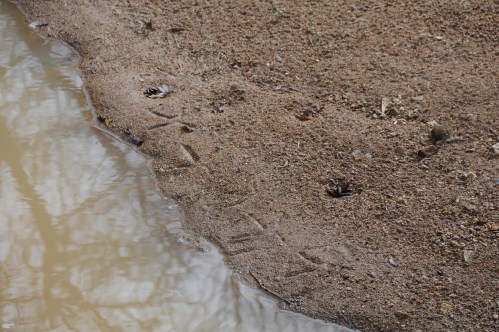
Blue Heron tracks along a still pool of water in Salt Creek (December 2011).

I walked in the grove this morning.  Several peninsulas emerge in the grove, cut by the swift and long-flowing water of Salt Creek.  Upon purchasing Flying Hat Ranchito eight-years ago, I found a red metal chair on the peninsula I photographed, a solitary chair for the previous owner to muse, observe or rest.  I took the chair off the peninsula.

Wet and cold the air, I saw track of the Great Blue Heron that frequents the creek that meanders among the elm, oak and juniper.  I see one or two of them each day flying to the cow tanks about the ranchito.  The heron track I identified with my Peterson’s field guide to animal tracks, a new third edition I purchased when Border’s went out of business in Fort Worth.

I was not alone as I walked in the grove.  The Great Blue Heron — past and present — walked with me in the grove today.

Related articles


7 Comments

Filed under Birds, Great Blue Heron, Juniper, Life in Balance