Tag Archives: Erath County Texas

Clouds with Mourning Dove

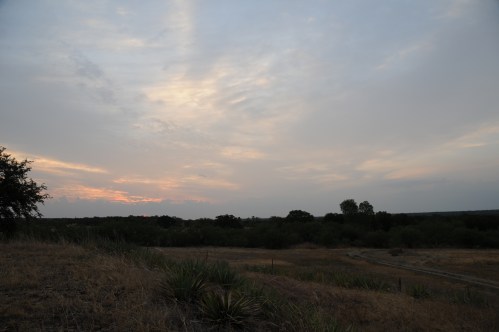
Pre-dawn clouds in Texas, north Erath County, August 2011.

Yesterday in mid-afternoon, August 10, 2011, a weak squall line walked through my ranchito in central-west Texas.  Blue-gray rain clouds edged and staggered to a halt south of my place.  A few drops of rain fell.  The power of the squall line churned up dust clouds, obscuring the Nowack barn across the county road in a microburst downdraft.  East of me, seventy-five miles away, Fort Worth had rain falling on Sundance Square, the heart of downtown commerce and entertainment that coarsely promotes the city as, “Where the West Begins.”  I disagree, but that argument will have to wait for another day.

The squall line with thunderclouds failed to bring rain on my land yesterday, but one weather change in the future will bring drops and sheets of rain.  I looked at the weather charts yesterday afternoon and saw thundershowers, sixty-miles north, let loose rain, then dissipate into nothingness but a void of mirages, quavering silver lakes far away.  No mirage here, the juniper trees in the ranchito grove threw off a luscious scent with the rise in humidity, dispelling summer for a time and bringing a promise of better days.

This morning, clouds remain to my east and as the sun rises, I see remnants of yesterday’s storm over Sundance Square.   I count three, perhaps five, sun rays through the cirrus and cumulus debris.  In all of this — the dust clouds, wind, scarce drops of rain and the sun’s rays — I look at yesterday’s date, August 10th, and know that Fall is forty days away, and that the sun rises later and sets earlier each day upon the earth’s northern hemisphere, Sundance Square and my hacienda. 

As if I needed any more natural substantiation that the season is turning — I do — Mourning Doves (Zenaidura macroura) sustained their ooah, cooo, cooo, coo this morning for over an hour, sitting on power lines and in the mesquite brush of the Dooley place to my west.  The Mourning Dove with hot mornings and brutal afternoons of heat on the ranchito does not coo earnestly, but quiets in sorrow for the lack of rain.

The Mourning Dove is in the lower-left photograph, a White-fronted Dove is pictured in lower-right (Audubon Society Field Guide, 1977).

______________________________

Notes, corrections and additions:

The call of the Mourning Dove comes from Roger Tory Peterson’s A Field Guide to Western Birds (1969), my constant reference and field guide that is tattered and torn.  But I would not have it any other way.

Photographs of the dove are from The Audubon Society Field Guide to North American Birds (1977).  This reference guide from Audubon was in the small library of my parents who grew up in the country of central Texas and were always cognizant of wildlife, thunderstorms, cattle and horses.  I inherited the library and treasure each volume of field manuals that they thumbed through.

Several species of dove reside and pass through the ranchito. 

10 Comments

Filed under Birds, Rain, Weather

Cool, clear water

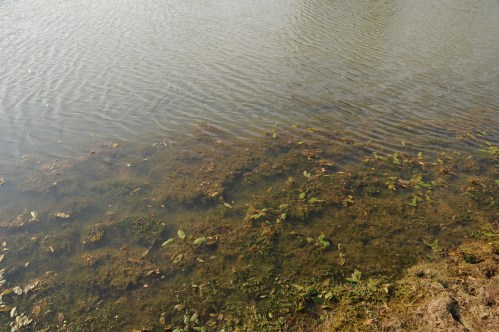
Western edge of pond, Flying Hat Ranchito, north Erath County, Texas, July 2011.

Proust had his tea cake that extended memories to prosy heights that we all have started to climb, but failed to reach — my ascent stopped at Swann’s Way, but I’m not going to stay long on the ledge for I have hammered the next piton to assail the final page of Mt. Swann.  “Cool Water,” a country and western classic by the Sons of the Pioneers, a tea cake of sorts, takes me back to old Camp Bowie, near Brownwood, Texas, as I complained the lack of water on a hot summer day, touring with my parents in a old, non-air conditioned Ford sedan.  Why they weren’t thirsty, I’ll never know, but I campaigned persistently for halting somewhere, anywhere, for water.

I must have been persuasive for my step-father stopped the car along the highway and I crossed over a fence and ran to a pond of fresh, cool water in a green pasture.  I drank, cupping the water in my hands, not muddling the water as I scooped.  Even today, I still see that pond when I drive in the region, although it has been dug out and deepened countless times.  Both my step-father and mother laughed in sympathy and I was dubbed, “Chief Water Bucket,” a name I did not like nor wanted.

The drought in the Southwest descends brutally upon the landscape, in the news and by the mails; the only shade at times is under lovely junipers.  I look out upon brittle, brown grasses; the trees in the grove are turning golden.  The newspapers boldface the headlines that cattle are being sold through the night at local auctions as cattlemen line up two-miles long with moaning cows in their trailers.  In the mail, Barton Water Cooperative states that I can only water the yard twice a week and if the water usage exceeds tolerable levels, I will be assessed a fine, a surcharge.  I fill one water trough for my horse, Star, allowing an overflow into a pan on the ground for wildlife.  I dare a surcharge for that.

This summer I have thought often about “Cool Water,” and sung and hummed the melody and lyrics.  Each time I reflect on the music, I am back with my parents alongside the road, running for the cool, clear water in that pasture.  “Cool Water,” is my tea cake, my madeleine.

Here are the lyrics to “Cool Water,” followed by a current photograph of the ranchito’s only pond.

All day I face the barren waste without the taste of water,
Cool water.
Old Dan and I with throats burned dry and souls that cry for water,
Cool water.

The night are cool and I’m a fool each stars a pool of water,
Cool water.
But with the dawn I’ll wake and yawn and carry on to water,
Cool water.

(Chorus)
Keep a movin’ Dan, don’t you listen to him Dan, he’s a devil not a man
and he spreads the burnin’ sand with water.
Dan can’t you see that big green tree where the waters runnin’ free
and it’s waiting there for me and you.
Water, cool water.

The shadows sway and seem to say tonight we pray for water,
Cool water.
And way up there He’ll hear our prayer and show us where there’s water,
Cool Water.

Dan’s feet are sore he’s yearning for just one thing more than water,
Cool water.
Like me, I guess, he’d like to rest where there’s no quest for water,
Cool water.

(“Cool Water,” Sons of the Pioneer, RCA Country Legends.)

Flying Hat Ranchito pond, north Erath County, July 2011.

19 Comments

Filed under Juniper, Recollections 1942-1966, Weather

Score: Mockingbird 1, Roadrunner 0

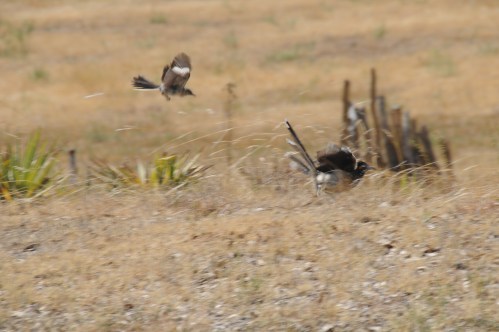
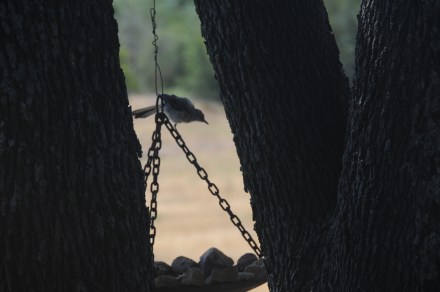
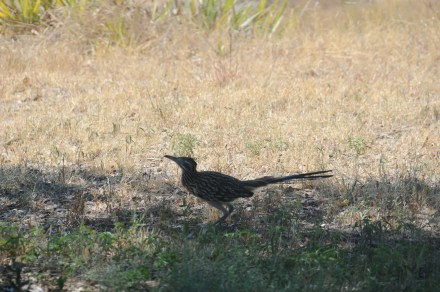
A mockingbird resides in a live oak tree on the east side of the terrace beside the house.  For several days I have observed roadrunners coming up to the terrace early in the morning and mid-afternoon to feast on grasshoppers.  Occasionally, the roadrunners will scale a separate live oak tree from the mockingbird’s nest only to be thrown back, not by cauldrons of burning drought-oil in Texas, but by the fierce, unrelenting assault of the mockingbird.  The trees upon the terrace are mockingbird territory!  Beware aliens!  The mockingbirds will allow red-headed woodpeckers to pierce bark for a meal, but not the roadrunner.

Yesterday, I took these photos of the tournament.  At end of battle, the score was Team Mockingbird 1, Team Roadrunner 0.  The roadrunner ran off the terrace and into the mesquite thickets on the Dooley place.

A roadrunner (Geococcyx californianus) is a cuckoo, here pictured on the terrace with pale-leaf yucca in background (north Erath County, Texas, 2011).

Mockingbird (Mimus polyglottos) assaults roadrunner (north Erath County, Texas, 2011).

Mockingbird stares at roadrunner.

Roadrunner stares at mockingbird.

I have had close encounters with both species in rescuing them from death.  I unloosed a mockingbird from bird netting several years ago.  He bit me and drew blood.  And, a year or so ago, I saved a roadrunner from drowning in a water trough.  He had fallen in and was unable to fly or climb out.  I have no idea if the roadrunners I see are survivors of that event — more than likely not since it was over a year ago.

I do have a field note about each of these birds.  I can hear the roadrunner chattering, a noise he makes by rolling mandibles together.  He has a voice like a dove, but more often I hear the chatter.  The other note is that the mockingbirds like to sing at night in the spring — all night long.  I used to hear them as a boy when I slept with the windows open; I barely hear them now with the air conditioner blowing.

Seeking comic relief in all this heat, I look for a coyote to come across the terrace tomorrow, laying a trap for Team Roadrunner.  I hear coyotes, but don’t see them.  “Beep, beep.”

20 Comments

Filed under Birds

If she isn’t the prettiest thing you’ve ever seen, I’ll give her to you!

Wild Flower Gal with verbena (north Erath County, Texas, late winter, 2007).

Four winters ago, my neighbor, Jerry Wood who lives two miles south of me on County Road 114 stopped at my mailbox as I retrieved letters one morning.  We chatted for a few minutes as he kept his diesel truck running and as we closed our conversation he said, “I have a horse, Jack, [words unintelligible over the engine noise] I’ll give her to you!”

“I’ll give her to you?”  I had three horses at this time, two tobiano black paints and one quarter horse, Sweet Hija, and another horse added to the remuda would not be a problem to train and feed.  But, a gift horse?  I thought as Jerry drove off that he must be terminally ill or something drastic was going on like divorce or bankruptcy.  I immediately decided that if the horse was sound, I would take her off Jerry’s hands and ease his problem — whatever it was.

Within the week, I drove down to Jerry’s with my trailer hitched up, pulled into his corrals and saw Wild Flower Gal, a sorrel tobiano paint that was drop-dead gorgeous.  “Why would he even want to get rid of this beautiful creature?” I quietly thought.  In any case, he took her through her paces, showed that she was healthy and halter-trained and I liked her behavior so she would fit in after getting to know my other three horses.

After seeing her training, paces and overall friendliness, I asked Jerry, “Are you sure you want to give this beautiful horse to me, Jerry?”  I thought he was making a big mistake to give Wild Flower Away and I did not want to exploit Jerry’s problem — whatever the heck it was — in his hour of crisis.

“What?” he said.

“You did say, didn’t you, Jerry, that you were giving this horse to me?”  This was quickly going in a perplexing direction I did not like.

“Oh, no!” he quickly replied.  “I said, ‘If she isn’t the prettiest thing you’ve ever seen, I’ll give her to you.'”

“Oh, you did?”  This was definitely in embarrassing territory.  “How much do you want for her?”

“One-thousand dollars,” he replied.

I became a tad dizzy in my thinking at that point, but my mind quickly cleared the confusion:  Jerry’s diesel engine had blocked out his words, “If she isn’t the prettiest thing you’ve ever seen…”  And I had slammed his statement into, “I have a horse to give you, Jack.”

What to do?  Buy the horse and lighten my bank account?  Probably the best exit strategy.  If I did not buy Wild Flower Gal, I would probably be the center of an oft-told tale at the Hannibal Country Store concerning my over-eagerness to gainsay another yegua for free.  I did not want that circulating around the cracker barrel.

So, I bought Wild Flower Gal, loaded her up and brought her to my stables.  Jerry signed over the pedigree, pocketing a thousand.

Wild Flower Gal was pretty, but not the prettiest gal I had ever seen.  But, pretty enough to buy and train and sever any anecdote about my confusion.  Several months later I snapped the photograph of her in late winter browsing through the wild verbena.  It was fitting, this photograph, because she was in a pasture of wild flowers that reflected her namesake.  I sold her a year later for a thousand dollars to a family near Abilene, Texas, that showed her at halter and loved her well.

A lot of lessons emerge from this story.  Verify and clarify conversations of commercial intercourse.  Cut your engines when conversing.  Above all, there’s no such thing as a free horse.

16 Comments

Filed under Horses, Sweet Hija, Wild Flowers of Texas

Field gifts in July

At 3:30 a.m., with such dignity as I can muster of a July morning, I step from my cabin door, bearing in either hand my emblem of sovereignty, a coffee pot and notebook.  I seat myself on a bench, facing the white wake of the morning star.  I set the pot beside me.  I extract a cup from my shirt front, hoping none will notice its informal mode of transport.  I get out my watch, pour coffee, and lay notebook on knee.

Aldo Leopold’s early morning field method, A Sand County Almanac, pp. 41-42.

This July morning, a warm morning that will expand into hot, I walked the one-half mile of Salt Creek on my 53 acre ranchito.  Salt Creek is an intermittently-flowing creek that twists and curves through the forested grove in the middle of the 53 acres.  During heavy rains, the creek reaches ten feet high and lays flat the water-gap fences on the east and west ends of the property.  This summer, waiting out the worst drought since 1895, the creek remains intact, its bed dry; yet elms, junipers (beautiful they are), cottonwoods, oak and pecan trees uplift subsurface moisture, retaining their leaves and shade for owl, redbird, bluebird, sparrow, deer, armadillo, skunk, coyote and fox.

Salt Creek on this day holds one watery seep, fifteen feet in length of oblong, deep water.  Flush against the shady side, this watery seep encapsulates water three-feet in depth, the water flowing from the native grass field I have tended these last four years.  I discovered on my walk, along the one-half mile of the creek bed, it is the only source of water in the bed.  Wildlife track abounds around the water cache, and it is supplemented by my stock pond — amply full — a quarter-of-a-mile away to the northeast.  Animal tracks puncture the wet soil of both seep and pond.  Trails radiate in all directions from these water pools, life-sustaining hubs among tens of thousands of water holes in west Texas.

Walking, ambling really, I kept watch for the unanticipated field discoveries that, without fail, always occur; and if none appear, I have not looked upon, within and close enough, the land upon which I trod.  I wrote in my field notebook the jack rabbit, woodpecker, roadrunner and fertile pond algae as they appeared in good order from the house.

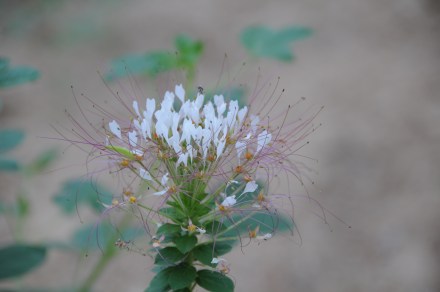
As I turned in the creek bed at the last big U-turn loop, I gazed upon color, flower color, I had never seen before: the Clammyweed.  Not exactly the classiest of names, but it is what it is.

Clammyweed (Polanisia dodecandra), Salt Creek, north Erath County, Texas (July 27, 2011).

Clammyweed grew on a sand bar in the middle of the dry creek bed.  Seven blossoms on three plants taunted the drought in all its brazen heat, stating in siren tones that shade, moisture and sand can bring forth purple and white, stamens a-blazing, here in July.  The heat be gone for the moment.  Hooray!  for Clammyweed!

I was already dizzy from the heat and lack of air circulation, but this discovery boosted me out of the spell.  I read later in field manuals that Clammyweed is a derivative of the caper family, one of my favorite garnishes, and that if one rustles the flower or plant, an odor emits that clams to the skin.  I must go back and find out for myself this attribute.

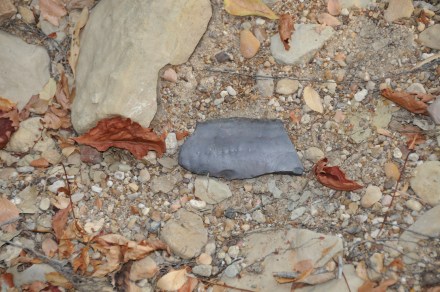
The second field gift on this July day came near the end of my one-and-a-half hour field trip.  Walking gingerly in the middle of the creek bed, avoiding large sandstone rocks, I looked down and saw a dark, flat-shaped, lithic object of iron ore that is abundant about the place.  Thinking it a natural chink or large piece of rock, I kicked at it with my boot.  Instead of a natural formation, it showed signs of flaking and abrasion — a lithic tool, used by Native Americans before the onslaught of mining, farming and ranching.

Abraded and flaked lithic tool (4'' x 2.5"), Salt Creek, north Erath County, Texas (July 27, 2011).

I noted the location, picked up the tool and continued my ambling to the west water gap, the end of my walk.

Returning to the house, I sat down, not with coffee but with a Dr. Pepper, and wrote out the rest of my field notes.  My observations had begun at 8:14 a.m. and concluded at 9:45 a.m.  The temperature by ten o’clock was 86 degrees, headed upwards to 105-107 degrees by the late afternoon.

The grove remains green.  A water seep looks healthy in the creek bed.  Wildlife track abounds.  Cultural artifacts appear, attesting to man’s continuing occupation of the surrounds.  The day will be hot.  Gifts, of a sort, have fallen in my path and I gain a sense of continuity with nature reviving itself in Clammyweed blossoms, bursting in color, a natural goddess emerging from the earth in July, glimmering in fertility.  Paradise regained.

* * *

The water cache and seep along Salt Creek, north Erath County, Texas (July 27, 2011).

______________________________

Notes and corrections:

The photograph of the Salt Creek water cache was appended.

The sentence, “Paradise regained,” was added in the last paragraph of the essay.

15 Comments

Filed under Field Log, Plants and Shrubs, Wild Flowers of Texas

Noise and relativity

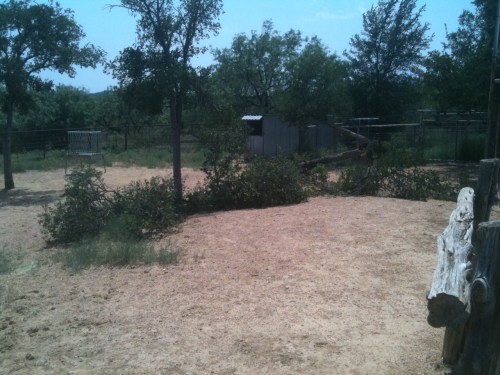
Felled tree in Corral No. 1 (May 2011).

In north Erath County, Texas, the south wind blew fiercely yesterday, its force bending high-grass seed tops to the ground in the arena pasture.  The sound of wind roughly soughing through live oak trees never let up during the day.  The temperature eased back to 93 degrees and I worked in the afternoon cutting down a split tree that threatened to topple onto a stable.  I chopped a large notch into the tree, lassoed the upper body of the tree with a lariat, tied a knot on the trailer hitch of the Case DX-55, pulled and brought the split tree down.  My step-father used the same axe as I did, chopping cedar and brush in Mills County, eighty-miles away and fifty-years ago.

A barn cat that I have not befriended — yet — watched from the stable while I worked out the physics of felling the tree.  Star fled from his feeding bin only when the tree fell, returning quickly to finish his block of coastal bermuda once the noise subsided.  Sweat stung my eyes and I opened up my shirt to cool as I sat in the shade of the barn alleyway, the high wind funneling through the alleyway more rapidly than in the corral.  The barn cat had eased his way into the hay and tools area, away from the wind.

I will clean up the tree debris in the corral today.

* * *

Deer and possibly quail returned to the far field, the Pecan Tree Pasture.  One reason is that mechanized noise has lessened in their habitat.  It is quieter.

My neighbors to the southeast, the Halls, are selling their home, stables and workshop.  Since they are dividing their time between here and Squaw Mountain near Throckmorton, much farther north of here, their off-road motor vehicles are silenced and they mow less frequently.  They do not fire pistols in training their horses to become accustomed to the noise.  To the west of me, on the Dooley place, the nephew has not target practiced in the adjacent pasture for several months.  And, finally, on my southern boundary the Old Bryant place, the deer stands and blinds have mostly been removed, only one remains.  I see deer browsing between my southern pastures and the pond, and on to a second healthy pond on the Blue place, to my east.  Blue takes care of his ailing mother and my rural route mail carrier sits with Blue’s mother so that he might go on errands or to church.  His place, his mother’s place, is quiet next to mine.

I labor under no illusion.  The noise might start again and the deer will flee.  I have no control over my neighbor’s behavior until my nose is bloodied or bone breaks.  I shall tend to my pastures and fields and allow all that is natural grow and browse.  The deer have not re-surged to levels six-years ago, but the deer are back.  The fawn prances again in the Grove.  The noise of mechanized activity, of gun powder and metal clanging has abated.  For now.

* * *

Several years ago, I almost purchased a place in northern New Mexico, up above Llano that bordered the Kit Carson National Forest.  The fifteen acres or so nestled up against an acequia that brought water to narrow fields below.  I envisioned building a small home, barn and corrals for horses.  A trail ascended into the national forest and I could ride Star for hours, even days into groves of aspen and high country meadows.  I did not buy the land.  I have no regrets for there are places like that near Taos and Rodarte still for sale.  If the need be, I will find them and resettle away from the clang of metal.

* * *

So much is relative; maybe all things are.  I am content that deer return, but in Australia the deer in places have populated so densely that the land is overgrazed and crops cannot be planted.  Yesterday, despite my focus on machine noise, I used a Case DX-55 tractor to pull down the split tree and a Stihl chainsaw to cut the trunk and limbs.  If I had continued to use my step-father’s axe, I would have had to soak the handle for the blade was loose.

Then, if I had moved to the high country of northern New Mexico, I would have the beauty of the land and resonance of diverse cultures, but jobs are few and the winters are bitter cold.  Yet, I could counter the cold with propane and wood, axe and chainsaw, sharpening files and good caulking about the quarters.

Ill fares the land?  No, not yet.

4 Comments

Filed under Life in Balance, Taos

Quail and deer lease my field

Deer skull with prairie grass (2011).

Temperatures reached 102 degrees yesterday.  Work slows or stops at 11:00 a.m.  Winds blew fierce, reaching 40 m.p.h. in gusts.  Yet, the pastures are green, the grass not browning for the moment.

* * *

Two days ago I shredded several narrow paths about the pastures.  I do not shred fields or pastures.  As I shredded a narrow path around the edges of Pecan Tree Pasture, I flushed a bobwhite quail.  Just one quail, but it is significant for quail habitually cluster in coveys.  Quail have disappeared in large portions of the area from hunting, shredding pastures, cropping and the spread of fire ants that kill young chicks.  I have reseeded the Pecan Tree Pasture with native grass and allowed the field to remain fallow for several years.  If I see more quail — the late sighting proving to not be an isolated occurrence — I will conclude I have done well in partial restoration of a native habitat.

* * *

Yesterday I sighted three mature deer and a fawn between the grove and the stock pond.  It is odd that their color is so pale brown, almost yellow, against the greenery of Spring.  Deer return, quail flush.  The fawn pranced.

* * *

As I sat on the back porch yesterday afternoon, a cattleman from Gordon knocked on the door.  He wanted to lease the pasture that I had flushed the quail and seen the deer — a monthly lease depending upon the number of cattle he would place.  I refused.  I told him that I would probably run a few head myself.  He stated that he had seen no cattle on the pasture and that’s why he had inquired.  I took his card and he said he was looking for pasture within ten miles of Gordon, so that if I heard of any land available for rent, please let him know.  I politely said I would.

Other inquires will follow this Spring.  They always do from cattlemen or harvesters of grass.  And, I always refuse and politely explain that I have the pasture for horses or a few head of cattle.  I have not run any cattle for four years.  I may put a few on the land this Spring, but not many and they will not disturb either deer or quail.  In the field, the Big Bluestem grass will be higher than the withers of horse and rump of cattle.

* * *

I had to kill a copperhead in the barn two days ago.  I knelt down to air up a tire and moved a salt block receptacle to position myself and a copperhead lay under the receptacle.  I will be cleaning out the barn early next week.  I had planned to do so — in fact I had moved six boxes of books to my office in Abilene a week ago –, but the danger of snake bite spurs me sooner to glean the barn.  My air conditioner repairman and contractor lost part of a finger last year from a copperhead bite.  For some reason, we have more copperheads in this portion of north Erath County, Texas, than most areas.

* * *

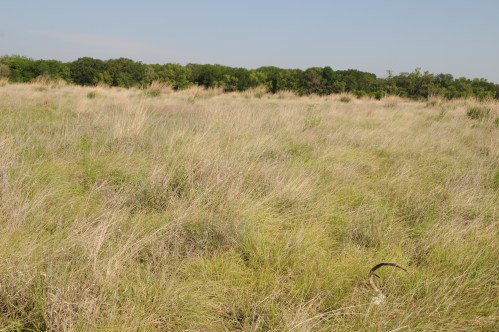
The photograph at the beginning of the post was taken over at Pecan Tree Pasture about where the solitary bobwhite was sighted.  I was observing the growth of native grasses a month ago and happened across the deer skull with horns.  I consider myself keenly observant of objects in my field of sight, but the grass has grown so high, secrets are undisclosed unless one tramps the land.  The skull remains in situ.  I like the simplicity, the complexity intertwined: deer, native grasses, treeline.

The field wholly remains in situ, lightly touched, deeply felt.

15 Comments

Filed under Birds, Deer, Field Log, Life in Balance

100 degrees and fire at Possum Kingdom 18 APR 11

After transferring items between two trailers here on our place, I ate a ham sandwich and departed for the northern part of our region, up SH 108, FM 919 through Gordon and up to US 180, approximately twenty miles away.  I turned west on US 180 and drove to the Stephens County-Palo Pinto County, Texas line.  I had not driven farther two days ago than the SH 16 highway intersection.

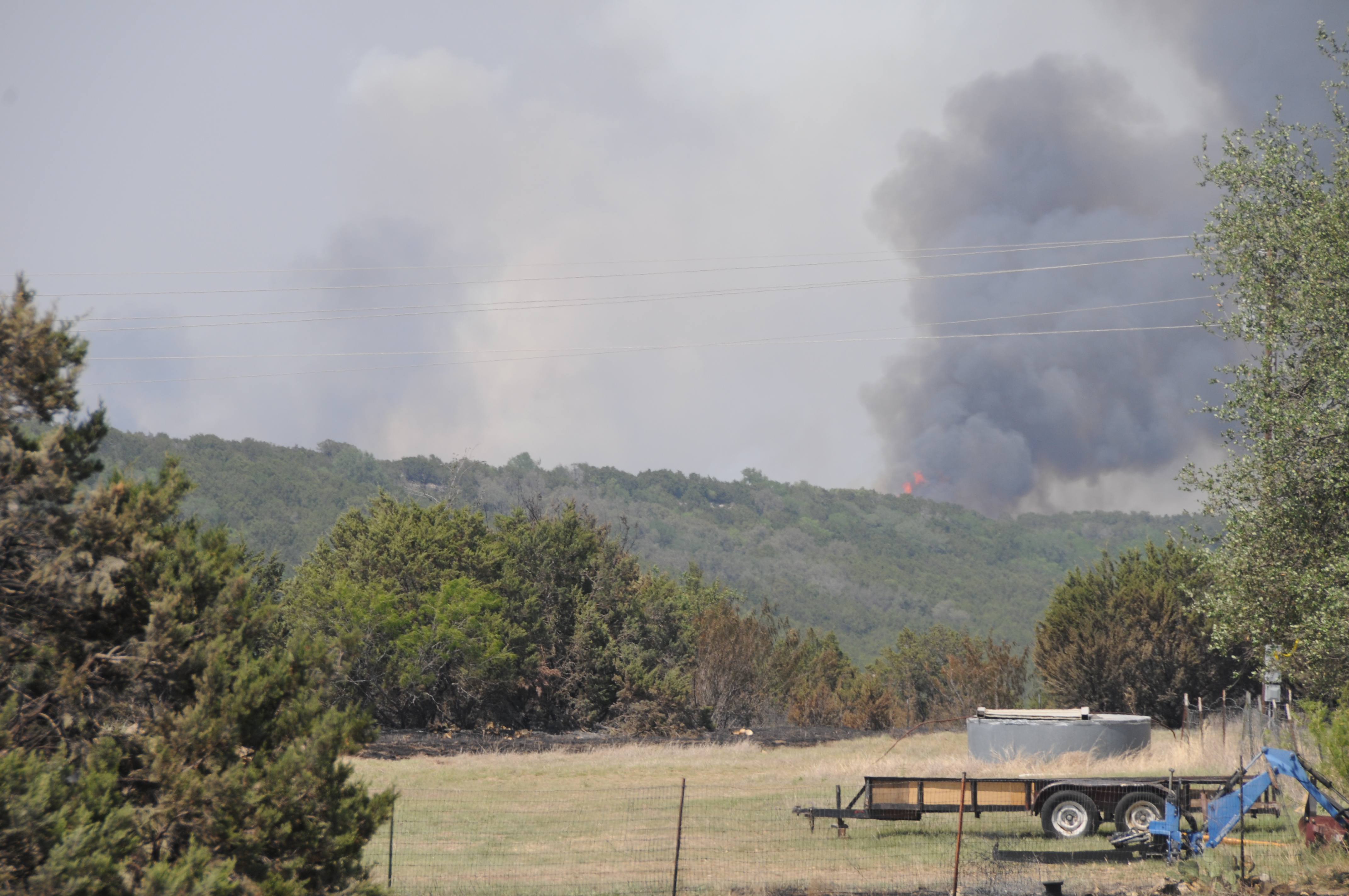
The magnitude of this fire stuns me.  From Ioni Creek to the Stephens County line on US 180, about ten miles or so, the country is blackened and hot spots still smolder in the hills.  As I approached the intersection of US 180 and SH 16, I looked out the window of my F-150 and saw the beginning of a huge fire eruption at Possum Kingdom East.

Click the photographs with your mouse to enlarge and get detail.

Looking north from US 180 near intersection of SH 16, PK East Fire.

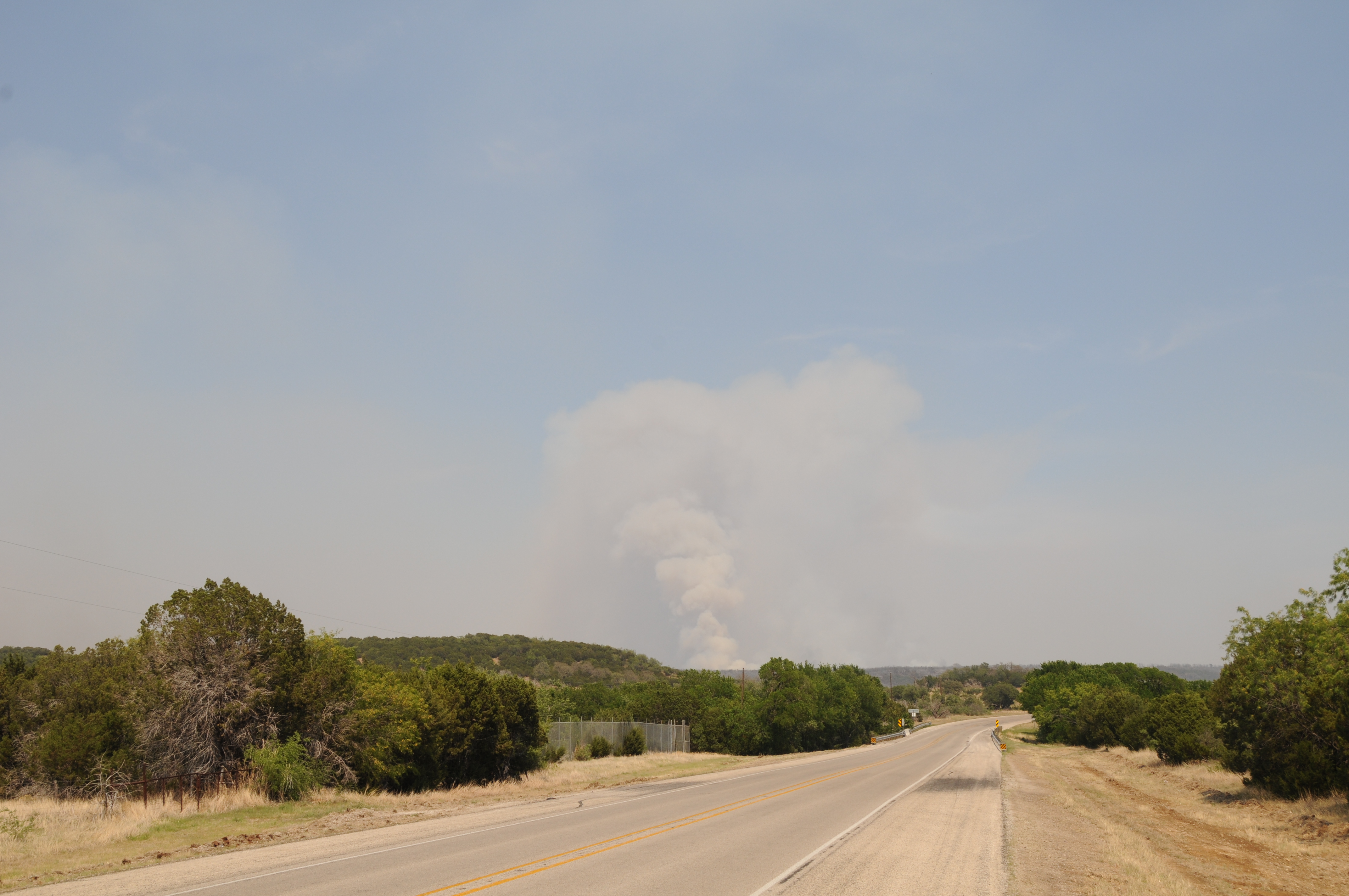
I drove farther from the SH 16- US 180 intersection — Highway Patrol blocked SH 16 north — and saw blackened countryside all the way to the Stephens County line.  I turned around and came back down US 180 and here is a shot of the smoke cloud.

Smoke cloud of PK East Fire on US 180 headed east back to SH 16 and Strawn.

I saw at least ten fires — not counting the hot spots — along US 180 and SH 16. Rio Vista, Joshua, Granbury and other volunteer units were scattered along the highway. With the outbreak of at least two fires northwest of Strawn, I saw the Cunningham Fire Department go into a ranch, led by the rancher and authorities.

Through-traffic in Strawn is prohibited and I cut across the country, using Davidson Cemetery Road to get back home.  Highway 16 in Strawn is scattered with vehicles and fire trucks.

I don’t like disaster-pandering posts.  I think they are bad form and take the mind away from applying its powers to correct defects that caused disasters in the first place.  Tours of Chernobyl are disgusting.   These events in my region — I am about fifteen-to-twenty miles south from the fires that have gone on for days it seems to me — are uncommon.  I’ve lived most of my life in Texas, in this region, and I’ve never seen fires like this.  My immediate surrounds in north Erath County are green and we’ve been fortunate.  Mingus, my mailing address, and Gordon, six-miles away, were ordered to evacuate several days ago.  As soon as these events are over, I will be glad to post on verbena and milkweed.

Tomorrow the Fire Weather Watch forecast is worse.  Today, it’s 100 deg. and wind at 20-25 m.p.h., humidity low.  If it gets worse, I won’t go to teach in Abilene, but stay here and monitor the place.

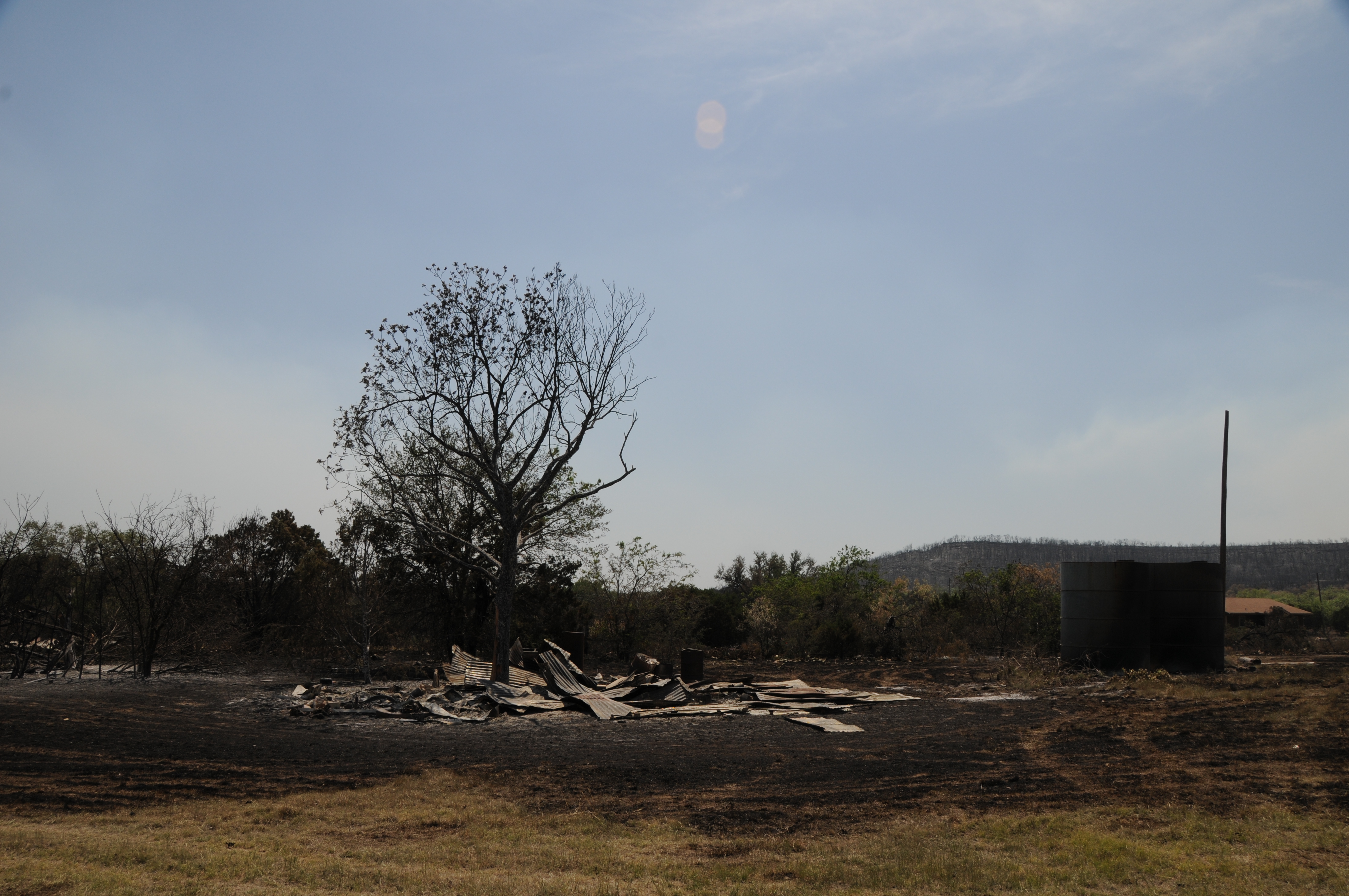
Burned structures at US 180 and SH 16.

12 Comments

Filed under Wildfire

Rabies and Star

Star Bars Moore

In the city, look out for the bus.  In the country, what doesn’t sting or bite you will stick you — wasps, mosquitoes, mesquite thorns or worse.  Still, I had rather be out in the country and take my chances.

Rabies in horses is rare, but on the Bryant place, across the fence to the south of us, two horses were put down because one of them had a full-blown case of rabies.  Its companion horse had not displayed rabies symptoms, but Erath County authorities ordered it killed as it had no rabies vaccination documentation.  One was euthanized Thursday, March 24, and the other unfortunate horse this Thursday, March 31.  The first horse exhibited rabies symptoms and the vet took tissue samples that confirmed the disease.  The Bryants are having to take rabies shots since they were in close contact with the horse.

My paint gelding, Star, had been staying in the front pastures away from the Bryant place until last Sunday, March 27.  For two days, Star had infrequent contact with the second horse over the fence that had been killed.  Since rabies can be transmitted via mucous interchange, it is a very serious situation for Star.

Star had been inoculated against rabies in 2009, and last week before the contact with the Bryant horse he had been given his rabies shot for 2011.  Our veterinarian, Dr. Skeet Gibson of Equine Sports Medicine and Surgery, Weatherford, says the 2011 inoculation has not gone into full effect, and the 2009 inoculation begins to diminish in effectiveness after a year-and-a-half.  But since Star had no contact with the rabid horse — only the companion horse that had been killed — the chances were slim that any transmission had taken place.

Nonetheless, the vet said to isolate Star for two weeks and minimize my contact with his muzzle and mucous discharges, look for symptoms (not eating, behavior changes, etc.) and contact my personal physician for advice.

I called our personal physician immediately and neither I nor Brenda will be required to take rabies shots unless Star is rabid.  Star will probably be okay, but isolation and observation is imperative.

And just how did I find out about this whole issue of rabies next door?  My neighbors to the east that have horses called me Thursday, March 31, to inform me of the euthanizing, and they have no land contiguous with the Bryants!  They called to alert me as a fellow horseman.  Neither the Bryants nor the Erath County authorities had contacted me.  Had I been informed last week, I would not have allowed Star to go to the far pasture — Pecan Tree Pasture.  As it is now, we are having to take measures to determine disease contact that may, in the end, be fatal to Star, although I repeat it is doubtful.

Within an hour after the Halls called me and I had visited with the Bryants to find out the facts, I went across the county road to inform a fellow horseman of the situation.  In the country, we must work together.  I choose to do so.

25 Comments

Filed under Flying Hat Ranch, Horses, Star

Cottonwood yellow sound

Cottonwood in the Grove

Populus deltoides var. occidentalis or Texas Cottonwood. Yesterday as I drove up the road to the ranch house, I saw in the Grove a brilliant yellow foliage from a solitary cottonwood along the creek.  As it was late, I vowed to take photos of it the next day — today.  I think it a young cottonwood, twenty-years old at the most, but I am not the authority.  It is a healthy tree and its roots are embedded firmly into the bank of Salt Creek.  I am concerned about the tree, however, as it is rooted within the confines of the creek and the creek flows quite rapidly after a thunderstorm.  The pull of the current may bring it down this next year, yet, it has withstood the flow of water these many years, so it may endure for years to come.

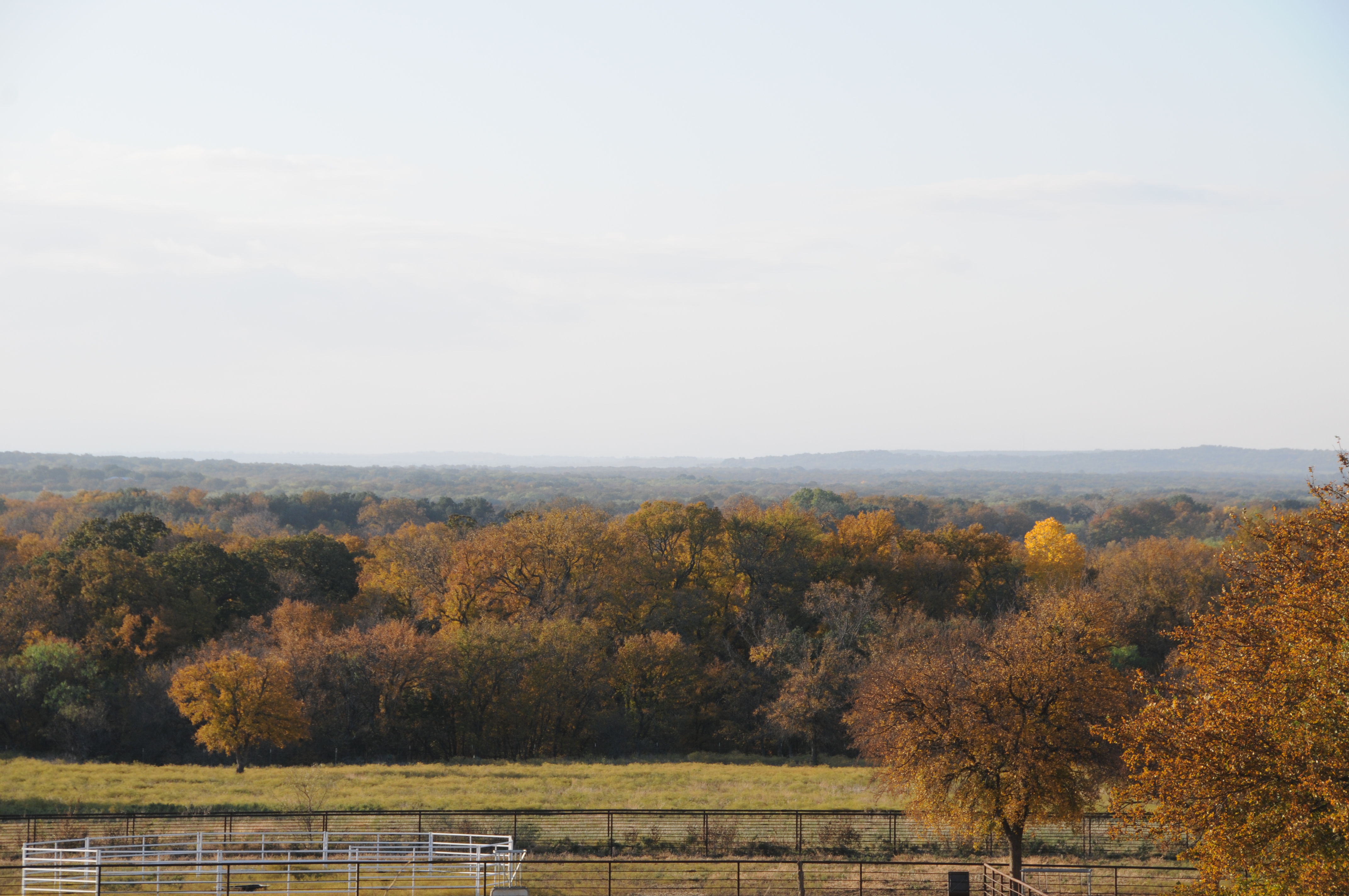
Panoramic view from the ranch house. The cottonwood is the bright yellow tree to the right of the scene.

The water current is not the only factor that affects the tree, but also the wind.  Today, southern wind gusts peak at 35-40 miles per hour and the cottonwood swayed in the wind.  Its leaves have been falling and blowing off for most of the day.  The wind blows strongly.  Rain is falling this afternoon as I write this post.  The major squall lines formed north and east of me, near Fort Worth and the Red River Valley.  I have had good rains in the summer, so the vegetation remains green, turning brown.  The rains must have nourished the cottonwood most favorably, as well as the creek bed, because its foliage was dense and now with colors turning, it is the most spectacular flash of color in the Grove.  Wind and rain have good and bad effect upon the tree.

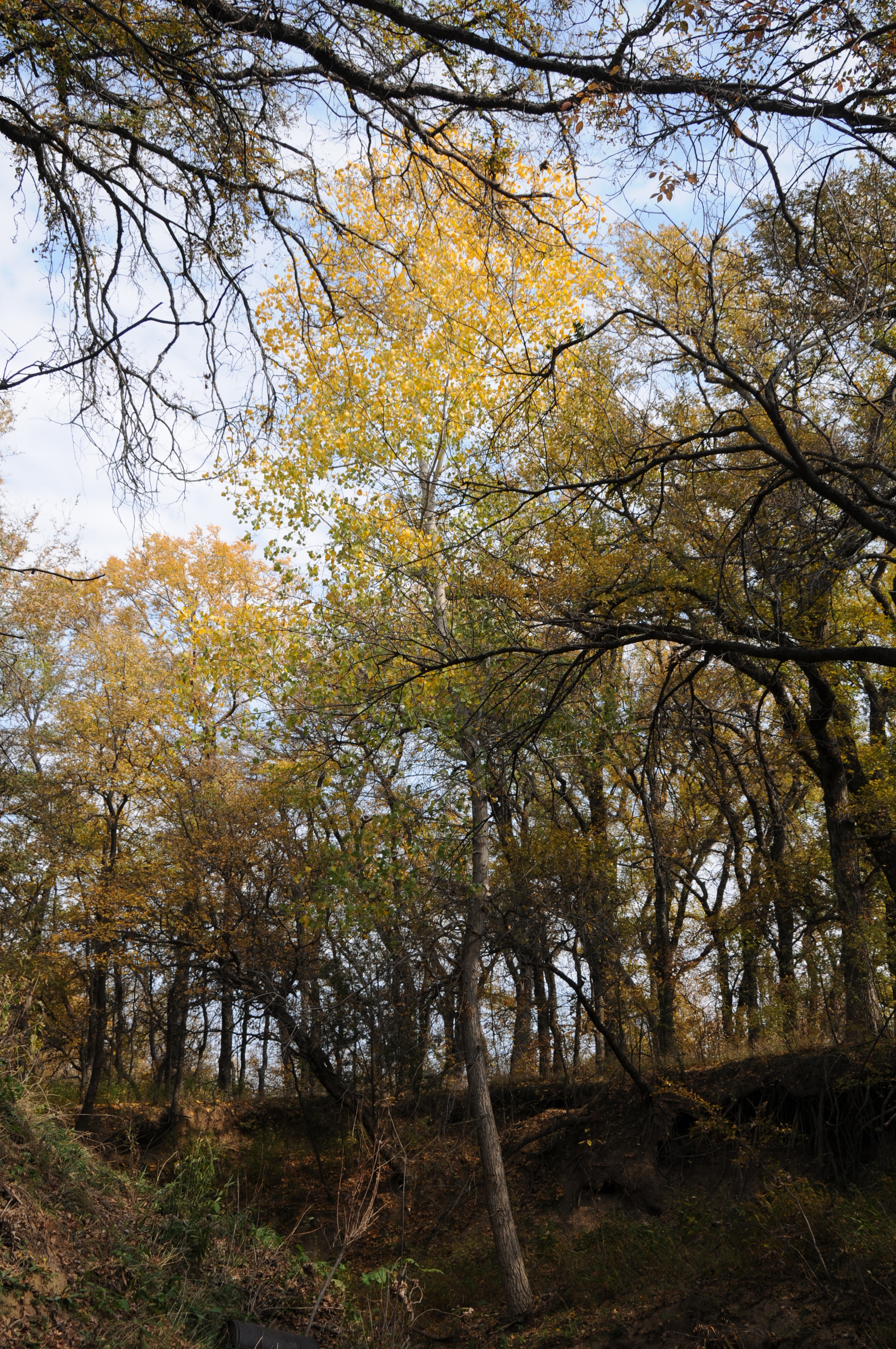
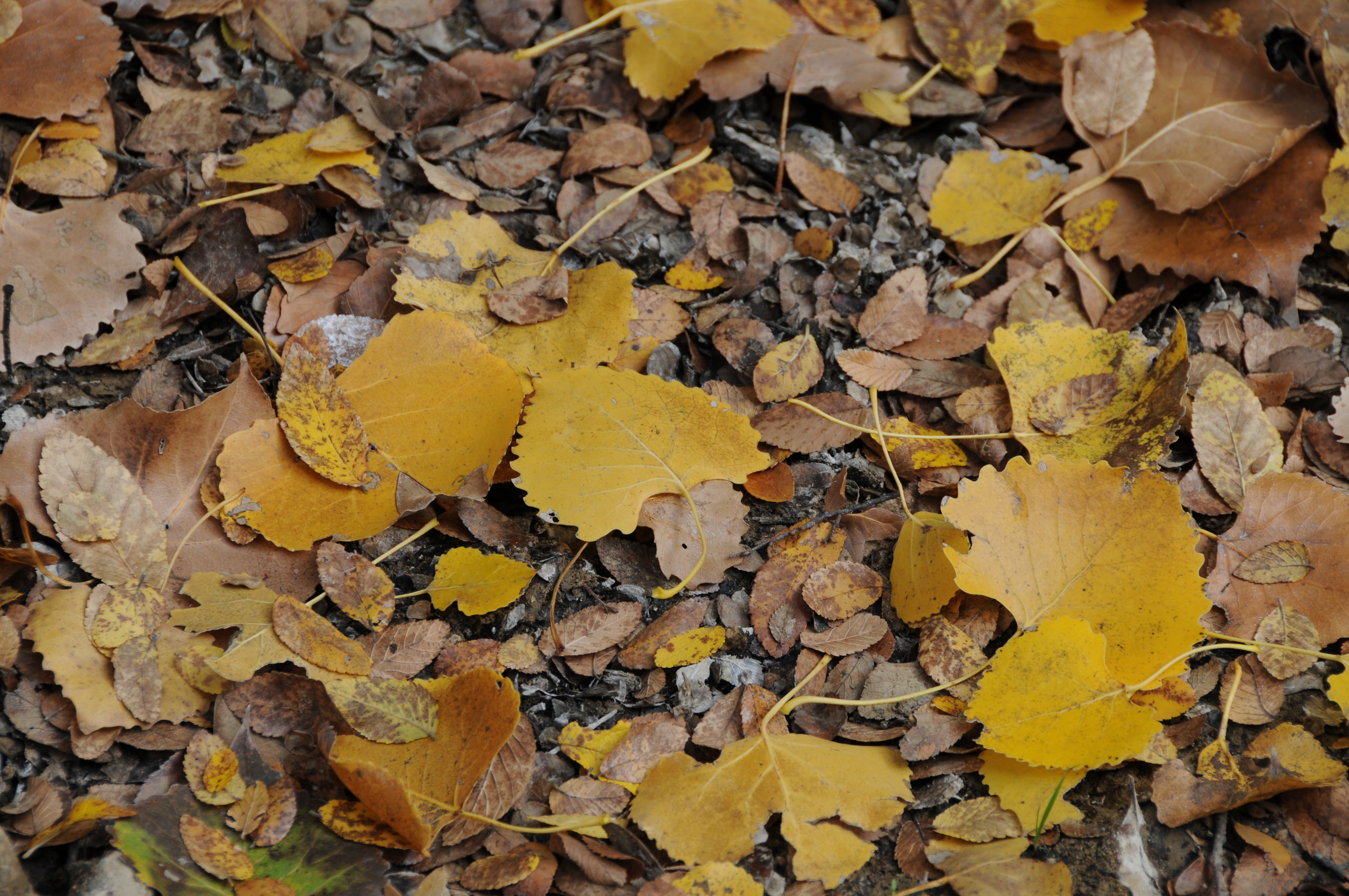
There are male and female cottonwood trees.  This tree appears to be male.  I have not seen cotton spores float off of it, thus identifying a female.  Here are the leaves on the bottom of the creek bed.  One feature of the cottonwood that I find soothing is the sound of the leaves rustling.  When the tree is green and fresh in the Spring, the sound is like a babbling brook, solid and deep.  In the Fall, the sound of the leaves is a higher pitch, shallower, lighter-sounding, a fragile clacking like extremely delicate china.  If this is a male tree — I think it is — somewhere in the vicinity is a female, a fecund being that issued seeds, bringing this tree to our place.  I will look for it, up the Salt Creek, to the higher Salt Creek Cove, two-hundred feet higher to the west.

Cottonwood leaves in the bed of Salt Creek

Today, the sound seemed like a frenzy with the wind blowing so very hard from the south.  The leaves, brittle and dry, began to fall in greater numbers and I was glad I hurried down after lunch to photograph the tree before all its leaves had fallen.  I had hoped that I might capture a leaf in flight, but I did not.  A monarch butterfly floated amongst the trees and I wondered if it could make Mexico by the freeze.

On the Blue place, the neighbors east of us, two cottonwoods grow along their pond next to our stock tank.  There may be a female there.  I hear them as well as see them.  The area in north Erath county is dry.  The appearance of these cottonwoods is uncommon and I revere their existence in clay and sand and moderate moisture.  I sit on the porch and see the one cottonwood in the distance.  I look to my left, to the east, towards Blue’s place and see and hear the trees.  Ducks quack on both our ponds.  When I drove to the Grove, I took the long way there, avoiding the pond road, lest I scare the ducks to the sky as I traveled to cottonwood yellow sound.

10 Comments

Filed under Ducks, Flying Hat Ranch