Tag Archives: Ecology

Rough Creek drums

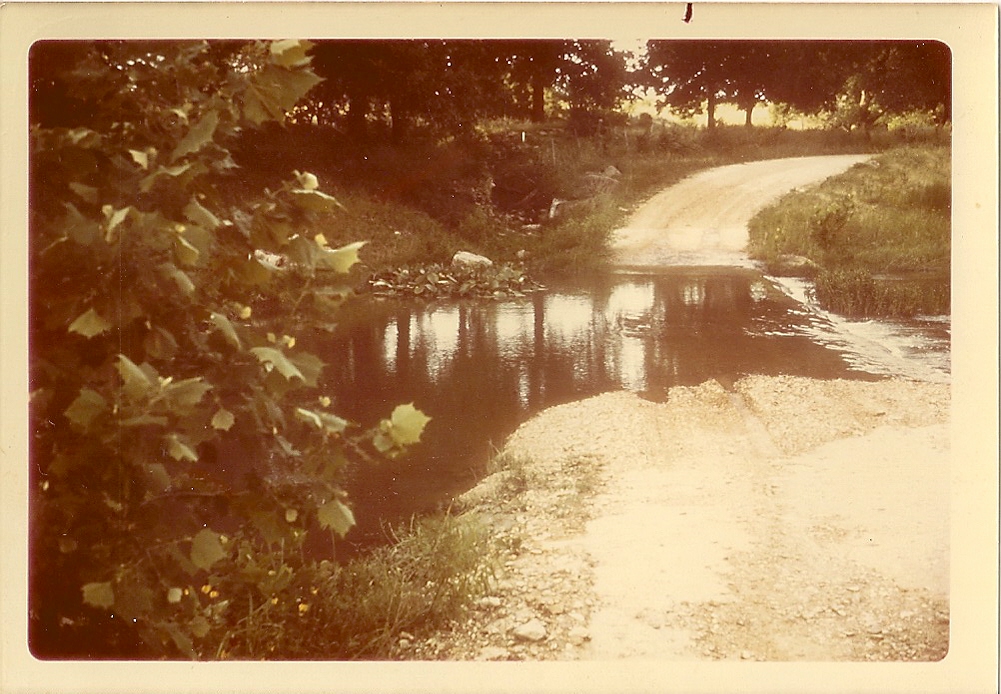
Rough Creek on the Parks Place, San Saba County, Texas, looking northeast, ca. 1970 (J. Matthews)

Relying upon memories of childhood can be misleading, even downright wrong in place and time.  As adults when we reflect upon last year’s vacation we may err in detail and conversations we thought we had.  Even so, memories preserve detail that can re-emerge with an almost preternatural force with a bit of reflection and musing, even to the point of re-evoking scents and cachets of the past that transcend the moment.

My mother and grandmother never hosted parties, but they hosted and partook of family celebrations — Thanksgiving, Christmas, Easter, birthdays.  And there were funerals, lots of them.  Funerals brought the Parks, McRorey, Morris, Ward, Millican and Ragsdale families together for burying kinfolk and re-establishing contact with distant relatives at Bend Sand, High Valley, Colony and Cherokee cemeteries in central Texas.  When I attended these functions, I had two sets of clothes, one for dressing-up and the other for outdoors.  Following the meal or funeral, I changed quickly into jeans and hiking shoes and explored and played with my cousins.  Having dinner at the Parks Place signified the best of all possible worlds because Rough Creek ran through it.

Rough Creek flowed through my great-grandfather’s place and formed the backdrop, foreground, side-scene and main-event for me.  Even today, still, Rough Creek continues to course through my mind and heart and its memory pacifies my days.  My great-grandfather’s ranch was called the Parks Place.  Not the Parks Ranch, the Parks Place.  Rough Creek cut the Parks Place in two parts, emptying into the Colorado River that bordered the east boundary.  For untold generations, Comanche Indians encamped at the confluence of Rough Creek and the Colorado, only to be driven away in the 1840s with the settlement of the area.  In the field north of the creek, after a hard rain, flint tools lay exposed.  A large midden revealed debris of hundreds of years.

I found stone tools, but my primary focus concerned the creek.  A county road ran through the Parks Place and at the creek, a large concrete slab had been poured, forming a stone-firm foundation for the road and continual pool of fresh water for perch, catfish and minnows.  Blue-colored dragon flies lit on green lily-pads and joined together in reproduction that I never fully figured out as to male and female flies.  Sycamore, cottonwood and pecan trees shaded most of the creek’s bank.  The water temperature was cold and it took a few minutes to become accustomed when as a boy my mother allowed me to swim and wallow with slippery moss on rounded stones.

I hiked up and down both banks of the creek.  When the terrible drought of the 1950s occurred, Rough Creek continued to run.  Neighbors in pickups with forty-five gallon water drums, came to the creek, parked on the slab and filled drums with water.  Their children swam and played in the water while the adults bailed water into the drums with buckets.  The elders were sun-tanned and strong, their hats crusted with dark sweatbands that bespoke toil and care for their cattle and family.  My great-grandfather never closed the road and I never saw the gates closed.  Cattle guards — steel-framed panels set in the ground — allowed trucks and pickups to pass over them unhindered, but kept the cattle in check and within the bounds of the Parks Place.

My great-grandfather gave me a branding iron, an iron with a capital “P” for the Parks Place, when I was a boy.  I have it hanging in the alleyway of my barn and see it everyday when I feed Star, my paint gelding.  I’ve not used it because our brand is a Running M.  I do not think of cattle when I see the the branding iron.  I think of Rough Creek on the Parks Place and I wonder how high the water is at the crossing.  Is it high enough that perch and catfish swim back and forth across the slab?  If another drought comes, will the present owners be patient with the neighbors who come to fill their drums?

In the early 1970s, I took the photograph of Rough Creek that sets the banner and feature photo of this post.  The Parks Place had been sold and passed into other hands.  The road remained open and I stopped at the creek’s edge and took this photograph.  I framed it with the sycamore on the left and the road and concrete slab in the foreground.  Behind the trees, on the upper left-side of the photograph is the grist mill, but you cannot see it clearly.

The photograph verified that my memory remained good and that cool, fresh water flowed over a concrete slab with lily-pads and bull rushes abounding.  After taking the photo, I drove slowly out of the Parks Place and up the road, past the mill and over the cattle guard I had seen when I was young and had most of my life in front of me.

______________________________

Notes:

The intersection of Rough Creek and the road is precisely 31.136°N 98.5468°W, elevation at center: 1,119 feet (341 meters), San Saba Quad map.

I have a true narrative I have written involving a court case between my relatives and the first owner of the Parks Place (not the present owners) after it was sold.  The first post-Parks owner attempted to close the road.  My cousins de-welded the gates, threw them in the pasture and smeared his brand on the portal with cow manure.  The owner sued my cousins in civil court — most upset he was about the cow manure.  My mother and cousins testified that the road running through the Parks Place had always been open for ranchers and their families living in the back country, and that closing the gate impeded the commercial and social intercourse, long-standing in history, of the community.  The owner lost the case, sold out and moved on.  The present owners of the former Parks Place indulge me and my kin when we stop and look at Rough Creek as we go into the back country.  My great-aunt Helen Tom, daughter of my great-grandfather, talks with the present owners about her growing up on the ranch and they allow my aunt to visit and see the place at any time she so desires.
16 Comments

Filed under Bend Texas, Colony Road, Recollections 1942-1966, Recollections 1966-1990, San Saba Texas

Acequia and Rough Creek mill race

Acequia Madre of Santa Fe

Throughout the upper Rio Grande bioregion, from the uplands of the north to the more desertic and mesa lands to the south, watercourses and their tributaries stand apart as the most defining features critical to all forms of life, biotic and human.  For centuries, this region has been homeland to the aboriginal peoples, the Tewa, Tiwa and Keres (Pueblo) Indians, and the descendants of the first European settlers, the hispano mexicanos.  These cultures revere water, treasuring it as the virtual lifeblood of the community….Nestled within the canyons and valley floors, tiny villages and pueblos dot the spectacular, enchanting landscape.  Their earthen ditches, native engineering works known locally as acequias, gently divert the precious waters to extend life into every tract and pocket of arable bottomland….

But these systems have also performed other important roles…social, political, and ecological.  As a social institution the acequia systems have preserved the historic settlements and local cultures spanning four major periods….The great majority of acequia villages are unincorporated.  In these instances the acequia institutions have functioned as the only form of local government below the county level.

As biological systems, the acequias have served other important objectives:  soil and water conservation, aquifer recharge, wildlife and plant habitat preservation, and energy conservation.

Jose A. Rivera, Acequia Culture: Water, Land, and Community in the Southwest, pp. xvii-xviii (1998).

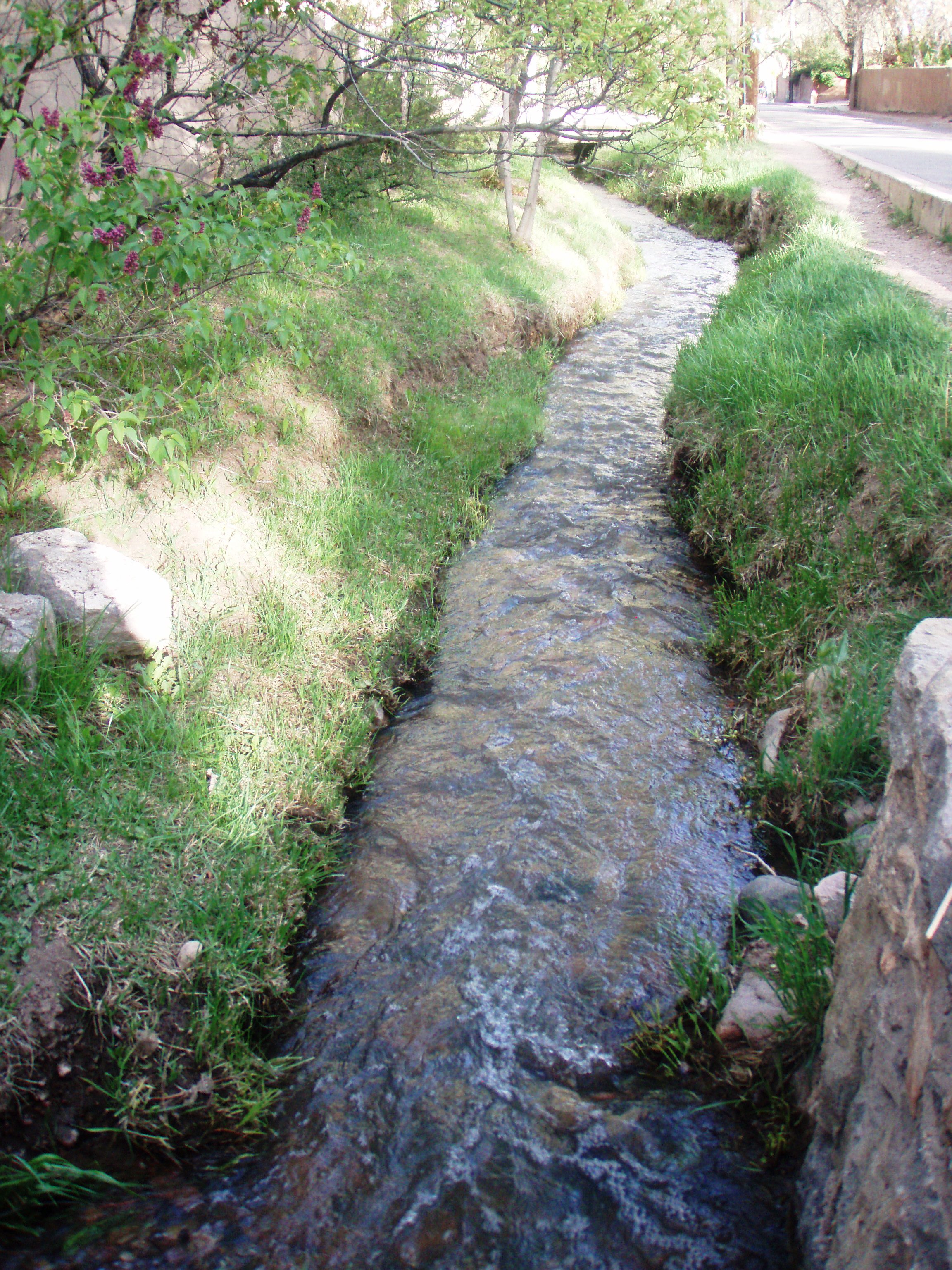
In 2007, I drove up Santa Fe River canyon from downtown to the iron gates of the reservoir that held water for the town, including the Acequia Madre.  The acequia no longer irrigated fields, but the channel held water for occasional diversions to small plots in the neighborhood.  For a distance of about two miles, I traced the acequia back towards the center of Santa Fe.  All along the way, I saw some neighborhoods had gleaned the acequia while others ignored it.  At the end of my search near the junction of the Old Santa Fe Trail, the acequia held little water, but it was visible and grasses sprouted about the narrow canal.  It appeared ready, at attention really, to carry water again.

* * *

I spoke with a vintner at Dixon, New Mexico, north of Santa Fe, who also superintended the annual cleaning of the Dixon acequia.  She told me that local inhabitants still work on keeping their canal clear of brush, even if it does not border their property,  a communal behavior extending back to prehistoric times.

* * *

On my great-grandfather’s ranch in San Saba County, Texas, the local inhabitants of Colony and High Valley constructed a grist mill for grinding grain in the late-nineteenth century.  They dug a mill race or channel to divert the water of Rough Creek to the wheel that powered belts to millstones.  My mother often told me she remembered her father coming out of the mill covered in flour, face smothered and sweaty.  As a boy, when I visited my great-grandfather’s ranch, I followed the channel upstream on Rough Creek to where the water diverted.

Today, the mill still stands sans roof, windows and doors; the mill race is visible, though eroded, and no water flows.  On the second story ledge of the mill, a prickly-pear cactus took root in shallow soil, erupting ten or twelve paddles of cacti clearly visible from the ground, its propulsion coming from the prevailing southwesterly wind from High Valley and warmer climes in Mexico that blew seed upwards onto the old mill’s second story.  To this day, picnics and family reunions congregate about the old mill and under the pecan trees nearby.

Although some acequias have fallen into disrepair and the old mill will no longer grind grain, no lament is necessary because these structures symbolize the communal efforts of people to work with the flow of water.  Acequias can be cleaned out and the mill race can be reconstructed to a higher ground so that its flow can be opened to a newly-planted orchard of plum and peach.  The mill race becomes acequia.


10 Comments

Filed under Bend Texas, Colony Road, Recollections 1942-1966, San Saba Texas, Santa Fe

The eve of a new year on the ranch

Pigeons flying towards a new year above the Santa Fe plaza.

 We make resolutions and there’s nothing wrong in doing so.  We plan to do better, give more and finish the big chores we have had on our list for months, maybe even curtail or give up our vices.  Well, maybe not completely give them up, but back off bad habits.

I work with students, horses and the land.  I work in order to live, not live in order to work.  That’s a big, big difference.  Working with students this last year has been more rewarding than ever before in my professional career.  I attribute that to my nearing retirement and wanting to give what I think is of value to the student before I put the chalk in the tray and walk away.  Time is fleeting and I don’t have time to cover all the points, just the most significant.  So, for this next year, I resolve to cut the excess from the lectures and discussions and get right to the core: finding your voice, writing down your voice and tending to your own garden (Voltaire, Gilgamesh, Trilling).

For my life with horses, it’s a sadder year coming.  We are selling Sweet Hija who is pregnant with a female and Shiners Fannin Peppy, the first foal out of Sweet Hija.  Brenda and I will be left with our two paints, Star and Lilly, both having their share of health problems these days.  In January, we are going to Oklahoma City for the Mixed Winter Sale at Heritage Place.  Market forces beyond my control have cut through our ranch operations with a vengeance and the cost of horse breeding and market conditions force my hand.  What Brenda and I are trying to do, in taking Hija and Fanny to the sale in Oklahoma, is to put these fine horses in the best sale around so that they will have good homes or ranches to live out their days.  So, for this next year, I resolve to focus on Star and Lilly, build some good, strong pens in the Pecan Tree Pasture for their safety.  I resolve not to think too much about our loss of Hija and Fanny and the little one — difficult to push that resolution through next year, I guarantee.

And, finally with the land, I resolve to set up brush piles for the little critters, deer and birds about the place, not shredding every single bush like some of my neighbors.  Further, I want to learn the name of every tree species on Flying Hat Ranch, or at least make a major dent in nomenclature.  I will also continue to plant native grasses about the pastures.

The eve of 2011 is here.  I toast to love, health and fortune to be found among horses and land, family and students — yours as well as mine.

Sweet Hija at full gallop in winter snow (2010).
Fanny strutting in the grove with Shiney (summer 2009).

15 Comments

Filed under Flying Hat Ranch, Lilly, Shiners Fannin Peppy (Fanny), Sweet Hija

“From the Stone Wall” by Wildramblings

Far away from the Southwest, this nature writer describes a day in the New England woods, not so far different from our treks and hunts among the mesquite, cholla and oak.  Wildramblings is a blog worthy of putting on your roll.  Click the link below and relish fine writing.

From the Stone Wall | Wildramblings.

7 Comments

Filed under Adventure, Life in Balance

Emergent Rushes on Baird Hill Pond?

I drove by the Baird Hill Pond on the way to work this morning in Abilene, Texas.  My habit pattern for eleven years has been to look closely at the pond’s condition and waterfowl that may be browsing.  The pond in the last two years has been devastated with unknown toxic runoff.

This morning, however, I think I noticed emerging rushes along the pond’s edges!  The water has appeared clear and a healthy-dark blue recently, so my first observation about new growth of rushes may be validated.  The pond is along Interstate 20 as you ascend the hill westward to Baird, Texas.  I shan’t get too excited until the sprouts I see emerge farther.

No access road beside the pond allows me to stop my pickup and look closer.  I will have to park about 200 yards away to take photographs from the barrier wall.

We shall see what we shall see.

2 Comments

Filed under Baird Hill Pond

Rewilding the Self

Rediscovering nature and its sentient beings is “rewilding.”  In the mid-1990s, Michael Soule of the University of California, Santa Cruz, proposed the idea that to restore ecosystems one should start from the topside down — reintroduce bears, wolves and otters to a deteriorating system.  Soule’s work was in conservation biology, but is now applied to psychology.

To many people in the field of mental health, a rewilding of the psyche is essential to the “heart’s ease.”  The following article from The New York Times expands on several themes surging in ecology and psychology.  I highly recommend you read this.

Is There an Ecological Unconscious? – NYTimes.com.

Artwork by Kate MacDowell (Photograph by Dan Kvitka for The New York Times)

8 Comments

Filed under Life in Balance

Yucca Meditation (Parachuting Cats)

Yucca Thoughts

This is Yucca Meditation.  Why yucca?  It’s an abundant succulent on our place here in west Texas and every time I look out from our porch to the southern skies and mesas, I see yuccas.  Yuccas here, yuccas there, yucca yucca everywhere.  I like yucca.  Surrounded by a lot of yucca, I think about many things.  Nothing more, nothing less.

The Pond on Baird Hill

I have written a post on the pond at West Cut on Baird Hill, along Interstate 20, near Abilene, Texas. The pond in the last two years has gone from a vibrant, lush pond of cattails and flora to a grayish-brown receptacle of run-off from nearby inclines.  Though my proof is impressionable and subject to further research, the most likely cause of the pond’s decline is water run-off from construction of power lines above the pond that transfer power from wind farms on the east and north side of Abilene.  I saw the construction crews and they did not run willy-nilly all over the ranch land.  From what I saw, crews behaved as stewards to the land.

These days, wind farm blades turn and electricity emerges from a green source, renewable and free by all accounts.  Even so, because of transmission lines, a pond declined in health, an impact unintended and unforeseeable.  This brings me to the cats.

Dayak of Borneo

The Dayak of Borneo (Imageshack, Asian Chat)

After World War II, the World Health Organization (WHO) and other similar agencies sought to eradicate the mosquito that carried the plasmodium of malaria.  DDT was the first insecticide applied in regions that had a high incidence of malaria.  In Borneo live the Dayak people, residing in large single homes or long houses of up to 500 people.   After the application of DDT to the mosquito population, malaria was eradicated and the overall quality of life and energy of the tribe dramatically increased.  The tribe’s health had never been so good (1).

Living in the long houses, however, were cockroaches, cats and small lizards — the gecko.  The cockroaches ingested the DDT and the geckos ate the cockroaches.  Normal pattern.  Cats ate the lizards, but the lizards had become lethal weapons through the eating of so many cockroaches laced with DDT.  The cats, unfortunately, all died from eating the lizards.  Not normal.

The unintended consequences of helping the Dayak people eradicate malaria did not stop there.  When the cats died, rats from the surrounding woods invaded the villages, bringing the sylvatic plague through fleas, lice and parasites rats normally vectored.  The Dayak missed their cats greatly.  The Royal Air Force (RAF) and the WHO met the situation in quick order.  The RAF parachuted 14,000 living cats into the villages to eat the rats.  I can see it now:  parachutes with kitty-cats in crates dropping from the skies.  I don’t think they would have harnessed the kitties with little webbings and ripcords, do you?

It doesn’t end there.

In the roofs of the thatched houses lived a small caterpillar that burrowed into the rafters and before the DDT spraying, caused little damage.  Parasites and predators of the little caterpillar had kept the caterpillar population in check, particularly the wasp.  The DDT killed the parasites of the caterpillar, the caterpillar population skyrocketed, burrowing deeper into the rafters of the long houses and single homes, resulting in the collapse of the huts and exposure of the population to the elements before repairs.

The Dayak must of thought the end of the world was near, seeing cats drop out of the sky and houses collapsing.  Oh, the evil WHO!

A Law of Unintended Consequences

DDT has now been discredited and is not used widely, if at all.  The initial application of the chemical was intended for good effect and that was attained, yet the unintended consequences were disastrous for the Dayak, and, we know today, bad for many organisms in the food chain.

The correlation of DDT and the effects of wind farm construction occurs only at the juncture of unintended consequences.  DDT has been completely taken out of most systemic plans for public health.  Wind farms will remain and should remain.  The West Cut Pond on Baird Hill will probably renew itself and ducks will arrive in October and not leave until March.  In comparing the degree of damage by DDT and transmission line construction, there’s no balancing of the equation.  Wind farms should stay.  DDT needs to be tightly regulated.

In the beginning, the application of new technology usually promises much: efficiency, improvement of health and speed (automobile vs. horse and buggy).  The continuing use of technology, however, reveals unintended consequences that may be destructive in a large sense (collapse of long houses) or small.  The decision arises as to whether to keep the technology, drop it entirely or regulate its use.

In my yucca frame of mind, let’s keep parachuting cats to a minimum and be careful, very careful, about the destruction of water habitats.

______________________________

Notes:

1.  See Harrison, Tom, 1965, “Operation Cat Drop,” Animals, 5:512-13 as quoted and utilized in the article, C. S. Holling and M. A. Goldberg, “Ecology and Planning,” pp.  78-93, in an anthology by Daniel G. Bates and Susan H. Lees (eds.), Contemporary Anthropology: An Anthology, New York: Alfred A. Knopf, 1981.

A blog post similarly composed is Planninga from Nanninga that has a parachuting cat cartoon and commentary on unintended consequences.

See also “Parachuting Cats — A True Story.” The cartoon illustration in the post is from this article.

Malaria cases in the U.  S. are minimal (1,200 cases a year), due to the previous use of DDT.  Malaria, however, appears in central Mexico today and is gradually coming northward to the U. S.  The application of some form of insecticide in the coming decades will be needed to eradicate the vector mosquito.

5 Comments

Filed under Life Out of Balance

Field Focus Log 4/18/2010 (RT)

North Erath County, Texas, 32.43 lat., -98.36 long. Elev. 1,086 ft.  Turkey Creek Quad.

I have a focus for field activity today: scout on ranch and immediate surrounds for white-tailed deer.  Last sign of track for deer was over a month ago and since then, noise and brush-clearing from adjacent development has occurred.  All entries for Sage to Meadow will be as close to real time (RT) as possible.

7:05 a.m. CST: scan in grove and pasture for deer, daylight.  No sighting.  Seek track later today with corn distribution.  No corn has been distributed for two weeks.  Probability of finding deer track is minimal.

11:30 a.m., depart for general store for deer corn.

1:00 p.m., arrive back at ranch with two sacks of deer corn, $7.50 per sack.  Rain and mist, 57 deg. F.

On Sundays, I purchase deer corn at the Circle H Shell gasoline station at Interstate 20 and Highway 281, approximately 20 miles away.  Since it is misting and raining, I place the deer corn in the cab of the pickup, the scent of fresh-shucked corn filling the cab as I come back to the pastures.  An attendant at Circle H remarks, “I loaded up a couple of sacks of corn yesterday in the back of my pickup and by the time I got back home there was water dripping from the sacks.”

“That’s why I put the sacks in the cab when it rains,”  I replied.  The conversation was amiable, an exchange of information from two strangers, overcoming boredom on a rainy afternoon.

2 Comments

Filed under Deer, Field Log

Field Log 4/3/2010

North Erath County, Texas, 32.43 lat., -98.36 long. Elev. 1,086 ft.  Turkey Creek Quad.

Day looks less windy and can broadcast grass seeds.  Disc and broadcast today (Saturday).  Take Sunday off.

Finished turning and applying disc implement to Pecan Tree Pasture and the house fields.  Turned about four acres in the far pasture, two acres at the house fields.  Harris’ Hawk flies overhead as I prep soil.  The Bryant field west of the pecan orchard is being plowed so lessee can plant seed for hay.  The lessee drives a John Deere enclosed cab.  I like my Case that is not enclosed, but has a Farmall sun shield, because I can feel the wind and smell the turned soil.  And, I really don’t want a CD player and radio on the tractor.  Also, when idling the engine, I can hear the Harris’ Hawk — can’t do that with enclosed cab.  Note: with the Bryant field stripped of grass and brush, there is less cover for wildlife.

As I apply the disc to the pasture, I can see the shadows of the Turkey Vulture (Cathartes aura) and Harris’ Hawk on the ground as they glide above the tractor.  Several vultures roost in the dead tree on the Bryant place, along Barton Creek.

Wind over past two weeks has dried out topsoil despite rain.

I say to Brenda at lunch that I saw a wren-type, ground-feeding bird in the native grasses that I have let grow in the Pecan Tree Pasture.  The bird spied the tractor coming and darted around and entered the tall bluestem grass (verify) as I passed by along the fence row.  I have shredded the pasture twice since I moved here, but I’ll not be shredding any more.  The fifty-three (53) acres will be as sustainable as I can make it.  Seeing the wren in the field of native grass that Cody Scott had planted in 2004, signals to me that the field is a good habitat for wildlife.  Last year as I worked in the field, I scared up two deer that had taken a rest in the high grass.  Since the Halls cleared their brush and have put Adirondack chairs in their grove, small bridges over their gullies and a workshop next to the Pecan Tree Pasture, I’ll not be seeing as many deer as I once did.  I’ll not be putting any chairs about the place.  I’ll sit on a log or lean up against a tree — nature’s furniture.

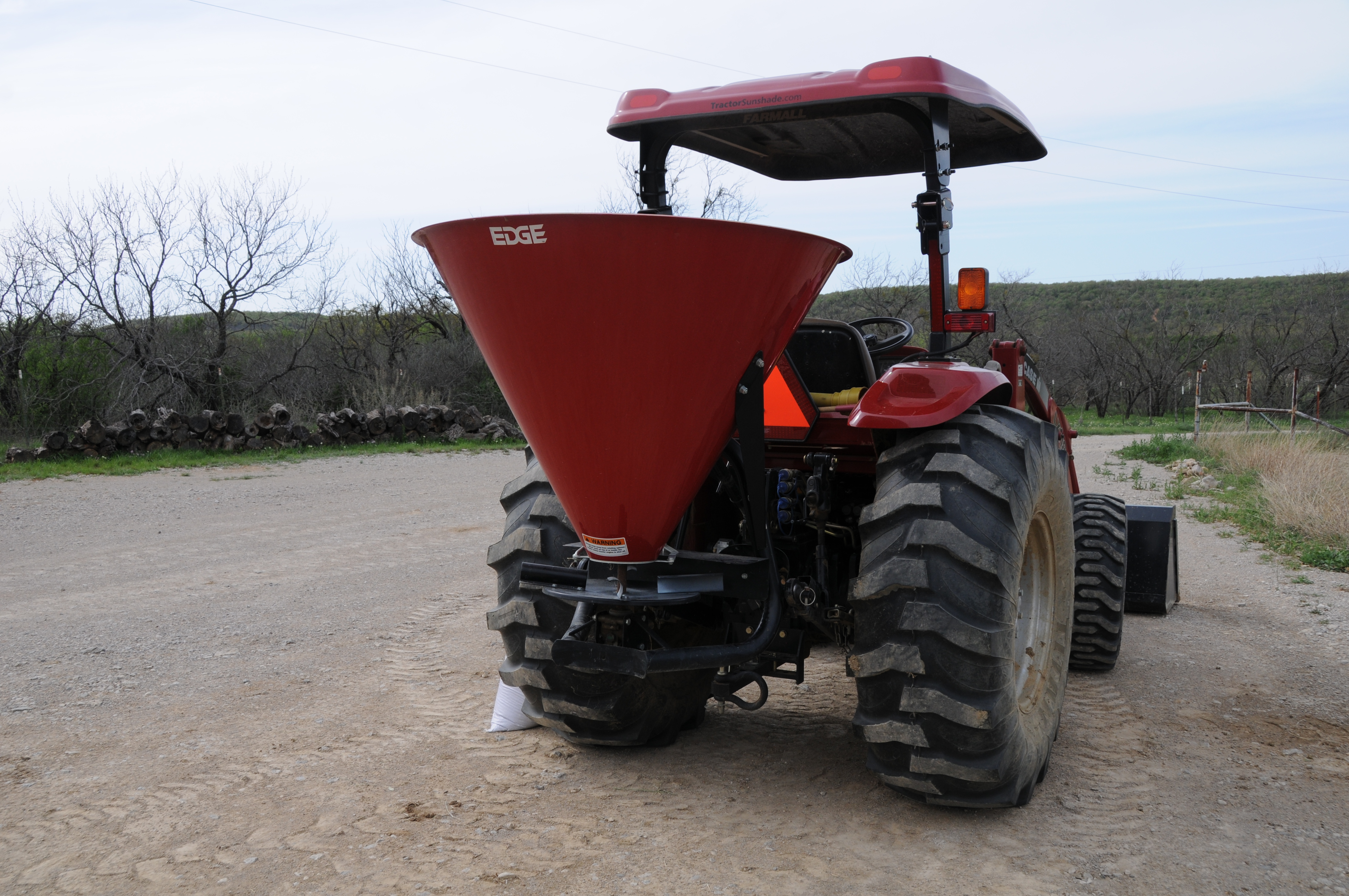
Brought up the tractor with the Edge broadcast seeder and spreader.  Backed tractor and spreader up to rocks on driveway so that water runoff would go onto lawn not puddle in driveway.  Attaching PTO difficult.  Used WD-40.

Case DX-55 with Edge Broadcast Seeder and Spreader, April 3, 2010 (click to enlarge)

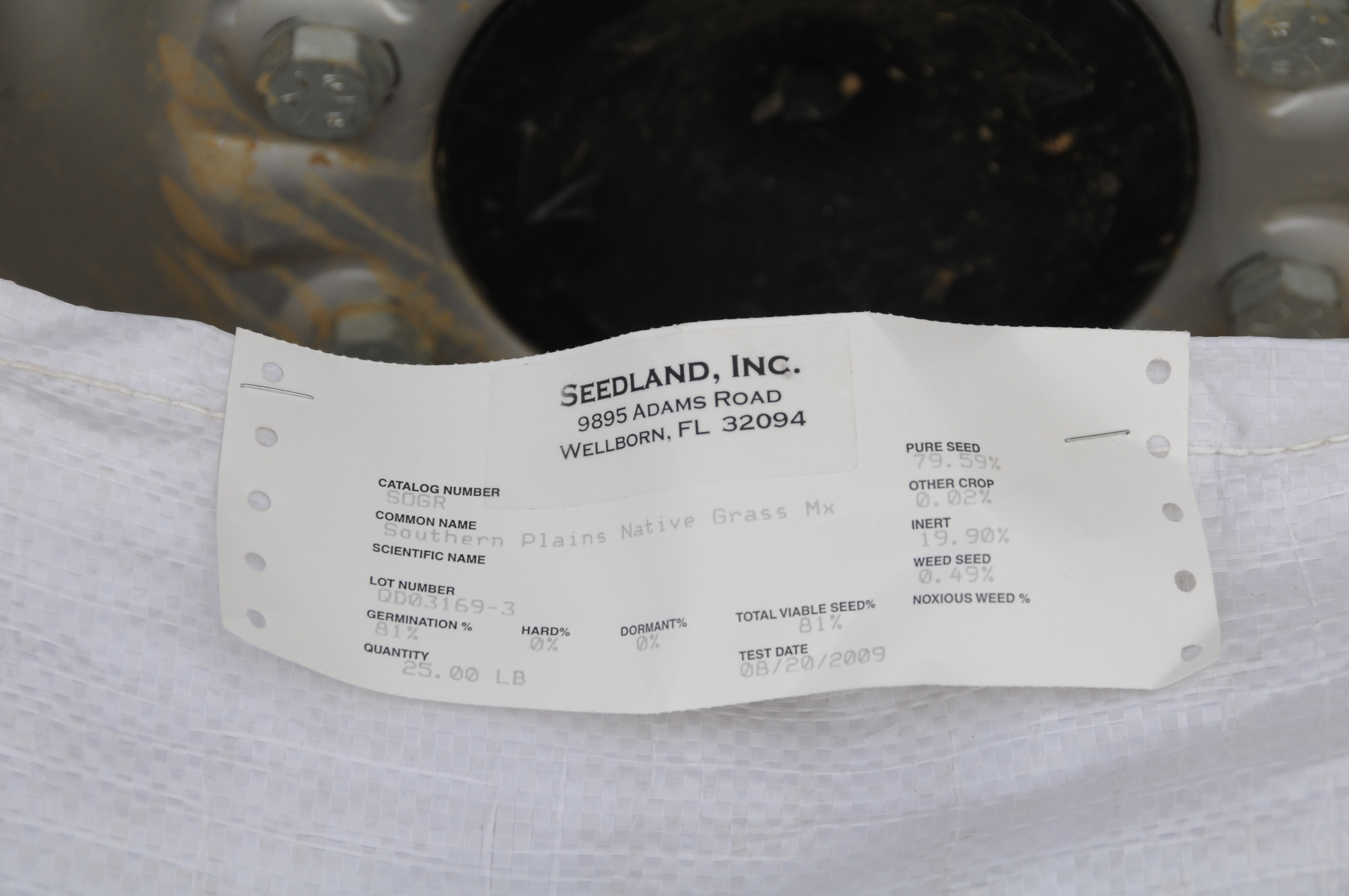
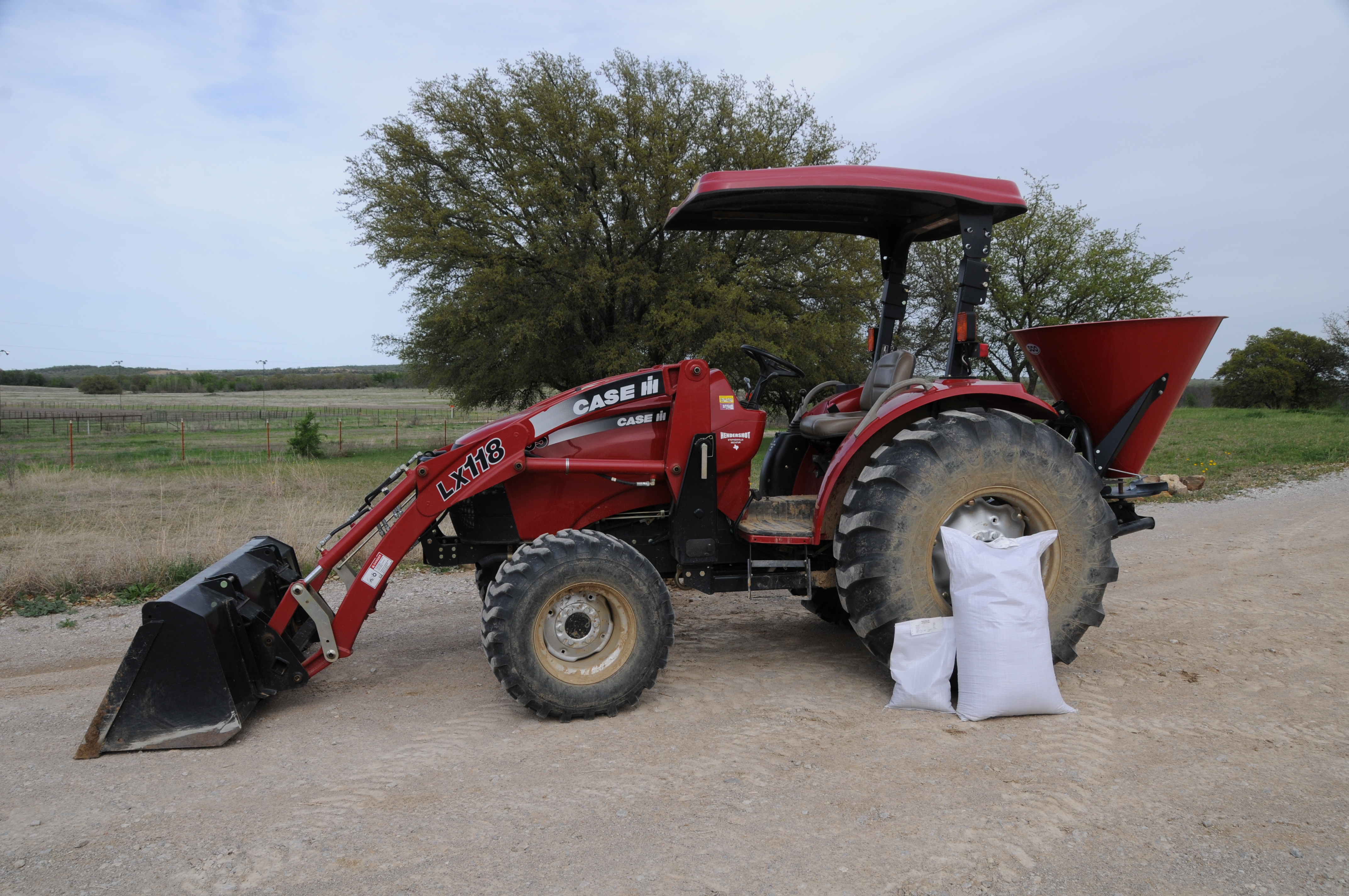
Made calculations as to orifice size to allow seeds to fall through and be broadcast.  Start out with a No. 2 opening.  In the thumbnail below you can see a large white bag and a smaller bag.  The larger bag is the native grass (25 lbs.) and the smaller is the wildflower seed (2 lbs.).

Southern Plains Native Grass Mixture #2901, April 3, 2010

Native Grass Seed Bag and Small Wildflower Bag, April 3, 2010

Texas and Oklahoma Native Wildflower Mixture, April 3, 2010

Wildflower Varieties Planted

Premium TEX / OKA Regional Wildflower Mixture

Common Name *Type Scientific Name Flower Color
Baby’s Breath, Annual A Gypsophila elegans White
Black-Eyed Susan A/B/P Rudbeckia hirta Yellow
Bluebonnet, Texas A Lupinus texensis Blue
Coreopsis, Lance-Leaved P Coreopsis lanceolata Yellow
Cosmos, Sulphur A Cosmos sulphureus Yellow/Orange
Candytuft, Annual A Iberis umbellata White/Pink/Violet
Coneflower, Purple P Echinacea purpurea Purple
Cornflower, Dwarf A Centaurea cyanus Mix
Coneflower, Prairie B/P Ratibida columnifera Yellow/Red
Coneflower, Clasping A Rudbeckia amplexicaulis Yellow
Golden Wave Tickseed A Coreopsis basalis Yellow
Evening Primrose, Dwarf P Oenothera missouriensis Yellow
Evening Primrose, Showy P Oenothera speciosa Pink
Gaillardia, Annual A Gaillardia pulchella Yellow-Red
Mint, Lemon A Monarda citriodora Lavender/White
Phlox, Annual A Phlox drummondii Red
Poppy, Corn A Papaver rhoeas White/Pink/Red
Prairie Clover, Purple P Petalostemon purpureum Purple
Sage, Scarlet A/P Salvia coccinea Red
Wildflowermix.com

Native Grasses Planted

The native grasses planted are: Blue Grama, Sideoats Grama, Buffalo Grass, Plains Bristlegrass, Little Bluestem, Prairie Junegrass and Sand Dropseed.

The wind came up to 10-15 m.p.h.  in the afternoon.  Delayed spreading until after supper at 6:15 p.m.

Following supper, spread seed in Pecan Tree Pasture and house pastures until 9:15 p.m.  Used headlights on tractor to finish spreading.  Orifice enlarged to Nos. 5 and 8.  Spread some seeds on arena-south pasture.  Must disc twice this area on Monday.

Salt Creek runs through the grove with about two-three inches of flow.  Tadpoles emerge.  I hear the trickle of flow as the water falls down on the rocks alongside the road to the far pasture.  Cannot use the road because of the water flow and must go around the Halls place on SH 108.  I put the Case tractor into high gear, fourth position and watch for traffic on the highway.  I have lights flashing.  In four trips to the far pasture today, only one vehicle passed me: a motorcycle with two people, man and woman, traveling to Stephenville, most likely to have barbecue at Hard Eight.

The quote I always have in mind:  Begin with the sun and all else shall follow.  — D.H. Lawrence.

4 Comments

Filed under Field Log, Plants and Shrubs