
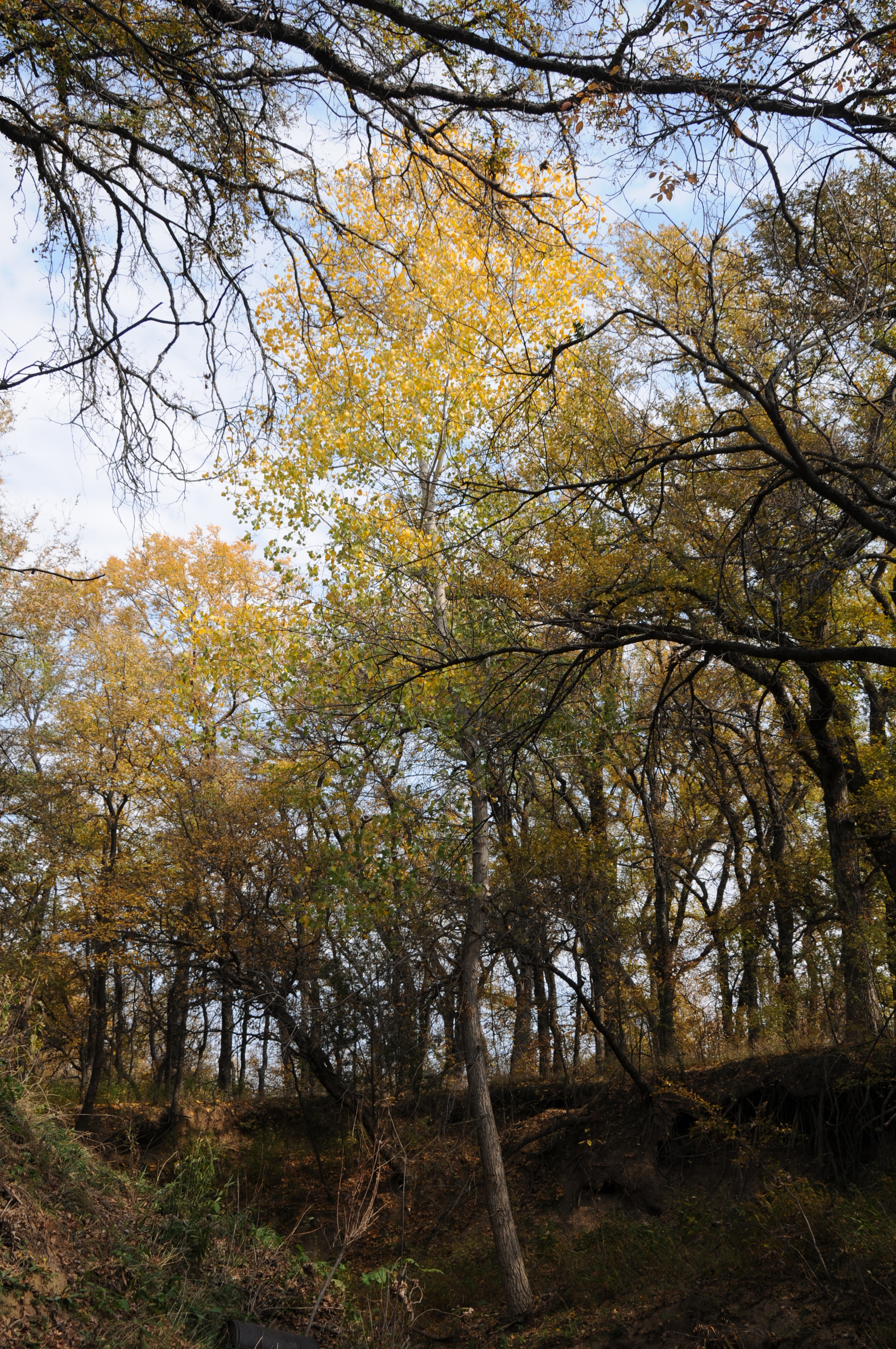
Cottonwood in the Grove
Populus deltoides var. occidentalis or Texas Cottonwood. Yesterday as I drove up the road to the ranch house, I saw in the Grove a brilliant yellow foliage from a solitary cottonwood along the creek. As it was late, I vowed to take photos of it the next day — today. I think it a young cottonwood, twenty-years old at the most, but I am not the authority. It is a healthy tree and its roots are embedded firmly into the bank of Salt Creek. I am concerned about the tree, however, as it is rooted within the confines of the creek and the creek flows quite rapidly after a thunderstorm. The pull of the current may bring it down this next year, yet, it has withstood the flow of water these many years, so it may endure for years to come.
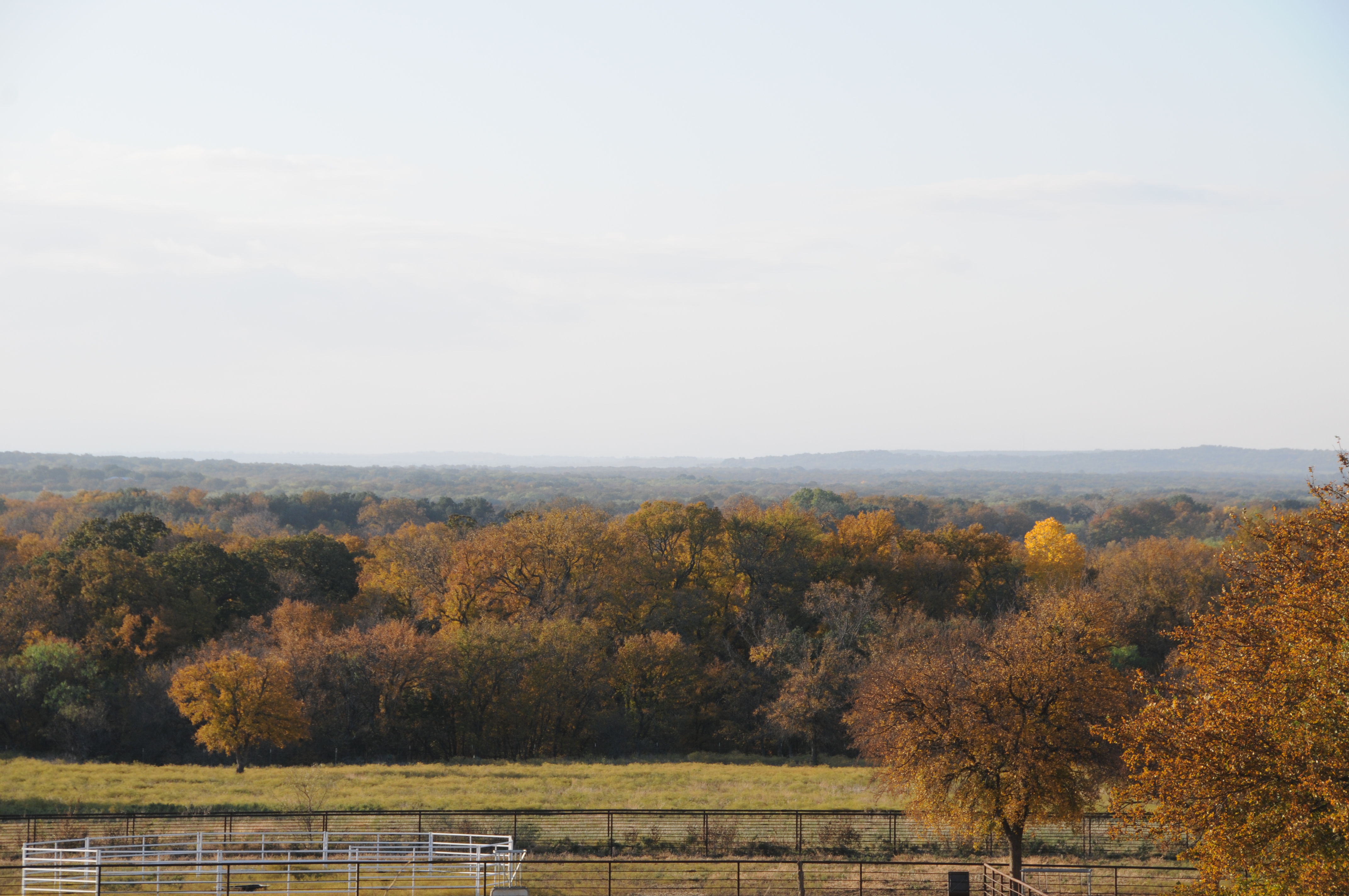
Panoramic view from the ranch house. The cottonwood is the bright yellow tree to the right of the scene.
The water current is not the only factor that affects the tree, but also the wind. Today, southern wind gusts peak at 35-40 miles per hour and the cottonwood swayed in the wind. Its leaves have been falling and blowing off for most of the day. The wind blows strongly. Rain is falling this afternoon as I write this post. The major squall lines formed north and east of me, near Fort Worth and the Red River Valley. I have had good rains in the summer, so the vegetation remains green, turning brown. The rains must have nourished the cottonwood most favorably, as well as the creek bed, because its foliage was dense and now with colors turning, it is the most spectacular flash of color in the Grove. Wind and rain have good and bad effect upon the tree.
There are male and female cottonwood trees. This tree appears to be male. I have not seen cotton spores float off of it, thus identifying a female. Here are the leaves on the bottom of the creek bed. One feature of the cottonwood that I find soothing is the sound of the leaves rustling. When the tree is green and fresh in the Spring, the sound is like a babbling brook, solid and deep. In the Fall, the sound of the leaves is a higher pitch, shallower, lighter-sounding, a fragile clacking like extremely delicate china. If this is a male tree — I think it is — somewhere in the vicinity is a female, a fecund being that issued seeds, bringing this tree to our place. I will look for it, up the Salt Creek, to the higher Salt Creek Cove, two-hundred feet higher to the west.
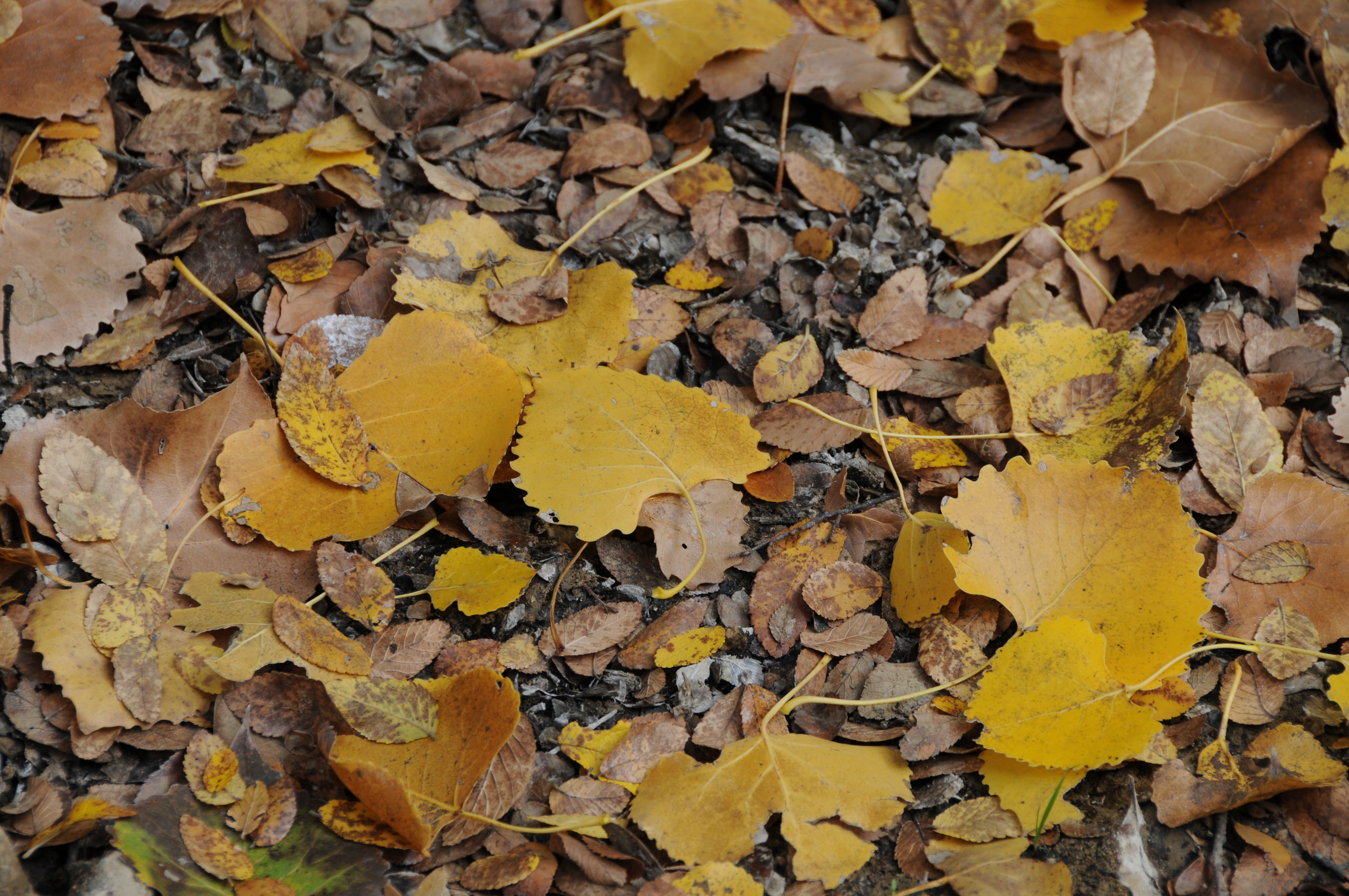
Cottonwood leaves in the bed of Salt Creek
Today, the sound seemed like a frenzy with the wind blowing so very hard from the south. The leaves, brittle and dry, began to fall in greater numbers and I was glad I hurried down after lunch to photograph the tree before all its leaves had fallen. I had hoped that I might capture a leaf in flight, but I did not. A monarch butterfly floated amongst the trees and I wondered if it could make Mexico by the freeze.
On the Blue place, the neighbors east of us, two cottonwoods grow along their pond next to our stock tank. There may be a female there. I hear them as well as see them. The area in north Erath county is dry. The appearance of these cottonwoods is uncommon and I revere their existence in clay and sand and moderate moisture. I sit on the porch and see the one cottonwood in the distance. I look to my left, to the east, towards Blue’s place and see and hear the trees. Ducks quack on both our ponds. When I drove to the Grove, I took the long way there, avoiding the pond road, lest I scare the ducks to the sky as I traveled to cottonwood yellow sound.
Related Articles
-
- A Rest Under the Shade of Cottonwoods (swamericana.wordpress.com)
- Sufficient fowl for our day (swamericana.wordpress.com)



















 Sage to Meadow ~ Jack Matthews