
Tag Archives: Abilene Texas
Ice in Trough
My first winters in Texas in the 1940s were in Brownwood, central Texas, but other winters fell upon me in Austin, Amarillo, and Mingus. Snowshoes and skies are not required in Texas, but gloves, long underwear, waterproof boots, field coat, and hood or toboggan cap are accouterments imperative to outdoor work or play. Chaps of wool aren’t optional, they don’t even exist this far south in the West. Wooly chaps would snag on brush and mesquite down here, spilling rider into the cactus and spooking the horse to bolt. If you insist upon wearing a hat, it must be felt and if it cold and windy, stampede strings are required to hold the hat in place although I have seen few strings in my lifetime. Usually, a hoodie is worn and a neckerchief is tied twice around the throat for warmth. The hoodie is hardly ever pulled up about the head. Too urban.
Most often these days the tending of cattle during a Texas winter is performed in a pickup, stopping to throw hay or chop ice from a trough. Mechanized feed bins on the back of flatbed pickups allow cattle cake or cubes to be dispersed without leaving the warmth of the cab.
This winter in the 2010s I must feed two horses in the stable area, then load hay and grain in the pickup and drive to the Well House corral to feed the other three horses. Before daylight in the morning, I shuttle the grain and hay into two feed bins without separating the horses. The horses sort themselves out, the alpha mare Sweet Hija makes the other two horses move aside as she chooses. I get out of the pickup with a flashlight and have the headlights beamed into the arena so that I can climb over the corral fence and chop ice. For the last five mornings I have taken the hatchet to the ice in the trough and chopped through two to five inches of ice. The water splashes up on my coat and glasses and freezes immediately. I become partially caked in ice and as I climb back over the corral fence, my gloves stick to the piping and I have to pull my hands away from the railing. I think of the movie Christmas Story and the boy whose tongue stuck to the flagpole. Nothing that serious here. Only gloves, not tongue.
I finish the chore of feeding horses before 6:00 a.m. on Tuesdays and Thursdays and drive around the Poprock Hill pasture, through the pasture gate and up the hill and out on the county road. Other days of the week I can feed later at daybreak, not in the dead of night. On Tuesdays and Thursdays I have a lecture at 8:00 a.m. in Abilene and I must be at the bottom of Ranger Hill by 6:15 a.m. to keep with my schedule on Interstate 20.
I drive to Abilene, my gloves are drying out on the dashboard, I’ve unwrapped the bandanna from my throat, taken my toboggan cap off and have my coat hung behind me. The Ford F-150 cab is warm. I think my lecture to the first class will be….
Filed under Horses
More Santa Fe Blizzard Express

Hermleigh, Texas, December 24, 2009
 Hermleigh, Texas, December 24, 2009
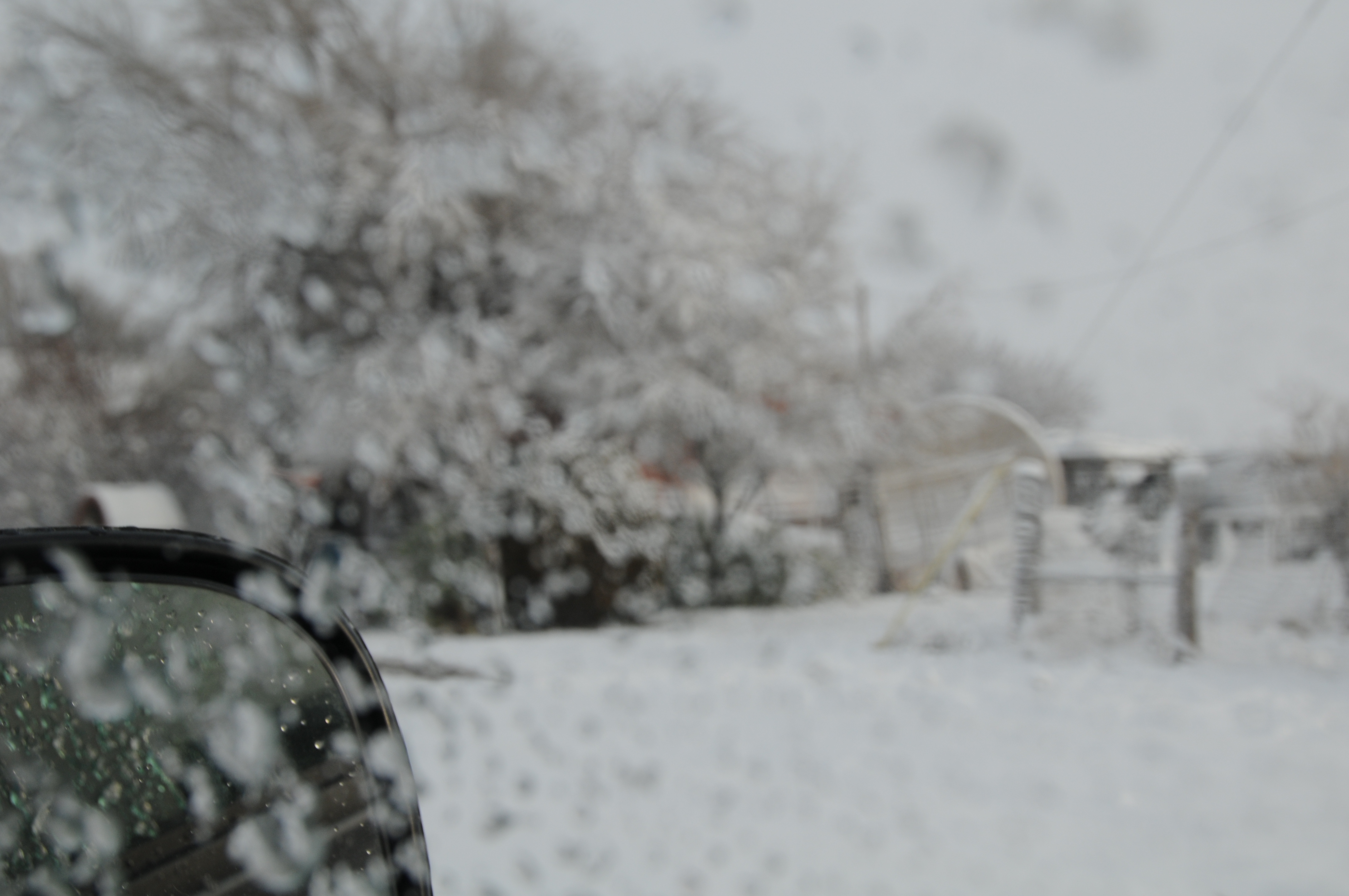 Roscoe, Texas, December 24, 2009
 Roscoe, Texas, December 24, 2009
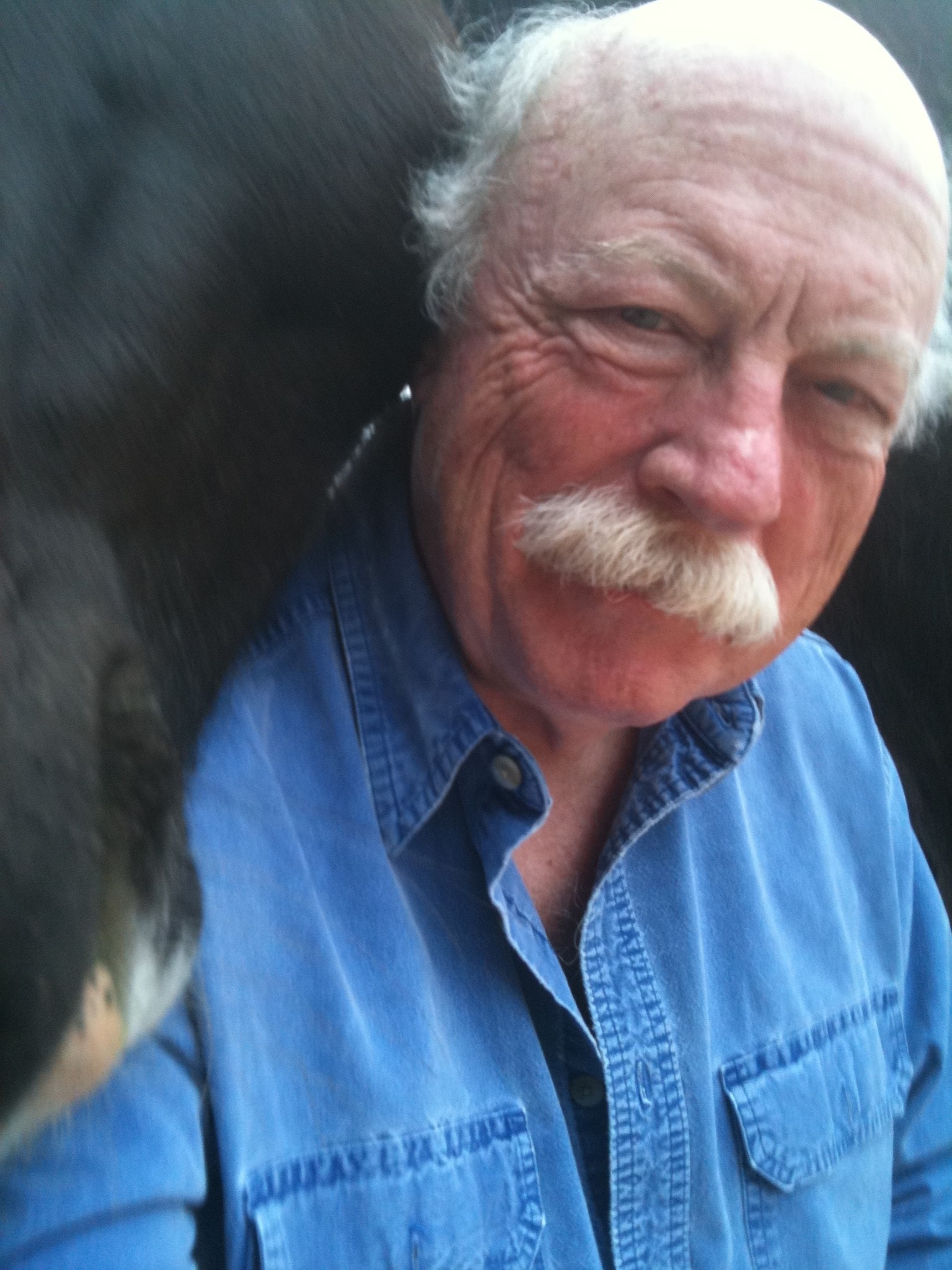
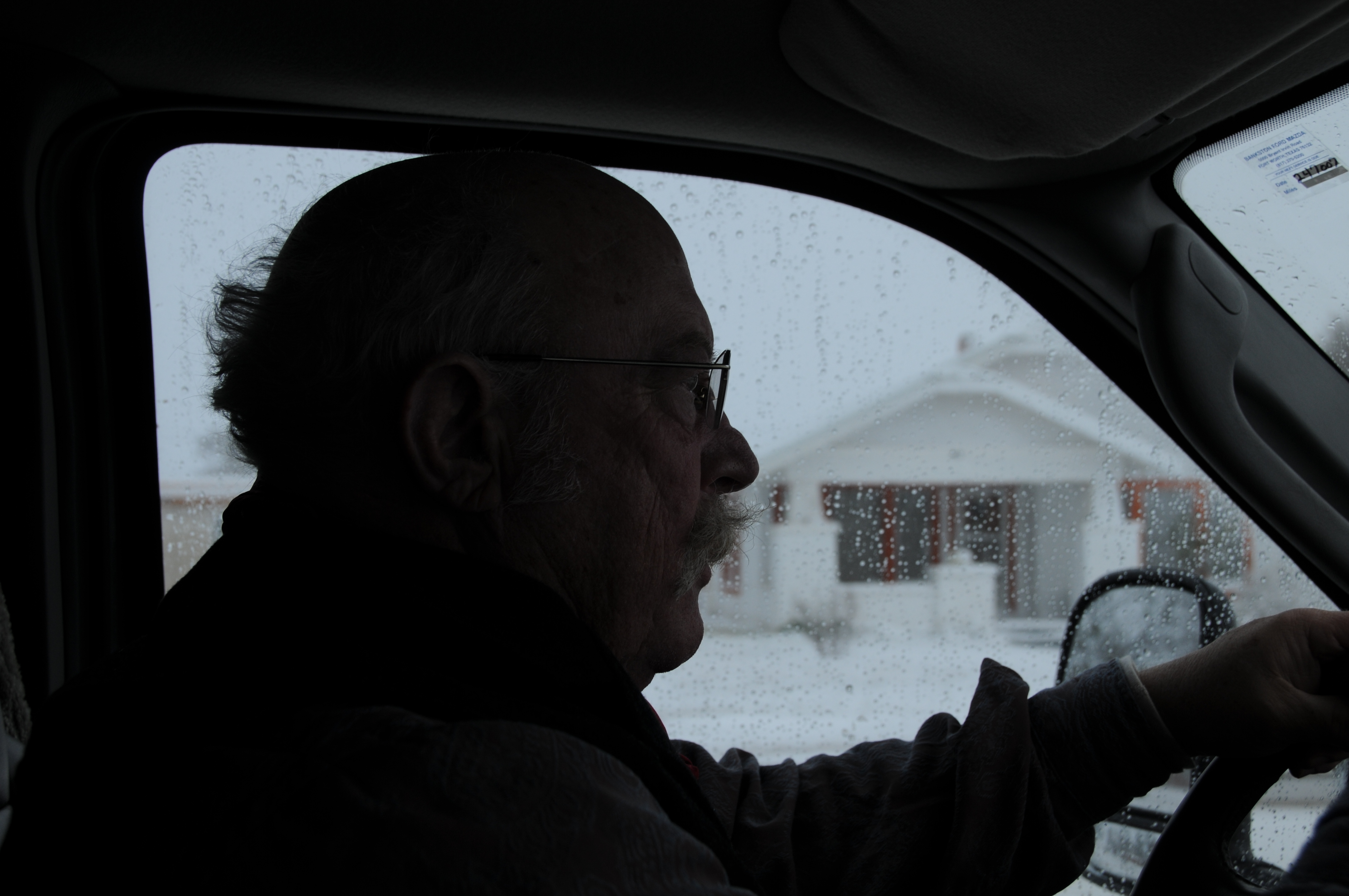 Jack Matthews, Roscoe, Texas, December 24, 2009
 Farm Fields, Slaton, Texas, December 24, 2009
We had been keeping up with weather forecasts before we left at 5:00 a.m. CST from our home in Mingus, Texas. The weather forecasts on December 23, indicated that the Arctic snow front would pass through the Texas Panhandle and Oklahoma, bypassing our route on Interstate 20 to Sweetwater, Roscoe north to Lubbock, then Clovis, Santa Rosa, Santa Fe.
On December 24, we left Mingus, temperature 37 degrees. We first encountered snowflakes in Eastland, Texas, but before that, only minutes out of Ranger, Texas, a Federal Express double-trailer had overturned, indicating, perhaps, high cross winds.
The snowflakes would not subside until we reached Lubbock at 2:00 p.m.
We did not encounter snow accumulating on the road until Sweetwater where we made a rest stop. At Sweetwater, the temperature was below 30 degrees. By the time we reached the turnoff to Roscoe, Texas, then north to Lubbock, the snow had accumulated on the highway and the wind blew the snow to a white out for a few seconds every so often. The turn off at Roscoe was treacherous because a white out suddenly occurred at the intersection and I had to “feel” the turn for a few seconds. At that point, I decided to go into Roscoe and put the cable-chains on the back wheels of the F-250. We also considered staying put and waiting the storm out and Highway Department to clear the roads.
The F-250 I drive is a 2003, the last year they made the 7.3 liter diesel engine. Our F-250 is maintained precisely to the Ford Motor Company’s guidelines, plus a few of our own. As a consequence, we have 240,000 plus miles and it pulls a twenty-six foot tack and stock trailer or a flatbed with a DX-55 Case tractor. We had a full fuel tank, blankets, phones, and food and water.
At Roscoe, I put the chains on and we ventured out again on the highway to Lubbock. At Hermleigh, we stopped at an Allsup’s for a rest stop but the convenience store was closed. Our daughter in Lubbock called by cell and said that there was a thirty-two car pileup at Post, so we first decided to go from Snyder to Lamesa, then Santa Fe by various routes, but the latest reports at Allsup’s from truck drivers indicated that the wreck had been cleared.
The wind turbines at Roscoe and Hermleigh were hidden by the snowstorm, but occasionally the wind would die down and we saw the giant turbines, less than a quarter-of-a-mile away, slowly turning in the storm. Nothing else but snow and the turbines. We maintained a long distance between ourselves and the car or truck in front of us to give us time to stop. Yet, we did not have the respect from cars in back of us. Truckers, however, gave us space. Since we had chains and traction, I could ease over and let cars and trucks pass us. Several cars that passed us we later saw in the ditch or median.
Our speed could not exceed 30 m.p.h. with chains. Finally, at Post, Texas, we stopped and I took off the chains. Between Post and Lubbock, we were diverted by the Highway Department to tour along the access roads and avoid going over bridges. In Slaton, a U.S. Postal Service truck was blocking the overpass because it had no traction and was stalled. We saw several National Guard medical vehicles headed south from where we had come. We later found out that Governor Rick Perry had called out fifty National Guardsmen to assist in rescue efforts.
From Post, then, we had no chains, but the Highway Department had cleared one lane by the early afternoon on the highway.
At Lubbock, we visited with our relatives and left Lubbock at 4:00 p.m. for Santa Fe, arriving at 9:30 p.m. MST.
Notes
“Postscript by Brenda: Jack’s writings depict the experience perfectly. What cannot be conveyed completely was the stress and emotions of the eight-hour drive to Lubbock…but, the picture of him above portrays his attentiveness. I was never terribly worried because I knew he was an excellent driver and near obsessive over safety. Yes, I wish we had left a day earlier, but I am happy to be in Santa Fe! Brenda Matthews, 12.28.2009.”
Filed under Adventure
Santa Fe Via Blizzard Express
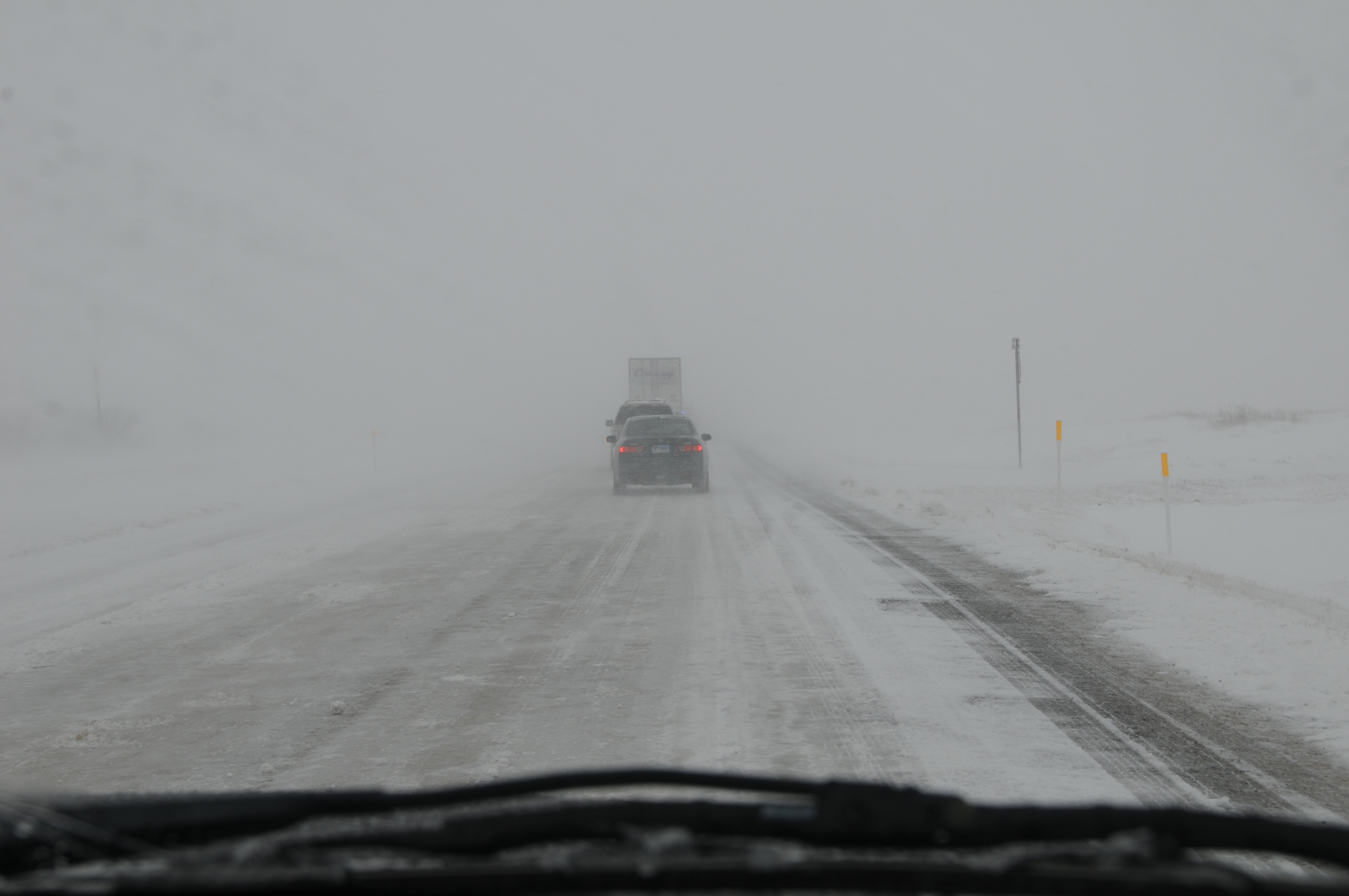
We made it to Santa Fe, New Mexico, yesterday evening at 9:30 p.m. MST, six-and-a-half hours behind our schedule, slowed and stopped by an unexpected blizzard that blasted into west Central and Panhandle Texas.
Nature commands, we follow.
We missed the farolitos and canceled our reservations at Casa Sena, but arrived at our hotel for the night. There was room at the inn, if you call ahead.
Filed under Adventure
Zacatecas Tutorial
I gave a tutorial yesterday to Alumna Zacatecas. (I have changed the name to protect her privacy.) Zacatecas is an older student from Mexico, enrolled in my world civilization course, prehistory to Treaty of Westphalia. Tutorials are incongruous with state junior colleges. Instructors have large classes, students coming by the office rarely occurs because of jobs and family. Zacatecas was different. She wanted to know things and, of course, there was the final examination on Thursday. She was blocked in deciphering Omar Khayyám The Rubáiyát [Edward Fitzgerald’s translation, 1859]. She had questions.
“I don’t get it,” she said. “Just what does Khayyám tell us in these verses about the meaning of life?” Zacatecas added.
Older student in her thirties, asking this? She was serious about understanding The Rubáiyát . She looked perplexed, not dramatic in face, small wrinkles between her eyes in puzzlement. Zacatecas had a tattoo about two inches below the hollow of her throat, often hiding it with high collar blouses because it had been inked when she was a teenager. Physically, somatically, she was interested, but wanted to know quickly and then leave the office. Other appointments, a teenager to manage? Many plates in the air.
“Tell me what you think Khayyám thinks is the meaning of life,” I asked.
It began, the tutorial.
“Fill the Cup…Wine of Life keeps oozing…A Jug of Wine…Cup of forbidden Wine…Drink!” She said, forcing an answer, phrases cobbled together.
“The meaning of life, is to drink?” She went on. Zacatecas was not being contemptuous, I could tell. Still perplexed.
No, not the meaning of life, to drink.
In class, I will ask the students to read a passage aloud they do not understand. Maybe it would work in the tutorial.
“Read the first quatrain, and, read slowly,” I said.
“The Bird of Time has but a little way/To flutter–and the Bird is on the Wing.” And, so on.
We paused. Zacatecas pondered, “The Bird of Time….” Still no change of expression in her face.
“Go on. The second quatrain.”
“The Wine of Life keeps oozing drop by drop/The Leaves of Life keep falling one by one….” And, so on.
“Continue, Zacatecas, the third quatrain.” I thought this quatrain would punch through her confusion since it is the most quoted.
She read the third quatrain, “A Book of Verses underneath the Bough/A Jug of Wine, a Loaf of Bread–and Thou/Beside me singing in the Wilderness–/Oh, Wilderness were Paradise enow!” And, there she stopped.
“Is ‘Thou’ you or is it me?” She asked. This was not exactly the question or declaration I wanted to hear, but at least it was movement.
I’m not a Rubáiyát scholar, but I answered, “Both, depending on how you read it, what context. ‘Thou’ can mean any person, you, me.”
She said nothing. Still cramped, stymied. So, let us skip and go on to the sixth quatrain. She read.
The Worldly Hope men set their Hearts upon
Turns Ashes–or it prospers; and anon,
Like Snow upon the Desert’s dusty Face,
Lighting a little hour or two–is gone….
Zacatecas became still in her chair, smiling faintly, looking at the sixth quatrain in her book. The smile held, her body visibly relaxed, her breathing slowed. She held the book more gently, less nervous, caring. The tension left her face.
Zacatecas looked up at me. “It’s about living fully because life ends like snow on the desert.”
The sixth quatrain captured her, but did not ensnare. Zacatecas integrated the refrain, something echoing from the high desert of her homeland, Mexico, an analogy with that day in her life when she parted from others of her village, seeing things they did not.
Tutorial over. I concluded Zacatecas was beginning to know The Rubáiyát, felt the quatrains, had a new sense, a higher circle of confusion. She left the office after a few more questions. Gregorian chant? Merovingian dynasty? Slipping her books into her backpack, she pulled her dark pea coat tightly against the Texas cold, her blouse tucked high over the tattoo and walked out of the tutorial.
She will pass that question on Thursday.
______________________________
Notes:
I use Elsa A. Nystrom’s anthology of primary sources, Primary Source Reader for World History, Volume I: To 1500.
Undergraduates, generally, say little to absolutely nothing to their instructors. At least, that has been my experience. Therefore, I have focused on para-linguistic qualifiers, above and beyond what tedious pedagogues call body language, although that, too. The pitch of the voice, facial expressions, postures, breathing, and the eyes. These behaviors are often the only way they will communicate. I have young men and women from different cultures and know that different cultures embed different qualifiers for communication. Hence, my observations about Zacatecas take a rather focused picture in my essay. During a regular class, I will observe a few students and how they are reacting. Mainly, however, I am focused on the material. A one-on-one lesson differs substantially.
Using diacritical markings occurs by composing the foreign word in Microsoft Word, then copying words created in Word, and then pasting onto WordPress. Cumbersome, but gives literacy to the composition.
I have always thought of D. H. Lawrence coming out of the last canyon on the road from Santa Fe, seeing Taos Mountain for the first time, the desert. He had written about New Mexico,
But the moment I saw the brilliant, proud morning shine high up over the deserts of Santa Fe, something stood still in my soul, and I started to attend.
The snows at Lawrence’s ranch linger longer than on the desert, but still melt in the spring.
Filed under Taos
Baird Hill Ducks and Mount Kilimanjaro
[I wrote this post on November 3, 2009. I have been writing about the Baird Hill Pond lately and decided to bring this forward to the front page and make it public.]
This morning at about 7:15 a.m. CST, I spied a flock of ducks on the Baird Hill Pond. This is my first trip by the pond since last Thursday (no ducks then) and with daylight savings time over, the dawn’s light illuminated the pond. From my pickup, I saw a flock of about fifteen ducks, paddling in the middle of the pond. Their presence shows that the pond sustains life. Whether or not the pond gains additional flocks remains to be seen, but the pond may be reconstructing itself.
Mt. Kilimanjaro snow cap is melting fast. Whether this is the result of global warming is unknown, but suspected. Arctic Ocean is opening up, Antarctica’s ice shelves are breaking up, and second homes (MacMansions) disturb the Taos Indian annual rabbit hunt. Baird Hill pond is losing its vegetation, but ducks are there today. How many more canaries have to die before we stop the misuse of our resources?
New York Times article on Mt. Kilimanjaro
______________________________
Notes:
Photo by Stephen Morrison on European Pressphoto Agency, as cited in The New York Times link above.
I think it was Borges that wrote once that a dead jaguar was found way up the slopes of Mt. Kilimanjaro, beyond his or her range by several thousand feet. Why? What so possessed the jaguar to seek the mountain, going beyond what was familiar? Borges or whomever it was wrote a short explication of their theory. I have mine and I shall post about it one day.
Filed under Ducks, Life Out of Balance
West Cut Pond on Baird Hill
Since 1998, I have looked at a beautiful stock pond along the West Cut of Baird Hill, on Interstate 20, near Baird, Texas, as I have driven to work in Abilene from Mingus, Texas.
The pond has deteriorated in health. It was a pond that had rushes of cattails, deep-green sturdy stalks, three to four feet high, lining the pond all the way around except for a few places where cattle could water or a tree had fallen. Ducks would fly in at the first cold snap in October and not leave until February or March.
The pond is set among hills on three sides, a spring-fed creek empties into the pond. The interstate highway at the West Cut blockades the downstream portion of the pond, creating a kind of highway dam.
Last year and the year before, power poles with transmission lines as big as your arm were erected above the pond and on the hills to the north of the interstate in order to carry electricity from wind farms on the north and east side of Abilene.
When the transmission lines were nearly constructed, all the the green rushes along the pond died.
The pond lost water and is down about a foot or two. At first, I speculated that the reeds had died as the result of some natural cycle, but that was not correct. The rushes died because of contaminants from the transmission line construction, road construction for the power lines, the wind farm construction, or a combination of all three factors. I did not take a water sample. Not my land. But, the owner of the ranch was just as surprised as I was about the change in the pond. The reeds have not reproduced.
So, we have more electricity that is suppose to be clean. It is. But, in the method of setting up clean energy, nature is destroyed. The pond is dying.
I will continue to observe the pond and will take photographs from the highway. Hopefully, nature will resurge again along the banks of the pond. And, I wonder if the ducks will stay long? Will they even stop?
______________________________
Notes:
July 25, 2010, update: The pond has remained unchanged. The color of the water has deepened to a blue-green and is not brown or brackish any longer. The reeds still have not replenished. I will attempt to take some photographs from the interstate for the record. To connect the transmission line construction and the death of the pond is correlative. I may be completely wrong in my hypothesis about cause and effect. More proof is needed.
Filed under Ducks
No Ducks Yet on the Pond
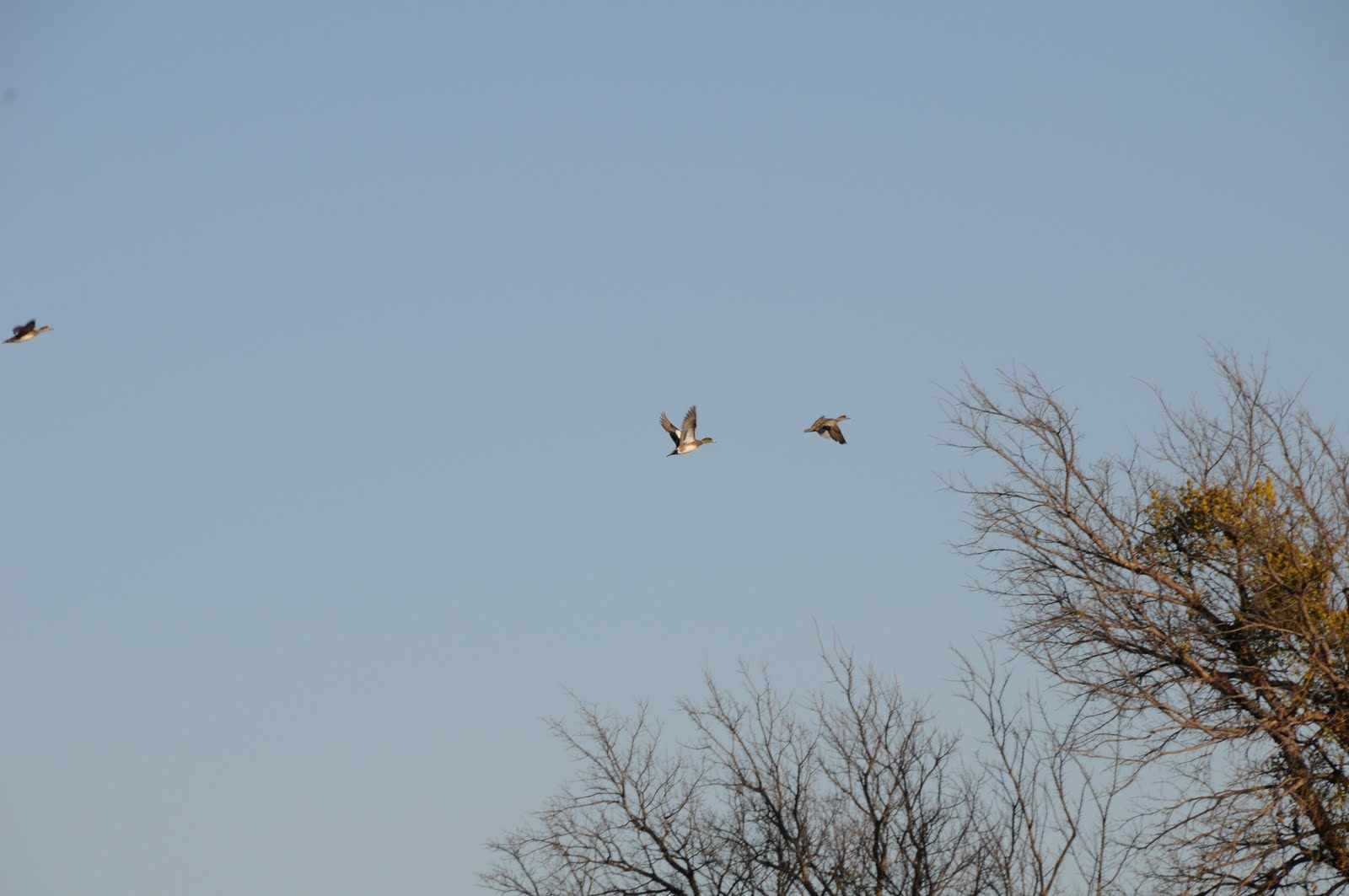
There have been no ducks on the pond as of today. There is a blue heron that comes every afternoon to feed at the pond. The coldest front of the season is to drive temperatures down tomorrow night and Tuesday. Perhaps, then, the ducks will fly in.
The photograph above, taken by Brenda, shows ducks in flight last winter.
Filed under Ducks
Old Dog Going Home
[I wrote this back in October as I drove to work. Thought I would bring it forward for you.]
I saw a dog as I drove on the highway to work this morning in Abilene, Texas.
The dog was a white, shepherd-like dog with long hair. He appeared old as his trot was barely a trot, more of a fast, determined walk. He was intent on staying on the left side of the highway, just a couple of yards out of the lane, a few feet from the grass median. I saw him about fifty yards before I came up along side him. He did not flinch when I passed him by. The traffic was fast at 7:30 a.m. and neither I nor anyone else could have avoided him had he decided to veer into the traffic.
But what impacted me viscerally was this old dog’s self-possession and determination to travel south on that road, at that time, to get home. It seemed that his intent to go home was so strong that neither dawn’s light nor the traffic would stop him.
Tomorrow, I don’t want to go down that highway and see him dead on the side of the road. I have to take that road; there’s no other highway to work. That old dog better not have gone the way of so many old souls. I may look for another route or go off on the access road.
I truthfully don’t know if the old dog was going home. He was old and may have been addled to the point of madness to walk along the highway. But, I would like to think he was headed home after escaping heartless people.
Seeing him, determined to go home, struck me viscerally and I frankly moaned at his fate, his momentum, his destiny. Whatever spirit-that-moves-in-all-things should spare that old dog an accident today and carry him to his destination safely with biscuits and bacon and companions-of-old being his due at the end of the road.
Filed under Dogs


















 Sage to Meadow ~ Jack Matthews