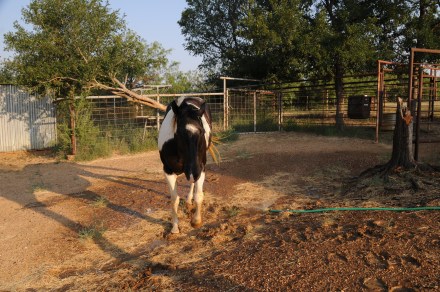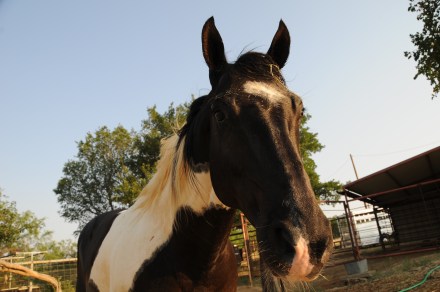
If she isn’t the prettiest thing you’ve ever seen, I’ll give her to you!

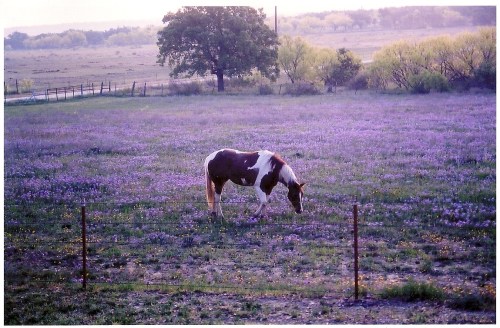
Wild Flower Gal with verbena (north Erath County, Texas, late winter, 2007).

Four winters ago, my neighbor, Jerry Wood who lives two miles south of me on County Road 114 stopped at my mailbox as I retrieved letters one morning.  We chatted for a few minutes as he kept his diesel truck running and as we closed our conversation he said, “I have a horse, Jack, [words unintelligible over the engine noise] I’ll give her to you!”

“I’ll give her to you?”  I had three horses at this time, two tobiano black paints and one quarter horse, Sweet Hija, and another horse added to the remuda would not be a problem to train and feed.  But, a gift horse?  I thought as Jerry drove off that he must be terminally ill or something drastic was going on like divorce or bankruptcy.  I immediately decided that if the horse was sound, I would take her off Jerry’s hands and ease his problem — whatever it was.

Within the week, I drove down to Jerry’s with my trailer hitched up, pulled into his corrals and saw Wild Flower Gal, a sorrel tobiano paint that was drop-dead gorgeous.  “Why would he even want to get rid of this beautiful creature?” I quietly thought.  In any case, he took her through her paces, showed that she was healthy and halter-trained and I liked her behavior so she would fit in after getting to know my other three horses.

After seeing her training, paces and overall friendliness, I asked Jerry, “Are you sure you want to give this beautiful horse to me, Jerry?”  I thought he was making a big mistake to give Wild Flower Away and I did not want to exploit Jerry’s problem — whatever the heck it was — in his hour of crisis.

“What?” he said.

“You did say, didn’t you, Jerry, that you were giving this horse to me?”  This was quickly going in a perplexing direction I did not like.

“Oh, no!” he quickly replied.  “I said, ‘If she isn’t the prettiest thing you’ve ever seen, I’ll give her to you.'”

“Oh, you did?”  This was definitely in embarrassing territory.  “How much do you want for her?”

“One-thousand dollars,” he replied.

I became a tad dizzy in my thinking at that point, but my mind quickly cleared the confusion:  Jerry’s diesel engine had blocked out his words, “If she isn’t the prettiest thing you’ve ever seen…”  And I had slammed his statement into, “I have a horse to give you, Jack.”

What to do?  Buy the horse and lighten my bank account?  Probably the best exit strategy.  If I did not buy Wild Flower Gal, I would probably be the center of an oft-told tale at the Hannibal Country Store concerning my over-eagerness to gainsay another yegua for free.  I did not want that circulating around the cracker barrel.

So, I bought Wild Flower Gal, loaded her up and brought her to my stables.  Jerry signed over the pedigree, pocketing a thousand.

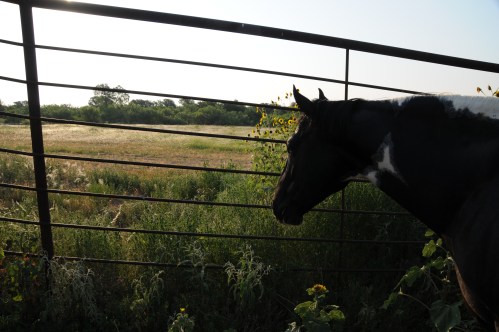
Wild Flower Gal was pretty, but not the prettiest gal I had ever seen.  But, pretty enough to buy and train and sever any anecdote about my confusion.  Several months later I snapped the photograph of her in late winter browsing through the wild verbena.  It was fitting, this photograph, because she was in a pasture of wild flowers that reflected her namesake.  I sold her a year later for a thousand dollars to a family near Abilene, Texas, that showed her at halter and loved her well.

A lot of lessons emerge from this story.  Verify and clarify conversations of commercial intercourse.  Cut your engines when conversing.  Above all, there’s no such thing as a free horse.

16 Comments

Filed under Horses, Sweet Hija, Wild Flowers of Texas

Downy feathers and purple fruit of Texas

The drought affect upon a person’s mood in Texas can quickly decline into prurient prose and photographs to the neglect of new abundances, new vacuums, curious presences in the arid lands. The drought’s vignettes multiple in west-central Texas:  Boer goats standing tall, eating mesquite and live oak leaves, dropping on all fours to dead grass; auction sales in Dublin, Eastland, and Coleman, Texas, that go on through the night and into the next day selling cattle that will, in the main, be quickly transported to packinghouses; cow tanks and water caches that were never dry in my lifetime are now barren, their empty beds cracking like dregs of buttermilk on clear glass; and reflective heat exploding my Boston Scientific Weather Station thermometer to 122 degrees.

No need to get angry at the weather; that’s crazy, wrote Nietzsche.  And after going over the daily picture rituals of dry, semi-arid, landscapes, I prefer not to reside in some smutty alcove of bereavement, rocking back and forth, counting beads, hoping for a drastic change in the jet stream.  I am in a droughty weather cycle, yes, but so?  Start designing interior plazas, stucco walls and arbors with water mists — all replete with scented juniper shade.  And, in the cool morning, begin construction.

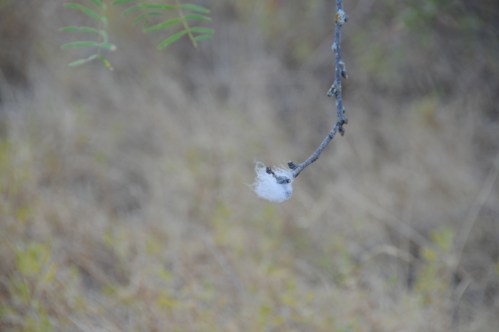
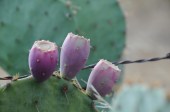
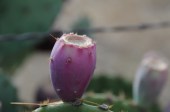
Then, in the field, observe all things, including downy dove feathers on mesquite and the purple tulip fruit of the ubiquitous Desert prickly pear.  These are trusty images to dwell upon during the heat of the day.

Desert prickly pear, New Mexico prickly pear, bearing tulip fruits that are edible (north Erath County, Texas, 2011).


15 Comments

Filed under Life in Balance

The aire be stirred with wild things

Barn swallow in flight, north Erath County, Texas (2010).

They were storks!  When they circled lower, the long beaks and the legs that trailed in the slipstream showed red as sealing wax.  An old shepherd was leaning on the ramp close by and gazing up at them too.  When some of the great birds floated lower, the draught of their feathers brushed our upturned faces, and he said something in Magyar — “Net, gobyuk!” and smiled.

Patrick Leigh Fermor in Hungary, 1934, in A Time of Gifts, p. 309.

Around me, the air has been stirred with wild things, but not storks.  During winters in central Texas I walked to the pond on my step-father’s farm and sat on the lee side of the water, standing still about a natural juniper blind, not moving, and ducks would fly so fast you heard them before you saw them, and they stirred the air about my face and landed swiftly upon pond water, sending ripples to the ice-crusted edge.  The aire be stirred with wild things.  In all the years around the pond, I took but one duck out of the sky, regretting it to this day because there was roast beef and bacon back at home beneath the thin, protective dish towel mother used to cover the food she prepared.

Three fall seasons ago I sat on the back porch, wearing an old, broad-brimmed felt hat as I looked out in the pasture at the horses.  Not moving much in the chair, a familiar wren — I had seen it countless times — flew down from the support post and landed upon my hat.  The wren stayed there for thirty seconds, maybe a minute, darting about the top of the hat, checking out the intricate perforations of the hat band for food, its tiny feet moving staccato-like about like a ballerina.  I felt its motion, the draught of wings I felt upon my face.  The aire be stirred with wild things.

Barn swallows fly through the porch today and stir the air.  They hover, literally hover in the air, fanning the porch like tiny, childish whirl-a-gigs, seeking a perch or possible nook for a new nest.  There are six swallows and they perform their aerobatics twice a day, morning and evening.  Coming close, within three feet, they chirp at me as an intruder in their world.  The aire, I tell you, is stirred with wild things.  And, ’tis good wild things.

______________________________

Notes:

See also The New York Times obituary of Sir Patrick:  NYT obituary of Patrick Leigh Fermor.

Somewhere in my reading, I remember an Englishman that was on an African safari and in the evening ventured beyond the compound’s fire pit and was attacked by a lion.  In the attack, the lion grabbed him about the shoulder from behind and started dragging him away into the bush.  The Englishman — how I wish I could find this story again — thought he was done with and remembered the smell of the lion and that the lion purred as he took him away.  Interesting the purr.  The man reached for his bush knife and stabbed the lion who released him and ran off into the dark.  Not all wild things that stir the air are so gentle.

10 Comments

Filed under Birds

Field gifts in July

At 3:30 a.m., with such dignity as I can muster of a July morning, I step from my cabin door, bearing in either hand my emblem of sovereignty, a coffee pot and notebook.  I seat myself on a bench, facing the white wake of the morning star.  I set the pot beside me.  I extract a cup from my shirt front, hoping none will notice its informal mode of transport.  I get out my watch, pour coffee, and lay notebook on knee.

Aldo Leopold’s early morning field method, A Sand County Almanac, pp. 41-42.

This July morning, a warm morning that will expand into hot, I walked the one-half mile of Salt Creek on my 53 acre ranchito.  Salt Creek is an intermittently-flowing creek that twists and curves through the forested grove in the middle of the 53 acres.  During heavy rains, the creek reaches ten feet high and lays flat the water-gap fences on the east and west ends of the property.  This summer, waiting out the worst drought since 1895, the creek remains intact, its bed dry; yet elms, junipers (beautiful they are), cottonwoods, oak and pecan trees uplift subsurface moisture, retaining their leaves and shade for owl, redbird, bluebird, sparrow, deer, armadillo, skunk, coyote and fox.

Salt Creek on this day holds one watery seep, fifteen feet in length of oblong, deep water.  Flush against the shady side, this watery seep encapsulates water three-feet in depth, the water flowing from the native grass field I have tended these last four years.  I discovered on my walk, along the one-half mile of the creek bed, it is the only source of water in the bed.  Wildlife track abounds around the water cache, and it is supplemented by my stock pond — amply full — a quarter-of-a-mile away to the northeast.  Animal tracks puncture the wet soil of both seep and pond.  Trails radiate in all directions from these water pools, life-sustaining hubs among tens of thousands of water holes in west Texas.

Walking, ambling really, I kept watch for the unanticipated field discoveries that, without fail, always occur; and if none appear, I have not looked upon, within and close enough, the land upon which I trod.  I wrote in my field notebook the jack rabbit, woodpecker, roadrunner and fertile pond algae as they appeared in good order from the house.

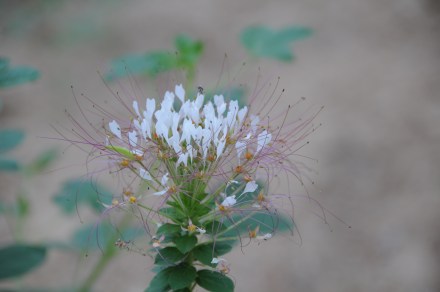
As I turned in the creek bed at the last big U-turn loop, I gazed upon color, flower color, I had never seen before: the Clammyweed.  Not exactly the classiest of names, but it is what it is.

Clammyweed (Polanisia dodecandra), Salt Creek, north Erath County, Texas (July 27, 2011).

Clammyweed grew on a sand bar in the middle of the dry creek bed.  Seven blossoms on three plants taunted the drought in all its brazen heat, stating in siren tones that shade, moisture and sand can bring forth purple and white, stamens a-blazing, here in July.  The heat be gone for the moment.  Hooray!  for Clammyweed!

I was already dizzy from the heat and lack of air circulation, but this discovery boosted me out of the spell.  I read later in field manuals that Clammyweed is a derivative of the caper family, one of my favorite garnishes, and that if one rustles the flower or plant, an odor emits that clams to the skin.  I must go back and find out for myself this attribute.

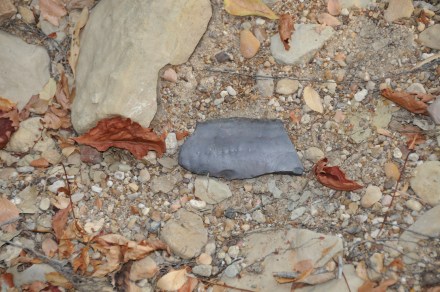
The second field gift on this July day came near the end of my one-and-a-half hour field trip.  Walking gingerly in the middle of the creek bed, avoiding large sandstone rocks, I looked down and saw a dark, flat-shaped, lithic object of iron ore that is abundant about the place.  Thinking it a natural chink or large piece of rock, I kicked at it with my boot.  Instead of a natural formation, it showed signs of flaking and abrasion — a lithic tool, used by Native Americans before the onslaught of mining, farming and ranching.

Abraded and flaked lithic tool (4'' x 2.5"), Salt Creek, north Erath County, Texas (July 27, 2011).

I noted the location, picked up the tool and continued my ambling to the west water gap, the end of my walk.

Returning to the house, I sat down, not with coffee but with a Dr. Pepper, and wrote out the rest of my field notes.  My observations had begun at 8:14 a.m. and concluded at 9:45 a.m.  The temperature by ten o’clock was 86 degrees, headed upwards to 105-107 degrees by the late afternoon.

The grove remains green.  A water seep looks healthy in the creek bed.  Wildlife track abounds.  Cultural artifacts appear, attesting to man’s continuing occupation of the surrounds.  The day will be hot.  Gifts, of a sort, have fallen in my path and I gain a sense of continuity with nature reviving itself in Clammyweed blossoms, bursting in color, a natural goddess emerging from the earth in July, glimmering in fertility.  Paradise regained.

* * *

The water cache and seep along Salt Creek, north Erath County, Texas (July 27, 2011).

______________________________

Notes and corrections:

The photograph of the Salt Creek water cache was appended.

The sentence, “Paradise regained,” was added in the last paragraph of the essay.

15 Comments

Filed under Field Log, Plants and Shrubs, Wild Flowers of Texas

Chocolate to mesquite

Several months ago in a previous post, I wrote that one of my field objectives on the Flying Hat Ranchito was to identify every tree species rooted about the pastures and Salt Creek.  Beginning with this post, I identify the mesquite tree.  Unless Southwesterners have been reared in a dark box, everyone recognizes the mesquite and usually such identification is followed with a curse word or two.   Except for the far pasture between Barton Creek and Salt Creek, mesquite erupts constantly about the ranchito and requires annual shredding or pruning.  I relate to the mesquite tree without impatience, finding it worthy of praise, not scorn.  But, first, from a objective point of view, then followed by subjectivity.

The mesquite tree…

Mesquite is one of the most widely distributed trees in Texas. It is a small to medium tree with an irregular crown of finely divided bipinnately compound foliage that casts very light dappled shade underneath. It is armed with thorns sometimes up to 2 inches long. In the spring, summer and after rains it is covered with fragrant white flowers, and the long bean pods are ornamental as well as providing food for wildlife and livestock. Mesquite is not a rancher’s favorite tree: it readily invades overgrazed sites and other disturbed land, is virtually impossible to get rid of, and the thorns injure livestock. However, the foliage, flowers and fruit are attractive, it adapts to almost any soil that is not soggy, it is heat and drought tolerant, it fixes nitrogen in the soil and provides many areas of Texas with shade, fuel and timber where otherwise there would be none. The wood is used in flooring, furniture, and as a cookwood for seasoning.

“Texas Native Plants Database,” Texas A&M University (2011).

The mesquite bean is also ground up and can be used as an additive to wheat flour or corn flour for making tortillas and bread.  I’ve not tried the recipe, but I shall from a Native American reference I have on file.

* * *

Objects that appear void of emotional affect to one person may be illuminated with soundings of deep, ineffable meaning to another.  The mesquite and juniper trees in my life resound with spiraling emotion that takes me to a different plain, evoking events in my memory that I never forget and can only begin to understand.   I shall write about the juniper another day.  Today my focus is the mesquite.

When I was a boy, about five or six years old, I used to play underneath a mesquite tree adjacent to my mother’s studio apartment in Brownwood, Texas.  It was shortly after World War II had concluded and my father had separated from us and was reestablishing himself in Pennsylvania, far away from Texas, the place he met my mother.  Across the street from mother’s apartment, my grandmother lived in a small trailer house and took care of me while mother worked at Southwestern States Telephone Company.  At the time, I did not know how close we were to destitution.  I was a boy and I played outside underneath the mesquite tree, thoughtless and innocent about money matters.

One day as I played under the mesquite tree, I heard the sound of the wind — a southwest wind — flowing through the trees as I had never heard it before, but have ever since.   The sound was of medium pitch, neither high nor low, and it persisted with a rising and falling velocity, bending branches, shifting the shade about me and my toys.  As I heard the wind, I felt lonely, really alone in the world.  My mother was in the house — I knew that — but I sensed a separation from her and a state of emotion that evoked a sadness, a sorrow that I found inexpressible at the time.  The moment remains clear and even the affect is still apparent.  It  never leaves me.

Years later I came to realize that under the mesquite tree I felt, for the first time, a separateness from other things, other people.  I realized I was an individual, distinctively apart from others, and there was no going back I came to find out.  Under a mesquite tree was the place  the affect of estrangement spooled out and bound me.  I’m not alone in that awareness and that is a comfort, for we all sense that estrangement and how we meet the abyss and gain unity or self-loss is the rest of our life.  These days, as I walk underneath and beside mesquite trees on the ranchito, I sense the mesquite as a companion one day and a intransigent master teacher the next.  It helped me grow.  I didn’t want to, but it threw me out of my Eden.

* * *

In Aztec mythology, Quetzalcoatl, the giver of knowledge and wisdom to the people was thrown out of his city, country and reign for moral turpitude.  As he went into exile, going east, he crossed the mountains to the sea, his dwarf companions died from the cold and the chocolate trees he passed turned to mesquite and great sorrow came upon the land.

[This is first of several posts on the mesquite.]

9 Comments

Filed under Cedar, Life in Balance, Life Out of Balance, Recollections 1942-1966

Allowing the flourishing of wildlife

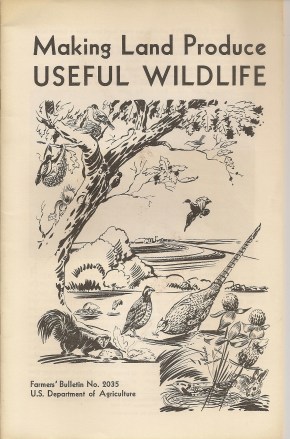
A 1975 reprint of Farmers' Bulletin No. 2035

The first summer I lived on my ranchito, the summer of 2004, I hired Cody Scott to plant native grass seeds in my far pasture, the Pecan Tree Pasture that lay between Barton Creek and Salt Creek.  Last summer I reseeded the pasture with native grass seeds and wildflowers.  The upshot of these two distributions has been a resurgence of bluestem, side-oats gramma, buffalo grass, coneflowers, Indian blankets and vetch.  Frankly, I held no longitudinal goal other than to provide habitat food for cattle, horses and wildlife.

Frank Waters of The Man Who Killed The Deer (1942) fame wrote that the proper relationship of a person to the land was to “live with the land,” not on it, but with the land.  Living with the land has been an axiom for me, a mantra for many years.  A U.S. Department of Agriculture Farmers’ Bulletin No. 2035, “Making Land Produce Useful Wildlife,” provides me guidelines to live with the land.  By way of full disclosure, I do not make my living raising cattle or horses, but teaching at a junior college in Abilene, so my basic approach to my ranchito is sustaining the land, not cropping, leasing or planting.  That being said, I integrate what I have learned with horses, cattle and the land into my lectures.

The land is my teacher and all things upon it instruct, from thistles under juniper to even — I hesitate to write this — the mesquite.

So, a few tips from “Making Land Produce Useful Wildlife,” by Wallace L. Anderson, biologist, Soil Conservation Service, I list below.

To support a high wildlife population, a farm or ranch must have a plentiful supply of good food close to cover that furnishes protection from enemies and weather.  And it must be available in all seasons of the year….

Pastureland practices harmful to wildlife are uncontrolled burning, overgrazing, and complete clean mowing early in the season….

There are three essentials to good cover for wildlife — grasses, weeds, stubble, and other low-growing plants for nesting and roosting; dense or thorny shrubs for protection from predators, for loafing, and for nesting; and, in the North, clumps of evergreens or other tall dense cover for winter protection.

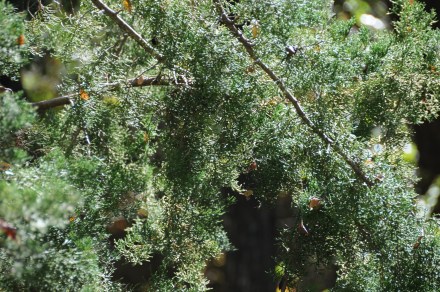
Mesquite thorns, poisonous plants and cacti also abound along the fence rows in the far field.   I have bull nettle, a stinging plant to the touch, but it has medicinal properties.  The nightshade plant that many define as a weed has been used to treat snakebite erupts along the corral.  And the few cedar trees, cut and harvested year after year prior to my ownership, their posts for sale in Mingus and Palo Pinto, are defined more appropriately as “juniper” provide berries for birds, aroma for incense and luscious shade from the sun.  I shan’t be cutting  cedar breaks or juniper.  All this in the far field allows the flourishing of wildlife close to me, close to you, close to us all.

Juniper, often referred to as cedar (J. Matthews, 2011).

[In my next post, I will write about the mesquite tree that is close to us all here in the bush.]

6 Comments

Filed under Cedar, Flying Hat Ranch, Juniper, Life in Balance, Plants and Shrubs, Wild Flowers of Texas

Flaming rainbow

Summer solstice rainbow

In the country, dust and heat on summer solstice day in Texas compress the air and stifle activity unless pickup doors close and air conditioning is set to near maximum.  Cattle bunch up under the shade of mesquite and live oak, chewing cud, panting and resting.  Highway construction workers — I see them between Mingus and Abilene — don white, flowing bandannas about their neck, issuing profiles of Bedouin upon the Arabian desert.  The workers move slowly, crumbling with drills and backhoes the old asphalt so that concrete may be laid for continental traffic.  They toil for dollars, but mostly for future mirages in far-off lands.

So dry, the forest service retorts, that in the recorded weather history of  Texas, no drier period between last October and May has occurred.  As the sun set two days ago, smoke from wildfires westward turned the sun blood-red and I thought of all the science fiction tales that speak of dying worlds, collapsing stars and barren wastes of uninhabitable planets.

But yesterday evening, thunder and lightening came through the ranchito with rain that pooled ever so briefly on the county road, setting new potholes that I will not regret.  The sky, the air turned yellow, yellowish-green, and in the east where the squall line flew, the darkest blue set the mantlepiece for a rainbow, two of them, in the sky.  How infinite the patterns of the weather for one day the sun scorches the veld and the next day reflects the colors of rainbows.  Flame and rainbow melt.  The colors drape beautifully, artfully, upon a landscape that nourishes life and hope again, an elegant form that rests against me.  Dust and heat will come again, I know.  But yesterday a rainbow colored my sky and will again.

10 Comments

Filed under Juniper, Wildfire

Arizona in Extremis | Find an Outlet

Arizona in Extremis | Find an Outlet.

My fellow blogger, Debra, out in Arizona is posting on the wildfires near her town of Bisbee.  This posting illustrates the problems of evacuation and caring for pets as well as the terrible destruction close-by her residence.  She has other postings about the wildfires.

There’s so much controversy over ignitions, forest management and evacuation that can be debated after the fires are put out.  Debra has spent major intervals of her life taking care of animals.  She and her husband moved to Bisbee several years ago from New England.

She is attempting to help her friend, Janice, who has many dogs and is worried about evacuation and her pets.

It’s terrible out there.


7 Comments

Filed under Wildfire

What is this with horses and water?

Hoof prints in water from Barton Creek.

And…

Star's hooves covered in mud so much you can't see his shoes. He's really a good boy.

Coming back for more…

Water, mud and a horse.

A good head shot…

Star after playing in water is curious about camera and all the excitement.

What is this with horses and water?  Or for that matter, kids and water?  They love playing in water.

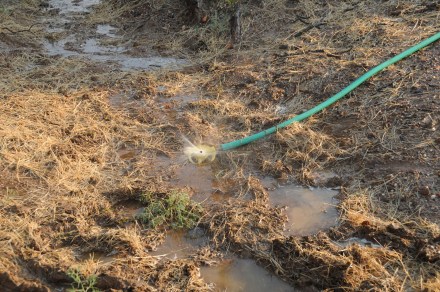
I’ve not had rain in a few weeks and the corral is dry.  Star’s hooves needed moisturizing, so I turned on the water sprinkler this morning to partially flood the corral — about thirty minutes of watering.  Star saw the water coming out of the sprinkler and shoved his head, nose and mouth down into the steam of water, pawed at the ground and for forty-five minutes stood over the sprinkler getting his front quarters wet and soggy as well as his hooves.

I finally left him there, went back up to the house for another cup of coffee and to fetch the camera.  When I returned, he had gone back to his hay bin, but returned to the sprinkler when I asked him to pose.  He posed for a pretty-good head shot.

* * *

I am down to one horse, Star, and no cattle — for the moment.  I sold three horses in January and Lilly had to be put down that same month.  The far Pecan Tree Pasture is ready for a few head of cattle to graze and Star and I need to be around bovine for awhile.  Star has a natural cutting ability and takes his cue from me, even when I am on foot and not in the saddle.  If he sees I am trying to pen cattle, he will help me round-up the cattle and put them in the pen — more shepherd than equine I sometimes think.

A farrier of mine once said that he was the smartest horse in the remuda, but so smart he would try to outwit you.  Once he joined-up with you, however, you were buddies for life and you worked together.  Maybe next week, the sale in Abilene…

Early morning scan for fresh grass through corral panels.

Post-publication note: If you have not clicked on the first link of Sage to Meadow Photostream, the picture with the elk in the water, do so.  It is a young elk playing in the water and is enchanting to watch.  The Photostream is on the first sidebar — NOT the Vodpod photos of guitarists.

7 Comments

Filed under Star

Spring to Summer in central Texas

Mustang grape vines on southern fence of Pecan Tree Pasture (May 2011).

Emergent flora signifies the arrival and maturation of Spring into Summer in central Texas.  Mustang grape vines climb trees and follow fence lines without fail.  I collect buckets of ripened grapes in late June or early July.  Daily observations of ripening grapes must take place or birds pluck the deep ruby-red berries and in over-consuming they fly dizzily, drunkenly away, first to the harvest, leaving my mouth and bucket empty.

Mesquite and mustang grapevines often intertwine and when harvesting, the mesquite thorns force the cost of harvesting painfully upward.

Mustang grapes with mesquite (June 2011).

*  *  *

Two stands of Big Bluestem grass (May 2011)

When rain falls, grass flourishes.  The top of the stems reach six-feet or more high.  Big.  Native.  Bluestem.

* * *

The final exhibit of Spring in this post is prickly-pear cactus with its brilliant yellow cactus flower.  I note that many varieties of insects clamor and dive into the flower, bees especially.  Cactus is destroyed as nuisance flora as a regular chore on small ranches and farms.  Yet, its fruit is edible, the flower yields pollen for honey and in drought, propane torches burn thorns and cattle consume the paddles.  The roar of burning pear signals drought upon the land.

* * *

For the moment, propane torches rest against barn walls.  Yesterday, west of my ranchito about a hundred miles, and northwest of Abilene, Erin Rea reports prairie fires near her farm.  The drought has descended brutally on her area and in a line stretching to the southeastern corner of Colorado,  the land reminds old-timers of the dust bowl days.  @Tuckertown tweets, “Wildfire in Southern Colorado fouls the air along Colorado’s Front Range. Very tender dry in the SE corner of Colorado. Very bad.”

The Spring to Summer in central and west Texas is endurable as we live with the land whether mustang grapes emerge or prairie fires burn.

5 Comments

Filed under Field Log, Weather