Sage blooms in Abilene

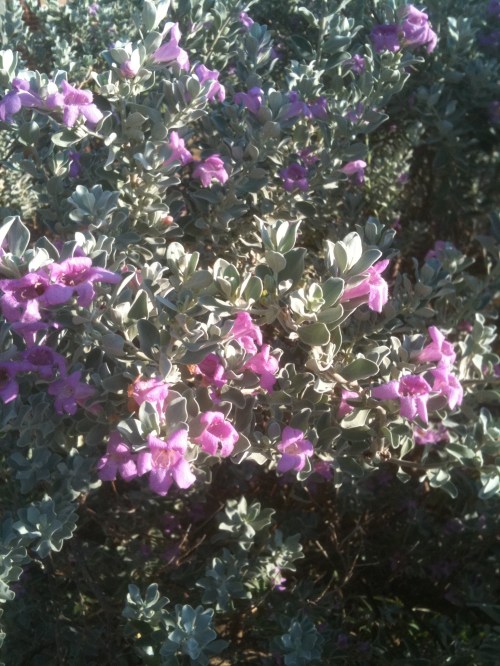
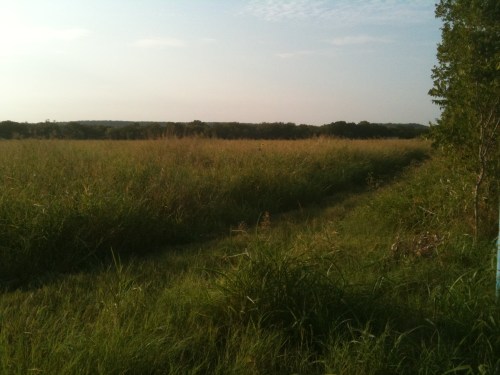
Sage blooming in Abilene, Texas, September 20, 2011.

This late summer, thundershowers fall infrequently around Abilene, Texas.  Yet, some showers do fall about this west Texas city that lies close to the Brazos River and Buffalo Gap, a niche in the hills that allowed buffalo to migrate from north to central Texas in the nineteenth century, following the shortgrass and bluestem in their casual browsing.

Two days ago as I worked late at my office at Cisco College, I walked by three large sagebrush by the back entry door.  A monarch butterfly floated by, floating and fluttering as if they are playing, and landed on one of the blossoms.  But before I could draw my iPhone from my coat pocket, it flew away and out of my range to snap a picture.  Alas, I was too slow on the draw.  I followed it to a green clump of slender grasses and lost it, despite my intent search.  The monarch had buried itself from my eyes, thinking me a raptor?

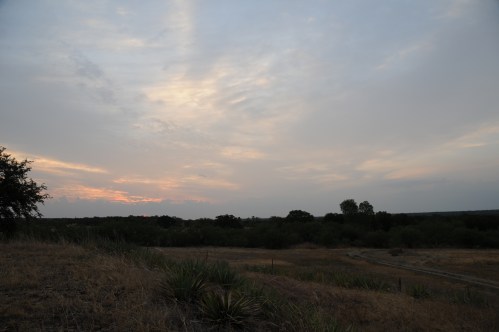
Yesterday, following the blooming sagebrush and my failure to photograph the butterfly, it rained about the city, to the north and west particularly.  A rainbow emerged with the sun setting to the east.  And, this morning, the temperatures were the coolest since May, a 61 degrees before sunup.

I think, if sagebrush blooms, can rain be far behind?  And playing monarchs about the purple sage?  Not far behind either.

Three sagebrush with blossoms at the back door of Cisco College, September 22, 2011. The monarch flew and hid in the bushes to the upper right of the photograph.


10 Comments

Filed under Monarch Butterfly, Plants and Shrubs, Sagebrush

Well springs Frio loam

Southeast corner of Pecan Tree Pasture, Johnsongrass and big bluestem (September 4, 2011).

Drought has come to the Southwest, particularly Texas. Wildfires erupt and I view every cloud in the sky as either friend or foe, rain-cumulus or pyrocumulus. Man lives in oscillating cycles: birth, maturity, degeneration and death; spring, summer, winter and fall; day and night. Nature’s theater, the grandest show — in fact the only show on the road — brings hot, dry days to us, an uneasy audience that sits without a program in hand.

Raising my hands and putting on a broad-brimmed hat to shield myself from the sun, I think, Is there is no way out of this parched country of west Texas, this incessant drought?  As a matter of habit, I drove to the far field two days ago, then again yesterday, and what I saw brought me out of the funk and into the reality of primary, nascent things that fosters renewal, not despair.  What I saw was the green field of my far pasture, Pecan Tree Pasture, a 35 acre field of buffalo grass, side-oats gramma, little bluestem, big bluestem and Johnsongrass that stood higher than my head!  The rain of about 2.5 inches two weeks ago provided enough moisture for a re-eruption of growth.

Trying to understand the dissonance of yellow-brown drought in Texas and this field of green grass, I gazed deeper and deeper into the field, trying to resolve these issues of color.  Then, it penetrated:  I was not looking deep enough, for beneath the grass lay soil, the wellspring for grass, the fountain of energy that we all thrive upon.  Well springs the soil.

Land, then, is not merely soil; it is a fountain of energy flowing through a circuit of soils, plants, and animals.  Food chains are living channels which conduct energy upward; death and decay return it to the soil.

Aldo Leopold, A Sand County Almanac, p. 216, New York: Oxford Press, 1949.

In primary school, we all saw the pyramid chart of soil, plants, animals, man, sun and the flowing of energy back and forth.  The tooth and claw of the pyramid remained omnipresent, but never voiced.  We knew one thing lived by absorbing another living thing, whether cougar on deer, fox on rabbit or kids on hamburgers, but our teachers for reasons of refinement side-stepped the tooth, the claw.  The revealing of one thing eating another lay with fathers and uncles in the field on cloudy, windy and cold days.  Perhaps that is how it should be.

To know my soil, early this morning I unfolded the Soil Survey Map of Erath County, Texas, in order to type the soil of the far field I saw yesterday.  The map is ninety-one years old (1920); it is still accurate, still a good map.  My land, temporary occupant that I am, encompasses three soil types.  First, I have rough stony land (R) upon which sits the house, barn, stables and arena.  Second, the tree grove of American elm, willow, live oak, red oak, juniper and pecan rests upon Frio silty clay loam, Colluvial phase (F).  Through the tree grove runs Salt Creek, an intermittent flowing stream.

In the far field, where big bluestem is stretching upwards of seven-feet in height, a pasture that has not been grazed by Angus cattle in four years, is Frio loam (Fm), deposits of earth that have rushed down from High Salt Cove and between two creeks, Barton Creek and Salt Creek.  From Frio loam springs the grass in the far field.  The doe and fawn I disturbed yesterday lie between the high stands of big bluestem, and I lapse back to Oklahoma’s plains and the waving blue-red waves of autumnal bluestem that rustle with wind, the stems making sounds as they brush against one another.  The pasture holds the moisture of the last rain and though I am not a person of edgy competition, I would put my far field of green grass up against any non-fertilized field in Erath County for height, vigor, nutrients and wildlife.

After tending the far field for eight years and seeing the soil’s fountain of energy this late summer, How is it that man fouls such richness, such gifts?  The answer is complex, but knowable.  The resolution to stop the pollution begins with a respect for knowledge, deep knowledge that is revealed early and, unfortunately, forgotten early on with so many other things in our youth, a bulletin board that displayed the food chain in first grade.  The ethic of conservation and sustainability rests upon simple principles that need the status of a Commandment, an article of the Constitution, a catechism of the church.  Better yet, we should recover that which was lost when we began to make pottery, metal and textiles thousands of years ago, or left on that bulletin board at Coggin Elementary School in Brownwood, Texas.

Land is a fountain of energy.  In my far field, Frio loam is a wellspring.

* * *
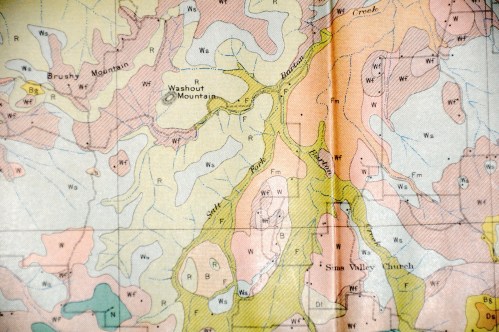
Click to enlarge. Soil survey map, Salt Creek and Barton Creek merger, from Soil Survey of Erath County, Texas (Washington: Government Printing Office, 1922). The far field is located at about center-left along Salt Fork and is associated with the symbol, Fm, for Frio loam.

______________________________

Notes, corrections and additions:

Aldo Leopold, A Sand County Almanac And Sketches Here and There, New York: Oxford Press, 1949.  I am quoting from the paperback, special commemorative edition that has an introduction by Robert Finch.

Soil Survey of Erath County, Texas, Washington: Government Printing Office, 1922.  The map was drawn in 1920, hence, it is ninety-one years old.  I found it in the workshop of the house I once owned in Mingus, Texas.  The house was know as the Old Bertino Place, named for the Italian family that had come to the area to work in the coal mines of Thurber in the nineteenth century.

I have been reading a considerable amount of literature this summer:  Aldo Leopold, Thoreau, Tolkien, Patrick Leigh Fermor, Edward Hoagland, Black Elk, Frank Waters, Wordsworth, Catulus.  I have something to write.  Whether it sells or not is a by-product.  I have to write, I really do.

18 Comments

Filed under Life in Balance, Rain, Sounds, Weather

Pyrocumulus over Possum Kingdom Lake

Pyrocumulus over Possum Kingdom Lake (MSNBC photo, August 2011)

As I drove back to the ranchito yesterday afternoon from Abilene, moving with light traffic on Interstate 20 near Eastland, Texas, I looked northeast and saw towering pyrocumulus clouds. Approximately forty to fifty miles away from where I drove on the highway, I pinpointed the fires at Palo Pinto, Texas, or Possum Kingdom Lake. My ranchito lay far away from the inferno, so my anxiety lessened and I began to think more intently about the precise location. The smoke rose high in the sky, becoming pyrocumulus, rolling and billowing upwards.  It had started at about 1:30 p.m.

When I arrived at the house, I turned on the television and Dallas-Fort Worth stations reported the fires near Possum Kingdom Lake, the southeastern side of the huge lake that dams the Brazos River, the largest river in Texas. In April, fires had erupted about the lake, destroying homes and thousands of acres of trees and grass with attendant wildlife. Once again, Possum Kingdom habitat ignites, the residents flee not having time to salvage photos or documents.

I ruminate that our region suffers a drought, cow tanks dry, underbrush decadent and my primary source of water, the Barton Creek Cooperative, restricts water use with heavy penalties for violators.  In the Possum Kingdom fire zone, summer camps for teenagers and children abound, primary homes and secondary homes stand close to trees that are pruned carefully, the underbrush removed as a fire hazard.  Yet, so, when the spark falls on the dead, crackly grass and brush, natural forces beyond man’s control take precedence and airships with their whap-whap-whap of whirling blades pour water onto flames that send smoke and ashes high into the sky, creating pyrocumulus in the blue skies of Texas.  I think of a line from Full Metal Jacket:  Who is in command here?

The origin of the fire is unknown and as of this morning, August 31, the fire is not contained.

For a morning news report, August 31, 2011, see “Wildfires burning homes in Texas, Oklahoma,” from MSNBC.

______________________________

Notes, corrections and additions:

The quote from the movie, “Who’s in command here?” originally read Apocalypse Now.  The proper citation is from the movie, Full Metal Jacket.

The photograph from MSNBC shows smoke and ash close to the ground and none of the “clouds” are pyrocumulus.  I saw the pyrocumulus while on the interstate highway and I failed to use my iPhone to photograph the phenomenon. 

23 Comments

Filed under Life Out of Balance, Weather, Wildfire

Thoreau the philosopher: The hound, a bay horse, and a turtle-dove

The following quote of Henry David Thoreau reflects a symbolism, rather deep I suspect, of three sentient beings: dog, horse and dove (bird).  Historians and literary scholars speculate these lost animals never existed.  Like so many queries, further research is necessary.  My quick and dirty (fast, not slow or deep) study assumes that they did exist AND they represent Thoreau’s tangential thinking.  In part, the dog is companionship, friendship, association; the horse is the passion and energy of men and women; and the dove is the transcendental quality, possessed by all men, to break the bonds of family, religion, nation and materialism.

I long ago lost a hound, a bay horse, and a turtle-dove, and am still on their trail. Many are the travelers I have spoken concerning them, describing their tracks and what calls they answered to. I have met one or two who have heard the hound, and the tramp of the horse, and even seen the dove disappear behind a cloud, and they seemed as anxious to recover them as if they had lost them themselves.

~ Henry David Thoreau, Walden; or, Life in the Woods (1854).

* * *

And, in association with such tracking and calling, I submit my own experiences with hound, horse and bird:

Come here, boy, come here. I hear the rustle of grass and juniper brush before I see my hound.

One long high whistle, followed by three low-toned whistles. The gallop towards me grows louder, the ground shakes and earth is a-flying.

The dove comes back to be with its own kind, a cooing ensues and a dance. I reach inside their loft — they are accustomed to me — and pick one gently up and as I stroke its breast, it sleeps, head tucked under its wing. I lay it gently down and in the morning’s light it disappears behind the clouds.

* * *

Not trying to be didactic or professorial (I hate that, even in my own classroom), what do you think about Thoreau’s quote?  Should this quote be taken literally?  Symbolically?  Or both?  I’ll expect your comments by September 1, or I will have to check the non-compliance box next to your name.  So, let’s get on with the punishment, shall we?

______________________________

Notes, corrections and additions:

The original post contained only Thoreau’s quote and my three extrapolations about hound, horse and dove.  I added the first paragraph before the quote and added the questions at the end of the post.  The photographs have also been added — all additions occurred August 27, 2011.

I originally started re-reading Thoreau for a variety of reasons, especially searching for irony and wit in his writing, but I got side-tracked with this quote.

17 Comments

Filed under Life in Balance, Nature Quote of the Day, Quote of the Day

My dog chewed my Peterson’s Field Guide!

Remnants Roger Tory Peterson's Field Guide

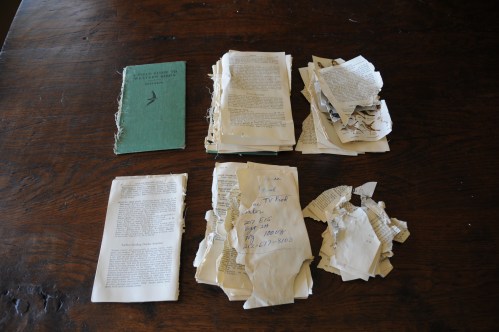
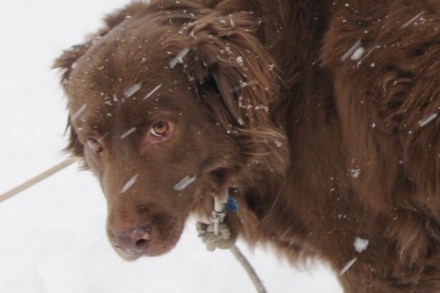
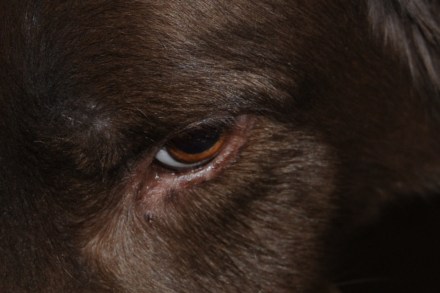
Yeller, my Australian Shepherd-Labrador mix, chewed and swallowed several color plates of my Roger Tory Peterson, A Field Guide to Western Birds, ninth printing of the 1969 edition.

Here is Yeller with snow several winters ago.  He’s a good dog!  Yeller has a habit pattern of wanting to play at about 6:30 p.m. in the evening.  Sedate most of the day, when that time rolls around he will seek me out in the office and pester me until I play with him.  He is most fond of me wrestling with him on his huge pad, a 3×4 foot mattress-like dog pad, until I give up.  Yeller will lead me to his pad, pick up a toy and challenge me to play, “Take Away!”

I am not always a good play companion for I get too busy with very important things like writing a blog and will command, “Lay down.”

Yeller retrieves 25 lb. sacks of dehydrated goat milk and children’s toys from about the countryside when I used to let him run uncontrolled.  I’ve found rubber Daffy Ducks and Pluto the dogs in my front yard, carefully placed by Yeller after rambling through neighboring pastures and juniper groves.  I keep him indoors now and will let him out on a “field leash,” a twenty-five foot yacht rope leash I used to train bird dogs.  In most cases, the toys he brought back to the ranchito were abandoned by insensitive little primates in the veld.  He is a rescue dog, sort of St. Bernard-like.

This fine, courageous dog chewed my Peterson’s one night last week.  When I arose at 5:00 a.m., I found my field book that I have carried in field packs, backpacks and floorboards of many pickups scattered into hundreds of pieces on the floor of my office.  Many of the color plates had been consumed.  He was especially hungry for the quail and duck color plates.

Punishment?  No way.  The act of destruction occurred in the middle of the night and if I had chastised Yeller he would not have connected the “event” with my scolding voice that I hardly ever use because he is such a fine dog, good dog.  Besides with all the scents attached to that field book, carried in my sweaty hands, dropped in a bog, stuffed in field bags with Trail Mix and held in my possession since 1972, I could hardly blame him.  My fondest remembrance of referring to the Peterson was when I was up in the Sangre de Cristos, near Truchas, New Mexico, and I identified my first Black-billed Magpie (Pica pica) that flew about the trail I ascended into the Pecos Wilderness.

That’s okay, Yeller, I understand you.  I can always get another Peterson’s from Amazon.com, but there never be another dog like you.  Now, go fetch your toy!  It’s playtime!

Yeller is looking for Peterson.


24 Comments

Filed under Dogs

My summer’s end

Medieval depiction of the four seasons, peasant perspective.

As far back as I can remember, my summers end with the beginning of school in late summer, although at college and the university eons ago the semester began in September, not the middle of one-hundred degree temperatures in August, a month christened:  harvest month (Finnish), month of leaves (Japanese) or month of the sickle (Polish).  August still blows hot and the cumulus clouds don’t always come together during the day for a thundershower in Texas.  These days, my summer’s end comes when the bugle sounds, “Faculty Assembly,” and I file in with other professors for another encounter with young men and women who must always be reminded that getting an education is beyond, way beyond, getting a job.  And, frankly, by December, they know the difference.  ‘Tis a seasonal thing, I say.

When does summer officially end?  Oh, gosh, no, here comes a science lesson: Summer is calculated as ending when “the tilt of the Earth’s axis is inclined neither away from nor towards the Sun, the center of the Sun being in the same plane as the Earth’s equator.”  This equality of the northern and southern hemisphere angle or tilt towards the Sun occurs twice, about March 21, September 22.  Enough of the astronomical parsing, just what is going on with my summer’s end, prematurely a month before its true shutoff?

Like the medieval image above, I lay down my sickle and pick up the history survey text of the United States and lecture.  No more harvesting here, I throw fertilizer and facts at students and hope the plants thrive.  I feel unnatural to put my farm tools down before summer ends.  What will happen when I am in the classroom and it has rained and the fields need cultivation?  The plow follows the rain, as every farmer knows.  Will things be okay without my studied interference?  I think so.  The fields manage quite well without my disc, chisel or shredder.  (I still have areas I cultivated five-years ago that remain dormant mainly because I interfered.  No more of that!)  I’ll catch up another day on interfering.

What I will miss most is arising at 4:30 a.m. and by 5:00 a.m. sitting out in the dark or early morning light and logging the sights, sounds and smells of the coming day, scribbling fast on my steno pad, nine to ten lines a steno page in the dark so as to keep up with the ending of night, the beginning of the day in American West.  Drought has a scent: dusty, dry wood, a tad smoky, bog water, leather that needs oiling, mesquite bean, burnt stone.  I should like next summer to rise early again, take notes in the dark, drink coffee and look for orioles as the rosy fingers of Dawn emerge before my summer’s end.  ‘Tis a seasonal thing, to be sure.

_____________________________

Notes, corrections and additions:

Orioles are uncommon in west Texas.  I have only seen two in my life: one when I was ten, then day before yesterday, I saw another oriole, brilliant in color against the green mesquite.  It flew with a rhythm like a runner jumping hurdles.

Here is a painting that depicts Everyman and their summer’s, life’s end:

Summer's end.

This painting comes from the blog: http://damnthefreshman15.wordpress.com/2010/08/21/summers-end/

18 Comments

Filed under Birds, Life in Balance

Rain in Broke Tree Corral

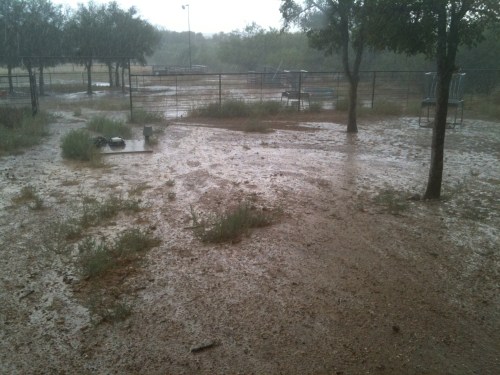
Rain in Broke Tree Corral, north Erath County, Texas, August 12, 2011.

Yesterday afternoon, after months of drought, rain came down sporadically in drops, then sheets of rain.

The first raindrops bounced on the aluminum roof of the barn and stables. Lightning flashed, thunder clapped, and Star the paint gelding and I flinched.  He bolted for about three gallops, then returned quickly to the shelter of the stable.  Within thirty minutes, five-tenths of an inch had fallen and a lightning strike on the oil piping fence about fifty-yards away knocked out electrical power.

I fed Star his grain and Horseshoer’s Secret — a potion for rebuilding hoof walls — and he munched haply through the noise of the thunderstorm, occasionally bringing his head out of the feed bin to see if I still sat in the alleyway waiting out the rain.  I talked to him, Good boy, fine fellow.

Broke Tree Corral is the first of two successive corrals about the barn and arena.  So named for an American Elm tree that broke in two, the tree has continued to thrive with bark and one-half of its internal veins intact for at least eight years now.  The grass in the corrals has become brittle and sparse.  The rain quickly formed small channels that flowed into the second corral, the Well House Corral, where bare ground could not stop the erosion-flow into the near fields of buffalo grass and mesquite sprouts.

Rain flows down the road towards the barn, north Erath County, Texas, August 12, 2011

Rain has fallen, the temperature has dropped and the Jack Rabbit has come out of his burrow to chomp on fresh sprouts and new, tender, blades of grass in the small dell between me and the Dooley place.  The drought has not been broken decisively, but this rainfall is a far away sound of better days and nights headed to Texas, a hunter’s footfall tracking a devil of fiery brutalities to slay and scatter to cool winds and shady juniper groves for those that live with the land.

____________________________

Notes, corrections and additions:

Try as I might, misspelled words sometimes slip through.  I do not rely on “check spelling” frequently, but will look again at a word if it is underlined in red.  In this post this morning, I misspelled, “lightning,” twice!  I spelled it “lightening” and missed the correction.  In writing posts, I do not have a proofreader.  It is an imperfect world filled with imperfect compositions.

27 Comments

Filed under Rain, Star, Weather

Clouds with Mourning Dove

Pre-dawn clouds in Texas, north Erath County, August 2011.

Yesterday in mid-afternoon, August 10, 2011, a weak squall line walked through my ranchito in central-west Texas.  Blue-gray rain clouds edged and staggered to a halt south of my place.  A few drops of rain fell.  The power of the squall line churned up dust clouds, obscuring the Nowack barn across the county road in a microburst downdraft.  East of me, seventy-five miles away, Fort Worth had rain falling on Sundance Square, the heart of downtown commerce and entertainment that coarsely promotes the city as, “Where the West Begins.”  I disagree, but that argument will have to wait for another day.

The squall line with thunderclouds failed to bring rain on my land yesterday, but one weather change in the future will bring drops and sheets of rain.  I looked at the weather charts yesterday afternoon and saw thundershowers, sixty-miles north, let loose rain, then dissipate into nothingness but a void of mirages, quavering silver lakes far away.  No mirage here, the juniper trees in the ranchito grove threw off a luscious scent with the rise in humidity, dispelling summer for a time and bringing a promise of better days.

This morning, clouds remain to my east and as the sun rises, I see remnants of yesterday’s storm over Sundance Square.   I count three, perhaps five, sun rays through the cirrus and cumulus debris.  In all of this — the dust clouds, wind, scarce drops of rain and the sun’s rays — I look at yesterday’s date, August 10th, and know that Fall is forty days away, and that the sun rises later and sets earlier each day upon the earth’s northern hemisphere, Sundance Square and my hacienda. 

As if I needed any more natural substantiation that the season is turning — I do — Mourning Doves (Zenaidura macroura) sustained their ooah, cooo, cooo, coo this morning for over an hour, sitting on power lines and in the mesquite brush of the Dooley place to my west.  The Mourning Dove with hot mornings and brutal afternoons of heat on the ranchito does not coo earnestly, but quiets in sorrow for the lack of rain.

The Mourning Dove is in the lower-left photograph, a White-fronted Dove is pictured in lower-right (Audubon Society Field Guide, 1977).

______________________________

Notes, corrections and additions:

The call of the Mourning Dove comes from Roger Tory Peterson’s A Field Guide to Western Birds (1969), my constant reference and field guide that is tattered and torn.  But I would not have it any other way.

Photographs of the dove are from The Audubon Society Field Guide to North American Birds (1977).  This reference guide from Audubon was in the small library of my parents who grew up in the country of central Texas and were always cognizant of wildlife, thunderstorms, cattle and horses.  I inherited the library and treasure each volume of field manuals that they thumbed through.

Several species of dove reside and pass through the ranchito. 

10 Comments

Filed under Birds, Rain, Weather

Cool, clear water

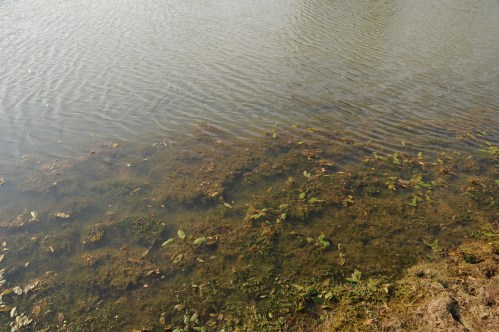
Western edge of pond, Flying Hat Ranchito, north Erath County, Texas, July 2011.

Proust had his tea cake that extended memories to prosy heights that we all have started to climb, but failed to reach — my ascent stopped at Swann’s Way, but I’m not going to stay long on the ledge for I have hammered the next piton to assail the final page of Mt. Swann.  “Cool Water,” a country and western classic by the Sons of the Pioneers, a tea cake of sorts, takes me back to old Camp Bowie, near Brownwood, Texas, as I complained the lack of water on a hot summer day, touring with my parents in a old, non-air conditioned Ford sedan.  Why they weren’t thirsty, I’ll never know, but I campaigned persistently for halting somewhere, anywhere, for water.

I must have been persuasive for my step-father stopped the car along the highway and I crossed over a fence and ran to a pond of fresh, cool water in a green pasture.  I drank, cupping the water in my hands, not muddling the water as I scooped.  Even today, I still see that pond when I drive in the region, although it has been dug out and deepened countless times.  Both my step-father and mother laughed in sympathy and I was dubbed, “Chief Water Bucket,” a name I did not like nor wanted.

The drought in the Southwest descends brutally upon the landscape, in the news and by the mails; the only shade at times is under lovely junipers.  I look out upon brittle, brown grasses; the trees in the grove are turning golden.  The newspapers boldface the headlines that cattle are being sold through the night at local auctions as cattlemen line up two-miles long with moaning cows in their trailers.  In the mail, Barton Water Cooperative states that I can only water the yard twice a week and if the water usage exceeds tolerable levels, I will be assessed a fine, a surcharge.  I fill one water trough for my horse, Star, allowing an overflow into a pan on the ground for wildlife.  I dare a surcharge for that.

This summer I have thought often about “Cool Water,” and sung and hummed the melody and lyrics.  Each time I reflect on the music, I am back with my parents alongside the road, running for the cool, clear water in that pasture.  “Cool Water,” is my tea cake, my madeleine.

Here are the lyrics to “Cool Water,” followed by a current photograph of the ranchito’s only pond.

All day I face the barren waste without the taste of water,
Cool water.
Old Dan and I with throats burned dry and souls that cry for water,
Cool water.

The night are cool and I’m a fool each stars a pool of water,
Cool water.
But with the dawn I’ll wake and yawn and carry on to water,
Cool water.

(Chorus)
Keep a movin’ Dan, don’t you listen to him Dan, he’s a devil not a man
and he spreads the burnin’ sand with water.
Dan can’t you see that big green tree where the waters runnin’ free
and it’s waiting there for me and you.
Water, cool water.

The shadows sway and seem to say tonight we pray for water,
Cool water.
And way up there He’ll hear our prayer and show us where there’s water,
Cool Water.

Dan’s feet are sore he’s yearning for just one thing more than water,
Cool water.
Like me, I guess, he’d like to rest where there’s no quest for water,
Cool water.

(“Cool Water,” Sons of the Pioneer, RCA Country Legends.)

Flying Hat Ranchito pond, north Erath County, July 2011.

19 Comments

Filed under Juniper, Recollections 1942-1966, Weather

Score: Mockingbird 1, Roadrunner 0

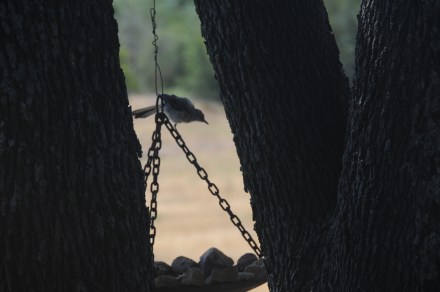
A mockingbird resides in a live oak tree on the east side of the terrace beside the house.  For several days I have observed roadrunners coming up to the terrace early in the morning and mid-afternoon to feast on grasshoppers.  Occasionally, the roadrunners will scale a separate live oak tree from the mockingbird’s nest only to be thrown back, not by cauldrons of burning drought-oil in Texas, but by the fierce, unrelenting assault of the mockingbird.  The trees upon the terrace are mockingbird territory!  Beware aliens!  The mockingbirds will allow red-headed woodpeckers to pierce bark for a meal, but not the roadrunner.

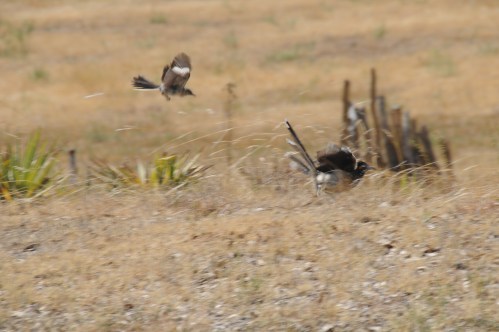
Yesterday, I took these photos of the tournament.  At end of battle, the score was Team Mockingbird 1, Team Roadrunner 0.  The roadrunner ran off the terrace and into the mesquite thickets on the Dooley place.

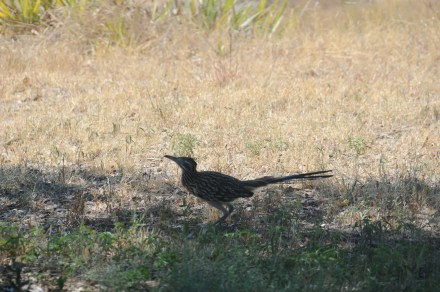
A roadrunner (Geococcyx californianus) is a cuckoo, here pictured on the terrace with pale-leaf yucca in background (north Erath County, Texas, 2011).

Mockingbird (Mimus polyglottos) assaults roadrunner (north Erath County, Texas, 2011).

Mockingbird stares at roadrunner.

Roadrunner stares at mockingbird.

I have had close encounters with both species in rescuing them from death.  I unloosed a mockingbird from bird netting several years ago.  He bit me and drew blood.  And, a year or so ago, I saved a roadrunner from drowning in a water trough.  He had fallen in and was unable to fly or climb out.  I have no idea if the roadrunners I see are survivors of that event — more than likely not since it was over a year ago.

I do have a field note about each of these birds.  I can hear the roadrunner chattering, a noise he makes by rolling mandibles together.  He has a voice like a dove, but more often I hear the chatter.  The other note is that the mockingbirds like to sing at night in the spring — all night long.  I used to hear them as a boy when I slept with the windows open; I barely hear them now with the air conditioner blowing.

Seeking comic relief in all this heat, I look for a coyote to come across the terrace tomorrow, laying a trap for Team Roadrunner.  I hear coyotes, but don’t see them.  “Beep, beep.”

20 Comments

Filed under Birds