I have kept this late evening photograph of the feed bin with clouds for several weeks. I like the symmetry of the tree line, feed bin, hills and clouds. The feed bin I bought at Gore Bros. Feed Store in Comanche, Texas, a store my family had patronized for fifty years. When it was said at the breakfast table that we were going to Comanche to pick up some “cow cake,” it was understood that Gore Bros. was the destination. Most of my ranch equipment has been purchased from their ranch supplies area, i.e., feed bins, water troughs, hay racks. The lime green color of the feed bin, the dark grasses and the white clouds compose a very simple photograph that I think is appealing. Of course, as we all know, there is no accounting for taste.
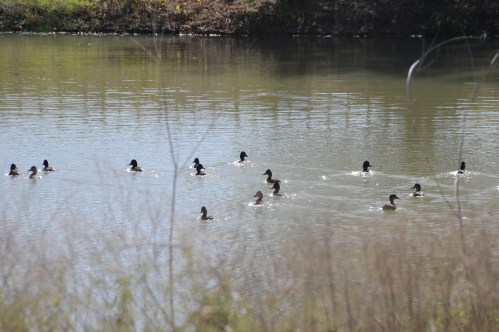
Ducks returning to pond
This morning I was surprised. I drove the F-150 to the grove gate to close it, so as to keep my gelding, Star, from going into the far pasture and gorging himself on new-growth grass. As I passed by the pond, I saw these ducks. Many of you see ducks all the time, but here in North Erath County, Texas, ducks are uncommon until November or December. These ducks made no quacking whatsoever. They plunged into the pond for feeding. I returned about two hours later and took some photographs.
In one of my earlier posts about the American Widgeon, I and my blogging friends spent time identifying the ducks. These guys in the photographs are unidentified. My Peterson’s guide was chewed up by my dog, Yeller, and I have yet to replace it. My Audubon field guide does not have flying profiles or additional attributes for me to say for certain what these ducks are. So, the ducks will be unidentified until I get my Peterson’s guide book re-ordered.
In any case, the ducks have returned to the pond. Can cooler weather and winter days be far behind? The ducks say, No, it’s not far behind!
Filed under Ducks
October in Texas: dusting and sunflowers
A light “dusting” of dust, not snow, descended with high winds upon Texas yesterday. A cold front came in the afternoon that sent temperatures this morning down into the lower 50s F. I love changes in weather. Of course, not with abrupt turns that bring destruction and fire, but changes like yesterday: brisk winds, racing clouds, lightening, rain in the distance that you can smell (my dog, Yeller, lifts his head high to catch the scents far away), dark clouds with long trailing edges that signal rain prospects and all of it bringing anticipation to the heart that tomorrow will be different, a new day with fresh starts all over the world.
How can one capture that cachet of weather change and anticipation for riding your favorite horse into the future? ( I am down to one horse, my Star paint gelding, so he is the favorite, the last of the remuda — but I will build a remuda back with brown mares that foal in the Spring.) Well, you can’t capture it, but you can take a photograph that elicits Texas weather change, and the above photograph of Texas plains, dust and sunflowers, brings yesterday’s moment to pause.
You must ENLARGE the photo above to get the full effect of yesterday’s “dusting” around Abilene, Texas. The evocations the photograph brings reminds me of migrating pioneers in the nineteenth century that saw the Trans-Mississippi West plains and stopped, not wanting to venture farther onto land that had little water, few trees and a population that spoke strange languages.
O, Pioneers! Be not afraid! There are springs and rivers, trees are in the ravines and highlands! The Indians will trade and parley and teach their tongues, if you will tread lightly upon the terrain!
Yes, I know that pioneers did not tread lightly. There were, however, places of concord — Bent’s Fort, the Pawnee, the Tewa, among other spaces and culture.
Despite this riff-tangent about the American pioneer, I come back to the weather change of yesterday that brought cold winds, turning the sunflowers to face the southern climes. Bees and butterflies still feasted on its pollen, riding the petals like cowboys on broncs; the contrast of red earth, dusty skies and yellow flowers showed a tough plant on inhospitable soil, holding on tight and bearing its colors to the world. I love these types of weather changes.
Related articles
- Massive dust cloud wraps rolls through Texas, looks crazy An… (shortformblog.tumblr.com)
- Sage blooms in Abilene (swamericana.wordpress.com)
- Dust Bowl Nightmare in Lubbock (speedofcreativity.org)
Filed under Weather, Wild Flowers of Texas
Fox and Salt Creek: field log entry 2
12:00 p.m. — 1:08 p.m.: After thirty minutes communing with a fussy wren, I finished a brief field observation with a walk up Salt Creek about one-tenth of a mile. I logged tadpoles, frogs, wrens, bluejays, heard the cry of the red-tailed hawk or the Harris hawk, photographed a turkey vulture (not included herein) and saw the owl (unidentified) fly into the grove away from my hike. Back at the ranch house, I identified the wren that had chattered at me — a Bewick’s Wren (Thryomanes bewickii). I saw numerous tracks in the mud.
I counted two monarch butterflies within the cool willows of the water cache — see photograph below for the Salt Creek water cache with sky blue.
The Audubon Society Field Guide to North American Birds states that Bewick’s Wren prefers drier conditions to its resemblance, the Carolina Wren. Bewick’s Wren has certainly enjoyed dry conditions throughout the summer.
I liked this photograph of the prickly-pear cactus with the willow and pecan trees in the background. It describes in essence what this part of Texas and my ranchito is all about — wet and dry, green and brown, cactus and pecan, things-that-stick-you and things-you-eat.
Fox I did not see. I did not expect to see any, but one never knows. My friend, Wild Bill of Wild Ramblings Blog, suggested that I get a animal call tool that sounds like a wounded rabbit to attract the fox. I think I shall because I want to see fox again. Cougars and bobcats have been sighted in our area, so I shall be cautious. I don’t want my day spoiled by predators of that size taking me from behind. We have a saying out here, “If it doesn’t sting or bite you, it will stick you!” I’ll take the stinging and sticking anytime over the biting. Now, where are my field catalogs?
Filed under Birds, Bluestem Field Log (Live), Field Log, Life in Balance, Monarch Butterfly
Fox and Salt Creek: field log entry 1
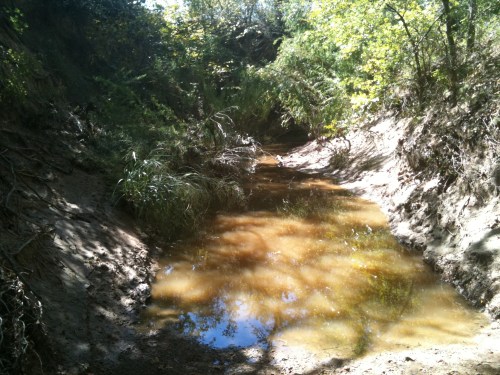
Eight minutes ago, I sat down at the site in the grove, above Salt Creek about fifteen feet, where I saw a fox trotting in the creek bed several years ago. I have a folding chair I sit in, my field log, pen, iPhone for composing and taking pics and an internet connection.
Since seated, I log: turkey vulture shadow passes over me, an unidentified wren chatters at me ten feet away, rifle and shotgun firing in the distance, crows cawing, vehicle traffic on SH 108, cool breeze.
I face northwest by west. Here is a photo of the creek bed at the precise spot I saw the fox:
Filed under Bluestem Field Log (Live), Field Log, Life in Balance
Grass: a side of oats with music
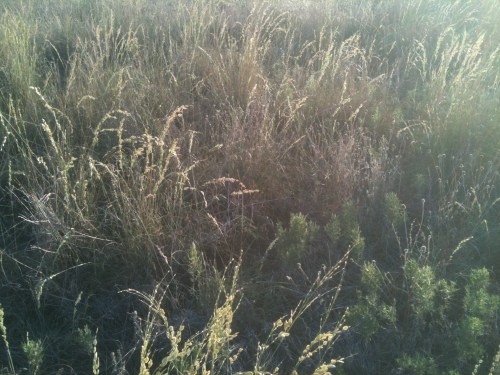
With recent rains, grasses re-sprout. Side-oats gramma grass yields its oats along the stem and when the sun back-lights the plant the seeds appear as golden beads hanging about a string. I see several broad patches of gramma in my far field. The gramma seems to congregate as a family, moving over the years a few yards to the northwest as if on slow journey to Salt Creek, a tenth-of-a-mile away. I hear wind sough* through grass as it does through mesquite and oak.
When I shred brush in the far field, I cannot — though I thought I would — mow the gramma. Gramma is now family, a natural plant that has created an art space in the far field, a sentient being that propagates and rears its young in front of me. I see Star, my paint gelding, browse through the family, munching on a few stalks and oats, but not many stalks, for the far field is lush and verdant and full of life.
In the 1950s, as a high school student in agricultural classes, we identified gramma, johnson and bluestem grasses, among many others. Above all, I remembered the gramma and bluestem, dreaming that someday I would have a field of these species that I could see and touch. At the time I took the high school classes from Mr. Bell who could hold a scorpion by the tail, I thought I would use grasses entirely for grazing purposes. That was then. I now want to see the grasses first, and then allow a brief grazing of cattle and horse upon the gramma that blows in the wind and provides reeds for wind-music that I hear and golden beads that droop and sway with southern winds out of Mexico.
Odd it is, I think, that I have golden-beaded grass with a side of oats that sings.
______________________________
Notes, corrections and additions:
*sough (suf, sou), Middle English is swough, Anglo-Saxon is swogan meaning to sound. Definition is a soft, low, murmuring, sighing or rustling sound. I can’t remember where I picked up this word way-back-when, but lately my reading of Patrick Leigh Fermor brought it up again. The definition herein comes from my first collegiate college dictionary, c. 1960. I still have the dictionary and it is taped up with duct tape about the binding. I must do a post on my old books someday.
Related articles
- Well springs Frio loam (swamericana.wordpress.com)
Filed under Plants and Shrubs, Recollections 1942-1966
The quail, the deer and setting the lesson
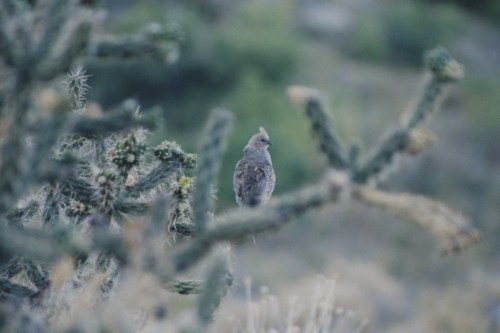
Quail are sociable, staying together from birth to death as a covey, and when one lone quail, separated from the group, calls out plaintively, the covey circles back and joins the solitary being, bedding down all together in the evening so that they appear to be one animal, not fifteen or twenty, when observed closely. (I have reared quail and know their habits.) The quail also make for a fine gumbo, or with a brown sauce on top of white rice, a delicious entree. They are beautiful and interesting to watch, but they are also food.
Deer, buck or doe, appear majestic in the field as they scan for predators and graceful when they arc over fallen timber or fence. Fawns scamper and play about their mothers like children at the playground. The backstrap or tenderloin of the deer is one of the finest cuts of meat on earth. The liver of venison when soaked in milk overnight becomes delicate to the taste when fried and offers potency to the sick. Deer are beautiful and interesting to watch, but they are also food.
Two years ago, in 2009, I chose the name of my blog, “Sage to Meadow,” based upon a post by Coffeeonthemesa, a blog published out of Taos, New Mexico.
Coffeeonthemesa uses a phrase in her post that describes a covey of scaled quail moving from “sage across the meadow” near her home. I like that. It describes plant and terrain, sage and meadow: expansive geographic images and symbols of the American West.
Here is the post of Coffeeonthemesa — the italics are mine — that gave my blog its name and a setting of a lesson about food.
The covey of scaled quail (Callipepla squamata) that pass through our yard on their mesa rounds is smaller this year. It seems there are only a dozen or so, but they are quite plump. They move north to south from the sage across the meadow, stop to graze under the sunflower seed feeder, move through the little shed (have they ever found anything to eat in there?) and out again, in a little row. They search around the wood pile and cross the barren summer garden, before heading down the road towards the mesa edge. Last week I found the feathers and scant remains of one on the north side of the house where our woodstove ash pit lies.
They’re short-tailed, chunky birds with a cotton top crest, and the lookout quail sits atop a sagebrush or low fence post and barks out warnings to the others. Generally they run when something nears, zigzagging through the underbrush. Although the covey can explosively flush when startled.
I cannot help, when watching them under the feeder, but imagine how their plump little breasts would make a fine gumbo.
Coffeeonthemesa blog, Taos, New Mexico, November 13, 2009.
The eloquence of Coffeeonthemesa’s prose brings the eternal cycle into her final sentence: “I cannot help, when watching them under the feeder, but imagine how their plump little breasts would make a fine gumbo.”
I have never been a consistent hunter in the food chain. I shop the food chain. I go to the supermarket for food, but I know it is not the supermarket that gives me food.
I have hunted in the food chain. In the 1970s, I went deer hunting with two friends, shot my deer and dressed it in the field. Oh, I had known the one-life-for-another axiom for a long time, but the buck I shot set the lesson inside me, inside my body so that all the literature and thinking I had ever done about one-life-for-another seemed faraway, alien even, to the beautiful, majestic animal I knelt before.
Beneath me, still breathing, eyes open, the grey coat shimmering, lay the deer, my first deer, its antlers hard and white. No longer would he browse the field, sniff the wind, eat acorns beneath live oaks. His animation was near end. As I put my pistol to his heart, I promised myself that I would prepare all of him for me and my wife and my friends to eat. I would honor this being, this deer, this day under the sun near Van Horn, Texas.
As I dressed the deer, I retched and threw up.
Must all lessons be assimilated like this? Or, expelled like this? Can’t very well drop the class can I? Can we? How do I get out of this university (universe)?
The regret and sadness I had that day recedes when I ponder the lesson the deer set in me. In my anthropology classes, the lesson is taught every semester, every class, to every student. I don’t grade them on it except for the economics of reciprocity in a society. I set them on a path to learn the lesson — they will have to go into the field to have the lesson truly set, but here are the words:
We all take life to sustain ourselves. To obscure that fact is profane. To recognize that we take a life to sustain ourselves is sacred. The sharing of food with another, next to laying down our life, is the greatest gift we can give others. Who feeds you? And, what do you do for them in return?
Jack Matthews, author of Sage to Meadow, Introductory Lecture in Physical and Cultural Anthropology.
____________________________
Notes, corrections and additions:
The New Mexico State University Scaled Quail Management Operation.
Marcus G. Martin Bird Photo Gallery. The quail on cholla bush is from Martin’s gallery — permission pending. Click his link for other photographs and website.
This post started out only as a post describing how my blog got its name. From quail gumbo, however, the post grew into what it is now.
Along with the more somber lesson herein written, there are other lessons from an anthropological perspective that relate to to food: (1) by giving food, parties, spreading your resources, you enlarge your social network and friends; (2) gifts make slaves; (3) by giving of gifts, including food, you create obligations. I think that we could go deeper into the psychology of harvesting animals, but for the moment, this is it. One aspect that bears mentioning is that if you take life with respect, you probably won’t harvest unnecessarily, and you will get beaucoup angry with those that do. You may even go to war with agencies that take the fat of the land and hold it in reserve, extracting a price for its distribution. Read most any history on the opening of the American West, the partial closing of the American West.
Filed under Deer, Life in Balance
Like a stag at eve [revised]
Yesterday I inadvertently hit the “Publish” button before I was ready to publish the post, “Like a stag at eve.” Please, if so inclined, look at the complete and revised post that emphasizes Patrick Leigh Fermor, a “happy, reckless and cultivated” writer of travel and nature.
The revised, updated and technologically-pure piece of prose is found at: Like a stag at eve.
Filed under Nature Writers
Like a stag at eve
This past summer I read books as never before, tearing through familiar and unfamiliar authors such as Patrick Leigh Fermor, Henry David Thoreau (again), Aldo Leopold, Willa Cather, Tolkien, Ptolemy Tompkins, Stanley Crawford, Bertrand Russell, Frank Waters and works about communal acequias in New Mexico that urge me to decamp to the streams of the Sangre de Cristo and grow beans. Not since I was a boy with a summer to burn have I ravaged pages.
The words were all good, beyond good, and took me into a sublimity of things hoped for, places to visit on a pilgrimage. Each author found precise words to describe, to explain, the nature of things above, below and in middle earth (seems fit to describe it this way, although “universe” is apropos, too).
Patrick Leigh Fermor’s travel and nature writing is so fine, so lush, that it reminds me of how Faulkner wrote of the South in prose so eloquent and deep. Fermor’s A Time of Gifts and Between the Woods and Water traces his travel from the Spit of Holland to Rumania in 1934, at the age of nineteen. Recomposed fifty years later with memory and field notes, he describes Europe and its nature with eloquence that entrances his readers and urges a reclamation of by-gone periods of wildness and sociability among people.
But, Fermor’s solitude in the woods evokes his best writing. In the Carpathian Uplands, he writes,
I saw nobody all day; there were numbers of red squirrels, a few black ones, and innumerable birds; but the only larger creatures were hawks and, usually in pairs, languidly and loftily afloat around the jutting bastions of rock, golden eagles. Sometimes I was looking across wide bowls of tree-tops before plunging into them; at others, striding over grassy saddles or scrambling on those expanses that, from below, looked like bald patches; but most of the time I followed whatever dim woodland tracks I could unravel; breaking off, every so often, to side-step across unstable and irksome cascades of shale; then back along the branches. As usual, on lonely stretches, poetry and songs came to the rescue, sometimes starting echoes. I still had plenty of food; there were dozens of streams to drink from, many of them thick with watercress, and as I flung myself face down beside one like a stag at eve, I thought how glad I was, at that particular moment, not to be standing properly at ease on the parade ground at Sandhurst. Oxford would have been better; but this was best.
Patrick Leigh Fermor, Between The Woods and The Water, p. 205, NYRB edition, 1986.
How often have we hiked through the high country, desert even, and seen the change of terrain? Frequently, of course, and if our commitment is strong to write the log or field notes, we have captured the trek with descriptions of wet rock, noisy streams, smells of conifers and clouds that stream fast-by, racing clouds that yield no rain. Fermor brings eloquence and deep associations in his life together.
“Like a stag at eve” is lifted from Sir Walter Scott’s, Lady of the Lake, Canto I. As I reread Thoreau this summer I was struck by his classic references to Greek and Roman mythology. Such associations in nature writing enliven the prose and send me to the encyclopedia.
There’s just not enough time to read all I want to read. Life is short, so let us enjoy as profoundly as we can. And, enjoyment comes from reading Fermor and his trip across Europe in 1934. Europe in ten years would not be the same.
______________________________
Notes, corrections and additions:
Note to readers and subscribers: as the case often is with technology, I inadvertently hit the “Publish” button before I was finished composing. I have added additional paragraphs after the quote and corrected the spelling. I withdrew the post for a few hours to recompose.
As a boy, the canon included the Hardy Boy’s mysteries and back issues of Boys Life magazine. I looked for bush pilot stories and camping out under the mesquites and oaks of the Southwest. Then, as well as this summer, I stacked books and magazines that fell off the nightstand.
The stag at eve had drunk his fill,
Where danced the moon on Monan’s rill,
And deep his midnight lair had made
In lone Glenartney’s hazel shade;
But when the sun his beacon red
Had kindled on Benvoirlich’s head,
The deep-mouthed bloodhound’s heavy bay
Resounded up the rocky way,
And faint, from farther distance borne,
Were heard the clanging hoof and horn.Sir Walter Scott, Lady of the Lake, Canto I.
“Life is short, so let us enjoy it as profoundly as we can,” is taken from a Renaissance saying about living life to its fullest.
Filed under Nature Writers
Lilly’s* cairn
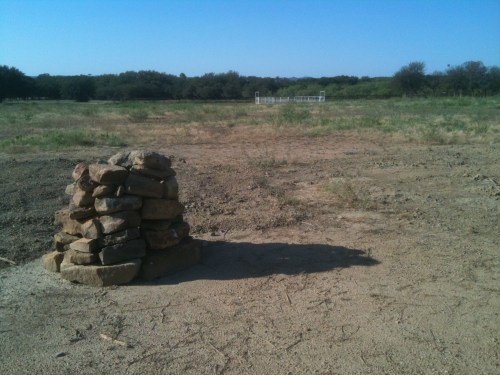
This summer I constructed a rock cairn to stack sandstone and petrified wood on the ranchito. A few feet up from the cairn in the photograph, I smoothed the soil with a hand rake. The smooth soil and the cairn mark the spot that Lilly*, known also by her registered name, Ima Lil Moore (APHA 111214), lies buried, six feet beneath the surface in a grave dug by the backhoe of a Stephenville, Texas, contractor. The cairn is about four feet in height and I pile smaller stones within the hollow of the cairn as I work through the day.
Cairns are built on top of mountains and within them sometimes a tin box is placed so that mountaineers may log themselves in and make a few comments about the climb to the top. I’ve done that with Mt. Taylor and Pedernal in New Mexico, climbs that I remember vividly and relive in my mind as I grow old. I shall not stop climbing. I don’t have a mountain to climb now as a goal, but the South Truchas peak in New Mexico is the only one of the Truchas peaks I have not assailed. I will find the South Truchas cairn and write of my climb some day.
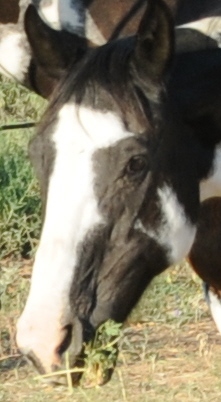
Lilly’s cairn contains no tin box, but as I look at it during the day I etch comments about her in a notebook that never fades or tears. She was my first and original teacher of horse behavior. I learned the difference between a kick of aggression and a kick of delight. Lilly never bit or kicked in aggression. She suffered to stand in her last days, allowing me to put a sling on the tractor and hoist her up by the neck, whereupon she shook herself and proceeded to the hay bin as if nothing had happened. To her last days, feeble as she was, the powerful King Ranch mare of mine who stood two hands above her always moved aside in respect for Lilly so that she could eat where she wanted. Lilly was alpha among the remuda.
I have thought of writing a post about putting Lilly down, and I will some day, but for now, I fill her cairn with rocks she galloped upon, throwing stones in her run to green pastures and fresh water. I know those stones and pick them up for her cairn. And in my dreams, Lilly walks beside me on a trail to the top of a unknown mountain, and she fills my night with peace.
______________________________
Notes, corrections and additions:
*The spelling of Lilly is “Lilly.” It is a nickname that originated with my mother. The flower, “lily,” is spelled with one “l,” but this horse has always had it spelled with two “l’s”. Call it quaint Texas spelling. The spelling of names on birth certificates is always interesting. And, unfortunately, sometimes confusing.
Filed under Lilly


![deer[1]](https://swamericana.com/wp-content/uploads/2011/10/deer1.jpg?w=440&h=440)