Category Archives: Wild Flowers of Texas

Photos and commentary of wild flowers of Texas. Most come from field work at Flying Hat Ranch, north Erath County, Texas.

Shame and Kisses: More Flowers of Flying Hat (12-13)

Catclaw or Shame Vine
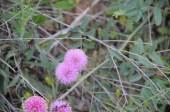
12. Catclaw, Shame Vine

This blossom and plant attests a rapid response to the human touch. It is variously known as: Shame Vine, Sensitive-Briar, Catclaw, Shame-Boy  (Mimosa microphylla). It has appeared every Spring since I have lived here, but I never photographed it before today. When I looked up the name of the plant, I also read that the tiny opposite leaflets close upward quickly when touched or walked upon. One authority says that the mechanism of withdrawal is not known in all respects.  Fascinated, I went down after lunch and shot this video of the Catclaw or Shame Vine.  Sure enough, when touched, it drew its claws in or folded its leaflets in ‘shame.’  Look at this video for it’s fascinating.


The Wild Honeysuckle or Kisses

13. Wild Honeysuckle, Bee Blossom or Kisses (Gaura suffulta), April 2012.

I spent two hours in the fields and grove this morning, photographing blossoms, mustang grapevines, yucca and the family of Gyp of Indian Blanket. Suddenly, there erupts in the pastures the Wild Honeysuckle pictured above. One day it is not there, the next day the flower is spread over five acres of pasture.  I never knew Honeysuckle grew on the ranchito.

The area has had two good rains in the last month that accounts for the lushness of the fields.

Of course, in identifying the blossoms above I found no quick method to do so.  I kept going among three wildflower books and the pictures in the books are not always precisely reflective of my photographs.  I find the Lady Bird Johnson Wildlife Center possesses a number of photos and variations that I can deduce better than one picture in one book.  But it did not help me this time.  I nearly gave up and was about to publish the blossom anyway, when I went into the Roadside Flowers of Texas by Mary Metz Wills and Howard S. Irwin.  Wills painted the wildflowers and did not photograph!  Nonetheless, I found a sketch of Wills that coalesced the attributes of the Wild Honeysuckle for me to identify.    Wills and Irwin’s book was published in 1961 by the University of Texas Press.

* * *

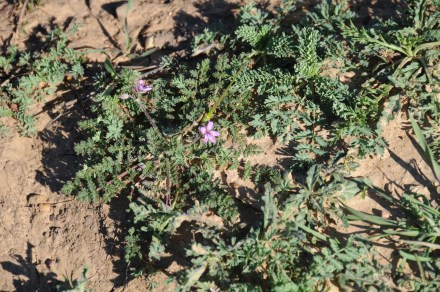
What is this with the local naming of plants?  Shame Boy, Shame Vine, Kisses, Catclaw?  Before we had scientific names, the visual and behavioral characteristics set plants and blossoms apart for identification.  ‘Tis useful, quaint, enduring in memory.  Only this Spring have I finally seen the ‘stork’s bill’ in the Stork’s Bill plant.  It is not in the blossom, but is the shape of the seed pods in the plant’s emergent foliage.  I think both names are necessary, the scientific for classification and study, and the local idiomatic names that reflect culture.  I enjoy learning names of nature’s plants and creatures for it is like meeting strangers — long and lasting friendships may endure, strangers no more.

* * *

I know you may think I am tedious about the Gyp Indian Blanket, but here is another picture of the family.  I can see the family outside my kitchen window and often monarchs perch and feed upon the family.  I have photos of monarchs perched upon the blossoms and will post them in the future.

16 Comments

Filed under Flowers of Flying Hat, Wild Flowers of Texas

Vacation chores

My Spring vacation ends today.  Tomorrow back to work, teaching.  On the list of chores for ‘vacation,’ several tasks were accomplished, some were not.  I changed the flatbed tire, carted the Case DX-55 for repair and managed cleanup in the corrals.  The tractor remains in the shop for repair.  The barn alleyway remains unpaved with rain coming tomorrow.  I shall have to wade through mud after the rain.

The unexpected came up.  I shopped for a lower-gas-mileage car, preparing to trade in the white F-250 (I’ll be left with Old Bull, the gray 2002, F-250).  Shopping for a new car ate up two days of the seven-day vacation.  Is that not the norm?  I did not purchase a new vehicle.

* * *

I spotted a male Western Bluebird yesterday perched on a yucca-flower stalk, occasionally turning around on the dead pods, flexing its wings.

This morning I saw two monarch butterflies, one in the grove and one near the house.  They fly higher than treetops.

* * *

Spring arrives in a couple of days.

* * *

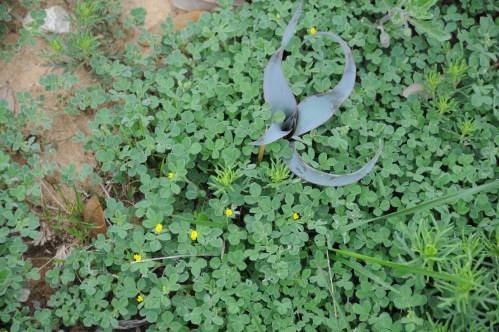
I have continued to photograph each new flower I see on the ranchito.  I’ve not identified all of them, but they have been photographed.  Yellow predominates as blossom color.  Here are clover with yellow blossoms and a pale-leaf yucca whorl.  The pale-leaf I am confident in identifying, but as to clover, have you ever looked up how many clovers there are?  There are several genus and species listed on the Lady Bird Johnson Wildflower Center website.  This clover abundantly erupts on the ranchito.


14 Comments

Filed under Birds, Succulents, Wild Flowers of Texas

Flowers of Flying Hat (5): Ground plum, not yummy

Yesterday evening as I came back a different path from the barn after feeding Star, I discovered this flowering plant, the Ground plum, milkvetch.  I spent over an hour perusing field books until I identified Ground plum.  I nailed the identification when I corroborated a field book description with the Lady Bird Johnson Wildflower Center website.  Depending upon the species of Astragalus, some members are poisonous, but this species is not.  Even so, Ground plum is not a yummy plant although its fragrance is lovely — somewhat spicy I believe.

5. Ground plum, milkvetch (Astragalus crassicarpus?). March 3, 2012, southeast second-level terrace. See: http://www.wildflower.org/gallery/result.php?id_image=9002; Wills and Irwin, p. 138, especially.

I discovered a new link for plants: University of Michigan-Dearborn Native American Ethnobotany.  You must check this out for medicinal uses of plants.

This medicinal use of plants starts me thinking.  I may set aside an area in the barn to harvest some of these plants.  I already have a request for bull nettle to be sent up to Wisconsin for an indoor greenhouse.  Don’t let the bull nettle go outside!

14 Comments

Filed under Flowers of Flying Hat, Wild Flowers of Texas

Flowers of Flying Hat (1-4): Late Winter blossoms

Human beings set goals, or at least I think they should.  On the other hand, doing what comes naturally has its attraction too.  I have set several objectives regarding nature observations on my 53 acres.  Here on the place — called variously, the ranchito, Flying Hat Ranch — I have sought to identify every tree on the place and have started a good list of American elm, cottonwood, mesquite, juniper, oak, and so on.  Identifying every tree continues to be a goal.  Tree identification was (still is) my first goal in field work on Flying Hat.  Other goals I have set up include:

observing another fox and taking its photograph,

identifying every bird I see,

identifying every bird I hear,

for one year, photographing every wild flower I observe on Flying Hat.

Achieving these goals, and the process of doing so, is personally satisfying and gives me narratives for this blog.  I have decided to start another goal-oriented project and demonstrate it on my blog.  I have begun taking pictures of the wild flowers on Flying Hat and my goal is to continue photographing and identifying flowers (all colorful blossoms) through a turn of seasons for one year – March 2012 – February 2013.  So, let’s see how far I can go with this project.  Here are my first photographs.  The No. 3 flower is disputable as a “Texas Star.”

(If I have made an error in typing, please comment or e-mail me your reasons for seeing the flower and plant differently.  I want to be right in my typing, but more than that I want the typing to be correct.  Note: All photographs are taken on the 53 acres of my ranchito; none are photographed off the place or off the ranchito grid.  For a precise location of Flying Hat, see location information in this blog footer.)

1. Verbena (Verbena bipinnatifida?). February 26, 2012, west slope of terrace, Fenster's field. See Wills and Irwin, p. 189.

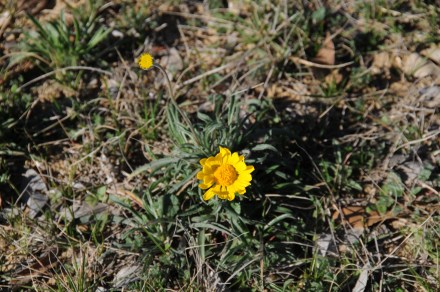
2. Parralena (Dyssodia pentachaeta), of the Aster family. February 26, 2012, on back terrace and in Fenster's field east of the house. See Ajilvsgi, p. 148.

3. Bluebell bellflower (Campanula rotudifolia), February 26, 2012. See http://www.wildflower.org/gallery/result.php?id_image=3102; see notes below.

4. Violet ruellia, violet wild petunia (Ruellia nudiflora). February 26, 2012, Fenster's field, far field. See http://www.wildflower.org/plants/result.php?id_plant=RUNU; Ajilvsgi, p. 377.

______________________________

Notes, corrections and additions:

No. 3 flower and plant is probably as described in caption.  Thanks to Montucky of Montana Outdoors blog and Grethe of Thyra blog.  The issue seems to be resolved it you stand up the flower and look at the total plant.  The flower would droop like a bell and the leaves and stem favor the image in the citation in the caption: http://www.wildflower.org/gallery/result.php?id_image=3102.

Mary Wills and Howard Irwin, Roadside Flowers of Texas.

G. Ajilvsgi, Wildflowers of Texas.

Campbell and Lynn Loughmiller, Texas Wildflowers.

Steven Foster and Christopher Hobbs, Western Medicinal Plants and Herbs (A Peterson Field Guide).

23 Comments

Filed under Flowers of Flying Hat, Wild Flowers of Texas

October in Texas: dusting and sunflowers

Sunflowers with dust storm near Abilene, Texas (October 17, 2011).

A light “dusting” of dust, not snow, descended with high winds upon Texas yesterday. A cold front came in the afternoon that sent temperatures this morning down into the lower 50s F. I love changes in weather. Of course, not with abrupt turns that bring destruction and fire, but changes like yesterday: brisk winds, racing clouds, lightening, rain in the distance that you can smell (my dog, Yeller, lifts his head high to catch the scents far away), dark clouds with long trailing edges that signal rain prospects and all of it bringing anticipation to the heart that tomorrow will be different, a new day with fresh starts all over the world.

How can one capture that cachet of weather change and anticipation for riding your favorite horse into the future? ( I am down to one horse, my Star paint gelding, so he is the favorite, the last of the remuda — but I will build a remuda back with brown mares that foal in the Spring.)  Well, you can’t capture it, but you can take a photograph that elicits Texas weather change, and the above photograph of Texas plains, dust and sunflowers, brings yesterday’s moment to pause.

You must ENLARGE the photo above to get the full effect of yesterday’s “dusting” around Abilene, Texas.  The evocations the photograph brings reminds me of migrating pioneers in the nineteenth century that saw the Trans-Mississippi West plains and stopped, not wanting to venture farther onto land that had little water, few trees and a population that spoke strange languages.

O, Pioneers!  Be not afraid!  There are springs and rivers, trees are in the ravines and highlands!  The Indians will trade and parley and teach their tongues, if you will tread lightly upon the terrain!

Yes, I know that pioneers did not tread lightly.  There were, however, places of concord — Bent’s Fort, the Pawnee, the Tewa, among other spaces and culture.

Despite this riff-tangent about the American pioneer, I come back to the weather change of yesterday that brought cold winds, turning the sunflowers to face the southern climes.  Bees and butterflies still feasted on its pollen, riding the petals like cowboys on broncs; the contrast of red earth, dusty skies and yellow flowers showed a tough plant on inhospitable soil, holding on tight and bearing its colors to the world.  I love these types of weather changes.

5 Comments

Filed under Weather, Wild Flowers of Texas

If she isn’t the prettiest thing you’ve ever seen, I’ll give her to you!

Wild Flower Gal with verbena (north Erath County, Texas, late winter, 2007).

Four winters ago, my neighbor, Jerry Wood who lives two miles south of me on County Road 114 stopped at my mailbox as I retrieved letters one morning.  We chatted for a few minutes as he kept his diesel truck running and as we closed our conversation he said, “I have a horse, Jack, [words unintelligible over the engine noise] I’ll give her to you!”

“I’ll give her to you?”  I had three horses at this time, two tobiano black paints and one quarter horse, Sweet Hija, and another horse added to the remuda would not be a problem to train and feed.  But, a gift horse?  I thought as Jerry drove off that he must be terminally ill or something drastic was going on like divorce or bankruptcy.  I immediately decided that if the horse was sound, I would take her off Jerry’s hands and ease his problem — whatever it was.

Within the week, I drove down to Jerry’s with my trailer hitched up, pulled into his corrals and saw Wild Flower Gal, a sorrel tobiano paint that was drop-dead gorgeous.  “Why would he even want to get rid of this beautiful creature?” I quietly thought.  In any case, he took her through her paces, showed that she was healthy and halter-trained and I liked her behavior so she would fit in after getting to know my other three horses.

After seeing her training, paces and overall friendliness, I asked Jerry, “Are you sure you want to give this beautiful horse to me, Jerry?”  I thought he was making a big mistake to give Wild Flower Away and I did not want to exploit Jerry’s problem — whatever the heck it was — in his hour of crisis.

“What?” he said.

“You did say, didn’t you, Jerry, that you were giving this horse to me?”  This was quickly going in a perplexing direction I did not like.

“Oh, no!” he quickly replied.  “I said, ‘If she isn’t the prettiest thing you’ve ever seen, I’ll give her to you.'”

“Oh, you did?”  This was definitely in embarrassing territory.  “How much do you want for her?”

“One-thousand dollars,” he replied.

I became a tad dizzy in my thinking at that point, but my mind quickly cleared the confusion:  Jerry’s diesel engine had blocked out his words, “If she isn’t the prettiest thing you’ve ever seen…”  And I had slammed his statement into, “I have a horse to give you, Jack.”

What to do?  Buy the horse and lighten my bank account?  Probably the best exit strategy.  If I did not buy Wild Flower Gal, I would probably be the center of an oft-told tale at the Hannibal Country Store concerning my over-eagerness to gainsay another yegua for free.  I did not want that circulating around the cracker barrel.

So, I bought Wild Flower Gal, loaded her up and brought her to my stables.  Jerry signed over the pedigree, pocketing a thousand.

Wild Flower Gal was pretty, but not the prettiest gal I had ever seen.  But, pretty enough to buy and train and sever any anecdote about my confusion.  Several months later I snapped the photograph of her in late winter browsing through the wild verbena.  It was fitting, this photograph, because she was in a pasture of wild flowers that reflected her namesake.  I sold her a year later for a thousand dollars to a family near Abilene, Texas, that showed her at halter and loved her well.

A lot of lessons emerge from this story.  Verify and clarify conversations of commercial intercourse.  Cut your engines when conversing.  Above all, there’s no such thing as a free horse.

16 Comments

Filed under Horses, Sweet Hija, Wild Flowers of Texas

Field gifts in July

At 3:30 a.m., with such dignity as I can muster of a July morning, I step from my cabin door, bearing in either hand my emblem of sovereignty, a coffee pot and notebook.  I seat myself on a bench, facing the white wake of the morning star.  I set the pot beside me.  I extract a cup from my shirt front, hoping none will notice its informal mode of transport.  I get out my watch, pour coffee, and lay notebook on knee.

Aldo Leopold’s early morning field method, A Sand County Almanac, pp. 41-42.

This July morning, a warm morning that will expand into hot, I walked the one-half mile of Salt Creek on my 53 acre ranchito.  Salt Creek is an intermittently-flowing creek that twists and curves through the forested grove in the middle of the 53 acres.  During heavy rains, the creek reaches ten feet high and lays flat the water-gap fences on the east and west ends of the property.  This summer, waiting out the worst drought since 1895, the creek remains intact, its bed dry; yet elms, junipers (beautiful they are), cottonwoods, oak and pecan trees uplift subsurface moisture, retaining their leaves and shade for owl, redbird, bluebird, sparrow, deer, armadillo, skunk, coyote and fox.

Salt Creek on this day holds one watery seep, fifteen feet in length of oblong, deep water.  Flush against the shady side, this watery seep encapsulates water three-feet in depth, the water flowing from the native grass field I have tended these last four years.  I discovered on my walk, along the one-half mile of the creek bed, it is the only source of water in the bed.  Wildlife track abounds around the water cache, and it is supplemented by my stock pond — amply full — a quarter-of-a-mile away to the northeast.  Animal tracks puncture the wet soil of both seep and pond.  Trails radiate in all directions from these water pools, life-sustaining hubs among tens of thousands of water holes in west Texas.

Walking, ambling really, I kept watch for the unanticipated field discoveries that, without fail, always occur; and if none appear, I have not looked upon, within and close enough, the land upon which I trod.  I wrote in my field notebook the jack rabbit, woodpecker, roadrunner and fertile pond algae as they appeared in good order from the house.

As I turned in the creek bed at the last big U-turn loop, I gazed upon color, flower color, I had never seen before: the Clammyweed.  Not exactly the classiest of names, but it is what it is.

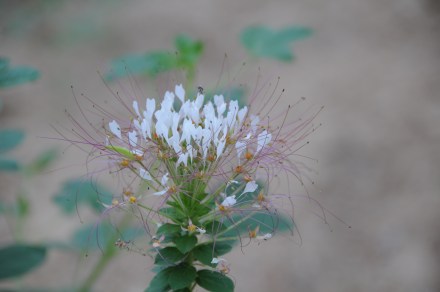
Clammyweed (Polanisia dodecandra), Salt Creek, north Erath County, Texas (July 27, 2011).

Clammyweed grew on a sand bar in the middle of the dry creek bed.  Seven blossoms on three plants taunted the drought in all its brazen heat, stating in siren tones that shade, moisture and sand can bring forth purple and white, stamens a-blazing, here in July.  The heat be gone for the moment.  Hooray!  for Clammyweed!

I was already dizzy from the heat and lack of air circulation, but this discovery boosted me out of the spell.  I read later in field manuals that Clammyweed is a derivative of the caper family, one of my favorite garnishes, and that if one rustles the flower or plant, an odor emits that clams to the skin.  I must go back and find out for myself this attribute.

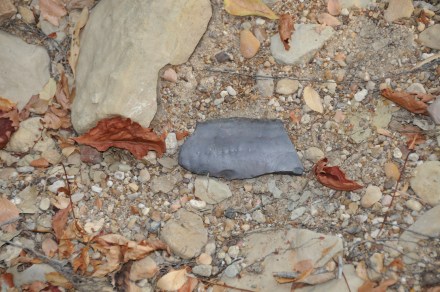
The second field gift on this July day came near the end of my one-and-a-half hour field trip.  Walking gingerly in the middle of the creek bed, avoiding large sandstone rocks, I looked down and saw a dark, flat-shaped, lithic object of iron ore that is abundant about the place.  Thinking it a natural chink or large piece of rock, I kicked at it with my boot.  Instead of a natural formation, it showed signs of flaking and abrasion — a lithic tool, used by Native Americans before the onslaught of mining, farming and ranching.

Abraded and flaked lithic tool (4'' x 2.5"), Salt Creek, north Erath County, Texas (July 27, 2011).

I noted the location, picked up the tool and continued my ambling to the west water gap, the end of my walk.

Returning to the house, I sat down, not with coffee but with a Dr. Pepper, and wrote out the rest of my field notes.  My observations had begun at 8:14 a.m. and concluded at 9:45 a.m.  The temperature by ten o’clock was 86 degrees, headed upwards to 105-107 degrees by the late afternoon.

The grove remains green.  A water seep looks healthy in the creek bed.  Wildlife track abounds.  Cultural artifacts appear, attesting to man’s continuing occupation of the surrounds.  The day will be hot.  Gifts, of a sort, have fallen in my path and I gain a sense of continuity with nature reviving itself in Clammyweed blossoms, bursting in color, a natural goddess emerging from the earth in July, glimmering in fertility.  Paradise regained.

* * *

The water cache and seep along Salt Creek, north Erath County, Texas (July 27, 2011).

______________________________

Notes and corrections:

The photograph of the Salt Creek water cache was appended.

The sentence, “Paradise regained,” was added in the last paragraph of the essay.

15 Comments

Filed under Field Log, Plants and Shrubs, Wild Flowers of Texas

Allowing the flourishing of wildlife

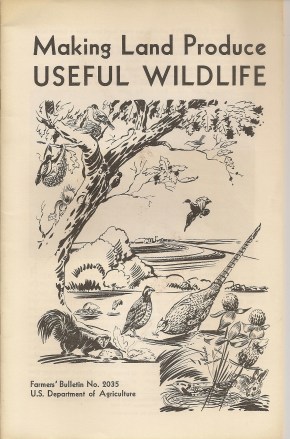
A 1975 reprint of Farmers' Bulletin No. 2035

The first summer I lived on my ranchito, the summer of 2004, I hired Cody Scott to plant native grass seeds in my far pasture, the Pecan Tree Pasture that lay between Barton Creek and Salt Creek.  Last summer I reseeded the pasture with native grass seeds and wildflowers.  The upshot of these two distributions has been a resurgence of bluestem, side-oats gramma, buffalo grass, coneflowers, Indian blankets and vetch.  Frankly, I held no longitudinal goal other than to provide habitat food for cattle, horses and wildlife.

Frank Waters of The Man Who Killed The Deer (1942) fame wrote that the proper relationship of a person to the land was to “live with the land,” not on it, but with the land.  Living with the land has been an axiom for me, a mantra for many years.  A U.S. Department of Agriculture Farmers’ Bulletin No. 2035, “Making Land Produce Useful Wildlife,” provides me guidelines to live with the land.  By way of full disclosure, I do not make my living raising cattle or horses, but teaching at a junior college in Abilene, so my basic approach to my ranchito is sustaining the land, not cropping, leasing or planting.  That being said, I integrate what I have learned with horses, cattle and the land into my lectures.

The land is my teacher and all things upon it instruct, from thistles under juniper to even — I hesitate to write this — the mesquite.

So, a few tips from “Making Land Produce Useful Wildlife,” by Wallace L. Anderson, biologist, Soil Conservation Service, I list below.

To support a high wildlife population, a farm or ranch must have a plentiful supply of good food close to cover that furnishes protection from enemies and weather.  And it must be available in all seasons of the year….

Pastureland practices harmful to wildlife are uncontrolled burning, overgrazing, and complete clean mowing early in the season….

There are three essentials to good cover for wildlife — grasses, weeds, stubble, and other low-growing plants for nesting and roosting; dense or thorny shrubs for protection from predators, for loafing, and for nesting; and, in the North, clumps of evergreens or other tall dense cover for winter protection.

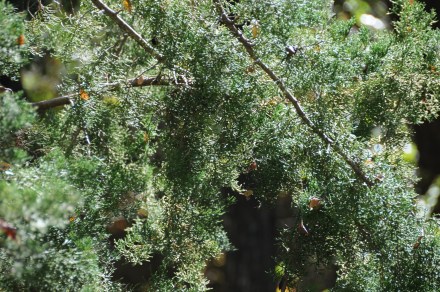
Mesquite thorns, poisonous plants and cacti also abound along the fence rows in the far field.   I have bull nettle, a stinging plant to the touch, but it has medicinal properties.  The nightshade plant that many define as a weed has been used to treat snakebite erupts along the corral.  And the few cedar trees, cut and harvested year after year prior to my ownership, their posts for sale in Mingus and Palo Pinto, are defined more appropriately as “juniper” provide berries for birds, aroma for incense and luscious shade from the sun.  I shan’t be cutting  cedar breaks or juniper.  All this in the far field allows the flourishing of wildlife close to me, close to you, close to us all.

Juniper, often referred to as cedar (J. Matthews, 2011).

[In my next post, I will write about the mesquite tree that is close to us all here in the bush.]

6 Comments

Filed under Cedar, Flying Hat Ranch, Juniper, Life in Balance, Plants and Shrubs, Wild Flowers of Texas

The color purple

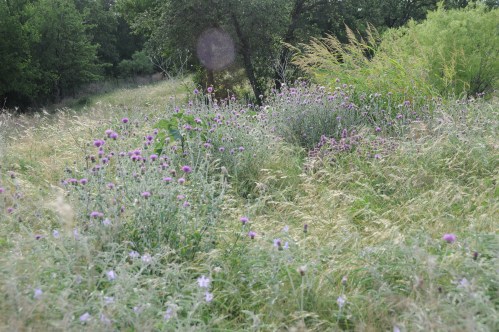
Thistles, horsemint and nightshade on embankment (June 2011).

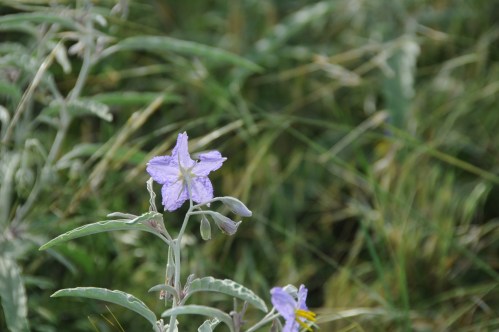
When I dragged the tree trunk and limbs to the cow tank embankment, I discovered the color purple in three flowering plants: thistle, horsemint and nightshade. The horsemint is clustered together in the center-right of the photograph and resembles a spindle. The nightshade is less prominent and has a star-shaped flower.  (Click the photo to enlarge and see detail.)

The star of nightshade (June 2011).

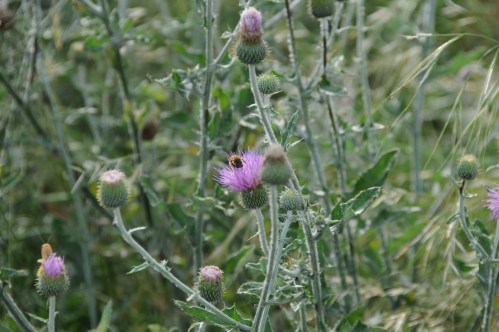
Emily Dickinson upon thistle (June 2011).

Bees collect pollen upon the thistle.  A few grasshoppers look on, ready to fly when I wade into the grass.  The embankment stands to the northwest of the cow tank or pond.

I have a predilection to call these runoff water ponds, “cow tanks,” from my background in San Saba, Texas.  I remember a cow tank I once swam in with my cousins.  We swam and got our feet muddy at the edges of the cow tank on the Hollingshead place near Mullin, Texas.  When the land was subdivided after my step-grandfather’s death, my step-father made sure that the surveyors included the cow tank within his parcel of 35 acres.  My cousins and I now own the 35 acres and this summer I plan to swim in the cow tank, its waters pure from pasture and rocky cliff runoff.

6 Comments

Filed under Wild Flowers of Texas

Wild flowers of a dry Texas Spring day

[Please note that when this post was first published yesterday, April 10, 2010, the Silverleaf nightshade was misidentified as a Dayflower.  The corrections have been made in the caption of the flower and plant and the notes contain a warning about the use of the Silverleaf nightshade.]

At 9:59 a.m. I drove down to the barn and parked the F-150.  Taking my camera and walking carefully, within the next hour I traced a familiar path from the barn thorough the corrals, into the arena pasture and into the grove.  I walked along the edge of Salt Creek and photographed these wild flowers of our dry Texas Spring.  Salt Creek is an intermittent-running creek, but there are pools of water and tracks abound.   The trees are green and lush about the creek and grass, despite the drought, remains verdant.

I picked a blossom of wild verbena in the main pasture and gently pressed it.  The fragrance flew about my face and I inhaled deeply.  Only a partial blossom I pressed, but it nonetheless imparted its scent that remained for minutes, not seconds, as I walked back up to the barn.  Beside the kitchen sink, we have liquid verbena soap, reminding me of the wild as I wash my hands, arms and face.

* * *

My uncle Floyd McRorey used to come in from the field and wash his hands in the kitchen sink with hard Lava soap as Aunt Lennie prepared a meal.  I never saw Aunt Lennie wash the dinner dishes.  She helped dry, but never washed the dinner dishes.  Uncle Floyd always washed the dinner dishes.

* * *

All of the following photographs may be enlarged with a click of your mouse.


Notes:

The scientific nomenclature for each plant may be incorrect as there are a broad range of varieties.  I refer to as many as four books and two databases to identify the plant, but I may be in error, so please verify my identification.

The Silverleaf nightshade is all toxic.  Medicinal: Used for rattlesnake bite – root chewed by medicine man, who then sucks on the wound to remove venom, then more root is chewed and applied to swollen area. (Steiner) Southwestern Native Americans used the crushed berries to curdle milk in making cheese, and the berries have also been used in various preparations for treating sore throat and toothache (Lady Bird Wildflower Center Plant Database).

Please see the link for Silverleaf nightshade:

Lady Bird Johnson Native Plant Database Silverleaf nightshade.

10 Comments

Filed under Wild Flowers of Texas