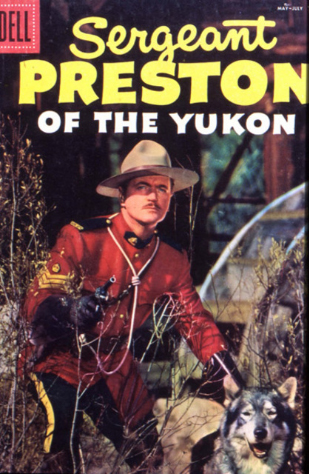
Sergeant Preston of the Yukon with his faithful dog, Yukon King. Rex, his horse Sgt. Preston rode during the summer, is not pictured. Neither is Pierre, his French Canadian friend.
I ran, trudged or bicycled home from Coggin Ward in the late 1940s and early 1950s, opening the door and running into my room to listen to fifteen-minute episodes, then thirty minutes of action in the 50s, on radio station KBWD, Brownwood, Texas, of the adventures of Sergeant Preston of the Yukon with his husky dog, Yukon King. “On King! On you, huskies!”
I had a radio, my own radio to hear Sgt. Preston’s daring does. I had been reared in a small trailer house, then a pier-and-beam house, with my mother and grandmother and the Philco 41-245T Tropic radio that glowed a soft-golden light across its frequency panel, emitting sounds with basso edge. Yes, it was golden. That Tropic radio stayed with my grandmother, but I had a small Philco to link me symbiotically to A.M. airwaves, theatrically setting the stage for desperadoes and their inevitable capture by Sgt. Preston. I pedaled like crazy to get home on the day Sgt. Preston came alive.
I look back now on Sgt. Preston and know that the setting in the Canadian outdoors, along with my dreams of becoming a bush pilot in Canada and Alaska, engendered a deeper attraction to earth, trees, wild things blowing in the wind. I never bought the comic books of Sgt. Preston as you see in the photograph. I had the animation of sound, produced by corporations and hosted by Quaker Oats! Preston’s voice, Yukon King’s bark, Rex’s nickering, evil doer’s cackle and the sound of wind in the trees replaced comic books. Comic books? Who needed comic books when Sgt. Preston was on the air, in the air and I could, with hundreds of thousands of other kids, hear his sled glide through snow? Crunching footfalls, trees cracking and rivers roar. All there, on the radio.
My radio days of yore included other programs. I went to sleep a thousand times with the radio on, the music fadin’ in and fadin’ out, the Jack Benny Show, Lucky Strike Hit Parade and the Louisiana Hayride. But, Sgt. Preston and Yukon King remained my boyhood favorite. The other shows were mainly the selections of my grandmother and mother.
I know now — perhaps as a boy, who can say? — that the cold, wild travels with a dog in the woods took me away from hot and arid Texas. Oh, yes, I liked the uniforms, who doesn’t? Snappy red, yellow-striped trousers, high-top boots. The uniform was trivial and I could only imagine it from other sources. On the radio, impressively, Sgt. Preston talked to his dog. His dog communicated with him. They conversed in a cold, wild woodland context, faraway, but not alien to me.
When the snow comes to Flying Hat Ranch, I go outside and I work, I play. My horses prance. I take their photographs — remember Star, the levitating horse? I secure chains to the pickup and glide through snow to Santa Fe and the Jemez, never doubting my survival for I have been snowbound and trapped on the Jemez Mountains at night and have spent a three-below night in my car at Taos. Sgt. Preston chased criminals, found them and concluded his program by saying to his dog: Well, King, this case is closed.
My travel in cold, wild, woodlands is not a chase. It’s a journey between two places whose starting and ending points change. I prefer to glide where it’s cold and wild and forested, wind blowing conifers, the sky cloudy or blue. At the close of the day, like those radio days of yore with Sgt. Preston and Yukon King, I shall build fire, embrace my companions and turn on the radio, seeking that signal, that program, that lets me fall asleep.
______________________________
Notes:
My cousin, Sam Gray, wrote on Facebook in response to this post that, ” Whenthe radio shows were in their last days you could only get them on Sunday nights, and my mother made me go to church instead. Broke my heart!”
Philco Model 41-245T for 1941 (T for tropic), introduced June 1940, 7 tubes, electronic push button, 3-band reception (540-1550 kc, 2-7 mc, 9-12 mc), original price $39.95, 22,566 made.
This is the identical model of radio that we had when I was a child.
The photograph and description of purchase by a antique radio collector is found on TubeRadioLand.
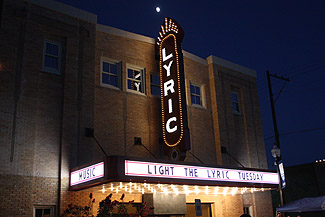
In the 1940s, in Brownwood, Texas, three movie palaces illuminated downtown: the Bowie, Lyric and Queen. I sat in all of them and learned much about Hollywood life, even Mexico because the Queen ran some of the best desperado celluloids I have ever seen. The Bowie theater showed upscale film, hardly any Saturday morning trailers for boys and girls. The Lyric posted both upscale (MGM, Colombia, 20th Century Fox) as well as the Lone Ranger, Roy Rogers, Tarzan and the Three Stooges. I can still see the darkened theater and kids at the Lyric waving and shouting and screaming and laughing, hands and arms waving between me and the screen. When I saw Purple Rose of Cairo, I saw myself in the audience at the Lyric theater watching the film come right off the screen and into my heart.
Mother took me to the Lyric one day and I took my teddy bear, young boy that I was. I fell asleep. After the showing, we came back to the trailer house on Austin Avenue, where the clocks spun in the dirt. The trailer was cramped for the three of us: mom, grandmother and me. Sweltering in the summer, pumping and pushing those sprayers of mosquito repellent at night. I looked for my bear at bedtime. The bear was gone. I had dropped teddy when I fell asleep and now it was gone and in the hands of who-knows-who at the Lyric theater.
A day went by and I missed that bear.
Then, magic, like Hollywood and the desperado escapes in Mexico, mother said, “Look under your pillow, Little Jack.”
I uplifted the pillow and there was my teddy bear, black buttons for eyes and leather for its paws, all back in my clutches, never to leave my side again. What vacuum had been was now evaporated in the retrieval my mother obtained from the Lyric theater management. She had gone next door to use the landlady’s telephone to have them hold the bear until she could walk (we had no car) back downtown the next day, rescue the bear and come back to our trailer house on Austin Avenue.
The good citizens of Brownwood have turned the old theater — it has been shut for decades — into a thespian venue, replete with new furnishings and grand opening. A new palace for acting and art. I can extrapolate, but won’t right now. It’s good, not bad.
I parse the loss of the bear and its return. What I see and feel is a mother caring, a business attentive to lost toys and a town that nurtured its community with innocent amusement for a post-war generation. The Lyric theater in 1914, from what I read about it, was to be a theater for live performance, probably a late-vaudeville medium as well. If that is true, then the Lyric theater has gone from a venue for live performance to Hollywood and serials on Saturday back again to live performance. A cycle.
When I lived in that small town, I never lost anything, not even a bear at the Lyric.
Albuquerque Central Avenue Vintage Postcard (Legends of America)
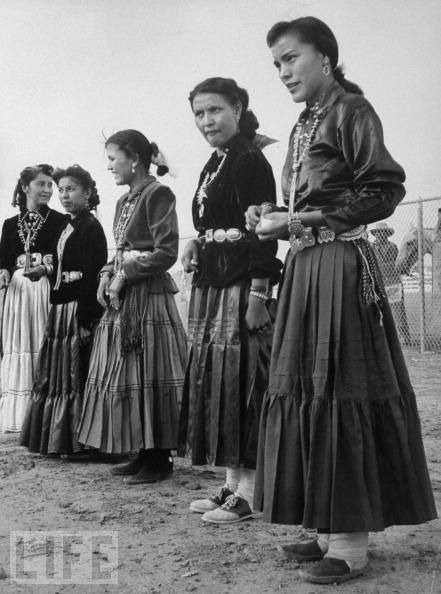
As a boy, I looked out of a hotel window in Albuquerque, New Mexico. I saw women in colored skirts and snow-covered mountains.
…
In 1947, my mother and I and her boyfriend traveled to Albuquerque, New Mexico, from Brownwood, Texas. I do not remember the name of mother’s friend, but he was a nice man and very kind to her. I was five-years old. The road we traveled to New Mexico included a long stretch of highway paved like a washboard. I sat in the backseat, and for an hour or so when we hit that stretch of highway, I bounced up and down. At the end of the bouncing lay Albuquerque, a city that imprinted the New Mexico I revere in memory.
My mother and father divorced shortly after World War II, and mother worked at several jobs to support herself and me. We lived with her mother, Effie, who worked also at odd jobs to pay the groceries and rent for trailer house space under walnut trees on Fourth Street. It was a very small trailer with one room composing three bunk beds and kitchenette. Our toilet was in the neighbor’s house from whom we rented the space for the trailer. Late into the evening, the Philco Safari shortwave radio emitted a golden glow with its sounds of music, news and comedy.
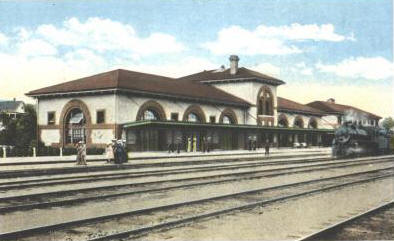
Mother must have met her boyfriend at the cafe she worked, across from the Harvey House at the Brownwood Santa Fe railway depot. He toiled for Santa Fe railroad.
Brownwood Santa Fe Train Depot (Historic Texas Net)
She also waitressed (it became a verb in our family) downtown at the Cactus Cafe where she became cashier before being hired by Southwestern States Telephone Company, a corporation she worked at for over thirty years. Mother had blond hair and blue eyes, about five feet, two inches tall in height. She was slightly built and vivacious — Irish through and through. She was quite verbal, having descended from a background of story tellers and fiddlers near Bend, Texas, a small village along the Colorado River in central Texas. Stern and hard-working, she pushed herself to the extreme while young and it did not cease when she grew old.
This trip, however, was a vacation to Albuquerque with a close friend and there was no work involved, just fun and merriment. We must have stayed several days in Albuquerque. Mother and I stayed in one hotel room and her friend stayed in another. She bought me a book, Indians of Yesterday, that I still have to this day. We visited the Old Town trading area and shopped downtown. Our hotel was several stories high, but I don’t remember the name of it.
The view from our hotel window looked down upon the main street and in the distance, the Sandia Mountains.
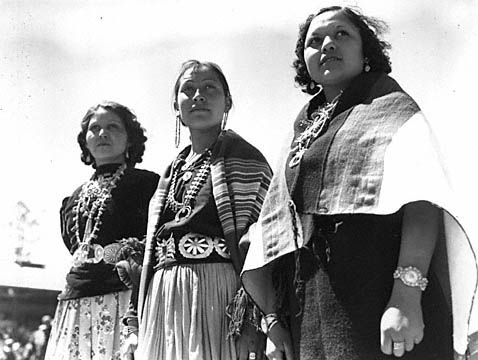
I remember gazing out that window. I would have solitude in the hotel room. Not long, just enough. From my window, I looked down on the street corner and saw women dressed in colorful skirts with concho belts. Their hair was black and they clustered in drops of color about the shops, standing, milling around. Within the skirt pattern, some of which were black or navy blue, I could see rhythmic lines of white ribbon. Soft boots, it seemed, they wore. I don’t remember their wearing hats or bonnets. Exotic women, full of energy, covered in color. It seemed as if they wore several skirts, layered one upon the other.
I peered up from the hotel room and saw snow-covered mountains in the distance, deep purple, deep blue, holding secrets. I looked at them and wanted to go to the snowline and touch the cold — or, have the cold touch me.
I looked down at the women and looked up at the mountains, then the scene as a whole, one tableau. As a child, I comprehended novelty, but I was also enamored by the scene from my window. Today I know that the women are the Navajo that come for trade and fun. The mountains are the Sandia, the location of the earliest paleolithic finds in North America, and I have taken students on field trips to see the Sandia Cave. These new attributions of New Mexico embellish my early memory; they neither replace nor smother what I saw as a child.
You could say, I suppose, if mother and her boyfriend had taken me to New York City, I would have become entranced with cities, but I doubt it. As it was, we returned to Brownwood, Texas, and I got bounced again on the highway while mother and her friend chatted and laughed. Mother continued for a time to work at the cafe across from the Harvey House. Time passed before I returned.
…
In 1955, I traveled to Glorieta, New Mexico, with a church group. I was distracted by infatuation and pious supervisors, but I remember the smell of conifers and the soft carpet of pine needles about the camp. There were neither colorful skirts nor snow-covered mountains — a regretful trip, in so many ways.
Then, in 1967, my wife and I traveled from Amarillo, Texas, to Raton, New Mexico. We had spontaneously decided to go at four o’clock that afternoon. So after packing quickly, we got in the Ford Mustang and drove through thunderstorms to New Mexico. As lightning flashed, it illuminated the countryside and I remember the volcanic hills and mountains flaring to light, then darkness all around. We reached Raton at midnight, excited by our thunderous passage westward.
For the next three days, we stayed in Raton, Taos, and Santa Fe. I was twenty-five years old, twenty years since I had been in Albuquerque with mother. To me at the time, and even now as I compose this piece, the early visit to Albuquerque and the jaunt to Raton seemed a hundred years apart — long, long in-between, though only twenty years. I cannot account for the emotional relativity of it, but it is true. The effect of the quick trip with my wife to New Mexico, however, was quite different from the regret of Glorieta.
I dreamed in vivid colors of New Mexico when I returned to Amarillo: passageways of art and pottery, cafes of chile, museums, people dressed in color and turquoise, adobe walls and hornos. I made plans for a second visit to go farther into the forest and into the desert and trade shops. Over the years, I slept in maid’s quarters and the backseat of my car. I was stranded alone, overnight, in a snowstorm on top of Jemez Pass, bundling in a bedroll and losing a bit of an ear by frostbite. I went again and again and I am still going. I have stayed long enough in the high desert and mountains, however, to become acquainted with rough and jaded junk that falls into arroyos, the brutality of domestic violence, the rage induced by alcohol and drugs on the streets and hyped-up-commercialism of art and craft. I was never an innocent about New Mexico. Never.
It is the land and the people that draws me: the rhythm of the drum, the conifers of Carson, the silky dust of an unpaved road, the remembrance of man and horse plowing the field at Mora, bronzes of Canyon Road, the Dona Luzes of La Casa Sena, Truchas, sagebrush, meadow and the vista of Logan. After my divorce, I took my daughter annually to New Mexico, camping out and staying in fine hotels. We saw Christmas lights on the highway from Tucumcari to Las Vegas, arriving late in Taos one evening. In the summer, dust devils rode beside us, rocking our pickup as we cowboyed through the devil to the campground in the cool forest. These days, I am in northern New Mexico, writing and living in my daughter and son-in-law’s home, renting houses on Witt Road in Taos, and paying beaucoup amount of money in Santa Fe and Albuquerque when I research in special collections and archives. Dust devils still whirl around me; snow and ice make Palo Flechado Pass dangerous; and acequia water still flows along the curbs of Mora and Fort Sumner.
In overcoming loneliness and discontent, I was lucky to have been seized by terrain, something massive and material rather than soft and ideological. It is not all pleasant, this nature writing, because one season is green, the other brown and dying. Yet, the sage blooms again and the riosgrandes have always run shallow or deep, never dry. I see it as my duty to attend these cycles and write about them so that a not-so-bloodless redemption may save our planet yet. It may be a futile effort and I may be wrong.
______________________________
Notes:
Indians Of Yesterday, by Marion E. Gridley, illustrated by Lone Wolf, M. A. Donahue & Company, 1940.
Use of the word, “cowboyed,” is a regionalism. See also “cowboy up.”
The Dona Luz was a restaurant in Taos. I use it here as a personal application to La Casa Sena restaurant, reflecting all the cuisines of the region. To my knowledge, there is no Dona Luz at La Casa Sena. The Dona Luz in Taos had a wine cellar that was dug deeply into the ground. I always liked to eat at a table near the stairwell to the cellar so that I could look down at the wine racks.
I have struggled to define the attraction I have for the Southwest, New Mexico in particular. Texas has its fine qualities and I’ve spent most of my life here and I type it, of course, as southwestern, too. Being a child and on my first, conscious, exotic vacation, the Albuquerque visit would be striking, a first-time event of major proportion. That is explainable by that context. The visit to Raton, Taos, and Santa Fe in 1967, is inexplicable. Calling it a “rebirth” makes me want to stick my finger down my throat. The closest classic description of what happened is D. H. Lawrence’s statement that New Mexico and the high desert vistas called him to fully attend the physical environment (I paraphrase). That’s about as close as I can define it: made me attend landscape and my life like never before.
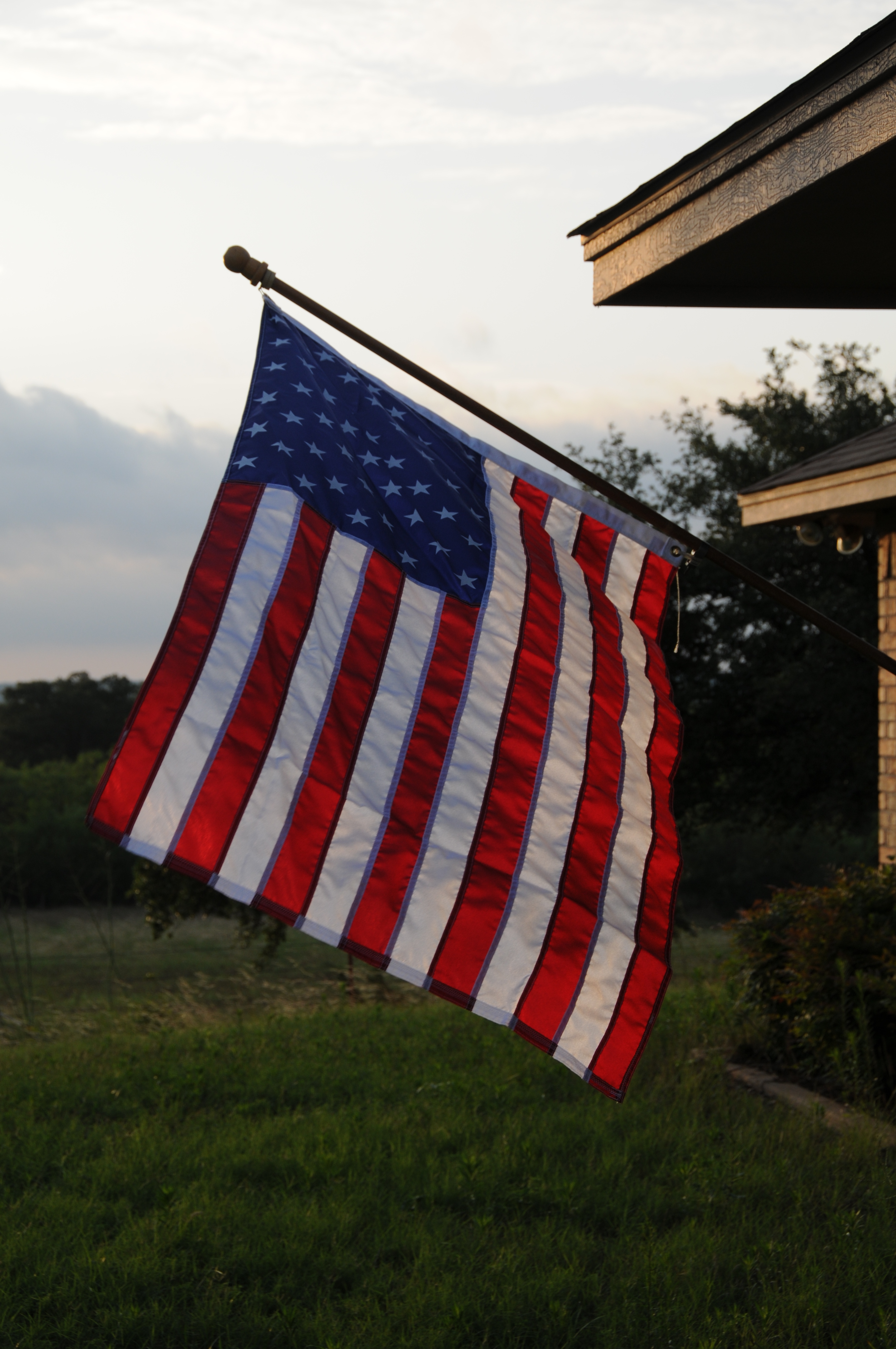
Flag and Early Morning (Photo by J. Matthews, 2010)
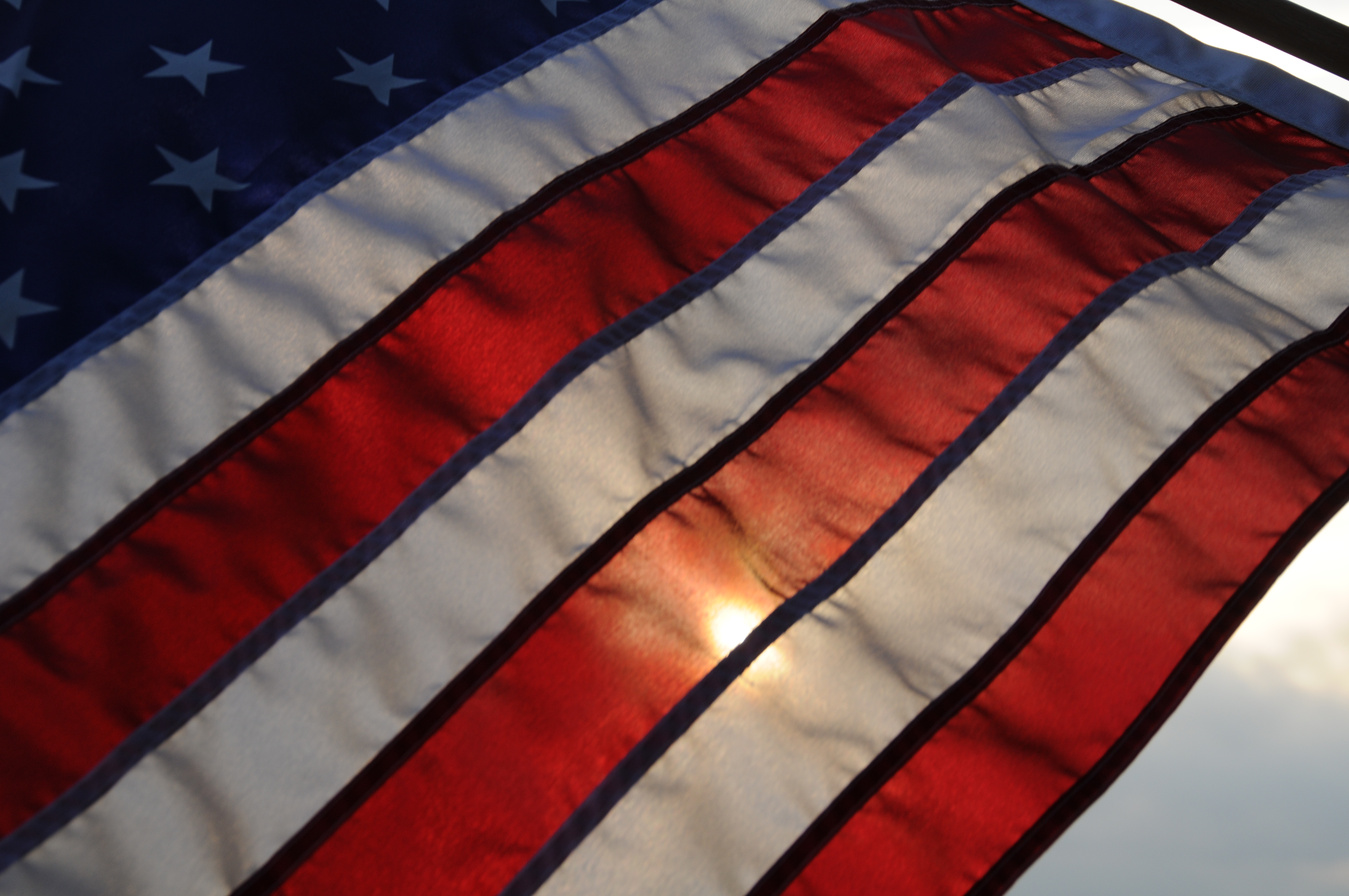
My wife prevailed upon me yesterday to put up an American flag. [Read the notes at the end of this post about Norman Rockwell and his American Ideal paintings.] I installed a pole caddy on the front porch, dusted off the flag pole, unfolded Old Glory, used twine to tie the lower end of the flag to the mast and hung it. Like so many other small projects on the ranch, flag pole installation had been put off for years. At our previous home in Mingus, we had hung a flag for several weeks after 9/11, but since moving to the ranch, we had left the flag carefully folded in the cedar chest that we use as a coffee table in the grand room.
As I was growing up in Texas, the Fourth of July was nearly always hotter than the hub of hell. Many jokes came from the heat in Texas: If I had a choice between hell and Texas, I’d live in hell. And so on. But enough about Hades. For several years, my parents and I would go to Brady, Texas, about fifty miles from our home in Brownwood and attend the Brady Jubilee. That was its name: jubilee. I always associated stifling heat, horse racing and yellow watermelon (salted, of course) with jubilee. It never made much sense to me to travel in a hot, non-air-conditioned pickup or old Ford sedan whose rough felt seats were smelly and lounge under trees and watch horse racing from a distance. Come the first of July, the dreaded Brady Jubilee jaunt lay in front of me like a sauna with no water. There must of been something character building about the event, but I never could figure it out.
This Fourth of July, the weather is cloudy in west-central Texas from the effects of a gulf hurricane and the temperature is a tolerable middle 80 deg. F. We’ve had about two inches of rain this past week and the grass has greened slightly — not a typical Fourth. Where were these days back in my boyhood?
Given this age of internet technology, the town of Brady, Texas, has a website. As a link within the website, there is the Brady Jubilee. I’m somewhat disappointed, however, as I read over the list of activities. There are none for July 4th and no horse racing. All of the Brady Jubilee activities take place July 1-3: Heart of Texas Ford Parade with a “Hats Off To Our Heroes” accent, washer and horseshoe pitching tournaments, fireworks the nights of July 1-3, and a dance Saturday night featuring Brian Burk, Kristen Kelly and the Modern Day Drifters.
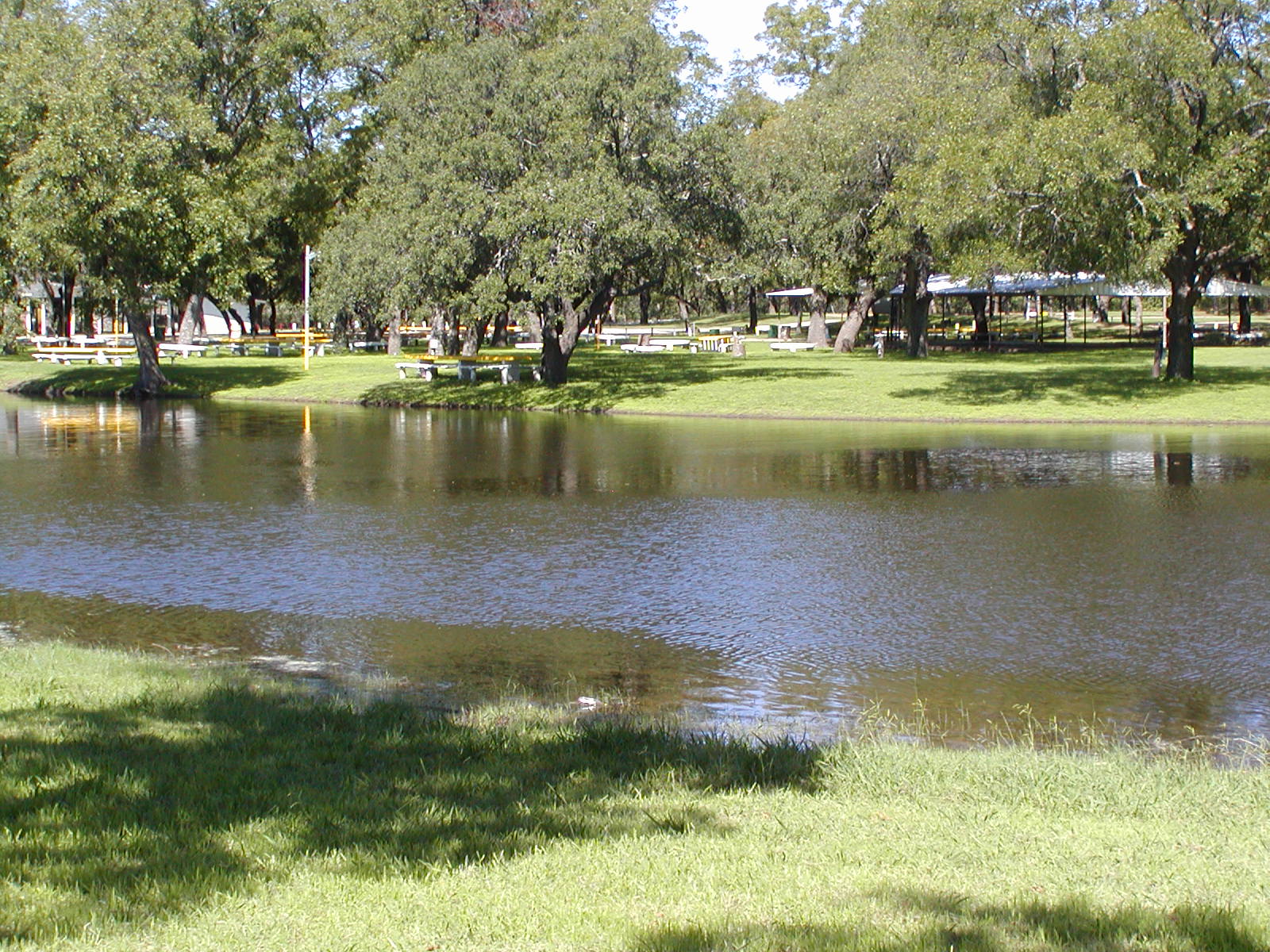
Brady Jubilee, Richards Park (Photo by Cross Bar Land Co.)
Suddenly, I realize that July 4th this year is on a Sunday! That’s why the Brady Jubilee has nothing planned for the Fourth. It’s a church day and normal activities cease and there’s no exception to that rule.
The horse racing, however, is probably a thing of the past — they were short races for quarter horses and not many were booked because of the July heat.
On this day, with no Brady Jubilee scheduled, our plans are to attend a fireworks display at either Possum Kingdom Lake or go into Fort Worth for dinner and watch the display over the Trinity River. Either way there will be no horse racing or jubilee today.
I have to go now and feed the horses and, just by chance, they may race around the arena. To my list of morning chores I will hang the flag. On this Fourth of July, I will think of the Brady Jubilee with its heat, melon and horses and quietly yearn for another day there. Yes, I know, the heat.
______________________________
Notes:
The New York Times today ran an article on Norman Rockwell. A quote about him: “These are qualities one wants to retain as a society, and it is a credit to Rockwell’s subtle, story-weaving imagination that he captured the values we celebrate on Independence Day without ever having done a painting of American flags waving from porches or July skies bursting with fireworks.”
That’s correct, never made a painting with American flags waving from porches. He painted America in the people he painted.
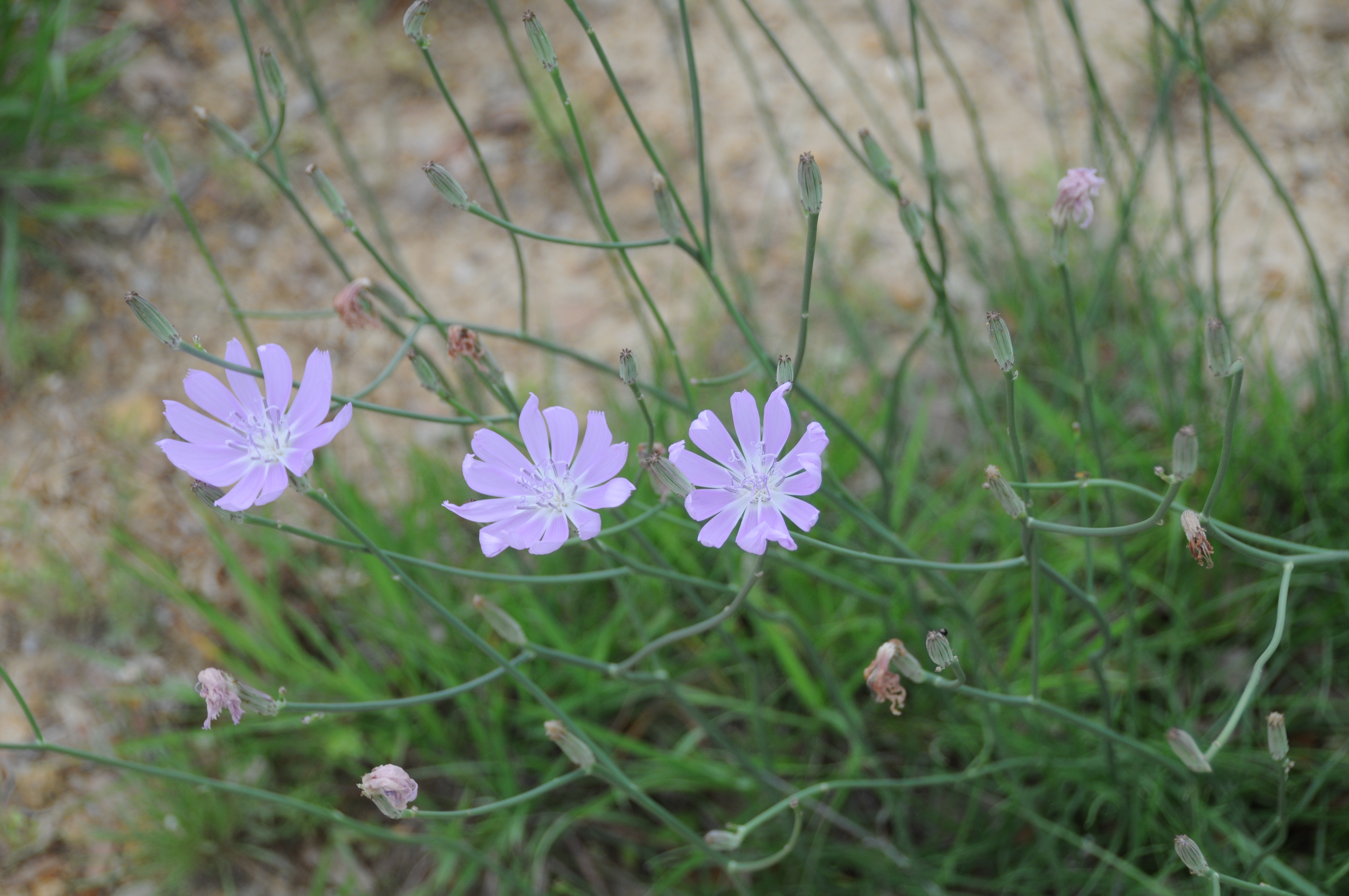
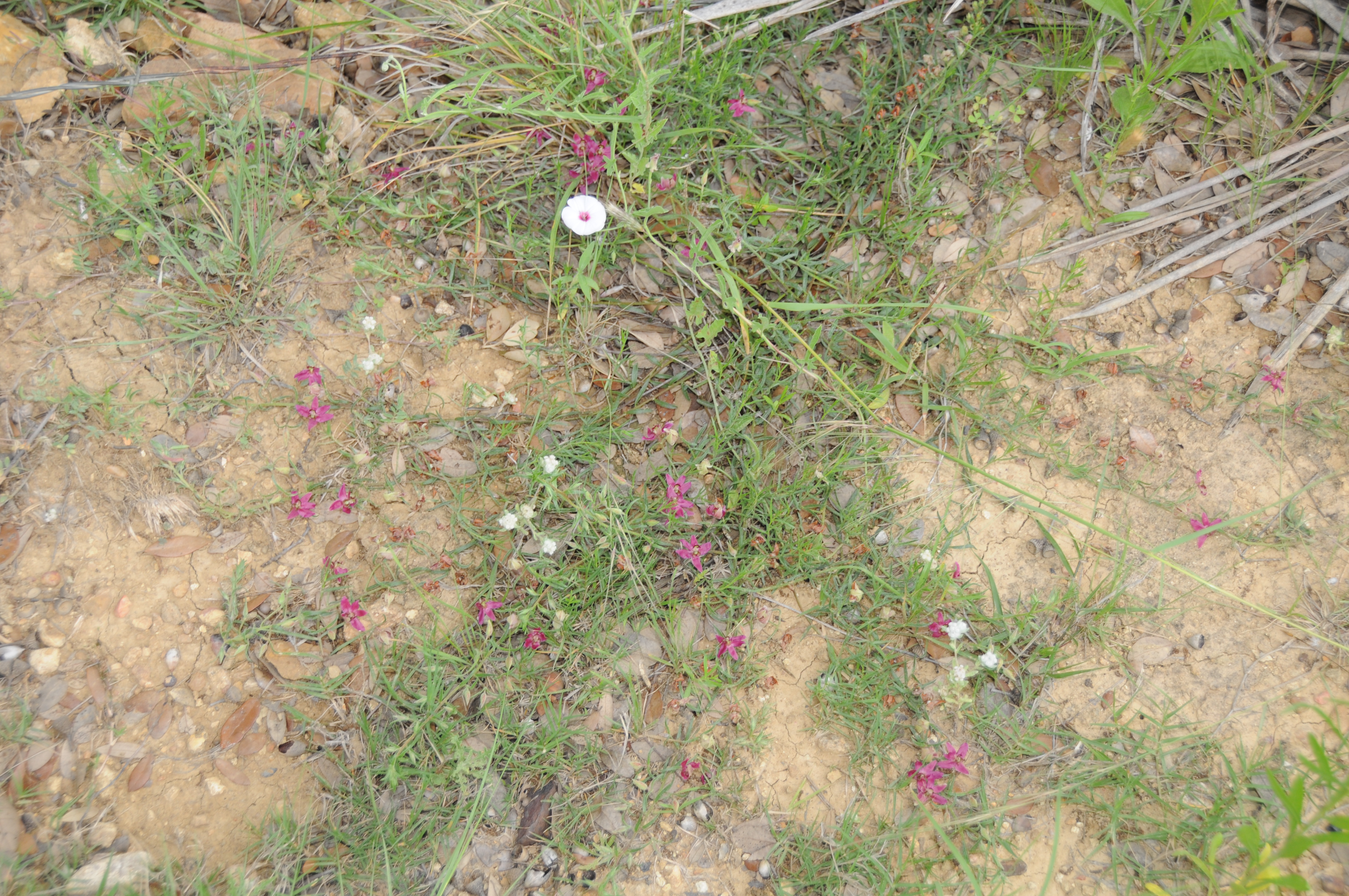
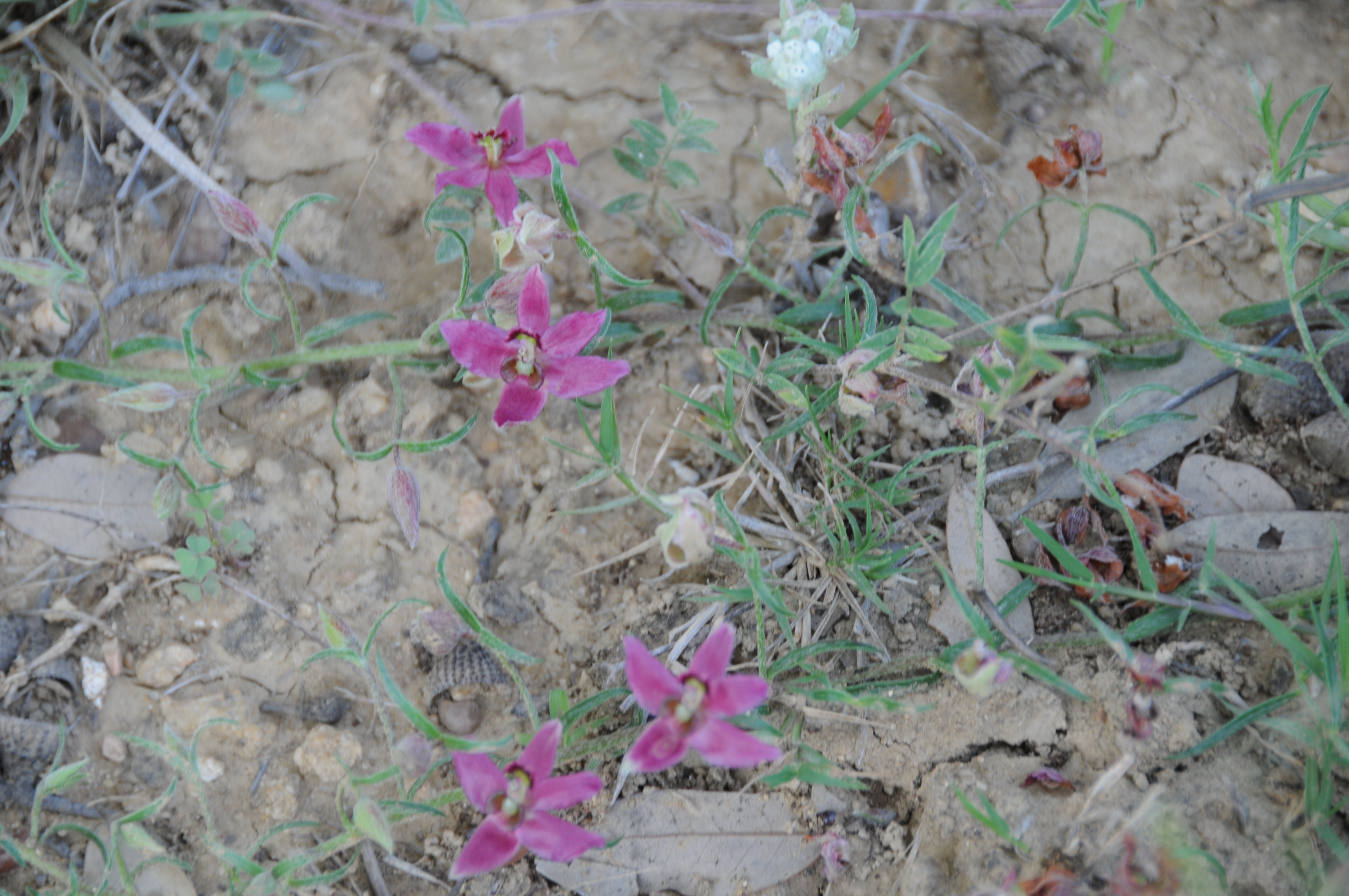
In my regular field work here on Flying Hat, two new discoveries were made this morning of Texasflowering plants. One discovery was the Texas Skeleton Weed (Lygodesmia texana), also known as Purple Dandelion, Flowering Straw. The other discovery, this one rather exciting, was the Prairie Sandbur (Krameria lanceolata), also known by the name of Crameria, Ratany or Trailing Ratany. Before we go to the Prairie Sandbur (accurate spelling), let’s look at the Texas Skeleton Weed, shall we? (I’m beginning to sound like Mr. Rogers here.)
Texas Skeleton Weed
Texas Skeleton Weed, May 2010
This beautiful lavender flower is the Texas Skeleton Weed (Lygodesmia texana), also referred to as the Purple Dandelion, Flowering Straw. These flowers appeared rather suddenly in the last two or three days. The term skeleton is applied because of the leafless stems and the odd angles of the stems, analogous to skeletal assemblies. According to Loughmiller, Texas Wildflowers, “When the stems are broken, they exude sap which coagulates into a gum.” The medicinal qualities of this plant are presently unknown to me. I am currently searching my bookselves for my medicinal plant book for North America. I do have Richard Evans Schultes, Hallucinogenic Plants, New York: Golden Press, 1976, but this Texas Skeleton Weed is not in it. I don’t like the term, “weed.” This plant is far to beautiful to be designated, “weed.” Perhaps the Bull Nettle is a weed, but I even have my doubts about the construct of the botanical term, “weed” applied to it. Weed carries a cultural signification of unwanted, not desirable or bad. I know we use the term, “weed,” a great deal and I understand the context, but I think it should be dropped from the lexicon.
Prairie Sandbur
Prairie Sandbur Cluster, May 2010
Prairie Sandbur Close-up, May 2010
The Prairie Sandbur is the reddish flower in the photographs above. It is also known as the Trailing Krameria, Ratany, Crameria and Trailing Ratany. This is not the sandbur of the grass family. The leaves and flowers grow from prostrate branches. According to Loughmiller, this plant and flower is neither conspicuous nor abundant. They state that the Prairie Sandbur does occur in many parts of the Trans-Pecos River area of Texas. Our ranch is in the West Cross Timbers region of Texas. We are Trans-Brazos by about 50 miles westward. This Prairie Sandbur was found on the east side of Poprock Hill in a well-drained slope area. This plant may be the rarest find on our place. I have looked carefully about Poprock Hill and this is the only cluster!
Texas Bull Nettle, Stinging Nettle, Tread-Softly, Spurge Nettle or STAY AWAY FROM THIS THING!
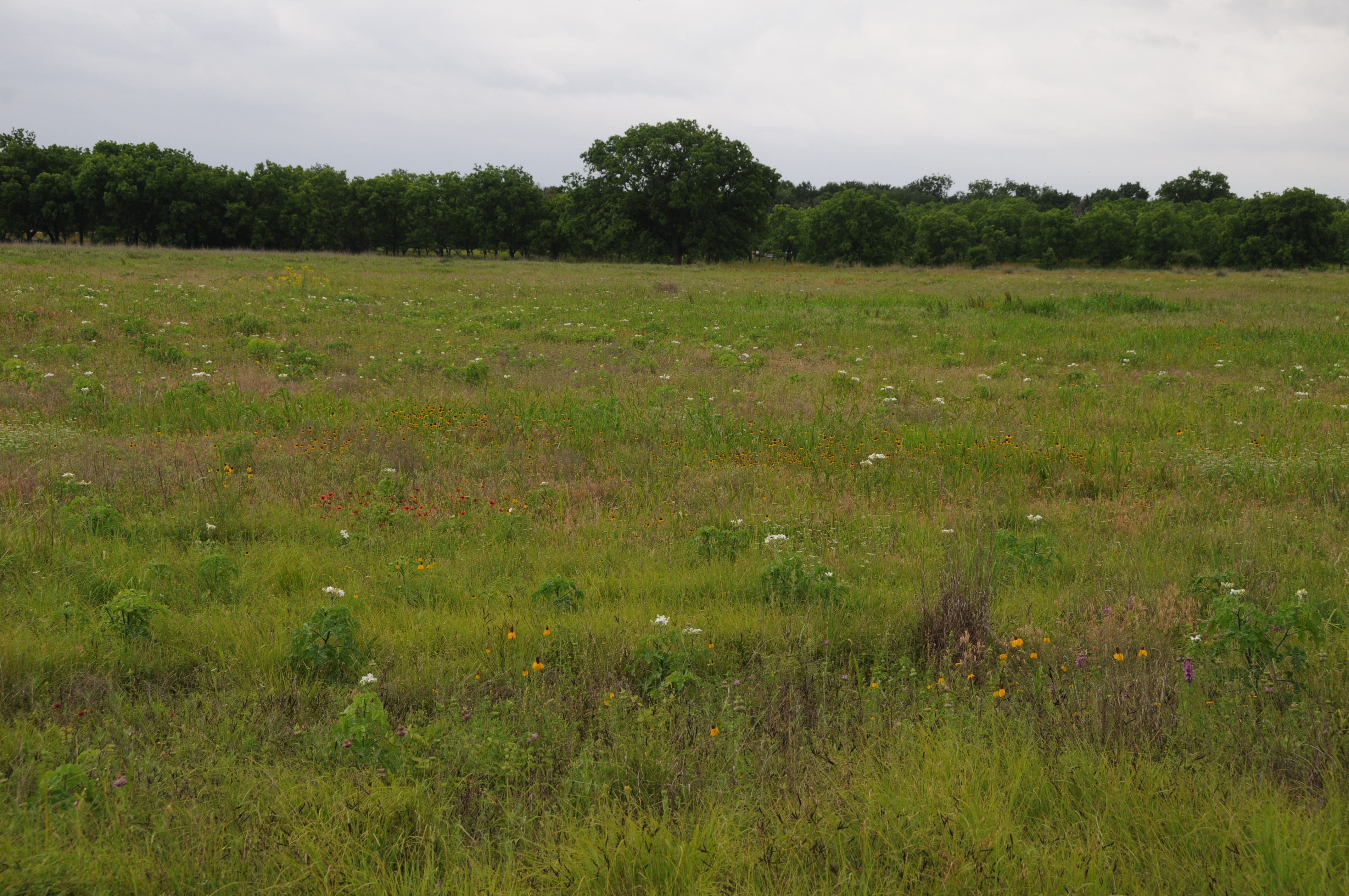
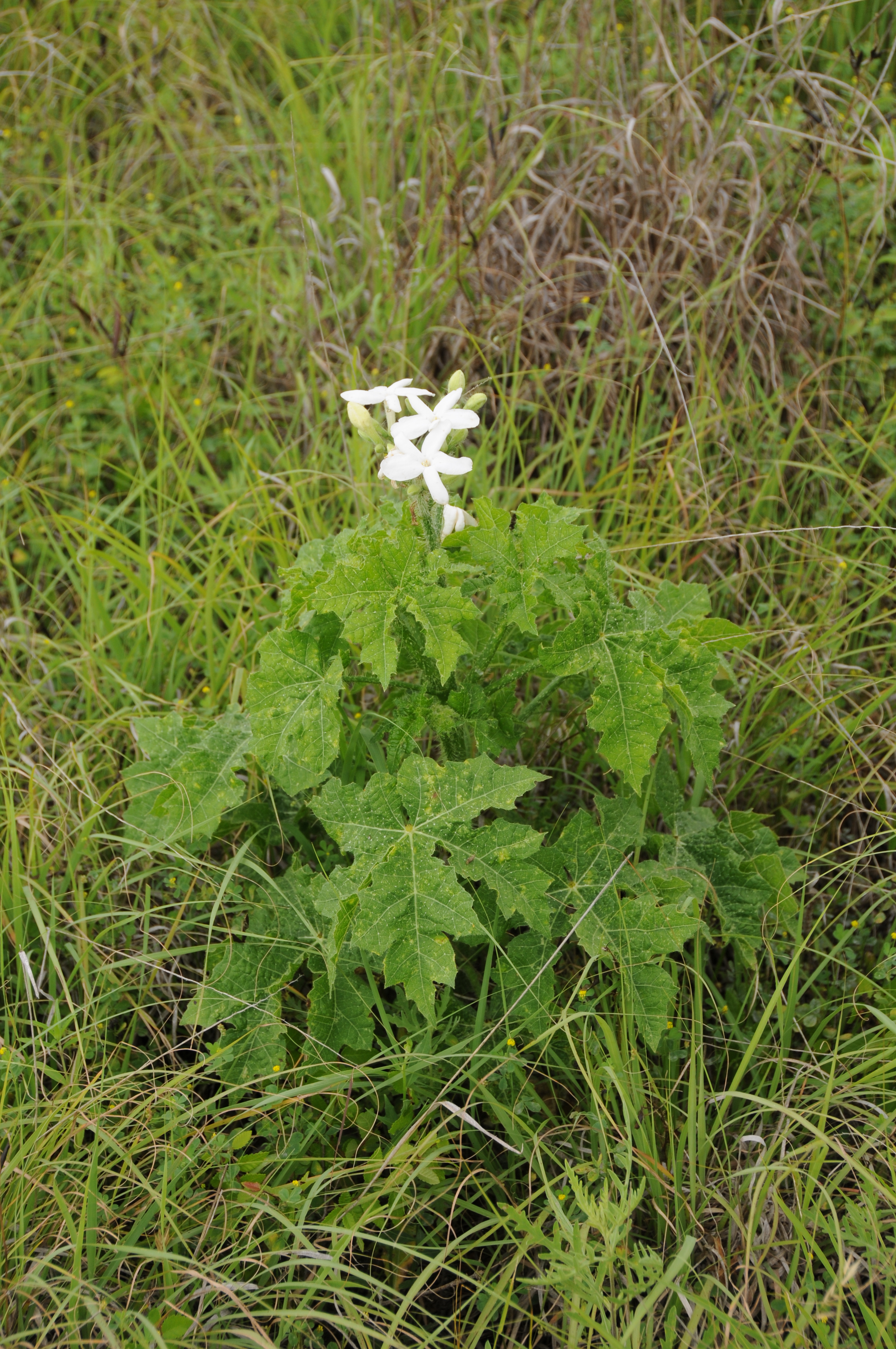
I went out to the Pecan Tree Pasture this morning and hoed or cut out by the hoe some 100 or so Bull Nettles (Cnidoscolus texanus). I still have about one more acre to hoe.
Bull Nettle (White Blossoms) in Pecan Tree Pasture, May 2010
Here you see the white blossoms of the Bull Nettle in the field. Actually, hoeing the plant is rather easy since the vascular main stems are soft at this stage of growth, plus with all the rain we have had, the soil is soft. This photograph is looking southward, towards the Old Bryant Place, and you can see that the pecan tree, for whom this pasture is named has dark-green foliage.
Single Bull Nettle Plant in Pecan Tree Pasture, May 2010
The Bull Nettle is a plant to be avoided. The plant has leaves that are prickly as well as the stem and if you brush up against it, the nettles will sting. Loughmiller says the effect of the nettles will last 30-45 minutes. The stems, if broken, will exude a sap that some people discover, too late, is an allergen.
Today, I brushed up against a Bull Nettle once and I was wearing denim jeans (Wranglers), but the nettle penetrated the denim and I felt a sharp sting. It was a light brushing, just once, but still burned. I have a quick recovery to Bull Nettle in my system and the stinging lasted for about one minute. My initial contact with Bull Nettle occurred when I was three or four-years old and I was with my mother and grandmother at the Sand Cemetery in Bend, Texas. They were on a cemetery clean-up for our ancestors’ graves when I grabbed a Bull Nettle (trying to help) in my right hand. It had a lovely blossom. I really, really experienced pain, especially in the palm of my hand, and for several years, the palm would erupt in a rash. I think that early exposure to Bull Nettle gave me a bit of tolerance, but not immunity.
The Bull Nettle has a personal and family history that goes back sixty-four years, to a time when we cleaned up the cemetery for the Morris, Baxter and Brazil families at Bend, Texas. With the 400 or so Bull Nettles I have scooped out of my pasture, every Bull Nettle or so, I think of my family and how I came to be doing precisely this hoeing, on this cloudy day in Texas.
______________________________
Notes:
A fine source for identifying Texas wildflowers is Campbell and Lynn Loughmiller, “Texas Wildflowers: A Field Guide,” Austin: University of Texas Press, 1989.
I supplement my typing operations with cross-checking from other sources, particularly the online services listed under my page, “Native Shrub Identification Guide.” The sources found online at the Ladybird Johnson Wildlife Center are quite valuable.
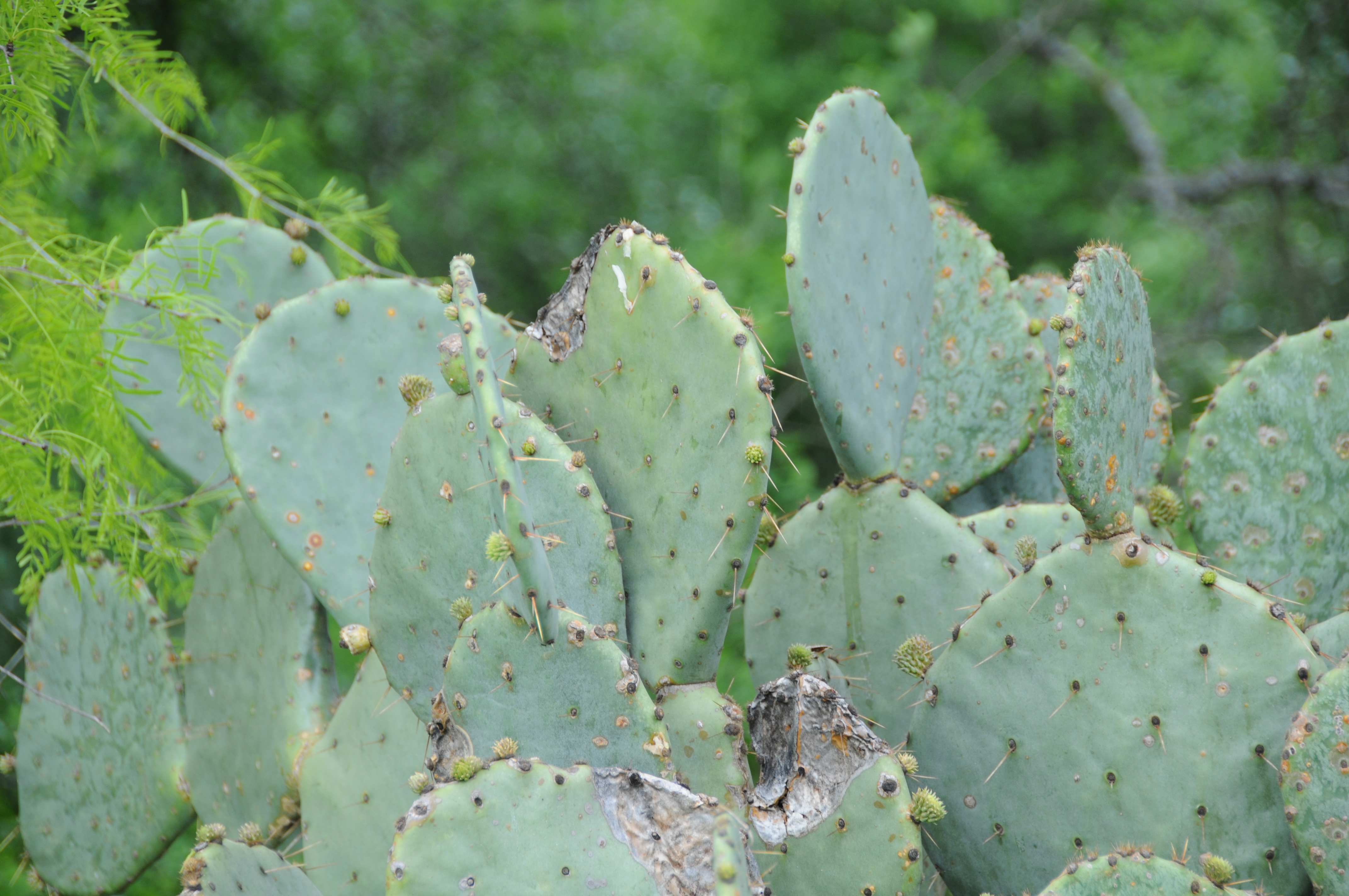
This is a common Prickly Pear in Texas, also known as Nopal Prickly Pear. There’s much about the cactus to be learned and applied in the world.
Texas prickly pear has been used extensively for food: the tunas are eaten raw or processed into preserves, syrups and fermented juice, tuna cheese (queso al tuna) and a tea to cure gallstones. Commercial alcohol is produced from the sap and the tender young joints are used as poultices to reduce swelling. The juice of the joints is also used in candle making. For cattle food the spines are burned from the joints. The older pads contain oxalic acid and may cause oxalic acid poisoning when eaten to excess. Of course many animals and birds feed on the fruit. There is a legend that the coyote brushes the spines off the fruit with his tail before eating it. [Texas A&M University, Texas Native Plants Database]
The Texas Prickly Pear is found along fence rows especially on Flying Hat. I am letting larger stands of the Nopal Prickly Pear alone to thrive. Can’t do it all. I have to set up a list of priorities on our place. Mesquite control in the fields is my first priority, then comes the elimination of broomweed. On the other hand, I have a fondness for the Nopal Prickly Pear–it relaxes me to see a good stand of it with fruit. I’ve eaten the fruit in survival training and it’s okay. Not cantaloupe, but good enough. It’s soothing to see a healthy stand of Prickly Pear because it’s a sign that no pear-burning has occurred. And, pear-burning is a task to be avoided.
My family burned Nopal thorns off the cacti for cattle to eat de-thorned cactus pads (other varieties of cacti, too). My great-grandfather Henry Morris labored at such terrible work during the drought of the 1930s. For him and others, west of San Angelo, it was a hot, brutal job. In the 1950s, I used to see and hear the burning of Prickly Pear thorns on ranches near San Saba and Lampasas, Texas. The sound the propane hand-held burners spewed was low-modulated, hollow–a raspy roar. Violent, unearthly. Uncommon sound, even for Texas, and you could hear the roar for miles around. It was rather disturbing, the sound, because it signified hard times and lack of rain upon the region as well as ghastly work for the crew performing the task. My uncle and cousin and their work crews would wear bandannas about their faces, shields from errant licks of flame and a filter from the smell of torched plants. After the toil of the day, blisters arose in bubbles upon parts of their hands and wrists. I never burned pear, for as a boy they made me stay in the shade.
As my uncle and crew burned pear, they would first give the snakes and small animals time to flee from the burning. The reptiles and animals would, after an hour or so, circle back to their stands of cacti, their habitat singed, but not destroyed. The cattle would have emergency rations. And, we might all see another day, a chance for rain. No good feelings came out of burning Nopal. We all suffered when pear burned.
Rain brought the good and allowed land and flesh to heal, and the coyote could use his tail for combing spines away–as legend would have it.
Millions of people cook and eat the tender young pads of several species of prickly pear. Besides being more tender, immature pads have less oxalic acid, which could be toxic in large amounts. Nopales (the edible species of prickly pear and the harvested whole pads of the same) are very nutritious. Nopalitos (small pads that are cut into bite-size pieces) are mucilaginous like okra, and good for thickening broths. The mucilage also helps control blood-sugar levels associated with adult-onset diabetes. Diabetes is a common affliction among native Americans who adopt Western high-fat, low-fiber diets. There is also clinical evidence that nopales reduce blood cholesterol. Widely ignored by Anglos, who often regard them as worthless nuisances, opuntias are abundant and healthy foods for those who know how to use them.
Prickly pears are a historically important reason that the Spaniards continued their conquest of the New World. They quickly looted the precious metals they were after, but they also discovered cochineal. Cochineal is a scale insect that feeds on prickly pears. Its body fluids contain a bright crimson, foul-tasting substance that protects it from predators. Ground up cochineal insects were used by native peoples to dye their textiles rich red or purple, depending on the processing. In Europe this color of dye was so rare that only royalty could afford it. In some kingdoms the colors “royal purple”(derived from a sea cucumber) and, after discovery of the New World, royal crimson from cochineal, were reserved for the king by law. The cultivation and export of cochineal dye became a major economic activity, and its source was kept secret for many years. The commercial cochineal was harvested and later cultivated from prickly pears in southern Mexico. Our Sonoran Desert species contain the same dye. [From Mark A. Dimmitt, A Natural History of the Sonoran Desert (ASDM Press, 2000), as quoted from webpage of Arizona-Sonora Desert Museum Digital Library on Opuntia wilcoxii.]
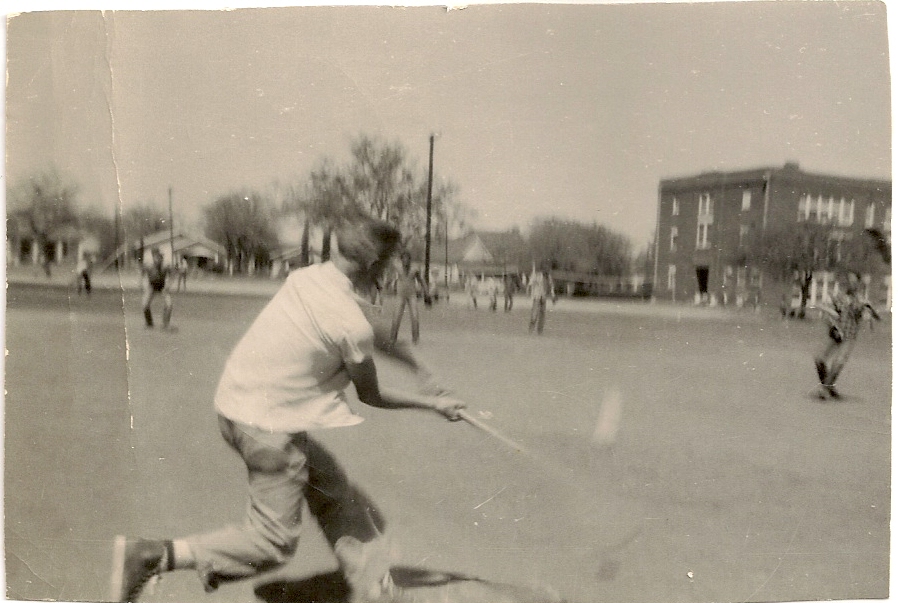
Dale Smith Hitting Home Run, Coggin Ward, Brownwood, Texas, 1955 (click to enlarge)
In the 1950s, when I went to elementary school at Coggin Ward in Brownwood, Texas, we had two recesses, one in the morning and one in the afternoon. The op-ed article from the New York Times today (see link below) decries the lack of playtime in childhood and the problems encountered at recess — bullying, arguing, intimidation — so much so, that recess coaches have been appointed for troubled schools and playgrounds. “For children in past eras, participating in the culture of childhood was a socializing process. They learned to settle their own quarrels, to make and break their own rules, and to respect the rights of others. They learned that friends could be mean as well as kind, and that life was not always fair”, so writes David Elkind.
I loved recess at Coggin! Not so much to escape academics because I loved most of my classes, but I engaged recess like a high form of testing my strength against my weaknesses — running, jumping, kicking soccer balls, escaping from tag, hitting the baseball, even playing mumblepeg on school grounds (pocketknife game, we all carried them).
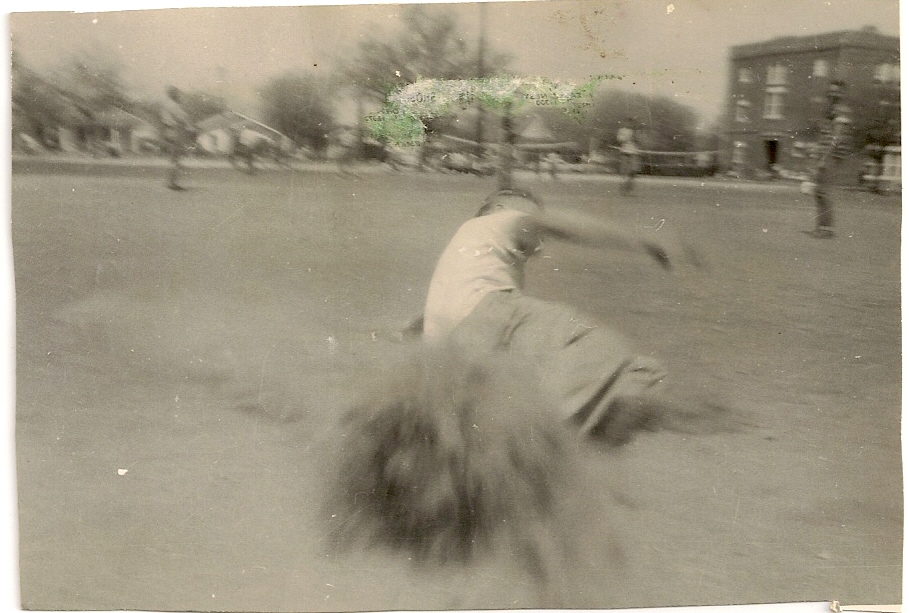
I used a 620 Kodak camera to take these pictures of us playing baseball in ca. March 1955, at Coggin Ward school. (Mother used the Kodak to capture pictures of Camp Bowie and my father in the 1940s.) Dale Smith was a good friend of mine and quite talented in athletics.
These photographs show no recess coaches. I think there were a couple of teachers observing from the building, but they were never interventionists in our play and gaming unless a major squabble broke out (I don’t remember any). We chose sides to play baseball. There was some organization every now and then — calesthentics were occasionally forced upon us. In the choosing of sides, athletic ability carried the most importance, then popularity. Even the poorest-talented boy would be chosen to play for there was no sulking allowed we ordered. I learned that life was not always fair and good, but most of the time the shame and failure could be overcome by coming up to bat again, having another chance for a hit to drive in Henley from second base. There was always another chance at the plate, and, even then, there was tomorrow’s recess to score a point to win the game.
Television, computer games and other devices have robbed children and adolescents of time outside in the sun and wind and rain. Look at the trees in the photographs. It’s late winter, early spring and the leaves are not even out on the trees. I can tell you that we would play at recess as long as the dust did not obscure second base from homeplate. We learned to play and adapt to each other. Oh, these were “social skill sets” that we carried into life beyond Coggin, beyond Brownwood High School. It may be strange for us of the 1940s and 1950s to visualize a recess coach on the playground, but if that is needed to get boys and girls, young men and women, out of boxes called classrooms and houses, then so be it. I think I’ll apply to be a recess coach in my retirement. I’d rather be on the playground than behind a lectern on any sunny day of the year.
Choose sides, boys! I want Dale, Joe and Jimmy on my side. Carol will lead the cheers. It won’t turn out that way, but that’s life, a lesson I learned at recess.
Dale Smith Sliding Into Homeplate, Coggin Ward, Brownwood, Texas, 1955 (click to enlarge)
In 1950, Aunt Lennie bought me a pair of jeans and a straw hat at Harry’s Store in San Saba, Texas, a dry goods store near the corner of East Wallace and Highway 16. As I was growing up, I visited Aunt Lennie and Uncle Floyd many times, spending weeks at their Cherokee, Texas, ranch near San Saba.
Harry’s purveyed hats, boots, shirts, Levis, jackets, coats and all associated accouterments to farm and ranch living in central Texas. The smell of leather, felt, and Levis surrounded a customer as they shopped. The dry goods were new and unbroken by weather and work. Trading at Harry’s was serious shopping, not browsing or spending time checking out the newest fashions, rubbing the fabric for quality. You bought jeans that withstood brush and barbed wire; hats that shielded you from a sun that blistered the fair-skinned into pain; coats that were warm and gave enough room to twist, turn and lift sacks of feed and drag cedar posts; and boots that had high-heels enough to keep the foot from plunging through the stirrup in a tight turn or a moment of fright.
I wasn’t riding horses or lifting cedar posts into holes in the ground. I was eight or nine-years-old and tagging along with my uncle into the pastures and fields, making a nuisance of myself, asking too many questions. Nonetheless, I had jeans and a hat from Harry’s after that trading day in San Saba. The possession of country dry goods to protect myself from brush and sun signified a boy’s development into life on farm and ranch. I dressed the part and looked like my uncle and cousin. Not a poser. You are not a poser when you buy from Harry’s and work on your uncle’s ranch.
Now in 2010, Harry’s has expanded into several adjacent stores, including the old San Saba Hardware store. Four buildings comprise Harry’s, not the one or two rooms I remembered. The expansion into the hardware store revealed a weather history. A clerk had recorded San Saba’s weather patterns, writing data on the wall for remembrance, prediction, or both. Today, the tin ceiling remains intact. The hat area is on the second floor. Silk western shirts are now sold with short-sleeved cotton work shirts and Levis.
Harry’s still evokes the same scent as years gone by. As my wife and I toured on Highway 16 to Fredericksburg this week, we went into Harry’s to purchase jeans and shirts. Opening the door to the new entryway, the smell of leather and new jeans surrounded us and I felt comforted that life may be, for a short time, comprehensible and integrated. I bought a pair of Wrangler jeans — a change from the past — that the sales girl said were pre-washed and less stiff to begin with. My wife looked at the shirt section and selected one for me: a Ryan brand, silk type that I would never wear in the field, but under my field jacket in winter it would give me flexibility in the barn as I fed the horses.
As I stood in the middle of Harry’s breathing a history, a friend and colleague came up to me. Surprise! He had seen me and and Brenda enter the store and had parked his car to come in and say, Hello — he was on the way to Austin down Highway 16 to visit his son on spring break. We talked and chatted about politics and the weather, the recent death of a colleague and her funeral.
I need to buy you a shirt, I said.
Oh, no, he said.
Oh yes, a work shirt. Come over here. Which one do you like? This one?
Well, yes.
Then, it’s yours.
I paid for it and told him the story of my first visit to Harry’s. I fetched him a business card from the sales clerk. Then, he looked down at the shirt and Harry’s store label was attached to the lower flap.
Oh, I’ll remember Harry’s, from the label on the shirt, he said, as he walked out the door.
Happy St. Patrick’s Day to all. My father sent a postcard to my mother in 1942, from a Georgia paratroop training camp, urging my mother, “Keep flying that Irish green, Blondie!” She flew the Irish green, converted to Catholicism before marriage to my father and basically accentuated her Irish heritage for as long as she lived. My mother always introduced me as, “Little Jack, the first and only heir to my property!” Later, I found out that the introduction was as Irish as the shamrock.
So, in remembrance of St. Patrick, let us fly the Irish green for a time. ‘Twould be good.

























 Sage to Meadow ~ Jack Matthews