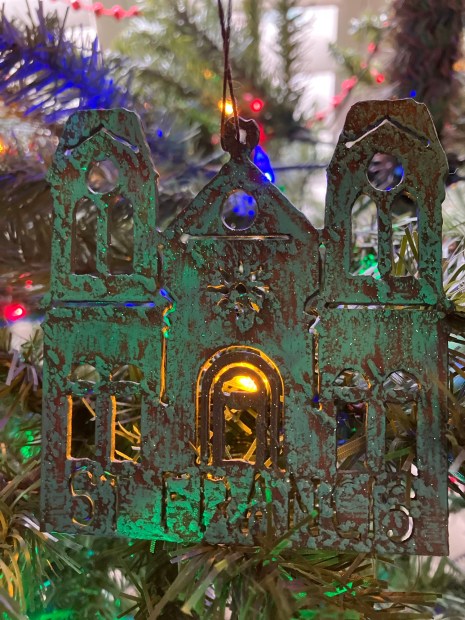
A Christmas Ornament Cathedral Basilica of St. Francis of Assisi, Santa Fe, New Mexico, 2025
Merry Christmas and a Happy New Year 2025 to you, your family, and all associated living things surrounding your life!
This Christmas ornament was purchased at a shop in Chimayo, New Mexico, several years ago. It hangs on a prominent spot on our Christmas tree. I adjusted the focus of the camera to have a golden ornament bulb shine through the door. The Cathedral in Santa Fe has a Christmas Eve midnight Mass most every year. Check the link I have provided to verify the Mass this year.
On Christmas Eve night, two other events in northern New Mexico occur worthy of attendance and participation: Canyon Road art walk in Santa Fe and the bonfire procession of the Holy Family clockwise around the Taos Pueblo Plaza. Take care in attending these celebrations. It’s impossible to make all three, but just one attendance at a celebration will make your evening bright.
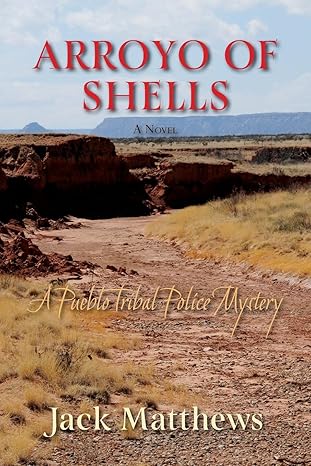
Newly released is ‘Arroyo of Shells: A Pueblo Tribal Police Mystery,’ published by Sunstone Press, Santa Fe, New Mexico. The novel, featuring the same characters and background as in ‘Death at La Osa,’ is tribal policeman Tafoya and U.S. Forest Service biology specialist Janet Rael search for stolen museum items and apprehension of a murderer in the high country of northern New Mexico. An attempt at kiva revitalization carries the story into noir-mystical worlds of pueblo ceremonialism and Navajo mythology. Three cultures interact, forming a matrix of detail of Puebloan, Hispano, and Anglo dynamics. Available through Amazon.com, BarnesandNoble.com, and Bookshop.org.
Quay County, New Mexico
QUICK LINKS TO ORDER ‘ARROYO OF SHELLS: A PUEBLO TRIBAL POLICE MYSTERY‘
“Midnight Star Ladder,” David Gary Suazo, ca. 2018, Collection of Wendy and Charles Needham
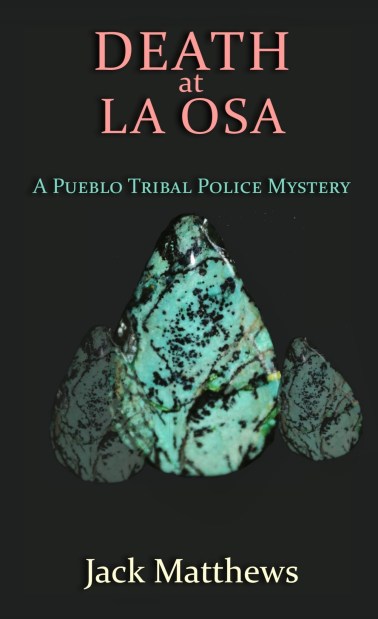
TRUE STORY IN THE NEXT PARAGRAPH! (to be followed by a excerpt of my novel, Death at La Osa: A Pueblo Tribal Police Mystery).
In ca. 2018, my daughter, Wendy, and I stopped for a light dinner and drinks at the Adobe Bar at the Taos Inn, in Taos, New Mexico. I had written Death at La Osa and was editing time and time again my writing. Knowing that David Gary Suazo’s paintings were on my mind when I was writing pages 47-48, I had decided to let Wendy read those pages, sitting in the bar with Suazo’s paintings on the wall. I wanted to let Wendy see part of the process in creating a scene. She read the two pages and was smiling and complimentary (hard to critique your father’s work in a bar after a Margarita…or maybe not). Wendy looked at Suazo’s paintings on the wall and smiled again. When we paid our bill and were walking out, she said, “Wait a minute, Dad.” She walked back to the bar, took ‘Midnight Star Ladder’ off the wall and went to the front-desk clerk at the inn and said, “I want to buy this painting.” Wendy bought the painting right then and there, and it now hangs in the living room of her home in Taos. As a writer AND father, I try to comprehend writing, art, and father-daughter relationships. The simple truth is this: Wendy purchased the painting in an act of love for me and my writing. When I first saw her at birth through the labor room window in Amarillo, she changed my life forever. Yo te amo, mi hija–siempre, siempre, siempre [1].
“The table of six at Ojo Verde Inn began to eat their food and those facing Paseo de Norte looked out of the window next to the street and saw eighteen wheelers carrying logs from fresh cuts in the Carson National Forest. Snow had frozen to the bark of the fresh cut logs…. Those at the table that faced away from the street glanced upward at vigas in the ceiling and at artwork for sale on the wall. The prices for artwork of local Ojo Verde artists were priced to sell and the Pinion-Buttermilk Pancake woman eyed the brilliantly-hued painting of the Tulona Pueblo….
“I will buy that painting and make a place for it in my living room,” the Pinon-Buttermilk Pancake woman said to herself. When brunch was over, she went to the front desk of the Ojo Verde Inn, and out of her billfold she carefully placed seven-hundred dollars on the counter, buying the painting outright. As time went on in her life, she never regretted the purchase and her children rotated the painting amongst themselves after she died…. The Pinon-Buttermilk Pancake woman gave an additional tip to her server at the Inn because she wanted to remember and enlarge the morning at brunch as a generous morning, a time punctuated with giving, and with art.
An excerpt from the novel by Jack Matthews, Death at La Osa.
[1] Translation is, “I love you, daughter–always, always, always.”
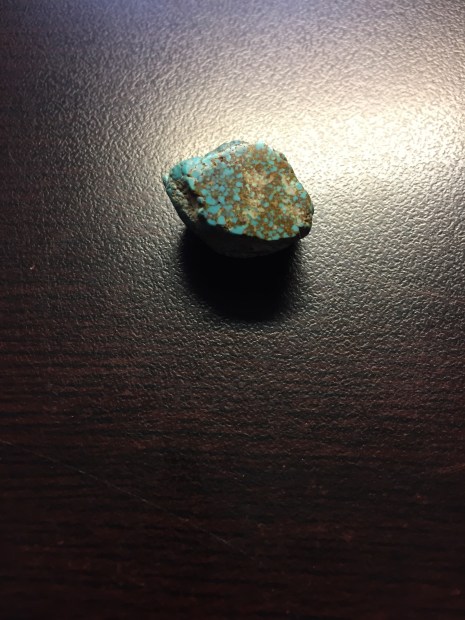
Some of my current writing involves turquoise extracted from mines close to Taos, New Mexico. I purchased this 25 carat piece of turquoise that came from the King’s Manassa mine near Manassa, Colorado, that is just over the border from New Mexico north of Taos. The lapidary had begun to polish the turquoise and I bought it in this unfinished, but impressive, state. It was not expensive in its unrefined state. The provenance was documented by the jeweler at the lapidary in Taos. Notice the golden matrix (not gold, the color gold) and slightly greenish cast along with the cerulean blue. The Manassa mine is not worked anymore. It was originally a mining site by Ancestral Pueblo peoples. L.P. King in 1890 found stone hammers and mallets about the site. King’s descendants still own the claim on private land.
The purchase of this King’s Manassa turquoise is an object of inspiration for my writing, like an old photograph or piece of music that is played. I think you know what I am writing about, don’t you? When you write a letter or email to a close friend, do you not have a photograph to remind you of your connection?
I have a close friend in Amarillo, Texas, who is in poor health, but when I write him, I have in front of me a group picture of us (with other friends) to remind me of when we were young and robust and had years (we hoped) in front of us.
So it is with this blue-green turquoise with golden matrix that is placed to the left of my word processor when I write of northern New Mexico mining claims. The stone helps me start thinking. Below is a photograph from Joe Dan Lowry and Joe P. Lowry, Turquoise Unearthed: An Illustrated Guide, that shows King’s Manassa turquoise in jeweled splendor.
From Joe Dan Lowry and Joe P. Lowry, Turquoise Unearthed: An Illustrated Guide (photo by Jack Matthews)
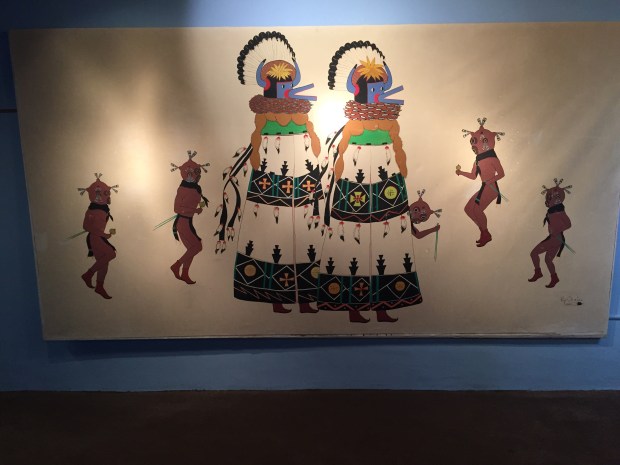
Shalakos and Mudheads, Pop Chalee, Taos Pueblo, Ca. 1930. Exhibit at Millicent Rogers Museum, Taos, New Mexico. Photo by Jack Matthews.
Pop Chalee’s Shalakos and Mudheads is a large painting, about eight feet in length. I saw this painting a few months ago. I’m not for sure it is still on exhibit. You need to email or call to find out if it is still displayed. I am currently in Taos and may go to the museum today.
I retired from teaching in 2015 at Cisco College. I had been teaching college students since 1965, starting as graduate assistant at Texas A&M.
Currently, I am conducting research and writing historical monographs relating to acequias and Old Spanish metrics of measurement in the 16th and 17th centuries as applied to explorations in New Mexico.
I am also writing fiction and have an accumulation of finished short stories as well as some longer pieces.
I spend a lot of time writing and conducting research in Fort Worth, Texas, and Taos, New Mexico.
When I can I will post photographs and posts on Sage to Meadow.
Several ceremonies are scheduled at Taos Pueblo over the next few weeks. Consult their website for more information.
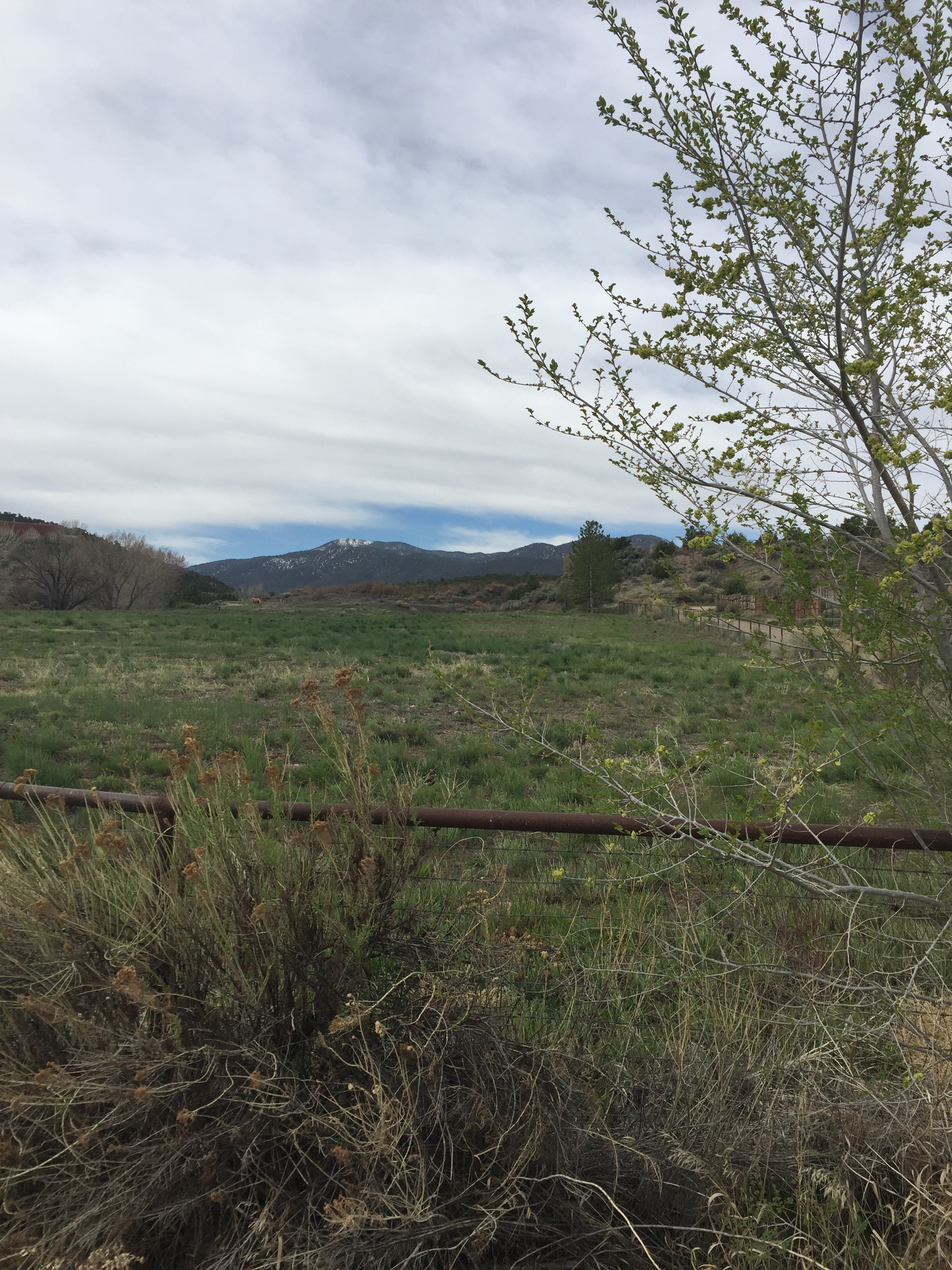
Arroyo Miranda, the final leg of El Camino Real looking south towards Picuris. This photo taken on the outskirts of Talpa, near Taos, New Mexico, April 18,2017.
This photo is framed for a historical record. It is not a pretty picture per se , but accurate as to the Royal Road from Mexico City northward to Santa Fe, the pueblos, and Taos.
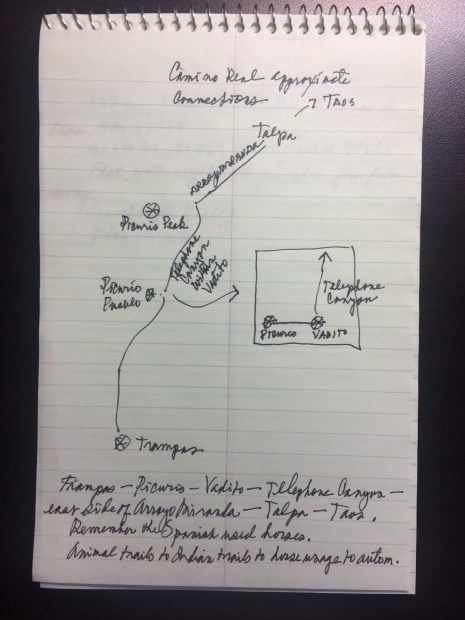
According to Spanish documents, this final part of the Royal Road leading to Taos went from Trampas to Picuris Pueblo, slightly east to Vadito, then up Telephone Canyon around Picuris Peak, and then connecting with the Arroyo Miranda, traversing the east side of the arroyo. The above photograph is looking south, up towards the Picuris Peak area. Lying behind me is Talpa that is close to Rancho de Taos and Taos.
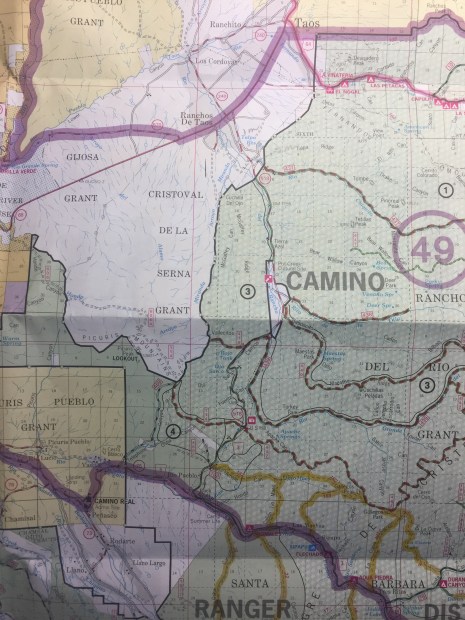
The map below indicates the route into Rancho de Taos. Note Telephone Canyon, Arroyo Miranda, Rancho de Taos, and Taos.
Carson National Forest Map, 2017.
The following are my field notes from the trip, showing the route as I described.
Jack Matthews Field Notes, April 18, 2017.
The El Camino Real is only partially open to public transit through the Carson National Forest. The final leg is on private land and closed to public transit. The Royal Road, however, can be followed within two miles of Talpa and one can sidestep to SH 518 and hike into Taos.





















 Sage to Meadow ~ Jack Matthews