Category Archives: Life Out of Balance

Bat Disease Crosses Mississippi: Species Extinction in Hyperdrive

A mysterious disease ravaging bat populations in northeast United States may be spreading westward.  It’s a fungus called white-nose syndrome.  The Center for Biological Diversity has sent letters to state officials, urging them to close state-owned bat caves to prevent the spread.  Bats help control populations of insects.

Bat-to-bat and bat-to-cave transmission appear to be the more common means by which white-nose syndrome is spread, but scientists believe that the newly discovered fungus for which the disease is named can also be spread by people on contaminated caving gear, clothing, and other equipment [Press release, Center for Biological Diversity].

Bat houses are often placed near gardens and homes to give bats a place to hang out–seriously.  My good friends, Caralee Woods and Jimmy Henley, had a bat house near Eagle Mountain Lake in Fort Worth, Texas.

A rancher near Kerrville, Texas, had a bat cave constructed on his ranch and after several years, bats began to populate the cave.

New Mexico and the American Southwest have been alerted, writes the New York Times.

National Briefing – Southwest – New Mexico – Bat Disease Spreads – NYTimes.com.

Center for Biological Diversity Press Release on Bat Disease

4 Comments

Filed under Life Out of Balance

Erasure of Deer

North Erath County, Texas, 32.43 lat., -98.36 long. Elev. 1,086 ft.  Turkey Creek Quad.

Forward to focused field scan, April 18, 2010.

Earlier today, I wrote that I sought fresh deer sign on our place.  One month ago, I found one deer track near the salt lick: March 20, 2010. Since last month, I have found no fresh deer track and I know how to find track.  This is not to say that no deer have passed through our place because that would require a more intense observation and scan pattern.  And, besides, the deer may return if they have fled, as I suspect they have.

But before I give you my field report this afternoon (I will continue to scan the grove and pasture until dark obliterates my view), let me explain what was, what used to be, on our place.
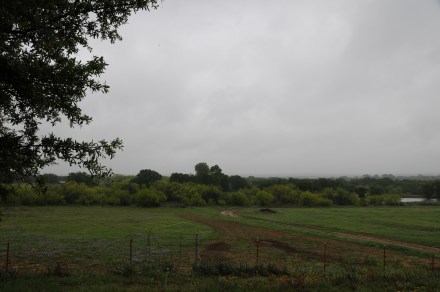
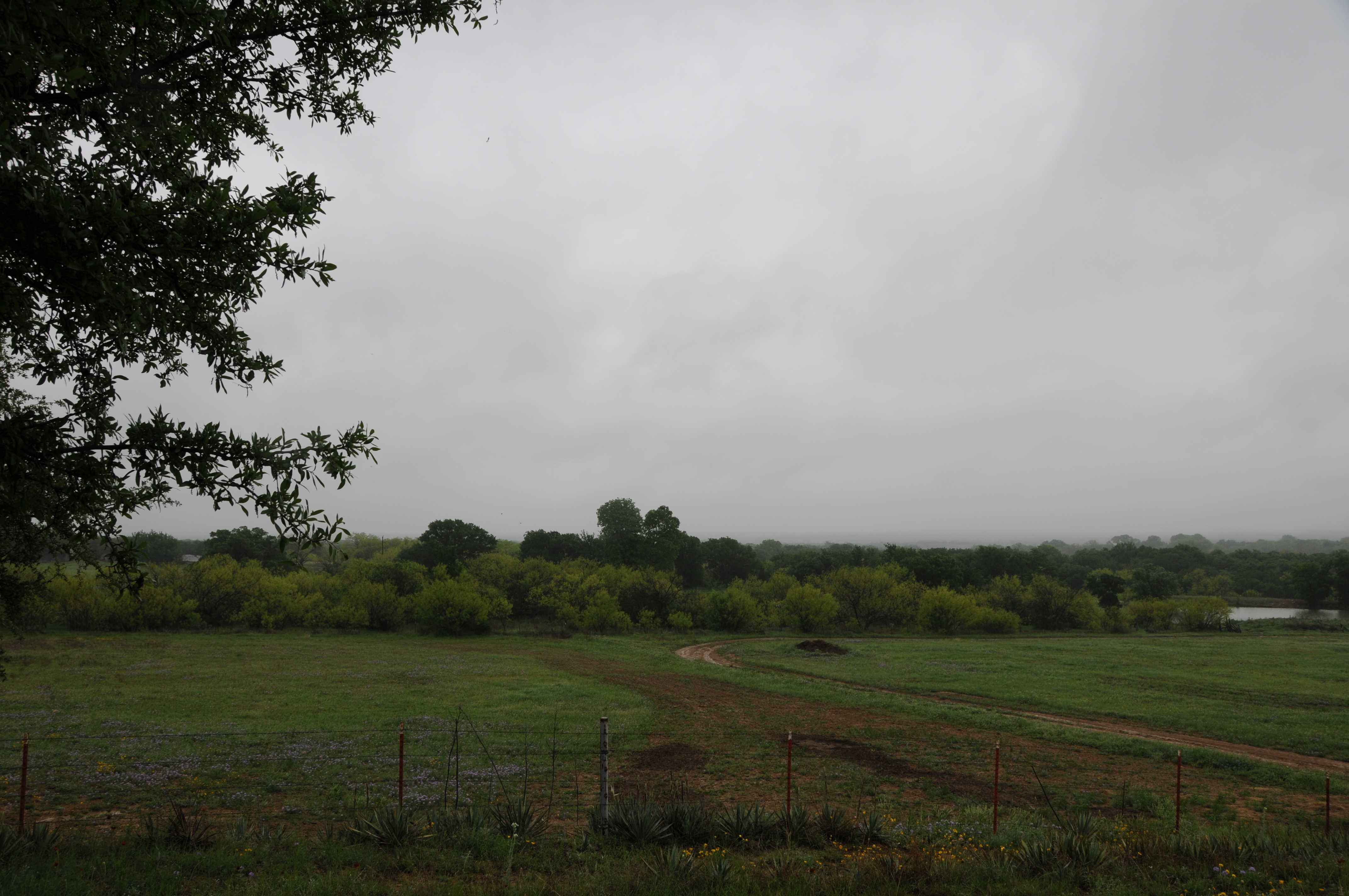
No. 1: East View from Poprock Hill, April 18, 2010

Photograph No. 1:  This is a view from Poprock Hill, looking east.  This photograph was taken on the terrace a few feet from our back porch.  The deer used to browse in the mesquites on the edge of the pasture.  The pasture on the other side of the mesquites is the Blue pasture, our neighbor to the east whose family has been here since the early twentieth century.  There is a pond on the other side of the mesquite line and deer, when we moved here in 2003, would loaf most of the day around the pond and in the brush.  The deer were predicable in browsing from left of the photograph to the right of the photograph.  Our pond is seen on the right side of the photograph.  In the late afternoon, the deer would pass in the distance, the herd numbering six to fifteen on any given day.

In 2008, a new set of neighbors set up residence beyond our pond and built a home, workshop, barn and corrals.

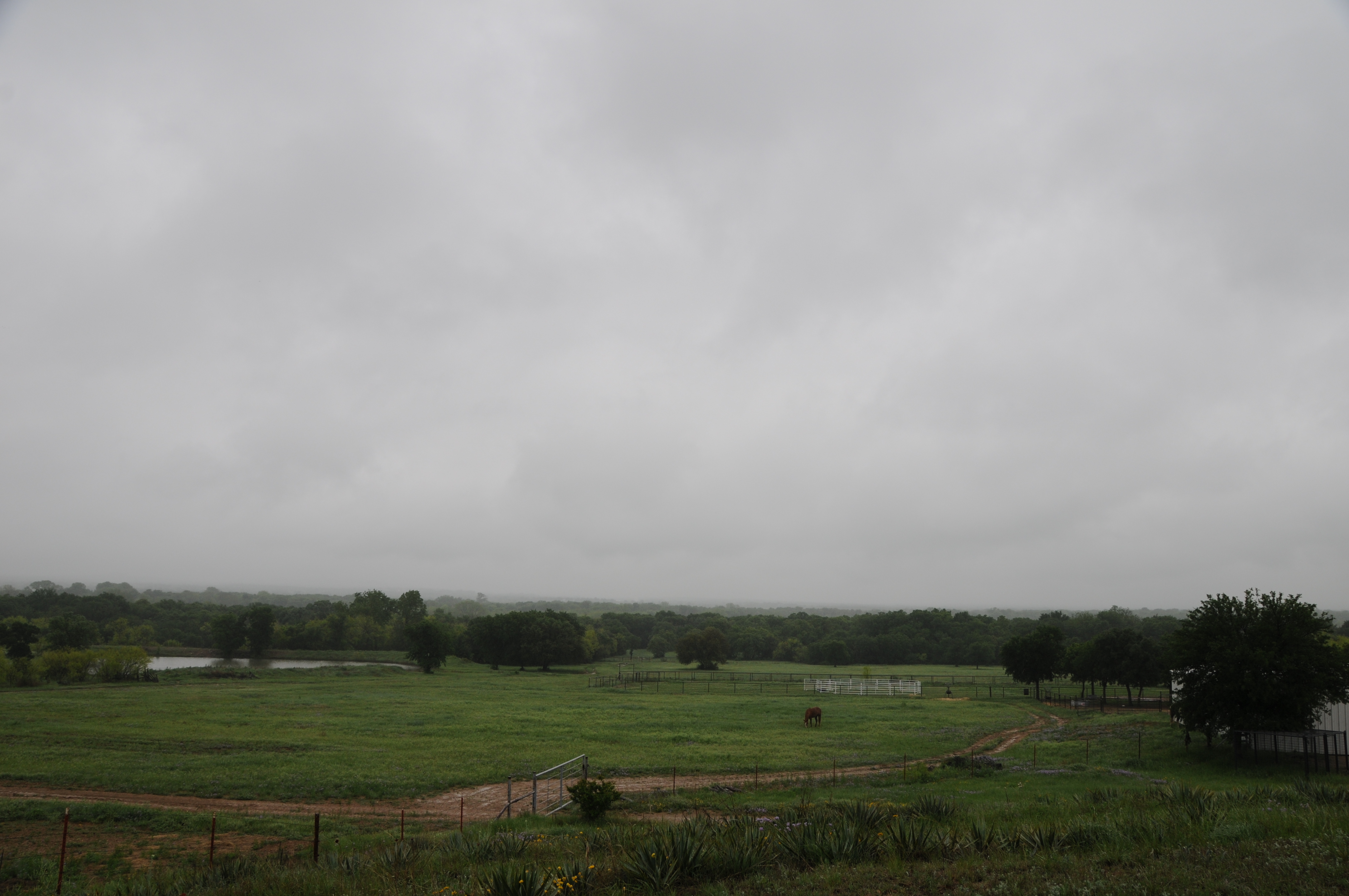
No. 2: South View from Poprock Hill, April 18, 2010

Photograph No. 2 shows a view from our terrace, looking south, southeast.  Deer would pass a few years ago back and forth into the brush.
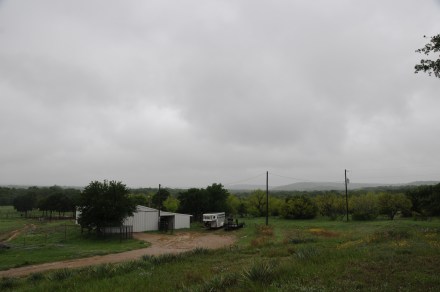
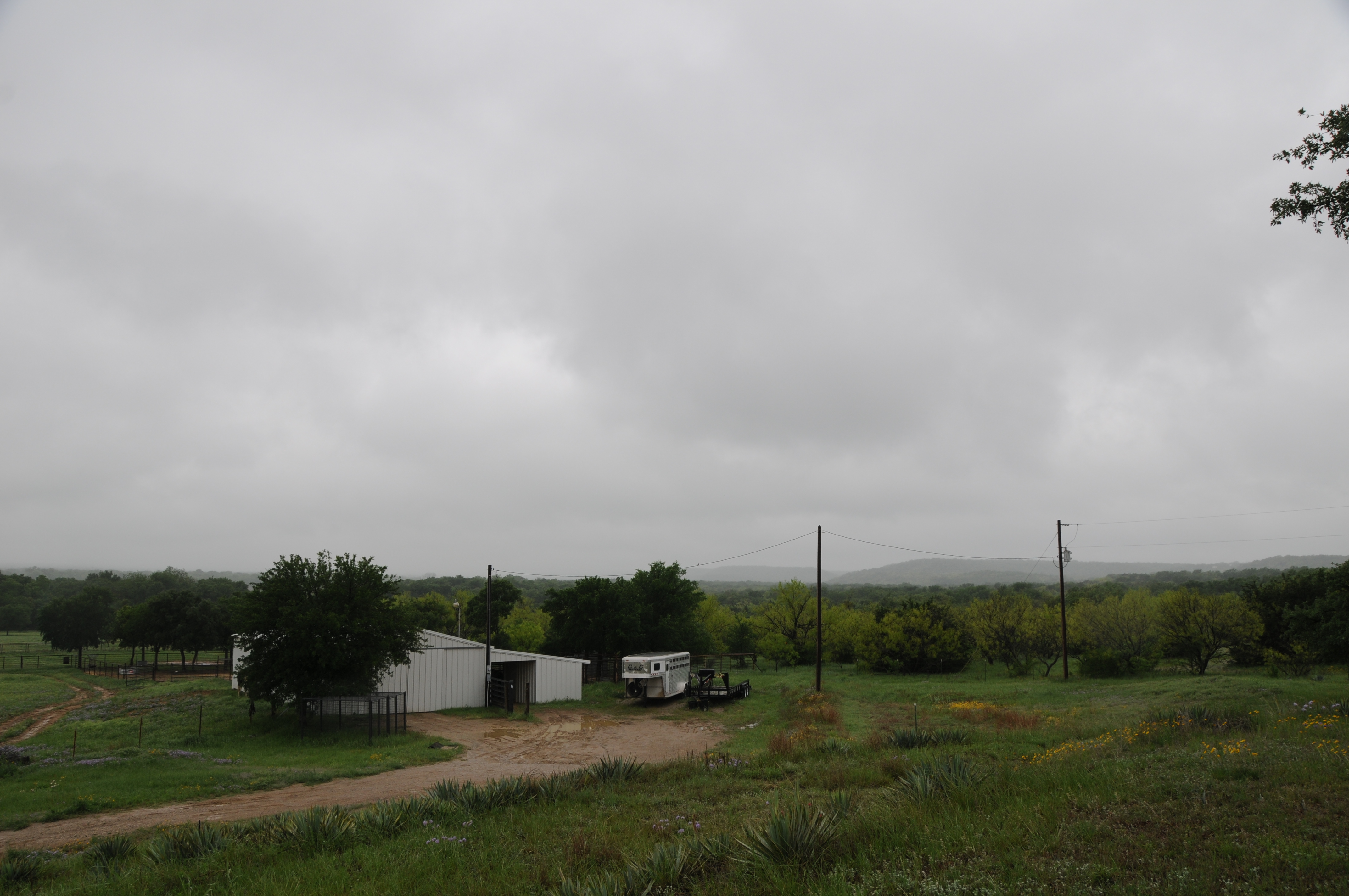
No. 3: Southwest View from Poprock Hill, April 18, 2010

Photograph No. 3 shows the view to the southwest.  The deer would browse into the grove beyond the barn, and, thence, towards the mountains in the distance.

Not only have our neighbors constructed a new home, but they have cleared the brush on their place.  This is not unusual, as it is customary for homeowners to clear thickets and mesquite.
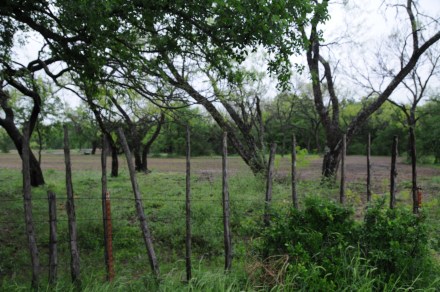
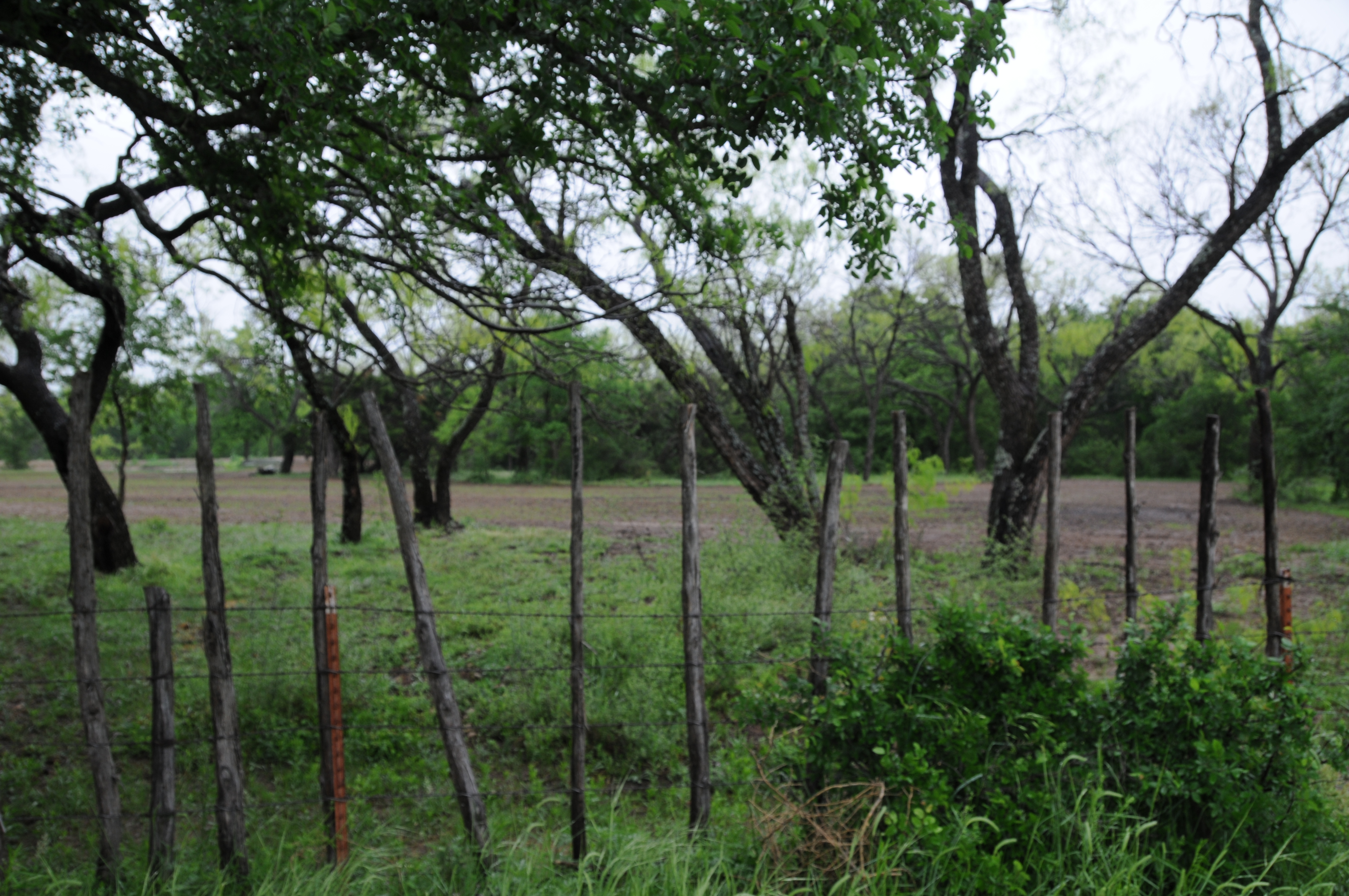
No. 4: Cleared Acreage of Neighbors to the Southeast, April 2010

Photograph No. 4 illustrates the acreage cleared in the last two years.

Today, I set up a focused field scan for deer.  I will continue today and into the early darkness for visuals of deer.

The results of the focused field scan for deer on April 18, 2010.

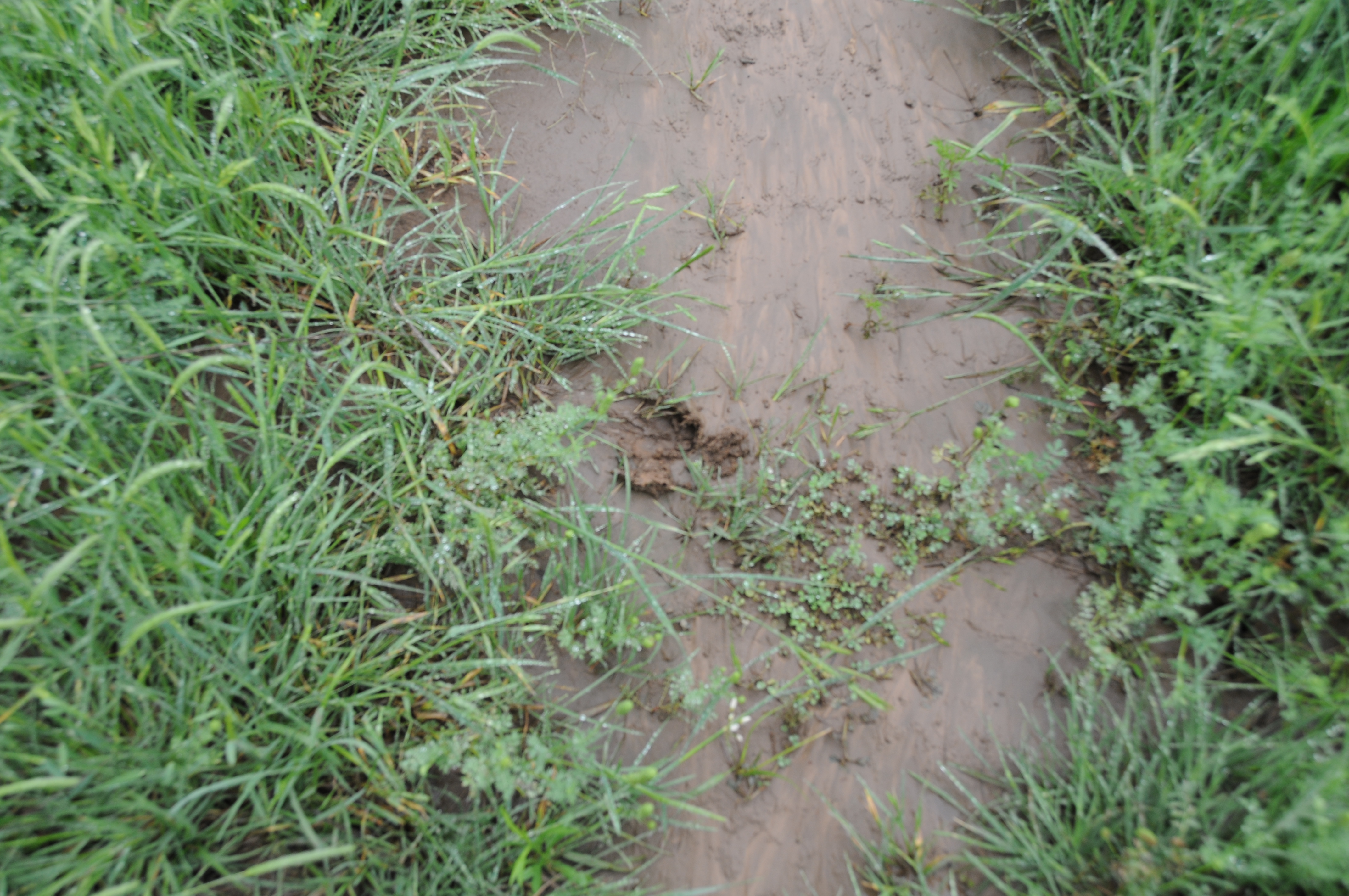
I found one deer print along the road into the grove.  It was fresh track.  Near the salt lick, I found no track.
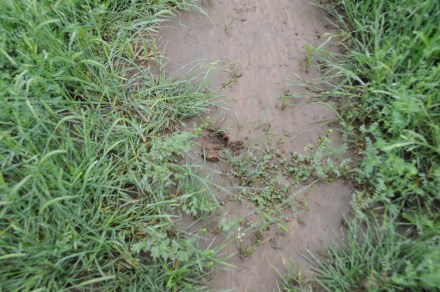
Deer Print in Grove, April 2010

Salt Lick in Grove, April 2010

In a sack this afternoon, I carried three quarts of corn to the salt lick.  As I walked down the road to the salt lick, gunshots commenced on the Dooley place.  Fortunately, since the last target-practice episode a few weeks ago, this firing of at least 100 rounds of two caliber of pistols or rifles stayed within the property lines of the Dooleys.  They take care to be safe in their shooting practice.

I scattered the corn near the salt lick.  No deer sign.  By the purity of Aristotelian logic, however, no deer sign is actually a Sign.  And the reading of the Sign is not pleasant.  It reads, thus:  The deer population that migrated through the Blue, Hall, Dooley, Bryant and our properties has been erased.  Since 2007, with the building of three homes in the immediate area (within a half-a-mile), the clearing of brush and the target practicing of young and energetic youth, our deer population, by my count and observations, has dwindled to one deer track from a high of fifteen animated, graceful creatures of grove and pasture that used to browse.

Neither do I see fox anymore.  Today, with the firing of shots, as I carried corn to the grove, crows cried Alarm! Alarm! and it was not my ambling that elicited the call, but the report of hot lead entering the good earth.  The principle of using one’s property as one sees fit is a constant in our culture, and it is not my aim to dislodge that behavior from our country, and I think it futile to even suggest a small amendment to it, but rather my aim is raising the morality of good people to the ethics of wild nature that show us we are not alone, but that we inhabit and live upon land that is home to many creatures.  I cannot stop my neighbors from alarming and scattering wildlife, and, most unfortunately, destroying the homes of animals and birds.  I used to hear more and see more wild things here on Flying Hat.  Now I hear and see less.  It is still rich and enchanting, but much has been diminished since we have moved here.

Between now (4:32 p.m.) and sundown, the darkness, I will look upon the pastures and seek the profile of the graceful deer.  If I sight even One, I will come back to this post and log its appearance before I sleep tonight.

I would not, if I were you, look for another entry to “Erasure of Deer” written on this post today.  Or, possibly, ever.

4 Comments

Filed under Deer, Life Out of Balance

Texas Buffalo Shooting

I affirm.  Life is out of balance: this news article and oral interview (on the primary NPR site link) brings out the worst on both sides of the fence here in Texas.  Ranch managers and owners, near Benjamin, Texas, clash over the buffalo of QB Ranch (diversified operation, but also a hunting ranch) straying consistently upon the Niblo Ranch, a traditional operation.  After pushing through the fence, fifty-one buffalo of QB ranch were shot on the Niblo Ranch.

Buffalo, by law in Texas, are classified as indigenous animals and have not the same protections as cattle or sheep.  The Niblo ranch foreman who shot the buffalo has been charged with criminal mischief.

Texas Buffalo Shooting Triggers Culture Clash : NPR.

“Two hundred years ago, great herds of plains bison — massive majestic animals — roamed the endless prairie of West Texas. What happened to those herds stains the national conscience. The bleaching white bones of the 51 animals rotting in the Texas sun near the QB Ranch are a throwback, a reminder of the carnage a man with a rifle can do.”  — Wade Goodwyn of NPR.

I affirm.  The placement of buffalo on a ranch for trophy-hunting purposes may be legal, but it is base and immoral.  It is base because it reflects a lack of refinement of virtue, the virtue of preserving life for its own sake, be it buffalo or the sage grouse.  It is immoral, for the act of killing buffalo is killing another life without just cause.  It never was just to kill buffalo except for the family and tribe to survive in the time before the railroads came.  At that moment in time, the buffalo kill sustained life and the animal itself was worshiped for what it gave to keep tribes and families intact — so different from now.  Much has been written about the near-extermination of the buffalo in the nineteenth-century and it is not my purpose to go over the historiography of America’s western expansion.  I am an historian and I know the canon.  And, the process of settling the New World was based on erasing the wild, stomping out the natural, and assimilating all things New World to the Old.

The big ranches at Benjamin are costly monuments to the Old World’s erasure of the New.  The Dallas oilman that stocks his ranch with buffalo for bloodsport reflects European kings that killed stags throughout the day and the next day and the next.  NPR states there is a culture clash.  That is correct, but they stopped short of indicting the largest cultural clash of modern times:  the artifices of man versus the naturalism of the world, death versus life, the city against the garden.  The rotting buffalo near the QB ranch do not stink, it is industrialized culture that settles over their spirits that stinks to hell.

[Please also refer to The Fat-Takers by Lame Deer.]

11 Comments

Filed under Life Out of Balance

Escape the Notion that Land is only Cropping Opportunity: Like Udall R.I.P.

Roger G. Kennedy, who was director of the National Park Service in the 1990s, said Mr. Udall “escaped the notion that all public land was essentially a cropping opportunity — the idea that if you cannot raise timber on it or take a deer off it, it wasn’t valuable.” On the other hand, Mr. Kennedy said, Mr. Udall understood that public lands like parks enhanced the economic value of privately held land nearby.

Stewart L. Udall, 90, Conservationist in Kennedy and Johnson Cabinets, Dies – Obituary (Obit) – NYTimes.com.

2 Comments

Filed under Life in Balance, Life Out of Balance

Deer Tracks Vanishing

Neighbors surround our place and new arrivals have built homes and constructed fences and water gaps.  Changing things, the habitat for wild things, most of all.  Not any of the change has been good for me.  Oh, I can look closer at settlement patterns and see loneliness overcome, socializing more frequent and assistance rendered when needed — but I would not depend on it.

Deer tracks vanish.  The fox are gone.  Wildlife disappears.  Within seven years since our arrival here in the country, human settlement has pushed wildlife to an endangered status on our place.

Yesterday, I scouted the south side of The Grove for deer track.  I found none.  Since 2003, I have found deer track every day I have looked on the south side of The Grove.  Not yesterday.  The new neighbors to the southeast cut and burned brush that harbored deer.  For what purpose?  Better view from their house?  To loose their dogs into the clearings for exercise?  To give horses a open area for turnout?  A person can use their property as they see fit — an English-American axiom.

And, to the west, our neighbor has permitted two more families to reside on their place.  Target practice occurs.  The creek bank and bed where shots are fired in practice are pathways for deer migrating through our place and onto adjacent ranches.  Last Sunday, I stopped counting the rounds fired in the creek bed.  A person can use their property as they see fit — an English-American axiom.

In 2003, I regularly saw a herd of twelve-to-fifteen deer migrate and browse in our pasture.  Our farrier, Allen Gaddis of Wyoming, marveled at the deer on a misty morning as he trimmed hooves.  Deer used to graze with our horses.  Last year, I saw no more than three deer in a grouping.

I will go tomorrow to the north side of The Grove and seek deer track.  I will take the camera.  If there is track, I want a record in the future of how things used to be and how people use their property as they see fit — an English-American axiom.

I may post photographs.  I may not.

6 Comments

Filed under Deer, Life Out of Balance

Primm, Nevada, Power Station

[I have copied this post by Chris Clarke on his Comment on the Ivanpah Solar Electric Generating Station.  His blog is Coyote Crossing: Writing and Photography from the Mojave Desert.]
——————————————————
Posted by Chris Clarke on February 11, 2010

I posted this earlier today at Desert Blog. My publicist tells me I should put it here as well. Today was the deadline for public comment.

re: Ivanpah SEGS Public Comment Thursday, February 11, 2010
To Whom It May Concern:

Of other public comments arriving with regard to the proposed Ivanpah Solar Electric Generating Station south of Primm, NV, I am confident many will address the abundant technical, hydrological, and wildlife-related problems contained in the proposal to bulldoze a broad swath of publicly owned ancient desert habitat for private industrial development. It is on these details that projects such as the Ivanpah SEGS are either approved or denied, and I am grateful that others can speak to those details more authoritatively than I.

What I can address with confidence and authority, however, is the fact that the Brightsource project threatens one of the most beautiful places in the United States. True, that beauty may not be apparent to the casual traveler on I-15 speeding through the desert with the airconditioning cranked up as they peer through tinted safety glass. It takes a few moments of quiet for the Ivanpah Valley’s beauty to sink in fully.

I lived in the Ivanpah Valley for much of 2008. I have been spending time there and in neighboring places in the desert for much of my life. The Ivanpah Valley is not wilderness, at least not that part of it outside the Preserve. There are many visible human intrusions there. Freight trains roar through the valley sounding loud horns, engines on both ends straining to build up momentum for the long climb to Cima. Off I-15 there is traffic on Nipton Road, long-haul truckers heading for Searchlight, vacationers in RVs and motorcycles heading for the Colorado River. One can in fact hear them from several miles away. They approach. They grow louder. They pass. The noise recedes.

And then the noise ebbs, and the cricket song swells, and the coyotes’ song, the breeze, the sound of blood in your veins. In the south end of the Ivanpah Valley, at least, human influence is limited and inconstant. From the Mojave National Preserve even Interstate 15 recedes in significance, becoming not much more than a pretty string of far head- and taillights in the distance, and that only at night. The sere backdrop of Clark Mountain, the McCulloghs and Lucy Grays in the east, and the protected peaks of the New York and Ivanpah mountain ranges contain between them a vast, largely wild piece of the Mojave. The Ivanpah Valley contains nearly all the Mojave’s landscapes in its boundaries — alkali flat, old-growth creosote and ancient Mojave yucca, Joshua tree woodland, piñon-juniper forests on the slopes of the fringing ranges. There is even an alpine sky-island overlooking the Ivanpah Valley, white firs clinging to the higher slopes of Clark Mountain, directly above the project site. The Valley is the Mojave in microcosm.

Paving thousands of acres of the Ivanpah Valley with mirrors would utterly destroy the wild character of the place. It would be an encroachment on the peace of the Preserve and the lands around it, with the noise and dust of construction and the subsequent blinding glare of the completed facility an intrusion into a peace I have found nowhere else on earth.

Others will question the actual carbon reduction benefit provided by building this plant, and rightly so. They will question the validity of tortoise relocation and mitigation, the additional demand on the 12,000-year-old water in the Ivanpah Valley’s aquifer, the loss of Mojave milkweed habitat. These are all crucial questions that absolutely must be answered. Neither Brightsource nor Interior have done so.

The loss I want to question, however, is the loss of our soul.

Are we really so bereft of wisdom that we see this beleaguered but beautiful stretch of ancient desert as nothing more than a blank spot on a map? Are we really so callous that we can consider the improbably old creosote, Mojave yucca and barrel cacti on the Ivanpah site less valuable than leaving our closet lights on when the door is closed? Many of the plants growing there are older than this nation. Some may pre-date European presence on the continent. We may as well raze the Parthenon to build a strip mall, knock down Stonehenge for use as highway berms. There is something very wrong in us if we value this place not for its beauty but for its square footage. There is something broken in us if we look at the Ivanpah Valley and see not peace, but merely a way to increase our power and the profit we derive from it.

In 2008, just before sunset after a day of scattered small rainstorms, a friend and I got out of her car near the abandoned railroad siding known as “Ivanpah,” in the southern Ivanpah Valley well within the Preserve. We had a clear and unobstructed view of the whole valley there at the end of the paved section of Ivanpah Road. A desert tortoise stood at roadside. We’d stopped to make sure no passing cars hit her as she tried to cross but there were no passing cars, and she had no apparent intent to cross. Unperturbed by our presence, she fell asleep as we watched. A band of coyotes began singing somewhere off toward Morning Star Mine Road. It was hard not to feel very small. The valley held an immensity of space and of time as well, humbling both in the sense of personal insignificance it conveyed and in the realization of our frightening capacity to do unintended harm.

It was one of those moments I have found surprisingly common in the Ivanpah Valley, a place that though altered by human hands is still precious, still wild in essence, well worth being defended from further unnecessary and destructive change.

I urge you to halt this project.

Chris Clarke
Private citizen

2 Comments

Filed under Life Out of Balance

Neda Kindles Fire

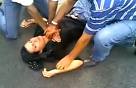
Neda in Life

I came to blog because of Neda, Twitter, and the constraints of 140 characters.

The Iranian election this past summer erupted into mass demonstrations, one result being the random murder of Neda, a university student in Tehran.  Outraged at this murder and failed election, I joined Twitter in late June 2009.  Information from Twitter was contemporaneous, edgy, and peremptory of newspapers and television.  My first ID was CodeLegionaire, reflective of my background and creed.  CodeLegionaire, however, was a bit misleading for I never served in the French Foreign Legion, so I changed my Twitter ID to NoRedDeer, a reference to the Greek philosopher Archilochus and Homer’s The Iliad “roe [red] deer” or coward as it was written and interpreted in those bygone days.  No Red Deer indicated a bravery, an act of defiance against the despotism and fascism erupting in Iran.  “noreddeer” is still my Twitter ID.

Twitter, however, limits users to 140 characters and I had to write more.  I started a blog under the Google format named No Red Deer.  That blog is closed and integrated with Mustang Latigo (read on).  My posts were quite specific about Iranian politics with some risk analysis entwined.

The blog No Red Deer, however, was Iranian-directed and I had more to write, more things to say about the world, my life out here in west Texas.  So, I started another blog that would not have Iranian content, but would focus on my past, my present in the Southwest.

My second blog I named The 27th Heart, so called for Unit 27 of Angus stocker calves I ran on my place.  The 27th Heart became ill and as I tried to load him into the stock trailer, he became stressed, wobbled to the corral fence, and knelt down in panic, hysteria, a kind of shutting-down.  He had become partially blind.  I am a gentle stockman, so I backed off and let him be.  I ached and grieved for him and the whole process of streamlining stocker calves to the feedlot I questioned.  I take care of my livestock in a non-violent fashion; I always have.  If I encounter a problem, say, a panicked cow or a horse that is wild-eyed and nervous, I walk away for there is another day to herd, to saddle and ride.  Coffeeonthemesa listed my blog on her site as The Gentle Stockman.  I like that brand-moniker and if my friends in the cattle and horse business disagree with my approach, then take some time and talk to me about managing cattle on foot or on horseback.  Talk to me about training horses.  There’s no screamin’ or yellin’ or usin’ Hot Shots on my place, and those that do, to paraphrase Pericles, have no business doing business on my ranch.

The 27th Heart blog site started slowly, but as I began to write for it, my interest in composing snatches of my past and present intensified.  And, as I wrote and became familiar with Google’s format I found other bloggers that shared my interest in nature, land, livestock, wildlife, and good writing about all.  (See Jerry Wilson’s blog, Observations from a Missouri River Bluff.  He no longer posts, but the archive for 2009 is worth reading.)

There’s another blog and another side to me, however, that few know.  I have a sarcastic, critical, radical blog called Mustang Latigo.  Its content revolves around the educationist jargon and cant that universities and colleges must endure.  My intent in writing Mustang Latigo is to eviscerate educationist concepts–without mercy.  Laura Gilpin Faust, president of Harvard University, in her inaugural address, stated that metrics measure, but she wasn’t so sure what they measured.  I agree.  If you have been out of education for a few years, I can tell you that the educational system has been hijacked by federal and legislative committees that are market-driven, business-dominated, and uniformly intent upon changing, even destroying, academic culture.  And, my critique includes bureaucracies-in-general.  To paraphrase Reinhold Niebuhr, all bureaucracy is evil, impinging the liberty of the individual.  Mustang Latigo is my Confucian side; The 27th Heart is my Lao Tsu side.

This brings me to my WordPress blog, Sage to Meadow.  Coffeeonthemesa wrote a piece on quail, using a phrase that described the quail she saw moving “from sage to the meadow.”  I liked that.  It describes plant and terrain, sage and meadow.  Sage configures for me, the purple-blossoming plant of the West, the scent after rain, and the crushing of its leaves to instruct the nostrils to attend desert heaven, the part of my life after I moved to Amarillo, Texas.  The meadow signifies my background in central Texas, the fields of paintbrush, bluebonnet that in the spring permeate the air, bringing me to heel at nature’s side.  And, so, I have the blog, Sage to Meadow, to carry The 27th Heart a little farther down the road in remembering and understanding land and people in the American Southwest.

All of my posts are composed on Sage to Meadow, but I will continue to enter a link on The 27th Heart.

Neda’s death prompted me and others to question the #iranelection, to enter Twitterverse, and start blogs of all colors and shades, black even.  That young woman, Neda, wanted to sing; she wanted to attend a protest rally against the #iranelection.  She should have sung; she should have raised her arms wrapped in green, protesting fearlessly the betrayal of the Persians.  But she could not; cut down, bled out, lifeless on asphalt in Tehran she became.  From her death, distributed on YouTube, Twitter, she launched a thousand ships bearing words that kindled fire.

And, that’s how I came to blog today.  Neda.

Neda in Death

7 Comments

Filed under Life Out of Balance

Baird Hill Ducks and Mount Kilimanjaro

[I wrote this post on November 3, 2009.  I have been writing about the Baird Hill Pond lately and decided to bring this forward to the front page and make it public.]

This morning at about 7:15 a.m. CST, I spied a flock of ducks on the Baird Hill Pond.  This is my first trip by the pond since last Thursday (no ducks then) and with daylight savings time over, the dawn’s light illuminated the pond.  From my pickup, I saw a flock of about fifteen ducks, paddling in the middle of the pond.  Their presence shows that the pond sustains life.  Whether or not the pond gains additional flocks remains to be seen, but the pond may be reconstructing itself.

Mt. Kilimanjaro snow cap is melting fast.  Whether this is the result of global warming is unknown, but suspected.  Arctic Ocean is opening up, Antarctica’s ice shelves are breaking up, and second homes (MacMansions) disturb the Taos Indian annual rabbit hunt.  Baird Hill pond is losing its vegetation, but ducks are there today.  How many more canaries have to die before we stop the misuse of our resources?

New York Times article on Mt. Kilimanjaro

______________________________

Notes:

Photo by Stephen Morrison on European Pressphoto Agency, as cited in The New York Times link above.

I think it was Borges that wrote once that a dead jaguar was found way up the slopes of Mt. Kilimanjaro, beyond his or her range by several thousand feet.  Why?  What so possessed the jaguar to seek the mountain, going beyond what was familiar?  Borges or whomever it was wrote a short explication of their theory.  I have mine and I shall post about it one day.

5 Comments

Filed under Ducks, Life Out of Balance