San Angelo, Texas, Concho Valley Farmers Market (San Angelo Standard-Times, May 8, 2010)
“From truck tailgates, more than a half-dozen vendors will display an array of freshly picked vegetables, fruits, plants and flowers at the traditional farmers market at El Paseo de Santa Angela on South Oakes Street, across from Fort Concho National Historic Landmark in downtown San Angelo….The initial inventory will consist of greens, radishes, carrots, beets, pecans, honey, houseplants, asparagus, spinach, potatoes, onions and garlic. Homegrown tomatoes should be harvested around the first of June, squash should be ready in the coming weeks, and watermelons will be available for sale in time for the Fourth of July. ‘All our farmers pick their gardens the day before, wash and ready the produce for next-day sale,’ she said. ‘It’s fresh, fresh, fresh because we pick it and we sell it.’ The market association’s bylaws prohibit outside vendors when locally grown vegetables are available. Most of the vendors are from Wall, Mereta, Fairview, Grape Creek, Knickerbocker and Christoval.”
By the count of the U.S. Department of Agriculture, there about 4,500 farmers markets in the U.S. Eat fresher food, support your local farmers market. Dallas, Texas, has a huge farmers market. Fort Worth used to have a farmers market on Belknap Street, but I not so sure it is still there.
And, once you have prepared fresh vegetables with your grass-fed beef or buffalo, go to a dance. The Old Glory civic hall is not open, but if it was, you might find your way to that fair place and say in the morning, “A good time was had by all!”
Old Glory, Texas, Senior Dance (Abilene Reporter-News, April 2, 2010)
“Seniors dance: A Senior Citizens Dance will be held from 7 to 10 p.m. Thursday at the Old Glory Community Center. Live music will be performed. Snacks will be served.”
Old Glory was settled in 1904, by German families, originally dubbed Brandenburg or Old Brandenburg, but with the outbreak of World War I, the name was changed to a more patriotic line: Old Glory. The schoolhouse came to be the civic center when the population of Old Glory dropped to 125 in the 1990s (Handbook of Texas, “Old Glory, Texas”).
Dancing in the old schoolhouse, small community in west Texas, music live, not canned. The blood flows with dancing and one can be young again.
Old Glory High School Civic Center (Photograph by Jack Williams)
Those that danced that weekend in Old Glory till soil and manage cattle, working in rural settings, close to nature and its infinite cycles of seasons. This very same month (April), the Sage-grouse in Colorado stomps ground, and in Old Glory, men wheel their pardners, round and round in an old high school that they learned about Europe’s wars, their wars in the Twentieth Century that brought about the name change under which they danced that early spring evening.
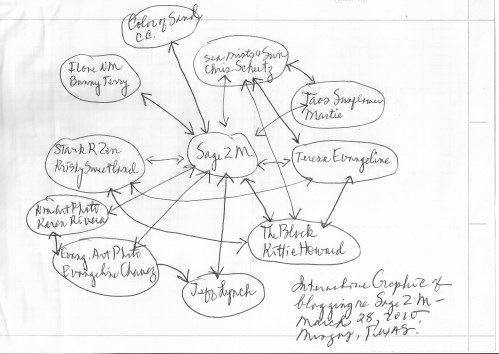
This is a Blog Vector Analysis, a *quick-and-dirty study of interactions among selected bloggers interacting with Sage to Meadow, March 28, 2010.
Each of the lines represent a blogroll connection. The arrows generally go two ways: bloggers put each other on their blogrolls, a matter of friendly and interested reciprocation.
I have more blogs on my blogroll than is seen in the Blog Vector. This diagram lists only those blogs that I have had interaction with for at least ten (10) to fifteen (15) times in the comment section of our blogs, both comment sections combined.
My blog is Sage2M or Sage to Meadow. My interactions on an involved level (10-15 comments) are with ten (10) bloggers.
The Blog Collective I have consists of eleven (11) nodes, myself included.
One objective I had in drawing the diagram was to ascertain where my Blog Collective might have originated and, then, multiplied. A second objective was to diagram the interaction of my blogging friends, to see who connected with whom.
My first search for bloggers involved New Mexico blogs and I came up with two: Stark Raving Zen and Teresa Evangeline (formerly of Santa Fe). From those two blog nodes, the Collective was begun, so that now I have the ten (10) involved nodes.
On the diagram, please note that Sea Mists and Sunsets, Chris Schutz, has four (4) interactions within the Collective, and so also does The Block with Kittie Howard and Teresa Evangeline’s blog.
Note also that the photographic blogs interact with each other and me, but not with others in the Collective: New Mexico Art Photography, Evangeline Art Photography and Jeff Lynch.
Seven nodes are related by New Mexico connections: Color of Sand, Taos Sunflower, Teresa Evangeline, Evangeline Art Photography, New Mexico Art Photography, Stark Raving Zen and I Love New Mexico. The diagram does not relate that attribute.
In conclusion, the graphic illustrates that if you like New Mexico, the American West, photography, writing, place or nature, then you will be a part of the Sage to Meadow Collective.
*A quick-and-dirty (Q&D) study is just what is sounds like: fast, quick, but revealing. Basically, there are two kinds of research: Q&D, sometimes called “hot” research when bullets are flying and bulldozers are idling in the background and pressure is on to evaluate a situation. The second is “cool” research–time can be taken to hypothesize, ponder and conclude, like writing a monograph or thesis.
Lubbock Bicycle Rest Area, Eagle Scout Project of Connor Needham
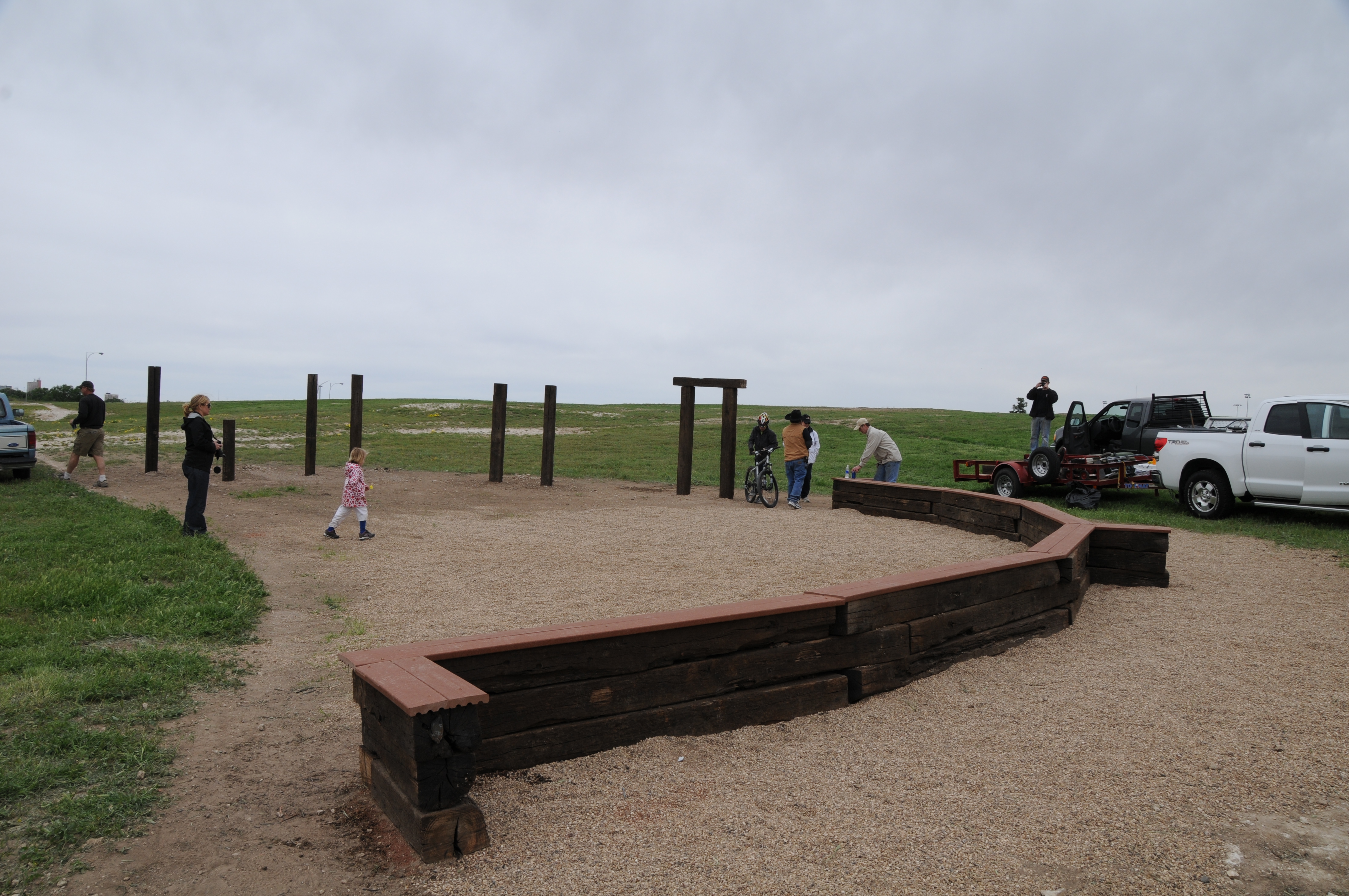
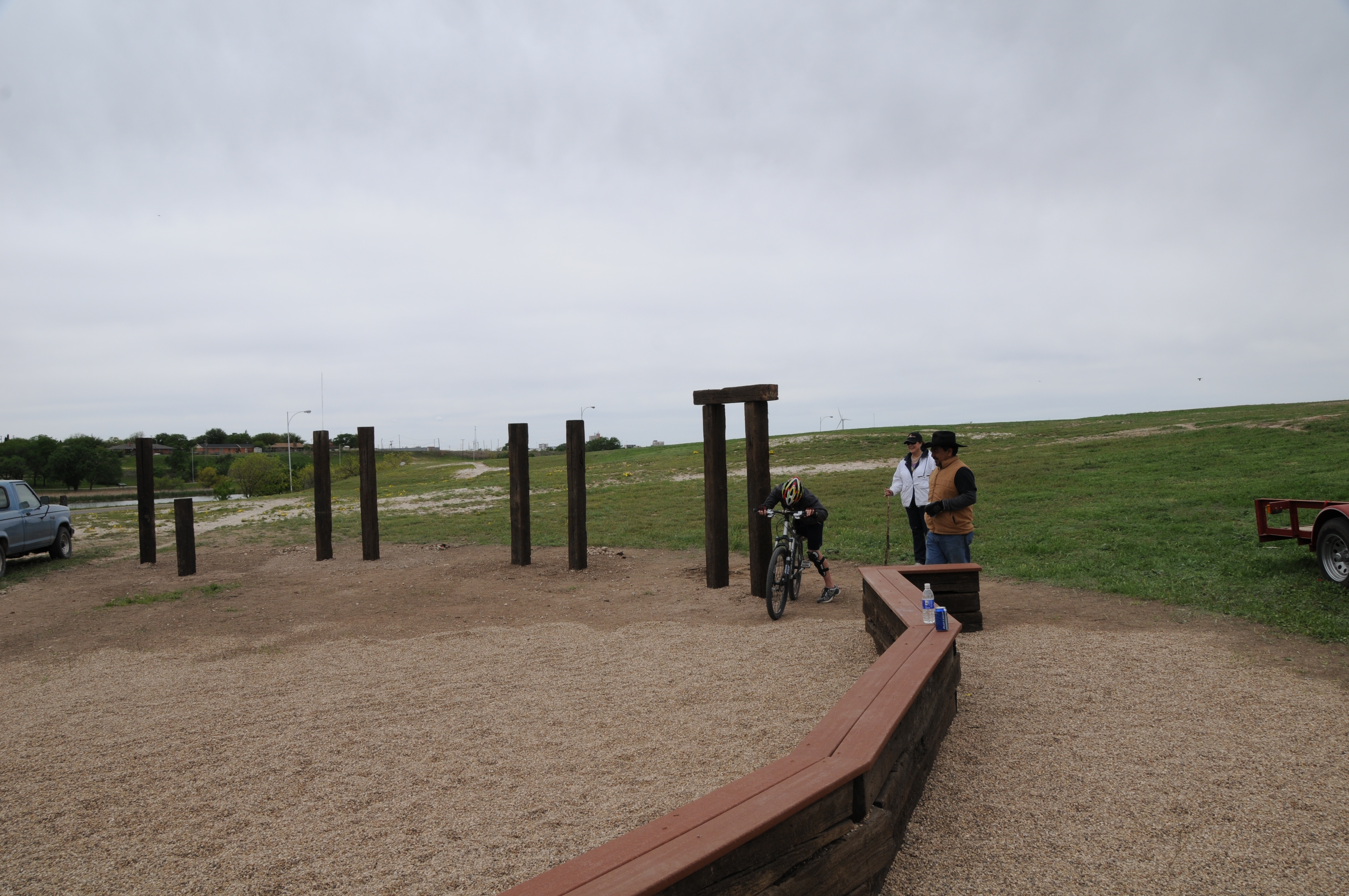
I came up to Lubbock, Texas, yesterday, to assist my grandson, Connor Needham, in constructing a bicycle rest area out at a recreation lake near the east loop. He seeks to attain the Eagle Scout rank and it was his project to gather scouts and family to build the rest area.
By my count, there were ten adults and ten scouts for the construction that began at 9:00 a.m. this morning and ended at 3:00 p.m. this afternoon. Connor composed the construction plans–a notebook-size description–and persuaded the the Lubbock City Government to level the ground for the site. The weather during the day remained cool, in the 60s F., and hot dogs and cold drinks were consumed in great quantities during the middle of the day.
An Eagle Scout from the Goliad Council who goes to school in Lubbock dropped by to give considerable assistance to the effort.
The family and scout effort succeeded. I remember my own Eagle Scout project to clean out and restore the Coggin Park Pond in Brownwood, Texas. Connor’s and my project taught us to think outside ourselves for a greater good, beyond self.
The bicycle rest area is at the head of a series of bike trails about the lake. As you can see from the photograph, not only is it functional, but also artful–note the Stonehenge design.
I have some photos about plants, animals, terrain and fossils I would like to show you. There’s always a photo opportunity here on Flying Hat. April offers some comforting snapshots about the place. There’s a lot of communication taking place, even with horses and yucca.
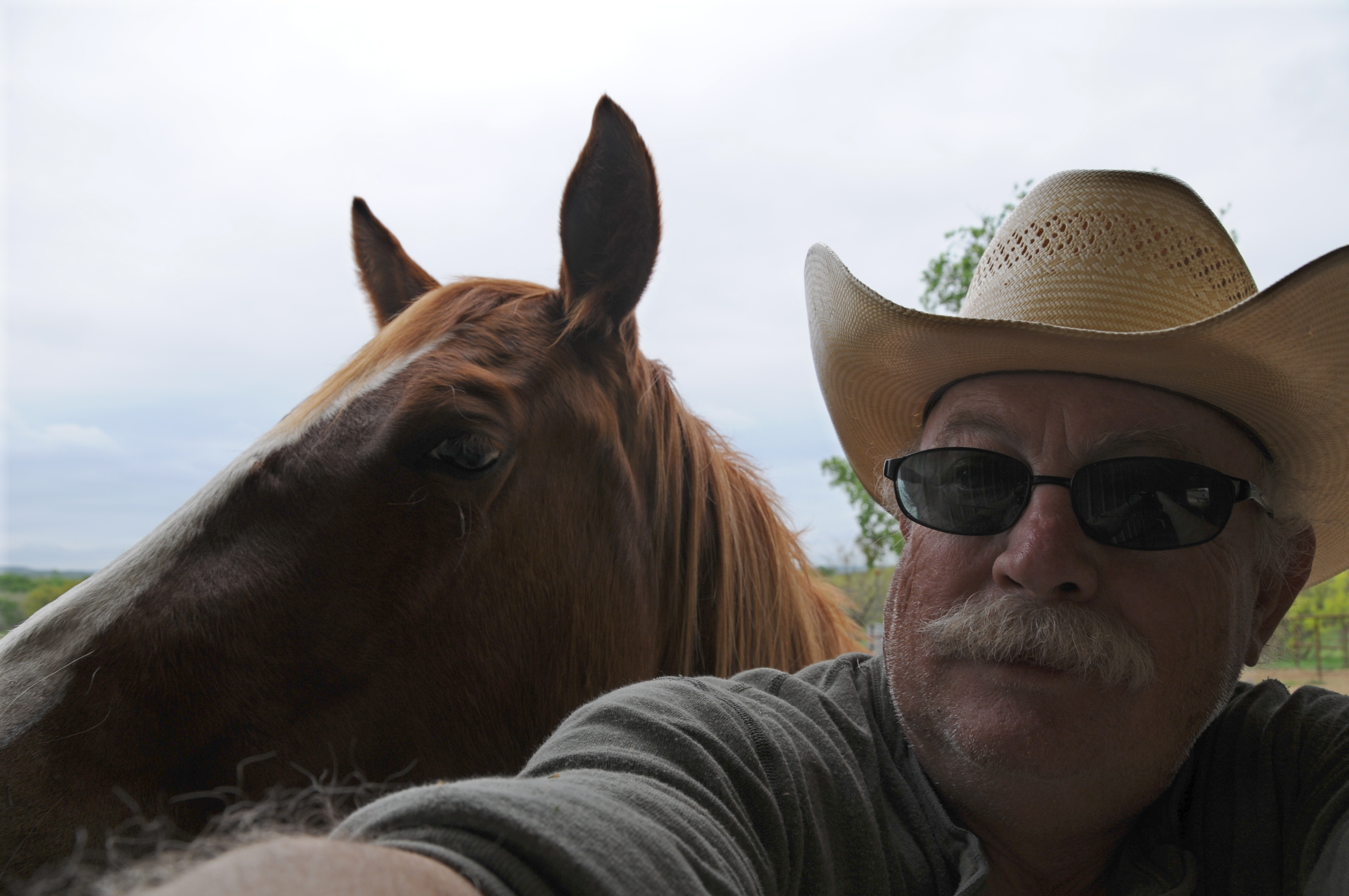
Fanny and Jack at Stable Alleyway
In “Fanny and Jack in the Stable Alleyway,” I am with Fanny and she wants to show her gratitude for the grain she got this morning. She sees the camera and wants to get her picture taken as well as give me a nuzzle in the neck.
Fanny is not an aggressive horse. Nonetheless, around horses, a person must be cautious. They are flight animals and when frightened, they will kick or bolt forward. Fanny is a good mare and her trainer, Duncan Steele-Park and the crew at GCH Land & Cattle Co., have taken her good qualities and improved them. From the day of her birth, we have been familiar with Fanny, lifting her feet and touching her.
Fanny Nuzzles Jack
A nuzzle on the neck is good sign that the horse has “joined up” with a person. “Joining up” is a trademark term of Monty Roberts, The Man Who Listens to Horses (1996) and From My Hands to Yours (2002).
Our horses have human contact–tactile contact–every day. The touching includes a “sacking out” with the hands. “Sacking out” is an term describing a procedure to rub the horse with a foreign object, i.e., a sack, halter, lead rope, blanket or with the hands. A daily touching and haltering with the horse boosts the familiarity between horse and human.
In most cases, horses anticipate the tactile contact. Lilly, our oldest mare, will glide up alongside us and stop, allowing us to rub her under her mane on the neck. The horse’s approach should not crowd the space of humans and it is best if they stop a few feet away and present themselves, more or less, with their flanks exposed. Even after a person becomes acquainted with equine behavior, it is always best to position the body at the flanks or broadside to the horse.
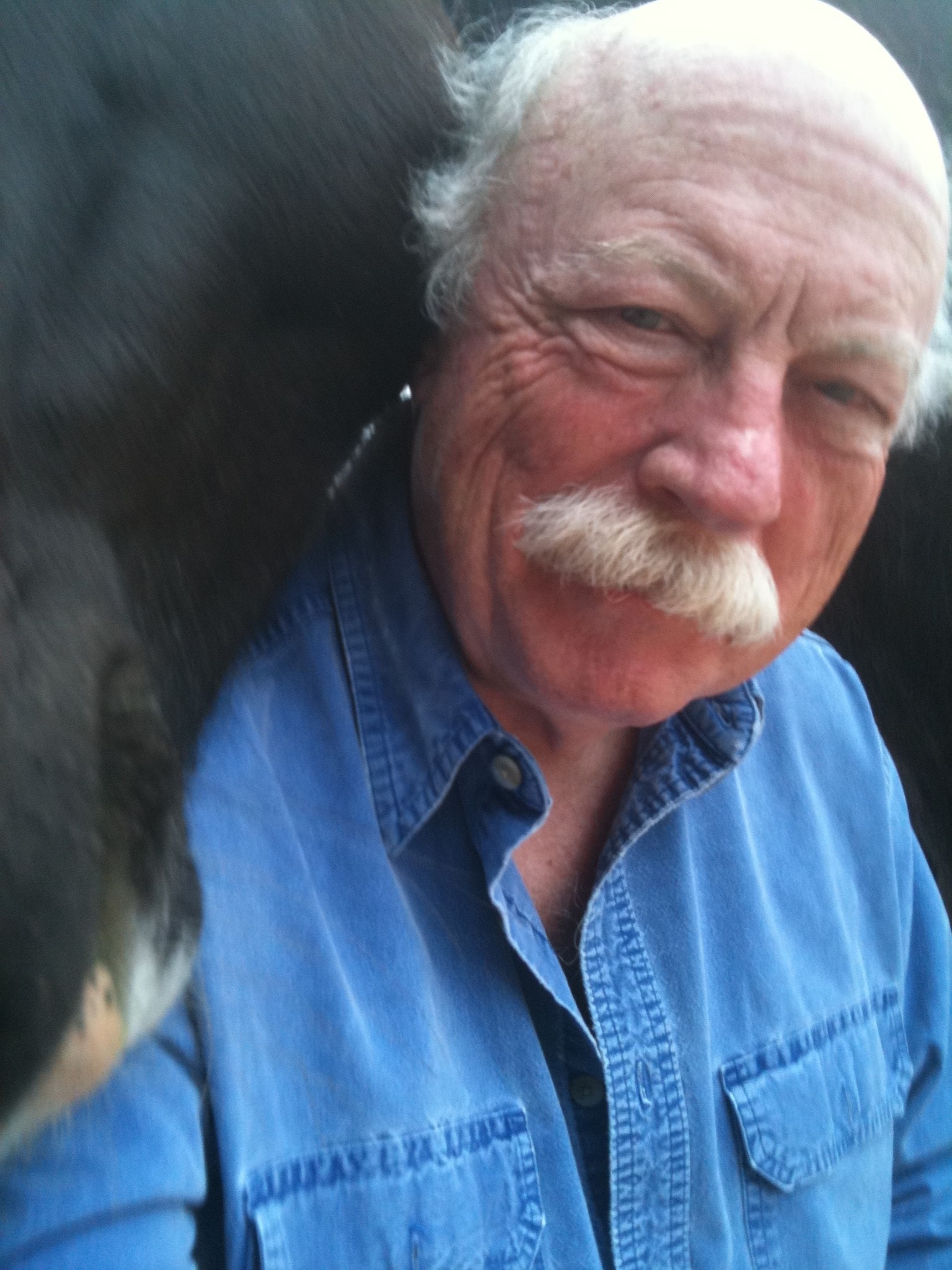
Fanny’s Head on Jack’s Shoulder
The daily contact with horses is a good thing for them and us. We rub the horses once or twice between the eyes, a place they cannot see, as a sign we are trustworthy.
* * *
Read on, there’s more…
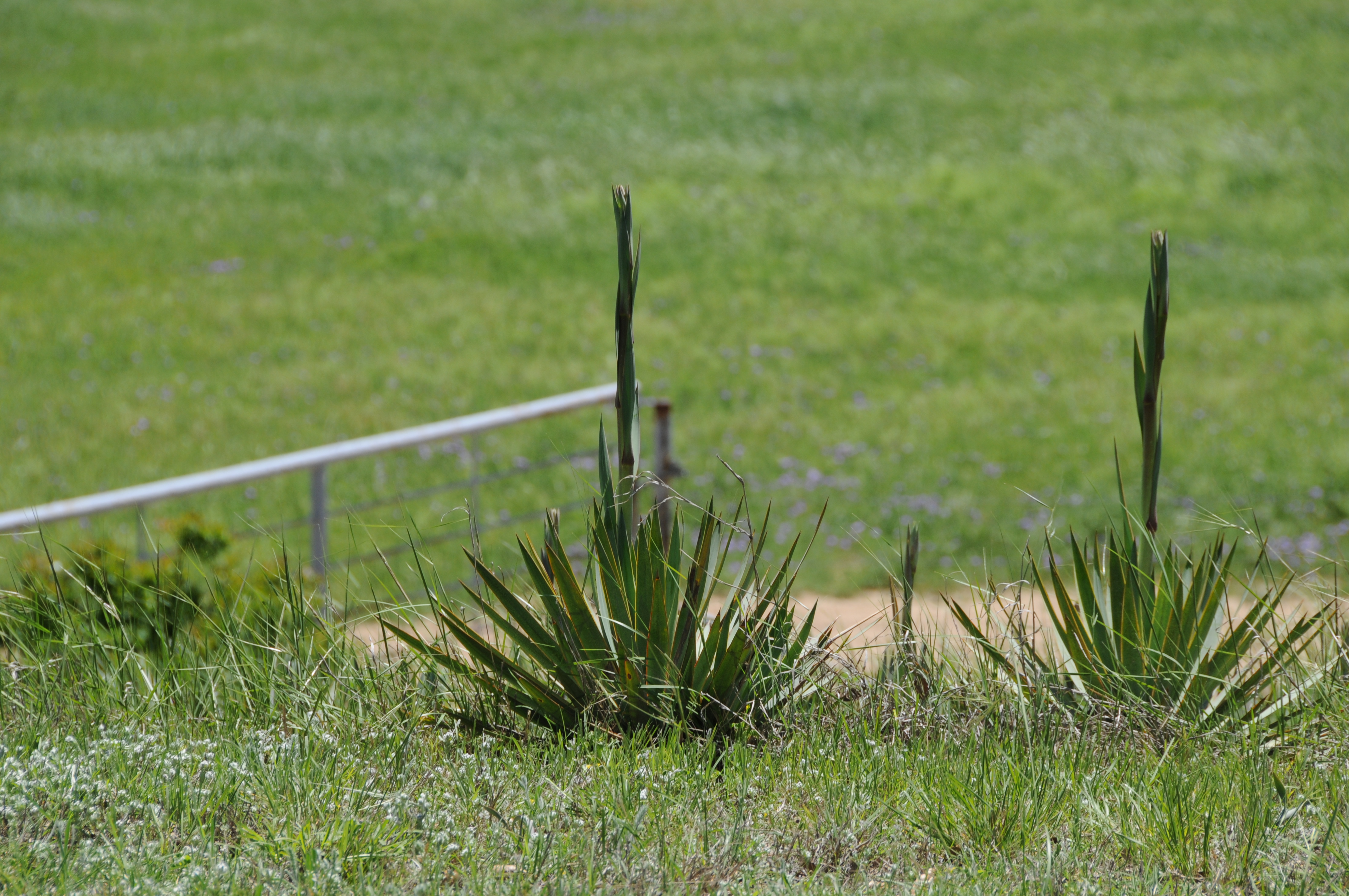
Pale-leaf Yucca (Y. pallida)
I have spent thirty minutes typing this yucca plant. I may be wrong, but my factor analysis seems correct. It is a Pale-leaf yucca (Yucca pallida). As stated in my “Notice to Readers of Sage to Meadow,” if you discern an error in my typing this plant, please correct me.
Pale-leaf yucca is endemic (native only to a particular area) to North Central Texas and may extend into the Edwards Plateau, growing on rocky soil and outcrops of the Blackland Prairies and the Grand Prairie. It bears sage-green or bluish-green, orderly-arranged leaves having a noticeable waxy bloom, or glaucous appearance. The rosette itself is stemless and small, providing a spherical, coarse-textured look in the landscape. It may be single or have multiple offsets. Like all yuccas, Yucca pallida requires good drainage. It may be grown in the shade garden for textural interest, but may not bloom as well as those in more sun. [Texas Plant Database, Texas A&M University.]
In my analysis, I also figured the yucca might be Yucca contricta (Buckley yucca) or Yucca necopina (Glen Rose yucca). In the next few days, these yuccas will blossom and I will provide field photos.
* * *
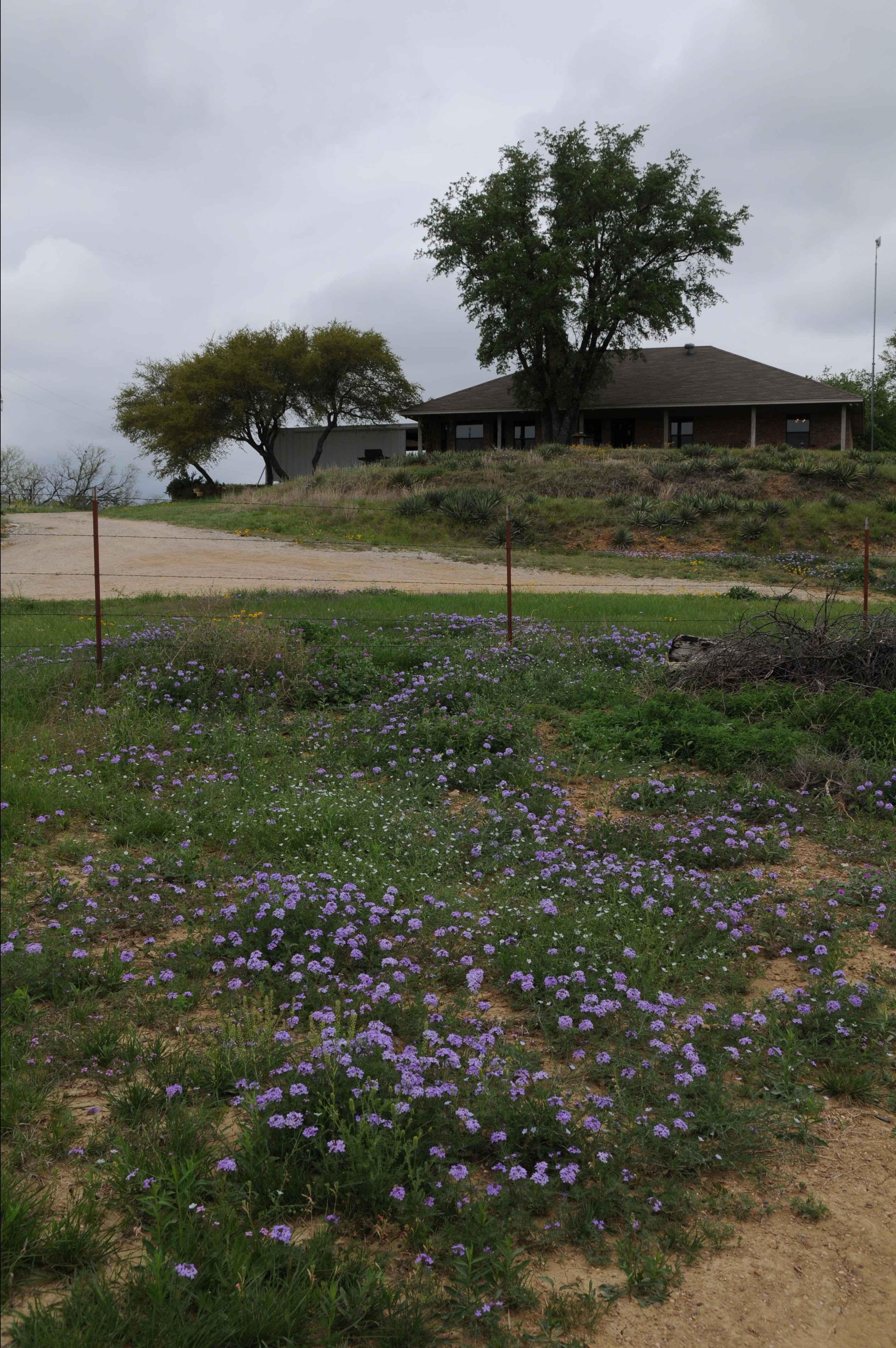
Verbena with Poprock HillI write so often about Poprock Hill, I thought I would provide a photo of the hill. This was taken earlier this April before the full eruption of grasses, but you can see the proliferation of verbena in the foreground. Notice also the abundance of Pale-leaf yucca (Yucca pallida) on the terraces below the ranch house. Poprock Hill is aptly named by local settlers because of the poprocks that are plentiful about the hill. I collect them, and with each rain poprocks emerge from the soil.
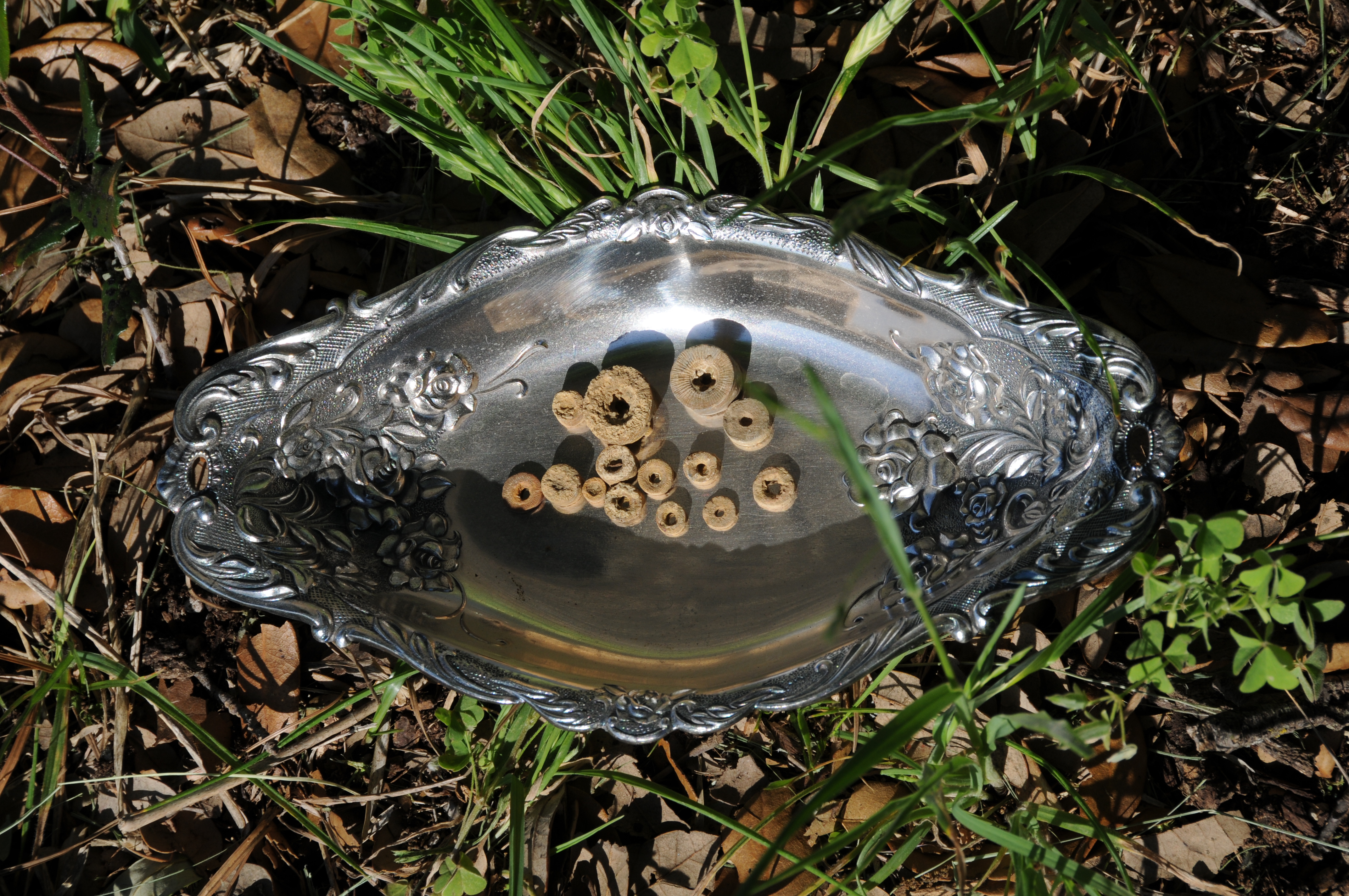
Poprocks on Silver
“Poprocks on Silver” shows several poprocks, large and small, that I have collected.
These photographs I have posted illustrate that even on simple, unglamorous land, there are natural items that are noteworthy and significant for study. The yucca plant I typed (hopefully, correct) required me to go back out to the terrace and look closer at the edges of the leaves to determine if there was a white line or if the leaves were curled, narrow or broad. As I began to type the yucca for posting, I got interested in the yucca for its own sake: what was it? Was it rare? Endemic? The Glen Rose yucca is a uncommon plant and needs some protection from extraction and destruction. Did I have a Glen Rose or not? I find the yucca in Texas worthy of further study. I may start a yucca farm.
Finally, I think this post with photos shows how connections can be funny and personal between species. Fanny and I communicated and I think both of us got pleasure and companionship out of the contact. The yucca could not respond. Whoa there, cowboy! From a Native American point-of-view, the yucca and I were talking to each other, weren’t we? It showed me its style, color and emerging blossoms. I watched it and it “told” me what it was doing. Yes. Certain species of the yucca can be used for soap, shampoo. And, when I give Lilly her supplement for her osteoarthritis, the veterinary insisted that the supplement include yucca. This personalization of plants and animals is beneficial to us all: medicine, companionship and a unity that, however briefly, overcomes life’s estrangement. That’s talking with the plants and animals. Maybe they are our relatives.
I wish you a pleasant week ahead: nuzzle your yucca, but be very careful. Like with all relatives.
Wind farms supporting upward to 200 or more huge wind turbines on 200-foot towers are becoming rather commonplace across West Texas these days, but what about smaller wind energy solutions for the single farm or ranch?
Joey Henderson, who is general manager of Porter Henderson Implement Co. with stores in San Angelo, Ballinger and Big Spring, observed the big gap between the large turbines and smaller units and decided to do something.
The demonstrator unit installed at the Henderson home office, east of San Angelo, gives prospective buyers an idea what a small unit looks like. The Endurance Wind Turbine is a 5-kilowatt model on a 105-foot tower with three fiberglass blades on a induction generator.
Henderson Wind Energy, a division of Porter Henderson Implement Co., has been in operation about a year and covers a territory made up of most of Texas and New Mexico, said Doran Reynold, wind specialist for the firm.
Reynold said the small machines are not competition to large wind turbines. They serve different purposes. The large turbines harvest the wind and supply electricity for thousands of homes or businesses. The smaller units provide clean, renewable energy for a single farm or a home.
“We offer 5-kilowatt machines that are geared more for residential use, either in town — if a person lives in an area which is zoned for the 105-foot tower — or a farm or ranch home. But they are predominantly geared toward rural residential application,” Reynold said.
“The 50-kilowatt machine we offer is more geared toward commercial application,” he said. “It can provide enough electricity for a cotton gin or a feedlot, even a small school district. They can produce up to 200,000 kilowatt hours.”
The commercial towers extend up to 140 feet on the 50-kilowatt model, he said. When the blades are pointed straight to the sky, it adds another 10.5 feet to the height of the residential models and 29.5 feet to the commercial models.
“We recently installed our fifth 5-kilowat unit at Munday, north of Abilene. We have a couple units around Big Spring and another at Monahans,” Reynolds said. “A 50-kilowatt model is currently under construction at McKinney, north of Dallas.”
The whole movement these days is focused on more “green energy” and it works hand-and-hand with West Texas where there is a wind source that is mostly untapped, Reynolds said.
Joey and Jeb Henderson represent the third generation to operate the West Texas John Deere dealership. Their grandfather, the late Porter Henderson Sr. became the sole owner in 1954 which was started in 1928 as Whitaker Brothers Implement.
In 1989, a major expansion took place with the opening of John Deere Sales and Service Center in Ballinger. It is interesting to note that Porter Henderson Sr. managed Whitaker Brothers, the dealership in Ballinger, from 1934 to 1936.
Porter Henderson Implement Co. added a third location in Big Spring in July 2001.
Although chairman Joe Henderson Sr. still maintains “veto power,” the Henderson Brothers have give him no real need to use a veto. They have grown the family business at a steady pace by latching onto the latest space-age technology to compliment the John Deere legacy.
In 2008, Porter Henderson introduced the Real Time Kinematics Network, the newest tool in precision farming. The main purpose of the RTK network is to correct signals which get distorted coming through the atmosphere from a satellite. The latest technology is also using satellite imaging to record where underground drip irrigation lines are located, so the farmer can plant cotton directly over the water source.

For the Hendersons, harvesting the wild West Texas wind is yet another challenge to better serve farmers and ranchers.
I have located a bioacoustical website at Ohio State University containing several thousand bird, animal and environmental sounds. I seek permission from O.S.U. to use some of the recordings on my blog, especially the Sandhill Crane, Gunnison Sage-Grouse and the Harris’ Hawk. Until that time, here is the link to the website: Borror Laboratory of Bioacoustics, Ohio State University. The Borror Laboratory has Sandhill Crane sounds nesting in Michigan (I looked for New Mexico and Texas) with two chicks. This laboratory also has domesticated sounds: canine, feline, bovine and equine.
The Acoustic Ecology Institute website links. This was the website to which I found the above links. This site has a construction date of 2006, and some of the links are dead. This institute (or a branch) is located in Santa Fe, New Mexico.
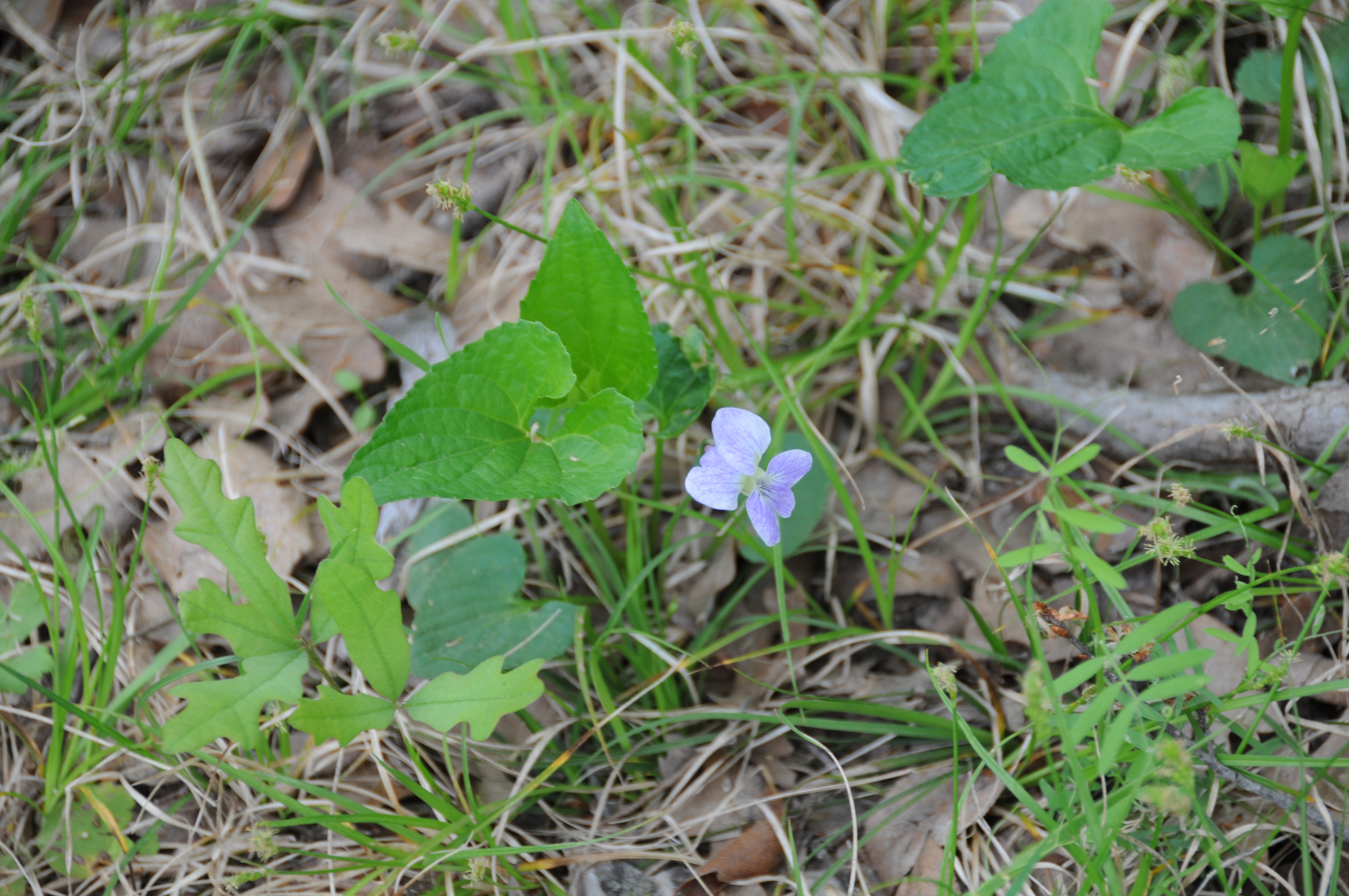
Today, Brenda and I drove to The Grove to have a small picnic lunch. She had suggested a picnic earlier in the morning. After a few chores, I came back by the house and Brenda met me at the back door with a picnic cloth sack. She got in the passenger seat after I moved the field bag and camera out of the way. We slowly drove to The Grove, about 0.4 miles on the pasture road, admiring the wildflowers along the way. (Tomorrow, I use a disc to bring topsoil over the seeds I spread yesterday.)
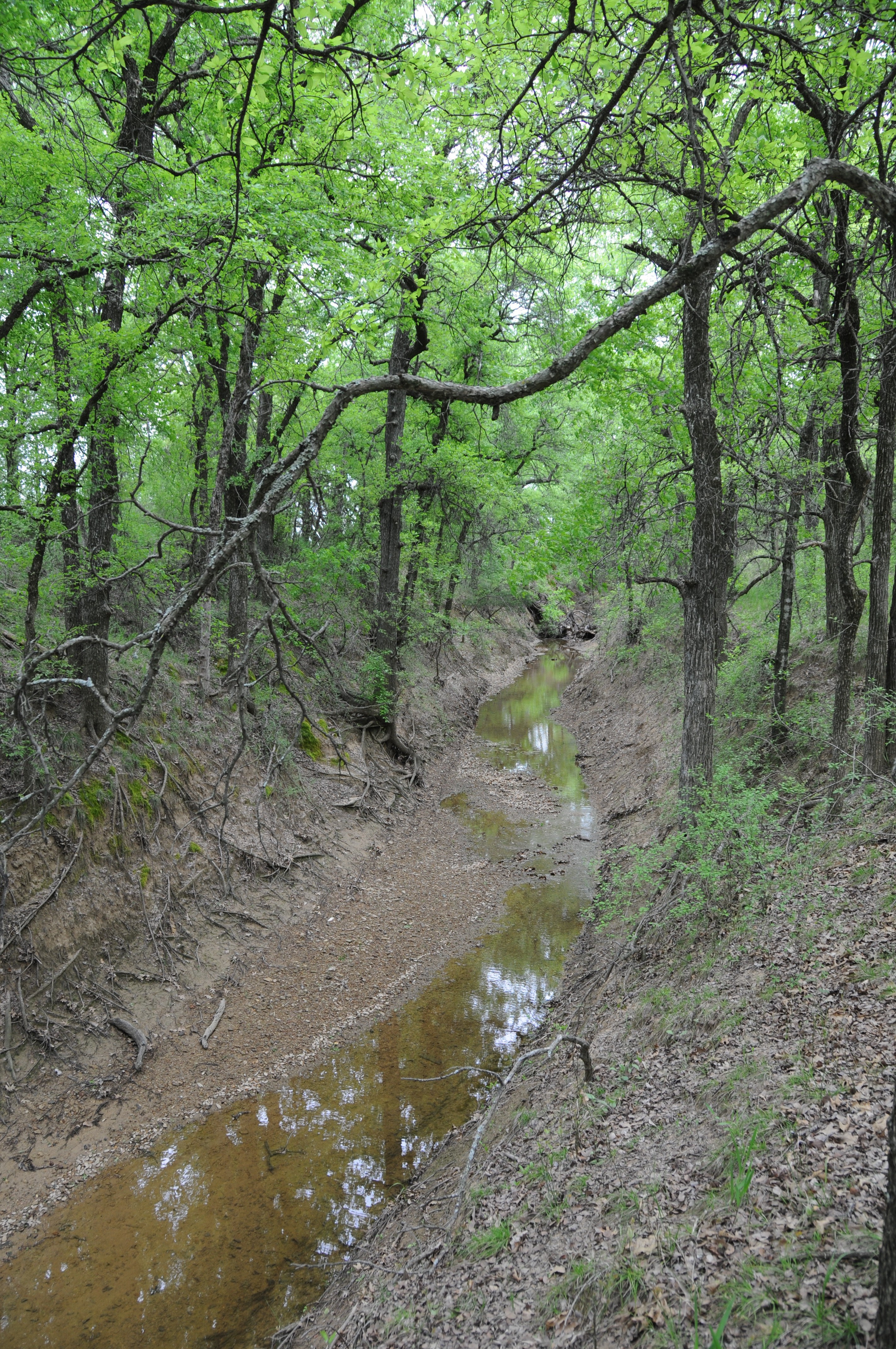
We had a light lunch of ham sandwiches, potato chips and Dr. Pepper. We finished the lunch off with small chocolate eggs wrapped in colored foil. As we sat on the tailgate of the pickup, we chatted about the flowers under our feet, the pre-blossom forms that presage the flower. We looked south into the Salt Creek ravine, not able to see the water in the creek, but feeling the effect of the cool water and the canopy of trees above us.
We then walked to the creek and I showed her the red oak tree (verify) that was different from other oaks along the bank. We walked along the creek bank — it’s rather deep, the creek ravine, about fifteen feet to the bed. We noticed a few old deer trails and holes under trees that animals had dug. I took photographs of wild flower specimens she discovered. She suggested that I hollow out a large oak tree that had fallen in order to put in some plants back at the house. We chatted about taking the surplus brick we had stored at the construction area and use it to floor the ground for the outdoor grill. I teased her that I was going to have to get out my notepad to take down all the projects she intends for me to accomplish.
We walked all the way to the east water gap and turned around, slowly walking back to the truck. Brenda said that this summer, Olivia, our grandchild, could put on long pants and hike with us along the creek and about the grove. We arrived back at the truck and drank some cold water, refreshing ourselves.
Brenda wanted to ride on the tailgate on the return trip. I promised I would go slow. I circled by the corrals and Shiney the colt was very interested in the person riding on the tailgate — a new visual for the little guy. After pausing to chat with the horses — fine horses, courageous horses — I drove back to the house, Brenda and I talking even though she was still riding the tailgate and I was driving. The wind was blowing, but not hard. Clouds and moisture from the Gulf of Mexico passed overhead. No rain fell although a forty percent chance had been forecast.
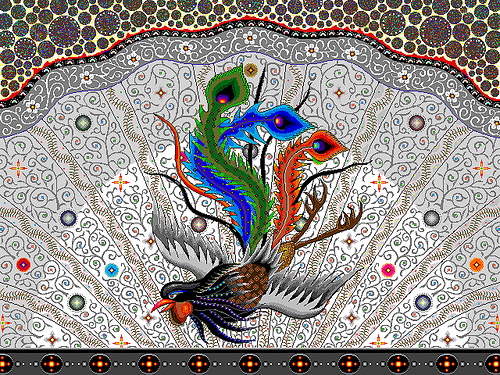
GrrlScientist Image on About Page (artist unknown)
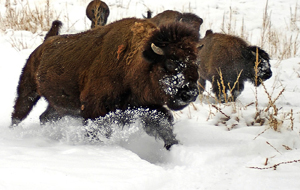
Grrl Scientist’s logo picture of herself is a parrot, inserted on her blog site. I am always intrigued as to self-portrait selections, logo appointments and gravatars. My gravatar is Evangeline Chavez’s photograph of buffalo stampeding through the snow at Sandia Pueblo. If I parse out the personal-emotive rationale for using award-winning Chavez’s photograph (with permission), it is this:
Motion, winter, symbol of the West (bison), vigor, nature, white and brown, buffalo hair, undomesticated, untamed, consequence of over cropping, revitalization, reestablishment of wilderness virtues, ghost and present animation, return of the repressed.
Caralee Woods and Jimmy Henley live near Kanab, Utah. They are building a straw bale compound on their place and have committed themselves to a minimum footprint on the land. With solar panel, water well and environmentally-green construction, Caralee and Jimmy portray the best application of technology, science and ethics to minimize humanity’s impact on the planet. They are truly off the grid — literally. You can see their efforts over the past few years by clicking on their website Building a Straw Bale House. When I posted the piece from Bioephemera Blog this morning concerning the ca. 1686, natural colors, Caralee commented with the email below and provided a photograph of how she and Jimmy artfully and craftily shaped balls of colors from the Utah countryside as a result of finding natural clays for their plastering. I think what she and Jimmy have created is not only an application for their home, but pieces of art that I wish to possess and place as a centerpiece upon my table.
“This is so interesting to me. One of the first things we did here is start looking for natural clay. We had plenty of the terra-cotta colored stuff here on the land for the earthen plaster, but what about the clay paint and finishing plaster for the interior? We drove around for a long time with a bucket and small shovel in the trunk so we could stop and take samples of the wonderful variety of Mother Earth’s colors when we saw something we liked. I would go home, sieve the clay, mix it with some water, and make clay balls that I then polished (I won’t bother you with this process here) to see what we had. The picture below is just a small sampling of the results; I’ve added many since. There are no more beautiful, soothing colors anywhere in the world than what is produced naturally.” –Caralee Woods to Jack Matthews, March 24, 2010.
Roger G. Kennedy, who was director of the National Park Service in the 1990s, said Mr. Udall “escaped the notion that all public land was essentially a cropping opportunity — the idea that if you cannot raise timber on it or take a deer off it, it wasn’t valuable.” On the other hand, Mr. Kennedy said, Mr. Udall understood that public lands like parks enhanced the economic value of privately held land nearby.