Category Archives: Life in Balance

Labor of All the Days

Happy Labor Day on September 6, 2010!

We work in order to live, not live in order to work.  From automobile mechanics to zoologists, the toil is dignified and noble.

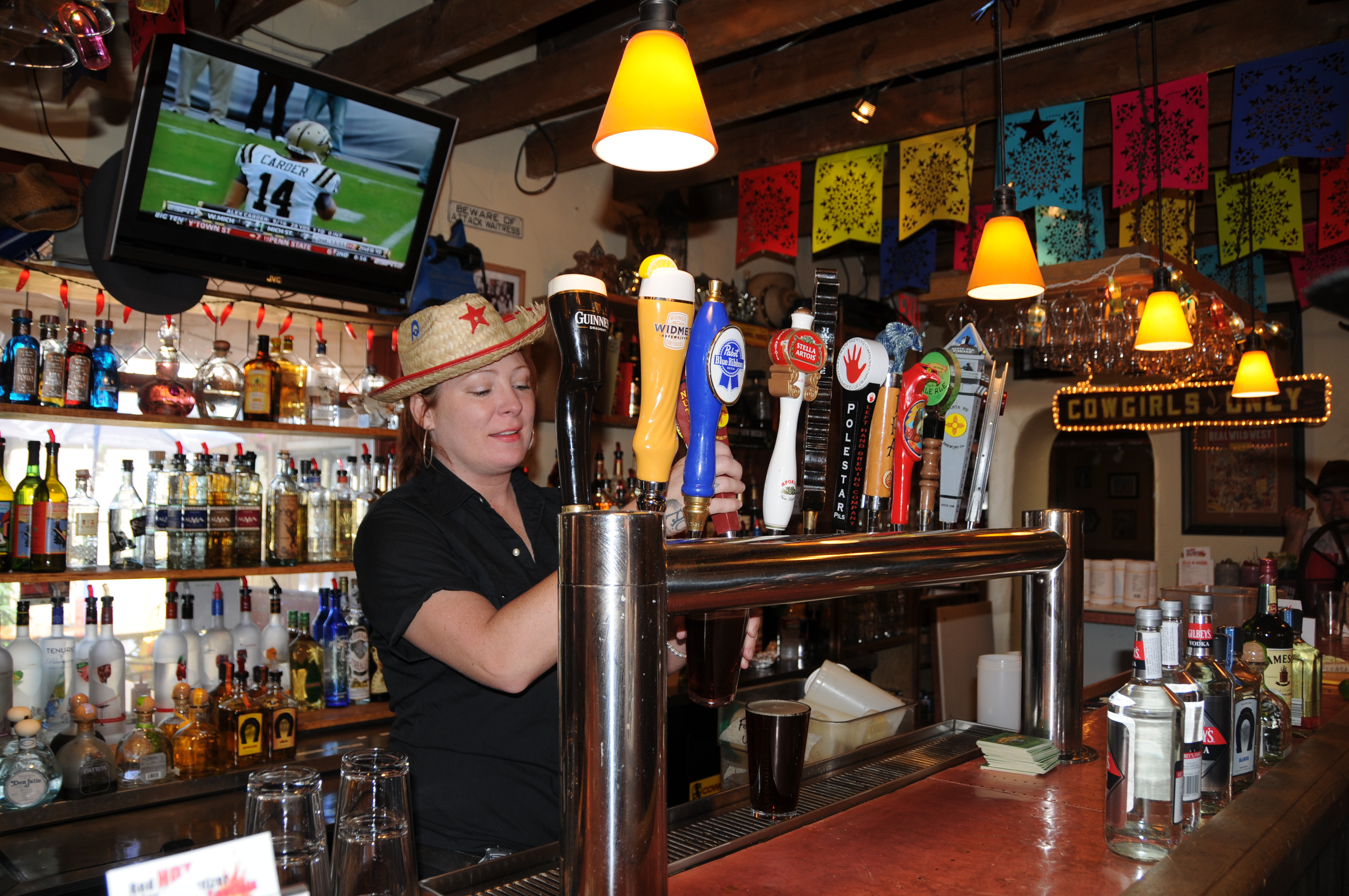
Here are some fine young men and women that made us happy this last year.  These are photographs from the past year in Santa Fe and Taos.

Sarah the Barmaid at Cowgirl Cafe in Santa Fe! Have a Good Labor Day!

Jennifer at Casa Sena opening a bottle of wine for us at lunch. Happy Labor Day, Jennifer!

Happy Labor Day, Lawrence, of The Candy Man, Santa Fe!

7 Comments

Filed under Life in Balance

In Death Giraffes Circled

Tadpoles Communicating with Observer (Road Crossing at Salt Creek)

Pleasant or not, I write to reveal the behavior of animals using language we humans have ignored or lost adeptness in translating, so that we might begin again to absorb information that has been showering us for thousands of years.  Such rain washes us everyday, purest liquid in clouds above us, below us, all around us.  In relearning the language of animals the purpose is not only for acquiring knowledge, but for creating a transcendent place for humans and animals once again.  It is finding the garden we humans have lost, not the animals, a place where the heart is at ease.

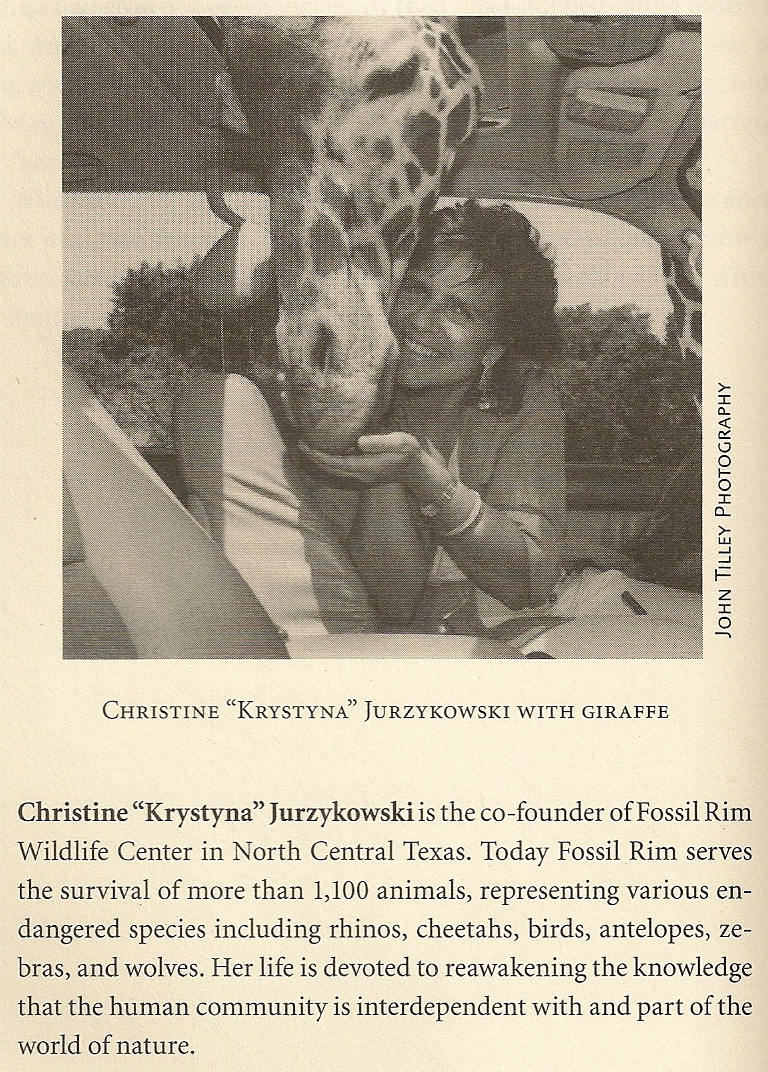
Christine “Krystyna” Jurzykowski wrote an article for Kinship and Animals. The excerpt below focuses on the death of a young male giraffe at Fossil Rim Wildlife Center near Glen Rose, Texas, about fifty miles from Flying Hat Ranch where I live.  This is an example of  inter-species communication in an extremely stressful event.

______________________________

He was six years old.  From birth, he had never really enjoyed good health….We found him fully horizontal one afternoon.  “Quick, prop his head up,” someone said.  A giraffe must have its head elevated or else the buildup of unused pressure causes an aneurysm of the brain.  We spend the next forty-eight hours with this gentle giant on our laps.

After twelve hours, I begin to get into a matched rhythm with his breathing.  I find myself supporting his strength or doubling my energy when his inability to fight dominates.  His head alone feels like a fifty-pound weight on my knees.  The other giraffes form a circle on the other side of the barn.  Slowly they walk, in formation, in silence, heads arching forward and back, as they move in one continuous circle, stopping from time to time for a minute or two.  Their pace seems in harmonious synchronicity to his own ability to fight or surrender.

Ceremony, ritual, a death dance, a communion of higher understanding?  The bull becomes nervous.  The females follow.  We move the bull out in order to regain some quiet.  Something tells us to watch them all at the same time.  The memory is clear: whatever the bull did, the females followed, both on body position and movements, all matching the energy level of the dying giraffe, all in silence, all in loyal reverence and support to his deteriorating condition.

His eyes would catch mine….His gaze would turn away when my own fear surfaced.  The circle, my affirmations, the questions, my cycles of hope and despair lasted another twenty-four hours.  Moments after his death, a group of professors from Texas A&M University arrived for their scheduled site visit.  I met them with tears streaming down my face.

______________________________

These are worlds colliding, animals and humans, worlds of different genetic makeups and culture.  The collision is not annihilation.  It is mysterious, transcendent, beyond the grasp.  For forty-eight hours, both worlds sought to re-vitalize the giraffe.  The herd circled about the one whose head lay in the lap of humans.  Humans elevated the head to prevent an aneurysm.  From a distance the herd watched and circled, parading in unison, swaying like a chorus, sending waves of motion to their kin to rise up.  In the end, both agents of mercy failed at their work, but the six-year-old giraffe did not die alone for there was the company of man and kin about his death chamber.

Do you need a translation for this event?  For now, no, it is sufficient.
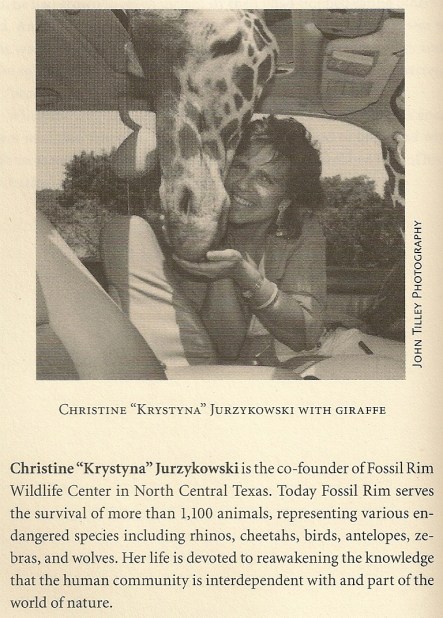
Christine Jurzykowski and Giraffe

______________________________

Notes:

Kate Solisti and Michael Tobias (eds.), Kinship with Animals, San Francisco: Council Oaks Books, 2006.

Christine “Krystyna” Jurzykowski, “Be Your Purpose, My Friend,” in Kinship with Animals, cited above.

Fossil Rim Wildlife Center website.

7 Comments

Filed under Life in Balance

Rewilding the Self

Rediscovering nature and its sentient beings is “rewilding.”  In the mid-1990s, Michael Soule of the University of California, Santa Cruz, proposed the idea that to restore ecosystems one should start from the topside down — reintroduce bears, wolves and otters to a deteriorating system.  Soule’s work was in conservation biology, but is now applied to psychology.

To many people in the field of mental health, a rewilding of the psyche is essential to the “heart’s ease.”  The following article from The New York Times expands on several themes surging in ecology and psychology.  I highly recommend you read this.

Is There an Ecological Unconscious? – NYTimes.com.

Artwork by Kate MacDowell (Photograph by Dan Kvitka for The New York Times)

8 Comments

Filed under Life in Balance

Teresa Evangeline’s Garden

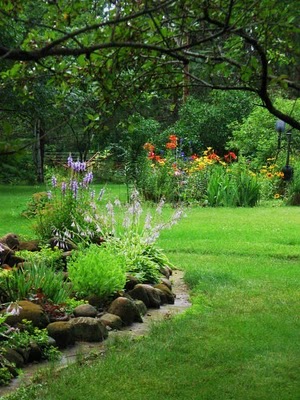
Teresa Evangeline's Garden

One of my friends has a beautiful garden and lawn in Minnesota that helps me transcend dust in the corral.  Today I turned the sprinkler on for the horses to cool themselves.  They liked it, but asked me, “How do we get to Teresa Evangeline’s garden?”

“We’re in Texas, guys,” I replied.  “She’s way north of us.”

“Saddle us, now,” I thought I heard.

______________________________

Notes:

Teresa Evangeline’s Garden and blog.

6 Comments

Filed under Life in Balance

Rockwell Paintings at the Smithsonian American Art Museum – NYTimes.com

The following is a link to the Rockwell notation I have made in the previous post, “Jubilee of My July.”

Rockwell Paintings at the Smithsonian American Art Museum – NYTimes.com.

Leave a comment

Filed under Life in Balance

FB is not Facebook Down Here in Lampasas

Farm Bureau Royalty

2010 Farm Bureau Royalty of Lampasas, Texas

FB stands for Farm Bureau down here in Lampasas, Texas.

At Saturday’s annual Lampasas County Farm Bureau contests, winners were crowned (1).

[The full story will be available online after two weeks from today, unless you are a subscriber to the Lampasas Dispatch Record.]

Lampasas, Texas, and the immediate surround was the birthplace of the Southern Farmers Alliance of the late-nineteenth century, the early-southern manifestation of the Populist Party in the United States that began to regulate corporations for the public good.  The association in Lampasas, Texas, became an integral part of my family’s background and its behavior set a pattern in my family (Parks, Morris, Ward, Brazil) to abhor corporate uniformity and place the tension of liberty and the public good at the front of every public decision (2).

To be sure, Lampasas folk, young and old, know FB may stand for Facebook, but the first association is the Farm Bureau.

______________________________

Notes:

1. http://www.lampasasdispatchrecord.com/ for June 29, 2010.

2.  The neighboring county, San Saba, also has a record of upholding the commonweal.  Its courthouse has a rock-chiseled motto:  “From the people to the people.”  I have a chapter in my unfinished book on an incident along Rough Creek in San Saba County that resulted in a semi-violent confrontation with an absentee landlord and ranchers who closed a county road on my family’s old ranch that he had purchased.  The road was re-opened and the oilman moved on out of the county.

A correction has been made from the original post distributed:  Southern Farmers Alliance rather than Association.

4 Comments

Filed under Life in Balance

Soaring Heart

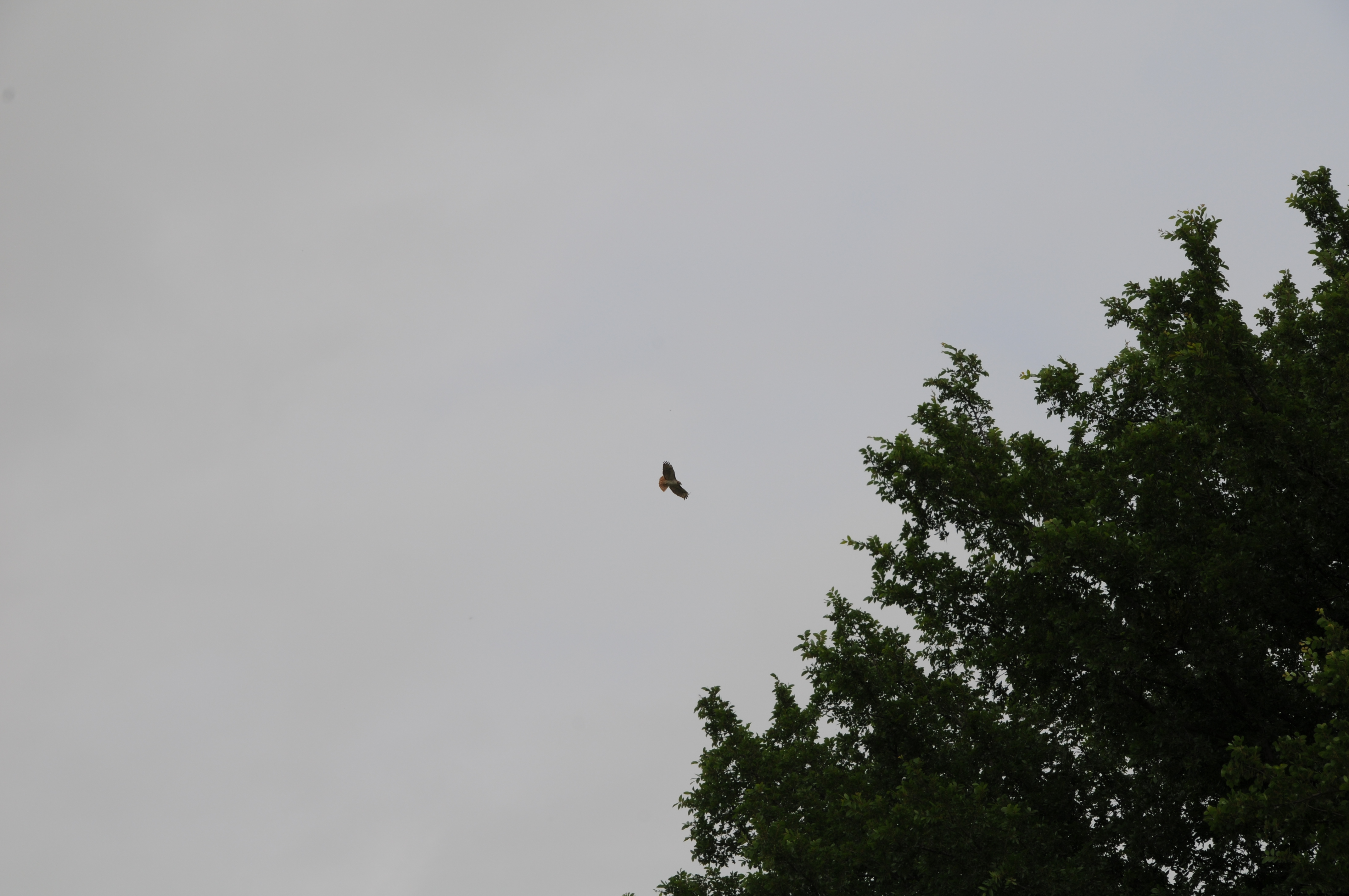
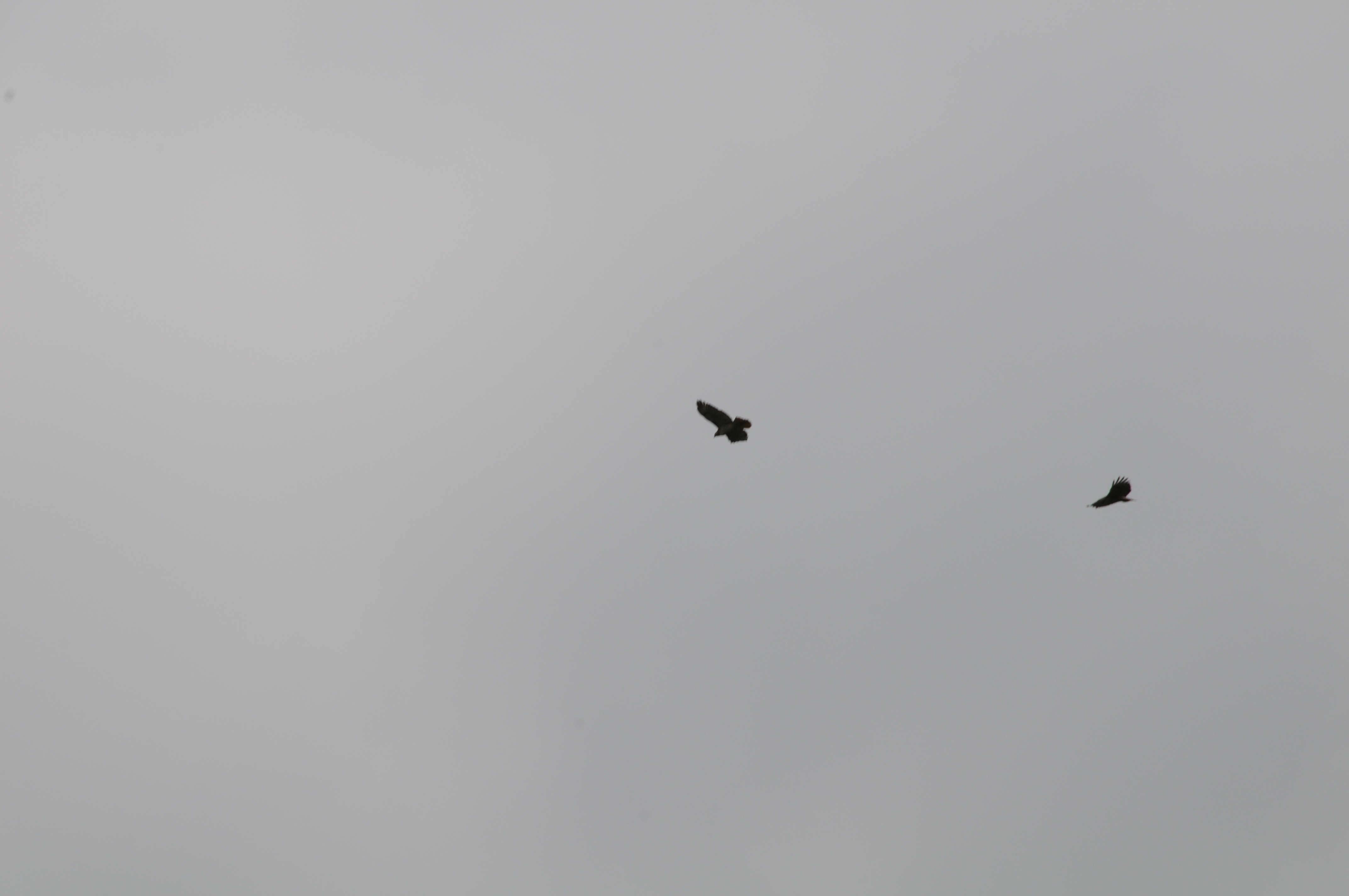
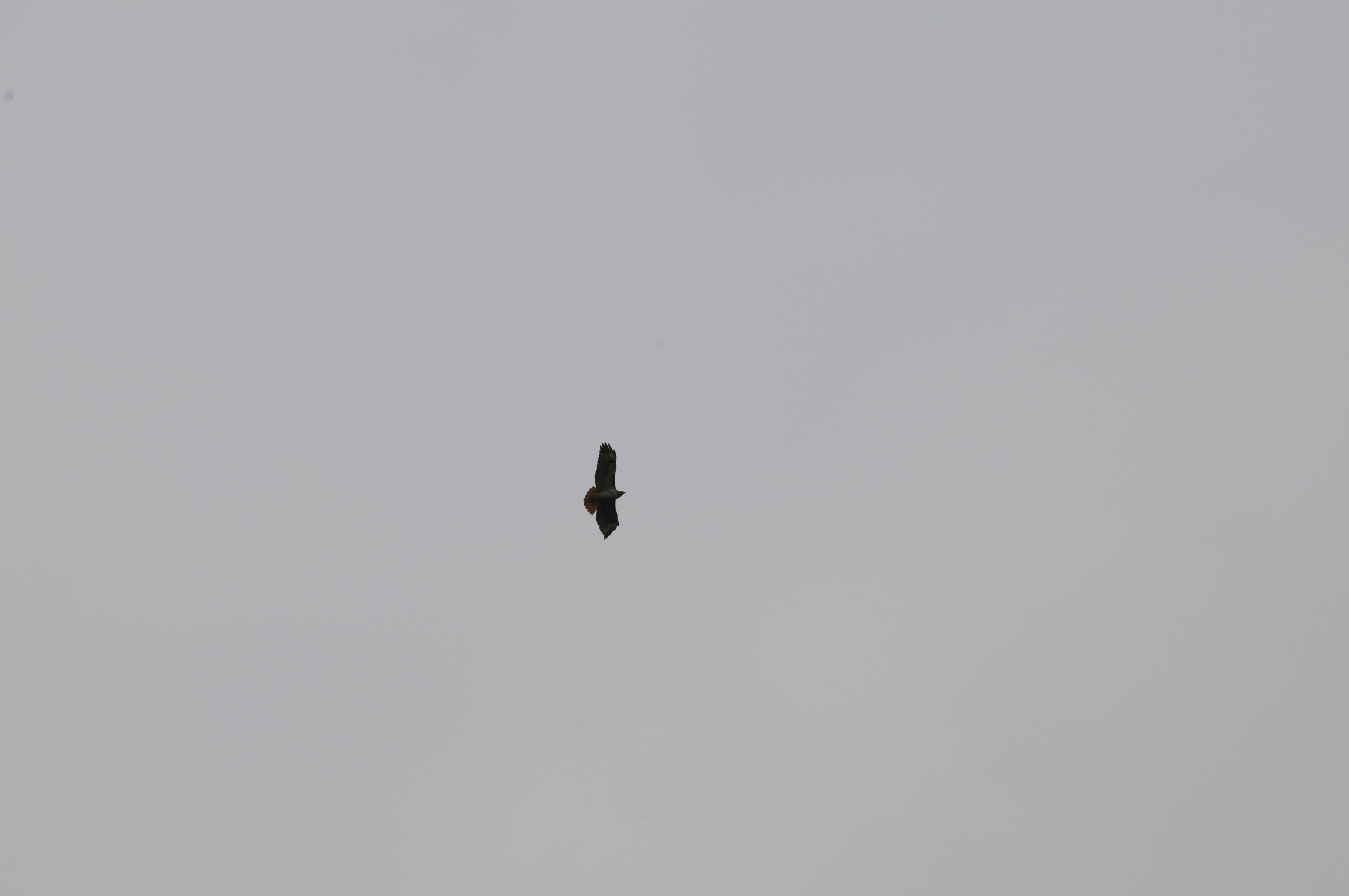
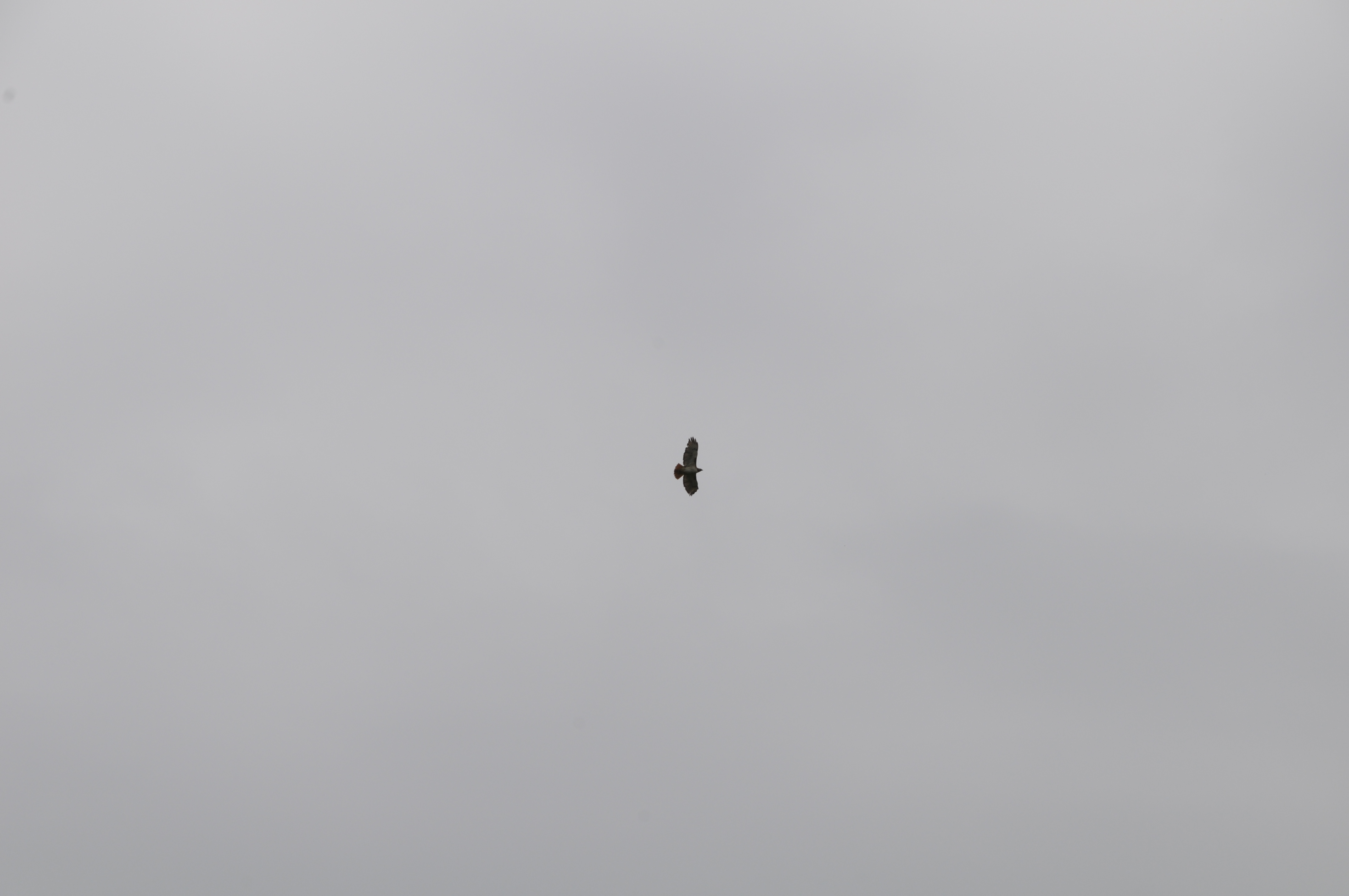
I suppose one of the great observations I make from day to day is the soaring hawk, a Red-tailed (Buteo jamaicensis).

The hawk is above the debris, the remains of daily chores.  Yes, I know that he or she must come down to earth, but as I watch the hawk, I think it plays and flies for the sheer fun of it, the pleasure of flight.  Who can say?  I personify the hawk more than I should, yet, it gives me pleasure to reach out and extrapolate the behavior in familiar terms, a kinship formed.

Two Red-tails inhabit the grove on our place, a riparian swatch that I am keen on developing.  Harris’ hawks also migrate through this area, soaring closer to the ground and smaller in physique.  I hear their voices: karr from the Harris and keeer-r-r from Red-tail.  Cris-crossing, floating, the swiftness with which they predate holds my attention.  It is said that the hawk will dance on its kill.  I have not seen that and do not look for that vintage behavior, but rather I am open to what the hawk displays.  And, in the fields and grove, soaring becomes the rule for display.

To the field we should go daily.  To the field and look and listen, especially to the sky when Red-tails fly.

It is no wonder that Lame Deer, the seeker of visions, would say, when happy: My heart soars like a hawk.

Thou art that: the hawk, the soaring heart.

______________________________

Notes:

For voice and bird identification, Roger Tory Peterson, A Field Guide to Western Birds, 2nd ed., Boston: Houghton Mifflin, 1969.  I have kept a life list of birds I have seen.  I’ve become interested lately in the voices and calls of birds.  The voice translation of the hawks come from Peterson.

One of the excellent sources of Native American life and biography is John (Fire) Lame Deer, Lame Deer Seeker of Visions: The Life of a Sioux Medicine Man, with Richard Erdoes, New York: Simon and Schuster, 1972.  My paperback copy of Lame Deer is old and full of markings.

“Thou art that,” is an ancient Asiatic perceptual insight in meditation.  What you see (and other senses), you are.  Basically, it is an insight that breaks down boundaries among objects and creates a unity.  It is a Vedic formula for enlightenment.  One source is the Chandogya Upanishad.  I teach world civilization and some of the most interesting classes among undergraduates is trying to understand the Orient.

Banner photograph taken by J. Matthews.  It is an enlargement of the Red-tail hawk in the first thumbnail.  Nikon D300 with telescopic lens is the camera.

9 Comments

Filed under Birds, Life in Balance

Going Green at Malabar Farm

Louis Bromfield of Pleasant Valley Malabar Farm, Ohio (Malabar Farm Website Photo)

Malabar Farm, Ohio, has sustainable outlook about their resources. Needs some emulation in the Trans-Mississippi West.

Malabar Farm is the farm name that Louis Bromfield gave his land.  Bromfield wrote, Pleasant Valley, 1943.

I do not like Wikipedia, but for fast information that needs backing-up or verification, it seems to be a first source.  Therefore, on sustainability, greenness or the LEED, this is what they have:  Leadership in Energy and Environment. I didn’t know what LEED was.

Our ranch is operated on the low-impact ranching principles.  In planning remodeling, we are considering LEED certification for the ranch house.  Our beef cattle operations in the future will include, after careful consideration, the Niman Beef production program.

Salt Creek, Flying Hat Ranch, Hannibal, Texas

2 Comments

Filed under Life in Balance

Survived by her Family and the Tamarin

Devra G. Kleiman (1942-2010) at National Zoo with Golden Lion Tamarins at National Zoo (NY Times Photo)

People Not Avatars

Examples, models and real-people, not avatars, present themselves as historic figures upon whose narratives we should integrate into our lives.  Dr. Devra G. Kleiman, who died this week, transformed zoo culture and assisted sentient beings in replenishing their species.  As Livy remarked:  “She is a model to emulate.”

Kleiman’s Procedures Relevant to American West

My blog, Sage to Meadow, focuses on the American West, mainly Trans-Mississippi West, and I worry everyday about the destruction and attenuation of not only sentient creatures, but also the sagebrush and native grassland.  Dr. Kleiman represents the scientific and emotionally best in us, Homo sapiens sapiens.  Her procedures–careful study, legal applications, conservation–can be applied anywhere in the biological environs of this planet, be it the Central Plains or the National Zoo.  Her work must be carried on by us and young men and women coming of age.  Writ small, it might be the feed you distribute occasionally to the mountain quail in Taos or establishing wildlife corridor for deer in Texas.  The caretaking of dogs and cats as Caralee Woods and Jimmy Henley in Kanab, Utah, reflect Kleiman’s outlook upon the wider biological kingdoms.  Writ large, it would be the slowing down or elimination of paved parking lots and strip malls: the culture of overconsumption.

Devra G. Keiman (1942-2010) Biologist Whose Work Transformed Zoos

Dr. Devra Kleiman worked successfully for decades to re-flourish the populations of the Gold Lion Tamarin and Giant Panda.  Her research and field crews impelled the culture of exhibition zoo-dom to restructure their entertainment and captivity culture “to concerted, scientifically informed conservation.”

Dr. Kleiman, in her work with the tamarin, persuaded zoos to give up title to the tamarin in return for the designation of  “a long-term loan from Brazil,” allowing zoo tamarins to be shuffled about the world for diverse breeding.  Her work became the paradigm for 100 breeding programs for endangered species, including the California condor and the black-footed ferret.

In 1972, when China presented the United States with two pandas, Ling-Ling and Hsing-Hsing, Dr. Kleiman and her research team begain to study the panda, holistically (social, sexual, gastronomic) in a 24-hour observation log.  Not until 2005, thirty-three years later, did the pandas produce offspring and only by artificial insemination.   The first offspring, a male by the name of Tai Shan, was later sent to China.

Please note the by whom she is survived in the quote,

Dr. Kleiman’s first marriage, to John Eisenberg, ended in divorce. Besides her husband, Mr. Yeomans, whom she married in 1988, she is survived by her mother, Molly Kleiman; a brother, Charles; three stepdaughters, Elise Edie, Joanna Domes and Lucy Yeomans; and four grandchildren.

She is also survived by the heirs of her scientific labors. When Dr. Kleiman began her work with golden lion tamarins, there were fewer than 200 alive anywhere; today, according to the National Zoo, about 1,500 live in the Brazilian wild.

Tai Shan, now almost 5, has lived since February at the Bifengxia Panda Base in China’s Sichuan Province.

I like that paragraph, “survived by the heirs of scientific labors.”  Give us legions of men and women like Dr. Kleiman.

Devra G. Kleiman, 67, Biologist Whose Work Transformed Zoos – Biography – NYTimes.com.

3 Comments

Filed under Life in Balance

Backlog Unclogged: A List of Worthy Links About Nature

Here are some links to articles about various topics that I have in my backlog.  Some of these I want to write a post about, but since I think they are of value, I wanted to get the links out to you before I wrote.

40 bloggers who really count – Times Online.  The London Times selects forty bloggers worthy of note.  Divided into categories, i.e., green, nature, feminism, politics, etc.

Costa Rica Learn Jaguars Need a Smooth Commute – NYTimes.com.  Costa Rica habitat preservationists are working to provide migrating corridors for the jaguars.

Worldchanging: Bright Green: Koyaanisqatsi Revisited A reflection on the film and its lasting affect.

I have come across the Borror Laboratory of Bioacoustics, Ohio State University.

Here are the sounds of a Sandhill Crane and two chicks about the nest in Michigan.

Sandhill Crane on nest.

Enjoy the sound.  I will be getting authorization to use the sound database more fully in my blog.

From The Atlas of Global Conservation – The Washington Post.  This is a tremendous map resource for reference.

The Daily Scrapbook.  All things related to scrapbooking.  Illustrates old scrapbooks from early twentieth-century forward.  Lots of photos.

Getting Used to It – Cooks Illustrated.  Christopher Kimball writes an essay with each publication.  This is one of his best.

Is There an Ecological Unconscious? – NYTimes.com.

New Finding Puts Origins of Dogs in Middle East – NYTimes.com.

Divide and Diminish – Opinionator Blog – NYTimes.com.

2010 Report: Climate Change — Grasslands.

Climate Change Threatens Migratory Birds, Report Says – NYTimes.com.

The Sleeping Giant.  A Montana blogger.

Bioregional Animism.

MSU News Service – Management of cheatgrass on Conservation Reserve Program lands.

Condor Lays Egg in National Park – NYTimes.com.

A Deal to Save the Everglades Could Rescue U.S. Sugar Instead – NYTimes.com.

3 Comments

Filed under Life in Balance