Category Archives: Life in Balance

Soft Fascination: Easing Brain Fatigue With a Walk in the Park

The effects of walking in parks, green spaces, the outdoors, are listed here and backed by new scientific technology that registers such experiences.  Natural settings, i.e., parks and green spaces invoke “soft fascination,” a term for “quiet contemplation.”

When I lived in Amarillo, Texas, I walked in Ellwood Park near the Amarillo College campus, and often drove to Palo Duro Canyon State Park for relaxation and exercise.  My brain fatigue–never knew what that was–eased and I felt better after the walk in the park.

Read and apply the lessons of the article below when you have a chance for it describes life in balance.

Easing Brain Fatigue With a Walk in the Park – NYTimes.com.

9 Comments

Filed under Life in Balance

Rare the white buffalo

On the highway to Lubbock from Hermleigh, Texas, there is a byway that goes west to a marker for the white buffalo.  I have visited it once, but I do not see any markers these days to the monument of the white buffalo.  The monument may not be standing anymore since vandals have besmirched much of the statues and markers here in west Texas.

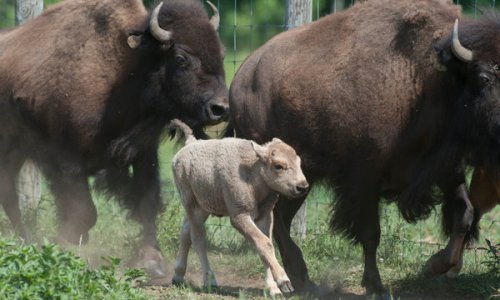
That being written, in Connecticut, a white buffalo has been born.  One in ten million the odds.  See the article in The New York Times:  White Buffalo,

http://www.nytimes.com/2012/07/13/nyregion/sacred-white-bison-is-born-in-rural-connecticut.html

Good, let us now praise a beautiful calf, and if it is born in Connecticut, so much the better.


14 Comments

Filed under Life in Balance

Pink Rain

Pink Rain, Caralee Woods, Kanab, Utah

My last post, ‘Cloud Portal to the coast’, prompted Caralee Woods of Kanab, Utah, to send her ‘Pink Rain’ photograph with this appended message,

For some reason your photo reminded me of a different kind of rain photo I took sometime back here in the desert, right out my back door.  The sun was setting and shining through some virga–rain that doesn’t reach the ground.  I thought of Prince’s ‘Purple Rain‘ and decided to call this one ‘Pink Rain.’  The photo wasn’t enhanced, and I like the fact that the sage seems to glow.

Caralee resides with her husband, Jimmy Henley, in Kanab, Utah, where they are building a strawbale compound a few miles from the town.  Jimmy and I have been friends since elementary school in the 1950s.  In the 1970s, I met Caralee when she was a book representative for Harper & Row publishers.  She came into my office at Amarillo College and called me, “Little Francis,” a nickname I had not heard since high school — courtesy of Jimmy, my old school chum.

Their website has several photographs of the guest house, main house foundation and walls, strawbales and their garden:  Building Our Strawbale Home!    The coloring treatment of their floors is fantastic: a dark copper, desert brown.  Caralee and Jimmy established a compound that is off the electrical grid, using solar and backup diesel generators for energy efficiency.  Visit their website also for the landscape vistas in her photographs.  One of these days I hope to visit them again and see the progress they have made as well as gaze at the glowing sage and pink-virga rain.

11 Comments

Filed under Life in Balance

Yucca morning

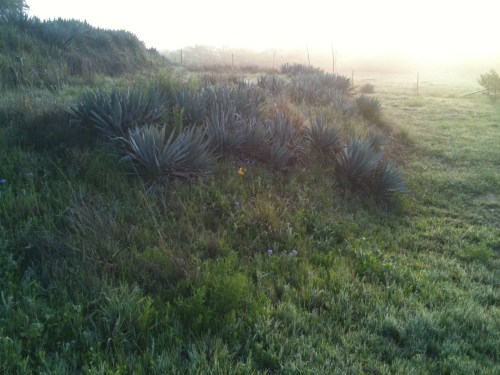
Pale-leaf Yucca on Terraces with Fog, Flying Hat Ranchito, March 30, 2012

In walking down to the stables to feed Star this morning, I paused and looked towards the east, the rising sun flared by fog, and I shot this photograph of yucca, fog, dew and a couple of blossoms of verbena (click the photograph to enlarge). Three terraces gird the ranch house and each level has families of yucca that hold the soil about the landscape and prosper in well-drained soil for their health.

The temperature briefly holds in the middle 60s as I look at this scene. I dwell on it as I write this post and think of the moisture upon green grasses and yucca.  So different from this time last year as fires broke out across Texas, consuming dried grasses, brittle brush and wildlife unable to flee.  Today is different, substantially so, with recent rains and low temperatures. The fire ban is off for Erath County. I see an abundance of wildflowers and I inhale the air suffused with humidity and perfumed with fresh grasses.

This ‘yucca morning’ will last in my senses for a long, long time, and I possessively want the moment to stand still as I look east towards the rising sun, flared by fog, that shall warm the day and send fresh grass shoots skyward.

14 Comments

Filed under Flying Hat Ranch, Life in Balance, Plants and Shrubs, Succulents

Why I wrote, ‘The fox, the hare and the chef.’

As benchmarks go, I have one coming up.  My blog will surpass 100,000 hits sometime today or early this evening.  That’s not like a seventieth birthday or turning twenty-one, and it will not be chiseled on some rock for passersby to see on the road to Samarkand.  It’s a blog thing, don’t you know?

Whether many or most people have read entire posts or have glanced and surfed on, I have no way of knowing.  What I do know is that one of my posts, ‘The fox, the hare and the chef,’ March 30, 2011, has continued to rack up over 1,000 hits a week for several months.  If I am to be known by one piece of writing in my life, this is the composition I desire that to be.

I want it remembered because with beauty comes violence, and, as human beings, we attend that performance in reverence — or at least we should.

‘The fox, the hare and the chef,’ was written in one, long sitting, but I had thought about the content and structure for a long time.  To be quick about it, I had wanted to write about Thomas Keller, the chef of the French Laundry in California, not because of his fine cuisine, but because of his full experience with preparing a rabbit dish, from slaughter to the pan.  He vowed not to waste that rabbit he had personally slaughtered.  This young man in learning the skills of his trade, to become one the world’s most heralded chefs, had insight of  a Socrates in the backyard of a restaurant.  He would not waste the life he had taken.

I nearly always seek humor in writing about nature and our relationship to our good earth.  That’s hard to find these days in the midst of waste, tar pit oil and needless consumerism, but it is there to alleviate the anguish of what we see and read about.  My post, ‘The fox, the hare and the chef,’ however, had no humor, no comedy and it just, frankly, turned out that way.

The humor in ‘The fox, the hare and the chef,’ is not evident, but it is there.  When I started to raise a beautiful herd of Angus cattle in 2007, I was going to be an impersonal cattleman — no affection or emotion for the heifers and steers, all business, no silliness or attachment.  Well, was I ever caught asleep.  In caretaking the Angus, I was shot twenty-seven times by cupid; for in each of the twenty-seven cows I raised, I found myself seeing personality, behavior patterns and sociability I never thought existed.  I walked among the creatures, just to be with them.  Go figure, I fell in love with a herd of cloven-hoofed beasts!  Impersonal?  Heavens no!  I took care of those cattle like they were my own offspring.  Funny, but also quite serious.

So, when I loaded the twenty-seven Angus in the stock trailer to take them to Carter Cattle Company for transport to Perryton, Texas, the cleanest feedlot in the state, a part of me went with them, and I knew that their rearing to that point had been the best around.  Whatever table they came to, I wanted people sustained with a healthy product and a sense that the great chain of being continue with a reverence for the gift of life on their plate — like Keller’s little bunnies.  Don’t waste the cattle I tended with love, and don’t waste your own life in boundless folly, for that does not honor the life in front of you — or on your plate.

With beauty comes violence, and, as human beings, we should attend that performance in reverence.  That is why I wrote, ‘The fox, the hare and the chef.’

______________________________

Notes, corrections and additions:

Thomas Keller, The Importance of Rabbits,‘ The French Laundry Cookbook, New York: Artisan, 1999.  See page 205 for the essay, recipe on page 207.

The fox is beautiful to behold, but it will take its cut in the barnyard and in the field — beauty and violence.

16 Comments

Filed under Life in Balance

Juniper: an evergreen for all my seasons

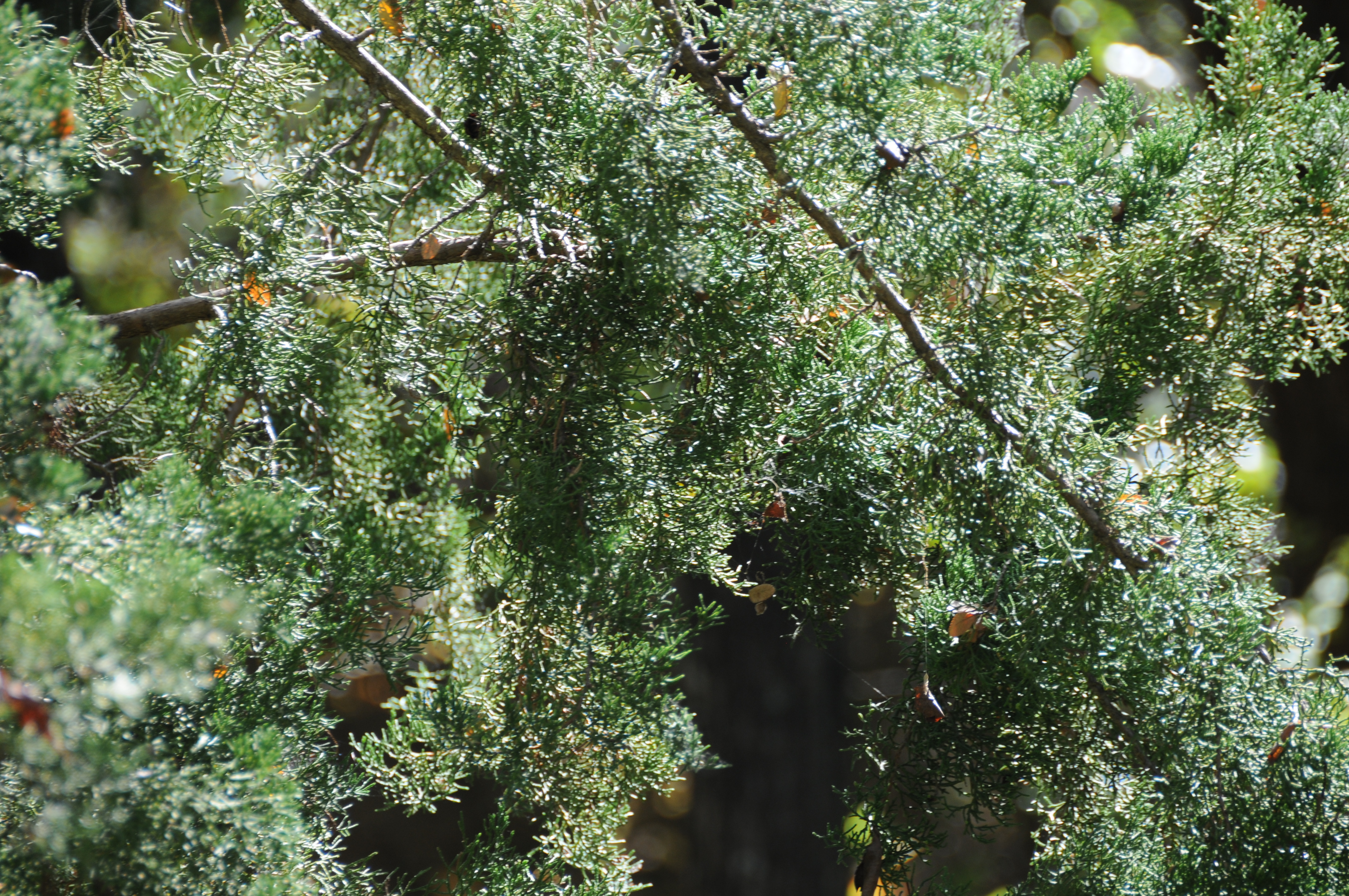
Juniper in Flying Hat Ranchito grove, often referred to as cedar (J. Matthews, 2011).

(As a disclosure, I use “cedar” and “juniper” interchangeably.  See notes below from Encyclopedia Britannica and Wikipedia.)

I grew up with cedar all around me, but cedar posts for building fence predominated.  T-posts (the steel ones) may be making fence construction faster these days, but I hold to the cedar post as a primary building material.  Allergies from cedar congest the lungs of Texans, particularly central residents who weather the Mountain Cedar every year.  A website dedicates itself to, “Cedar: The Allergy Plague of Trees.

All of that being said, the cedar or juniper holds personal value for me beyond the descriptions, quotes and links I attach in this post.

Of all the flora about me as I grew up and the plants about me now, the juniper radiates scent and memories, even beyond the majestic pecan in my far pasture.  I burned juniper in a Folger’s coffee can to sweeten the air at campsites and even in my apartment from time to time, placing the coffee can at the edge of the hearth.  I have taken cedar bark and twisted it into fine pieces and lit a single match to start a campfire, and I have carried cedar tinder in my backpack to start fire along the trail.  I cut cedar staves and posts one Christmas vacation to earn extra money and to say, I once worked as a cedar chopper.

Green juniper groves along the Colorado River near Bend, Texas, contrasted with bleached white-gray rock outcroppings, and I found old campsites of roundups in pastures about the river, the blackened rock, not the red, holding the remains of cedar fires.  My grandmother once pointed out a cow camp firepit near the Colorado that she had cooked for the crew and her husband-cowboy Jake, before his accident on the horse Hell’s Canyon.

I have camped near cedar breaks many times, but the one time I remember was on the Zuni Reservation, out in the middle of the reservation, by myself with junipers and coyotes through the night.  I built a small fire of cedar and munched on a juniper berry for its bitter effect.  I had sped to the reservation from Grants, New Mexico, and hastily set up camp, sleeping in my bedroll beside the fire the night through.  I was seeking a medicine man, but he never found my camp.

More often than not at Christmas time, my family cut a juniper tree from the ranch to place in the living room.  The tree may have been as short as three feet, at other times, five-feet tall.  I loved the aroma of the juniper as it filled the house for Christmas.  Tinsel drooped from the branches with those bubbly lights all aglow.

Near Abilene, on the road to Coleman, there is a park on the east side of the highway at Buffalo Gap, a broad cut in the hills that buffalo and migrants used to go into southwest Texas from the High Plains and Caprock.  The park has a large grove of junipers that have trunks three to five feet in diameter.  I have rested there many times and note the broad-deep shade the junipers provide in the Summer and windbreak during Winter.  From the Juniper Park — as I have taken to call it — one can see into Buffalo Gap and off in the distance the plains to the north.  This Juniper Park has been a lookout, a redoubt of some sort, for a long, long time.  I think I stopped there one time when I was traveling to Brownwood to take care of my aging mother, or it may have been another time, and I rolled the windows down to smell the juniper and place my hand on the fertile greenery I had known all my life, or that other day anew in late Spring.  I thought then, as I do now, that I will remember this day for as long as I live, for although my mother lay dying and I was teaching in a foreign land, the evergreen of juniper and its effect transcended my sorrow and sense of alienation from this world.  I have found home and peace and love beneath junipers for all my seasons.  To me, its fruit is never bitter.

______________________________

Notes, corrections and additions:

Some juniper trees are misleadingly given the common name “cedar,” including Juniperus virginiana, the “red cedar” that is used widely in cedar drawers. True cedars are those tree species in the genus Cedrus, family Pinaceae.

In Morocco, the tar (gitran) of the arar tree (Juniperus phoenicea) is applied in dotted patterns on bisque drinking cups. Gitran makes the water more fragrant and is said to be good for the teeth.

American Indians have used juniper to treat diabetes; such treatments by the Navajo, for example, are under clinical study.[3] Clinical studies have shown that treatment with juniper may retard the development of streptozotocin diabetes in mice.[4] Native Americans also used juniper berries as a female contraceptive.[5] The 17th Century herbalistphysicianNicholas Culpeper recommended the ripened berries for conditions such as asthma and sciatica, as well as to speed childbirth.[6]

“Juniper,” Wikipedia, accessed December 25, 2011.

* * *

juniper, any of about 60 to 70 species of aromatic evergreen trees or shrubs constituting the genus Juniperus of the cypress family (Cupressaceae), distributed throughout the Northern Hemisphere. The juvenile leaves of a juniperare needlelike. Mature leaves are awl-shaped, spreading, and arranged in pairs or in whorls of three. Some species have small, scalelike leaves, often bearing an oil gland, which are pressed closely to the rounded or four-angled branchlets. Male and female reproductive structures usually are borne on separate plants. The reddish brown or bluish cones are fleshy and berrylike and often have a grayish, waxy covering. They mature in 1 to 3 seasons and contain 1 to 12 seeds, usually 3.

Common juniper (J. communis), a sprawling shrub, is widely distributed on rocky soils throughout the Northern Hemisphere. Many ornamental cultivars have been developed. The berrylike megastrobilus of this species is used to flavour foods and alcoholic beverages, particularly gin, which is named after Juniperus through the French genièvre. Juniper “berries” have a fragrant, spicy aroma and a slightly bittersweet flavour. Used with venison, they remove the gamey taste. They are also used to season sauces and stuffings, in pickling meats, and to flavour liqueurs and bitters.

An important ornamental and timber tree of eastern North America is the eastern red cedar (J. virginiana), whose fragrant wood is made into cabinets, fence posts, and pencils. This species is an invader of glades, pastures, prairies, and other open grassy areas in parts of its range; thus, it is considered a troublesome weed by some botanists and land managers. The savin (J. sabina) of central Europe, Chinese juniper (J. chinensis) of eastern Asia, and creeping juniper (J. horizontalis) of eastern North America are other popular ornamental species with many horticultural varieties. The wood of incense, or Spanish, juniper (J. thurifera), of Spain and Portugal, and of Phoenician juniper (J. phoenicea) of the Mediterranean region sometimes is burned as incense.

Oil of juniper, distilled from the wood and leaves of several species, is used in perfumes and in medicines such as diuretics. Galls produced by junipers as a reaction to fungal infection are known as cedar apples. This fungus, cedar apple rust, completes its life cycle on members of the apple subfamily of the flowering plant family Rosaceae, which contains numerous species of trees and shrubs commercially valuable as fruit and ornamental plants. The growth of junipers around apple orchards and plantings of related genera is thus discouraged to avoid disfigurement or loss of these important cultivated plants.

Encyclopædia Britannica Online, s. v. “juniper,” accessed December 25, 2011, http://www.britannica.com/EBchecked/topic/308301/juniper.

12 Comments

Filed under Cedar, Juniper, Life in Balance

Walking with Great Blue Herons

The grove peninsula. This is one of several peninsulas formed by the meandering Salt Creek (December 2011).

Blue Heron tracks along a still pool of water in Salt Creek (December 2011).

I walked in the grove this morning.  Several peninsulas emerge in the grove, cut by the swift and long-flowing water of Salt Creek.  Upon purchasing Flying Hat Ranchito eight-years ago, I found a red metal chair on the peninsula I photographed, a solitary chair for the previous owner to muse, observe or rest.  I took the chair off the peninsula.

Wet and cold the air, I saw track of the Great Blue Heron that frequents the creek that meanders among the elm, oak and juniper.  I see one or two of them each day flying to the cow tanks about the ranchito.  The heron track I identified with my Peterson’s field guide to animal tracks, a new third edition I purchased when Border’s went out of business in Fort Worth.

I was not alone as I walked in the grove.  The Great Blue Heron — past and present — walked with me in the grove today.

Related articles


7 Comments

Filed under Birds, Great Blue Heron, Juniper, Life in Balance

My Little Bull

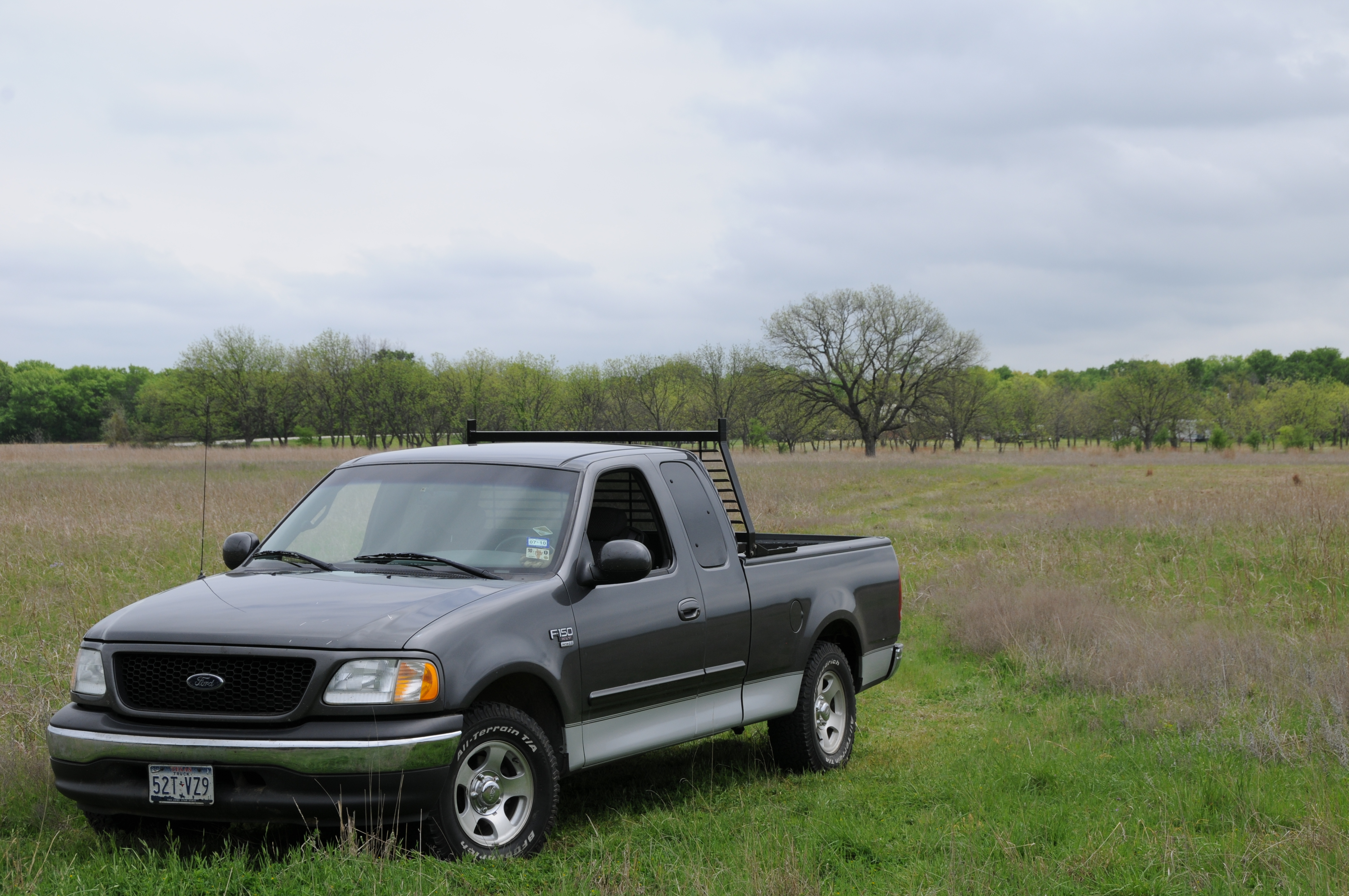
Little Bull in the far field.

We like, even love, our pickups.  The vehicle in people’s lives possess an almost life-like identity as we accelerate, speed and reach our destination, or for that matter, drive just to be driving — touring, it used to be called.  We remember our first car we owned, the first car or pickup we drove.  My first lesson in driving came in a 1950 Chevy pickup, green in color, in the sands of Sulfur Springs road, near Bend, Texas.  I was ten-years-old and the year was 1952.  My grandmother sat beside me and taught me clutch and foot-feed (accelerator).  I stalled it one time and then, off we went!  I loved that Chevy pickup, and, of course, the instructor who finally gave me a passing grade.

This month, December, I am selling my 2002 Ford F-150.  Its name is Little Bull.  His coat is gray.

Little Bull has carried me, my friends, my family and all things horsey and mechanical for nearly ten years.  He has 260,000 plus miles and is tired and broke, his transmission needing replacement.  The service department at Arrow Ford in Abilene, Texas, holds his remains and a repairman wishes to purchase Little Bull and use him for short hauls about the city.  For me to repair him costs $2,500.00 and that is beyond my budget.  The repairman can tend Little Bull back into health for way less than I can and he keenly wants him.  Little Bull is still wanted, still admired, and so I have made the choice to sell.

Chariots, wagons and pickups have carried commerce and people through the ages.  Vehicles have been spaces for conversations and monologues, carriages to weddings and funerals and platforms for hay and feed.  Little Bull has pulled trailers with injured horses to the vet, pregnant mares for foaling and newly-bought furniture from Dallas.

I shan’t grow maudlin about Little Bull for it is not good for me and he deserves better in his next life than to be sent away in sorrow.  He’s been a good boy, a fine man and now, in his later years, a helpmate for another respectful owner.  Little Bull may be cannibalized for parts, his wheels and tires going one way, the headache rack another, but I have cherished his life, his dependability and his character.  Like that Chevy in the sands of central Texas, I shall never forget my Little Bull.

8 Comments

Filed under Life in Balance, Recollections 1942-1966

WeBLOG adobe las golondrinas

Window with bars, Las Golondrinas, New Mexico (2011)

A few notes from las golondrinas behind the bars:

Private business in cahoots with governmental agencies build solar arrays and oil pipelines that crisscross the American West.  Is this really necessary?  Tortoises are relocated — or at least a great many of them were — and wildlife corridors “will” be constructed to allow wild game to browse in the Great American West.  By all means let’s  power our cell phones, televisions and gaming equipment so that we can “see” nature on television, iPhones and earn all the levels of virtual combat games that we can boast about to our chums by e-mail on yahoo, gmail and msn.com.  Why, who needs “real” critters when we have “virtual” critters?

* * *

An old Native American narrative:  Grandfather takes grandson to see a river that runs between two mountains.  The river has cut a deep gorge between the mountains.

Grandfather:  Grandson, which is stronger, the river or the mountains?

Grandson:  (trying hard, puzzled)  The river, Grandfather?

Grandfather says nothing, looks at Grandson.

Grandson:  (trying harder to figure it out, changing answer)  The mountains, Grandfather?

Grandfather says nothing for a minute or two.

Grandfather:  Grandson, it doesn’t matter!

* * *

Henry David Thoreau wrote in Walden that a telegraph line was being built to connect Maine with Texas.  He said, in effect, That’s nice, but will they have anything to say to each other?

* * *

On the topic of a lot things:  It doesn’t matter.

______________________________

Notes, corrections and additions:

“Los Golondrinas” is Spanish for swallows.

There is a huge solar array system being built out on the Mojave Desert between California and Nevada.  Chris of Coyote Crossing has tried to impede the construction of the array because of the tortoise issue.  See his blog on my bloglist below for further news of these “necessary” and stupendous power grids in the making.

The narrative about Grandfather-Grandson is courtesy of Blu Cooksey.

Of course everyman has his Walden, so the quote is in there!  Please go look it up.

The origin of “blog” is from the two words, Web and log.  I don’t know if the OED has caught up with “blog” yet.  “In hindsight, it seems amazing that I did finish [her translation] — and, indeed, that anyone working the British university system ever finishes anything…,” writes translator Susanna Morton Braund in her preface of Juvenal and Persius, Cambridge: Harvard University Press, 2004.  Now, in my opinion, finishing the translation of Juvenal’s writing from Latin to English does matter.  Well, maybe not.

10 Comments

Filed under Life in Balance, Life Out of Balance

Not mine, not yours, but ours: Penasco Upper Llano acequias

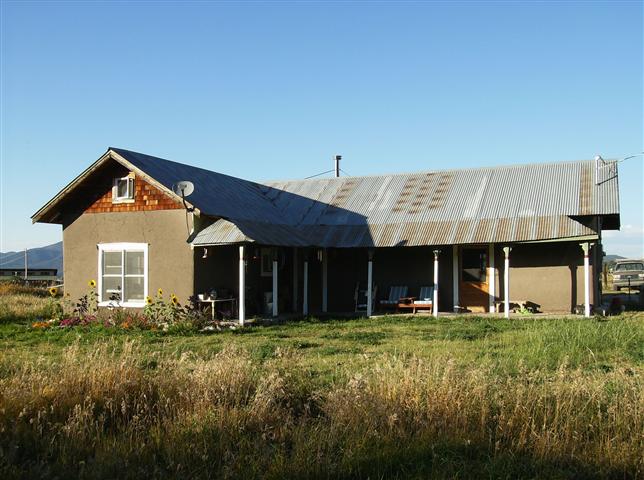
The house on 17 irrigated acres from the Acequia de San Juan Nepomoseno del Llano. Water rights since 1789 (photograph by Taos Properties).

Forty-four years ago, in 1967, I traveled to New Mexico from Amarillo, Texas.  It was my third and most memorable trip for I dreamed for days about colors and pottery and adobe and silver.  I would lie down, fall asleep and pass into a dream world of silver and blue skies — northern New Mexico.  It was not all pleasant because I became ill from eating different Native American and Mexican foods, but that never deterred me from returning again and again and again.

Aside from digestive and dreaming events, I vividly remember a man plowing his field with horses near Mora, the unpaved streets about the Taos plaza and the narrow strips of farm land that bordered rivers and irrigation ditches.  The narrow strips of irrigated land not only reflected a precise lay of the land by survey crews, but also reflected a community, a meshing of farmers.  What was there about those fertile strips that drew me in?    In later anthropological field trips, I took my students by the Pecos River irrigated plots along State Highway 3 that ran from Interstate 40 to Interstate 25 between Santa Rosa and the Pecos Pueblo.  (Click to see Google map of the Pecos River plots.)

The system of irrigation is called acequia, referring both to the irrigation ditch and the association of members organized around it.

I have never owned land in New Mexico, but if I did I would buy a parcel of land that had water rights to an acequia, a system that stretches back in time to Native American communities before the arrival of the Spanish who adopted the local customs of water rights (riparian rights).  Having land that possesses an acequia, one automatically gains entry into a community that cleans, rebuilds and nourishes the ditches and, further, is granted rights to meet in a democratic association to discuss apportioning water and policies affecting owners that border the irrigation ditch.

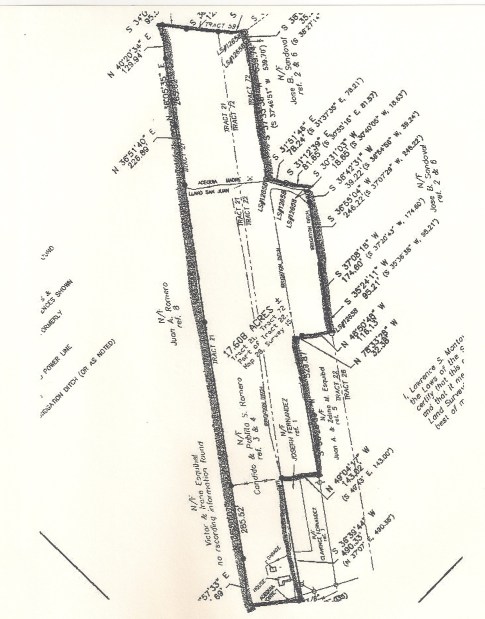
Several weeks ago, I came across a piece of property near Penasco that if I could sell my ranchito, I would buy and move my horses and equipment post haste to Penasco Upper Llano.  See the following Google map:  This is the map-image of the Penasco Upper Llano property and other strips of community property.

This particular piece of property with the adobe house pictured above is located in the high country between Taos and Santa Fe and can produce 700 bales of hay a year.  The water rights go back to 1789, the year that the United States inaugurated its first president, George Washington.  The surveyor’s plat looks like this:

Stanley Crawford in his work, Mayordomo: Chronicle of an Acequia in Northern New Mexico (1988), writes of the acequia culture that I admire:

There are few other civic institutions left in this country in which members have as much control over an important aspect of their lives; relatively autonomous, in theory democratic, the thousand acequias form a cultural web of almost microscopic strands and filaments that have held a culture and landscape in place for hundreds of years….

Ditch-cleanings are all very much the same, and in this they often feel more like ritual than work.  The crew varies from year to year: a couple of old men don’t turn up each year, a couple of boys barely able to handle a shovel, fifteen- and sixteen-year-olds, take their places; the weather is better or worse than some vague notion of what is usual, mayordomos come and go and some are responsible and fair, others vindictive, punitive, almost military, others are lazy and heedless of the needs of the ditch; and the crew can be a good-natured, hard-working creature, or sullen and complaining and evasive, qualities perhaps dictated by the amount of pride or fear circulating through the hearts of both those in charge and those doing the actual digging….

Buddy Manzanares who, on one of my last perfunctory inspection tours half an hour from the end of the spring digging, calls on me to admire a meticulously dug out and cleaned up tarea [a grave-size chunk of the ditch], with the banks cleaned of grass and squared neatly where they end in the bottom of the smoothly shoveled-out channel….This man knows how to make this small thing, this chore, into more than we commonly imagine, and what can be more important to know in this life, than just that.

Mayordomo, pp. 176, 224, 228-29.

The deep thing about acequia that pulls on me is the ready-made community that circulates around water rights that nourish subsistence crops and the growth of hay.  The isolation of many Texas ranches and the people that tend them and steward their animals is not good; in fact, it diminishes the rancher to a coarse individuality that thins the possibilities of  human endeavors, insinuates a obsessive pecuniary attitude about the land and narrows civic — read unselfish — behavior to the mere casting of a vote once or twice a year.

There are western ranching communities that transcend these deficiencies, I grant you, but the tendency has been to sell out or buy more land, thus expelling more people from the agrarian way of life.  I have experienced this and have witnessed the deleterious affect upon my family.

I shall not be accused of romanticizing the acequia culture — oh, go ahead and accuse! — because it is a human community and there will be conflict and law suits, but there is an association, a group of men and women meeting about water and how to nourish their livestock, beans, alfalfa, corn, tomatoes, okra, flowers, lawns, chilis, vineyards, peaches, plums, apricots, coastal bermuda, roses, trees, and every other conceivable plant that flourishes from the soil that is watered.  Having an acequia culture forces the lesson about sharing in real, material ways that no desk-bound, box-bound person will ever learn.  The basic premise is:  water is limited, we all need it, how will we share it?  And, how are we going to keep it coming down the ditch?  The answer: let’s talk about it, let’s vote on it, let’s implement our decision.

Like so many other things in life, the ditch is more than a ditch.  The acequia and the water is not mine, not yours, but ours.
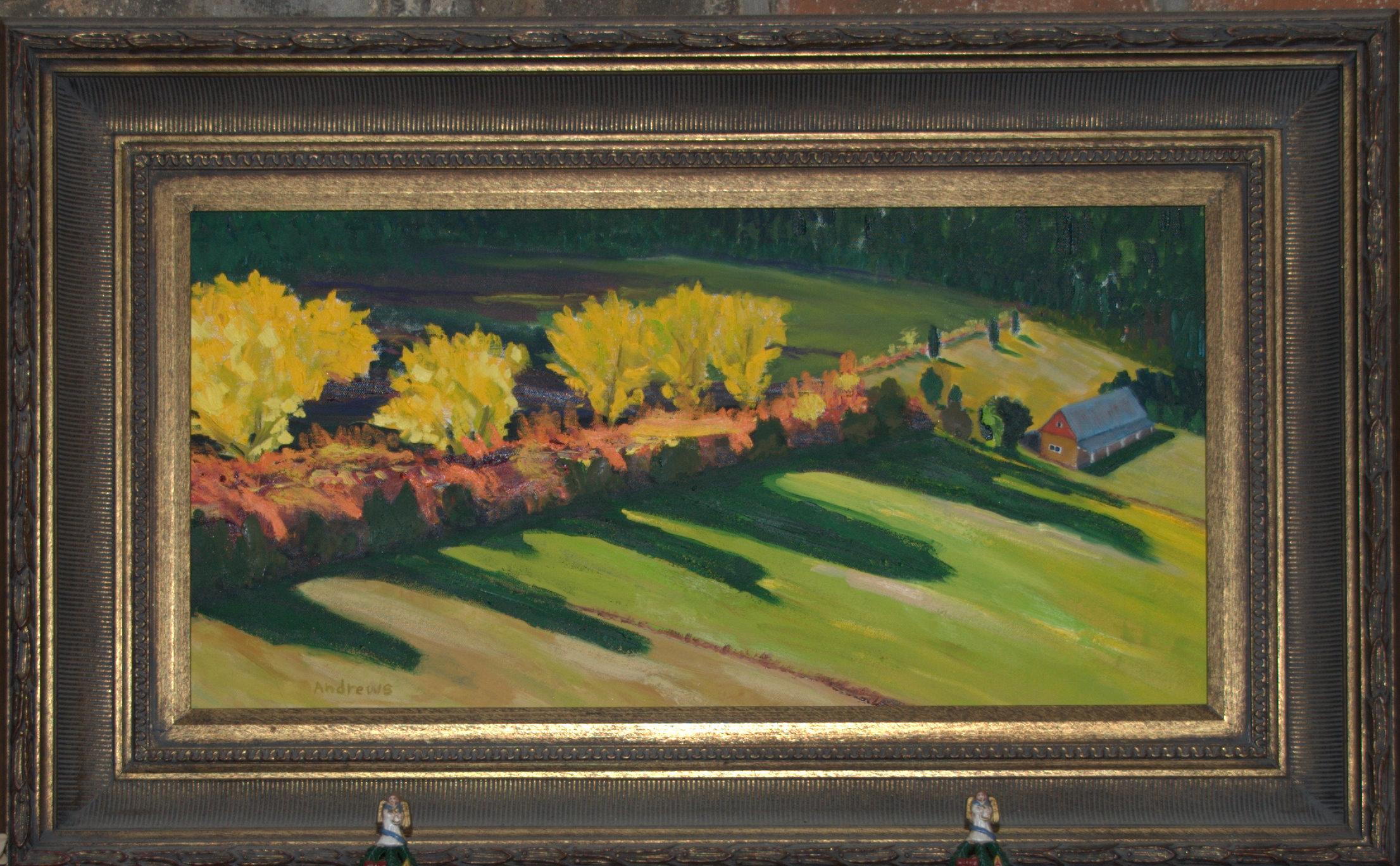
Acequia near Vadito, New Mexico, (Vadito II, oil by Eric Andrews, Taos, personal collection of J. Matthews).

______________________________

Notes, corrections and additions:

The language keyboard for Spanish and diacritical markings frustrates me.  Hence, the Spanish diacritical markings for “Penasco” are missing, although about every 20 times, I can get the tilde above the “n” in Penasco.  If anyone has any suggestions within the WordPress format to easily apply diacritical markings to writing, please comment or drop me an email at matthewsranch@msn.com.  I am intent upon using proper markings, but I am not going to spend ten minutes every time I need a tilde to paste it on.  Can Windows Vista do anything right?  Of course they can, but you have to update your browser every five minutes.  And, then restart.

13 Comments

Filed under Life in Balance, Santa Fe, Taos