
As I finished throwing hay to Star, I saw this sunlight in stalls and thought it artful.
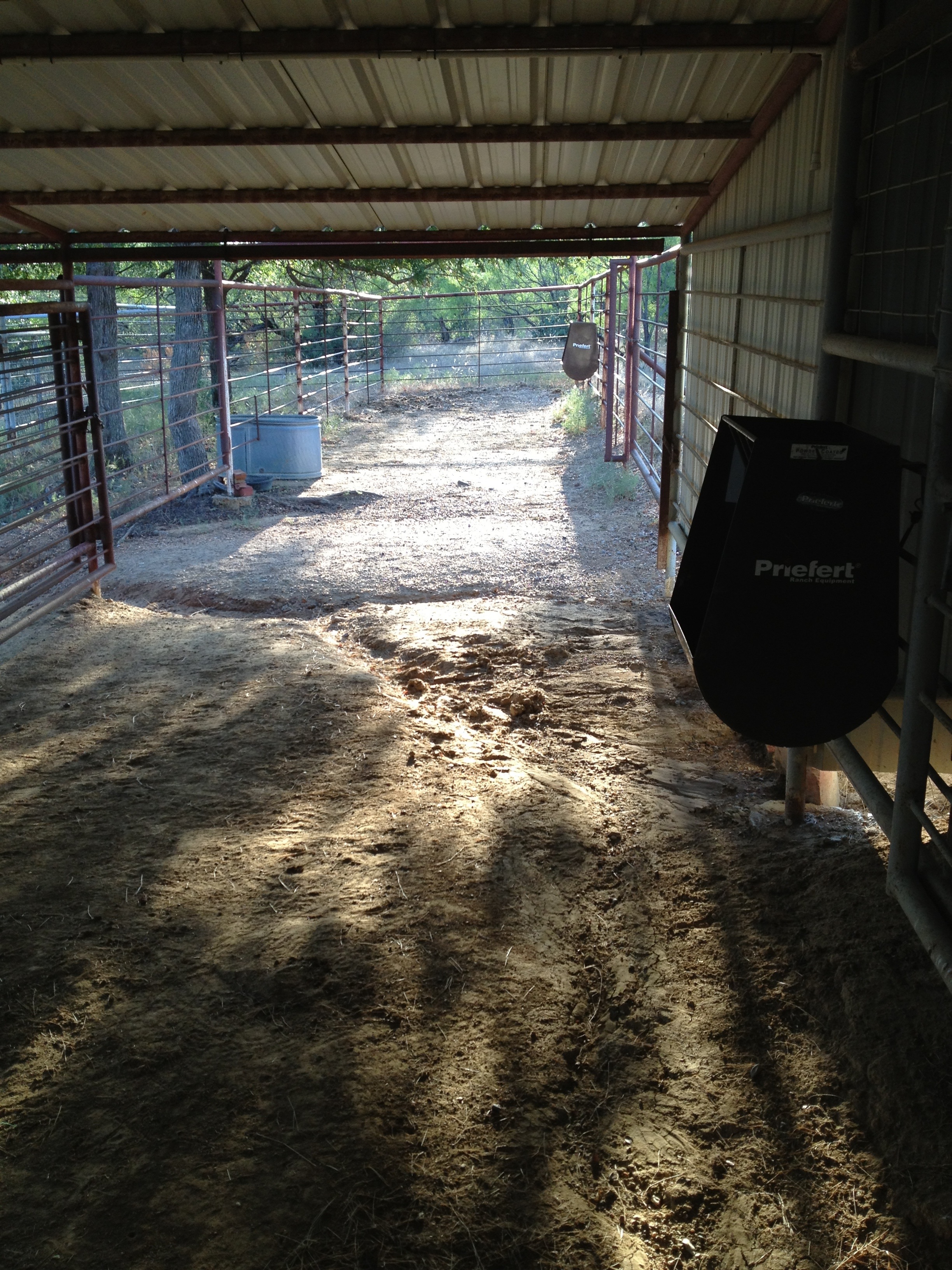
As I finished throwing hay to Star, I saw this sunlight in stalls and thought it artful.
Filed under Flying Hat Ranch, Horses

George Catlin (1796-1872), Prairie Meadows Burning, 1832, 11 x 14.13 in., Smithsonian
Lately, some of my blogger friends have had fires break out near their cabins, farms and ranches. George Catlin (1796-1872) in Prairie Meadows Burning (1832), portrays the flight of people on horseback from fire.
Three days ago, fire erupted thirty miles to the north of my place, near Possum Kingdom Lake. It has been mostly put under control at this time.
(See another post of mine about George Catlin: ‘The Day I Saw the George Catlins.’)
I suppose we all have nested away some items, some event or photograph we cherish. I published a photograph several weeks ago on the feed bin in the far field with clouds that I had set aside in the files, but every time I came across the feed bin and clouds photograph I wanted to post it and share it with readers in the blogosphere. I present two things here with a short story line, one is the long shadows in Stall 1 of the stables, the other is an artwork of Eric Andrews of Taos, New Mexico.
* * *
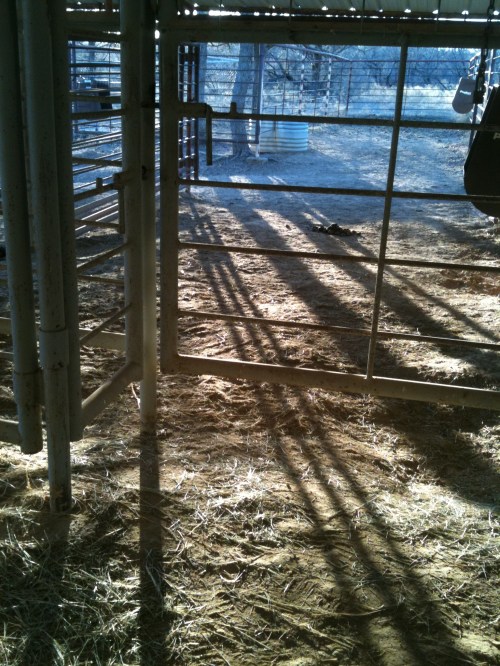
A January 28, 2011, photograph of Stall 1 in the stables
When this photograph was taken on January 28, 2011, the late afternoon shadows of the stall panels were surrounded by cold mist of a winter’s day. I was terribly sad because I had recently sold three of my prize horses at an auction in Oklahoma City, and the absence of Hija, Fanny and the foal-to-be was anguishing. The economy had gone sour and I had — through my own ineptitude — lost money on the stock market. So had other people lost money, but they had not be forced to sell their companions. I sold the horses — no small relief, to be sure — to fine people in Canada and Missouri and I was comforted in the transfer. The photograph illustrated to me the emptiness in my life at the time.
* * *
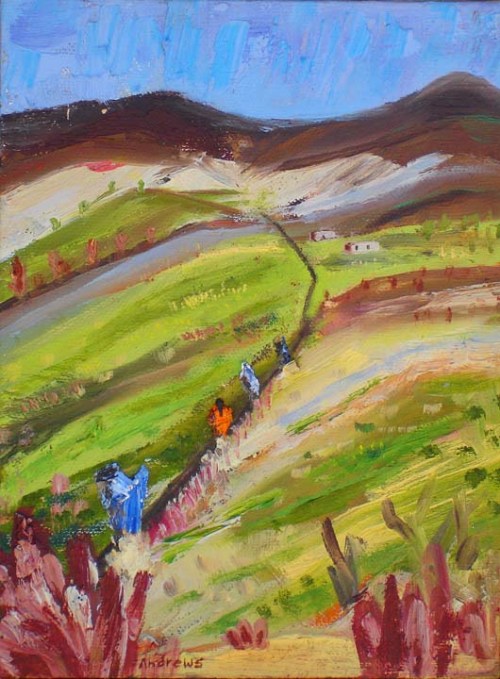
Walking the Acequia 2, Eric Andrews, 203 Fine Art Gallery, Taos
Eric Andrews’ painting, Walking the Acequia 2, is one of his current paintings for sale and is a good example of his art. I possess one Eric Andrews painting. He and his wife own the 203 Fine Art Gallery in Taos, New Mexico. After the death of my mother in 2003, I wanted to invest my inheritance in either fine art or land. I eventually settled on buying the Flying Hat Ranchito. Before I bought the Flying Hat, however, I traveled to Taos and Santa Fe to put together an ensemble of southwestern paintings of the Taos Society of Artists — Bert Geer Phillips, Ernest L. Blumenschein, Joseph Henry Sharp, Oscar E. Berninghaus, E. Irving Couse and W. Herbert Dunton.
As I made a laundry list of the paintings I might purchase, going from art gallery to art gallery, I met Eric Andrews at the Parsons Gallery in Taos. It was an immediate friendship. I traveled to his studio out on the High Road to Taos from Santa Fe to visit with him and his wife and see their work. Although I made the decision to buy my ranchito, I bought Eric’s Vadito II that hangs over my fireplace (you can see it on the “About” page of Sage to Meadow). The painting above, Walking the Acequia 2, illustrates my acquaintance with Eric and my deep interest in all things acequia.
_____________________________

The Taos Society of Artists -- image via Wikipedia
Filed under Horses, Shiners Fannin Peppy (Fanny), Sweet Hija, Taos
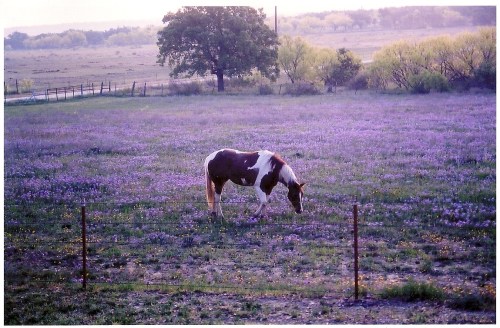
Wild Flower Gal with verbena (north Erath County, Texas, late winter, 2007).
Four winters ago, my neighbor, Jerry Wood who lives two miles south of me on County Road 114 stopped at my mailbox as I retrieved letters one morning. We chatted for a few minutes as he kept his diesel truck running and as we closed our conversation he said, “I have a horse, Jack, [words unintelligible over the engine noise] I’ll give her to you!”
“I’ll give her to you?” I had three horses at this time, two tobiano black paints and one quarter horse, Sweet Hija, and another horse added to the remuda would not be a problem to train and feed. But, a gift horse? I thought as Jerry drove off that he must be terminally ill or something drastic was going on like divorce or bankruptcy. I immediately decided that if the horse was sound, I would take her off Jerry’s hands and ease his problem — whatever it was.
Within the week, I drove down to Jerry’s with my trailer hitched up, pulled into his corrals and saw Wild Flower Gal, a sorrel tobiano paint that was drop-dead gorgeous. “Why would he even want to get rid of this beautiful creature?” I quietly thought. In any case, he took her through her paces, showed that she was healthy and halter-trained and I liked her behavior so she would fit in after getting to know my other three horses.
After seeing her training, paces and overall friendliness, I asked Jerry, “Are you sure you want to give this beautiful horse to me, Jerry?” I thought he was making a big mistake to give Wild Flower Away and I did not want to exploit Jerry’s problem — whatever the heck it was — in his hour of crisis.
“What?” he said.
“You did say, didn’t you, Jerry, that you were giving this horse to me?” This was quickly going in a perplexing direction I did not like.
“Oh, no!” he quickly replied. “I said, ‘If she isn’t the prettiest thing you’ve ever seen, I’ll give her to you.'”
“Oh, you did?” This was definitely in embarrassing territory. “How much do you want for her?”
“One-thousand dollars,” he replied.
I became a tad dizzy in my thinking at that point, but my mind quickly cleared the confusion: Jerry’s diesel engine had blocked out his words, “If she isn’t the prettiest thing you’ve ever seen…” And I had slammed his statement into, “I have a horse to give you, Jack.”
What to do? Buy the horse and lighten my bank account? Probably the best exit strategy. If I did not buy Wild Flower Gal, I would probably be the center of an oft-told tale at the Hannibal Country Store concerning my over-eagerness to gainsay another yegua for free. I did not want that circulating around the cracker barrel.
So, I bought Wild Flower Gal, loaded her up and brought her to my stables. Jerry signed over the pedigree, pocketing a thousand.
Wild Flower Gal was pretty, but not the prettiest gal I had ever seen. But, pretty enough to buy and train and sever any anecdote about my confusion. Several months later I snapped the photograph of her in late winter browsing through the wild verbena. It was fitting, this photograph, because she was in a pasture of wild flowers that reflected her namesake. I sold her a year later for a thousand dollars to a family near Abilene, Texas, that showed her at halter and loved her well.
A lot of lessons emerge from this story. Verify and clarify conversations of commercial intercourse. Cut your engines when conversing. Above all, there’s no such thing as a free horse.
Filed under Horses, Sweet Hija, Wild Flowers of Texas
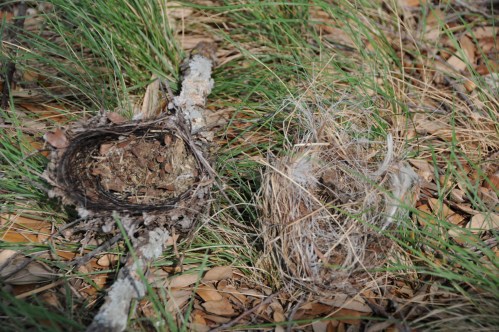
Two bird nests with horse hair (May 2011).
When I cut the split tree down yesterday, I recovered two bird nests I had seen in the tree. The fledglings had already flown away and no new eggs had been laid. I would have continued to anchor the split tree if fledglings had remained or the parents were sitting, and then I would fell the tree. All birds had flown away.
The nest on the left has more black horse hair than white. Some sorrel hair is intertwined. The nest on the right has more white hair woven in. The black horse hairs came from Sweet Hija and Lilly. The sorrel horse hairs emanated from Shiney, Fanny and Wild Flower Gal. The white hairs came from Star.
Star remains on the ranchito. Lilly is buried on the place. Sweet Hija is in Canada. Shiney and Fanny are resettled in Missouri and Wild Flower Gal is still in Texas. Scattered as the horses be, their hair has remained in north Erath County, Texas, for other creatures to use and as a memento for me to see.
Filed under Horses

Lonespurs Shining Badger born April 11, 2011, Calgary, Alberta.
Sweet Hija foaled a colt, Lonespurs Shining Badger, on April 11, 2011. Kim Elliott, the owner of Sweet Hija, has selected the paper name for the colt: Lonespurs, the name of their ranch near Calgary where Legends of the Fall and Open Range were filmed; Shining, after the sire Shiners Lena Doc; and Badger, after the King Ranch bloodline of Sweet Hija.
Kim said that Sweet Hija was as big as Mac Truck before she foaled and that she had the foal all by herself, no problem. That’s one of the reasons we bought Sweet Hija in 2003. She was strong and bred for ranch work and could take care of things quickly.
I thought that all my tears had been shed about Sweet Hija, but Brenda and I gave a few more tears to the good earth when we learned of Hija and Highway 101, the barn name for the little colt named, Lonespurs Shining Badger.
Kim Elliott and her family — I talked to them on the phone — are so very proud of Hija and Highway 101 that I think (don’t know for sure) they will keep Highway 101 intact and have him sire a whole new bloodline in Canada. We’ll see if my hunch is correct.
In any case, watch out, Canada, for this little man!
Notes:
Kim Elliott and her family operate and own Elliott Equine Transport, the premier horse transport for North America. Highway 101, Kim told me, is the coastal highway they travel between Canada and Mexico and the place in between and a fitting name for the little colt.
Filed under Horses, Sweet Hija
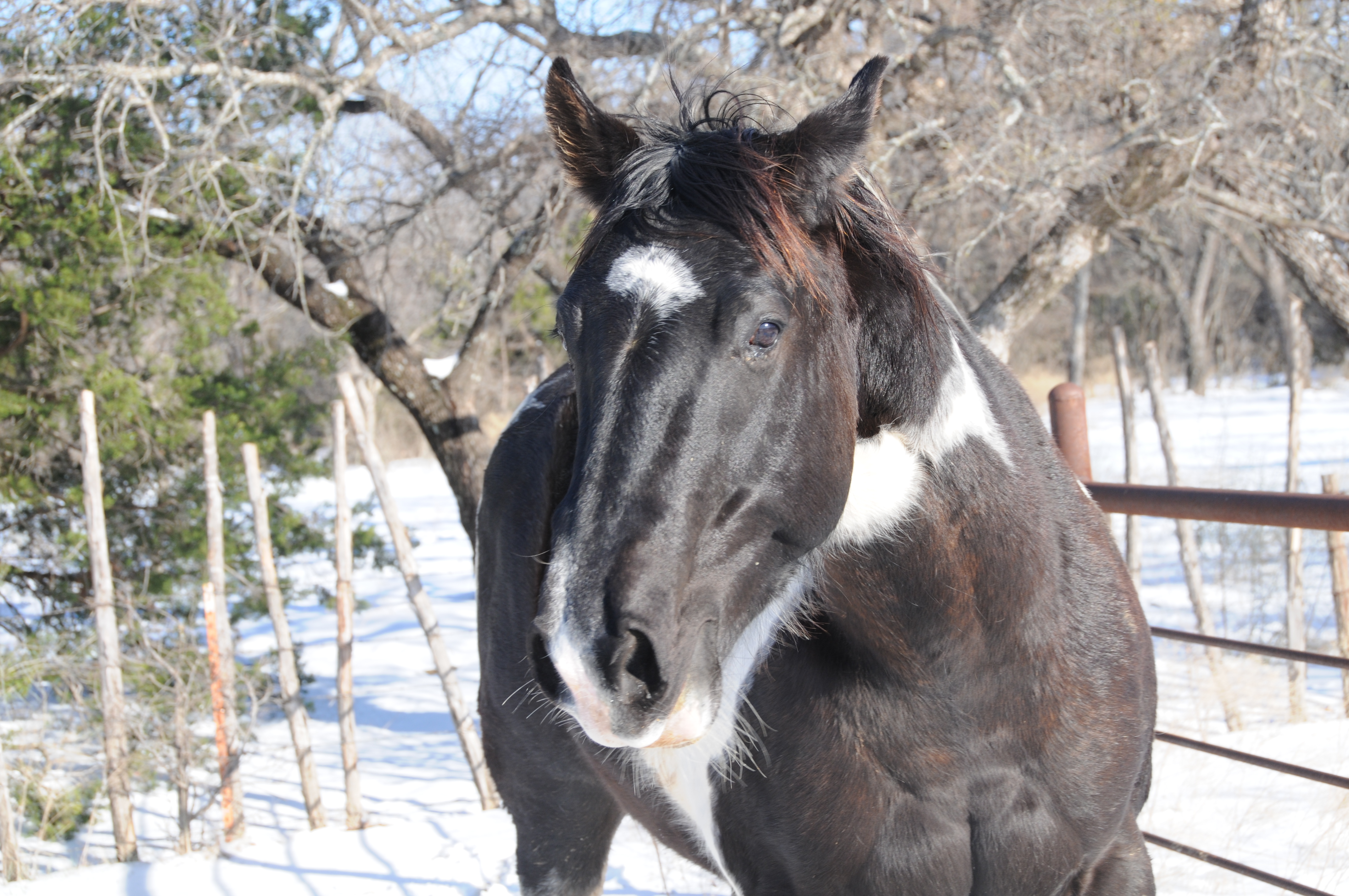
Star Bars Moore
In the city, look out for the bus. In the country, what doesn’t sting or bite you will stick you — wasps, mosquitoes, mesquite thorns or worse. Still, I had rather be out in the country and take my chances.
Rabies in horses is rare, but on the Bryant place, across the fence to the south of us, two horses were put down because one of them had a full-blown case of rabies. Its companion horse had not displayed rabies symptoms, but Erath County authorities ordered it killed as it had no rabies vaccination documentation. One was euthanized Thursday, March 24, and the other unfortunate horse this Thursday, March 31. The first horse exhibited rabies symptoms and the vet took tissue samples that confirmed the disease. The Bryants are having to take rabies shots since they were in close contact with the horse.
My paint gelding, Star, had been staying in the front pastures away from the Bryant place until last Sunday, March 27. For two days, Star had infrequent contact with the second horse over the fence that had been killed. Since rabies can be transmitted via mucous interchange, it is a very serious situation for Star.
Star had been inoculated against rabies in 2009, and last week before the contact with the Bryant horse he had been given his rabies shot for 2011. Our veterinarian, Dr. Skeet Gibson of Equine Sports Medicine and Surgery, Weatherford, says the 2011 inoculation has not gone into full effect, and the 2009 inoculation begins to diminish in effectiveness after a year-and-a-half. But since Star had no contact with the rabid horse — only the companion horse that had been killed — the chances were slim that any transmission had taken place.
Nonetheless, the vet said to isolate Star for two weeks and minimize my contact with his muzzle and mucous discharges, look for symptoms (not eating, behavior changes, etc.) and contact my personal physician for advice.
I called our personal physician immediately and neither I nor Brenda will be required to take rabies shots unless Star is rabid. Star will probably be okay, but isolation and observation is imperative.
And just how did I find out about this whole issue of rabies next door? My neighbors to the east that have horses called me Thursday, March 31, to inform me of the euthanizing, and they have no land contiguous with the Bryants! They called to alert me as a fellow horseman. Neither the Bryants nor the Erath County authorities had contacted me. Had I been informed last week, I would not have allowed Star to go to the far pasture — Pecan Tree Pasture. As it is now, we are having to take measures to determine disease contact that may, in the end, be fatal to Star, although I repeat it is doubtful.
Within an hour after the Halls called me and I had visited with the Bryants to find out the facts, I went across the county road to inform a fellow horseman of the situation. In the country, we must work together. I choose to do so.
Filed under Flying Hat Ranch, Horses, Star

Leading edge monarch in Spring 2011, north Erath County, Texas.
Earlier this week on the first full day of Spring 2011, I received a communication from Journey North that the monarchs “were pouring out of Mexico” and that the leading edges were entering Oklahoma, about a 100 miles from our place in north Erath County, Texas. A day before the e-mail, I had seen a monarch in our front field feasting on nectar of wild verbena, but I did not have my camera to take a picture.
The next day, March 23, 2011, I spotted this leading edge monarch in our live oak tree out in front of our house. Twenty-three live oak trees live on the knoll of our home, a hill really, that is known as Poprock Hill in local folklore. These trees have been the roosting place for monarchs, I am sure, for several generations. We have seen monarchs every year since we have moved here and last year I snapped pictures for the blog of a large roost of monarchs in the Fall as they flew to Mexico.
I have known of butterflies all of my life, but only in the last fifteen years have I begun to look deeply into the ecology of where I live in north Erath County, Texas. This blog I write, Sage to Meadow, has become a platform for me to the rest of the world, a medium of communicating my love of nature, its greens and browns, births and deaths that encompass us all. Butterflies such as the monarch abound where I live and I did not know milkweed was a prime source of its nutrition.
Milkweed, like many other things, is an example of nature’s complexity and diversity, for although it is a prime source of food for butterflies, its over-indulgence by horses and cattle is toxic and may result in death if untreated. When I learned of that last year, I quickly researched the milkweed and its correlation with horses and found that adequate grass and grain prevents the livestock from consuming large quantities of milkweed.
So, the lesson here is balance for farmers and ranchers. Keep good stands of grass in the field, do not overgraze, and horses and man and butterflies can co-exist. It’s not the final lesson of life, but it’s one of the best lessons to acquire — for the monarchs can continue to find food to and from Mexico, horses will graze elsewhere and be pacified, and we will be able to look upon all their beauty and grace as we observe from close and far away the interconnectedness of us all.

Green-flowered Milkweed (Asclepias asperula), May 2010, north Erath County, Texas.
Filed under Horses, Life in Balance, Monarch Butterfly
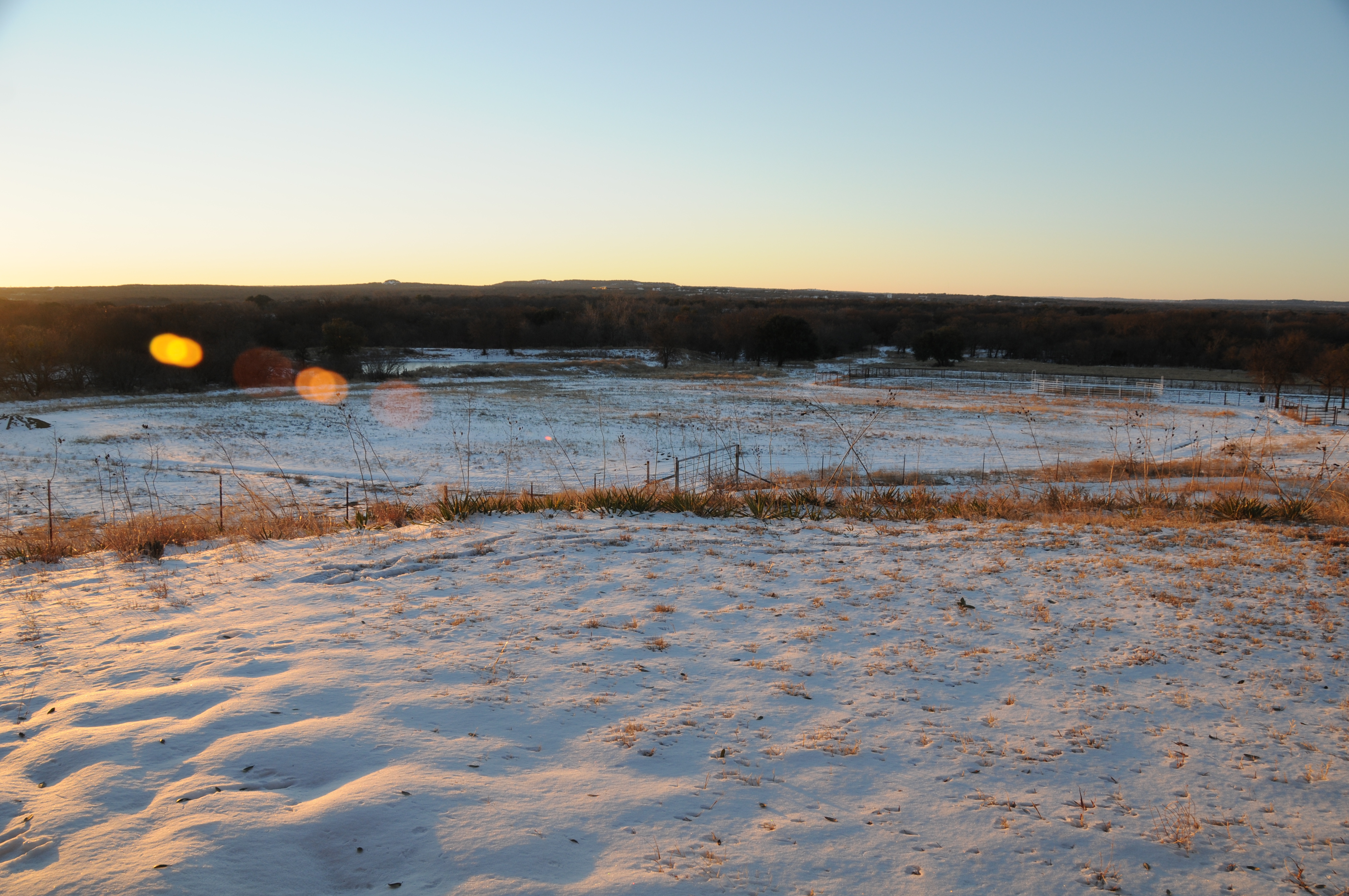
Lilly's Mound in an early Winter morning at Flying Hat Ranch, Texas, 2011 (click to enlarge)
In the far background are the Twin Mountains of north Erath County, Texas, 1,400 feet. Ducks swim and feed upon and beneath the pond in the middle of the photograph even in this cold weather. The gate opens into the arena pasture. The small mound with cedar posts upon it, to the far, far left in the photograph (you may have to enlarge), is Lilly’s Mound, 1,065 feet. The mound is small and does not stand out in the photograph — in fact, hardly noticeable — , but it is a meaningful part of this good earth to me and Brenda and Star.
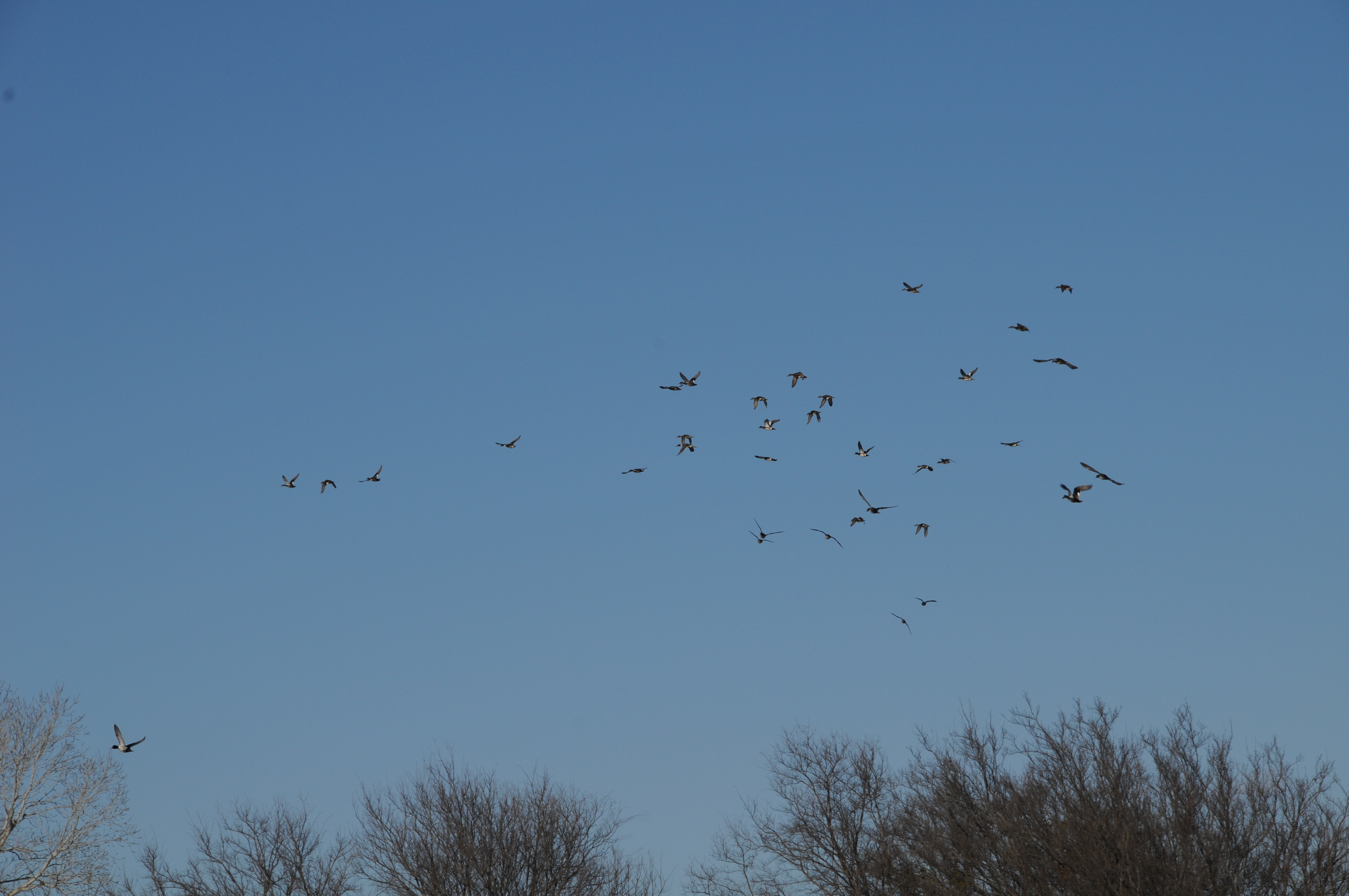
Duck flight, Flying Hat Ranch, Texas, 2011
The temperatures rose to 35 degrees and the sun came out, melting the snow about the place. Corrals turned to mud. Meadow Lark, White-crowned Sparrow, and Chickadee scattered away from their emergency ration station in the barn alleyway and I turned Star out so that he could run about the pastures and go to the county road to visit his friends at the Nowack place. I saw deer track along the grove lane and vowed to throw corn near the salt block tomorrow.
Star galloped through snow and mud to the pond and as we both made our way towards the barn, ducks flew upward from their browsing, but circled back to the pond, dousing their beaks, grasping algae and minnow. A west wind blew across the snow and I wore sunglasses to reduce the glare of the sun. After I fed Star, I walked up the hill to the house, strongly striding because cold air filled my lungs and I was content with Winter.
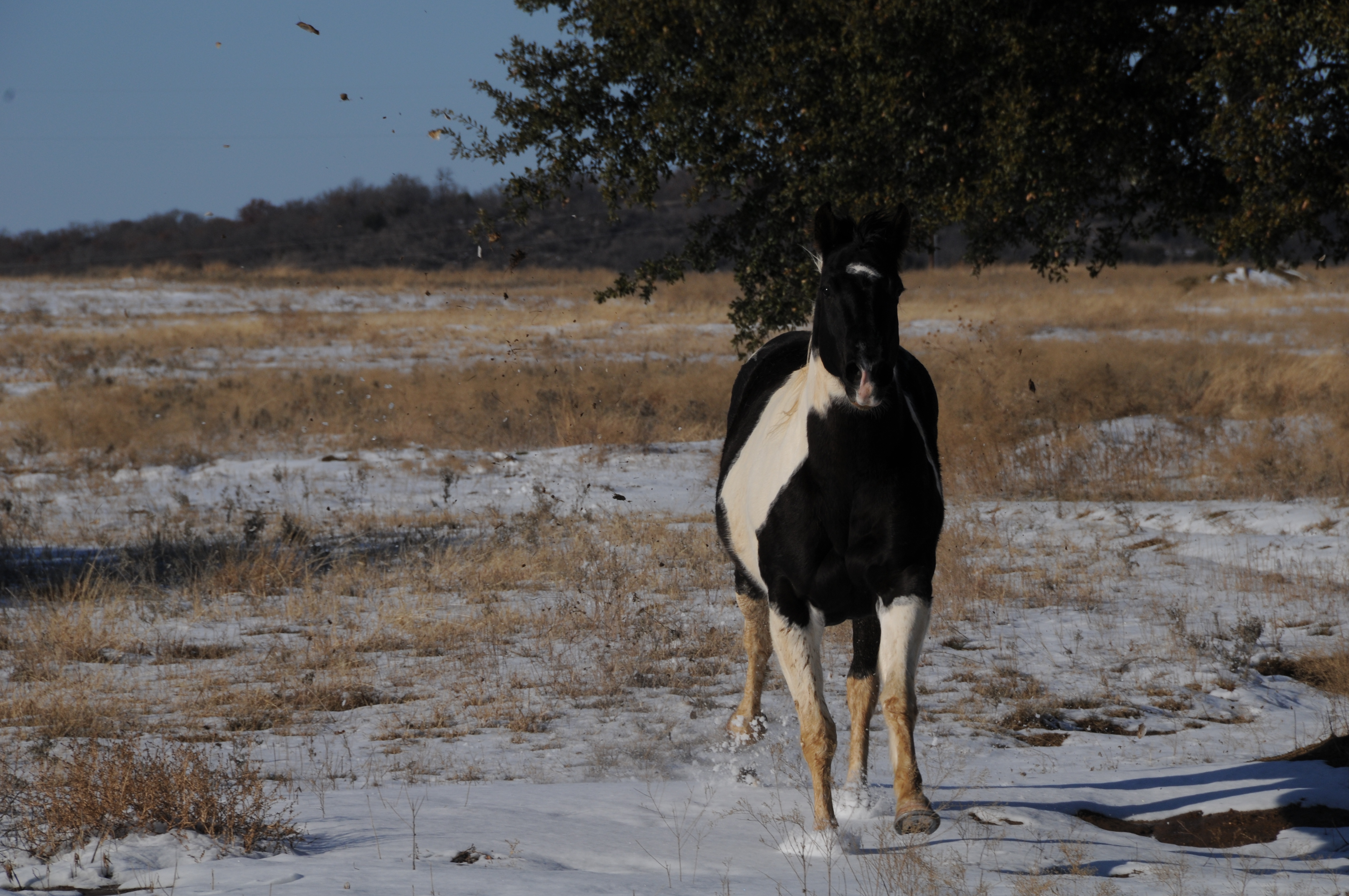
Star galloping, Flying Hat Ranch, Texas, 2011


La Jicarita: Community advocacy for northern New Mexico

New Mexico State Film Office and Milagro at Los Luceros












Because of Greenpeace more than 21 million acres of forests are legally protected from destruction in Brazil's Amazon and Canada's Great Bear rainforests. Reduce, reuse, recycle.

Colorado Film Commission

 Sage to Meadow ~ Jack Matthews