Category Archives: Flying Hat Ranch

The eve of a new year on the ranch

Pigeons flying towards a new year above the Santa Fe plaza.

 We make resolutions and there’s nothing wrong in doing so.  We plan to do better, give more and finish the big chores we have had on our list for months, maybe even curtail or give up our vices.  Well, maybe not completely give them up, but back off bad habits.

I work with students, horses and the land.  I work in order to live, not live in order to work.  That’s a big, big difference.  Working with students this last year has been more rewarding than ever before in my professional career.  I attribute that to my nearing retirement and wanting to give what I think is of value to the student before I put the chalk in the tray and walk away.  Time is fleeting and I don’t have time to cover all the points, just the most significant.  So, for this next year, I resolve to cut the excess from the lectures and discussions and get right to the core: finding your voice, writing down your voice and tending to your own garden (Voltaire, Gilgamesh, Trilling).

For my life with horses, it’s a sadder year coming.  We are selling Sweet Hija who is pregnant with a female and Shiners Fannin Peppy, the first foal out of Sweet Hija.  Brenda and I will be left with our two paints, Star and Lilly, both having their share of health problems these days.  In January, we are going to Oklahoma City for the Mixed Winter Sale at Heritage Place.  Market forces beyond my control have cut through our ranch operations with a vengeance and the cost of horse breeding and market conditions force my hand.  What Brenda and I are trying to do, in taking Hija and Fanny to the sale in Oklahoma, is to put these fine horses in the best sale around so that they will have good homes or ranches to live out their days.  So, for this next year, I resolve to focus on Star and Lilly, build some good, strong pens in the Pecan Tree Pasture for their safety.  I resolve not to think too much about our loss of Hija and Fanny and the little one — difficult to push that resolution through next year, I guarantee.

And, finally with the land, I resolve to set up brush piles for the little critters, deer and birds about the place, not shredding every single bush like some of my neighbors.  Further, I want to learn the name of every tree species on Flying Hat Ranch, or at least make a major dent in nomenclature.  I will also continue to plant native grasses about the pastures.

The eve of 2011 is here.  I toast to love, health and fortune to be found among horses and land, family and students — yours as well as mine.

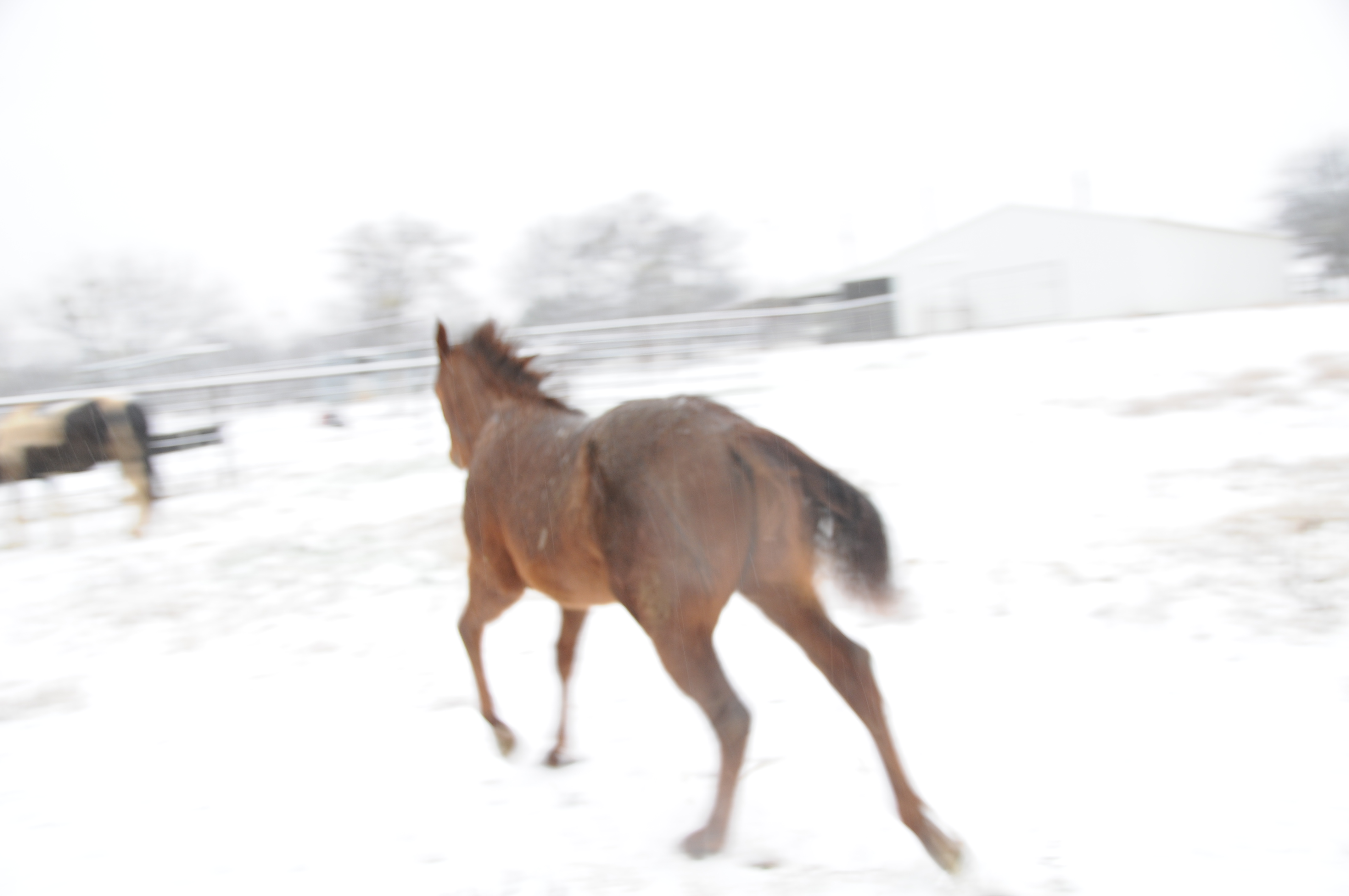
Sweet Hija at full gallop in winter snow (2010).
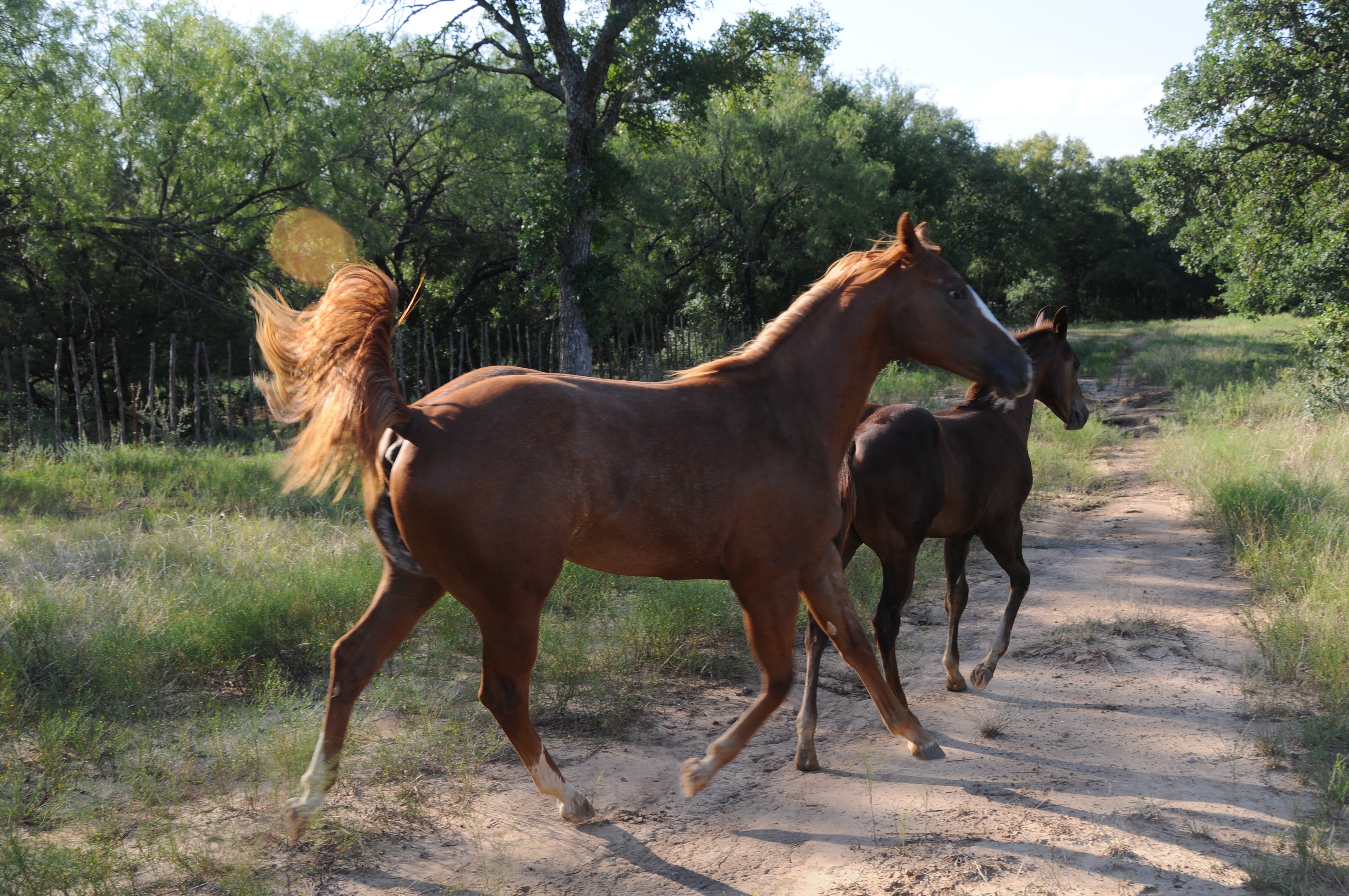
Fanny strutting in the grove with Shiney (summer 2009).

15 Comments

Filed under Flying Hat Ranch, Lilly, Shiners Fannin Peppy (Fanny), Sweet Hija

Holiday wishes from Sage to Meadow and field notes

Shiney galloping to the corral during winter. No fear of the sun disappearing here.

A holiday greeting…

The sun in the northern hemisphere is at its lowest points this time of the year.  I do not think ancient and prehistoric people feared the sun would continue to sink towards the south and disappear forever — at least in southern latitudes of the northern hemisphere.  There was and is sufficient overlap of folk knowledge and tribal elder history to instruct the young and anxious that nature’s cycle continues her circle of cold to warm to hot, hot to warm to cold.

Christmas Eve and Day are here.  I wish each of you a Merry Christmas and Happy New Year!

* * *

Update on Lilly and Star…

Lilly, our oldest mare, is holding her own at 25 years of age.  She moves between the Well House Corral and the pasture, indicating a good level of energy and health.  Her feed consists of all the alfalfa she wants, Equine Senior Purina grain and 1 – 2 grams of bute (painkiller for horses) a day.  To husband animals rewards the steward: nickers and whinnies of recognition and impatience, warmth of animal in cold weather, riding for fun (both rider and horse can enjoy if accomplished properly) and work, and the sheer companionship and friendship of the horse.  One of my pleasures of having horses is hiking in the woods and having Star follow me like a hiking friend.  Star will go up and down creek bank, push aside brush to continue the hike and rest with me beside a fallen log.  If I wish to walk alone, I have to close the gate to the woods.  Most of the time, I want him with me.

Star is confined to the first corral.  He is overweight and feed intake must be limited.  He has all the coastal bermuda hay he can eat and some painkiller for his front legs.  His confinement lasts one week.  I have had to separate him from Lilly since she has alfalfa, he must have coastal.  Star is not pleased, but he adjusts.

* * *

A field post about bird songs on winter mornings…

December 16, 2010, 7:05 a.m.

Within the last two weeks I have noted birds about the barn and stables sing profusely only in the morning during the winter and are relatively quiet for the rest of the day.  I have not spent the day about the barn and stables to confirm unequivocally this observation (I’ll probably regret having brought this up in the first place), but it seems a sound observation.  During the day when I do chores and in the evening when I feed the horses and spend a hour or so in the barn area, I hear no birds or few birds.  In the morning, birds chatter and tweet, but do not break into long melodious fugues.

Our small ranch is located in North Erath County, Texas, Lat 32.43 N, Long -98.36 W, elev. 1,086 ft. Turkey Creek Quad.  Mesquite trees, live oak trees, elm and underbrush comprise the habitat for birds.

Among singing birds I see in the morning are redbird (just tweets), titmouse, chickadee, wrentit, wren, red-headed woodpecker, white-crowned sparrow, house sparrow, dove and a couple of other species I have yet to identify.  They browse in trees, on the ground and in the underbrush.  If I remain motionless in the corral after disturbing them, they resume their chattering and calls in a few minutes.  When the sun reaches a point in the sky at approximately 10:00 a.m. or so, songs and calls diminish.  I see birds for the remainder of the day, though not quite as frequent as the first two or three hours in the morning.  I hear during the day the quacks of ducks on stock ponds and crows on the fly.

7:35 a.m.

I have returned from the barn and stable area and this post is taking a curious turn.

A cold front moved in last night and the temperature is 40 deg. F.  The sun is not shining and clouds completely obscure the sky.  On point, birds are quiet, not even a peep, casting a different observation and bringing to light variables I had not considered: temperature, sunshine, clouds.

With the temperature in the 40s and no sunshine, I hear no birds.

17 Comments

Filed under Christmas, Flying Hat Ranch, Horses

Saving a drowning Roadrunner

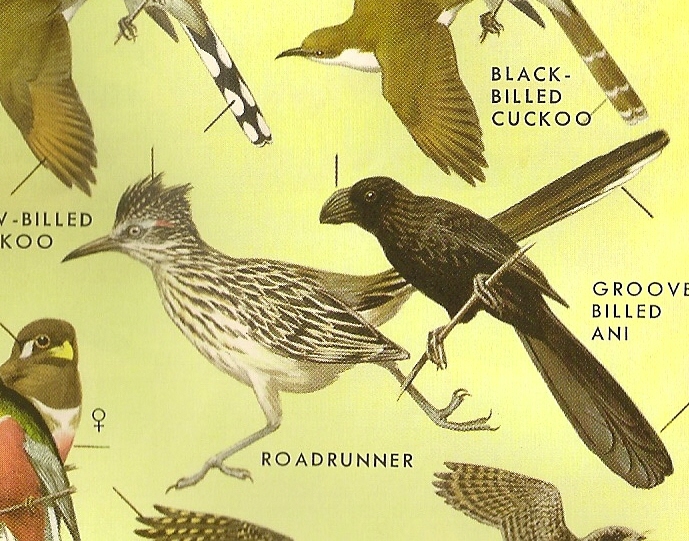
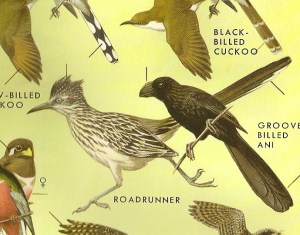
Roadrunner (Geococcyx californianus), Petersen Field Guide

In the summer of 2009, I rescued a roadrunner (Geococcyx californianus) from drowning in the circular water trough in the Well House Corral.

Roadrunners occupied a minor niche in my bird and animal kingdom as I grew up in central Texas.  My Aunt Lennie McRorey who lived on a ranch with her husband in San Saba County, Texas, kept a minor collection of roadrunner figurines and commissioned a small oil painting of a roadrunner that my daughter displays on her end table in Lubbock.  Driving down highways and especially back roads, roadrunners flew or ran across the road in front of the car.  I never saw any remains of roadrunners beside the road, attesting, I think, to their agility and speed.  They were big and seemed amusing the way they ran and picked at insects along the highways.  In a way, the roadrunner to me seemed unique among birds, more of an ostrich-like being than a flight creature — a miniature ostrich, for sure.

When we moved to our ranch in 2003, I saw roadrunners occasionally along our county road, but in 2008 and 2009, I noticed a pair of roadrunners that nested or habitually occupied the Well House Corral next to the Dooley Pond and mesquite brush to the west of our fence line.  As are most of my discoveries here on the place, my initial observation was accidental.  I was resting in the shade of the barn alleyway one hot summer day in 2008, when I saw a roadrunner dart from well house to the arena and under the trees in the corral.  Initially, I saw only one, but after a few more sightings during the summer, I saw two of them.  They often flew up in the lower branches of the live oaks and sat in the afternoon.  At the most, I spent thirty minutes watching their antics in the lower branches, wallowing and playing in the arena, and then I followed their hunt towards the east and our stock pond.  The summer of 2008 came to a close and I did not see them until the next summer.
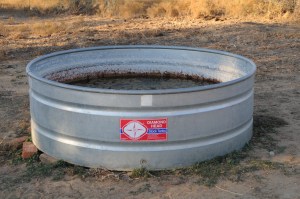
Water trough in Well House Corral that ensnared roadrunner.

I had set a circular water trough in the Well House Corral for cattle and horses.  The trough was large, about six feet in diameter and held enough water for two or three days for cattle.  One afternoon in the summer of 2009, I walked down to the trough to check its level and noticed that the water was greenish and appeared disturbed.  Live oak leaves fell in the trough, and algae grew about the leaves and errant grass stems.

As I looked at the level of water I saw a long, log-like thing in the water.  It was listless, dead.  I looked closer and realized it was some kind of animal?   I thought at first a very large squirrel or possum?  Then, the parts all came together and I realized it was a roadrunner, one of the roadrunners I had been observing for two summers.  I thought, How could you have gotten drowned as crafty and smart as you are?  Oh, no, you poor thing.  I beat myself up for a moment, thinking I should have kept the water level higher so that if he had wanted a drink, he could have perched on the edge.

Well, I had to get him out of the water or it would become contaminated.  As I reached over to pick him up, his eye blinked!

Good god almighty, he’s alive!

I gotta get him out of there.  As I reached over to pick him up with my bare hands, I stopped.  The roadrunner could turn and peck me mightily, drawing blood.  Several years ago I had grabbed a mockingbird that had become caught in some netting I used to protect ripening grapes in our vineyard and the mockingbird had turned and pecked my finger in two places, drawing blood before I could let it go.  Pecked by a mockingbird is one injury, but a roadrunner peck may be a wound to the bone.

Seeing that the roadrunner was exhausted and I had to do something fast, I ran back up to the barn and grabbed my sombrero that was large and a couple of warm, fresh towels I used to groom horses.  I hurried back down to the water trough and dipped the sombrero under the roadrunner and lifted him out.  He was still blinking, but not moving at all.  He was huge.  I never knew how big these things were.  He was at least two feet long!  Think a small ostrich.

I put the roadrunner and sombrero on the ground and gently gathered him up in the towels.  With one towel I held him and the other I dried him off thoroughly.  With each stroke of the towel, going from head to tail, he would stretch his neck and extend his body as if running.  As he would stretch, his neck area would reveal sparse feathers and tender skin.  I saw no lesions or breaks or fractures.  I continued for five minutes or so drying him off.

Now what to do?  He was not standing or trying to fly off.  I decided to keep him on the towel and take him to the arena where it was sunny and warm and away from our barn cats.  I placed him down alongside the arena panels, near an area that I had seen him and his mate play.  He remained still, but was beginning to stir a bit.

I walked back up to the alleyway where I could monitor him and watched.  After about thirty minutes, I saw him stand up and begin to fluff his feathers and preen.  This went on for fifteen minutes.  I had to move on to other chores and left him alone.  An hour or so later, I went back to the arena and checked on his condition.  He was gone, most likely over the fence line to the Dooleys and his mate.

I’ve often wondered, fantasy-like, Borges-like, that somewhere in Mexico after he had recovered, this roadrunner told a story to his friends about a sombrero, the marvelous power of a hat that came down out of the sky and carried him out of water to dry land and life again amongst the cactus and creosote of the desert.  Just a fantasy.
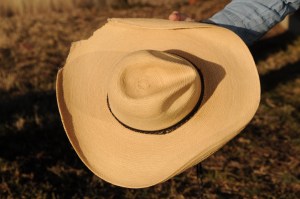
The sombrero that was used to rescue the roadrunner.

______________________________

Notes:

This last summer, 2010, I have not seen any roadrunners in the Well House Corral.  Our neighbors to the east have cleared a lot of brush from their property and deer and other critters have moved southward, into the grove and far pasture, so the habitat for the roadrunner has changed.  I continue to look for them.  I know that observing the roadrunner in the wild is most infrequent and I am motivated to observe more when I can.

In the photograph of the hat, you will notice two bite marks out of the rim.  Star, my paint gelding, reached through the stall and took two chunks of straw out of it while I wasn’t looking.  The hat is made by SunBody hats www.sunbody.com and is constructed from palm leaves in Guatemala by Jose Medrano.
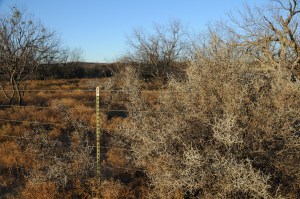
Towards the Dooley Pond where the roadrunners have their nest.
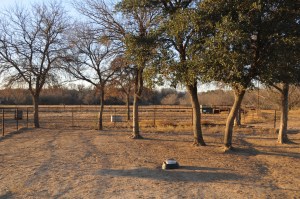
The live oak trees where the roadrunners sat.

The arena where the roadrunners played.
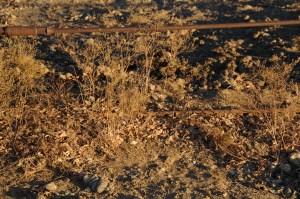
The spot where I put the roadrunner to dry off.
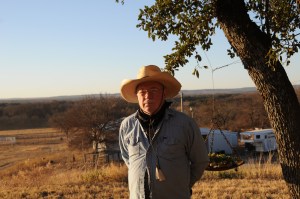
Senor Jack wearing the hat that saved the roadrunner.

17 Comments

Filed under Flying Hat Ranch, Life in Balance, San Saba Texas

Cottonwood yellow sound

Cottonwood in the Grove

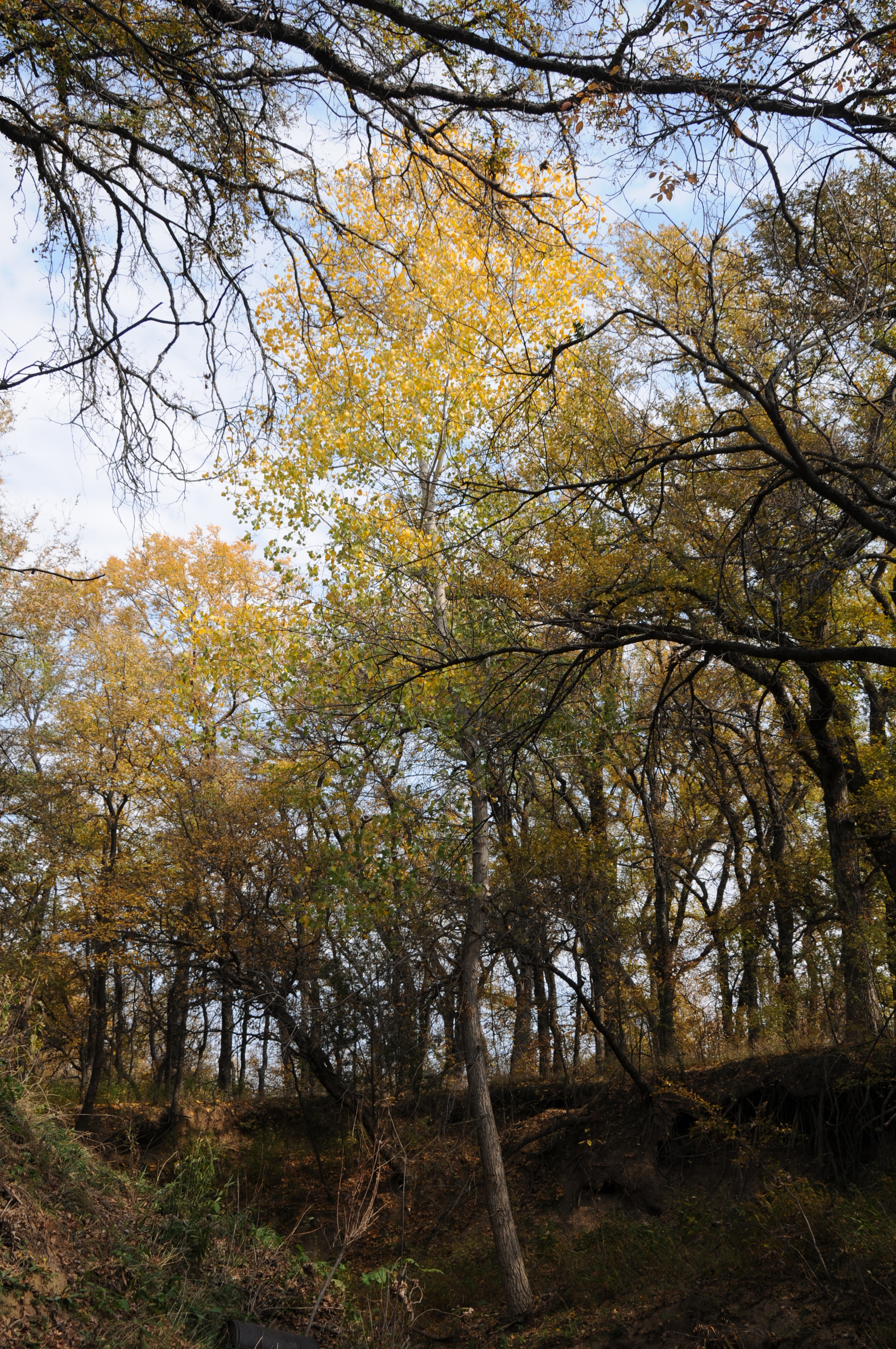
Populus deltoides var. occidentalis or Texas Cottonwood. Yesterday as I drove up the road to the ranch house, I saw in the Grove a brilliant yellow foliage from a solitary cottonwood along the creek.  As it was late, I vowed to take photos of it the next day — today.  I think it a young cottonwood, twenty-years old at the most, but I am not the authority.  It is a healthy tree and its roots are embedded firmly into the bank of Salt Creek.  I am concerned about the tree, however, as it is rooted within the confines of the creek and the creek flows quite rapidly after a thunderstorm.  The pull of the current may bring it down this next year, yet, it has withstood the flow of water these many years, so it may endure for years to come.

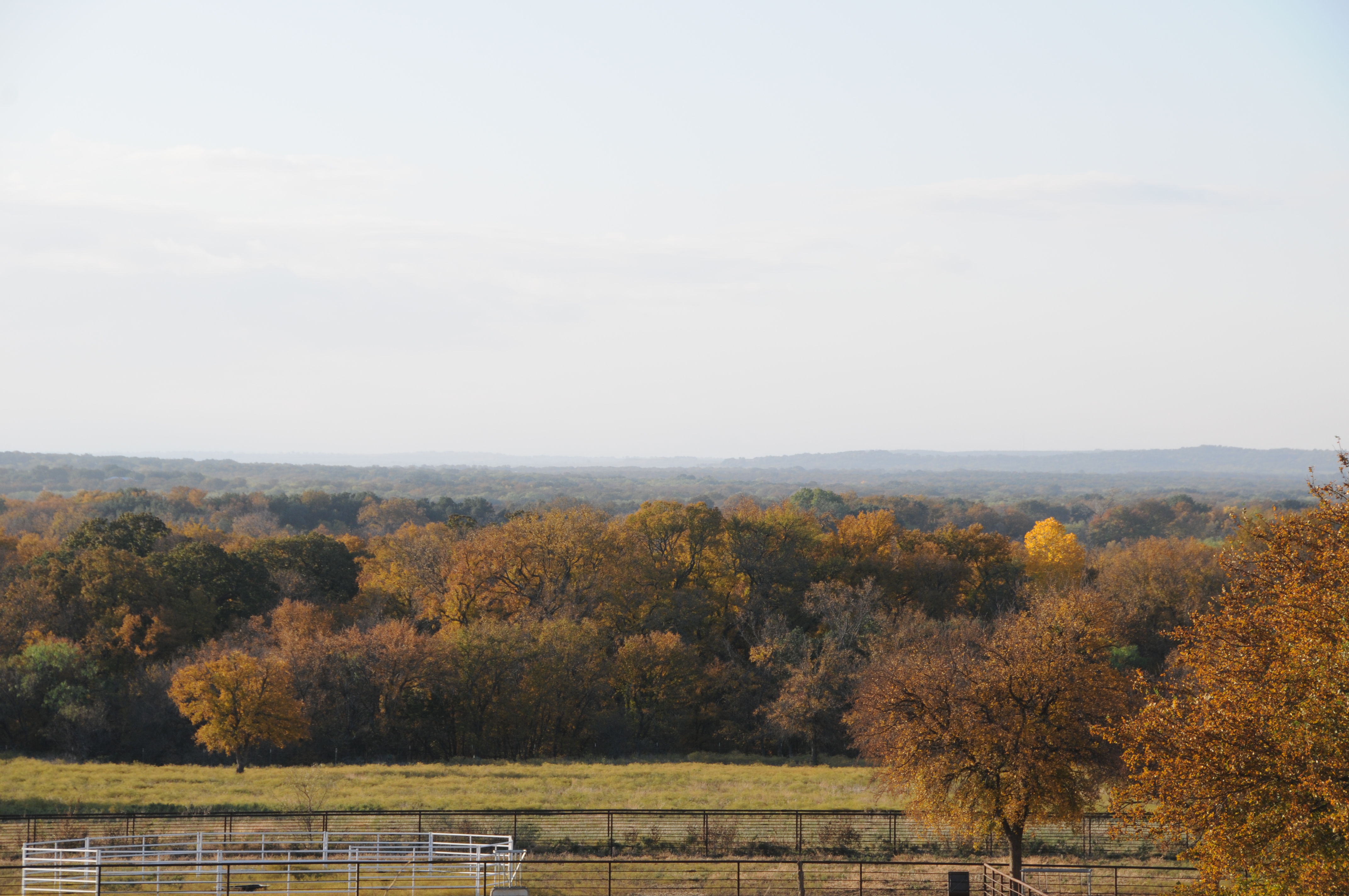
Panoramic view from the ranch house. The cottonwood is the bright yellow tree to the right of the scene.

The water current is not the only factor that affects the tree, but also the wind.  Today, southern wind gusts peak at 35-40 miles per hour and the cottonwood swayed in the wind.  Its leaves have been falling and blowing off for most of the day.  The wind blows strongly.  Rain is falling this afternoon as I write this post.  The major squall lines formed north and east of me, near Fort Worth and the Red River Valley.  I have had good rains in the summer, so the vegetation remains green, turning brown.  The rains must have nourished the cottonwood most favorably, as well as the creek bed, because its foliage was dense and now with colors turning, it is the most spectacular flash of color in the Grove.  Wind and rain have good and bad effect upon the tree.

There are male and female cottonwood trees.  This tree appears to be male.  I have not seen cotton spores float off of it, thus identifying a female.  Here are the leaves on the bottom of the creek bed.  One feature of the cottonwood that I find soothing is the sound of the leaves rustling.  When the tree is green and fresh in the Spring, the sound is like a babbling brook, solid and deep.  In the Fall, the sound of the leaves is a higher pitch, shallower, lighter-sounding, a fragile clacking like extremely delicate china.  If this is a male tree — I think it is — somewhere in the vicinity is a female, a fecund being that issued seeds, bringing this tree to our place.  I will look for it, up the Salt Creek, to the higher Salt Creek Cove, two-hundred feet higher to the west.

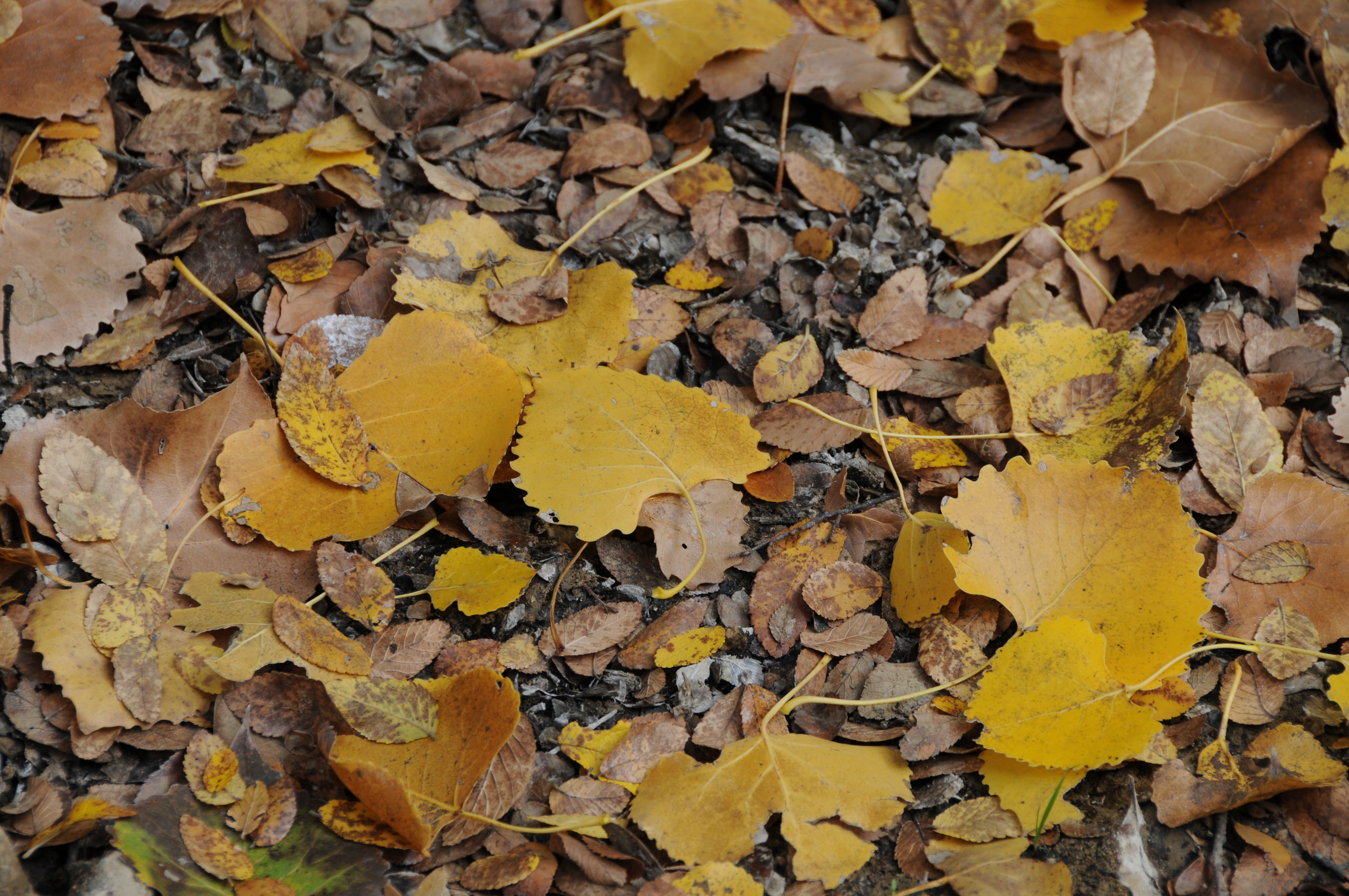
Cottonwood leaves in the bed of Salt Creek

Today, the sound seemed like a frenzy with the wind blowing so very hard from the south.  The leaves, brittle and dry, began to fall in greater numbers and I was glad I hurried down after lunch to photograph the tree before all its leaves had fallen.  I had hoped that I might capture a leaf in flight, but I did not.  A monarch butterfly floated amongst the trees and I wondered if it could make Mexico by the freeze.

On the Blue place, the neighbors east of us, two cottonwoods grow along their pond next to our stock tank.  There may be a female there.  I hear them as well as see them.  The area in north Erath county is dry.  The appearance of these cottonwoods is uncommon and I revere their existence in clay and sand and moderate moisture.  I sit on the porch and see the one cottonwood in the distance.  I look to my left, to the east, towards Blue’s place and see and hear the trees.  Ducks quack on both our ponds.  When I drove to the Grove, I took the long way there, avoiding the pond road, lest I scare the ducks to the sky as I traveled to cottonwood yellow sound.

10 Comments

Filed under Ducks, Flying Hat Ranch

Quarter-size moon in north Erath County, Texas

For the last two mornings as I have walked the dogs and tended horses, the temperatures have been down into the lower 50s, upper 40s.  Such a relief to have Fall come.  I slip into my old, red coat to enjoy the cool, late-night outdoors before dawn.  My Aussie shepherd, Yeller, and schnauzer, Lottie, linger at the gate.  The quarter-size moon in the eastern sky holds water like a cup.  I hear coyotes.  Yeller stands still, facing the coyote chorus.

The pack goes quiet and we return to the house, enter the kitchen and begin the day.

7 Comments

Filed under Dogs, Flying Hat Ranch

Oak Tree Mast Year

Lichen and moss on the north side of live oak tree in the front yard at Flying Hat.

Moss grows on the north side of trees.  That’s true in the northern hemisphere.  Probably it’s on the south side of trees in the southern half of Earth.  We have many oak trees bearing fruit this Fall.

Acorns fall from trees abundantly this season.  Our car port becomes a tin drum when the acorns fall — about one every thirty seconds at the fastest rhythm.  This is a “mast” year for acorns, a season of superabundant oak tree fruit.

Here on the ranch in prehistoric times, acorns were a staple supply for the Indian.  About the ranch house, in the front pastures and around the barn, I have discovered stone tools in abundance:  choppers and grinders.  It is possible that archeological analysis will reveal Flying Hat a quarry for tool making since non-worked iron ore and meteorite sources are plentiful (1).

Horses must be watched lest they overeat acorns.  A few nuts will not hurt them.  This Fall season the grass is so abundant the horses don’t care about the acorns.  During a lean year of grass in the Fall, I have seen Star (levitating and stealth horse) stand beneath an oak tree and wait for nuts to fall, some bonking him on the head, other nuts bouncing off his backside.  This year, however, come the browning of the grass, horses must be given ample hay or put in another pasture without acorns.  Star would much prefer to be gently pelted with nuts.

______________________________

Notes:

(1)  Archeological analysis in Texas falls under the Texas Historical Commission administration.  Contract archeological firms analyze sites.  My work in archeological field survey and analysis (I like the fieldwork) stems from my graduate field school tenure at Texas Tech University, anthropology department, under Dr. William Mayer-Oakes.

See also Texas Historical Commission, Archeological Subset.

3 Comments

Filed under Flying Hat Ranch, Horses

Fall of All Seasons

Fall foliage in the grove at Flying Hat Ranch (2009). Photo by B. Matthews

Today, September 22, 2010, is the first day of Fall.  The sun positioned equally between northern and southern hemispheres today falls to southern skies from today until about December 21, the winter solstice, shortest day of the year.

Fall of all the seasons is harvest time, but it is more.  It seems to be a time for catching up and preparation.  The Winter is coming and windbreaks must be established for the horses and hatchets and axes placed in the pickups to chop the ice from the water troughs.  An uptick of hay must be stored in the barn.  When it is drier (this season it is not) grass must be shredded in places to stop the spread of wildfire into the woods and structures.  A hard look must be given to livestock to affirm they are properly conditioned weight-wise to make it through the winter.  If not, then added grain or alfalfa must be apportioned to the weak.  Crevices must be stuffed, caulking pressed into cracks.  The tire chains must be brought out and placed in the trucks.

Summer in most parts of Texas is brutal from 10:30 a.m. in the morning until the long shadows in the evening.  Fall, Winter and Spring give comfortable temperatures for outdoor labor and I anticipate Fall coming way back in June.  June through the middle of September is a time I tolerate and mechanically toil outdoors.  I’m not trying to rush through the Summer, but I am happier when I feel the cool temperatures before daylight in the Fall, as I did this morning, standing in the pasture road looking at the moon, almost full, falling through the mesquite trees on the Dooley place.

I have long since passed the time in the Fall when I saw it as a time of playing football or watching the sport.  I do occasionally watch games and on Friday nights I see the stadium lights from Gordon and Stephenville and other towns about our region.  Interstate 20 is filled with band and supporter buses going to games, intent upon boosting the boys and their play with pigskin.  Better to have the game than waste away in destructive behaviors despite the risk of concussions.

Fall.  I am glad for cooler temperatures and the colors changing in the grove of trees.  I hope your first day of Fall is a good day.  I know mine is.

12 Comments

Filed under Flying Hat Ranch

Tropical Storm Hermine Blows Hats Off

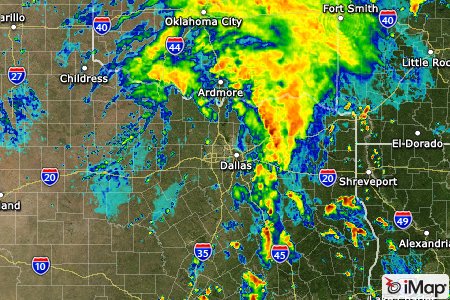
Tropical Storm Hermine, September 8, 2010, 3:05 p.m. CDT. Hermine has passed over our ranch and is headed northeast out of Texas. If you look west of Dallas about 100 miles, that is the location of Flying Hat Ranch.

Tropical Storm Hermine came through Flying Hat Ranch yesterday, dumping four inches of precious rainfall.  The clouds were low to the ground.  The mussel shells we place in the road going to the barn floated down the road with eroded soil, giving the appearance of beach front property instead the semi-arid West.

Hermine blew my hat off and knocked out our high-speed internet connection.  I came into Fort Worth today in order to work on my online classes.  As we left the ranch, the eye of Hermine passed over Interstate 20 and the sun shined and blue sky appeared.  But within a matter of minutes the eye of the storm passed and we were in gentle rain again.

When I fed the horses this morning, Star and Fanny ran around the corral in excitement, kicking and prancing, enjoying the cooler temperatures and wet weather.  I had to empty their feed bins of water.  Lilly, who is by herself in the Broke Tree Corral, loves the cooler weather, too.  The corrals are side-by-side so that they all can be together, young and old alike.

10 Comments

Filed under Adventure, Flying Hat Ranch

Summer Has Broken

Three weeks ago, I rode Fanny bareback in the Broke Tree Corral.  Terribly hot.  She is such a fine horse.  But she was moody after the ride.  The summer is hard on us all.

Sweet Hija had a problem with flies, dust and heat.  She is nearly five months pregnant with a filly (ultrasound verified) and was having a tussle with summer heat.  To the vet, I have taken her.  When I loaded her, she first balked, then I backed her up, then brought her forward and she came into the trailer, knowing good medicine was at the end of her journey.  She, too, is a good horse.

A few showers had fallen before the change.  Not many, but enough to keep a pale-green cast to the grass, inducing the remuda to browse in pasture.

Then, last week, about Wednesday, the summer broke.  Temperatures went down below a hundred degrees and the sky cleared of summer haze.  You know the haze of summer.  (Oh, how much we want clarity.)  Behavior lightened.  The dark before the dawn was cool, a time when I walk my companion-dogs.

Thunderstorms walked about, shafts of rain as legs, and at night they gave strobe lights to the sky.  At daybreak following storms, horses nickered in tones of cordiality, neither rushed nor anxious.  They sensed a difference.  And I fed more quietly, pausing to feel cool air flowing down the hill to our feed bins.  All seemed lighter, cooler, last Wednesday.

The summer has broken.

12 Comments

Filed under Flying Hat Ranch

Our Taos Blue Door

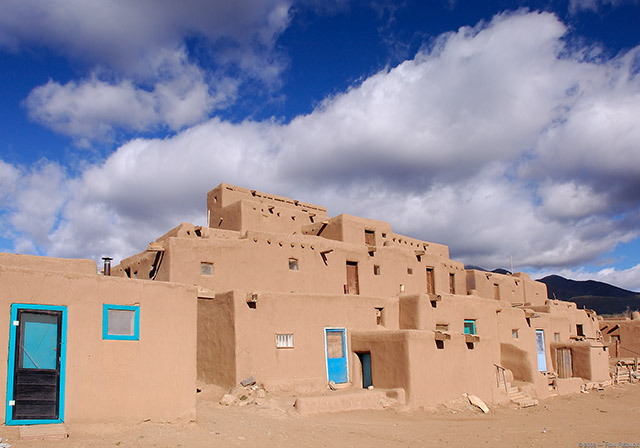
On my first visit to Taos Pueblo in 1967, blue doors and window frames reflected color brilliantly against adobe walls.  Still do.  Never outlandish in my opinion, the blue gave an even more mysterious quality to the north and south pueblo complexes.  I read that the Taos blue or Taos green, as it might also be designated, prevented evil and witchcraft from entering the dwelling.  The color surrounded the window or door frame with a protective halo.  It was also a beautiful color by itself, the security notwithstanding.

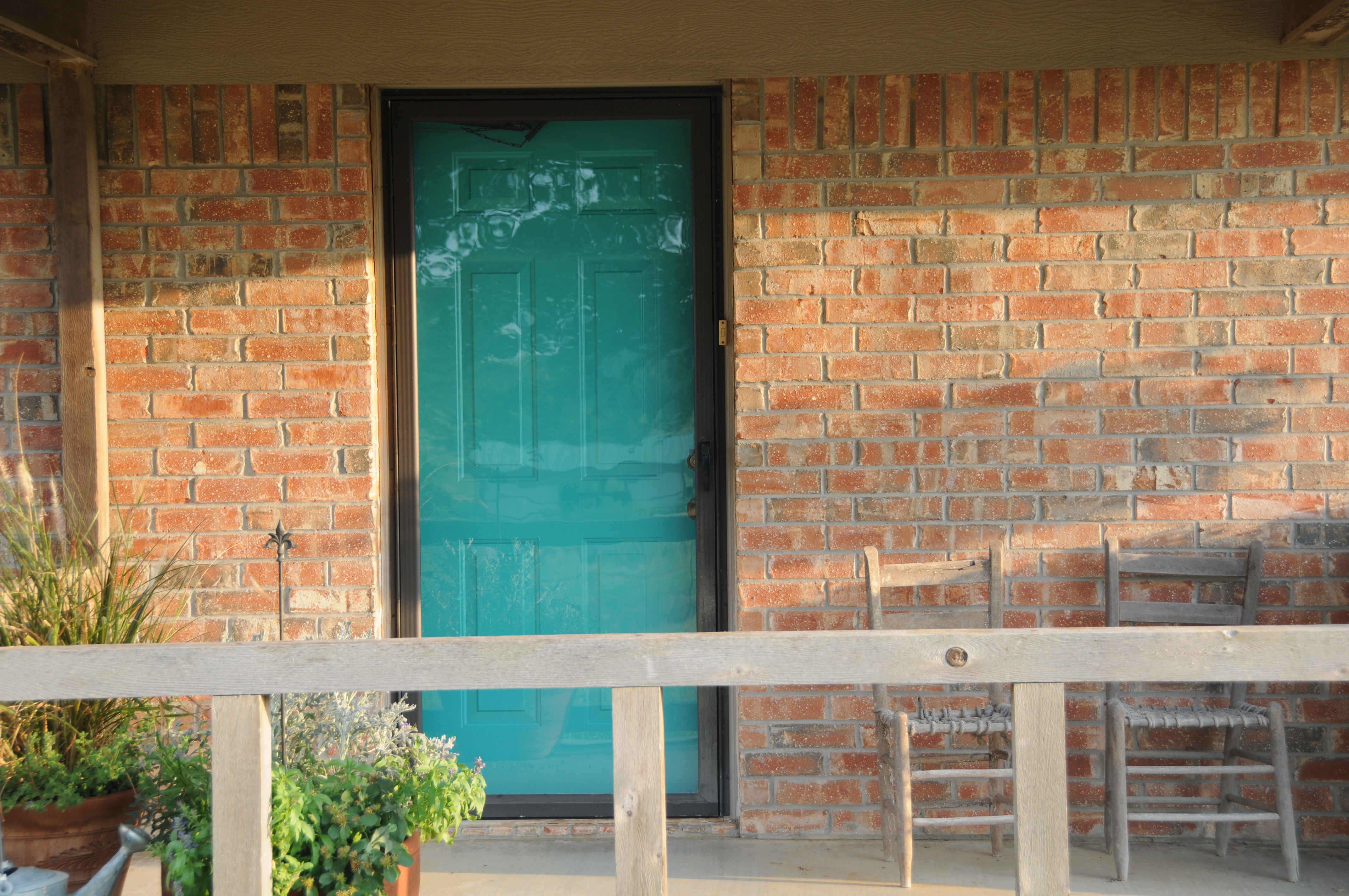
Blue Front Door, Flying Hat Ranch

When we decided to paint our gray doors, we looked up photographs in our books of the Taos blue and green, settling on the color you see in these photographs.  Brenda painted all three of our doors.  We got the paint from Sherwin Williams in Weatherford, Texas.  She took in a swatch that she had compared with photos in Christine Mather and Sharon Woods, Santa Fe Style, p. 25, lower right-hand photograph.  Sherwin Williams designated the color, Turquish, No. 6939.  She bought a gallon, using a third of the gallon to paint the doors twice.  I am trying to get her to paint the tack room door of the barn.  Course, there are no evil spirits down there.  Not with the horses chasing away bad dreams.

Close up of Taos Blue front door of Flying Hat Ranch house

______________________________

Notes:

Christine Mather and Sharon Woods, Santa Fe Style, New York: Rizzoli, 1986.

21 Comments

Filed under Flying Hat Ranch, Santa Fe, Taos, Taos Blue Doors