Category Archives: Flying Hat Ranch

Allowing the flourishing of wildlife

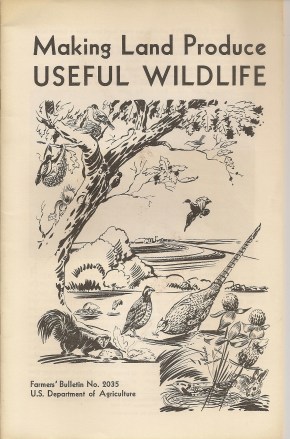
A 1975 reprint of Farmers' Bulletin No. 2035

The first summer I lived on my ranchito, the summer of 2004, I hired Cody Scott to plant native grass seeds in my far pasture, the Pecan Tree Pasture that lay between Barton Creek and Salt Creek.  Last summer I reseeded the pasture with native grass seeds and wildflowers.  The upshot of these two distributions has been a resurgence of bluestem, side-oats gramma, buffalo grass, coneflowers, Indian blankets and vetch.  Frankly, I held no longitudinal goal other than to provide habitat food for cattle, horses and wildlife.

Frank Waters of The Man Who Killed The Deer (1942) fame wrote that the proper relationship of a person to the land was to “live with the land,” not on it, but with the land.  Living with the land has been an axiom for me, a mantra for many years.  A U.S. Department of Agriculture Farmers’ Bulletin No. 2035, “Making Land Produce Useful Wildlife,” provides me guidelines to live with the land.  By way of full disclosure, I do not make my living raising cattle or horses, but teaching at a junior college in Abilene, so my basic approach to my ranchito is sustaining the land, not cropping, leasing or planting.  That being said, I integrate what I have learned with horses, cattle and the land into my lectures.

The land is my teacher and all things upon it instruct, from thistles under juniper to even — I hesitate to write this — the mesquite.

So, a few tips from “Making Land Produce Useful Wildlife,” by Wallace L. Anderson, biologist, Soil Conservation Service, I list below.

To support a high wildlife population, a farm or ranch must have a plentiful supply of good food close to cover that furnishes protection from enemies and weather.  And it must be available in all seasons of the year….

Pastureland practices harmful to wildlife are uncontrolled burning, overgrazing, and complete clean mowing early in the season….

There are three essentials to good cover for wildlife — grasses, weeds, stubble, and other low-growing plants for nesting and roosting; dense or thorny shrubs for protection from predators, for loafing, and for nesting; and, in the North, clumps of evergreens or other tall dense cover for winter protection.

Mesquite thorns, poisonous plants and cacti also abound along the fence rows in the far field.   I have bull nettle, a stinging plant to the touch, but it has medicinal properties.  The nightshade plant that many define as a weed has been used to treat snakebite erupts along the corral.  And the few cedar trees, cut and harvested year after year prior to my ownership, their posts for sale in Mingus and Palo Pinto, are defined more appropriately as “juniper” provide berries for birds, aroma for incense and luscious shade from the sun.  I shan’t be cutting  cedar breaks or juniper.  All this in the far field allows the flourishing of wildlife close to me, close to you, close to us all.
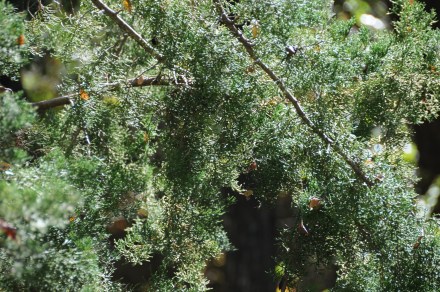
Juniper, often referred to as cedar (J. Matthews, 2011).

[In my next post, I will write about the mesquite tree that is close to us all here in the bush.]
6 Comments

Filed under Cedar, Flying Hat Ranch, Juniper, Life in Balance, Plants and Shrubs, Wild Flowers of Texas

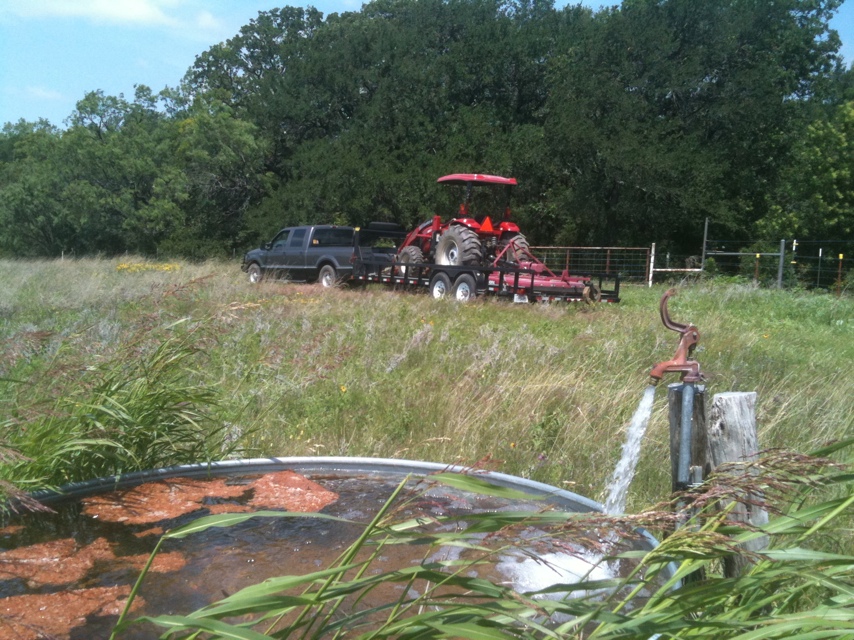
Water into trough

Barton Water Co-op provides this water.

20110602-103646.jpg

3 Comments

Filed under Flying Hat Ranch

Field note — all clear at Flying Hat

About our place, rain has fallen the last two days. For us the fire danger is gone.

Storms knocked out our internet provider.

This is a text message via wireless. Our IP does have a dialup number as backup and I will use it if necessary.

Yucca blossoms are on the way. A roadrunner darted across the Well House Corral. Queen Ann’s Lace erupts overnight. The pond is up.

23 Comments

Filed under Flying Hat Ranch, Wildfire

Sound of wind and bird in live oaks near Mingus, Texas

Wind sounds, April 19, 2011, on Flying Hat Ranchito beneath evergreen live oaks.  Turn up your volume to hear bird calls and wind through live oaks.  A bit of a respite from the last few days.  The wind increases in volume.  Shadows of leaves on the ground.

14 Comments

Filed under Flying Hat Ranch, Sounds

Red flag flying with good horse Star 17 APR 11

This Sunday is another day of remaining alert for smoke in west and central Texas.  Fire Weather Warnings have been issued.  Red flags are flying.

Before we focus at noon until late evening on possible wildfires, errands are run and Star, our paint gelding is fed.

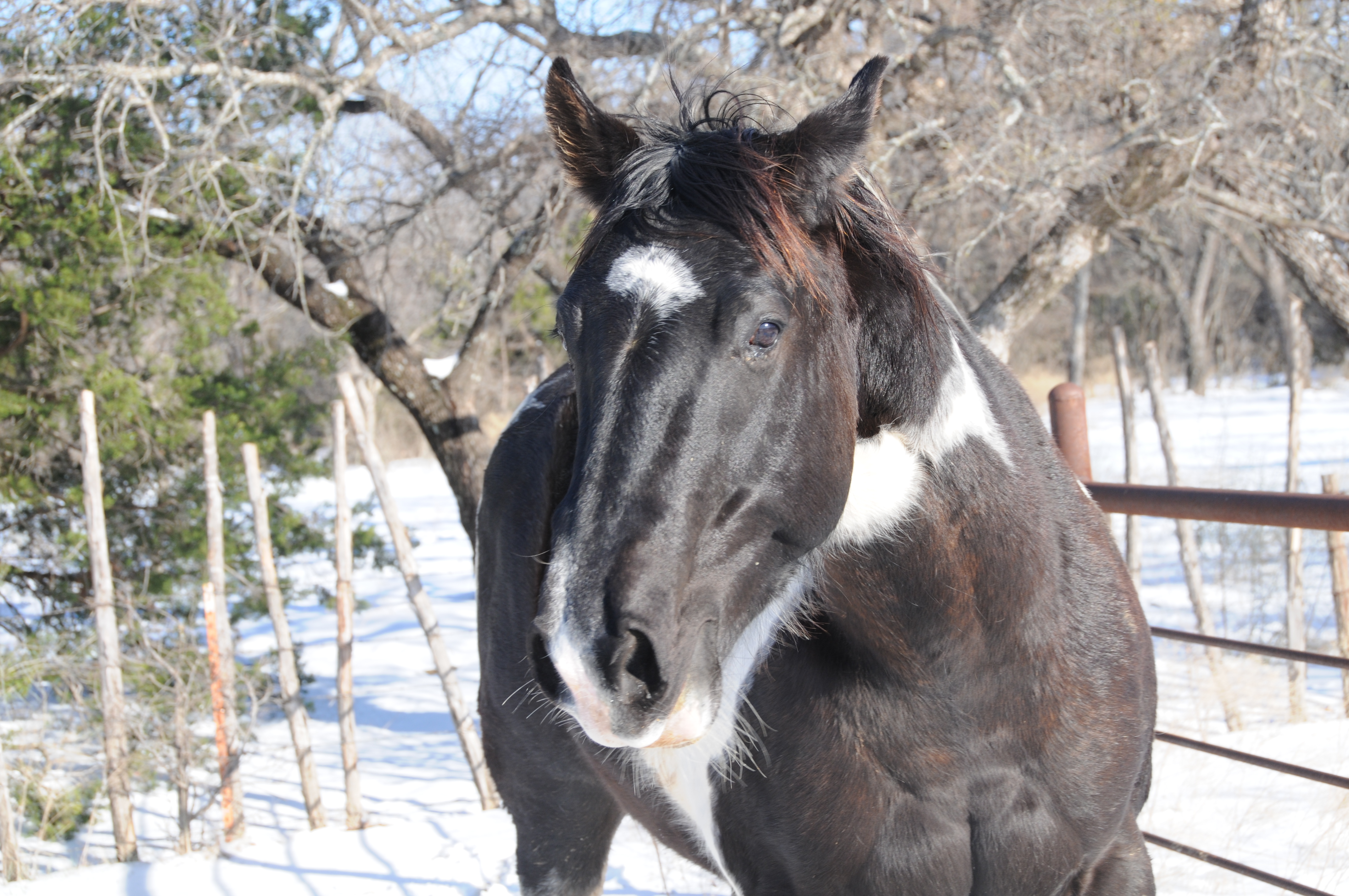
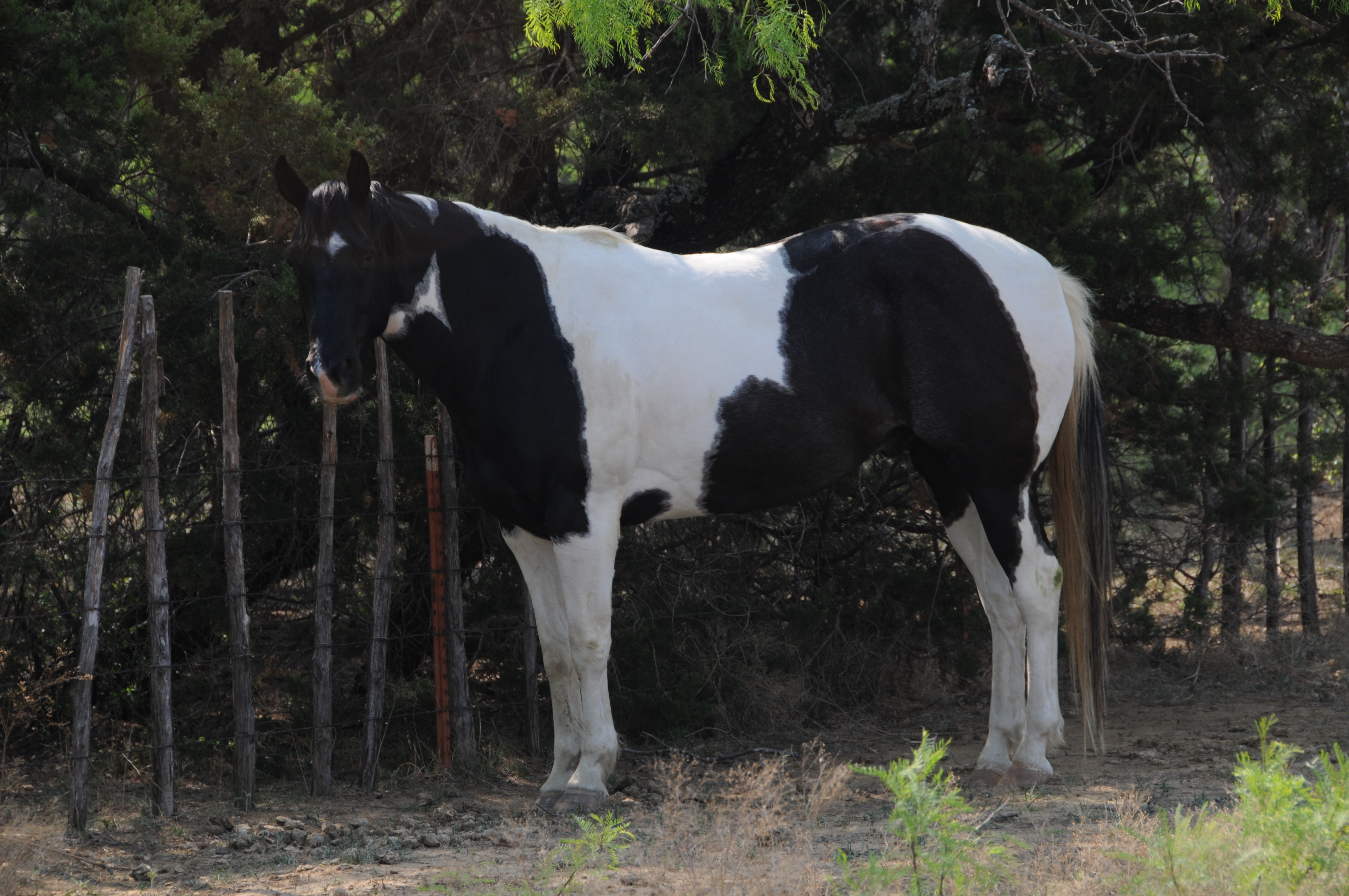
Star is out of isolation for rabies since Friday.  Now, after two weeks of isolation, he can once again nuzzle his horse neighbors next door and set his huge neck upon my shoulder.  Here is a photo of Star taken last week.

Star Bars Moore APHA 808164, loafing in arena pasture under mesquites.

So that is some of the good news here on Flying Hat Ranch or “Ranchito” as Donald Worcester, a deceased friend of mine, used to call his 142 acres near Fort Worth.

Unfortunately, later today we have to work with the following forecast from the National Weather Service:

URGENT – FIRE WEATHER MESSAGE…UPDATED NATIONAL WEATHER SERVICE FORT WORTH TX 436 AM CDT SUN APR 17 2011 TXZ091-092-100gt;103-115gt;119-129gt;134-141gt;147-156gt;162-174-175-171800- /O.CON.KFWD.FW.W.0014.110417T1700Z-110418T0100Z/ MONTAGUE-COOKE-YOUNG-JACK-WISE-DENTON-STEPHENS-PALO PINTO-PARKER- TARRANT-DALLAS-EASTLAND-ERATH-HOOD-SOMERVELL-JOHNSON-ELLIS- COMANCHE-MILLS-HAMILTON-BOSQUE-HILL-NAVARRO-FREESTONE-LAMPASAS- CORYELL-BELL-MCLENNAN-FALLS-LIMESTONE-LEON-MILAM-ROBERTSON- 436 AM CDT SUN APR 17 2011 …RED FLAG WARNING REMAINS IN EFFECT FROM NOON TODAY TO 8 PM CDT THIS EVENING… A LOW PRESSURE SYSTEM IS EXPECTED TO DEEPEN ACROSS THE TEXAS AND OKLAHOMA PANHANDLES LATER TODAY RESULTING IN GUSTY SOUTHERLY WINDS. SOUTHERLY WINDS 15 TO 25 MPH WITH GUSTS TO 35 MPH CAN BE EXPECTED ALONG WITH HUMIDITY VALUES AROUND 20 PERCENT. THE COMBINATION OF GUSTY WINDS…LOW HUMIDITY…AND DRY FUELS WILL LEAD TO DANGEROUS FIRE WEATHER CONDITIONS THROUGH EARLY EVENING. PRECAUTIONARY/PREPAREDNESS ACTIONS… A RED FLAG WARNING MEANS THAT EXTREME FIRE WEATHER CONDITIONS ARE EITHER OCCURRING NOW…OR WILL SHORTLY. A COMBINATION OF STRONG WINDS…LOW RELATIVE HUMIDITY…AND DRY VEGETATION WILL CREATE EXPLOSIVE FIRE GROWTH POTENTIAL. AVOID ALL OUTSIDE BURNING AND WELDING TODAY. DO NOT TOSS LIT CIGARETTE BUTTS OUTSIDE. REPORT WILD FIRES TO THE NEAREST FIRE DEPARTMENT OR LAW ENFORCEMENT OFFICE.
I obtain this weather warning when I click on our weather service and a red banner streaks alarmingly across the top of the page.  Catches your attention real fast!  There’s a red flag flying today with our good horse, Star.  All will be well and if not, we’ll manage with help of a Star.

6 Comments

Filed under Flying Hat Ranch, Star, Wildfire

Rabies and Star

Star Bars Moore

In the city, look out for the bus.  In the country, what doesn’t sting or bite you will stick you — wasps, mosquitoes, mesquite thorns or worse.  Still, I had rather be out in the country and take my chances.

Rabies in horses is rare, but on the Bryant place, across the fence to the south of us, two horses were put down because one of them had a full-blown case of rabies.  Its companion horse had not displayed rabies symptoms, but Erath County authorities ordered it killed as it had no rabies vaccination documentation.  One was euthanized Thursday, March 24, and the other unfortunate horse this Thursday, March 31.  The first horse exhibited rabies symptoms and the vet took tissue samples that confirmed the disease.  The Bryants are having to take rabies shots since they were in close contact with the horse.

My paint gelding, Star, had been staying in the front pastures away from the Bryant place until last Sunday, March 27.  For two days, Star had infrequent contact with the second horse over the fence that had been killed.  Since rabies can be transmitted via mucous interchange, it is a very serious situation for Star.

Star had been inoculated against rabies in 2009, and last week before the contact with the Bryant horse he had been given his rabies shot for 2011.  Our veterinarian, Dr. Skeet Gibson of Equine Sports Medicine and Surgery, Weatherford, says the 2011 inoculation has not gone into full effect, and the 2009 inoculation begins to diminish in effectiveness after a year-and-a-half.  But since Star had no contact with the rabid horse — only the companion horse that had been killed — the chances were slim that any transmission had taken place.

Nonetheless, the vet said to isolate Star for two weeks and minimize my contact with his muzzle and mucous discharges, look for symptoms (not eating, behavior changes, etc.) and contact my personal physician for advice.

I called our personal physician immediately and neither I nor Brenda will be required to take rabies shots unless Star is rabid.  Star will probably be okay, but isolation and observation is imperative.

And just how did I find out about this whole issue of rabies next door?  My neighbors to the east that have horses called me Thursday, March 31, to inform me of the euthanizing, and they have no land contiguous with the Bryants!  They called to alert me as a fellow horseman.  Neither the Bryants nor the Erath County authorities had contacted me.  Had I been informed last week, I would not have allowed Star to go to the far pasture — Pecan Tree Pasture.  As it is now, we are having to take measures to determine disease contact that may, in the end, be fatal to Star, although I repeat it is doubtful.

Within an hour after the Halls called me and I had visited with the Bryants to find out the facts, I went across the county road to inform a fellow horseman of the situation.  In the country, we must work together.  I choose to do so.

25 Comments

Filed under Flying Hat Ranch, Horses, Star

Kiowa wind, grass, colors

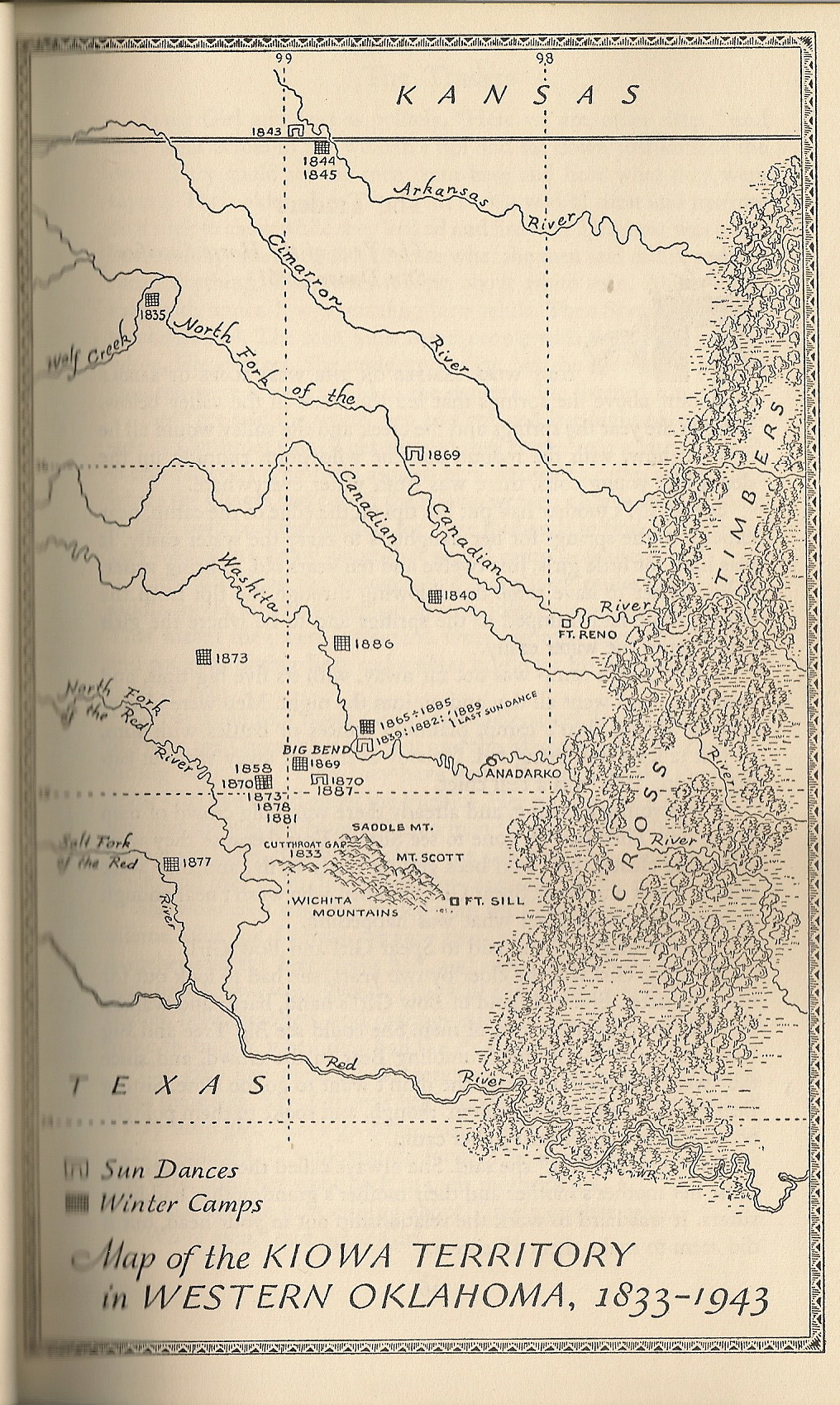
Map of the Kiowa Territory in Western Oklahoma, 1833-1843, from Alice Marriott, The Ten Grandmothers, p. 15.

In 1944, Alice Marriott in her book, The Ten Grandmothers, recorded Kiowa Spear Woman’s narrative of the motion and color changes of prairie grasses.  The “Ten Grandmothers” are ten Kiowa medicine bundles.  The bundles still exist, but they have not been opened since the 1890s when the last person who had the right to see the contents died.

For Leah the south porch of the big house was the best part of home.  Here you could sit and watch sunrise or sunset; watch the shapes of the earth change and move as the sun moved.  Then you knew, when you sat out there, that the earth was alive itself.

Spear Woman sat beside her granddaughter and thought that the earth had gone dead.  Lights played and moved, and cloud shadows came and went, but the earth itself had somehow died.  It was all one color now; not like the old days when its shades really changed and flickered like flames under the wind.  She stirred and sighed and spoke.

When the buffalo moved across it, there were other colors and other lights.

The thought was near enough Leah’s own to startle her.  There are lots of colors there now.

Her father spoke behind them.  Not like there used to be.  In the days that even I remember, there was one color when the wind was from the north and another when it was from the south, one from the east and another from the west.  Now the grass is all one color on every side, and it doesn’t change with the wind.

Sometimes the colors change.  Down near Lawton there is a prairie where the grass takes different colors.

* * *

[Spear Woman insists they travel to Lawton (Fort Sill, Oklahoma), fifty miles away.]

She brought her best Pendleton blanket from the trunk and spread it over the seat.  She put on her very best clothes and painted her face….

Two lines of high, tight fence spread across the prairie from a gate, and Spear Woman sat stiff, suddenly.  What is that!  That is grass like the old days.  Real grass.  All different colors.

It was, too.  It was like changeable silk, the kind the Delawares used to trim their blankets.  Yellow as the wind struck it; rose-color as it died away; then a sort of in-between color, with patterns that moved like patterns in silk when you folded it….

Shade was not even in sight, and when they had driven through the gates, with the lines of the fence on either hand, it was still not easy to find.  Spear Woman didn’t care.  She sat and watched the grass turn over in the sun, flickering and bending and straightening like little campfire flames, and was happy.  It was the old kind of grass, the old, rippling, running prairies, even if there were fences.  She was glad her eyes were dim, because she didn’t always see the fences, and could forget about them.  It was all peaceful and alive again.

From Alice Marriott, The Ten Grandmothers, pp. 285-288.

* * *

When I was a boy, my grandmother drove between Brownwood and Bend, Texas, near San Saba to visit relatives.  I watched fields of grass sway in the wind on either side of the road, a narrow two-lane highway.  She would point out to me where she and her family had camped and where she had seen buckboard wagons ascend a hill along the creek, the hubs carving their initials along the cliffs.  I saw them and put my hands in wagon-hub grooves when we stopped to rest.  The prairie wind flowed over the grass, moving stems and leaves in a rhythm, a wave of motion like water I saw in Corpus Christi Bay.

* * *

Last year I planted six acres of native grasses in the Pecan Tree Pasture.  The grasses are native to the Cross Timbers of Oklahoma where Spear Woman found peace again, and the grasses are native to our ranch that is also designated as Cross Timbers.  The grasses in our pastures grow waist-high, chest-high in some areas, and when the prevailing wind, a southwest flow from Mexico, crosses the pastures, grasses move and bend and change color.  As I go up the road towards Huckabay, Texas, about six miles away, I always notice a very old stand of Bluestem that turns reddish-brown in the Fall and Winter, but becomes blue and green in the Spring.  The stand of Bluestem is only an acre in size and machines have not touched it in many years for it is on the side of a hill.  It is old, that family, and I care for it.  If I could move that acre of old Bluestem to my ranch, I would.  I can’t.  But I have planted its relatives in the Pecan Tree Pasture and there I shall attend to their health and growth.

______________________________

Notes:

The citation is: Alice Marriott, The Ten Grandmothers, Norman: University of Oklahoma Press, 1945.  I have the fourth printing, October, 1951.  In the excerpt, I have omitted quotation marks and substituted italics for the spoken words.

Lawton, Oklahoma, is also the home of Fort Sill, Oklahoma, that is seen in the map above.  If you click on the map, then enlarge it with your computer, you can see more clearly the locations of encampments and the Sun Dance locations.  The Cross Timbers designation flows all the way down into Texas and includes our ranch, Flying Hat Ranch, Mingus, Texas.

12 Comments

Filed under Flying Hat Ranch, Life in Balance, Life Out of Balance, Nature Quote of the Day

Lilly’s Mound: early Winter morning


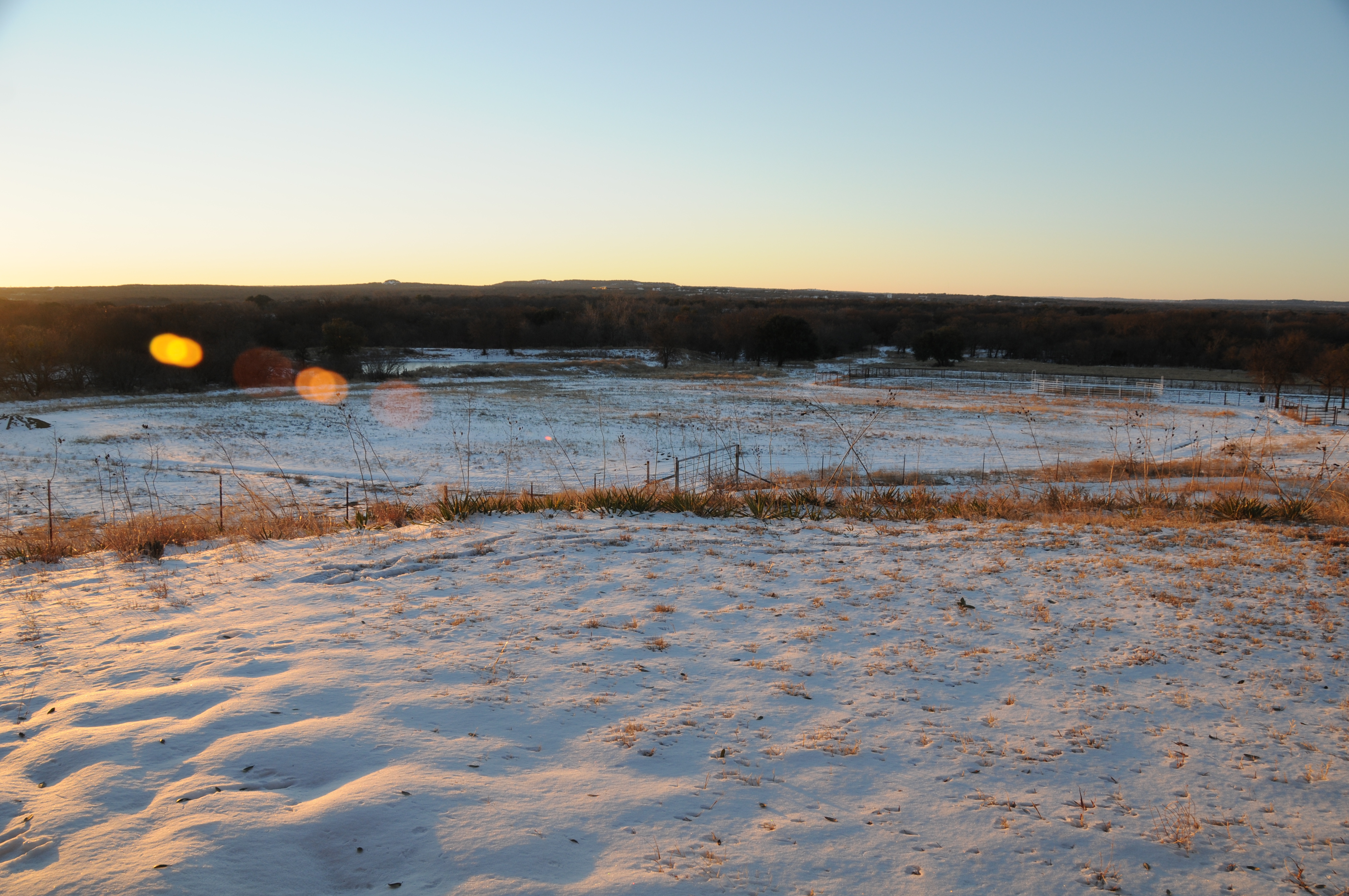
Lilly's Mound in an early Winter morning at Flying Hat Ranch, Texas, 2011 (click to enlarge)

In the far background are the Twin Mountains of north Erath County, Texas, 1,400 feet. Ducks swim and feed upon and beneath the pond in the middle of the photograph even in this cold weather.  The gate opens into the arena pasture.  The small mound with cedar posts upon it, to the far, far left in the photograph (you may have to enlarge), is Lilly’s Mound, 1,065 feet.  The mound is small and does not stand out in the photograph — in fact, hardly noticeable — , but it is a meaningful part of this good earth to me and Brenda and Star.

21 Comments

Filed under Cedar, Flying Hat Ranch, Horses, Juniper, Lilly, Star

Cedar post traction

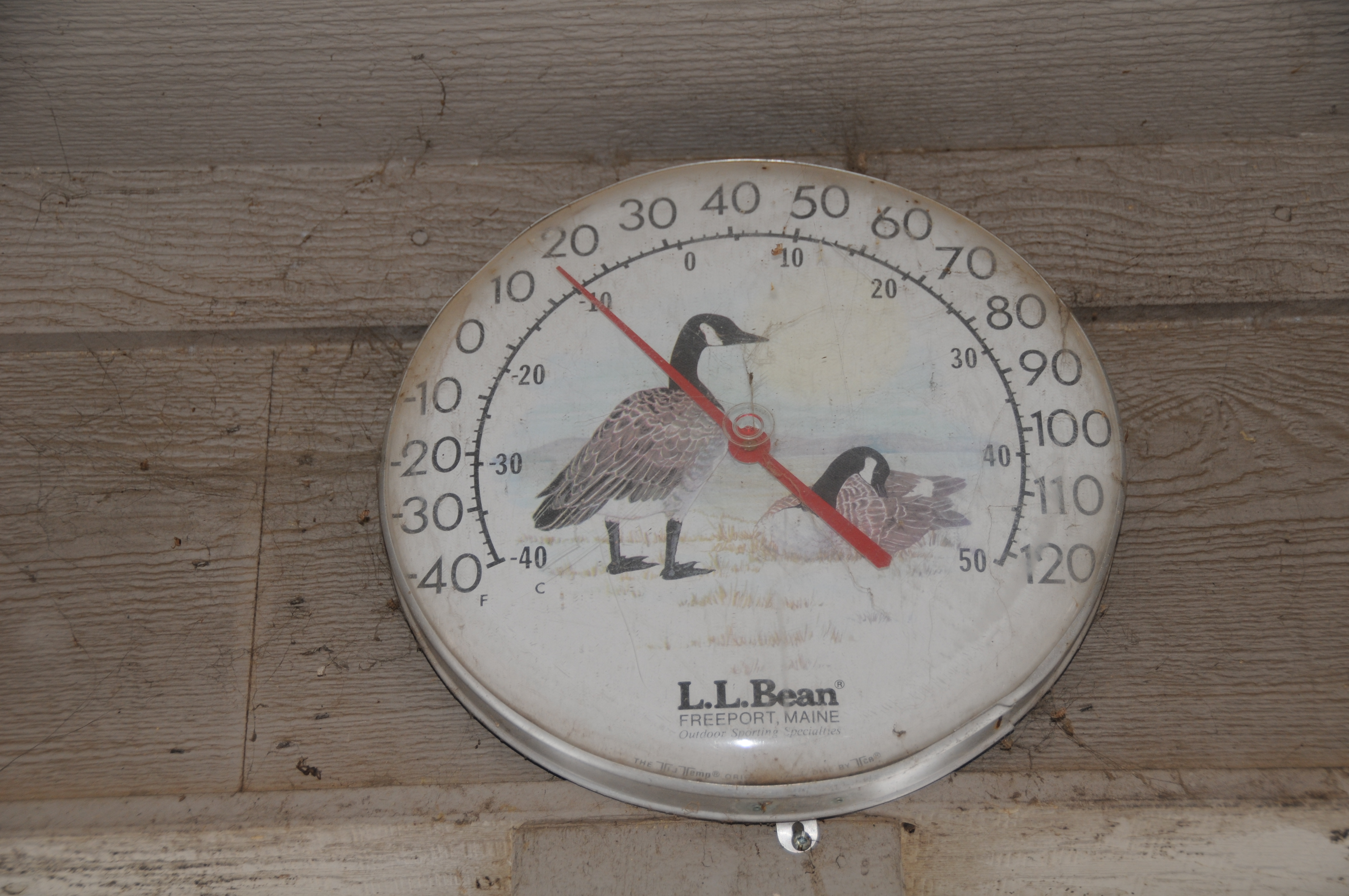
The weather remains cold, down to 12 degrees last night and up to 21 degrees at 3:00 p.m.  I do like Winter.

Since Tuesday, we have stayed put in the ranch house, burning pinion in the fireplace during the day, lowering the thermostat to 65 degrees in cooperation with emergency power issues in Texas.  The temperature is not expected to go above freezing until Saturday and another snowfall descends this evening.

Schools closed.  Our mail carrier, Jeannie Chisolm, told us this morning that the roads are treacherous on her route that encompasses county roads in Erath and Palo Pinto Counties.

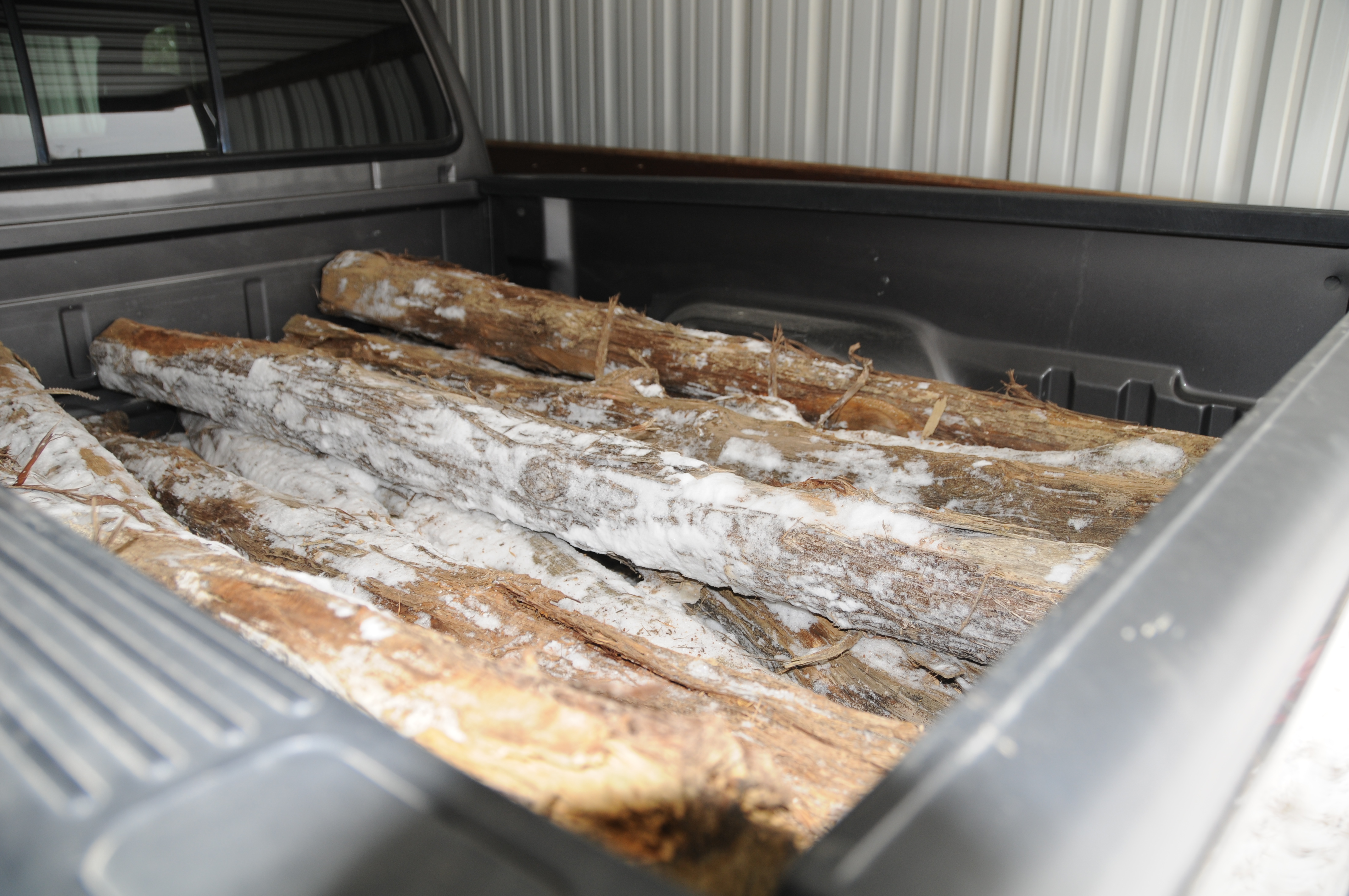
I needed to make a mercy run to Interstate 20, five miles away, for supplies.  First, I had to put weight in back of the F-250.  The old “two-bales-of-hay-watered-down-and-frozen” ploy was not feasible.  Too cold and I didn’t want the hassle of clean up next week.  As a second option, I decided to load the F-250 with cedar posts in order to weigh the rear end down.  Actually, the wood used for fence posts is not cedar, but juniper.  The colloquial is “cedar,” however, and I’m not about to go to the “cedar” yard and ask for “juniper” posts — might result in fisticuffs about definition of terms. But, back to loading cedar.

It’s not as easy as it sounds.  First, I broke the ice around the barn doors with a flat shovel in order to drive the DX-55 Case-Farmall into the pasture where I stored the posts.  After the tractor warmed up, I loaded two big stacks of cedars into the front-end loader, sweeping some snow off the posts and observed Meadow Larks nearby, scratching for seed where the posts had rested.  I drove up the hill to the house.  I used a rubber hammer to dislodge the goose-neck ball from the bed of the pickup, as it had become frozen after the rain Monday evening.  I use the rubber hammer and vise-grips frequently in these times.

I dumped — very carefully — two loads of 6 to 9 inch cedar posts into the bed of the F-250, raising the front-end loader above the bed of the pickup and away from the back window.  I estimated the load to be about 800 pounds, sufficient to give traction on ice for the pickup.  I test drove the 250 up and down the lane.  Two loads seemed sufficient — it was.

Between our place and the interstate, a pickup had overturned and at least ten off-road events in the bar ditch had occurred.  Trucks on the interstate traveled in one lane at 15-20 m.p.h.  We bought our few supplies and came back to the house on the road with two inches of ice beneath several inches of snow.  The clerk at the Exxon station stated that the local propane dealer had run out of propane and his trucks could not resupply until the roads cleared.  There was no milk for sale — all sold out.

Back at the house, we settle in.  I give Star a loaf of hay to tide him over till supper.  Lottie our Schnauzer jumps up on the fireplace bench to warm herself after we relight the fire.  I look out and see cedar posts in the F-250 and I know in an emergency we can make the Palo Pinto Rural Health Clinic (PPRHC) in Gordon with cedar posts as weight in the back for traction.

14 Comments

Filed under Adventure, Cedar, Flying Hat Ranch, Juniper

Snow and ice at Flying Hat

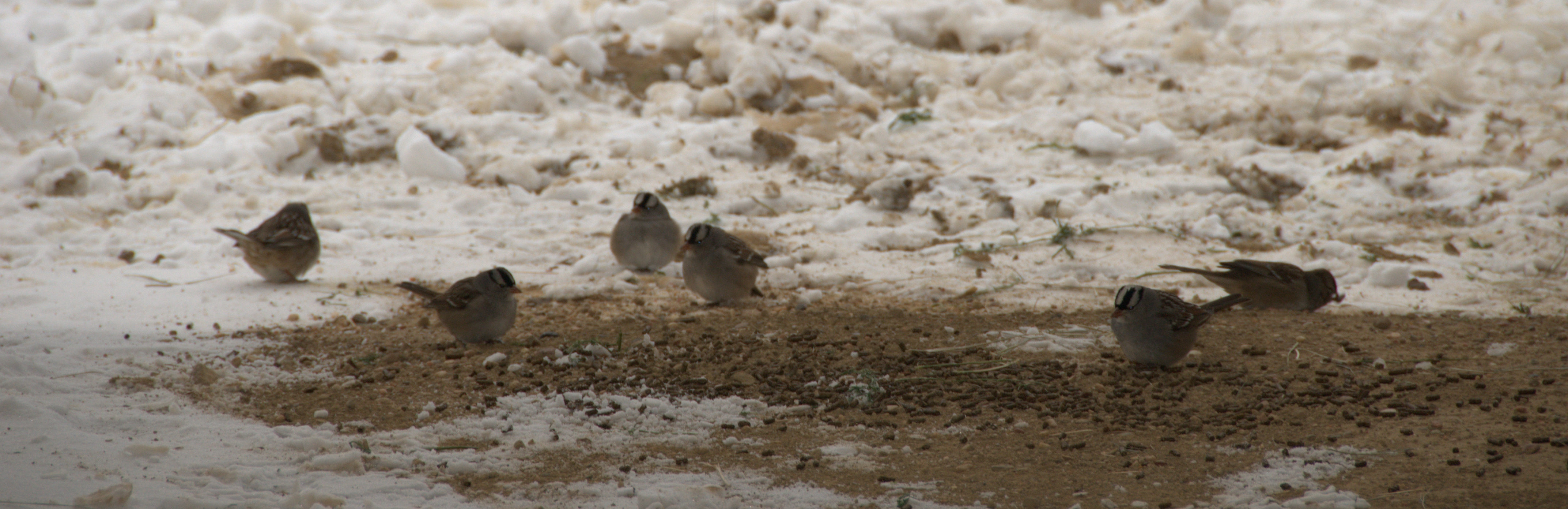
White-crowned Sparrows, Flying Hat, Texas, February 2011

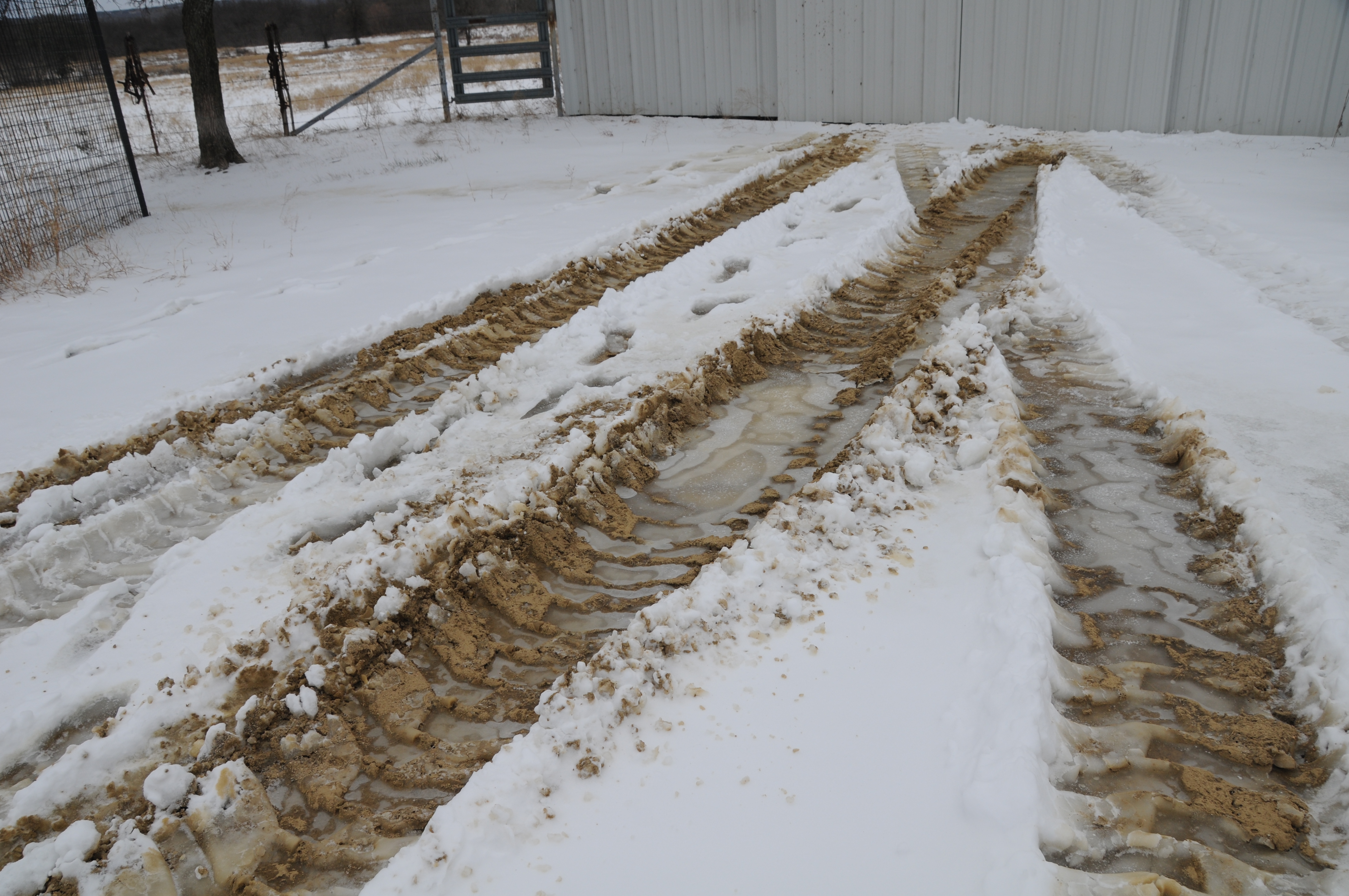
Two nights ago, early Tuesday morning at 12:30 a.m., a rain storm followed by sleet and snow descended on our ranch. The wind blew, gusts to 50 m.p.h., and the temperature reached 10 degrees this morning.  Yesterday, I used the Case Farmall DX-55 tractor to pull our F-250 out of the lane that intersects County Road 114.  Beneath a snow of four inches, two inches of ice held fast to the ground and the F-250, being a two-wheeled drive, could not gain traction in the lane.  Brenda backed up the F-250 while I pulled with the Farmall.  We parked the pickup close enough to the electrical circuit at the house so that if necessary we could warm the engine with its electrical plug.

Yesterday, our rural mail carrier, Jeannie Chisolm, posted mail throughout her route using a four-wheeled drive Jeep.  I called her this morning for road conditions and she told me she became stuck one time yesterday as she delivered the last three mailboxes on her route.  She made it back to her home at 8:00 p.m. last night.  The road between Flying Hat and Interstate 20 is only passable with four-wheel vehicles or those with chains.

Star munches on hay and grain in the stable and I crunched some horse feed and threw it on the ground so White-crowned Sparrows could peck and fill themselves.

The State of Texas has declared a power emergency and seven-million people will begin to experience rolling blackouts to prevent an overload of the grid.  We have experienced no blackouts, but our Internet Provider, centered in Fort Worth, Texas, goes down infrequently.

Weather forecasts indicate below freezing temperatures through Friday at noon.  We have lowered our thermostat to 65 degrees and switched unnecessary electrical appliances to the OFF position.  We have a week’s supply of firewood stacked in the shed and oakwood windfall in the grove.

* * *

Additional comment:  We had a blackout at 11:25 a.m. for about forty minutes.

19 Comments

Filed under Adventure, Flying Hat Ranch