Category Archives: Flowers of Flying Hat

Ranchito blossoms: Flowers of Flying Hat (14-19)

In my continuing task of photographing all different species of blossoms for one year on Flying Hat Ranchito (less than 2560 acres in western America), I have six new pictures to post, only two have I identified.  I thought it better to start posting the ranchito blossoms even though identification is lacking because I don’t want to archive these beautiful plants and I think posting the unidentified will stimulate me to do further research, or possibly you-as-reader have a quick classification in mind.

This time last year, my posts focused on the wildfires and drought.  Today, pastures are green — there is some browning already — and county fire bans in my area are lifted.

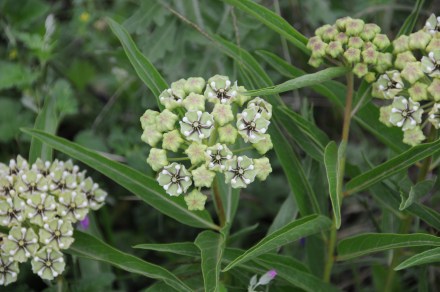
14. Milkweed

15. Nightshade

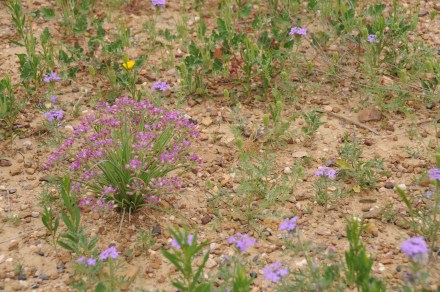
16. Texas vervain (Verbena halei)

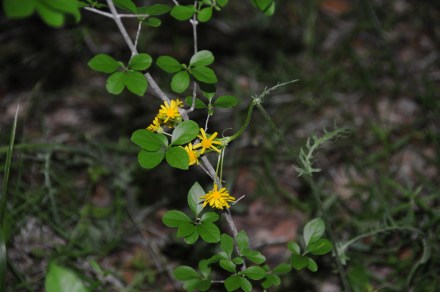
17. Unknown

18. Unknown

19. Annual Phlox, periwinkle

16 Comments

Filed under Flowers of Flying Hat, Wild Flowers of Texas, Wildfire

Shame and Kisses: More Flowers of Flying Hat (12-13)

Catclaw or Shame Vine

12. Catclaw, Shame Vine

This blossom and plant attests a rapid response to the human touch. It is variously known as: Shame Vine, Sensitive-Briar, Catclaw, Shame-Boy  (Mimosa microphylla). It has appeared every Spring since I have lived here, but I never photographed it before today. When I looked up the name of the plant, I also read that the tiny opposite leaflets close upward quickly when touched or walked upon. One authority says that the mechanism of withdrawal is not known in all respects.  Fascinated, I went down after lunch and shot this video of the Catclaw or Shame Vine.  Sure enough, when touched, it drew its claws in or folded its leaflets in ‘shame.’  Look at this video for it’s fascinating.


The Wild Honeysuckle or Kisses

13. Wild Honeysuckle, Bee Blossom or Kisses (Gaura suffulta), April 2012.

I spent two hours in the fields and grove this morning, photographing blossoms, mustang grapevines, yucca and the family of Gyp of Indian Blanket. Suddenly, there erupts in the pastures the Wild Honeysuckle pictured above. One day it is not there, the next day the flower is spread over five acres of pasture.  I never knew Honeysuckle grew on the ranchito.

The area has had two good rains in the last month that accounts for the lushness of the fields.

Of course, in identifying the blossoms above I found no quick method to do so.  I kept going among three wildflower books and the pictures in the books are not always precisely reflective of my photographs.  I find the Lady Bird Johnson Wildlife Center possesses a number of photos and variations that I can deduce better than one picture in one book.  But it did not help me this time.  I nearly gave up and was about to publish the blossom anyway, when I went into the Roadside Flowers of Texas by Mary Metz Wills and Howard S. Irwin.  Wills painted the wildflowers and did not photograph!  Nonetheless, I found a sketch of Wills that coalesced the attributes of the Wild Honeysuckle for me to identify.    Wills and Irwin’s book was published in 1961 by the University of Texas Press.

* * *

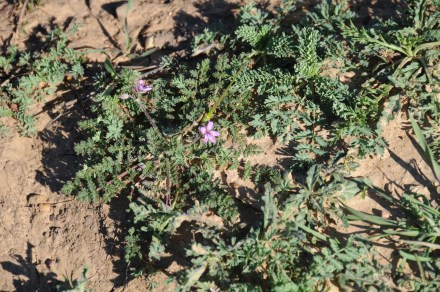
What is this with the local naming of plants?  Shame Boy, Shame Vine, Kisses, Catclaw?  Before we had scientific names, the visual and behavioral characteristics set plants and blossoms apart for identification.  ‘Tis useful, quaint, enduring in memory.  Only this Spring have I finally seen the ‘stork’s bill’ in the Stork’s Bill plant.  It is not in the blossom, but is the shape of the seed pods in the plant’s emergent foliage.  I think both names are necessary, the scientific for classification and study, and the local idiomatic names that reflect culture.  I enjoy learning names of nature’s plants and creatures for it is like meeting strangers — long and lasting friendships may endure, strangers no more.

* * *

I know you may think I am tedious about the Gyp Indian Blanket, but here is another picture of the family.  I can see the family outside my kitchen window and often monarchs perch and feed upon the family.  I have photos of monarchs perched upon the blossoms and will post them in the future.

16 Comments

Filed under Flowers of Flying Hat, Wild Flowers of Texas

Flowers of Flying Hat (10-11): Salt Creek water sounds

The rains about two weeks ago produced sufficient runoff from pastures farther upstream to maintain a water flow in Salt Creek, an intermittent creek that runs through the ranchito.  You can turn up your sound volume and hear the burble of water flowing over and down sedimentary rock.

This is the first sustained water flow — beyond thunderstorm rains — since before the drought.

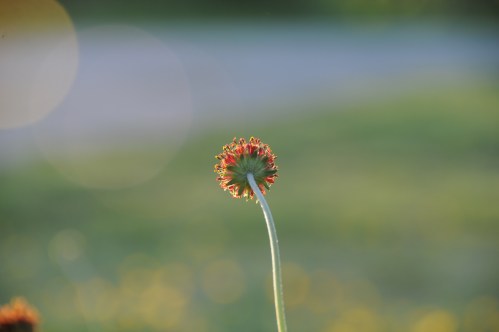
10. Gyp Indian Blanket, rear view of blossom that is pointed west.

The Gyp Indian Blanket is one of my favorite wildflowers.  They are so free-standing, tall and bunched together like a family.

Gyp Indian Blanket family


11. Vetch with yucca sprouts

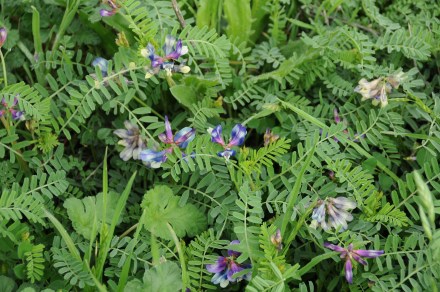
The vetch is knee-high near the house and in the far field it is waist-high in some places.  I like this photograph because of the contrast — yucca and delicate vetch blossoms.

My photography of every new-emergent flower continues.  I have several varieties backlogged in pictures.  Today I have taken several photographs of the Stork’s Bill blossom and will post them soon.

11 Comments

Filed under Flowers of Flying Hat

Broke Tree Corral antics and Flowers of Flying Hat (9): Blueish Ground plum

At the beginning of this Spring Break I set out to accomplish several chores:  Construct dirt foundation for alleyway and stalls, change tire on flatbed trailer so I can haul tractor to repair shop, take tractor to repair shop and return, shred mesquite sprouts and replace rain gauge.  The list changed.  No surprise there.

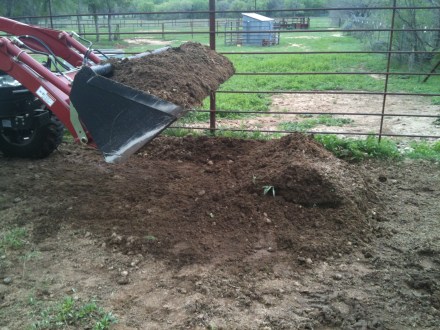
Putting more of a fine gravel foundation is delayed because stalls and the alleyway are still wet.  I have changed the tire on the flatbed trailer and will load the tractor later today.  Before I can hitch up the shredder, the linkage to the power train operation must be repaired.  So, the list has changed and I have conducted manure management tasks before I take the tractor to Stephenville — muckraking with tractor.

As I worked on cleaning the corrals, I let my gelding, Star, out for a browsing and to visit his friends over the fence, like neighbors chatting across the hedge in suburbia. When I went to halter him and bring him back after two hours of browsing, he bucked and snorted on halter like a rodeo horse. He wanted to remain out and become satiated with grass to a point of sleepiness. I can’t let him do that since he is laminitis prone, a condition that requires close monitoring of green grass consumption. Star entered Broke Tree Corral and continued to act horsey with bucking and running. What a day he was having!  Here is Star munching on grass about an hour before the rodeo began.

My morning had a few Kodak moments — no more Kodachrome, I know.  Digital rules.  The Bluebell bell flowers opened up with the few minutes of sun this morning and I brought the camera down to the pasture before I started cleaning the corrals.  Bluebell flowers erupt all over the two front pastures.  Where I had one patch of bell flowers a couple of days ago, now the flowering occurs in multiple patches.

The final photo in my continuing year-long goal of photographing the different species of flowering plants on the ranchito is another Ground plum or milkvetch, but with a different color, a more blueish hue to the blossom. I’ll go ahead and give it a different number because of the definitive difference in color.

9. Ground plum, milkvetch (blueish-violet blossom), Astragalus crassicarpus?

I will take some photographs of the namesakes of the corrals. I have had to give them names because Corral No. 1, Corral No. 2 get lost in the process of giving directions to cowboys and haulers.  I end up saying, Put the horse in the corral with the broken tree in it!  I have no signage for the place, just naming with visible, easily identifiable attributes (broken tree, well house, pecan tree). Nothing like trying to identify a sparrow these days, a process we are all still involved in as the attributes continue to be noted.

10 Comments

Filed under Flowers of Flying Hat

Sparrow with Bluebell

The proper identification of this red-headed or rusty-headed bird continues to churn me, not only in my daylight hours, but also as I lie awake at night.  For the moment, the species identification includes: Rufous-winged Sparrow, Field Sparrow, immature White-crowned Sparrow.  (Probably another possibility looms in the Peterson’s.)  Factor analysis must wait, however, until I get some chores out of the way today. I will, however, cease all toil if I see these guys again so I can focus.  Thanks to Caralee, Rubia, Montucky and others that have further focused my attention on identification.

Here is a closeup of the Bluebell bell flower.  I discovered a patch thirty-by-twenty feet in size, east of the barn.  Walked right over the patch without noticing at first, saw this flower, bent down and looked around and there was the patch of bell flowers.  I wanted to get a closeup of the flower, so here it is.  I have seen field biologists on their hands and knees with a camera, snapping pictures.  Since I have this goal of taking pictures of every species of wildflower on the ranchito for one year, I best start kneeling with knee pads on?

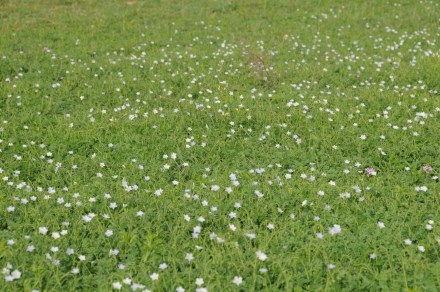
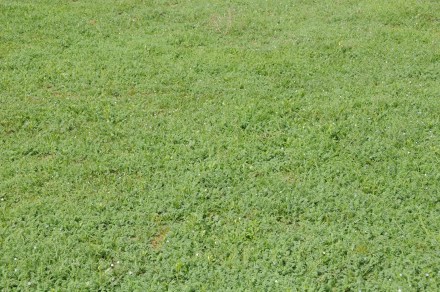
Below is a wide shot of the Bluebell bell flower patch I discovered.  As you can see, the flowers are quite small, barely discernible in the photo as they are in the field.  You will have to click on the photograph to enlarge in order to see the flowers.  Looks like a lawn of sorts, but it is not.

I am off to the barn and field. I will be looking for the sparrow and flowers. The sun is shining and the temperatures are forecast in the upper 70s, lower 80s.  I shall pace myself.

11 Comments

Filed under Birds, Flowers of Flying Hat

Flowers of Flying Hat (6-8): Sow thistle is not a weed.

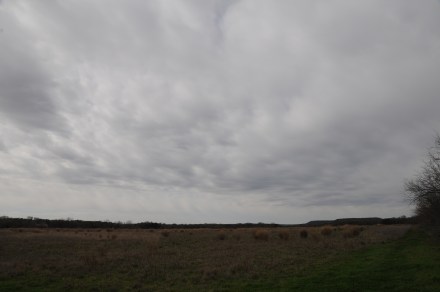
Far field clouds, March 2012.

6. False Garlic, Crow Poison (Nothoscordum bivalve), March 2012.

This False Garlic flowers early and there are several colonies clustered together throughout the ranchito.  This False Garlic is closed and due to the rains and cold yesterday and today, I do not have an open flower to illustrate — but, I shall.  This is found in the lane to County Road 114, and other colonies are about the gate between the arena and the grove pasture.

7. Sow Thistle (Sonchus asper), March 2012.

Sow Thistle appears to be a weed, but it is not.  Authorities claim the milk of this plant relieves eye ailments.  I wonder if I could apply this to my left eye?  I think not.  I’ll rely upon Dr. Callanan, but then again…. This appeared one afternoon and then its flowers have closed.  This Sow Thistle inhabits the disturbed soil underneath the live oak tree to the southeast of the house.  I have read much about the categorization of ‘weed’ versus ‘plant.’  The term ‘weed’ seems culture-specific, a term of dislike, marginal.  Goats, sheep and cattle eat this with relish.  To them, it seems, this is a plant, not an obnoxious weed.  One person’s plant is another person’s weed?

8. Unknown.

These little-bitty guys erupt on the top terrace and emerge as small, almost unnoticeable flowers. As of today, I have failed to find their name, and I also need a closeup to gain greater resolution of their attributes. Today it is raining and the blossoms are closed.

More Violet ruellia, violet wild petunia (Ruellia nudiflora).

This is a another photograph of violet wild petunia, previously identified.  It has erupted in large numbers along Interstate 20 from Mingus to Abilene.

13 Comments

Filed under Flowers of Flying Hat

Flowers of Flying Hat (5): Ground plum, not yummy

Yesterday evening as I came back a different path from the barn after feeding Star, I discovered this flowering plant, the Ground plum, milkvetch.  I spent over an hour perusing field books until I identified Ground plum.  I nailed the identification when I corroborated a field book description with the Lady Bird Johnson Wildflower Center website.  Depending upon the species of Astragalus, some members are poisonous, but this species is not.  Even so, Ground plum is not a yummy plant although its fragrance is lovely — somewhat spicy I believe.

5. Ground plum, milkvetch (Astragalus crassicarpus?). March 3, 2012, southeast second-level terrace. See: http://www.wildflower.org/gallery/result.php?id_image=9002; Wills and Irwin, p. 138, especially.

I discovered a new link for plants: University of Michigan-Dearborn Native American Ethnobotany.  You must check this out for medicinal uses of plants.

This medicinal use of plants starts me thinking.  I may set aside an area in the barn to harvest some of these plants.  I already have a request for bull nettle to be sent up to Wisconsin for an indoor greenhouse.  Don’t let the bull nettle go outside!

14 Comments

Filed under Flowers of Flying Hat, Wild Flowers of Texas

Flowers of Flying Hat (1-4): Late Winter blossoms

Human beings set goals, or at least I think they should.  On the other hand, doing what comes naturally has its attraction too.  I have set several objectives regarding nature observations on my 53 acres.  Here on the place — called variously, the ranchito, Flying Hat Ranch — I have sought to identify every tree on the place and have started a good list of American elm, cottonwood, mesquite, juniper, oak, and so on.  Identifying every tree continues to be a goal.  Tree identification was (still is) my first goal in field work on Flying Hat.  Other goals I have set up include:

observing another fox and taking its photograph,

identifying every bird I see,

identifying every bird I hear,

for one year, photographing every wild flower I observe on Flying Hat.

Achieving these goals, and the process of doing so, is personally satisfying and gives me narratives for this blog.  I have decided to start another goal-oriented project and demonstrate it on my blog.  I have begun taking pictures of the wild flowers on Flying Hat and my goal is to continue photographing and identifying flowers (all colorful blossoms) through a turn of seasons for one year – March 2012 – February 2013.  So, let’s see how far I can go with this project.  Here are my first photographs.  The No. 3 flower is disputable as a “Texas Star.”

(If I have made an error in typing, please comment or e-mail me your reasons for seeing the flower and plant differently.  I want to be right in my typing, but more than that I want the typing to be correct.  Note: All photographs are taken on the 53 acres of my ranchito; none are photographed off the place or off the ranchito grid.  For a precise location of Flying Hat, see location information in this blog footer.)

1. Verbena (Verbena bipinnatifida?). February 26, 2012, west slope of terrace, Fenster's field. See Wills and Irwin, p. 189.
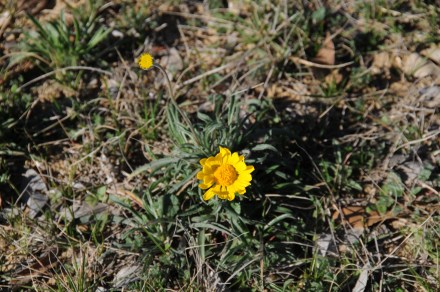
2. Parralena (Dyssodia pentachaeta), of the Aster family. February 26, 2012, on back terrace and in Fenster's field east of the house. See Ajilvsgi, p. 148.

3. Bluebell bellflower (Campanula rotudifolia), February 26, 2012. See http://www.wildflower.org/gallery/result.php?id_image=3102; see notes below.

4. Violet ruellia, violet wild petunia (Ruellia nudiflora). February 26, 2012, Fenster's field, far field. See http://www.wildflower.org/plants/result.php?id_plant=RUNU; Ajilvsgi, p. 377.

______________________________

Notes, corrections and additions:

No. 3 flower and plant is probably as described in caption.  Thanks to Montucky of Montana Outdoors blog and Grethe of Thyra blog.  The issue seems to be resolved it you stand up the flower and look at the total plant.  The flower would droop like a bell and the leaves and stem favor the image in the citation in the caption: http://www.wildflower.org/gallery/result.php?id_image=3102.

Mary Wills and Howard Irwin, Roadside Flowers of Texas.

G. Ajilvsgi, Wildflowers of Texas.

Campbell and Lynn Loughmiller, Texas Wildflowers.

Steven Foster and Christopher Hobbs, Western Medicinal Plants and Herbs (A Peterson Field Guide).

23 Comments

Filed under Flowers of Flying Hat, Wild Flowers of Texas