Category Archives: Birds

Fox and Salt Creek: field log entry 2

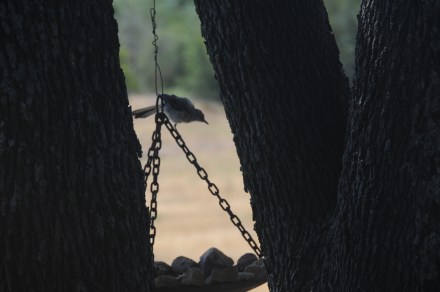
12:00 p.m. — 1:08 p.m.:  After thirty minutes communing with a fussy wren, I finished a brief field observation with a walk up Salt Creek about one-tenth of a mile.  I logged tadpoles, frogs, wrens, bluejays, heard the cry of the red-tailed hawk or the Harris hawk, photographed a turkey vulture (not included herein) and saw the owl (unidentified) fly into the grove away from my hike.  Back at the ranch house, I identified the wren that had chattered at me — a Bewick’s Wren (Thryomanes bewickii).    I saw numerous tracks in the mud.

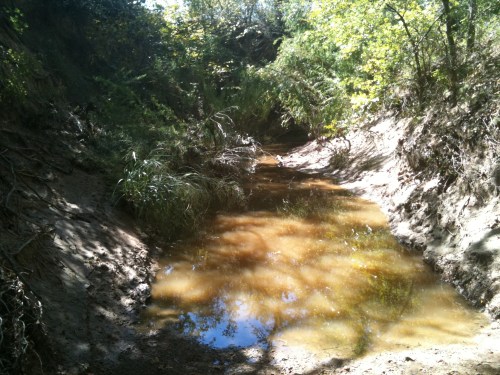
I counted two monarch butterflies within the cool willows of the water cache — see photograph below for the Salt Creek water cache with sky blue.

Salt Creek water cache with sky blue (October 15, 2011).

The Audubon Society Field Guide to North American Birds states that Bewick’s Wren prefers drier conditions to its resemblance, the Carolina Wren.  Bewick’s Wren has certainly enjoyed dry conditions throughout the summer.

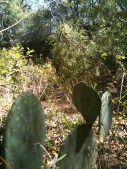
I liked this photograph of the prickly-pear cactus with the willow and pecan trees in the background.  It describes in essence what this part of Texas and my ranchito is all about — wet and dry, green and brown, cactus and pecan, things-that-stick-you and things-you-eat.

Fox I did not see.  I did not expect to see any, but one never knows.  My friend, Wild Bill of Wild Ramblings Blog, suggested that I get a animal call tool that sounds like a wounded rabbit to attract the fox.  I think I shall because I want to see fox again.   Cougars and bobcats have been sighted in our area, so I shall be cautious.  I don’t want my day spoiled by predators of that size taking me from behind.  We have a saying out here, “If it doesn’t sting or bite you, it will stick you!”   I’ll take the stinging and sticking anytime over the biting.  Now, where are my field catalogs?

5 Comments

Filed under Birds, Bluestem Field Log (Live), Field Log, Life in Balance, Monarch Butterfly

My summer’s end

Medieval depiction of the four seasons, peasant perspective.

As far back as I can remember, my summers end with the beginning of school in late summer, although at college and the university eons ago the semester began in September, not the middle of one-hundred degree temperatures in August, a month christened:  harvest month (Finnish), month of leaves (Japanese) or month of the sickle (Polish).  August still blows hot and the cumulus clouds don’t always come together during the day for a thundershower in Texas.  These days, my summer’s end comes when the bugle sounds, “Faculty Assembly,” and I file in with other professors for another encounter with young men and women who must always be reminded that getting an education is beyond, way beyond, getting a job.  And, frankly, by December, they know the difference.  ‘Tis a seasonal thing, I say.

When does summer officially end?  Oh, gosh, no, here comes a science lesson: Summer is calculated as ending when “the tilt of the Earth’s axis is inclined neither away from nor towards the Sun, the center of the Sun being in the same plane as the Earth’s equator.”  This equality of the northern and southern hemisphere angle or tilt towards the Sun occurs twice, about March 21, September 22.  Enough of the astronomical parsing, just what is going on with my summer’s end, prematurely a month before its true shutoff?

Like the medieval image above, I lay down my sickle and pick up the history survey text of the United States and lecture.  No more harvesting here, I throw fertilizer and facts at students and hope the plants thrive.  I feel unnatural to put my farm tools down before summer ends.  What will happen when I am in the classroom and it has rained and the fields need cultivation?  The plow follows the rain, as every farmer knows.  Will things be okay without my studied interference?  I think so.  The fields manage quite well without my disc, chisel or shredder.  (I still have areas I cultivated five-years ago that remain dormant mainly because I interfered.  No more of that!)  I’ll catch up another day on interfering.

What I will miss most is arising at 4:30 a.m. and by 5:00 a.m. sitting out in the dark or early morning light and logging the sights, sounds and smells of the coming day, scribbling fast on my steno pad, nine to ten lines a steno page in the dark so as to keep up with the ending of night, the beginning of the day in American West.  Drought has a scent: dusty, dry wood, a tad smoky, bog water, leather that needs oiling, mesquite bean, burnt stone.  I should like next summer to rise early again, take notes in the dark, drink coffee and look for orioles as the rosy fingers of Dawn emerge before my summer’s end.  ‘Tis a seasonal thing, to be sure.

_____________________________

Notes, corrections and additions:

Orioles are uncommon in west Texas.  I have only seen two in my life: one when I was ten, then day before yesterday, I saw another oriole, brilliant in color against the green mesquite.  It flew with a rhythm like a runner jumping hurdles.

Here is a painting that depicts Everyman and their summer’s, life’s end:

Summer's end.

This painting comes from the blog: http://damnthefreshman15.wordpress.com/2010/08/21/summers-end/

18 Comments

Filed under Birds, Life in Balance

Clouds with Mourning Dove

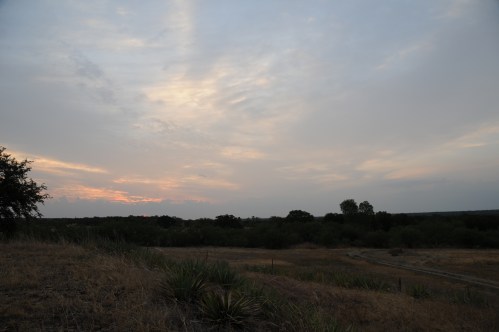
Pre-dawn clouds in Texas, north Erath County, August 2011.

Yesterday in mid-afternoon, August 10, 2011, a weak squall line walked through my ranchito in central-west Texas.  Blue-gray rain clouds edged and staggered to a halt south of my place.  A few drops of rain fell.  The power of the squall line churned up dust clouds, obscuring the Nowack barn across the county road in a microburst downdraft.  East of me, seventy-five miles away, Fort Worth had rain falling on Sundance Square, the heart of downtown commerce and entertainment that coarsely promotes the city as, “Where the West Begins.”  I disagree, but that argument will have to wait for another day.

The squall line with thunderclouds failed to bring rain on my land yesterday, but one weather change in the future will bring drops and sheets of rain.  I looked at the weather charts yesterday afternoon and saw thundershowers, sixty-miles north, let loose rain, then dissipate into nothingness but a void of mirages, quavering silver lakes far away.  No mirage here, the juniper trees in the ranchito grove threw off a luscious scent with the rise in humidity, dispelling summer for a time and bringing a promise of better days.

This morning, clouds remain to my east and as the sun rises, I see remnants of yesterday’s storm over Sundance Square.   I count three, perhaps five, sun rays through the cirrus and cumulus debris.  In all of this — the dust clouds, wind, scarce drops of rain and the sun’s rays — I look at yesterday’s date, August 10th, and know that Fall is forty days away, and that the sun rises later and sets earlier each day upon the earth’s northern hemisphere, Sundance Square and my hacienda. 

As if I needed any more natural substantiation that the season is turning — I do — Mourning Doves (Zenaidura macroura) sustained their ooah, cooo, cooo, coo this morning for over an hour, sitting on power lines and in the mesquite brush of the Dooley place to my west.  The Mourning Dove with hot mornings and brutal afternoons of heat on the ranchito does not coo earnestly, but quiets in sorrow for the lack of rain.

The Mourning Dove is in the lower-left photograph, a White-fronted Dove is pictured in lower-right (Audubon Society Field Guide, 1977).

______________________________

Notes, corrections and additions:

The call of the Mourning Dove comes from Roger Tory Peterson’s A Field Guide to Western Birds (1969), my constant reference and field guide that is tattered and torn.  But I would not have it any other way.

Photographs of the dove are from The Audubon Society Field Guide to North American Birds (1977).  This reference guide from Audubon was in the small library of my parents who grew up in the country of central Texas and were always cognizant of wildlife, thunderstorms, cattle and horses.  I inherited the library and treasure each volume of field manuals that they thumbed through.

Several species of dove reside and pass through the ranchito. 

10 Comments

Filed under Birds, Rain, Weather

Score: Mockingbird 1, Roadrunner 0

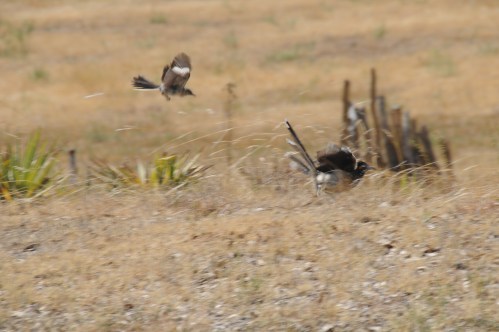
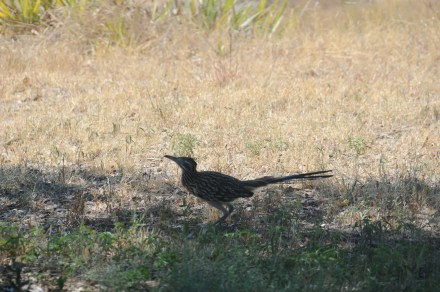
A mockingbird resides in a live oak tree on the east side of the terrace beside the house.  For several days I have observed roadrunners coming up to the terrace early in the morning and mid-afternoon to feast on grasshoppers.  Occasionally, the roadrunners will scale a separate live oak tree from the mockingbird’s nest only to be thrown back, not by cauldrons of burning drought-oil in Texas, but by the fierce, unrelenting assault of the mockingbird.  The trees upon the terrace are mockingbird territory!  Beware aliens!  The mockingbirds will allow red-headed woodpeckers to pierce bark for a meal, but not the roadrunner.

Yesterday, I took these photos of the tournament.  At end of battle, the score was Team Mockingbird 1, Team Roadrunner 0.  The roadrunner ran off the terrace and into the mesquite thickets on the Dooley place.

A roadrunner (Geococcyx californianus) is a cuckoo, here pictured on the terrace with pale-leaf yucca in background (north Erath County, Texas, 2011).

Mockingbird (Mimus polyglottos) assaults roadrunner (north Erath County, Texas, 2011).

Mockingbird stares at roadrunner.

Roadrunner stares at mockingbird.

I have had close encounters with both species in rescuing them from death.  I unloosed a mockingbird from bird netting several years ago.  He bit me and drew blood.  And, a year or so ago, I saved a roadrunner from drowning in a water trough.  He had fallen in and was unable to fly or climb out.  I have no idea if the roadrunners I see are survivors of that event — more than likely not since it was over a year ago.

I do have a field note about each of these birds.  I can hear the roadrunner chattering, a noise he makes by rolling mandibles together.  He has a voice like a dove, but more often I hear the chatter.  The other note is that the mockingbirds like to sing at night in the spring — all night long.  I used to hear them as a boy when I slept with the windows open; I barely hear them now with the air conditioner blowing.

Seeking comic relief in all this heat, I look for a coyote to come across the terrace tomorrow, laying a trap for Team Roadrunner.  I hear coyotes, but don’t see them.  “Beep, beep.”

20 Comments

Filed under Birds

The aire be stirred with wild things

Barn swallow in flight, north Erath County, Texas (2010).

They were storks!  When they circled lower, the long beaks and the legs that trailed in the slipstream showed red as sealing wax.  An old shepherd was leaning on the ramp close by and gazing up at them too.  When some of the great birds floated lower, the draught of their feathers brushed our upturned faces, and he said something in Magyar — “Net, gobyuk!” and smiled.

Patrick Leigh Fermor in Hungary, 1934, in A Time of Gifts, p. 309.

Around me, the air has been stirred with wild things, but not storks.  During winters in central Texas I walked to the pond on my step-father’s farm and sat on the lee side of the water, standing still about a natural juniper blind, not moving, and ducks would fly so fast you heard them before you saw them, and they stirred the air about my face and landed swiftly upon pond water, sending ripples to the ice-crusted edge.  The aire be stirred with wild things.  In all the years around the pond, I took but one duck out of the sky, regretting it to this day because there was roast beef and bacon back at home beneath the thin, protective dish towel mother used to cover the food she prepared.

Three fall seasons ago I sat on the back porch, wearing an old, broad-brimmed felt hat as I looked out in the pasture at the horses.  Not moving much in the chair, a familiar wren — I had seen it countless times — flew down from the support post and landed upon my hat.  The wren stayed there for thirty seconds, maybe a minute, darting about the top of the hat, checking out the intricate perforations of the hat band for food, its tiny feet moving staccato-like about like a ballerina.  I felt its motion, the draught of wings I felt upon my face.  The aire be stirred with wild things.

Barn swallows fly through the porch today and stir the air.  They hover, literally hover in the air, fanning the porch like tiny, childish whirl-a-gigs, seeking a perch or possible nook for a new nest.  There are six swallows and they perform their aerobatics twice a day, morning and evening.  Coming close, within three feet, they chirp at me as an intruder in their world.  The aire, I tell you, is stirred with wild things.  And, ’tis good wild things.

______________________________

Notes:

See also The New York Times obituary of Sir Patrick:  NYT obituary of Patrick Leigh Fermor.

Somewhere in my reading, I remember an Englishman that was on an African safari and in the evening ventured beyond the compound’s fire pit and was attacked by a lion.  In the attack, the lion grabbed him about the shoulder from behind and started dragging him away into the bush.  The Englishman — how I wish I could find this story again — thought he was done with and remembered the smell of the lion and that the lion purred as he took him away.  Interesting the purr.  The man reached for his bush knife and stabbed the lion who released him and ran off into the dark.  Not all wild things that stir the air are so gentle.

10 Comments

Filed under Birds

Quail and deer lease my field

Deer skull with prairie grass (2011).

Temperatures reached 102 degrees yesterday.  Work slows or stops at 11:00 a.m.  Winds blew fierce, reaching 40 m.p.h. in gusts.  Yet, the pastures are green, the grass not browning for the moment.

* * *

Two days ago I shredded several narrow paths about the pastures.  I do not shred fields or pastures.  As I shredded a narrow path around the edges of Pecan Tree Pasture, I flushed a bobwhite quail.  Just one quail, but it is significant for quail habitually cluster in coveys.  Quail have disappeared in large portions of the area from hunting, shredding pastures, cropping and the spread of fire ants that kill young chicks.  I have reseeded the Pecan Tree Pasture with native grass and allowed the field to remain fallow for several years.  If I see more quail — the late sighting proving to not be an isolated occurrence — I will conclude I have done well in partial restoration of a native habitat.

* * *

Yesterday I sighted three mature deer and a fawn between the grove and the stock pond.  It is odd that their color is so pale brown, almost yellow, against the greenery of Spring.  Deer return, quail flush.  The fawn pranced.

* * *

As I sat on the back porch yesterday afternoon, a cattleman from Gordon knocked on the door.  He wanted to lease the pasture that I had flushed the quail and seen the deer — a monthly lease depending upon the number of cattle he would place.  I refused.  I told him that I would probably run a few head myself.  He stated that he had seen no cattle on the pasture and that’s why he had inquired.  I took his card and he said he was looking for pasture within ten miles of Gordon, so that if I heard of any land available for rent, please let him know.  I politely said I would.

Other inquires will follow this Spring.  They always do from cattlemen or harvesters of grass.  And, I always refuse and politely explain that I have the pasture for horses or a few head of cattle.  I have not run any cattle for four years.  I may put a few on the land this Spring, but not many and they will not disturb either deer or quail.  In the field, the Big Bluestem grass will be higher than the withers of horse and rump of cattle.

* * *

I had to kill a copperhead in the barn two days ago.  I knelt down to air up a tire and moved a salt block receptacle to position myself and a copperhead lay under the receptacle.  I will be cleaning out the barn early next week.  I had planned to do so — in fact I had moved six boxes of books to my office in Abilene a week ago –, but the danger of snake bite spurs me sooner to glean the barn.  My air conditioner repairman and contractor lost part of a finger last year from a copperhead bite.  For some reason, we have more copperheads in this portion of north Erath County, Texas, than most areas.

* * *

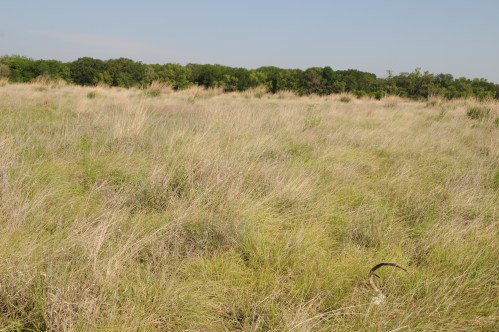
The photograph at the beginning of the post was taken over at Pecan Tree Pasture about where the solitary bobwhite was sighted.  I was observing the growth of native grasses a month ago and happened across the deer skull with horns.  I consider myself keenly observant of objects in my field of sight, but the grass has grown so high, secrets are undisclosed unless one tramps the land.  The skull remains in situ.  I like the simplicity, the complexity intertwined: deer, native grasses, treeline.

The field wholly remains in situ, lightly touched, deeply felt.

15 Comments

Filed under Birds, Deer, Field Log, Life in Balance

Dickcissel on Bluestem for Mother’s Day

Dickcissel (Spiza americana), the bird perching on the stems, Flying Hat Ranch, north Erath County, Texas, May 8, 2011 (see photograph below for closeup).
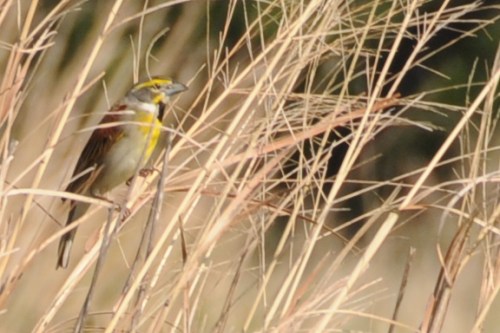
Closeup of Dickcissel on Big Bluestem, Flying Hat Ranch, May 8, 2011.

This morning I drove over to the Pecan Tree Pasture to check on the spring growth of grasses.

The Big Bluestem erupts into the old clumps of Bluestem from last season.  I heard a bird, a familiar call, that I vowed I would photograph and identify.  I walked fifty yards into the field and looked in the direction of the call.  I saw nothing.  Looking at several Bluestem clumps, I finally spied the bird and fixed it with the sound.  (If I had had my wits about me, I would have recorded the sound.)  The sound was a rendition of its name (I found out later), dick-ciss-ciss-ciss.

I focused the camera on the bird and it looked like a meadow lark, but smaller, yet yellow.  I took several shots and walked closer each time.  A sudden movement way across the pasture near the Hall’s place caught my attention.  A deer bounded through the high grass, gracefully jumped the fence and disappeared into the Grove.  I was pleased and I’m sure the deer was also that grass and trees provided foliage and food.  That was the first deer I’ve seen on the property in months.

Returning to the ranch house, I got down the Peterson and Audubon field guides to identify the bird I saw.

It is a Dickcissel (Spiza americana) male.  The species was on the 2005 Audubon Watchlist, but it has since been taken off.  The Dickcissel used to inhabit the eastern coastal states, but it now resides in the Midwest this time of year.  It had been placed on the Watchlist because in Venezuela its feeding habits damaged crops.

The major threat to Dickcissel comes from its wintering grounds in Venezuela. Because of the species’ propensity for gathering in enormous flocks and feeding on cultivated plants such as rice and sorghum, it can be a serious agricultural pest for Venezuelan farmers, who have sometimes taken to trying to poison flocks. Dickcissel flocks in Venezuela can number over a million birds, meaning that the wintering population can become highly concentrated at certain favored roosting sites. A single “successful” poisoning event of a large flock of roosting birds could significantly reduce the world population of Dickcissel.

On its North American breeding grounds, Dickcissel faces several additional threats: cowbird parasitism, the destruction of nests and nestlings by mowing machines, and loss of habitat due to changing agricultural practices and succession [1].

I have neither mowed nor shredded the field for six years.  In 2007, I ran twenty-seven Angus stocker calves in the field, but did not let them overgraze the pasture.   Other than Hija, Star, Lilly and Fanny, no livestock have been placed in the field since 2007.  In 2004 and 2010, I reseeded the field in native grasses.

I did not make a count of how many Dickcissels I saw or heard.  A very rough estimate is about 10-12 within the western half of the 35 acre field.

Of the Dickcissels nesting habits, the female lays 4 or 5 pale blue eggs in a cup of stems and grass set on or near the ground, often in alfalfa and clover fields [2].

Happy Mother’s Day, Ms. Dickcissel!  My field is your home — our world together.

______________________________

Notes:

1.  http://audubon2.org/watchlist/viewSpecies.jsp?id=72

2.  The Audubon Society Field Guide to North American Birds Eastern Region.  Also references to Peterson’s field guide.

The ecology of the Dickcissel as stated in the Audubon Watchlist link above is as follows (for Wild Bill and others):

Dickcissel nests in grasslands, meadows, savanna, and hay fields. Its nest is a bulky, loose cup of woven grass and leaves, usually placed in a grassy field. Males arrive at breeding territories about a week before females, and may have more than one mate. Females are responsible for nest building and incubation, usually of a clutch of four eggs. Young birds fledge a week to ten days after hatching, but are not capable of flight until a few days after leaving the nest. The diet of breeding adults is 70% insects and 30% seeds, while for young birds, it is the reverse: 70% seeds and 30% insects. Outside of the breeding season, Dickcissels feed mostly on seeds, including weed seeds and cultivated grains. Dickcissels migrate in flocks, sometimes gathering into groups of several hundred birds, and on their wintering grounds in the llanos of Venezuela, they are extremely gregarious, forming flocks that can number over one million birds.

17 Comments

Filed under Birds

Interstate 20 Kestrel

Sparrow Hawk (Falco sparverius, from Peterson's Field Guide)

In my long commute to Abilene from Mingus, Texas (87.2 miles), I see flora and fauna of Cross Timbers and west Texas plains along Interstate 20.  The Clear Fork of the Brazos River is the major river in the area, meandering north of the interstate at a distance I cannot discern from the highway, but within sight of the wind turbines that I see turning swiftly with the wind.

Between Abilene and Clyde, Texas, I have seen for several years a particular type of hovering bird above the interstate that dives down, usually on the median, to take a field mouse.  The angle of the sun has not been right for me to identify the bird nor have I minimal traffic to definitely type the predator.  (Trucks carry a lot of cargo on Interstate 20 between El Paso and Dallas-Fort Worth and must be respected.)  Yesterday, however, at the same spot (about a two-hundred-yard splotch) that I have seen these birds over the years, I was able to identify a Sparrow Hawk (Falco sparverius), as my elusive companion for the commute.

The Sparrow Hawk or “American Kestrel” flashed a rufous back, wings spread with blue-gray color and a rufous tail, signifying a male, as it dove onto the median.  Returning home, driving east, the sun on my right side at 3:30 p.m. in the afternoon, I saw brightly illuminated the plumage and color of this beautiful hawk.  The sighting occurred within five seconds, but I will remember this Interstate 20 Kestrel for a long, long time.

* * *

How can we ever think ourselves alone when in the absence of our own kind we have kestrel, oak and four-legged companions about?  But we do feel estranged.  I have and will feel alone again.  Yet, so, and despite it all, our senses become filled with flapping wings, stamping hooves and trees swaying in the wind among ten thousand sights and sounds.  Our yearning for connectedness disappears with a self-loss in nature’s rhythm, even along the interstate.  It is a kind of sacred hoop, Black Elk once said.

25 Comments

Filed under Birds

Swarming berry feast for Tufted Titmouse

Tufted Titmouse (Cornell University)

I wrote my dissertation in Fort Worth, Texas, from a second-floor office, looking out upon an enclosed patio. Adjacent to the large window that framed my view were White Fringetrees that bore dark blue berries.  I composed intently and turned frequently to the window, yearning to be in high country, viewing pinon, spruce and ponderosa, not the Fringetree in a hot Texas summer.

One afternoon as I churned out sentences I saw birds fly onto and into the White Fringetrees.  Not just a few, but hundreds of birds landed on tree branches, weighing them down, almost to a point of snapping the branches from the tree trunk.  I turned away from writing and gazed upon Tufted Titmice engorging fringetree berries (1).  The animated flock, chirping and calling loudly, ate for fifteen or twenty seconds and then abruptly flew away, out of sight, in a orchestrated arc of motion.

I was stunned at clasping claws, fluttering wings, pecking mouths and swarming birds within ten feet of my desk.  No sooner than I began to think about their behavior the titmice returned, engorging and hanging upside down, flying crazily away, drunk upon the nectar, happily filled.

They stripped the tree of berries after two more returns to the table and I never saw them again that summer.  I waited for a few to return in the remaining days, but they never flew back.

I revere that image.  I thought then, as I do now, that the berry feast of swarming titmice lifted my mood and helped propel me to finish my dissertation, for at my desk I saw nature churning, grasping, eating and flying.  High country, after all, in Texas.

______________________________

Notes:

1.  Please read my reply to Bill’s comment in this post about my confidence in typing a Tufted Titmouse.  I have a measure of doubt about the typing.  I wrote to Bill:

I’m not one-hundred percent confident it was a tufted titmouse. At the time, I had never seen any bird like it: tufted, grayish, small, energetic. Fort Worth is 65 miles from where I live now, 120 miles from where I was born and reared. I would say I am seventy-five percent confident about the typing. I’m not by any means a birder and I was hesitant in presenting this post. I remember at the time that I got my Peterson out a few days after the event. My first definition was some sort of junco, passing through like you say, but a junco was too large. With a little bit more definition, photographs and migrating patterns into Texas (no farther than Texas, I read), I hesitantly put it as a tufted titmouse. No one was with me at the time of the sighting to corroborate….If you read my reply to your comment, how do you go about your typing of birds up there? Today, I use the Peterson and Cornell University website. My Peterson is falling apart from use in the field and carrying around for, say, forty years?…Thanks, Bill, for commenting.  [Bill writes a nature blog and lives in New England.  His blog is Wildramblings.]

The White Fringetree (Chionanthus virginicus), http://en.wikipedia.org/wiki/Chionanthus_virginicus.  See also Rutgers Landscape and Nursery Services, New Jersey.

Tufted Titmouse, Identification, All About Birds – Cornell Lab of Ornithology (Baeolophus bicolor).

9 Comments

Filed under Birds, Recollections 1990-

Sufficient fowl for our day

North Erath County, Texas, Lat 32.43 N, Long -98.36 W, elev. 1,086 ft. Turkey Creek Quad.

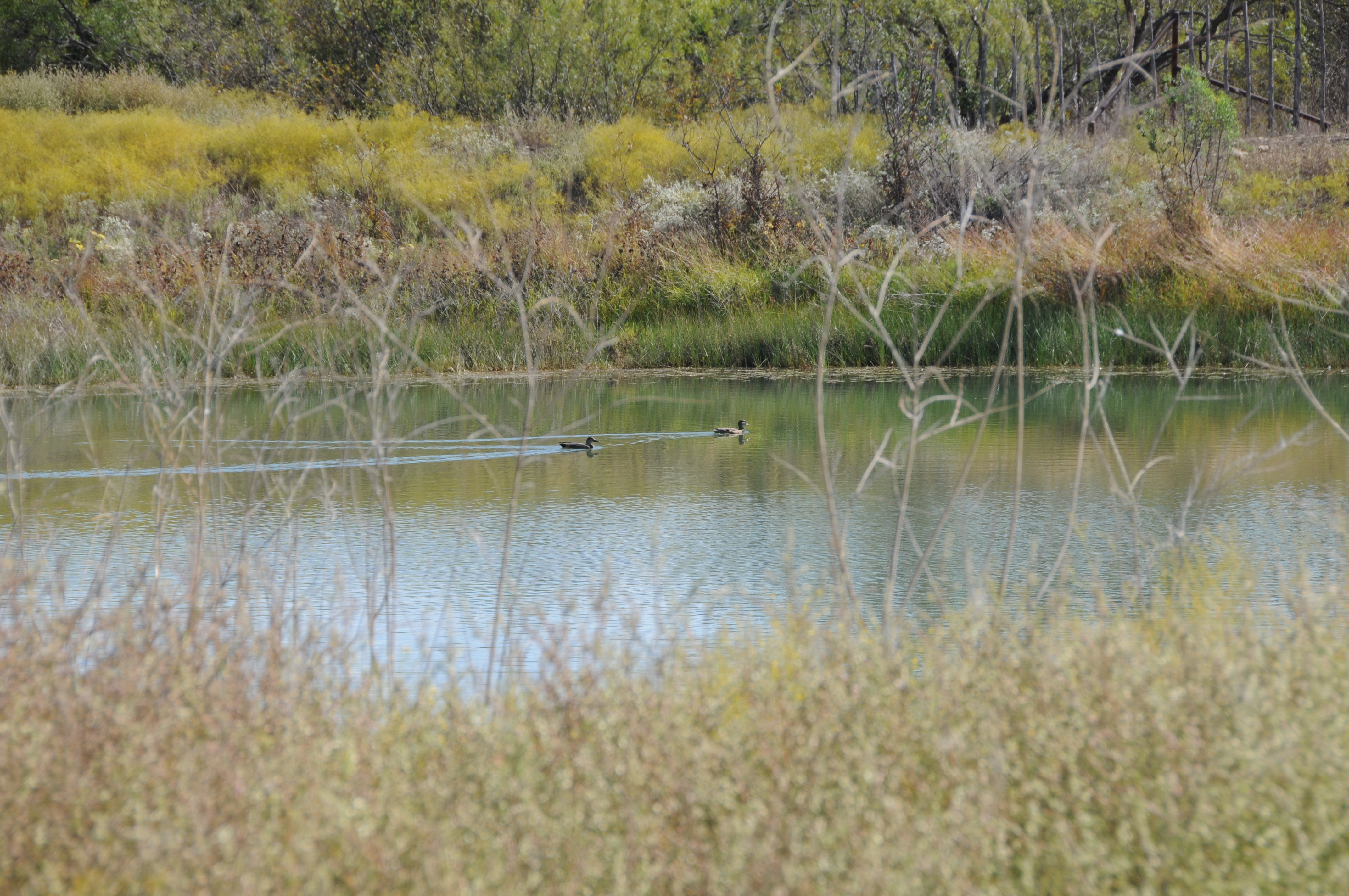
Two ducks on stock pond, November 1, 2010.

Your habitat, wherever you may be, probably sustains larger flocks of ducks, but I was glad to see these two ducks on our pond once again this Fall.

I walked across the Arena Pasture, diagonally to the road and directly to the pond, quietly edging up the slope and stopping in an area of broomweed in order to take a photograph of the two ducks.  I had seen them three days ago and yesterday there were a dozen or so of their acquaintances feeding on the pond.  When I finished snapping this photo, I walked on the road and scared up other ducks that were feeding, altogether about twelve.  I will be more careful and not frighten them to flight although they rise just enough to clear the cottonwoods and land on Blue Pond, our neighbor’s stock tank to the east of us.

I took this walk after lunch, down to the Grove and around the edges of Salt Creek that has several caches of water, but is not flowing owing to the lack of rainfall.  The water caches provide a source of water for deer, raccoon, fox and bobcat, among other species.  Birds drink their fill and as they scatter in the trees, I hear their wings slap leaves.  I walked, ambled is more like it, for forty-five minutes, taking photographs of foliage.

Yucca in the Grove as I ambled on November 1, 2010.

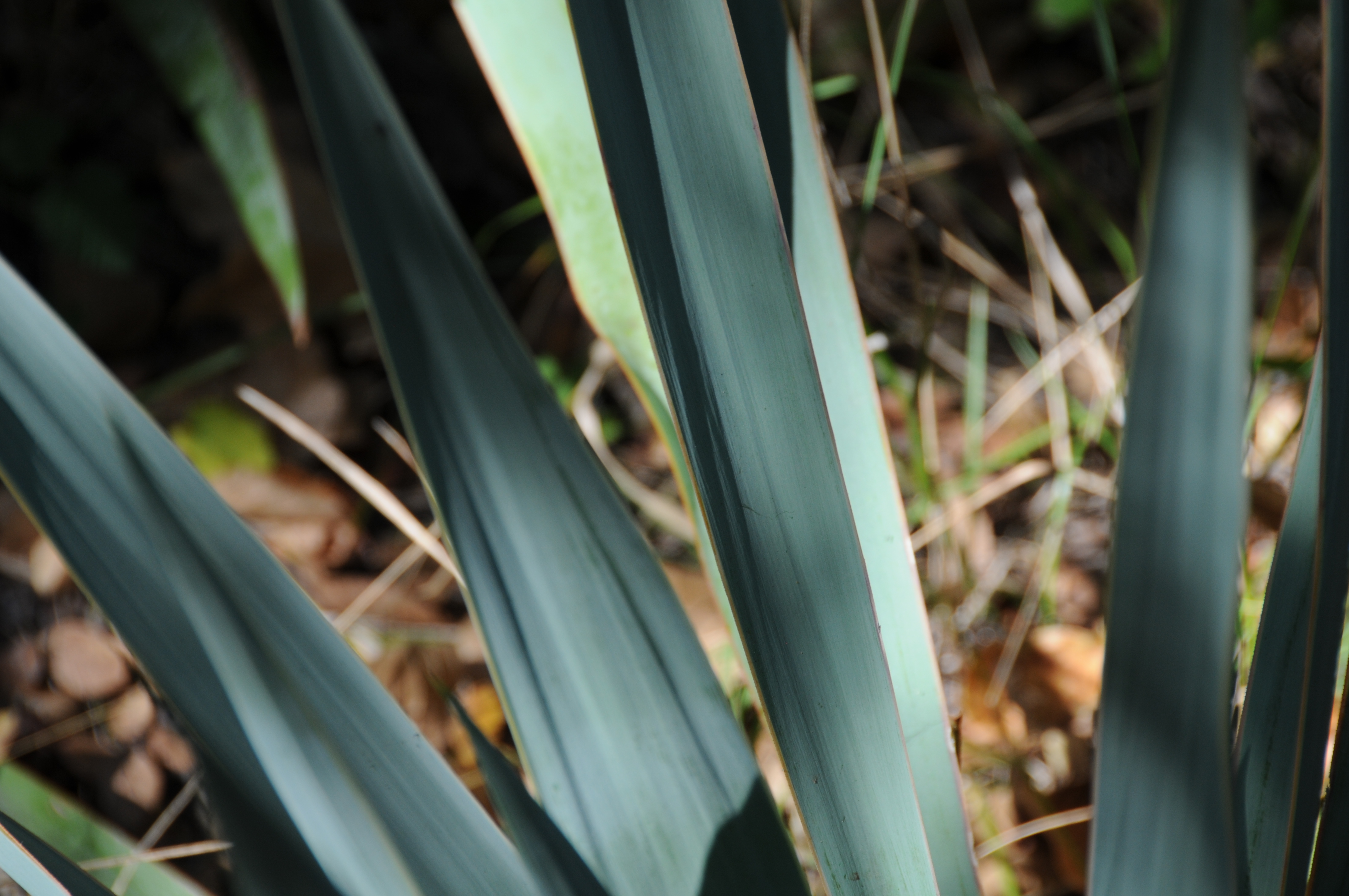
I came across a species of yucca that I must identify.  I think it different from the narrow Pale-Leaf variety we have close to the house.  This yucca has broader leaves and its color is a deep turquoise.  The turkey bones that Olivia, my granddaughter, and I discovered this summer have been carried off.  No feathers of the Thanksgiving fowl remain.  What animal would carry off bleached bones and feathers?

I eased into this walk today, relaxed and breathing deeply.  Nothing lay ahead of me except my next step, my scan of the ground and sky.  I would have liked company, but this solitude was restful and aimless, other than to walk to the far field and turn around to retrace my trail.  I could hear the dogs bark back at the house.

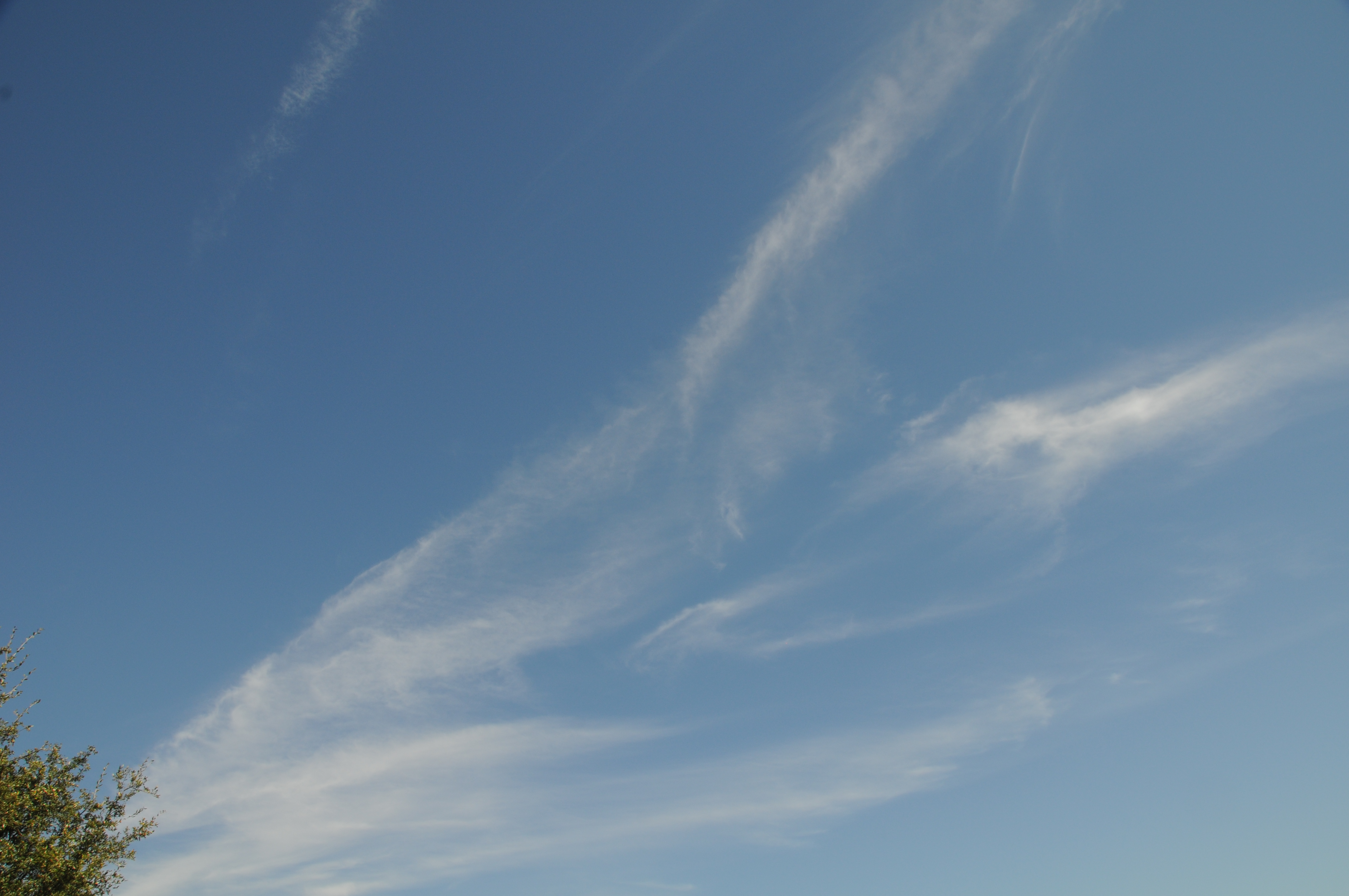
Then, I heard them.  Sandhill Crane.  I looked high and all I could see were the stratocirrus clouds.  Their calls are like burbles, water gently falling over smooth stones in a clear stream.  Gentle and calming.  I could not see them.  Their calls faded and I walked back up to the house.  I stood for a moment on the back terrace and as I started back into the house, I heard a flock of Sandhill again.  I looked up and 2,000 plus feet above me, a flock of crane flew.  They could of been higher above ground than that and as I pulled my camera up for my first shot of the season, I could not see them.  But I had seen them and they had such a pale-grey, whitish even, underside that it reminded me of the underside of jet planes I see above.  Their undersides reflected the clouds below them and I took a photograph of where they had been, aiming their graceful necks towards the southeast and warmer climes.

I shall photograph them soon, but today I could not find them low to our earth for they soared above me and my camera.  I heard them.  I saw them, but their image I could not preserve en camera today.  But I photographed two ducks for our Fall season.  What’s the saying, “Sufficient unto this day?”  I think so.

Stratocirrus where the Sandhill Crane had flown, November 1, 2010.

12 Comments

Filed under Birds, Ducks, Sandhill Crane