Category Archives: Adventure

Sangre de Cristo Notes

Over the past week, my wife and I have encamped near the Pecos Wilderness in the Carson National Forest of northern New Mexico, traveled the High Road of Taos down to Santa Fe and rented a pleasant room at the Inn at Loretto.  Observations noted during field work and retrenchment in the The City Different Santa Fe are listed below, impressionable and subject to interpretive change with further research as well as some drying out and recuperation.

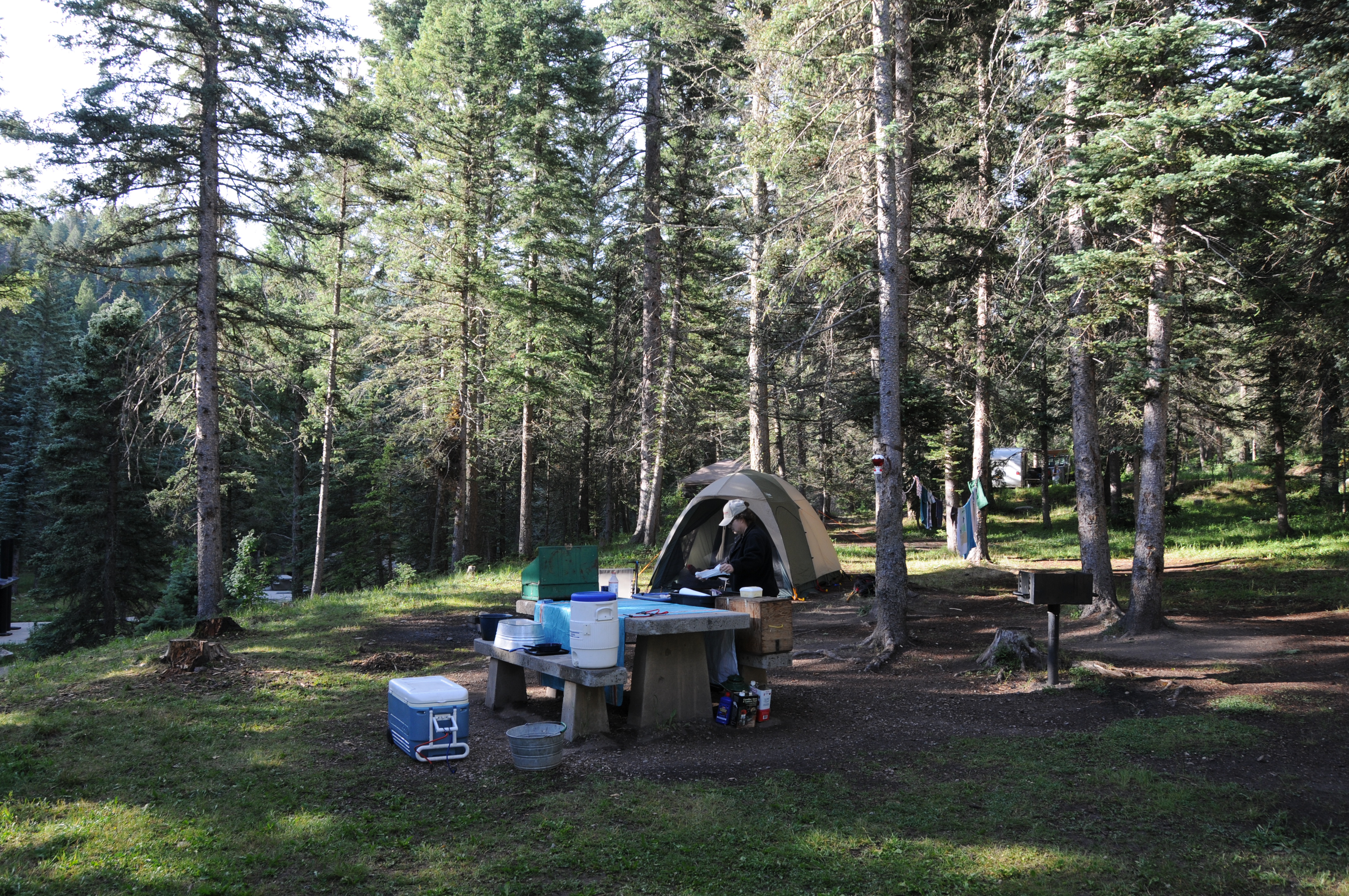
  • Santa Barbara campground, in fact all of the Carson National Forest campground facilities, has been contracted out to a private concessionary firm, Scenic Canyons Recreational Services, Inc. A resident couple permanently camp at the entry point.
  • Vegetation on the trail from Santa Barbara to Pecos Wilderness seems healthy and more intense than I remember in 1968.
  • The Chimayo Restaurant serves a spicy carne adovada, whose effect remains for hours (1).
  • The Trujillos of Chimayo gave us wood for three fires when they broke camp.  Mr. Trujillo has an apple orchard and a V-10 F-250.  Mr. and Mrs. Trujillo had camped beside us.
  • A fisherman from Rodarte, New Mexico, scanned the debris area of the space shuttle Challenger for several weeks.  They formed lines of 1,000 scouts, side-by-side and touching.  When debris was found, the whole line stopped while it was harvested.   He had been a U. S. Forest Service employee at the time of the disaster.
  • Considerable road improvements are being made on the High Road to Taos, straightening out curves.
  • The diamond hitch for roping cargo in our pickup works extremely well.
  • We ate at Doc Martin’s, Osteria, La Fonda, Luminaria, Casa Sena and 315.
  • Don Rael’s margarita at the La Fonda bar is one good concoction and we met Rael who created the drink.  At the bar, I met a young lady who works at the Santa Fe Opera and who once lived in Hurst, Texas.
  • Santa Fe Pale Ale now puts out a wheat beer.
  • Brenda and I danced at the La Fonda bar to the tunes of “Nadine” and “Luckenbach.”
  • Brenda gave me a birthday present: a sage-cornmeal-sea salt exfoliation and massage at the spa at the Inn at Loretto.  I am not given to such follies, but Brenda was insistent.  I have visited in the early 1970s the springs at Jemez after extended field work in the Gila.  The spa treatment was a little different.  Amelia was my therapist whose family is from East Prussia.
  • The Ernest Thompson Seton exhibit at the New Mexico Historical Museum is sad, inspiring and elevating.  President Teddy Roosevelt was wrong to have set Seton aside in developing the outdoor movement.  The Boy Scouts of America did award him, however, the Silver Beaver Award.
  • On the plaza, I hear more variety of music from several directions, sometimes at once, reminding me of  something old and ancient.  I hear dobro, banjo, guitar, mariachi instruments, harmonica, vocals.  This is an increase of variety from years past.  Locals are now coming back downtown in greater numbers to hear local bands and itinerant musicians.  The plaza is a family affair, all ages, reminiscent of older times.
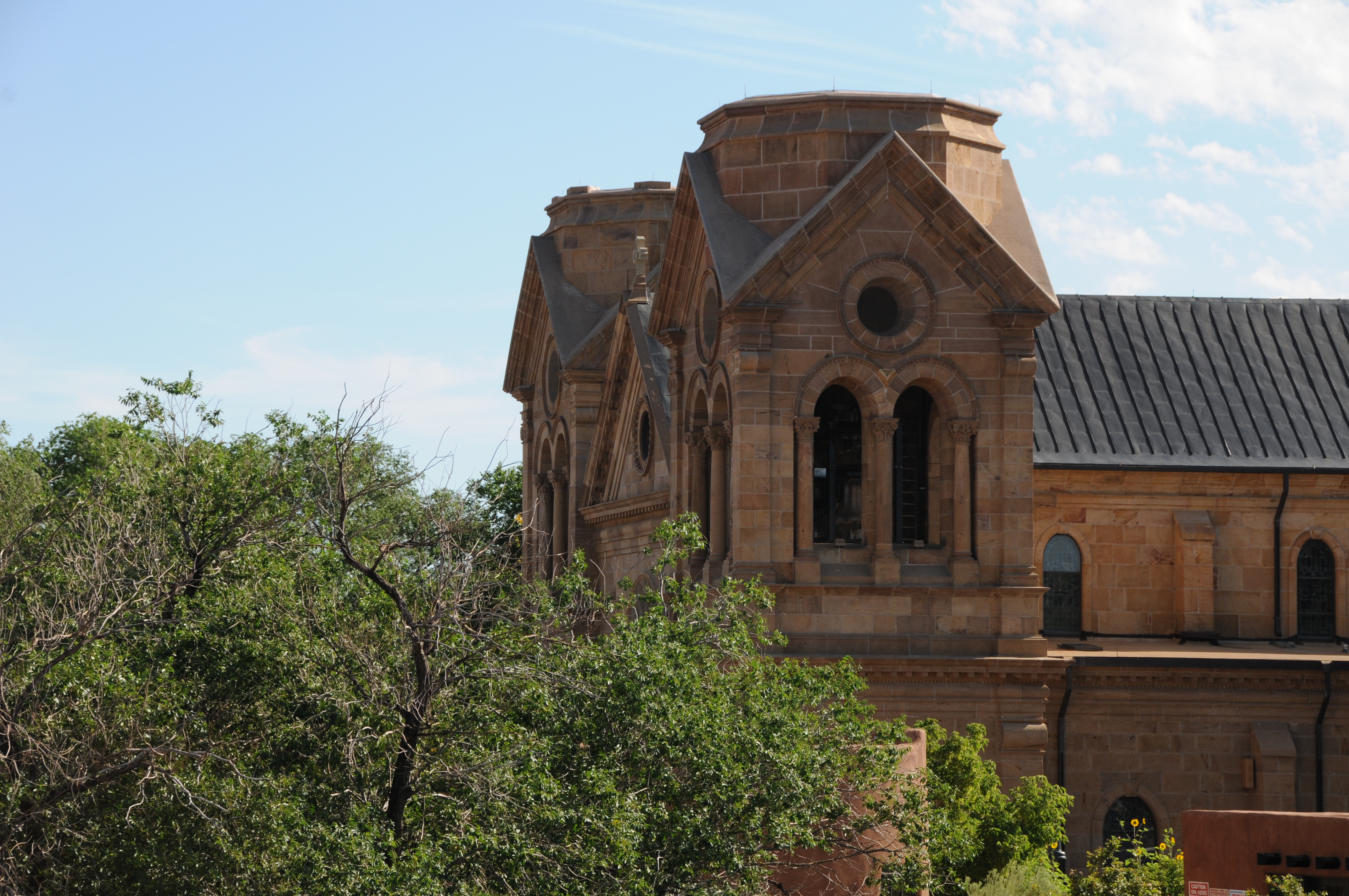
  • On Saturday, the bells of the cathedral of Saint Francis rang for two weddings in addition to regular tolling at 00:15, 00:30, 00:45 and the beginning of the hour.  At one of the wedding parties following the ceremonies, through terrace doors, we saw Mother and Son dancing together in celebration of the marriage to his lovely bride.

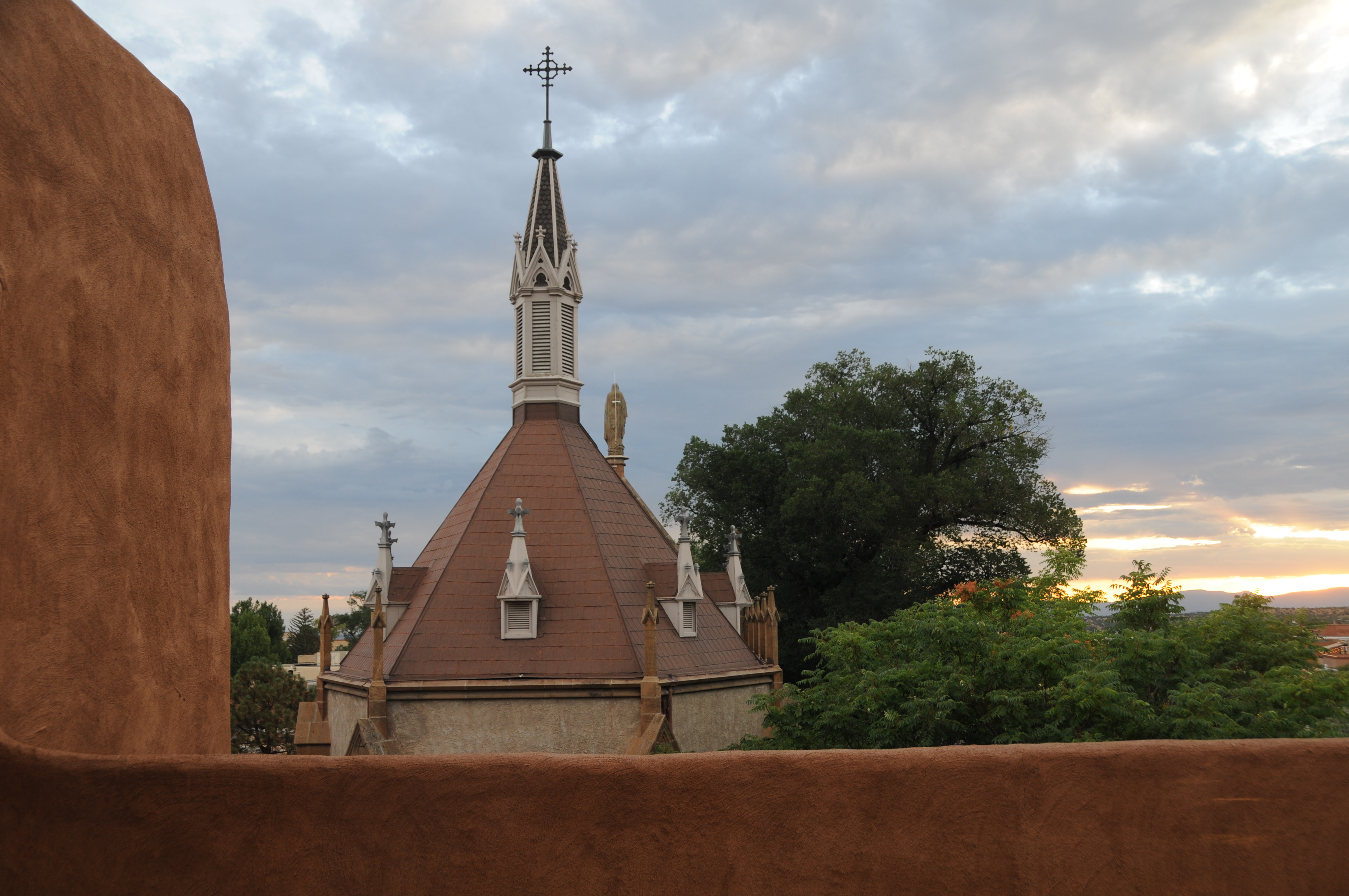
    St. Francis Cathederal, View from Inn at Loretto Balcony
______________________________

Notes:

1.  Presently, diacritical markings are omitted for Anglicized spelling because of expediency.

Plaza walking in the late afternoon  and early evening incites the senses.  There are food carts about the plaza, hanging baskets of flowers from the lamp poles, music and young children and grand parents playing.  A few couples are dancing when appropriate.  Some apparently homeless individuals are passing their time.  A number of people are lounging on the plaza grass.  I counted about 200-300 people about the plaza on an early Saturday evening.  People greet and meet, come and depart, lightened.

7 Comments

Filed under Adventure

Sharing the Trail? Guest Post by Ruth Karbach

[Ruth Karbach of Fort Worth, Texas, is an historian whose most recent work are two chapters in Grace and Gumption: Stories of Fort Worth Women, TCU Press, 2007. This is a comment she wrote in response to “Upper Llano Redoubt,” a recent post on the blog.  Ruth’s statement brings out issues we will have to resolve in the outdoors.]

Lone Hiker (All Big Bear California)

Last year my generous friend loaned me her home in the mountains of southern Colorado.  Solitude to commune with nature after a tough twenty months dealing with terminal illness of my beloved and grief with his death was the solace I needed.  Alerts about armed robberty on trails in the last couple of years were discouraging to hiking as a single female; but my two Shelties came to the rescue. We traveled many a trail during our week of “Rocky Mountain High” and meet some interesting people and critters.

Unprecedented in forty years of hiking state and national forest was being nearly hit by a mountain bike as I was helping my dogs up a four foot vertical embankment to get off the trail.  The two teen riders did not slow, move over or stop after I had to throw myself onto the embankment to avoid an accident.

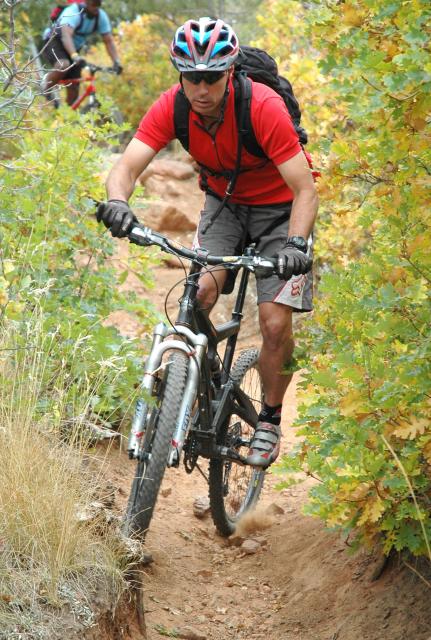
Mountain Biking (All Big Bear California)

My husband was a naturalist at a nature center and refuge which prohibited this kind of traffic because of environmental damage, and Fort Worth supplies park rangers to patrol the largest city owned nature refuge in the Continental U. S. People unfamiliar with nature do destructive and unthinking things sometimes endangering animals and themselves.

With the present economy we are seeing more neglect and underfunding of the quality of life services such as libraries, parks and the arts.  To me, this is the time when these services and talents are most needed.  During the Great Depression greater wisdom in government caused a flowering of public arts, building of park structures and funding by local businesses and individuals of book purchases for libraries.  Have we become too urban, too materialistic, too self-centered a people interested in immediate gratification?  I hope not.

Ruth Karbach (Facebook)

1 Comment

Filed under Adventure

Upper Llano Redoubt

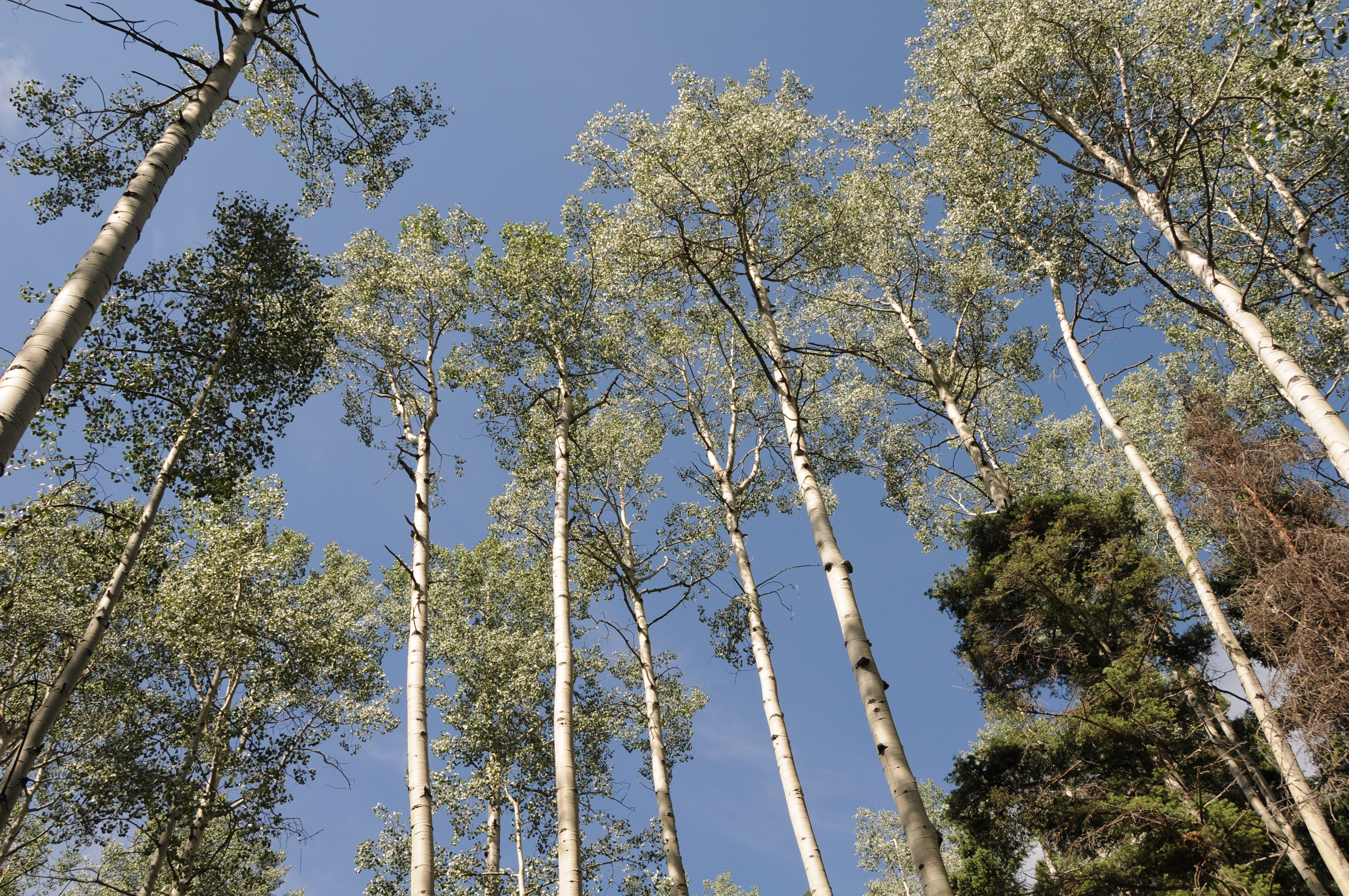
Aspens

A yearly trek to the northern New Mexico mountains encounters warmer temperatures and a reflection on the ethical use of firearms when confronted with dangerous and rude behavior, leading to a conclusion that visits to some national forests become occasions for redoubt construction in a search for solitude in modern times.

Preparation for Upper Llano Camping Delayed

Our vacation this summer has been postponed several times.  Fanny, our youngest mare, injured her leg and I had to make sure she was healing before heading outdoors in northern New Mexico.  Once she was on the mend, we packed the F-250 with group-camping gear, tied a diamond hitch about the tarp and drove to the Upper Llano area near Penasco and pitched camp along the Rio Santa Barbara (latitude 36.08556, longitude -105.60833).

We had looked at eighteen acres of land bordering the Carson National Forest several years ago near Llano.  An acequia bordered the parcel we came close to purchasing, but in the end we decided to wait a few more years and look again.  We were not in the market for land this summer, but wanted cooler ambient temperatures for a few days, relief from Texas July weather.

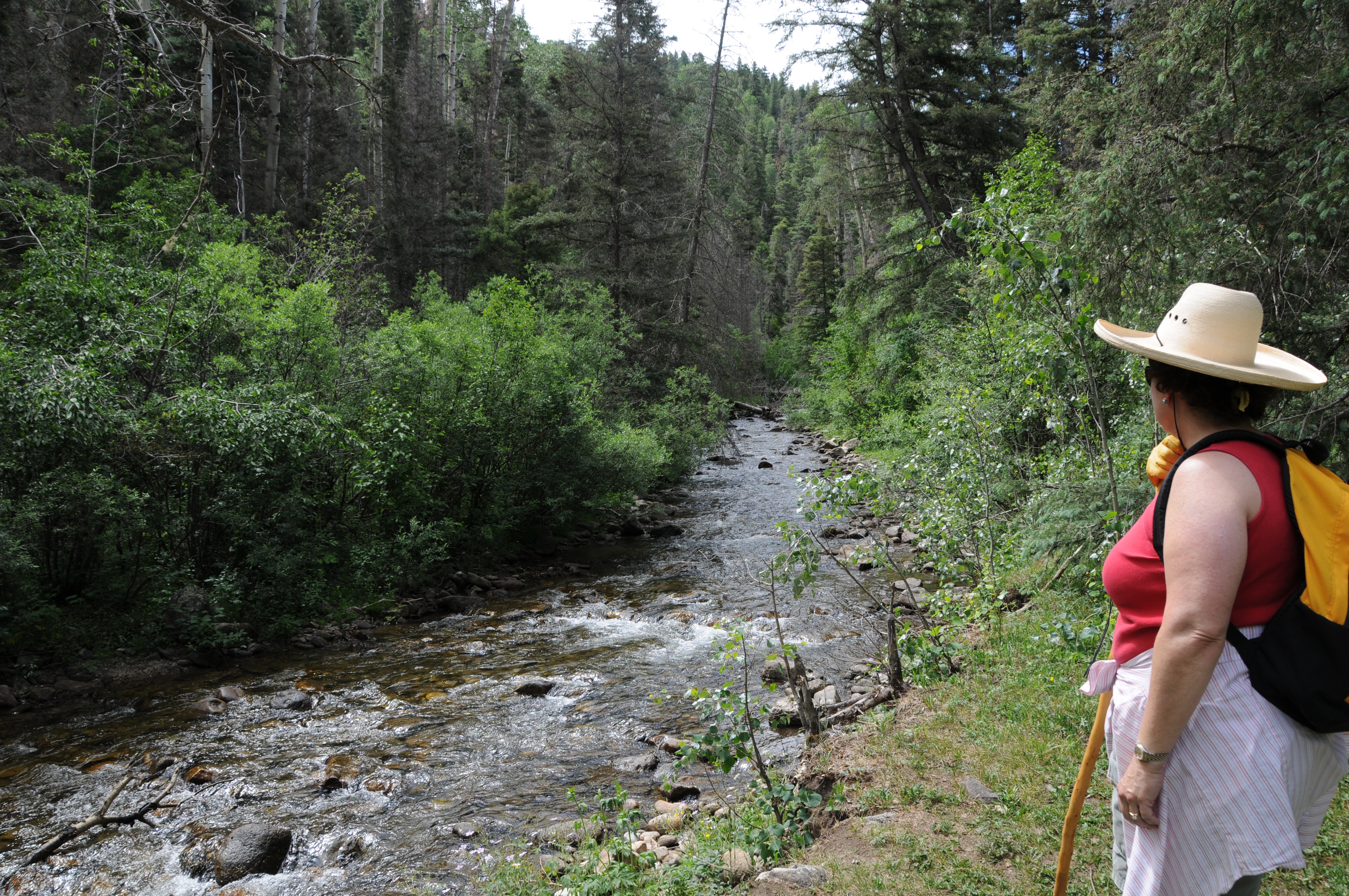
Brenda and Rio Santa Barbara

Basically, near Upper Llano, we have experienced cooler temperatures, especially in the mornings.  Our camp site is at 8,500 ft. amidst spruce, fir, aspen and ponderosa, a sub-alpine zone.  Temperatures during the day in the mountains have been about 83 deg. F., and at night, probably in the lower 40s.

Hiking into Pecos Wilderness

Brenda and I hiked into the Pecos Wilderness for three miles and admired the fern and sub-alpine flora.  My first hike into the northern Pecos Wilderness occurred in 1968, and much remains the same, perhaps an increase in vegetative cover and I think the aspens are much, much higher.

What Would Teddy Roosevelt Think?  Or Gifford Pinchot?

The U. S. Forest Service, however, turned campground management over to a private concessionary, Scenic Canyons Recreational Services Inc. , Hyrum, Utah.  The daily fee is fifteen dollars for an improved site, although one may camp off the grid, porting water and digging latrines.  Since the Forest Service has Stage 1 Fire Restriction, no fires are permitted outside the developed park campground, one would be reduced to precooked meals (1).  Not an attractive choice.

We decided to pitch camp within the developed area.  We stayed for four nights and days.

I saw no U.S. Forest Rangers in pickups or horse packing into Carson or Pecos Wilderness.  When I first started coming up to the Upper Llano forests and Carson in the 1960s, I would at least see in the established campgrounds, a forest ranger in a pickup once a day, sometimes twice.  And, back in the forest or wilderness area, I would come across a ranger every few days or so.  By the longest of shots, I am not given to the idea that a gendarme on every trail is necessary, but to see none in four days and nights, is not good.

Reflection on Personal Security

My idea of security is that a person is in charge of their own safety and protection first, then call in the law when the dust settles or the event indicates the odds are mightily against you.  By those lights, I have learned basic defense skills and also pack pistols and rifles when necessary.  I offer absolutely no apologies for doing so.  I was reared with firearms and they have provided protection from poisonous and rabid critters and, on one occasion, food for my family’s table when resources were scarce.  Above these reasons, however, is protection against invaders and aggressors —  man.  (On two occasions in my family, firearms were used for personal protection.  Fortunately, I have never had to use them.  Several years ago, two miles down our county road in Texas, three people were killed in a crime of revenge.)

I pack pistols on every camping trip.  This trip, the hog legs were a .357 magnum Colt revolver and a .45 cal. Colt semi-automatic.

I did not carry them with me when we hiked up into the wilderness for a short, three-mile hike.  It was a leisurely hike and we were close to the main trails and no reports of trouble had been rumored among the local campers.  We hiked, took photographs and returned to base camp.

Yesterday, July 16, we broke camp, hummingbirds whirling about us, and drove down the High Road from Taos to Santa Fe, the Upper Llano left behind, reluctantly.

Trouble in the Back Country

Today, I pick up The Santa Fe New Mexican and the headline is: “Hikers Report Trouble on Trails.”

The summary of the article was that a man was attacked by a mountain biker on a trail in the Santa Fe National Forest when he complained that the biker needed to leash his dog after the dog twice charged after him, his wife and their leashed dogs.  The biker hit him several times and threw him down the hill, stating he was going to teach him some trail manners.  The second incident was up in the Pecos Wilderness (south of the Truchas Peaks where we hiked) where horsemen fired a pistol and made rude remarks to female backpackers.  They were drunk.  Pistols are not always peacemakers.

So much for solitude.

A Partial Solution to Violence in the Back Country

Who can stop such incidents?  It’s an imperfect world and there will always be some ruffians about, but the lack of U. S. Forest Rangers on the trails and campgrounds establishes a context of free-for-all and uninhibited behavior.   Ethics and codes exist outside of federal and state regulations and that assures in most cases a chance to enjoy nature, wild and free.  I saw more respect for the rules on the trail and while encamped in Carson than I saw disrespect.  Men and women are generally given to cooperation rather than competition and confrontation.  The U. S. Forest Service, however, needs more rangers in order to establish a presence of authority so incidents like those reported in The Santa Fe New Mexican can be reduced.

I will continue to hike and encamp as usual with all our equipment.

Tenting at Rio Santa Barbara

Next post: dining from the Pecos Wilderness to Santa Fe and follies in between.

_____________________________

Notes:

1. On July 9, 2010, the Taos District of Carson National Forest released a bulletin that the Stage 1 Restriction had been lifted because of predicted moisture and monsoon season.  I did not know this until today, July 17, 2010, as my last contact with the Taos District was on July 7.

11 Comments

Filed under Adventure

Is This the Way to Idaho?

In the 1970s, in the middle of May after I finished teaching the spring semester, a few of us guys from Amarillo, Texas, would go camping in New Mexico and Colorado before snow completely melted in the mountains.  We called our movable camp, The Rendezvous, after the “present yourselves” French word, and more historical, the mountain man trade meetings in the early nineteenth century.  We camped out for a week, avoiding established campsites in favor of back country in the national forests:  Gila, Kit Carson, Isabell.  We took several pickups and one pop-up Coleman camper, tons of grub, beer (before several guys went on the wagon in the late 70s), money for bail, and reading material.  Over the decade of the seventies, we camped from the Conejos River Valley in Colorado to the desert boot heel of Columbus, New Mexico.  We bailed our friend out of jail at Tierra Amarilla and ate native plants near Jemez Springs.

One May, we started our movable camp at Holy Ghost Canyon near Santa Fe, up the Pecos River , then northwest ascending Holy Ghost Creek.  Getting to the campgrounds was tedious, dangerous, and way, way far into the forest.  The road to Holy Ghost turned into a one-lane, barely passable road where if you met a car or truck, you usually had to back up to a side cut in the road so both could pass.  Warning signs back at the main road that goes from Pecos to Cowles alerted recreational vehicles from ascending to Holy Ghost Campground, although stock trailers could usually make the trip to pastures in the high country of the Sangre de Cristo Mountains to round up cattle.  Holy Ghost Creek was far away from normal camping areas.  Remote, quiet, and unnerving.  We really liked it even though it was built up with national park structures, tables, outhouses, the like.

After a couple of nights, we planned to leave Holy Ghost and venture elsewhere.  But before we left, three of us had to go into Terrero for some supplies.  Terrero was back at the crossroads to Cowles, a beautiful place at the entry to the Pecos Wilderness area.  We got in a pickup and headed back down the road following Holy Ghost Creek, coasting down the narrow road and being careful lest we run off to the side of the road and down the embankment.

About halfway down the road to Terrero, we met a car, an aged maroon Impala Chevy, driven by an old, mostly toothless driver waving frantically out the window for us to stop.  We slowed down and saw the car was filled with camping gear and trash, up to the window sills in the back seat and papers and junk on the dashboard.  The driver was alone.  A little Chihuahua dog was barking like crazy inside the car, running over the camping gear and junk in the back seat.  The driver was wide-eyed and hair-blown.  When we halted, he stopped waving.  We thought there must have been a landslide or accident down the road and he was summoning our aid or warning us to turn around.

We pulled closer so that we could understand him over the barking Chihuahua and truck, and still hanging out the window, the old man shouted at the three of us:  Is this the way to Idaho?

I thought: for god’s sake, mister, Is this the way to Idaho?  Do you know just where in the hell you are?  Apparently not.  That’s why the question, but you are at least three states away from Idaho and if you continue up the road, you will dead end at Holy Ghost Canyon.  There’s no way out.  Further, you are way off the Interstate 25 by at least fifteen miles.  Our Rendezvous group of revelers could barely navigate the road to Holy Ghost and you are looking for Idaho?  Up here?

We wanted to help.  So, being courteous to the old coot, we answered his question:  No, this is not the way to Idaho, you are pretty far off the beaten path for that, old timer.  We gave him correct directions back to Pecos, then to the interstate.  He thanked us and drove up and I guess turned around at Holy Ghost and went back to the highway cause we never saw him again.  We slowly drove to Terrero for supplies.

The three of us very nearly fell out of the pickup in laughter:  Is this the way to Idaho?  We must have told that story a hundred times over the years, but we pitied the old man in a good way.

We knew he was disoriented and probably a bit addled, but with his Chihuahua and car full of camping equipment, he probably wouldn’t hurt himself, but spend his days, driving the backroads,  trying to find the road to Idaho.  He could have been in a lot worse place, say, the Golden Age Nursing Home, looking at television.  The old guy, I think, was much better off searching for Idaho, El Dorado or the grail in the Great West of North America than watching reruns of Bonanza from bed.

17 Comments

Filed under Adventure, Recollections 1966-1990

Leroy and Alibates

Taos, 1970s…

Leroy, a northern Tiwa, came over and sat beside me on a bench on the Taos city plaza before they removed the jail that plunged beneath the ground on the northwest side.  It seemed a dungeon, of sorts, the jail.  Could be a Taos County law enforcement kiva?  Hey! he said.  Hey, back.  I read a newspaper.  We talked that day.  We talked the second day.  Jack, can you loan me ten?  Yes, I said.  It may have been the first day he wanted the ten.

Leroy and I talked the third day, on the plaza before they covered the jail underneath.  He said he used to make jewelry, but it bored him and he quit and drank too much.  So, he said, I came back here, to the pueblo.  More conversation.  I was from Amarillo, loved to come up to the mountains, the high-desert country, I confessed.

I liked Leroy.  So, I gave him a gift.

Out of my backpack on the third day, I brought out a paleolithic axe I had discovered in an exposed sandbank in the middle of  the Canadian River near the Alibates flint quarry in Texas.  I had waded across the Canadian River when it was low in the winter to find the 1849 rock cairns of Major Randolph B. Marcy when his survey team mapped a southern transcontinental railroad route.  I found Marcy’s cairn.  My legs cramped from the freezing, cold water when I waded across the Canadian River and when I came back.  The muscle cramps were worth it: I found a rare tool, a paleolithic axe, perfectly formed, grayish-blue.  And, I’ve never found such a prize since.

I handed the axe to Leroy.  He took it in his hands and then quickly raised it to his cheek and rubbed the Alibates flint axe against his face.

Why the rub against his cheek?  He smiled.  Ahh! he said.

It’s yours, I said.

All I can remember now is that he said, Ohh.

Then, Leroy:  Let me take you to the pueblo and up the mountain, Jack.

We went together up the Taos Mountain that day with his cousins in a blue Volkswagen with sunroof.  Towards Blue Lake, towards the sky, towards birch trees all around.

4 Comments

Filed under Adventure, Colony Road, Recollections 1966-1990, Taos

More Santa Fe Blizzard Express

Hermleigh, Texas, December 24, 2009

Hermleigh, Texas, December 24, 2009

Roscoe, Texas, December 24, 2009

Roscoe, Texas, December 24, 2009

Jack Matthews, Roscoe, Texas, December 24, 2009

Farm Fields, Slaton, Texas, December 24, 2009

We had been keeping up with weather forecasts before we left at 5:00 a.m. CST from our home in Mingus, Texas.  The weather forecasts on December 23, indicated that the Arctic snow front would pass through the Texas Panhandle and Oklahoma, bypassing our route on Interstate 20 to Sweetwater, Roscoe north to Lubbock, then Clovis, Santa Rosa, Santa Fe.

On December 24, we left Mingus, temperature 37 degrees.  We first encountered snowflakes in Eastland, Texas, but before that, only minutes out of Ranger, Texas, a Federal Express double-trailer had overturned, indicating, perhaps, high cross winds.

The snowflakes would not subside until we reached Lubbock at 2:00 p.m.

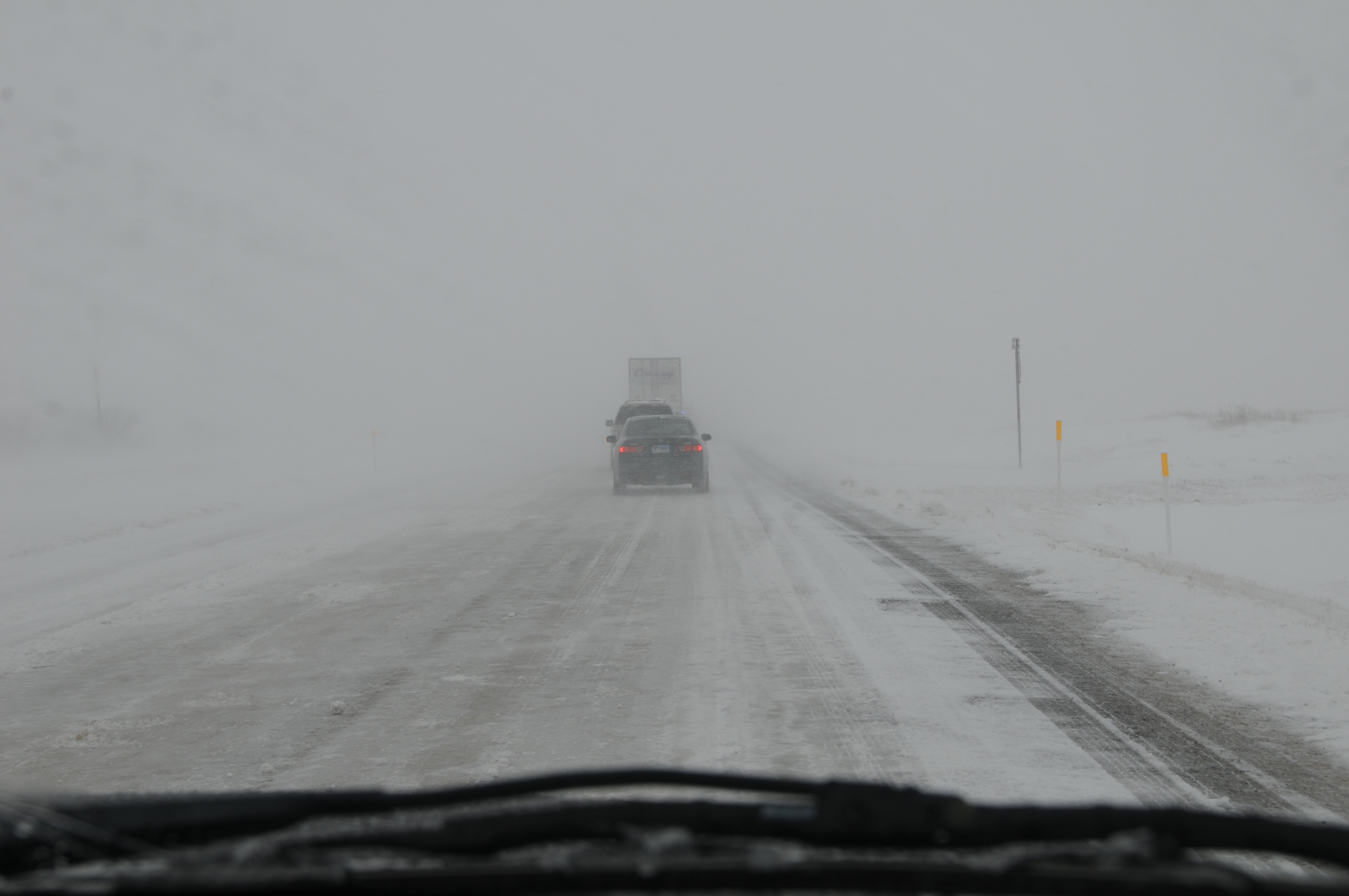
We did not encounter snow accumulating on the road until Sweetwater where we made a rest stop.  At Sweetwater, the temperature was below 30 degrees.  By the time we reached the turnoff to Roscoe, Texas, then north to Lubbock, the snow had accumulated on the highway and the wind blew the snow to a white out for a few seconds every so often.  The turn off at Roscoe was treacherous because a white out suddenly occurred at the intersection and I had to “feel” the turn for a few seconds.  At that point, I decided to go into Roscoe and put the cable-chains on the back wheels of the F-250. We also considered staying put and waiting the storm out and Highway Department to clear the roads.

The F-250 I drive is a 2003, the last year they made the 7.3 liter diesel engine.  Our F-250 is maintained precisely to the Ford Motor Company’s guidelines, plus a few of our own.  As a consequence, we have 240,000 plus miles and it pulls a twenty-six foot tack and stock trailer or a flatbed with a DX-55 Case tractor.  We had a full fuel tank, blankets, phones, and food and water.

At Roscoe, I put the chains on and we ventured out again on the highway to Lubbock.  At Hermleigh, we stopped at an Allsup’s for a rest stop but the convenience store was closed.  Our daughter in Lubbock called by cell and said that there was a thirty-two car pileup at Post, so we first decided to go from Snyder to Lamesa, then Santa Fe by various routes, but the latest reports at Allsup’s from truck drivers indicated that the wreck had been cleared.

The wind turbines at Roscoe and Hermleigh were hidden by the snowstorm, but occasionally the wind would die down and we saw the giant turbines, less than a quarter-of-a-mile away, slowly turning in the storm.  Nothing else but snow and the turbines.  We maintained a long distance between ourselves and the car or truck in front of us to give us time to stop.  Yet, we did not have the respect from cars in back of us.  Truckers, however, gave us space.  Since we had chains and traction, I could ease over and let cars and trucks pass us.  Several cars that passed us we later saw in the ditch or median.

Our speed could not exceed 30 m.p.h. with chains.  Finally, at Post, Texas, we stopped and I took off the chains.  Between Post and Lubbock, we were diverted by the Highway Department to tour along the access roads and avoid going over bridges.  In Slaton, a U.S. Postal Service truck was blocking the overpass because it had no traction and was stalled.  We saw several National Guard medical vehicles headed south from where we had come.  We later found out that Governor Rick Perry had called out fifty National Guardsmen to assist in rescue efforts.

From Post, then, we had no chains, but the Highway Department had cleared one lane by the early afternoon on the highway.

At Lubbock, we visited with our relatives and left Lubbock at 4:00 p.m. for Santa Fe, arriving at 9:30 p.m. MST.

Notes

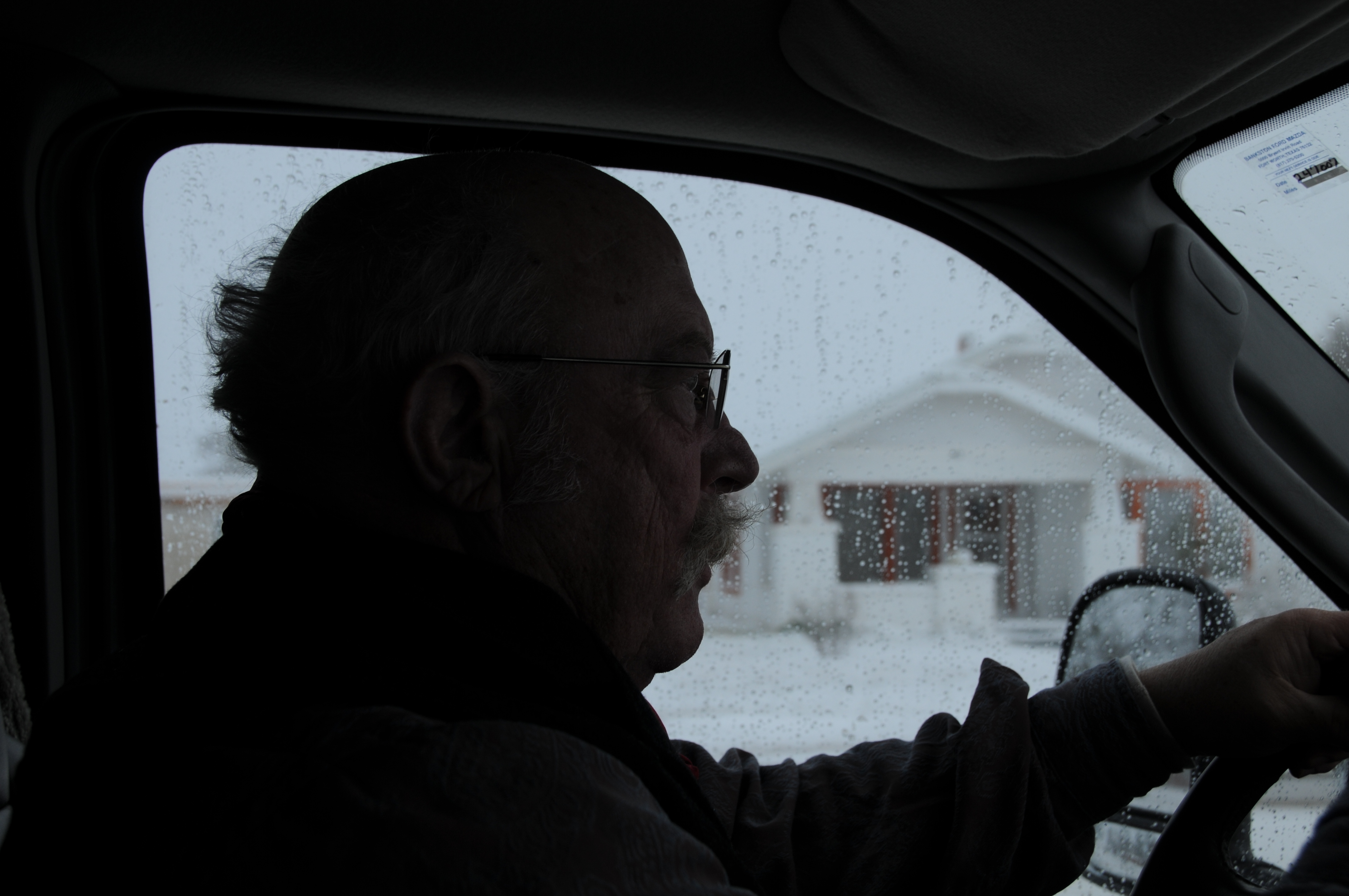
“Postscript by Brenda:  Jack’s writings depict the experience perfectly.  What cannot be conveyed completely was the stress and emotions of the eight-hour drive to Lubbock…but, the picture of him above portrays his attentiveness.  I was never terribly worried because I knew he was an excellent driver and near obsessive over safety.  Yes, I wish we had left a day earlier, but I am happy to be in Santa Fe!  Brenda Matthews, 12.28.2009.”

11 Comments

Filed under Adventure

Santa Fe Via Blizzard Express

We made it to Santa Fe, New Mexico, yesterday evening at 9:30 p.m. MST, six-and-a-half hours behind our schedule, slowed and stopped by an unexpected blizzard that blasted into west Central and Panhandle Texas.

Nature commands, we follow.

We missed the farolitos and canceled our reservations at Casa Sena, but arrived at our hotel for the night.  There was room at the inn, if you call ahead.

4 Comments

Filed under Adventure

Blue Ground I

In 1977, I climbed Mount Taylor during the day and came down the mountain in the evening by full-moon light.  The coming-down at night was unplanned.

I still climb mountains, not with rope and anchor, but one foot in front of the other, up the trail to the summit where a cairn is located, signing my name on the log book tucked in a steel tin.  Mountaineering climbs test body, attack motivation; high altitudes increase depression, morbid thoughts.  One of my climbs, Mount Taylor near Grants, New Mexico, combined the usual test of fortitude with a special insight into mysticism.   Mount Taylor is the southern holy mountain in Navaho mythology and I was determined to see what was at the summit and, more importantly, what was on the mountain that made it sacred.

To be candid, the nature of man’s life is radically material.  For a short period of time, the individual is formed as an ensemble of perceptions and sensations, the life cycle, four score years or so.  Before birth, the ensemble, there is oblivion and after death, the same:  oblivion.  But during the ensemble, there is life, movement, talking, sensing.  Religion, magic, and witchcraft exist as explanations about oblivion, life, oblivion.  Saints, sages, and shamans that seek to explain are in the end, like Thomas Aquinas, swept away by the magnitude of life, the universe, that they become silent (or should) and express only that the ultimate mystery is ineffable [1].

That the ultimate mystery is unexplainable should not mean despair, immobility.  It often does petrify.  Nevertheless, take the body and place it there, here, over there, up there, down there!  Explore.  There is the mountain, desert, ocean, space.  Witness the inexpressible grandeur of the place.  It is all we have, but it is quite enough.

My reasoning, therefore, in climbing Mount Taylor was to put myself on top of the sacred mountain to encounter the ineffable or, at least, be present in nature at a high altitude, looking at vistas from the summit.  I would be a moving participant, a spectator, to the incomprehensible spirit that moves in all things.  I was not in search of the supernatural or mystical in the conventional, religious sense.  Within my life, I wanted to place myself in nature at her most inspiring locations.  That was all, but quite enough as it turned out.  For at the climb’s end, that evening, the coming-down time from Mount Taylor, I saw blue ground, but I did not understand.

(Next, Blue Ground II)

Notes

[1]  Bertrand Russell, “A Free Man’s Worship,” in Mysticism and Logic. See also Four Noble Truths, Eightfold Path of Guatama, “The Benares Sermon of Buddha–6th century BCE,” in Elsa Nystrom, Primary Source Reader for World History, Volume I to 1500, Wadsworth, 2006, pp. 38-39.

7 Comments

Filed under Adventure, Colony Road