Monthly Archives: August 2010

Siesta in Mingus

Texas heat and the great, fiery bronze orb in the sky drives us into long siestas these August days.  Temperatures in the 100s bleaches the hair on my horses.  Star, my big paint gelding, loses the black color on his head to a color of creamed coffee and his browsing during the afternoon comes in bursts of fifteen or twenty minutes before he seeks the shade of the live oak trees in the corral.

I stay inside the house from about 11:00 a.m. until 6:00 p.m.  At six o’clock I go down to the corral to feed the horses and my barn cat, Painters.  But, most of the day is siesta, hiding from the heat.  If this is a foretaste of global warming, we are all in for despairing afternoons.   Buy misters to put on the porches, turn the air conditioners to 75 deg. F. and put the ceiling fans on medium speed.  Put ice cubes in the bathtub with your daily wash.

The highest spot in Texas is in the Guadalupe Mountains of west Texas.  Guadalupe Peak is 8,749 feet.  Is it cool there?  The National Park Service that manages the park does not report the temperature on their web page.  I frankly can’t answer if it is cool or not on Guadalupe Peak.  I’m busy taking my siesta in Mingus.

12 Comments

Filed under Flying Hat Ranch

Let the Scallop Be (Field Log 8/1/2010)

North Erath County, Texas, Lat 32.43 N, Long -98.36 W, elev. 1,086 ft. Turkey Creek Quad.

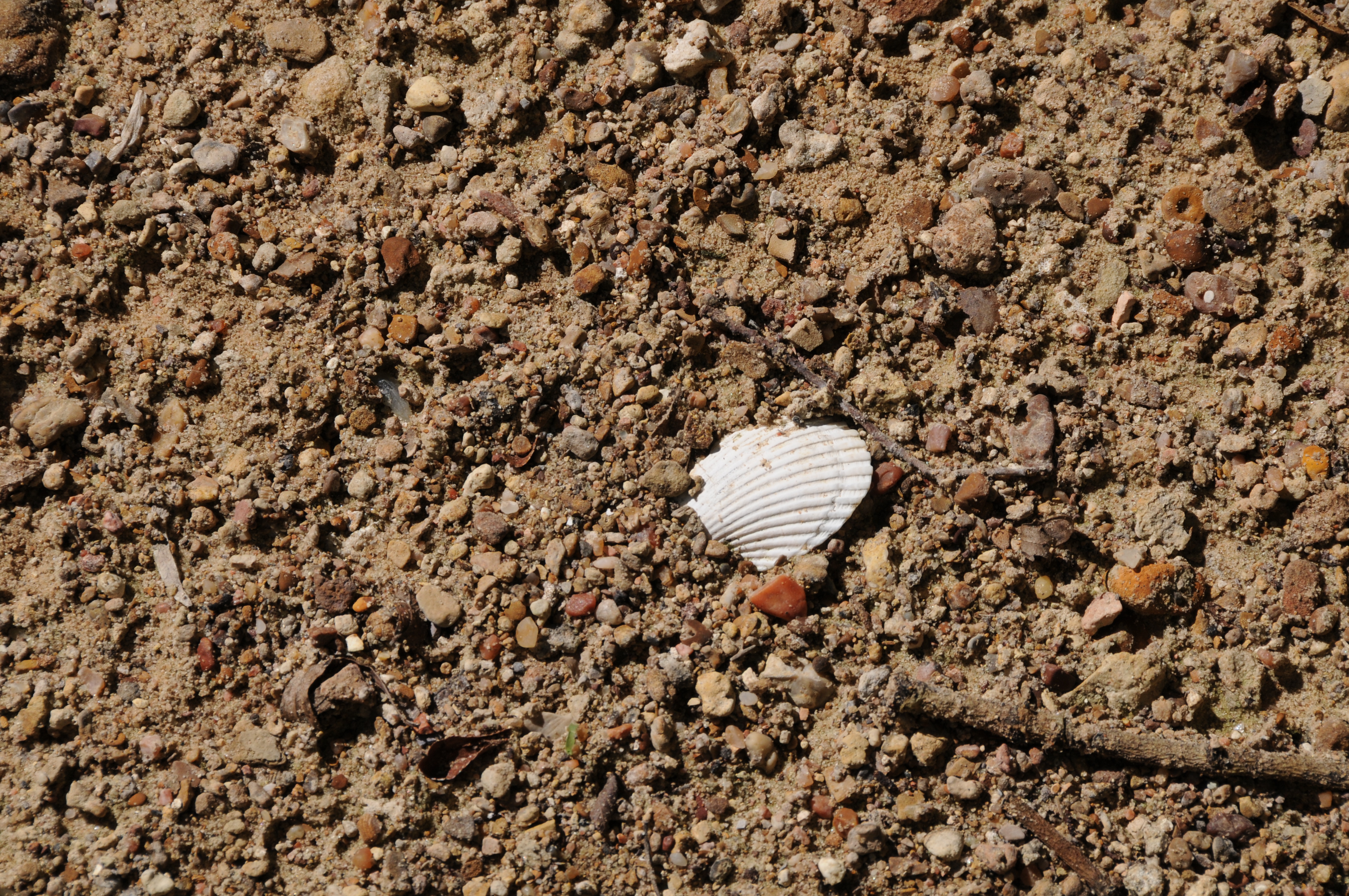
[I incorrectly identified the shell (see photograph above) as a mussel shell and had written in the notes section of this post that I would change the title and identification if someone knew their shells better than me.  It is a scallop shell, well-bleached.  My good friend, Caralee Woods of Kanab, Utah, sent a comment about my incorrect typing and I have made the necessary changes for accuracy in the post.]

Jack, I hate to be the one to tell you, and I’m not a biologist, but I did have an extensive shell collection as a child (I still have it somewhere)! I learned a lot about shells in those days, and I can tell you this ain’t a mussel! It appears to be one half of a very bleached-out scallop shell. I know you’ve eaten mussels, so you know that the mussel shell is tear-shaped and smooth inside and out. The scallop is ridged as you see this one is, and rounder in shape.

Caralee Woods of Kanab, Utah

A high pressure sits above Texas.  Temperatures predicted here in north Erath County are in the range between 100 and 105 deg. F.

10:00 a.m.  I drive in the F-150 towards the grove.

Barn swallows are flying two to five feet above the pasture grasses, eating mosquitoes.  In my shredding of broomweed over the past week, I focus on shredding it alone — broomweed — leaving native grasses and coastal bermuda for insects, loafing areas for the jack rabbits and cottontails and browsing for the horses.

At the pond, a Red-tailed hawk flies from its perch in the willow tree or live oak tree that borders the north side of the pond.  The hawk flies low to the ground, ten feet or so, in the direction of Blue’s pond over the fence line.  I shall be careful next time and try to photograph the Red-tail.

In the grove, above the creek bed, the temperature falls slightly.  Birds are silent.  One bird, a finch encircles me and then flies into the brush.  Cicadas chatter, sawing a melody, then silent.

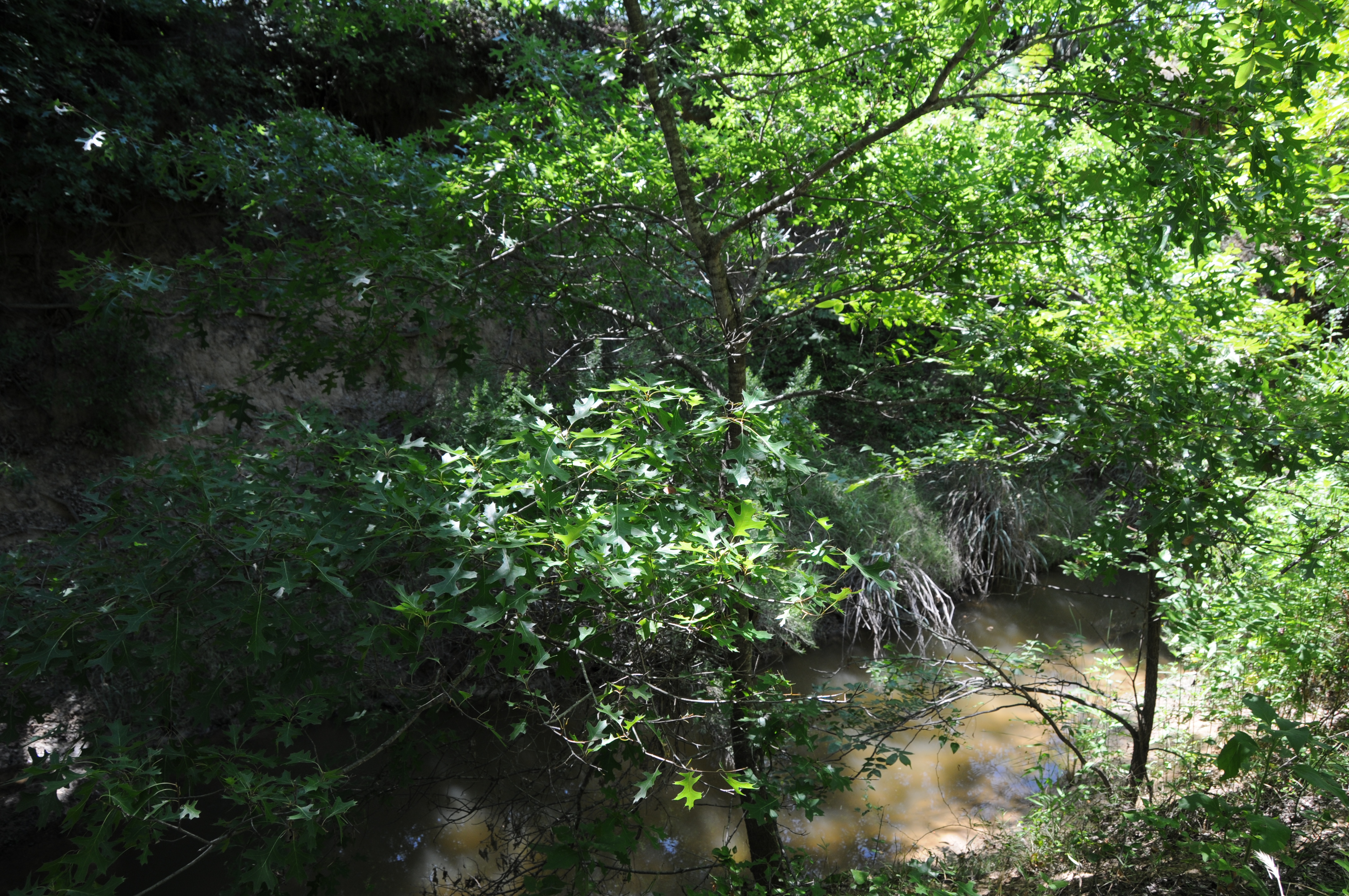
Along the creek bed next to the native grass pasture (Pecan Tree Pasture), pools of clear water stand under oak, pecan, elm, ash and hickory.  Willow and a few cottonwoods grow close to the water.  The temperature falls significantly under the canopy of trees.  The trees are vibrant.  Mustang grapevines erupt leaves, some vines for the first time in years.  This riparian swatch regrows.
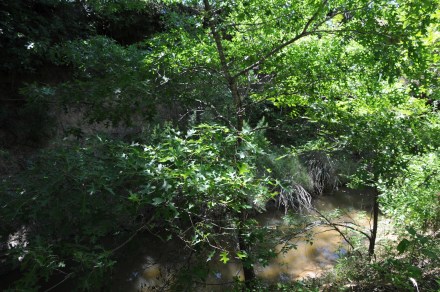
The Riparian Swatch, Salt Creek, Flying Hat Ranch, Texas

Star and Lilly have been turned out around the barn and have browsed their way to the front of the house pasture.  Star, however, sees me in the grove and he gallops away from Lilly and neighs to me in the creek bed.  (When I return, he will kick and gallop back to Lilly at the front of the pasture.)

I walk in the creek bed towards the Hall place and east water gap.

I photograph tadpoles and small frogs.  Standing on the edge of a pool of water, the tadpoles turn as a group towards me, peering through the water’s filmy surface.  I am reminded that when I used to swim in the Colorado River and Rough Creek near San Saba, Texas, the tadpoles would come and nibble my flesh.  I wonder if these tadpoles would do the same?

I amble down the creek.  Deer trails appear unused and leaves and debris cover the trail where four-years ago, ten to fifteen deer browsed and migrated about the ranch.  Allen Gaddis, my previous farrier for the remuda, saw fifteen deer in the pasture and grove during a cool and foggy morn when he trimmed horses.  He stopped trimming, looked at the herd and motioned for me to see them.  From east to west, the deer glided in the fog.  Most deer are gone now and Allen Gaddis has relocated to Benjamin, Texas, near the 6666 Ranch and his daughter.  He used to work in Wyoming and once rode a King Ranch stallion that was the fastest and smartest cow horse he had ever ridden.  Though Gaddis is gone, I have his story about that ride he took as a teenager.  I find no deer track.

Turning around, I retrace my steps to the F-150.  Star sees me driving and he gallops back to the front of the pasture and his mother.  I going to my place and he must get back to his.

I had photographed a scallop shell and when I enlarge the photo back at the house I see many things I did not see when I took the shot.  Stones small and colorful.  A poprock.  Seed hulls.  Twig.  Bone.  Leaves.  The outline of the white shell reminds me of Neanderthal decorations I once saw in a textbook.  Earthly things held together in a creek bed matrix.  I notice that the white scallop shell has sand on it.  Should I have brushed it off to improve the photogenic quality of the shell?  I briefly think, yes, but then, no.  I take nature as I have discovered her — earthy, water-coursed, bursting with color and containing the past in bone and hull.  A receptacle.

Let the scallop be.
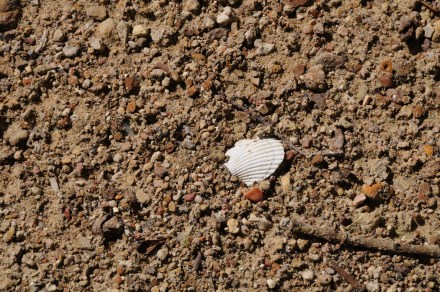
Scallop Shell in Salt Creek Bed, Flying Hat Ranch, Texas

______________________________

Notes:

My presumption is that the shell is a mussel shell.  I’ll be mightily embarrassed if I am wrong, but I will correct my post and title if a biologist sets me straight.  I have Peterson guides for a lot of categories, but nothing on shells.

All photographs are taken with a Nikon D300 with AF-5 Nikkor 18-200 mm lens.  Each shot is taken with full digital exposure.  You can always reduce the detail, but you can never add to it.

Updated, August 3, 2010.  Please see the comment quoted at the first of this post about shell identification.  My apologies to both the mussel and scallop worlds.

9 Comments

Filed under Field Log

In Death Giraffes Circled

Tadpoles Communicating with Observer (Road Crossing at Salt Creek)

Pleasant or not, I write to reveal the behavior of animals using language we humans have ignored or lost adeptness in translating, so that we might begin again to absorb information that has been showering us for thousands of years.  Such rain washes us everyday, purest liquid in clouds above us, below us, all around us.  In relearning the language of animals the purpose is not only for acquiring knowledge, but for creating a transcendent place for humans and animals once again.  It is finding the garden we humans have lost, not the animals, a place where the heart is at ease.

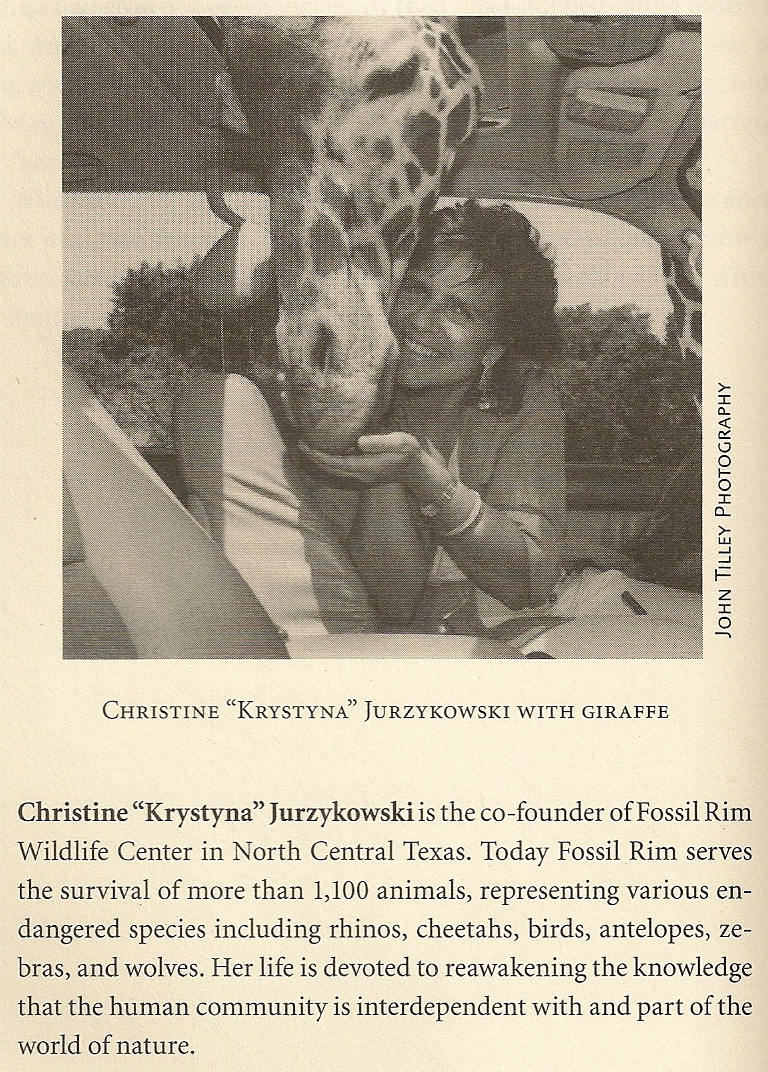
Christine “Krystyna” Jurzykowski wrote an article for Kinship and Animals. The excerpt below focuses on the death of a young male giraffe at Fossil Rim Wildlife Center near Glen Rose, Texas, about fifty miles from Flying Hat Ranch where I live.  This is an example of  inter-species communication in an extremely stressful event.

______________________________

He was six years old.  From birth, he had never really enjoyed good health….We found him fully horizontal one afternoon.  “Quick, prop his head up,” someone said.  A giraffe must have its head elevated or else the buildup of unused pressure causes an aneurysm of the brain.  We spend the next forty-eight hours with this gentle giant on our laps.

After twelve hours, I begin to get into a matched rhythm with his breathing.  I find myself supporting his strength or doubling my energy when his inability to fight dominates.  His head alone feels like a fifty-pound weight on my knees.  The other giraffes form a circle on the other side of the barn.  Slowly they walk, in formation, in silence, heads arching forward and back, as they move in one continuous circle, stopping from time to time for a minute or two.  Their pace seems in harmonious synchronicity to his own ability to fight or surrender.

Ceremony, ritual, a death dance, a communion of higher understanding?  The bull becomes nervous.  The females follow.  We move the bull out in order to regain some quiet.  Something tells us to watch them all at the same time.  The memory is clear: whatever the bull did, the females followed, both on body position and movements, all matching the energy level of the dying giraffe, all in silence, all in loyal reverence and support to his deteriorating condition.

His eyes would catch mine….His gaze would turn away when my own fear surfaced.  The circle, my affirmations, the questions, my cycles of hope and despair lasted another twenty-four hours.  Moments after his death, a group of professors from Texas A&M University arrived for their scheduled site visit.  I met them with tears streaming down my face.

______________________________

These are worlds colliding, animals and humans, worlds of different genetic makeups and culture.  The collision is not annihilation.  It is mysterious, transcendent, beyond the grasp.  For forty-eight hours, both worlds sought to re-vitalize the giraffe.  The herd circled about the one whose head lay in the lap of humans.  Humans elevated the head to prevent an aneurysm.  From a distance the herd watched and circled, parading in unison, swaying like a chorus, sending waves of motion to their kin to rise up.  In the end, both agents of mercy failed at their work, but the six-year-old giraffe did not die alone for there was the company of man and kin about his death chamber.

Do you need a translation for this event?  For now, no, it is sufficient.

Christine Jurzykowski and Giraffe

______________________________

Notes:

Kate Solisti and Michael Tobias (eds.), Kinship with Animals, San Francisco: Council Oaks Books, 2006.

Christine “Krystyna” Jurzykowski, “Be Your Purpose, My Friend,” in Kinship with Animals, cited above.

Fossil Rim Wildlife Center website.

7 Comments

Filed under Life in Balance

Rewilding the Self

Rediscovering nature and its sentient beings is “rewilding.”  In the mid-1990s, Michael Soule of the University of California, Santa Cruz, proposed the idea that to restore ecosystems one should start from the topside down — reintroduce bears, wolves and otters to a deteriorating system.  Soule’s work was in conservation biology, but is now applied to psychology.

To many people in the field of mental health, a rewilding of the psyche is essential to the “heart’s ease.”  The following article from The New York Times expands on several themes surging in ecology and psychology.  I highly recommend you read this.

Is There an Ecological Unconscious? – NYTimes.com.

Artwork by Kate MacDowell (Photograph by Dan Kvitka for The New York Times)

8 Comments

Filed under Life in Balance