[Ruth Karbach of Fort Worth, Texas, is an historian whose most recent work are two chapters in Grace and Gumption: Stories of Fort Worth Women, TCU Press, 2007. This is a comment she wrote in response to “Upper Llano Redoubt,” a recent post on the blog. Ruth’s statement brings out issues we will have to resolve in the outdoors.]
Lone Hiker (All Big Bear California)
Last year my generous friend loaned me her home in the mountains of southern Colorado. Solitude to commune with nature after a tough twenty months dealing with terminal illness of my beloved and grief with his death was the solace I needed. Alerts about armed robberty on trails in the last couple of years were discouraging to hiking as a single female; but my two Shelties came to the rescue. We traveled many a trail during our week of “Rocky Mountain High” and meet some interesting people and critters.
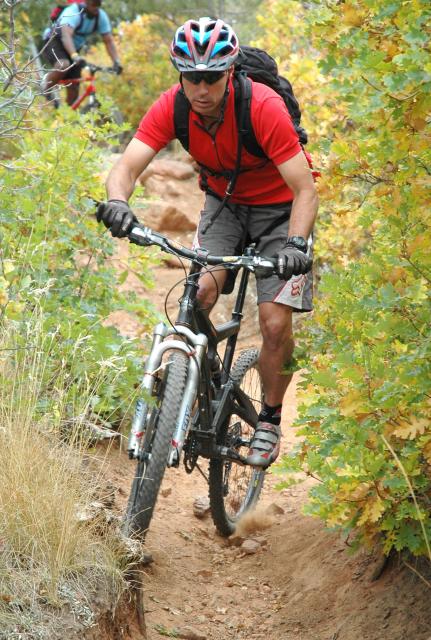
Unprecedented in forty years of hiking state and national forest was being nearly hit by a mountain bike as I was helping my dogs up a four foot vertical embankment to get off the trail. The two teen riders did not slow, move over or stop after I had to throw myself onto the embankment to avoid an accident.
With the present economy we are seeing more neglect and underfunding of the quality of life services such as libraries, parks and the arts. To me, this is the time when these services and talents are most needed. During the Great Depression greater wisdom in government caused a flowering of public arts, building of park structures and funding by local businesses and individuals of book purchases for libraries. Have we become too urban, too materialistic, too self-centered a people interested in immediate gratification? I hope not.
A yearly trek to the northern New Mexico mountains encounters warmer temperatures and a reflection on the ethical use of firearms when confronted with dangerous and rude behavior, leading to a conclusion that visits to some national forests become occasions for redoubt construction in a search for solitude in modern times.
Preparation for Upper Llano Camping Delayed
Our vacation this summer has been postponed several times. Fanny, our youngest mare, injured her leg and I had to make sure she was healing before heading outdoors in northern New Mexico. Once she was on the mend, we packed the F-250 with group-camping gear, tied a diamond hitch about the tarp and drove to the Upper Llano area near Penasco and pitched camp along the Rio Santa Barbara (latitude 36.08556, longitude -105.60833).
We had looked at eighteen acres of land bordering the Carson National Forest several years ago near Llano. An acequia bordered the parcel we came close to purchasing, but in the end we decided to wait a few more years and look again. We were not in the market for land this summer, but wanted cooler ambient temperatures for a few days, relief from Texas July weather.
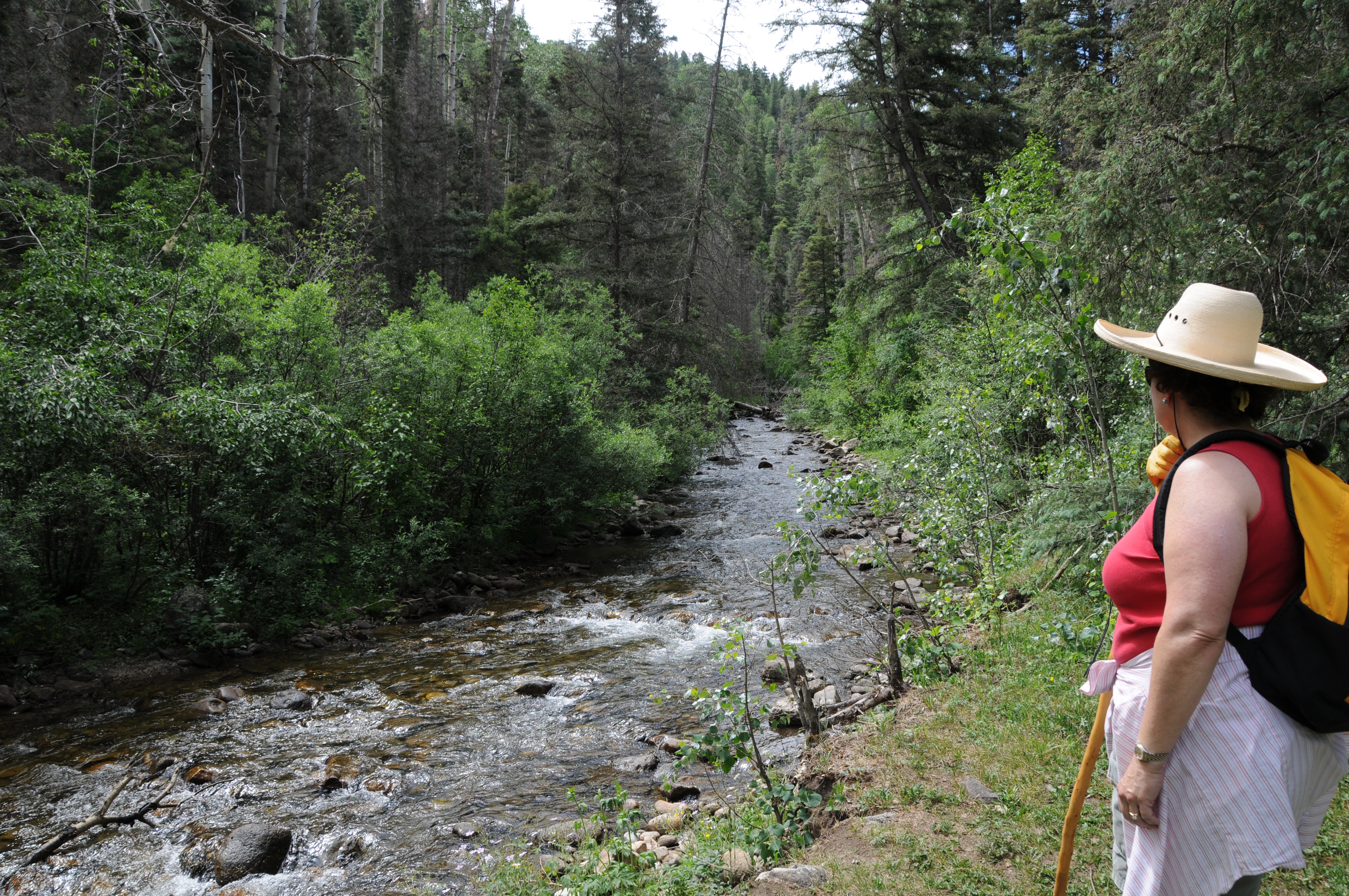
Brenda and Rio Santa Barbara
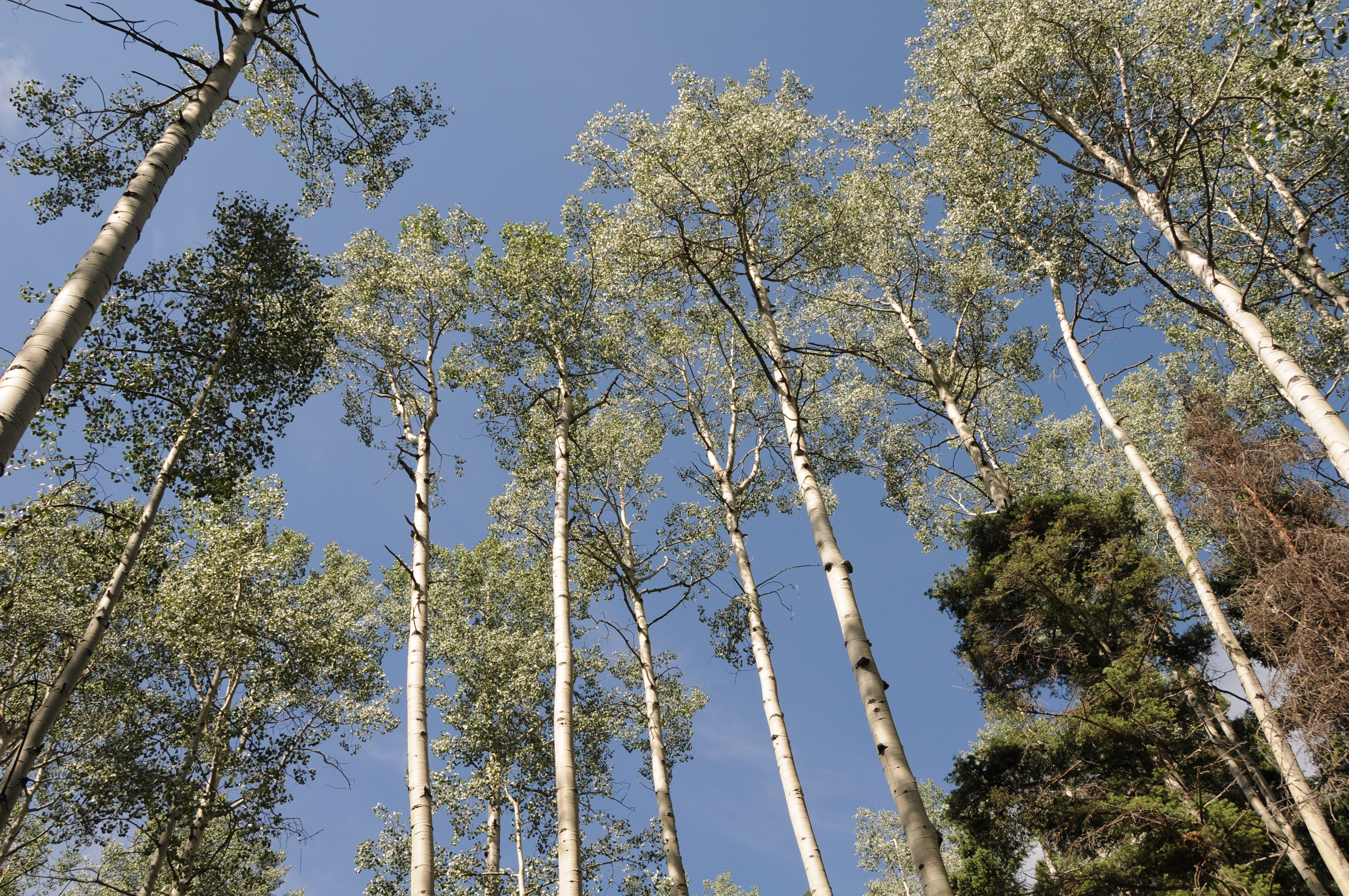
Basically, near Upper Llano, we have experienced cooler temperatures, especially in the mornings. Our camp site is at 8,500 ft. amidst spruce, fir, aspen and ponderosa, a sub-alpine zone. Temperatures during the day in the mountains have been about 83 deg. F., and at night, probably in the lower 40s.
Hiking into Pecos Wilderness
Brenda and I hiked into the Pecos Wilderness for three miles and admired the fern and sub-alpine flora. My first hike into the northern Pecos Wilderness occurred in 1968, and much remains the same, perhaps an increase in vegetative cover and I think the aspens are much, much higher.
What Would Teddy Roosevelt Think? Or Gifford Pinchot?
The U. S. Forest Service, however, turned campground management over to a private concessionary, Scenic Canyons Recreational Services Inc. , Hyrum, Utah. The daily fee is fifteen dollars for an improved site, although one may camp off the grid, porting water and digging latrines. Since the Forest Service has Stage 1 Fire Restriction, no fires are permitted outside the developed park campground, one would be reduced to precooked meals (1). Not an attractive choice.
We decided to pitch camp within the developed area. We stayed for four nights and days.
I saw no U.S. Forest Rangers in pickups or horse packing into Carson or Pecos Wilderness. When I first started coming up to the Upper Llano forests and Carson in the 1960s, I would at least see in the established campgrounds, a forest ranger in a pickup once a day, sometimes twice. And, back in the forest or wilderness area, I would come across a ranger every few days or so. By the longest of shots, I am not given to the idea that a gendarme on every trail is necessary, but to see none in four days and nights, is not good.
Reflection on Personal Security
My idea of security is that a person is in charge of their own safety and protection first, then call in the law when the dust settles or the event indicates the odds are mightily against you. By those lights, I have learned basic defense skills and also pack pistols and rifles when necessary. I offer absolutely no apologies for doing so. I was reared with firearms and they have provided protection from poisonous and rabid critters and, on one occasion, food for my family’s table when resources were scarce. Above these reasons, however, is protection against invaders and aggressors — man. (On two occasions in my family, firearms were used for personal protection. Fortunately, I have never had to use them. Several years ago, two miles down our county road in Texas, three people were killed in a crime of revenge.)
I pack pistols on every camping trip. This trip, the hog legs were a .357 magnum Colt revolver and a .45 cal. Colt semi-automatic.
I did not carry them with me when we hiked up into the wilderness for a short, three-mile hike. It was a leisurely hike and we were close to the main trails and no reports of trouble had been rumored among the local campers. We hiked, took photographs and returned to base camp.
Yesterday, July 16, we broke camp, hummingbirds whirling about us, and drove down the High Road from Taos to Santa Fe, the Upper Llano left behind, reluctantly.
The summary of the article was that a man was attacked by a mountain biker on a trail in the Santa Fe National Forest when he complained that the biker needed to leash his dog after the dog twice charged after him, his wife and their leashed dogs. The biker hit him several times and threw him down the hill, stating he was going to teach him some trail manners. The second incident was up in the Pecos Wilderness (south of the Truchas Peaks where we hiked) where horsemen fired a pistol and made rude remarks to female backpackers. They were drunk. Pistols are not always peacemakers.
So much for solitude.
A Partial Solution to Violence in the Back Country
Who can stop such incidents? It’s an imperfect world and there will always be some ruffians about, but the lack of U. S. Forest Rangers on the trails and campgrounds establishes a context of free-for-all and uninhibited behavior. Ethics and codes exist outside of federal and state regulations and that assures in most cases a chance to enjoy nature, wild and free. I saw more respect for the rules on the trail and while encamped in Carson than I saw disrespect. Men and women are generally given to cooperation rather than competition and confrontation. The U. S. Forest Service, however, needs more rangers in order to establish a presence of authority so incidents like those reported in The Santa Fe New Mexican can be reduced.
I will continue to hike and encamp as usual with all our equipment.
Tenting at Rio Santa Barbara
Next post: dining from the Pecos Wilderness to Santa Fe and follies in between.
_____________________________
Notes:
1. On July 9, 2010, the Taos District of Carson National Forest released a bulletin that the Stage 1 Restriction had been lifted because of predicted moisture and monsoon season. I did not know this until today, July 17, 2010, as my last contact with the Taos District was on July 7.
North Erath County, Texas, Lat 32.43 N, Long -98.36 W, elev. 1,086 ft. Turkey Creek Quad.
The Use of Twine for Safety in Horse Trailers
Rained off and on most of the day.
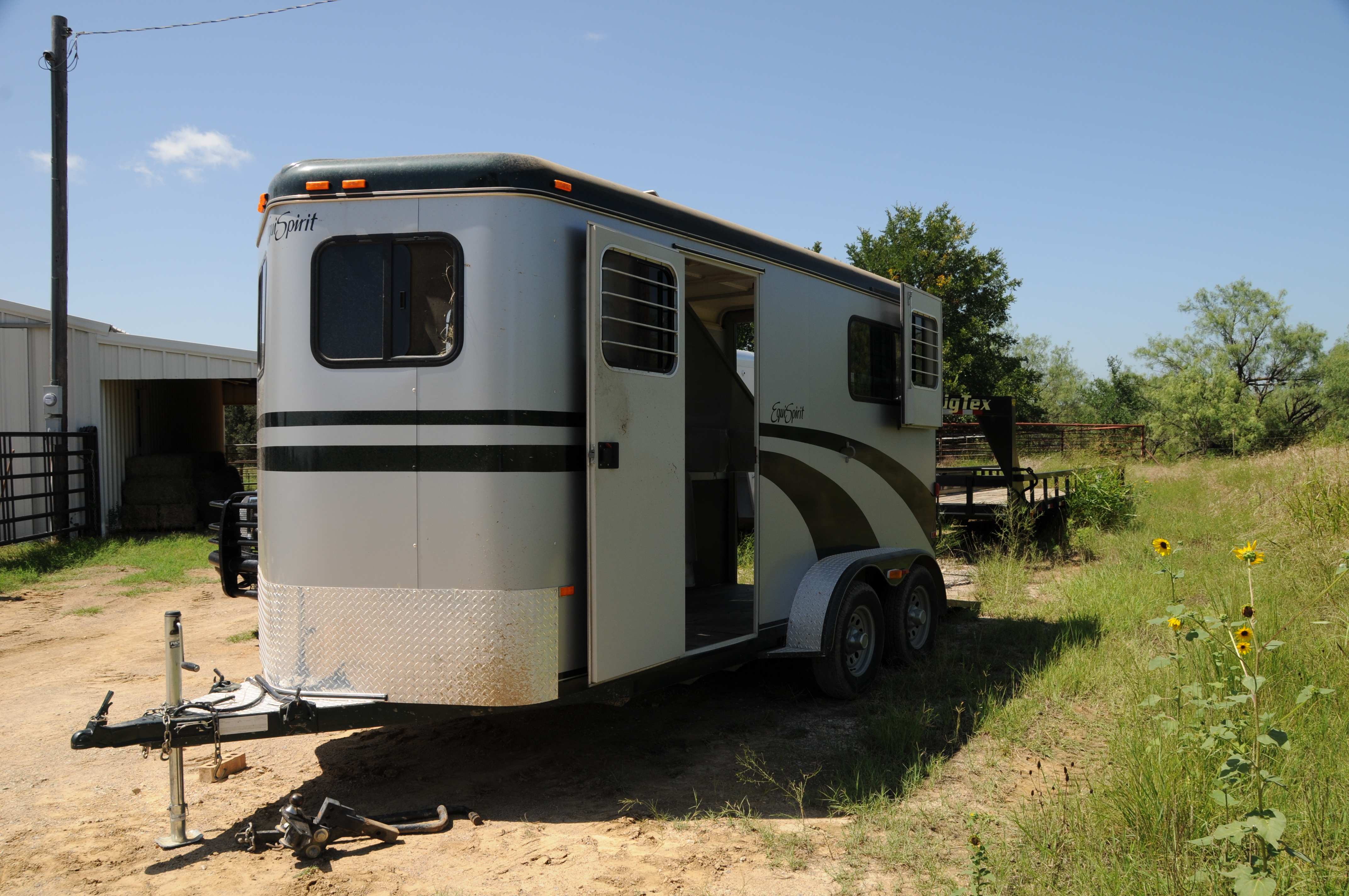
Took Sweet Hija to Equine Sports Medicine and Surgery (ESM&S) on the Brazos for a pregnancy check. Loaded Hija into the two-horse, side-by-side trailer. Some balking at loading.
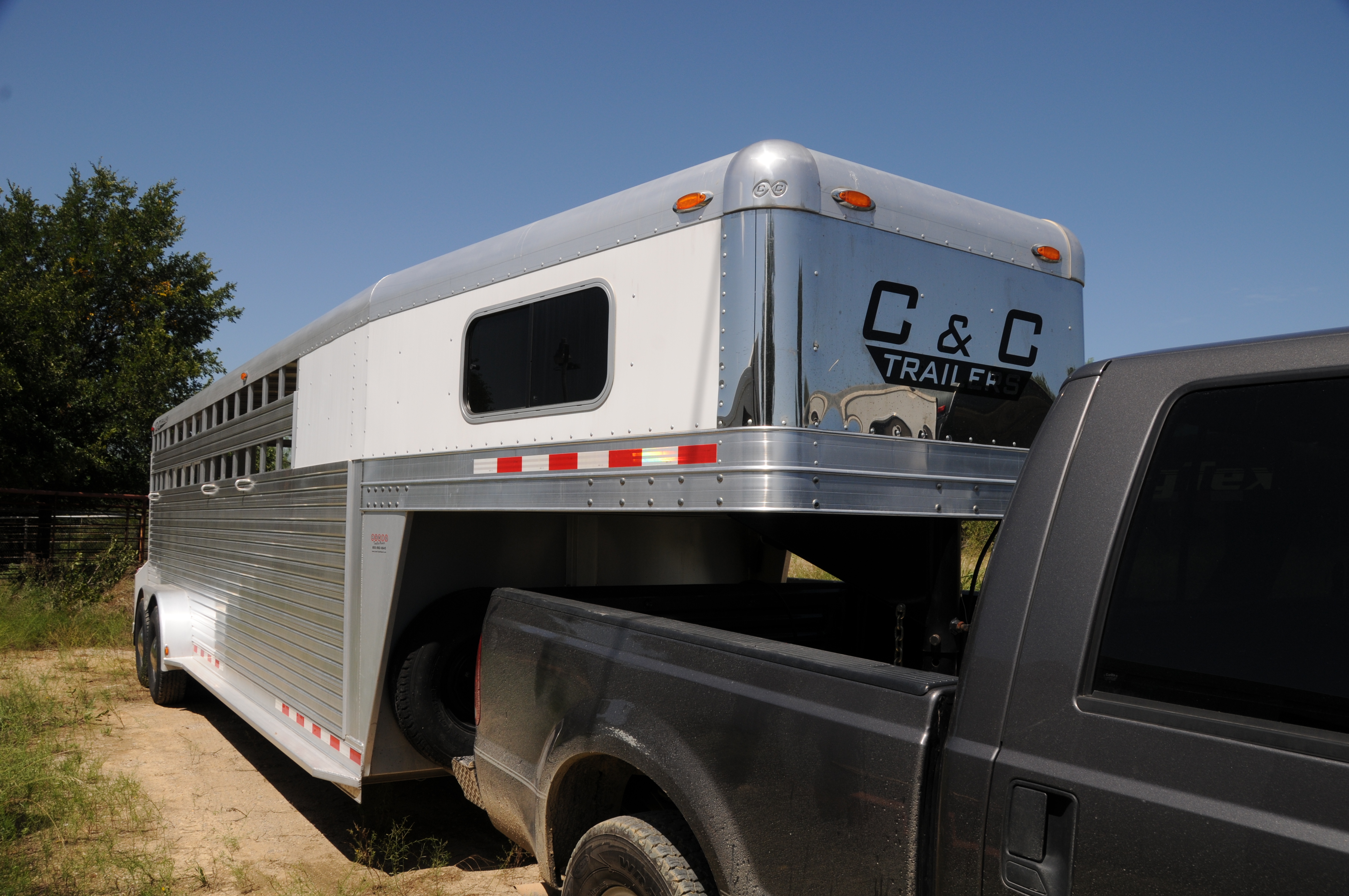
C & C Stock Trailer at Flying Hat Ranch
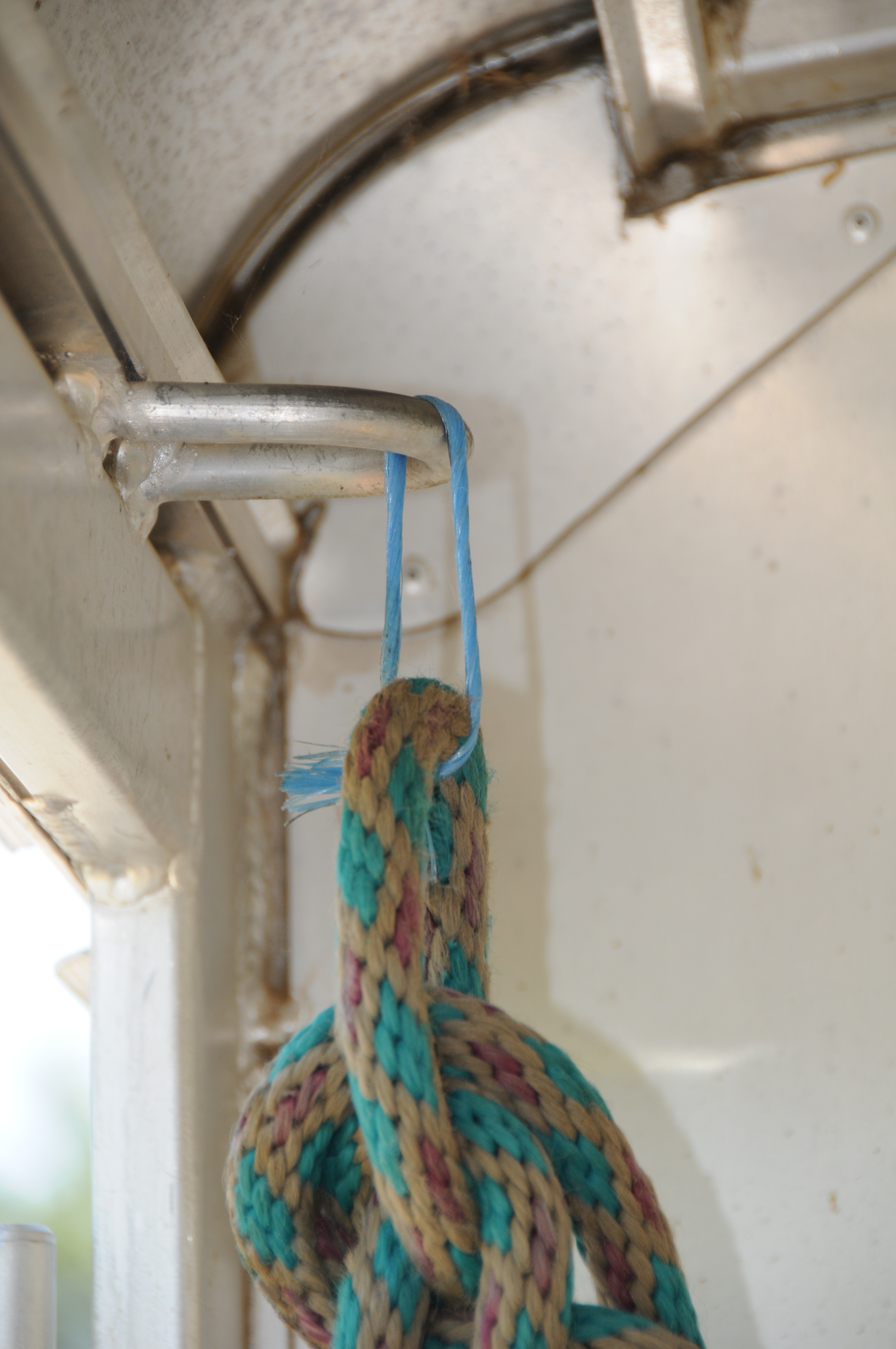
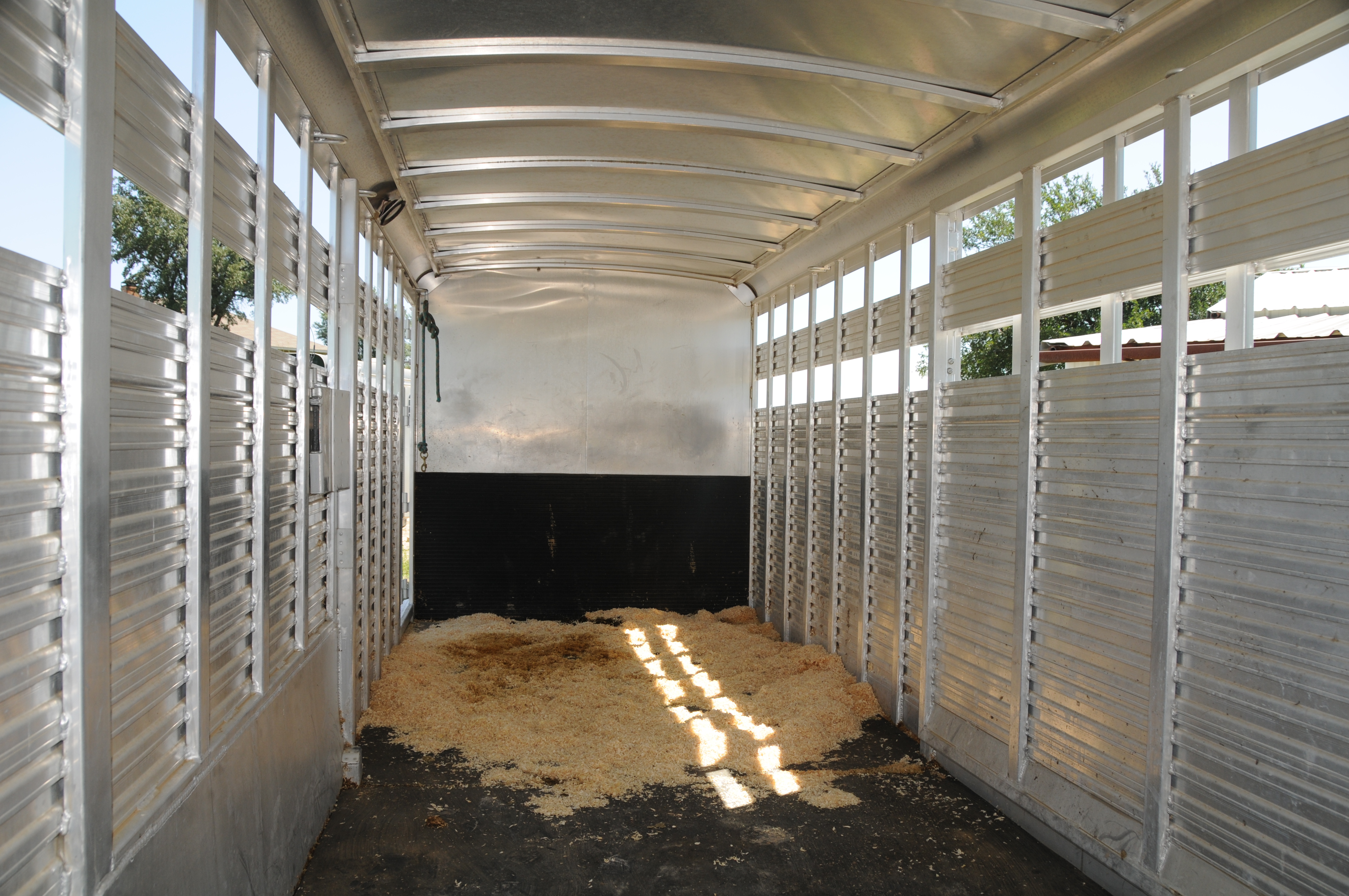
On our place, the horses are accustomed to a C & C stock trailer that is twenty-six feet long, not the two-horse, side-by-side. The C & C stock trailer, for both horses and cattle, allows a larger space, plenty of views between the side rails, a good comfort zone. I don’t tie them up during the trip, only during the loading and unloading process. In the stock trailer, I put up baling twine to tie the lead rope, in case there is an accident or a panic incident, they can snap the twine much easier.
I used the two-horse, side-by-side trailer today rather than the C & C.
Bailing Twine Attached to Lead Rope for Safety
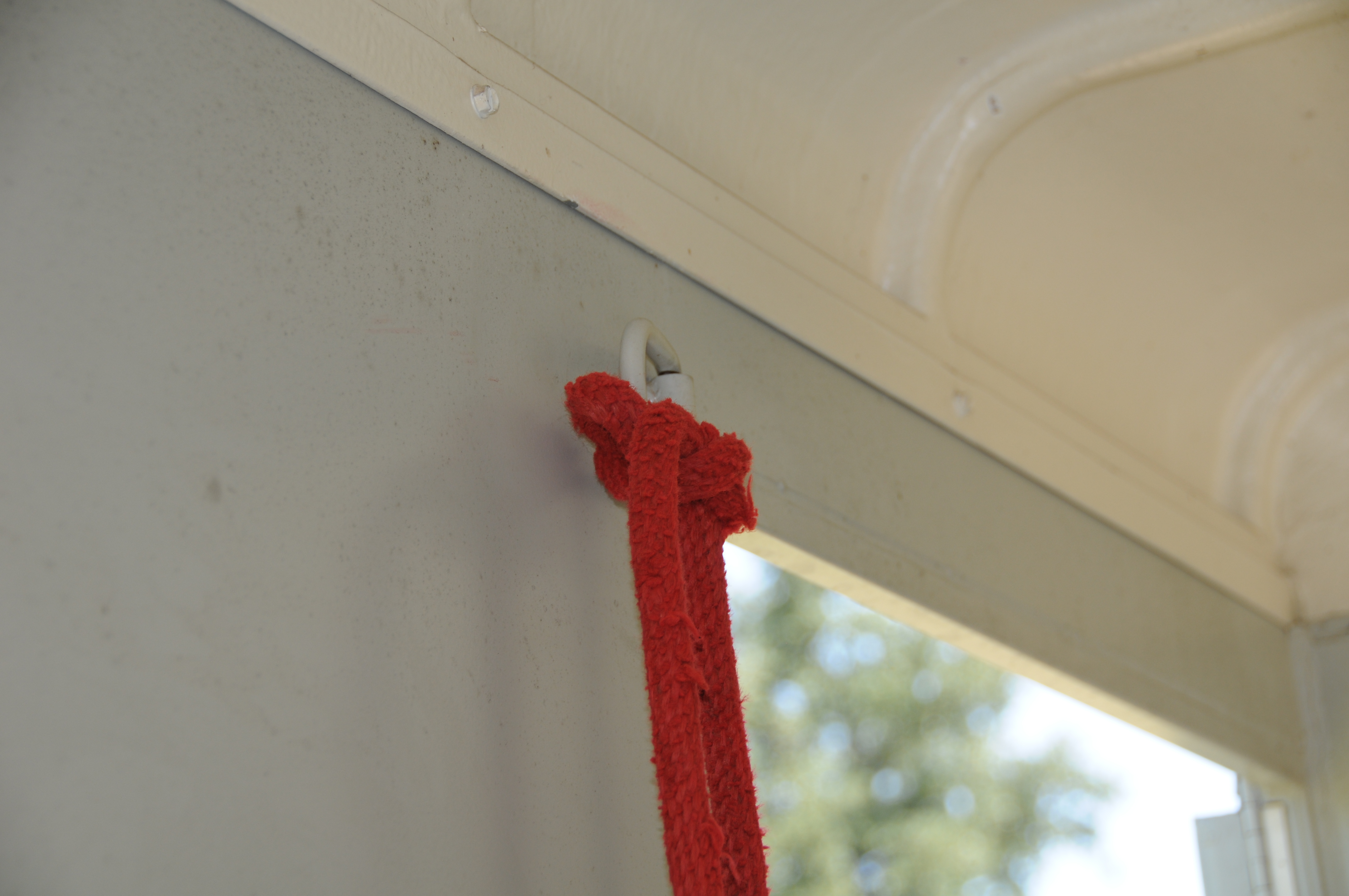
In the two-horse, I had failed to use the baling twine to tie the lead rope, but instead put the lead rope through the conventional steel rung. It did not register on me that I was side-stepping safety behavior for the horse and me. I failed to perform a checklist because I was in a hurry.
Equine Spirit Two-Horse Trailer, Side-by-Side, Flying Hat Ranch
Trip to Equine Sports Medicine and Surgery on the Brazos was slowed by several hundred bicyclists on a race via the Brock Road. Had to drive slowly and be careful passing. Rain tapered off at Brock.
Sweet Hija Will Birth a Filly in May 2011
Dr. Semira S. Mancill gave Hija her sixty-day physical and also sexed the newly-developing foal. Two weeks ago, the sonogram signaled a colt, but the definitive conclusion with ultra-sound yesterday was that the foal was a filly. The sire is Shiners Lena Doc out of Carol Rose’s stables north of Denton, Texas. Dr. Mancill said that the ultra-sound indicated a healthy filly will be developing for birthing next April 15, 2011.
Bad sign in trying to reload Sweet Hija in the trailer. She balked and it took us ten minutes to convince her to join-up with the two-horse trailer. Dr. Mancill, Zack (our helper at ESM&S) and I completed the task. I was embarrassed.
Load completed, I drove to Stephenville to pick up supplies and hay. Twelve bales of coastal and alfalfa, three Strategies, one Horseman’s Edge. Rain eased up so I transported the hay in the bed of the pickup, the grain in the horse trailer.
Accident Due to Several Factors
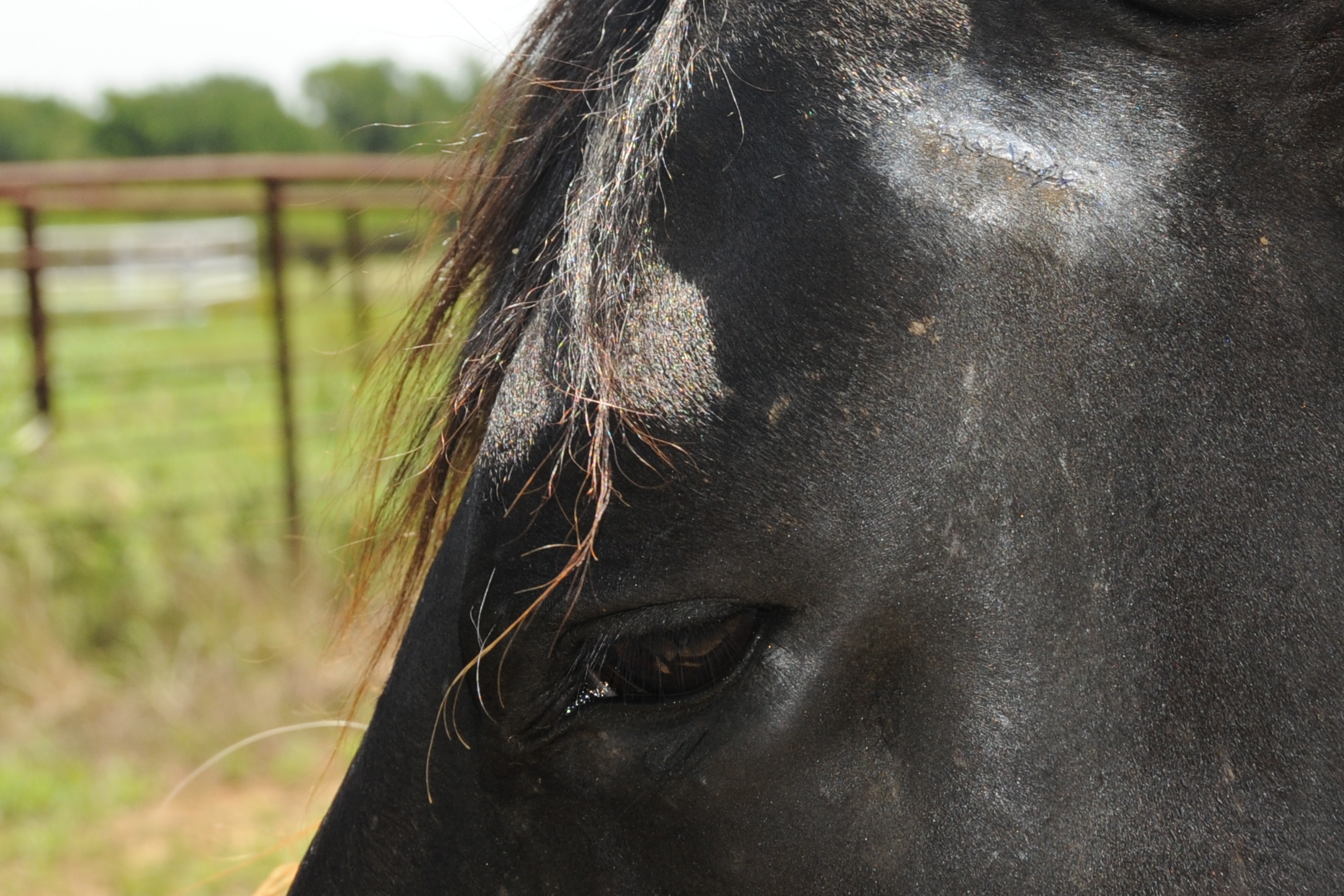
Back at the ranch, I proceeded to unload Hija. Instead of being fully safety-conscious, I proceeded to undo the butt bar on Hija, intending to walk around to side door, climb in the trailer and back her up. Hija panicked and pulled back on the lead rope, breaking the snap on the rope that was under her chin. In rearing backwards, she got a laceration above her left eye from the brass on the halter. I had seen her start to back up and thought she would stop once she got to the end of the lead rope, but she did not. I grabbed her halter without a lead rope and she quickly calmed down, but the laceration was three-inches long and deep, bleeding, though not to the bone.
Entangled Lead Rope on D-ring As Result of Aggressive Pullback of Horse (No Baling Twine)
I asked Brenda to come down to the stables and help me assess what to do. Brenda says it’s bad enough to go to the vet. She calls ESM&S in Weatherford, Texas (not the reproduction center on the Brazos) to tell the emergency staff we are coming with Hija. It was a Saturday afternoon, about 1:30 p.m.
ESM&S Staff Stitches Hija
I hitch up the C & C stock trailer to the white F-250 we have. I’m not going to use the two-horse again today — bad medicine. I proceed to tie Hija to the twine loop, then unfasten her for the trip to ESM&S once she is loaded in. We speed to Weatherford, unload Hija. She is bleeding a bit more, but not effusively. The staff stitches the laceration and we return home by 5:00 p.m. We must take her back in two weeks to get the stitches out.
Sweet Hija With Stitches, Flying Hat Ranch
In the response to Hija’s accident, we were negligent in applying known safety standards. Fortunately, the snap broke before further injury occurred.
Open stock trailers like the C & C trailer have their drawbacks. Probably the most serious is that the separation of horses must be well-planned because there are no panels as in the side-by-side or slant transport. In most situations, however, the trailer has two compartments, large stall areas, and that seems adequate for separation.
Albuquerque Central Avenue Vintage Postcard (Legends of America)
As a boy, I looked out of a hotel window in Albuquerque, New Mexico. I saw women in colored skirts and snow-covered mountains.
…
In 1947, my mother and I and her boyfriend traveled to Albuquerque, New Mexico, from Brownwood, Texas. I do not remember the name of mother’s friend, but he was a nice man and very kind to her. I was five-years old. The road we traveled to New Mexico included a long stretch of highway paved like a washboard. I sat in the backseat, and for an hour or so when we hit that stretch of highway, I bounced up and down. At the end of the bouncing lay Albuquerque, a city that imprinted the New Mexico I revere in memory.
My mother and father divorced shortly after World War II, and mother worked at several jobs to support herself and me. We lived with her mother, Effie, who worked also at odd jobs to pay the groceries and rent for trailer house space under walnut trees on Fourth Street. It was a very small trailer with one room composing three bunk beds and kitchenette. Our toilet was in the neighbor’s house from whom we rented the space for the trailer. Late into the evening, the Philco Safari shortwave radio emitted a golden glow with its sounds of music, news and comedy.
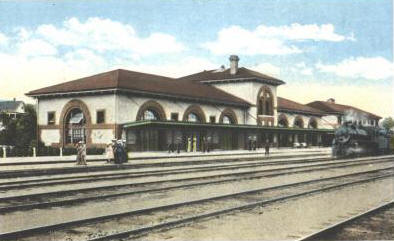
Mother must have met her boyfriend at the cafe she worked, across from the Harvey House at the Brownwood Santa Fe railway depot. He toiled for Santa Fe railroad.
Brownwood Santa Fe Train Depot (Historic Texas Net)
She also waitressed (it became a verb in our family) downtown at the Cactus Cafe where she became cashier before being hired by Southwestern States Telephone Company, a corporation she worked at for over thirty years. Mother had blond hair and blue eyes, about five feet, two inches tall in height. She was slightly built and vivacious — Irish through and through. She was quite verbal, having descended from a background of story tellers and fiddlers near Bend, Texas, a small village along the Colorado River in central Texas. Stern and hard-working, she pushed herself to the extreme while young and it did not cease when she grew old.
This trip, however, was a vacation to Albuquerque with a close friend and there was no work involved, just fun and merriment. We must have stayed several days in Albuquerque. Mother and I stayed in one hotel room and her friend stayed in another. She bought me a book, Indians of Yesterday, that I still have to this day. We visited the Old Town trading area and shopped downtown. Our hotel was several stories high, but I don’t remember the name of it.
The view from our hotel window looked down upon the main street and in the distance, the Sandia Mountains.
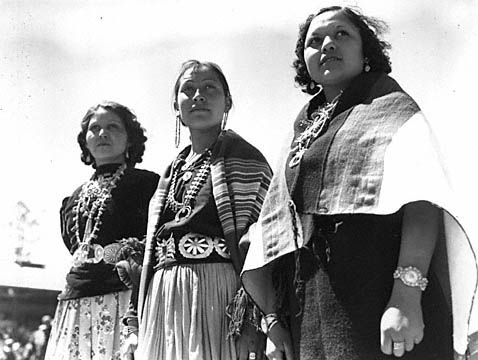
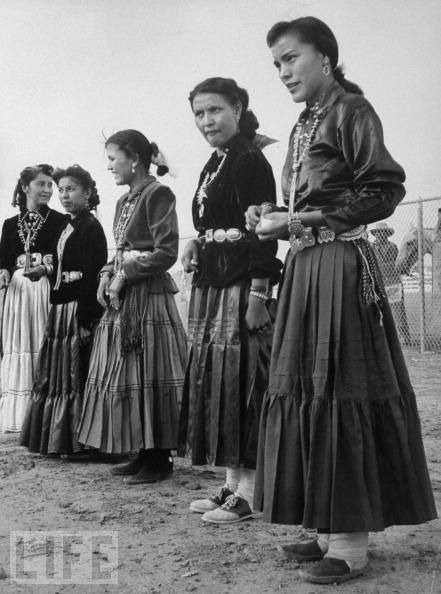
I remember gazing out that window. I would have solitude in the hotel room. Not long, just enough. From my window, I looked down on the street corner and saw women dressed in colorful skirts with concho belts. Their hair was black and they clustered in drops of color about the shops, standing, milling around. Within the skirt pattern, some of which were black or navy blue, I could see rhythmic lines of white ribbon. Soft boots, it seemed, they wore. I don’t remember their wearing hats or bonnets. Exotic women, full of energy, covered in color. It seemed as if they wore several skirts, layered one upon the other.
I peered up from the hotel room and saw snow-covered mountains in the distance, deep purple, deep blue, holding secrets. I looked at them and wanted to go to the snowline and touch the cold — or, have the cold touch me.
I looked down at the women and looked up at the mountains, then the scene as a whole, one tableau. As a child, I comprehended novelty, but I was also enamored by the scene from my window. Today I know that the women are the Navajo that come for trade and fun. The mountains are the Sandia, the location of the earliest paleolithic finds in North America, and I have taken students on field trips to see the Sandia Cave. These new attributions of New Mexico embellish my early memory; they neither replace nor smother what I saw as a child.
You could say, I suppose, if mother and her boyfriend had taken me to New York City, I would have become entranced with cities, but I doubt it. As it was, we returned to Brownwood, Texas, and I got bounced again on the highway while mother and her friend chatted and laughed. Mother continued for a time to work at the cafe across from the Harvey House. Time passed before I returned.
…
In 1955, I traveled to Glorieta, New Mexico, with a church group. I was distracted by infatuation and pious supervisors, but I remember the smell of conifers and the soft carpet of pine needles about the camp. There were neither colorful skirts nor snow-covered mountains — a regretful trip, in so many ways.
Then, in 1967, my wife and I traveled from Amarillo, Texas, to Raton, New Mexico. We had spontaneously decided to go at four o’clock that afternoon. So after packing quickly, we got in the Ford Mustang and drove through thunderstorms to New Mexico. As lightning flashed, it illuminated the countryside and I remember the volcanic hills and mountains flaring to light, then darkness all around. We reached Raton at midnight, excited by our thunderous passage westward.
For the next three days, we stayed in Raton, Taos, and Santa Fe. I was twenty-five years old, twenty years since I had been in Albuquerque with mother. To me at the time, and even now as I compose this piece, the early visit to Albuquerque and the jaunt to Raton seemed a hundred years apart — long, long in-between, though only twenty years. I cannot account for the emotional relativity of it, but it is true. The effect of the quick trip with my wife to New Mexico, however, was quite different from the regret of Glorieta.
I dreamed in vivid colors of New Mexico when I returned to Amarillo: passageways of art and pottery, cafes of chile, museums, people dressed in color and turquoise, adobe walls and hornos. I made plans for a second visit to go farther into the forest and into the desert and trade shops. Over the years, I slept in maid’s quarters and the backseat of my car. I was stranded alone, overnight, in a snowstorm on top of Jemez Pass, bundling in a bedroll and losing a bit of an ear by frostbite. I went again and again and I am still going. I have stayed long enough in the high desert and mountains, however, to become acquainted with rough and jaded junk that falls into arroyos, the brutality of domestic violence, the rage induced by alcohol and drugs on the streets and hyped-up-commercialism of art and craft. I was never an innocent about New Mexico. Never.
It is the land and the people that draws me: the rhythm of the drum, the conifers of Carson, the silky dust of an unpaved road, the remembrance of man and horse plowing the field at Mora, bronzes of Canyon Road, the Dona Luzes of La Casa Sena, Truchas, sagebrush, meadow and the vista of Logan. After my divorce, I took my daughter annually to New Mexico, camping out and staying in fine hotels. We saw Christmas lights on the highway from Tucumcari to Las Vegas, arriving late in Taos one evening. In the summer, dust devils rode beside us, rocking our pickup as we cowboyed through the devil to the campground in the cool forest. These days, I am in northern New Mexico, writing and living in my daughter and son-in-law’s home, renting houses on Witt Road in Taos, and paying beaucoup amount of money in Santa Fe and Albuquerque when I research in special collections and archives. Dust devils still whirl around me; snow and ice make Palo Flechado Pass dangerous; and acequia water still flows along the curbs of Mora and Fort Sumner.
In overcoming loneliness and discontent, I was lucky to have been seized by terrain, something massive and material rather than soft and ideological. It is not all pleasant, this nature writing, because one season is green, the other brown and dying. Yet, the sage blooms again and the riosgrandes have always run shallow or deep, never dry. I see it as my duty to attend these cycles and write about them so that a not-so-bloodless redemption may save our planet yet. It may be a futile effort and I may be wrong.
______________________________
Notes:
Indians Of Yesterday, by Marion E. Gridley, illustrated by Lone Wolf, M. A. Donahue & Company, 1940.
Use of the word, “cowboyed,” is a regionalism. See also “cowboy up.”
The Dona Luz was a restaurant in Taos. I use it here as a personal application to La Casa Sena restaurant, reflecting all the cuisines of the region. To my knowledge, there is no Dona Luz at La Casa Sena. The Dona Luz in Taos had a wine cellar that was dug deeply into the ground. I always liked to eat at a table near the stairwell to the cellar so that I could look down at the wine racks.
I have struggled to define the attraction I have for the Southwest, New Mexico in particular. Texas has its fine qualities and I’ve spent most of my life here and I type it, of course, as southwestern, too. Being a child and on my first, conscious, exotic vacation, the Albuquerque visit would be striking, a first-time event of major proportion. That is explainable by that context. The visit to Raton, Taos, and Santa Fe in 1967, is inexplicable. Calling it a “rebirth” makes me want to stick my finger down my throat. The closest classic description of what happened is D. H. Lawrence’s statement that New Mexico and the high desert vistas called him to fully attend the physical environment (I paraphrase). That’s about as close as I can define it: made me attend landscape and my life like never before.
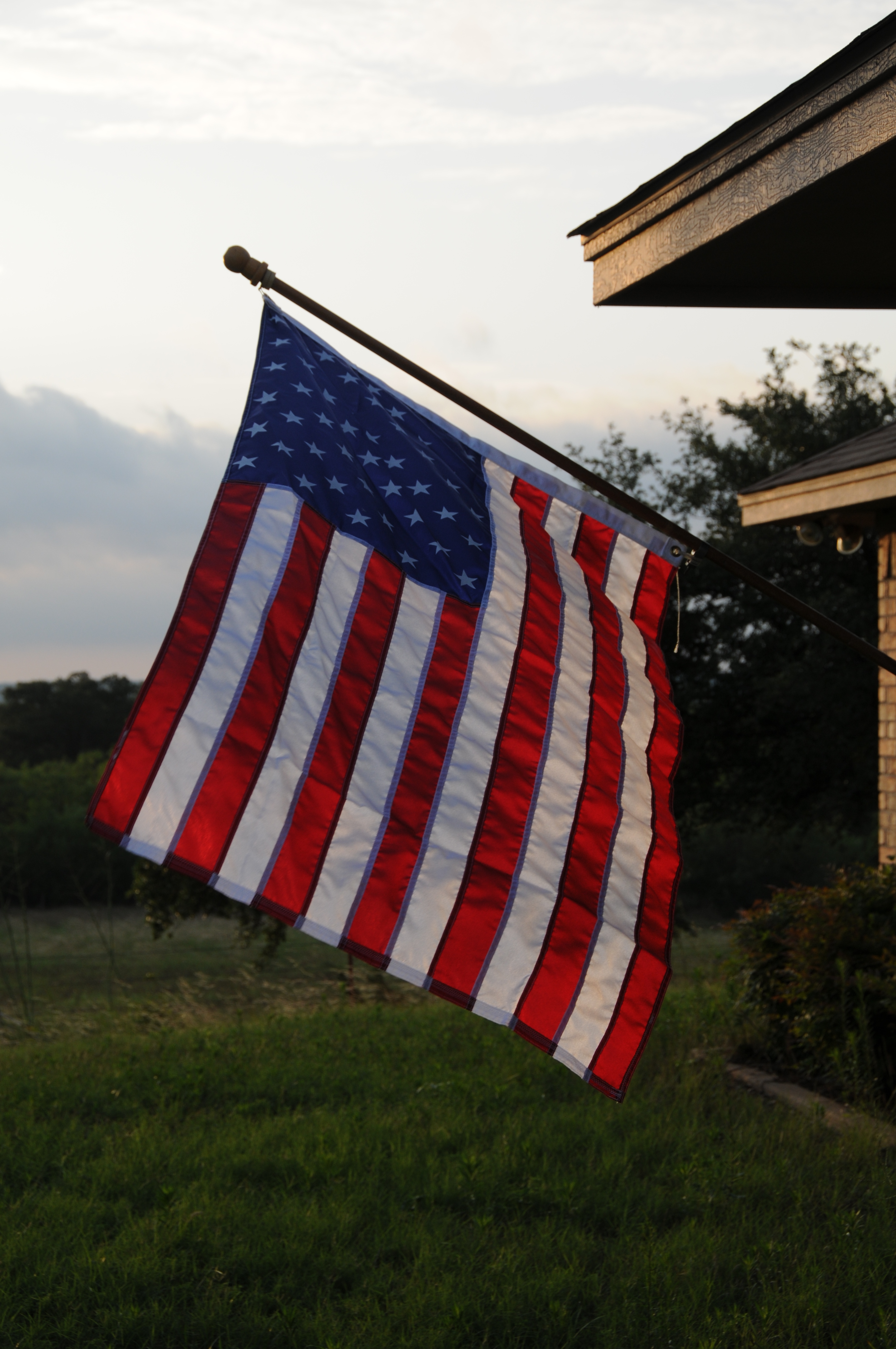
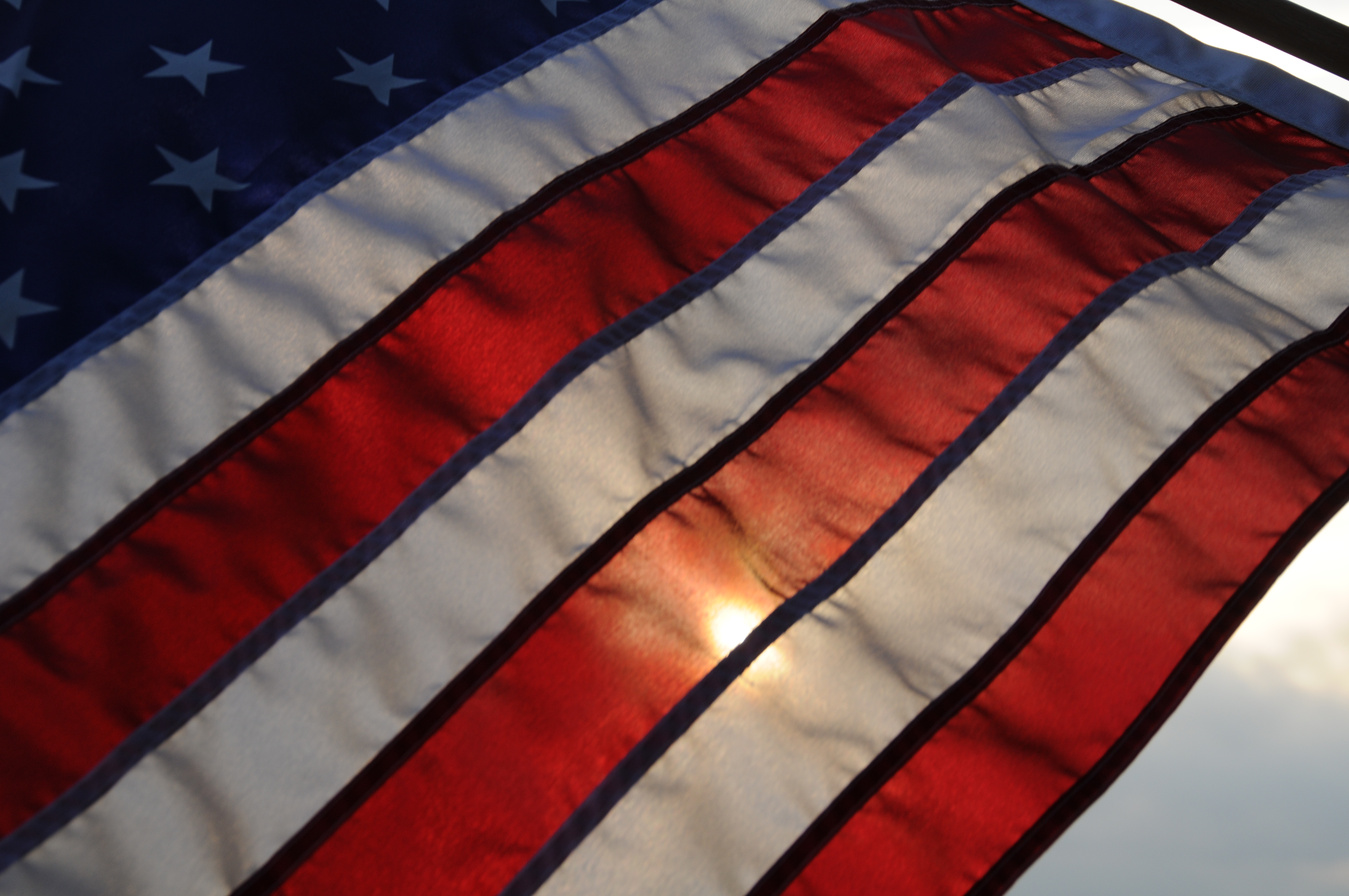
Flag and Early Morning (Photo by J. Matthews, 2010)
My wife prevailed upon me yesterday to put up an American flag. [Read the notes at the end of this post about Norman Rockwell and his American Ideal paintings.] I installed a pole caddy on the front porch, dusted off the flag pole, unfolded Old Glory, used twine to tie the lower end of the flag to the mast and hung it. Like so many other small projects on the ranch, flag pole installation had been put off for years. At our previous home in Mingus, we had hung a flag for several weeks after 9/11, but since moving to the ranch, we had left the flag carefully folded in the cedar chest that we use as a coffee table in the grand room.
As I was growing up in Texas, the Fourth of July was nearly always hotter than the hub of hell. Many jokes came from the heat in Texas: If I had a choice between hell and Texas, I’d live in hell. And so on. But enough about Hades. For several years, my parents and I would go to Brady, Texas, about fifty miles from our home in Brownwood and attend the Brady Jubilee. That was its name: jubilee. I always associated stifling heat, horse racing and yellow watermelon (salted, of course) with jubilee. It never made much sense to me to travel in a hot, non-air-conditioned pickup or old Ford sedan whose rough felt seats were smelly and lounge under trees and watch horse racing from a distance. Come the first of July, the dreaded Brady Jubilee jaunt lay in front of me like a sauna with no water. There must of been something character building about the event, but I never could figure it out.
This Fourth of July, the weather is cloudy in west-central Texas from the effects of a gulf hurricane and the temperature is a tolerable middle 80 deg. F. We’ve had about two inches of rain this past week and the grass has greened slightly — not a typical Fourth. Where were these days back in my boyhood?
Given this age of internet technology, the town of Brady, Texas, has a website. As a link within the website, there is the Brady Jubilee. I’m somewhat disappointed, however, as I read over the list of activities. There are none for July 4th and no horse racing. All of the Brady Jubilee activities take place July 1-3: Heart of Texas Ford Parade with a “Hats Off To Our Heroes” accent, washer and horseshoe pitching tournaments, fireworks the nights of July 1-3, and a dance Saturday night featuring Brian Burk, Kristen Kelly and the Modern Day Drifters.
Brady Jubilee, Richards Park (Photo by Cross Bar Land Co.)
Suddenly, I realize that July 4th this year is on a Sunday! That’s why the Brady Jubilee has nothing planned for the Fourth. It’s a church day and normal activities cease and there’s no exception to that rule.
The horse racing, however, is probably a thing of the past — they were short races for quarter horses and not many were booked because of the July heat.
On this day, with no Brady Jubilee scheduled, our plans are to attend a fireworks display at either Possum Kingdom Lake or go into Fort Worth for dinner and watch the display over the Trinity River. Either way there will be no horse racing or jubilee today.
I have to go now and feed the horses and, just by chance, they may race around the arena. To my list of morning chores I will hang the flag. On this Fourth of July, I will think of the Brady Jubilee with its heat, melon and horses and quietly yearn for another day there. Yes, I know, the heat.
______________________________
Notes:
The New York Times today ran an article on Norman Rockwell. A quote about him: “These are qualities one wants to retain as a society, and it is a credit to Rockwell’s subtle, story-weaving imagination that he captured the values we celebrate on Independence Day without ever having done a painting of American flags waving from porches or July skies bursting with fireworks.”
That’s correct, never made a painting with American flags waving from porches. He painted America in the people he painted.
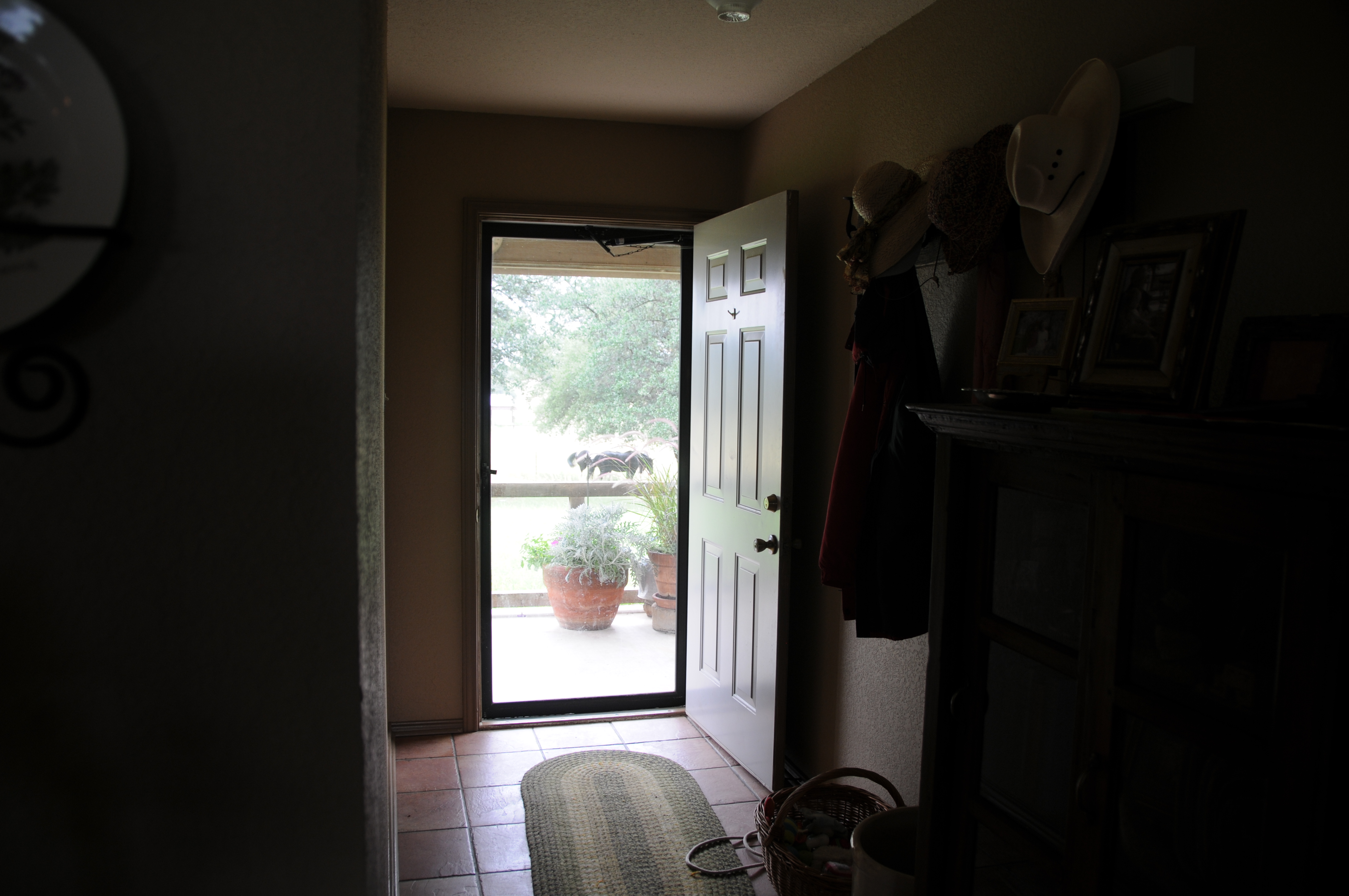
In the country, hallways and alleyways are often crammed with tools, coats, hats, hay and feed, not to even mention dogs and cats. The hallway and alleyway to home, barn and stable give additional shelter and protection during a rain or busy day. Mudrooms are quite common on farms and ranches as well as wide porches, some extending all around the house. Porches may be a place to relax, but the porch chairs and swing share space with barrels, boxes and rope. It’s not all neat and tidy on the ranch.
Ranch House Hallway (Photo by J. Matthews, 2010)
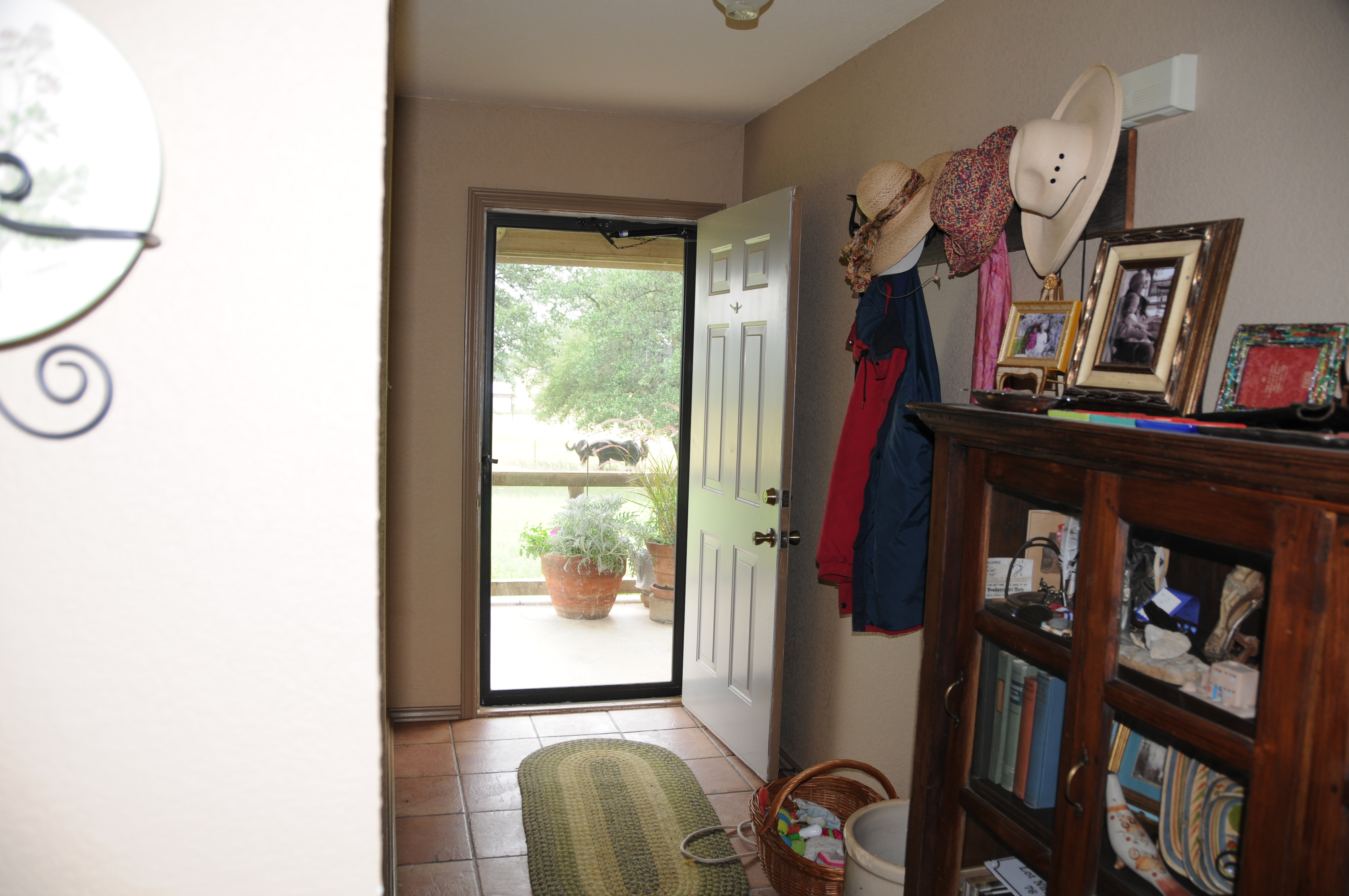
Here is the hallway in our home that extends out onto a small, front porch that has a couple of rope-crossed chairs and flower pots. The barn cats often come up to the front porch to lounge because it faces north and has ample shade. The front porch is merely an entryway for the house, but the back porch extends the length of the house.
The hallway has a hat and coat rack on the right side of the photograph. I have counted as many as ten hats and caps on the rack, and during the winter, coats and rain gear hang appropriately for convenient use.
Hallway by Flash (Photo by J. Matthews, 2010)
The second photograph of the hallway, illuminated by the modern invention of flash, illustrates the glass hutch with books, photographs, Native American pottery, prehistoric-lithic tools, horse bits and spurs. Hallway as museum.
In the old days before air conditioning, porches would be screened-in and iron bedsteads would be moved out onto the porch so that you could sleep in the mild night air. I was not interested in sleeping on a bed on a porch, but preferred to sleep under a sheet within the house, tolerating the heat until morning. I might move a pallet into the hallway beside the screen door. Hallway as bedroom.
The barn alleyway this morning shows hay bales from Arizona. These bales weigh 100 lbs. and are three-stringed — barely manageable. The first set of bales on the wooden plat is alfalfa; the second set is coastal bermuda. These bales provide about a week-and-a-half of hay to four horses. I have been cleaning out the barn and opted to put the hay in the alleyway for a time to allow the barn to dry out and give me some room to move tools and implements around.
Barn Alleyway with Hay (Photo by J. Matthews, 2010)
Hallway and barn alleyway — country-style — have multiple uses and are always comfortable spaces for storage and resting. Let the cool, fresh air flow down the barn alleyway and things are good whether you are from the city or country.
One of my major objectives in writing about nature is to bring people out into nature, the woods, desert, mountains or, even, the backyard. The population of this planet congregates in cities, but even there, nature abounds in established parks, vacant lots, terraces and backyards. Within our backyard here at the ranchito, we grow herbs for cooking. The stewardship of nurturing herbal plants forces us out of the house and into our small plots to water, fertilize, prune and, best of all, harvest for the table and cooking.
Brenda cooks mostly and today she prepared mussels in a white wine and shallot broth with butter and fresh parsley from our back porch. Since it has been raining, I’ve been inside most of the day and decided to take some photos in between the rain sprinkles of our herbs and the mussels in white wine.
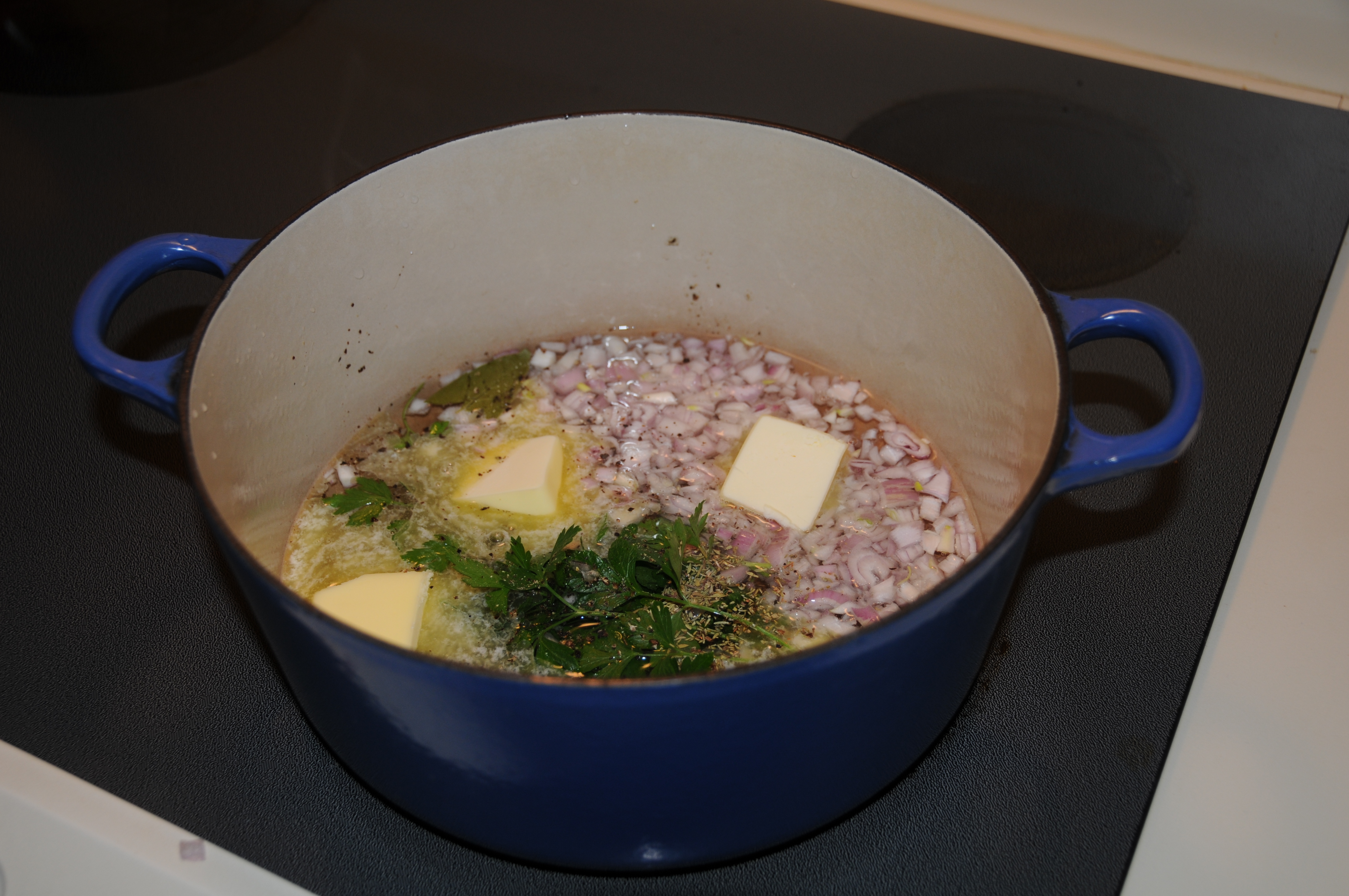
White Wine, Shallots and Parsley Broth for Mussels (Photo by J. Matthews)
A broth is prepared. We have an all-electric kitchen and off-and-on we want to replace the electric range with propane gas. At our previous home in Mingus, Texas, we had a propane stove and I think we had better control over the heat for cooking. Back then in Mingus, I did not have horses and cattle, so I could help Brenda prepare meals. I did have a small vineyard of forty plants, but that did not require constant management. The parsley that you see inside the Creuset dutch oven is from a pot of parsley on the porch. The Creuset dutch oven was one of several Creuset pieces we have purchased over the years from a Creuset outlet store near San Antonio, Texas.
Mussels after Boiling
Here you can see the mussels, after being boiled in white wine and shallot broth, have opened up. We’ve all been trained in family etiquette, so the eating of mussels with small forks or other instruments is known well. Well, there’s another way to do it! Take the mussel out of one shell and use the empty shell to pick the mussels out of the others — a method showed us by a French waiter from Marseilles.
Lunch Table with Mussels at Flying Hat (Photo by J. Matthews)
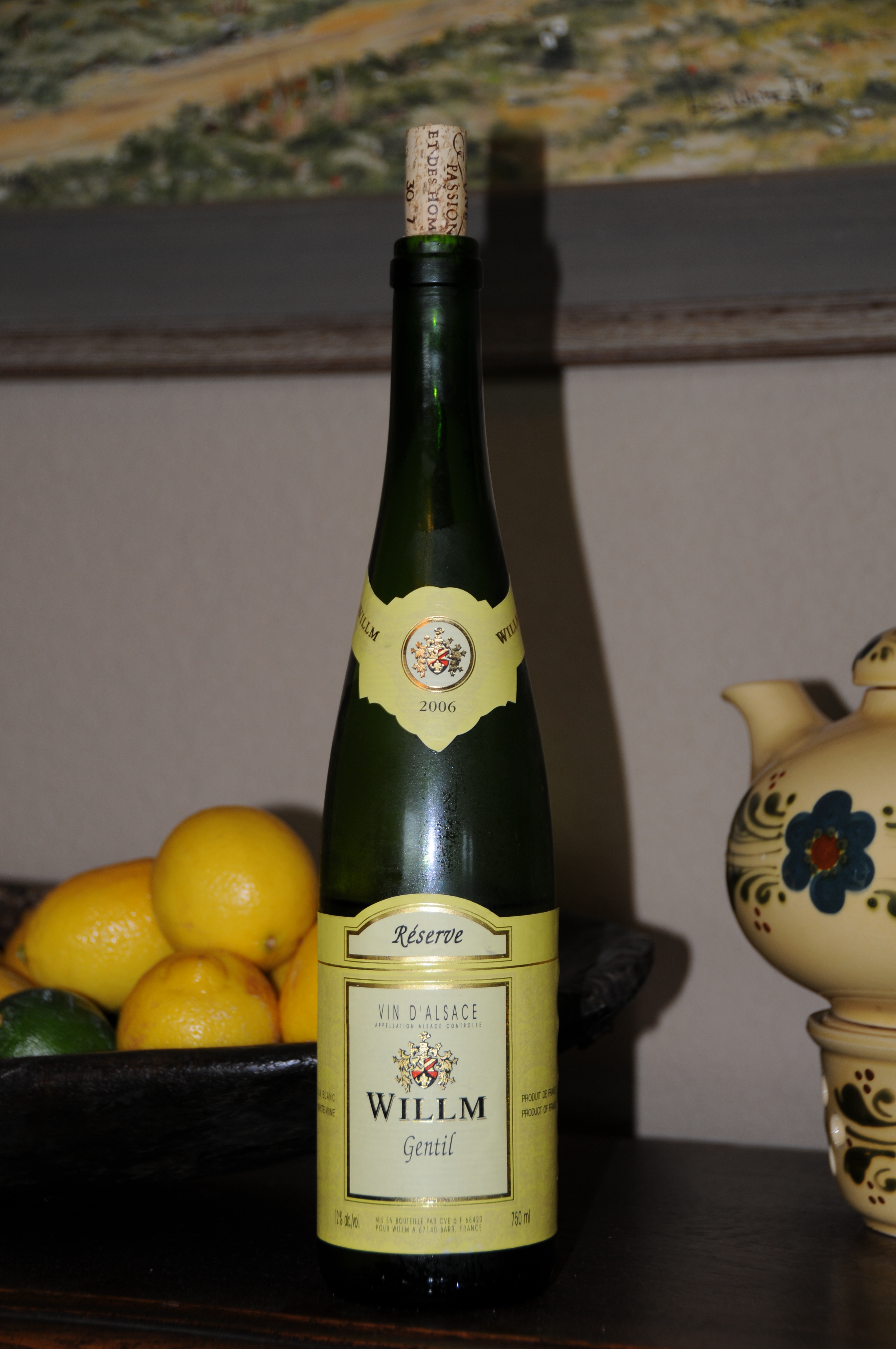
Vin D'Alsace, Gentil, 2006 (Photo by J. Matthews)
Brenda and I sat down at our French farmhouse table (late-nineteenth-century) and ate mussels with a 2006 Vin D’Alsace Gentil. It was a dry wine and we enjoyed it immensely. After we sat down, Brenda remembered that she needed to put fresh parsley on the mussels, so she did, but I did not get a photograph of the parsley on the pile of mussels because I was chomping down and quaffing wine. After all of the mussels are consumed, we take the shells out onto the pasture road and place them in washouts. At night, critters browse on the remains of the mussels and I have seen our mussel shells 200 yards from where I have laid them. Our barn cats enjoy a few remnants as well.
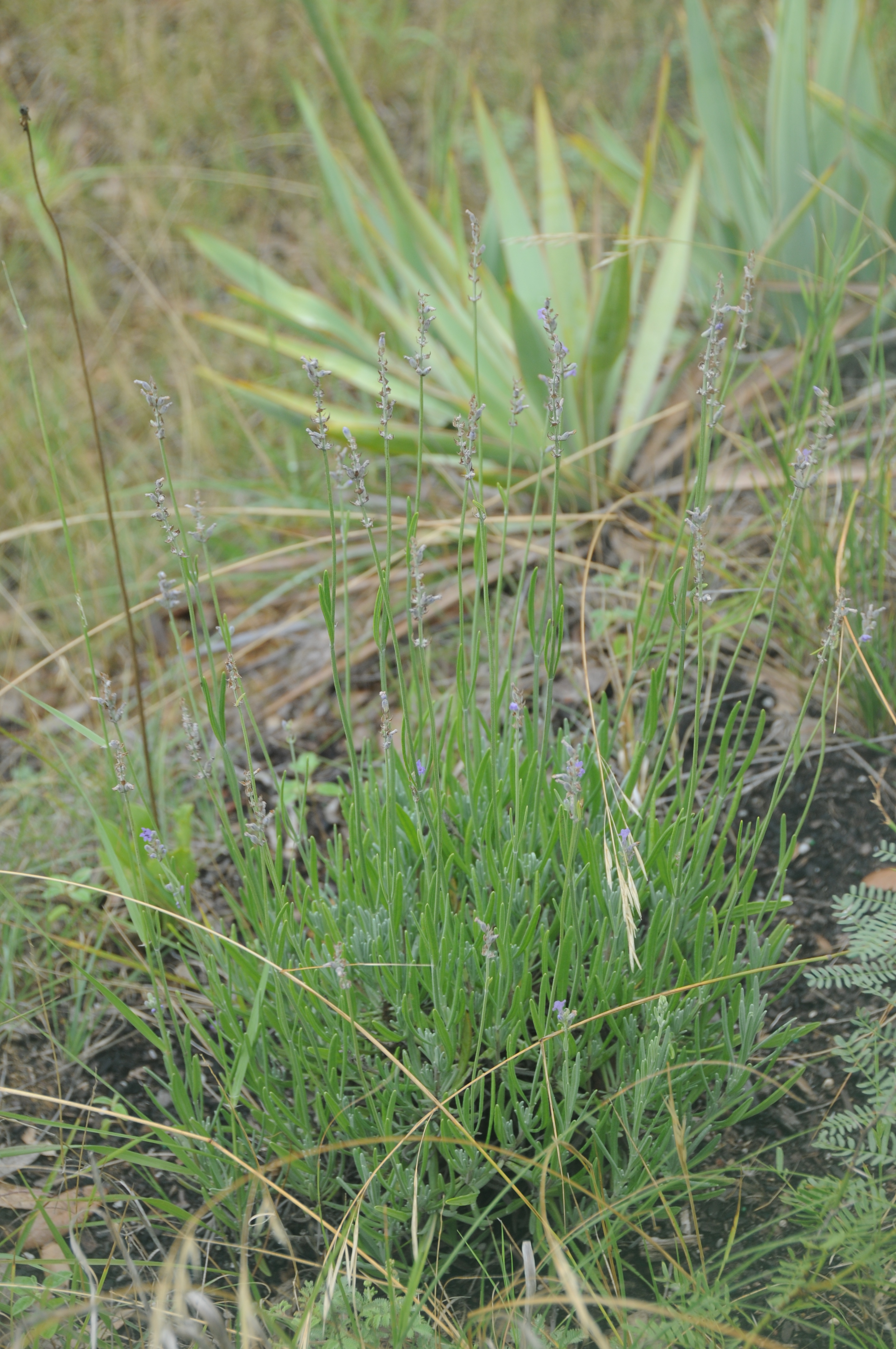
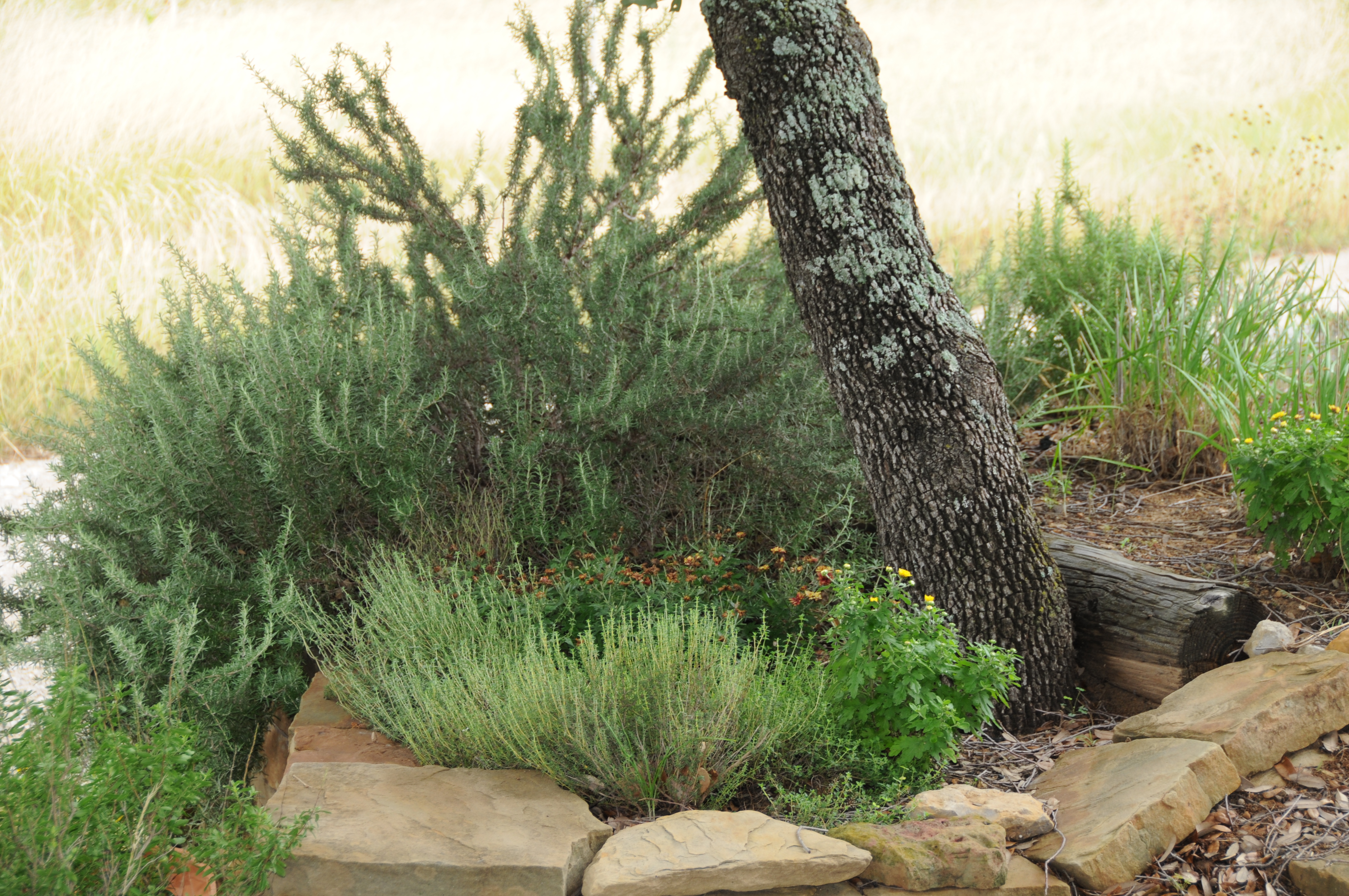
From left to right, our herbs include lavender, sage, basil, parsley and in the cluster under the live oak tree, several varieties of thyme and rosemary.
To walk onto your patio of potted herbs or amble in the backyard with a garden, you encounter the elements. You are out of boxes called houses or apartments. You develop a connection with plants. As you ingest your meal, the sweetness of basil arises in your palate and nostrils and you realize treasures grow from the soil. Not so remarkable, but then again it is: it was with your tending that the true coin of earth becomes a part of you.
You go out of your box for a time and you learn about a little chain of being that links you to a plant that enhances your meal. Enriches your life.
Last Friday night an old fashion straw ride was gotton up, and participated in by Misses Clara Fentress Maymee and Lillie Dofflemyre, and Mrs. Tennon, Messrs Chas. Biggs, A. P. Homar, T. A. Murray, Nix Lidstone, and Elsworth McKenna. They visited the bridges and rode through town. Quite a merry crowd, but hard up for fun.
______________________________
Notes:
From the San Saba County News, San Saba, Texas, February 19, 1892, Vol. XVIII, No. 14, p. 4.
The Library of Congress, National Endowment for the Humanities, has digital newspapers of small towns, some ten or so from Texas. San Saba, Texas, is the birthplace of many of my ancestors and is part of the digital archive of the Library of Congress.



























 Sage to Meadow ~ Jack Matthews