Monthly Archives: May 2010

Blog Collective I: Vectors

Blog Vectors with Sage to Meadow, March 28, 2010

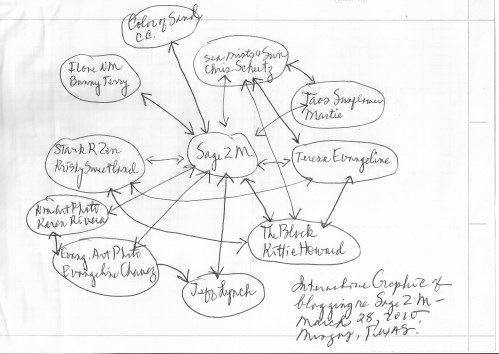
This is a Blog Vector Analysis, a *quick-and-dirty study of interactions among selected bloggers interacting with Sage to Meadow, March 28, 2010.

Each of the lines represent a blogroll connection.  The arrows generally go two ways: bloggers put each other on their blogrolls, a matter of friendly and interested reciprocation.

I have more blogs on my blogroll than is seen in the Blog Vector.  This diagram lists only those blogs that I have had interaction with for at least ten (10) to fifteen (15) times in the comment section of our blogs, both comment sections combined.

My blog is Sage2M or Sage to Meadow.  My interactions on an involved level (10-15 comments) are with ten (10) bloggers.

The Blog Collective I have consists of eleven (11) nodes, myself included.

One objective I had in drawing the diagram was to ascertain where my Blog Collective might have originated and, then, multiplied.  A second objective was to diagram the interaction of my blogging friends, to see who connected with whom.

My first search for bloggers involved New Mexico blogs and I came up with two: Stark Raving Zen and Teresa Evangeline (formerly of Santa Fe).  From those two blog nodes, the Collective was begun, so that now I have the ten (10) involved nodes.

On the diagram, please note that Sea Mists and Sunsets, Chris Schutz, has four (4) interactions within the Collective, and so also does The Block with Kittie Howard and Teresa Evangeline’s blog.

Note also that the photographic blogs interact with each other and me, but not with others in the Collective: New Mexico Art Photography, Evangeline Art Photography and Jeff Lynch.

Seven nodes are related by New Mexico connections: Color of Sand, Taos Sunflower, Teresa Evangeline, Evangeline Art Photography, New Mexico Art Photography, Stark Raving Zen and I Love New Mexico.  The diagram does not relate that attribute.

In conclusion, the graphic illustrates that if you like New Mexico, the American West, photography, writing, place or nature, then you will be a part of the Sage to Meadow Collective.

*A quick-and-dirty (Q&D) study is just what is sounds like: fast, quick, but revealing.  Basically, there are two kinds of research: Q&D, sometimes called “hot” research when bullets are flying and bulldozers are idling in the background and pressure is on to evaluate a situation.  The second is “cool” research–time can be taken to hypothesize, ponder and conclude, like writing a monograph or thesis.

12 Comments

Filed under Life in Balance

Spring Flowers in Texas

Stork's Bill (Erodium texanum) April 2010

Here is Stork’s Bill or Pine Needle (Erodium texanum) found here on Flying Hat.  It is an annual herb, member of the Geranium family, most of which are found in Europe and South Africa [C. and L. Loughmiller, Texas Wildflowers: A Field Guide, p. 104; H. Irwin and M. Wills, Roadside Flowers of Texas, pp. 140-41.]

Scarlet Paintbrush or Indian Paintbrush (Castilleja indivisa) April 2010

These Indian Paintbrushes are uncommon on Flying Hat.  I found most of these in the Pecan Tree Pasture and not many of them.  The Blue Place, the family to the east of us, has a field that is quite loaded with the paintbrushes.  I have a photograph of the Blue field and will post it in the future.

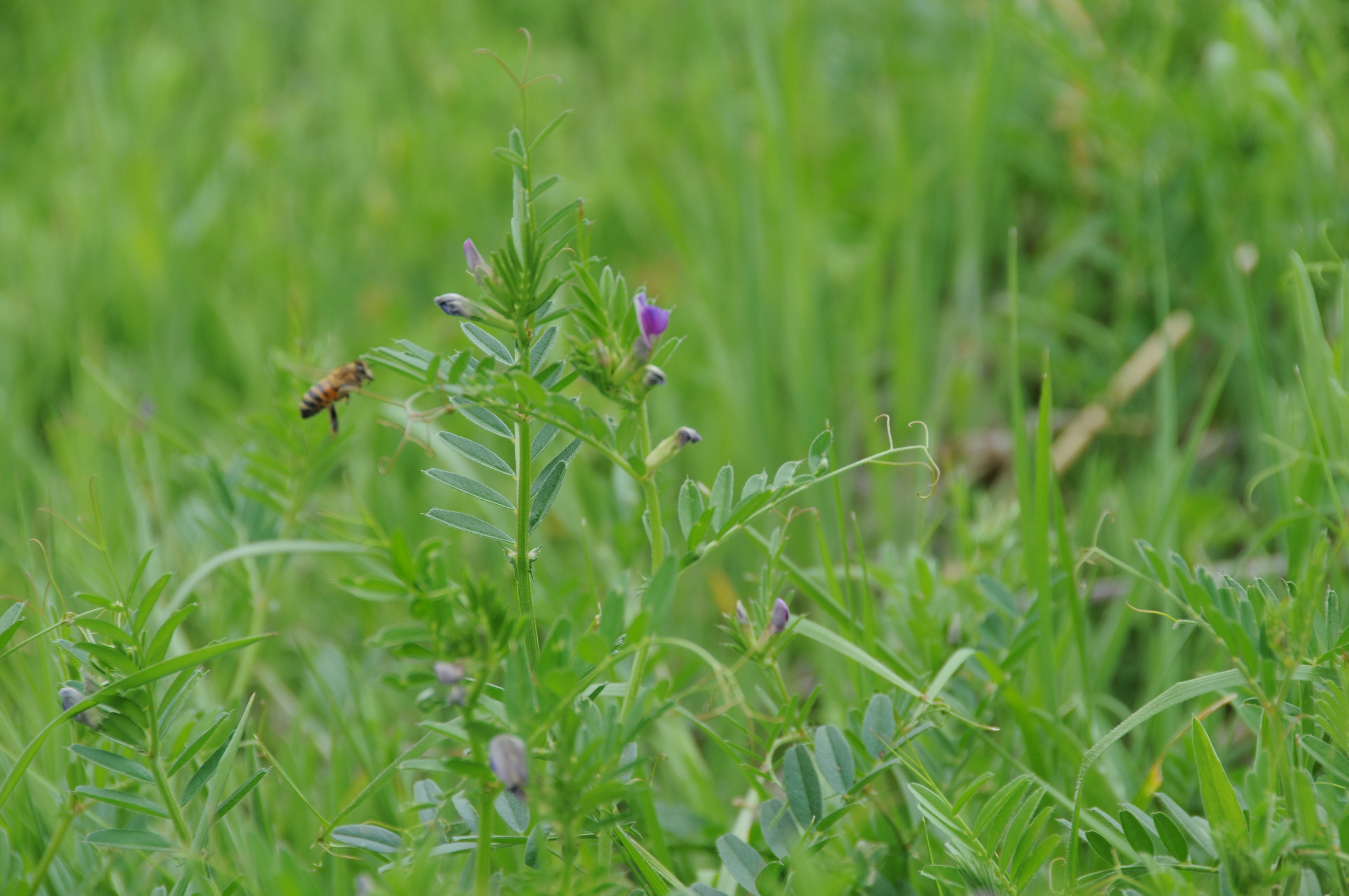
Purple Vetch (Vicia dasycarpa) with Bee April 2010

This vetch, Purple Vetch (Vicia dasycarpa), is not the poisonous variety. Notice the bee that is pollen-gathering.  The spring rains have been so abundant that the vetch is knee-high in my fields and the Blue Place, to the east of us, has vetch that is chest-high as it climbs on the field fence.  As I say, this is not the poisonous variety and the bees love to gather pollen from it.

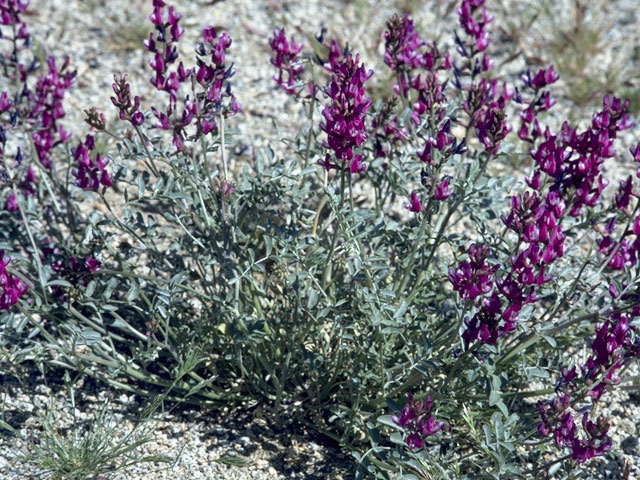
Wooly Milkvetch (Astragalus mollissimus), Wooly Locoweed (NPIN Image Gallery, Lady Bird Johnson Center)

This is a photograph of the poisonous variety of vetch that we do not have on the ranch.   From Irwin and Wills, Roadside Flowers of Texas, p. 138:  “Of the nearly 1000 species of Astragalus, over 200 occur in the United States, about 35 of them in Texas.  The members of the genus that are poisonous to livestock are called Locoweeds, while the harmless ones are known as Milk-vetches.  In the former category is the Woolly Loco of the Panhandle and Trans-Pecos area, a tufted, soft-hairy, deeply rooted perennial with dense racemes of purplish flowers in the late spring.  Quite innocuous looking to the eye, the Woolly Loco is among the ‘early risers’ in the spring, and so tempts cattle, even though its taste is so disagreeable that they normally avoid it.  Later, in periods of drought when grasses succumb, the persistent Woolly Loco remains, seemingly unaffected.  Nor are browsing animals the only ones concerned.  The nectar contains poisonous substances, sometimes causing decimation of bee populations.”

In talking with Roland Stroebel today, my colleague at the college who tends Angus cattle, our non-poisonous Purple Vetch is abundant on his place also, but does not cause a problem for his browsing livestock.  Roland’s ranch is south of Cisco, Texas, and his family goes back several generations.

2 Comments

Filed under Plants and Shrubs

Bicycle Rest Area Lubbock

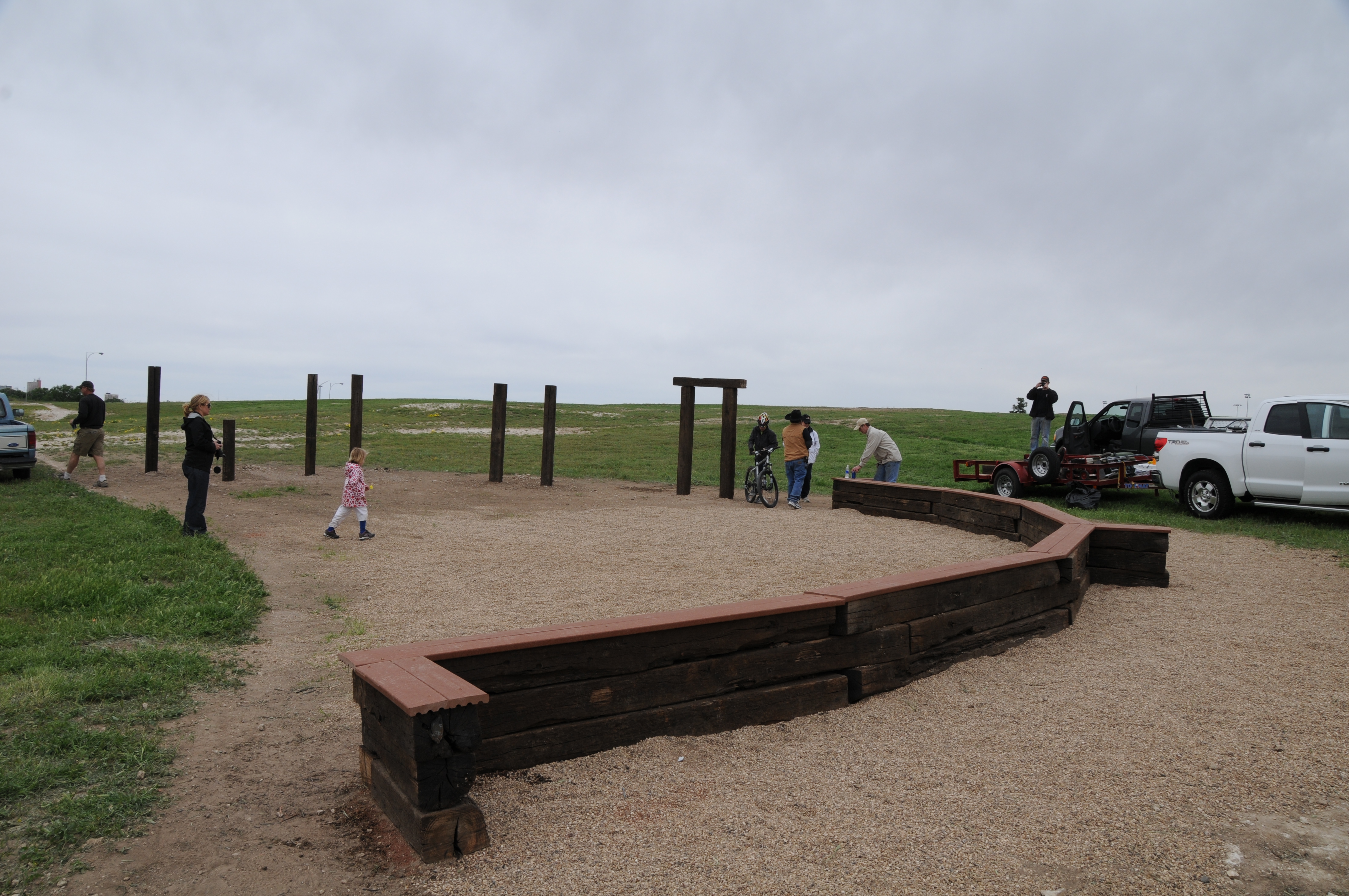
Lubbock Bicycle Rest Area, Eagle Scout Project of Connor Needham

I came up to Lubbock, Texas, yesterday, to assist my grandson, Connor Needham, in constructing a bicycle rest area out at a recreation lake near the east loop.  He seeks to attain the Eagle Scout rank and it was his project to gather scouts and family to build the rest area.

By my count, there were ten adults and ten scouts for the construction that began at 9:00 a.m. this morning and ended at 3:00 p.m. this afternoon.  Connor composed the construction plans–a notebook-size description–and persuaded the the Lubbock City Government to level the ground for the site.  The weather during the day remained cool, in the 60s F., and hot dogs and cold drinks were consumed in great quantities during the middle of the day.

An Eagle Scout from the Goliad Council who goes to school in Lubbock dropped by to give considerable assistance to the effort.

The family and scout effort succeeded.  I remember my own Eagle Scout project to clean out and restore the Coggin Park Pond in Brownwood, Texas.  Connor’s and my project taught us to think outside ourselves for a greater good, beyond self.

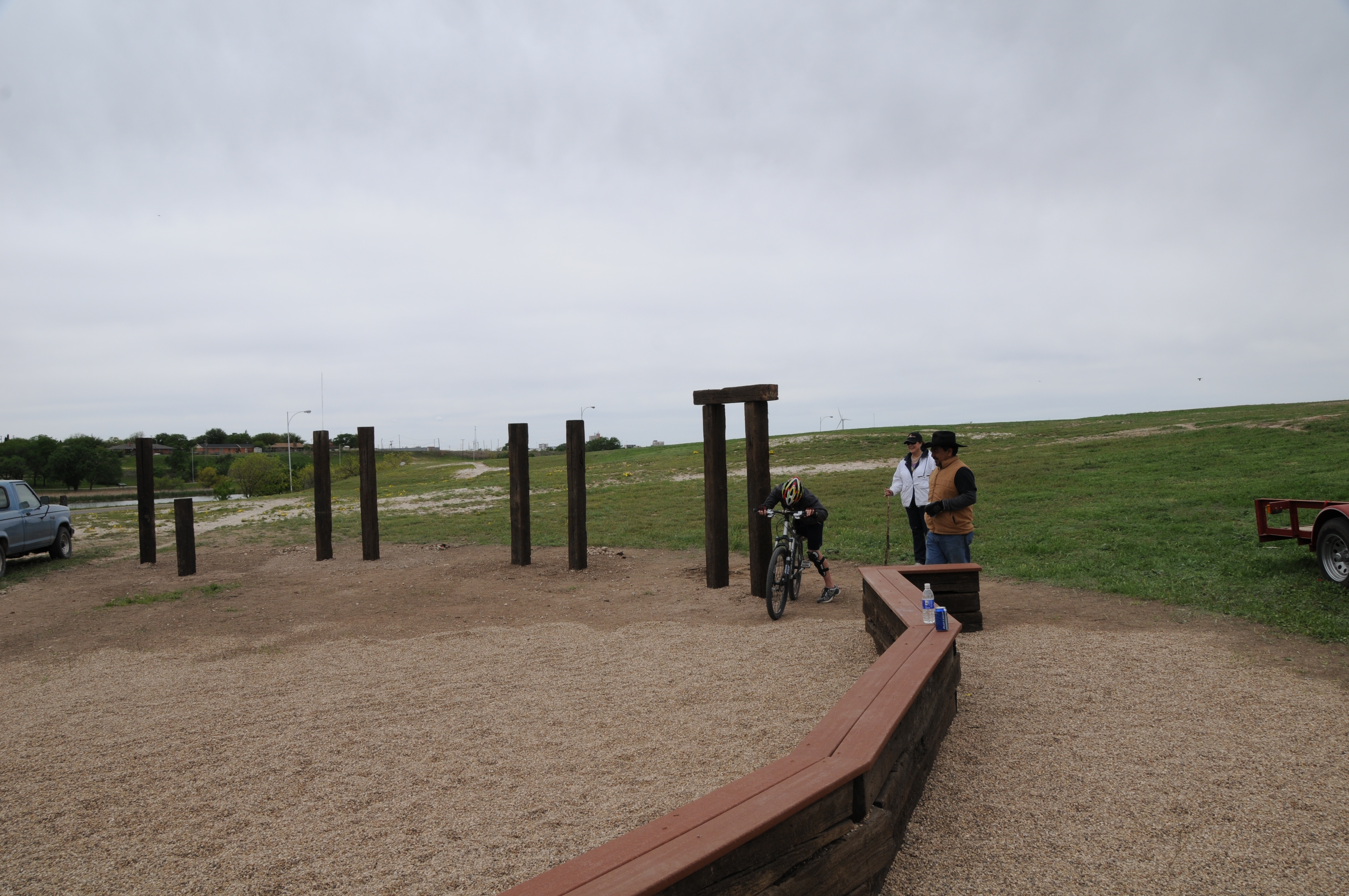
The bicycle rest area is at the head of a series of bike trails about the lake.  As you can see from the photograph, not only is it functional, but also artful–note the Stonehenge design.

Lubbock Bike Rest Area

Connor Needham and Father (Charlie Needham)

14 Comments

Filed under Life in Balance